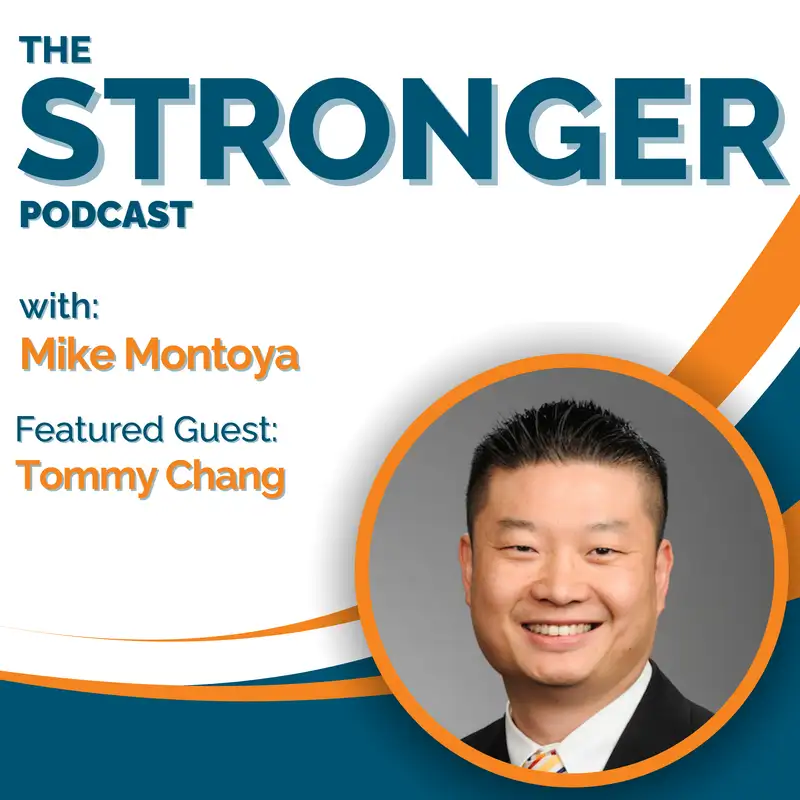
Teacher Attendance Predicts Turnover: The Retention Signal Most School Systems Miss with Dr. Tommy Chang
Welcome to the Stronger Podcast. Each week, we have honest conversations with education and social impact leaders about their leadership and career journeys. We talk about their origins, inflection points, and the work that they're doing today. The conversations are honest, human, and practical. If you're here for real stories and real takeaways, you're in the right place.
Mike Montoya:Let's jump in, and let's get stronger together. Public education changed Tommy Chang's life. As an immigrant who arrived in The United States without speaking English, he experienced firsthand the power of great teachers and strong public schools. Today, as the CEO of The New Teacher Center, he's focused on helping educators stay, grow, and lead because better support for teachers creates better outcomes for every student. Let's jump in.
Mike Montoya:Alright. Good afternoon. Good morning, everybody out in Podcast land. This is Mike Montoya.ca I'm here with Tommy Chang, the CEO of The New Teacher Center, which is not it's kinda based in California, but I think but Tommy is, I think, in Los Angeles.
Mike Montoya:Right? So, Tommy, welcome. Thanks for being with me. Thanks, Mike.
Tommy Chang:It's great to be in space with you.
Mike Montoya:It's it's great. And I I we were just chatting before we got started about, like, the West Coast, a contingent of of Ed space folks. Right? And and I live in Portland, so it's been good to, I call it, be on the same time zone with people again Mhmm. Which really makes life a little easier.
Mike Montoya:So, Tommy, I like our listeners to kinda hear kinda where you're physically at and then also, like, kinda origin story ish stuff. Right? Like, where where did you grow up, and what was, like, your early k 12 experience like if you have a recollection of that that time in your life?
Tommy Chang:Yeah. So I I'm calling in from Los Angeles. LA is home. It's been home since I immigrated to The US at the age of, six years old. And, I often lead, in my leadership story, I often lead with the statement that I deeply believe in a promise of public education because public education paved the way for me, immigrant that came to this country at the age of six without a word of English to take on one of the greatest responsibilities a human being can have, leading the education for a city's children.
Tommy Chang:And I had the honor of leading Boston Public Schools for a number of years as part of my very long career in education, and I started off as a teacher. I was a high school principal. I was a system leader in Los Angeles, and I led the nation's first school system, Boston Public School. Currently, I am the CEO of New Teacher Center. As you said, we, we have strong roots in California.
Tommy Chang:Our origin story for the organization started over twenty five years ago when Ellen Moir, who at that time was working in Santa Cruz County, created a vision for organization that aimed to support the coaching and mentoring of new teachers. And she would often say, why would we dare to leave up to chance the experience of our newest educators? And so the idea that teachers had new teachers had a guaranteed experience in their first few years in their careers was not a thing until New Teachers Center came to be. And so I'm here now leading NTC. I've been here about three and a half years.
Mike Montoya:Right. Well, it's critical work that in the way you describe it. So so it sort of seems like, no kidding, there should be a I call it predictable experience, right, for the early career educators, right, that kind of entry in after college or grad school. Right? They can kinda come in at different spots, different ways now.
Mike Montoya:But back twenty five years ago, right, there was pretty narrow as as a as a pathway. Right? And most schools of ed, right, were kind of the primary engine, right, that kid the teachers were goes to and they go into, like, college to be a teacher. Right? And that's changed a a little bit considerably.
Mike Montoya:Right? And I think there's some good scholarship about, like, subject matter, stuff matters, and you could learn to be a teacher, not at a school event. I mean, have you guys do you guys have a point of view about that? Like or how's that how's that playing out in in practical terms these days?
Tommy Chang:For us, we understand the context that we are all operating in, that you are gonna have some new teachers who come through the traditional path. You also have teachers that have had very extensive experience, for example, in residency programs before they actually become the teacher records and are hired full time in a school system. And then on the other opposite end, especially right now, there are states that are approving for people to move into the classroom without any experience. So, like, no credentialing or minimal credentialing. I actually came into teaching through an alternative pathway.
Tommy Chang:I was on emergency credential when I came into teaching in 1997 in California, teaching in Compton. And for our organization, we just like, we our opinion is, like, however people come in, it is our job to help support that experience for a new teacher. It may feel different depending on your pathway, but you should have some sort of coaching and mentoring. And our organization helps districts and schools build their capacity to coach and mentor teachers.
Mike Montoya:So right. So the the the alternative pathways have gotten broader. Right? I hear sometimes I hear funny stories like like National Guard members are leading classrooms in New Mexico or something where because the teacher shortage, right, is so significant. Right?
Mike Montoya:The career the profession itself has changed significantly in that much time, and and to say that, like, it's a it's a viable career choice for a young professional is, like, a kind of kind of feel like it's leading. Right? It's gonna be to be a moving target as an opportunity for folks because, like, ten years, like, kinda changed a lot. Right? Their expectations of folks over time, those things that people don't stay in careers for thirty years like they did when, like, our previous generation was.
Mike Montoya:Right? So are there are there districts that you're working with without maybe being specific at, like, that are doing a good job of of teacher onboarding and support, like, that you feel like you're making good progress?
Tommy Chang:Yeah. There are definitely before answering that question explicitly, let me build on a previous comment of yours. Yeah. There definitely have been historically just different cycles of, who's choosing education as a career choice. And we're actually at a point right now where there are more people looking at education as an entryway into that postsecondary life.
Tommy Chang:And, historically, when the economy hasn't done as well, you actually see people coming into education, into teaching. We are actually seeing that at this very moment in time. But at a time where more people are leaving the profession earlier than ever. And so there is survey data that shows 60 to 70% of teachers, current teacher, saying in a survey, I'm planning on leaving this professional a lot earlier than I expected. And we are looking at careers in teaching of six to eight years rather than the ten, to fifteen.
Tommy Chang:And I agree with you, whether it's teaching or any other career, we do have a generation of young people who don't see themselves in any career for the rest of their lives. Like, the promise of work really hard for thirty five, forty years, and you'll get the the pension at the end isn't attracted enough to get someone to come into teaching and stay in teaching for thirty, forty years. So, I think these are all dynamics, but these do historically go in cycles. And I think it is ultimately the responsibility of school systems per to create the best conditions so teachers do choose to stay in a profession if they so decide and that they can be effective. Because when they are effective, when they are supported, in particular by their school site administrators, they do stay at a higher rate.
Tommy Chang:And we know the more experience a teacher has, there is impact on student performance. So we want to keep effective teachers in the classroom.
Mike Montoya:Well, and that makes sense. I mean, I think the normal workplace rules apply, right, which is like a a great supervisor and a great experience, right, as an as an employee, right, of an organization, right, like, to, like, longevity. Right? And I think that's consistent with what we expect from the teaching experience as well. But I think the the pathway and I think the support systems seem to be quite varied at at different districts and different school systems.
Mike Montoya:Right? Like, sometimes they're really strong and extremely powerful and sticky, and other times they're quite, like, you know, early stage or nascent and not not quite as as effective. So that's where the new teacher center can be really supportive of an of an organization to build effective practices for for leadership to, you know, make the first, you know, three to five years, right, really great. And then then people have, I call it, their teaching legs, right, or something like that. Right?
Mike Montoya:So
Tommy Chang:Yeah, Mike. I should have explicitly answered your question. I do think the experience in new teachers is very depending, not only in the school system they're teaching in, but more actually of at the school site that they're teaching in. So you do see teacher turnover vary across school school system. The data you can't if you just look at data at school system by school system, you actually lose a lot of nuance.
Tommy Chang:So Yeah. Really understanding school by school is ultimately what's most important. And it is it is varied across, schools and, like, a part of a school system you may be working in. We do know that schools has served students traditionally more, traditionally, historically furthest from opportunities. They have the most turnover in their in their schools.
Tommy Chang:So, when we do the work with school systems, we work to ensure that districts understand their data and understand where to target that support. So we work with some of the largest school systems in the country like New York and Ally. We will also work with small school system and charter management organizations to do this work.
Mike Montoya:Yeah. Well, because each school site, as you said, matters. Right? Because each school site has maybe 200 to 500 kids or maybe more a thousand kids, right, for these bigger school systems. Right?
Mike Montoya:And so that cadre of teachers that exists in that building is 20 people to 50 or 70 people. Right? And that's a lot potential to support. Because I think sometimes when people think about, like, impact in education, like, you think about the broad giant policy challenges, but, like, also, there's, like, the reality that, like, each kid's experience really matters. Right?
Mike Montoya:And, like, there's a whole life that we're creating and supporting, right, in this early stage of their lives, right, that we can be doing great work at if we're sort of focused on that. So so, I mean, I don't know. Do you feel like you do you get close enough as a as a CEO to, like, some of the work that you have a, like, a sense of, like, hey. I really feel like we're making a difference with a particular school system? Are you guy are you are you you got programmatic people that are kinda in between those things?
Mike Montoya:What's that like from your your personal leadership experience? Yeah.
Tommy Chang:I no. I have the honor and opportunity to actually go on some of the work and to be able to work along I I enjoy working along alongside school leaders and system leaders to really think through their systems as a previous superintendent, as someone who's worked in central offices. I believe strongly that it is about building the right systems in place. Talent matters. Leadership matters, but sustaining work over time requires strong systems that we put in place.
Tommy Chang:So, like, I I I love getting my hands dirty. Obviously, as a CEO, you don't have as much opportunity to do that sort of work. But when I do do that work, I love it. I enjoy it. I embrace it.
Tommy Chang:And my colleagues love that I I roll up my sleeves and do something.
Mike Montoya:They show up there. I'm not too afraid when you show up. They're like, oh gosh. Here comes the guide. Right?
Mike Montoya:Yeah. That's that's awesome. Well, I think it kinda makes I mean, one of the best parts about being in the education space is the actual experience of working with kids in schools and teachers close close to the action, I call it. Right? And that's that's rewarding if you can get to it.
Mike Montoya:I'm curious if you feel there is I think I asked this a little bit, the places that that you're, like, super excited about, that you're like, hey. This place is, like, really like, building those great systems that you think are, like, starting to be self sustaining, right, and where they can, like, call it not rely on outside support all the time? Like, do you feel like you're is there a place in your mind that's, like, been really making great progress?
Tommy Chang:Yeah. I would I without getting you some specifics, I can definitely name districts both, like, large urban school systems, even smaller or rural conglomerates that are doing incredible work, and they're I I will highlight a few things. I think number one, ensuring that the support of the new teachers isn't isolated within, like, one department or seen as a work of any one or two people.
Mike Montoya:It's really
Tommy Chang:Yeah. It's really the work of the entire system and ensuring that new teachers are getting the information they need to not only be successful as a teacher in general, but also know that initiatives are being driven within the school system. So for example, one of the large urban school systems we work with have a number of big initiatives that they've invested in, that they're training up all their teachers on. We make sure that those initiatives are brought in to the very beginning of a new teacher's experience in that school system. And like the coherence making is really critical.
Tommy Chang:And so like this sort of collaboration across the system. Number two, ensuring that principals, school systems that think about this work not only from a mentor or coaches work, don't see it just like coaches work, but see it as the work of every principal. Like, every principal should be building the conditions at their schools where new teachers are getting support from peers, from themselves, even from the community. Like, that sort of full school induction approach, there are a number of school systems that are taking that sort of approach. And then lastly, school systems are really analyzing their data or investing in data systems that help them understand where their hotspots are.
Mike Montoya:I think. Yeah. Opportunity, right? So I mean, a while, right? This is interesting.
Mike Montoya:I'm really curious about like the data that you guys are able to access or not the you know, like, systems are utilizing. Like so what kinds of things do they tend to focus on, like, in terms of, like, like, data reporting? There was a lot of challenge. There's always been challenge, like, measuring performance of teachers. Think that that but sounds like you're talking about something a little bit broader, like, in general.
Mike Montoya:Right? So tell me about the data.
Tommy Chang:Yeah. I think the it is we start with what data a school system has. So some school systems have teacher survey data, school climate data, others don't. Some school systems have teacher evaluation data, others don't. So it really depends on what data that they have.
Tommy Chang:One particular data point that has become, kind of a leading indicator for a teacher turnover is actually teacher attendance. We know very clearly, when we've studied this, that you can actually predict where there will be turnover in twelve to eighteen months based on, teachers' attendance. So, if a school system is measuring that and ensuring that their, decision makers know that data well, then they can help to mitigate potential turnover in the future. Right? That's a leading indicator.
Tommy Chang:But a lot of system leaders don't know that. I can admit as a former superintendent, I wasn't tracking that data.
Mike Montoya:You know? Yeah. I was how
Tommy Chang:important that data was. But I think this is where our capacity building matters. Our data analysis matters, and we provide this sort of service
Mike Montoya:to school systems. So, yeah, that's I mean, it seems now that you're saying it, it seems obvious that that should be an indicator, right, but it's also not something that people sort of think as as relevant or important because, I mean, I guess, teachers can, you know, be absent or call out or things like that. Right? And then if they have a maybe there's a frequency of that, then you can kinda just start to see that it's like a a curve that they'll be eventually hitting a wall or making the decision to leave. Right?
Mike Montoya:So that seems, like I said, it seems obvious now, but it also didn't make come up I didn't come up with the idea. You just kinda made it, like, clear to me. Right? So I feel like so I feel like make sure we're gonna make that point in the art in the marketplace. Right?
Mike Montoya:Like like, if you're a school system leader or a school leader and you're not tracking, you know, a teacher attendance, right, in addition to how they're doing on a bunch of other things, then you're also missing an important indicator about what their future success might look like in terms of their Well, all this gets to the crux of this, and I think my I'm gonna say it in my terms, and so you feel free to make it better, is to say, like like, mostly what we're trying to do is achieve high quality teachers in classrooms consistently over time. Right? So that students, young people are getting consistently good experiences in their classrooms over time because that data then that that kind of practice allows the student to have, like, a better chance in the in the long term because they've had high quality experiences for multiple years. Right? Like, it used to be, like, two or three years.
Mike Montoya:Three years of, like, consistently high quality things really sets you on a great path, and then if you have inconsistencies there, it's kinda messy. Right? That's kinda what I remember.
Tommy Chang:Yeah. Yeah. Well, I mean, we we talk about this work as building a resilient and modern educator workforce, and that we really are inspiring educators to stay, grow, and lead in the profession. And so while, yes, I can accept the fact that folks may not see themselves, forever in the classroom, but there are so many other ways that they, can be leading and they can be growing, in this profession. And, ultimately, it is meant to serve young people, that get a great education that really unlocks a joy that they have for learning, that they're prepared for career and life.
Tommy Chang:And, that's ultimately the work that we should all be doing. Like, in the to preserve our democracy, we need a strong education system. And I do think there are some signals, right, that we're getting, for recent NAEP data that we are not moving in the right direction as a nation. And and we see it with our democracy as well. Like, there are signs that our democracy being in danger, and yet we are a very resilient nation, and we've always been resilient, historically.
Tommy Chang:And so I'm I am deeply optimistic, but also know that this requires effort and, role that I can play and NTC can play in building the right conditions so teachers can thrive is,
Mike Montoya:like,
Tommy Chang:my current mission at this point in my career.
Mike Montoya:Well, and it's a huge one too, and I I appreciate it. Let's talk about democracy a little bit because I feel like there's, like, a I call it forgetfulness, right, in our maybe we all need better history, education, and ongoing historical data floating into our into our into our consciousness all the time because, like, you know, before and this is, like, nineteen o eight, right, before public education became reasonably well funded to turn into a real thing. Right? So that was a hundred and almost twenty years ago now, right, that we got and made some big progress on on this as a policy of the country that that kid most people did not know how to read and write right, in this country past third grade. And then it turned into a thing that we got into middle school, and then we got into high school.
Mike Montoya:Right? And now we're to get them all through college. Right? And so it it feels like this has been the economic engine of the maybe the country, maybe the planet. Right?
Mike Montoya:Because we're able to turn that wheel effectively. But at the same time and it's helped the the country to become richer and stronger. At the same time, it's also, like, I'm kinda getting whittled away at a little bit now because people are under I guess, we're underfunding it maybe. Maybe we're not doing it appropriately, right, because it's more complex, because it's bigger Mhmm.
Tommy Chang:And the
Mike Montoya:types of needs are different than they used to be. But and do you guys have a or maybe you personally have a sense of, like, what are some of the things that, you know, we as educational leaders need to be thinking about as we head into the the second quarter century of this of this new millennium. We we always talked about the millennium. Here we are headed into the middle of it. So what are you guys thinking about in terms of, like, things we should be headed towards?
Tommy Chang:Yeah. And let me do a little bit of a double click in what you have shared about the history. I mean, as this nation moved from agrarian society to be a society where, you know, people were living both in cities and in rural communities, like, this country did build an incredible education system that really did guarantee some things for young people. So, like, a guaranteed k 12 experience where things doclike the Carnegie unit, like, young people had to take particular courses. And, like, there we we work very hard to guarantee that, like, to graduate from high school in this country means that you've studied certain things.
Tommy Chang:And we've also come to a point where information truly is democratized, that You can't think of about content in just sort of these discrete subject areas. Like, things are a lot more cross quicker. You need young people to have durable skills, to have skills, social emotional learning competencies, and, like, this work has to be a lot more integrated. And we have not designed a school system that is preparing young people for kind of the needs of today. We still have a model that is a 100 years old.
Tommy Chang:So I just wanna double click on what you said and affirm what you said, and say, like, we've got a lot of redesigning to do, and there's just a lot of inertia.
Mike Montoya:There's a lot of inertia is the word I was just thinking about. Right? You just said it right. Which is, like, we're kinda, like, dealing with a lot of, like, stickiness and, like, depth and heaviness, right, that's, like, been built over now a century of of time that it's hard to shift out of that here because, like, the as you said, like, information's available everywhere. We could everything that's ever been known by mankind, right, is in the computer, right, on the Google or whatever you are, the AI now.
Mike Montoya:You can pull it out of out of there. So it's not about who knows what. Right? It's a little bit about how do you think. Right?
Mike Montoya:And how do you then utilize that in the in this future future context? And it almost is like, oh, now we get to actually be humans with each other because we're not with the memorizing stuff, which is actually harder probably. Right? How do we interact with each other and be with each other is much more complicated than, like, regurgitating facts. Right?
Mike Montoya:Because that's kind of what what I don't know. Most of us learn how to do. I was thinking went I got out of high school in, 1990, so it's been a minute. Right? But it's it feels like that hasn't changed almost at all because I've been into high schools recently, and I'm like, looks the same.
Mike Montoya:Basically the same. Now we have computers versus paper. Right? So it feels like good question. So what do you think is there is there and I know you sit on some boards nationally and things like that.
Mike Montoya:So are there places that are thinking about this future work in a way that you call it I call it something to have a meaningful, like, besides higher ed potentially even. But
Tommy Chang:Yeah. I I think it's a call a topic of conversation on almost every board I sit on. I I recently joined the CASEL board Yeah. Library for academic and social emotional learning. And then CASEL has been in the work for twenty five, thirty years as well and has helped to promote, that learning ultimately is both, social and emotional.
Tommy Chang:And it is about young people really being able to be self aware, to understand their thoughts, their values, like their emotions, like their identity, and that they are able to, like, regulate their thoughts and their behaviors in a way that's positive, self motivating to themselves and others, that they should be aware of who is around them and have the relationship skills to be able to make responsible decisions in collaboration with their peers. And, like, when you describe learning in that way, that's actually life. Right? That's what we do as adults. Like, we move our organizations forward because we have those skills, not because we know how to do calculus.
Tommy Chang:And I also often emphasize that the opportunity of this nation is that the world's resides within our boundaries. And, like, the cultural and linguistic assets of this globe live in The United States. And every single student, whether you are a document or undocumented legally, have the right to an excellent education in this country. And if we can affirm and sustain the cultural and linguistic assets of all the young people, and we can create this space and environments where they are truly interacting with each other. We could be a model for this nation.
Tommy Chang:I oh, sorry, for this globe. I mean, everybody is looking at The United States as a model of what the world can be. And that's our that's our challenge. That is our opportunity. And we haven't always got that right, but I am hopeful.
Tommy Chang:And because I talk to educators all all the time. This is what they want for our nation. They do not want a nation that is closed off to the rest of the world. They want a nation that is truly reflective of everybody on this on this globe. So
Mike Montoya:Well, it feels like and I appreciate, like, we're kinda headed down the road of, like, the value of humans in the way that The US has as a nation, you know, been built by immigrants over I mean, everybody came from somewhere, right, and had had settled here in some way, right, for now now we're coming up on the what what this is the the two hundred fifty year anniversary year, right, of of the nation founding. And so, like, that's a lot of humans that have come here to build lives, right, that we have created the thing together. And and, like, there's, like, lots of division in the country right now, which is frustrating in many cases. Right? But if you do go into classrooms and you work with teachers and educators and kids, right, you start to see, like, they're, like, we don't care about that stuff.
Mike Montoya:Like, we just wanna be with each other. Right? And they, like, wanna be with their communities and their neighborhoods and their families, and that's, like, a pretty like, it's it's pretty grounded. Right? It feels, like, really, like it's, like, really real.
Mike Montoya:Right? Versus if we pay attention to the news only, we're, like, in a different place, right, in our heads. Right? So it's, like, crazy making. So, yeah, I feel like we have some work to do in this area.
Mike Montoya:So I I appreciate the the CASEL conversation around social emotional learning. It used to be, like, the sidebar, like, this other thing that we should be doing in addition to learning math and history. Right? But, I mean, you're really talking about the way that biology works. Right?
Mike Montoya:Which is like we kind of show up as human beings first, and then we have then we have an experience of of being with each other in a in a classroom setting. Like, it's a it's a it's it's really a truly physical and emotional experience. Right? Not just cognitive, I guess, is the word I'm thinking about. Right?
Tommy Chang:Yeah. And when I can honestly say, yeah, don't speak to any teachers and school administration system leaders that feel differently. Yeah. I think there's just a lot of rhetoric about how polarized we are, but when you're talking to folks working in schools, it is very consistent. The experience I got from my first grade teacher, miss Helen Cowles, when I came to this country who, like, taught me how to read and write and, like, embraced my the the love I had for the arts and the sciences.
Tommy Chang:Like, it made me a leader in a classroom. Like, that's what I see in classrooms across this country, and that hasn't changed. I think some of the rhetoric at the very top has changed, but, like, educators deeply believe in serving every student. Awesome.
Mike Montoya:Yeah. I think that's where the power of the the listening closely to the ground kinda really matters. And well, and if we could shift gears a little bit, you've you've you as you as you said at the beginning, you you've been in the space, in the ed space, and and kind of working on on with big school systems for a lot of your career. Right? But you were a classroom teacher when you were I'm gonna call it when you were a younger man.
Mike Montoya:Right? So the so now that now that you've kinda gotten some seasoning under your belt, like, when you think about, like, the the leadership skills that you've had to, I call it, build, leverage, and adapt into. Right? What are the things that you're leaning on now? Right?
Mike Montoya:Versus something that, like, you know, you maybe in early in your career didn't even know about, right, like something that you've had to develop as a leader has been in the last, like, ten or fifteen years?
Tommy Chang:Yeah. No. I I think there's just always this tension as a leader who has a sense of urgency in the work. Like, how, is is the work about, trying to drive change as quickly as possible because there are young people's lives at stake, Or is it about taking the time to move at a speed where you can build a trust and you can build a sort of sustainable systems? And I don't I still grapple with that tension.
Tommy Chang:Like, there I don't think there's a clear answer of whether it's, like, right. One, a is a is any more right than choice b. I do think context obviously matters a lot, but I still struggle with that as a leader. And, when I was growing up as a school system leader, I think there was such an embrace of the, like, warrior superintendent, like someone who was, like, confident, independent, self sufficient. Like like, they will run through walls to do what was right.
Tommy Chang:It didn't matter what sort of things they were breaking on their way. And I have seen that, like, that has gotten great results and, have saved the lives of so many young people. And sometimes those that improvement isn't sustained over time. And right now as a leader, I I work really hard to be a leader that promotes teamwork and better coordination across departments and being open to be humble and taking the time and helping and working alongside, my colleagues. And as, like, says, like, need pit crews, not cowboys in this sort of work, referencing an old article he wrote called cow pit crews, not cowboys.
Tommy Chang:But we like, you I I also understand, like, I have the luxury to be able to do that as a nonprofit leader. And when I was working at school systems where there are young people in classrooms going through school every single day, every single year. Like like, you're just you feel like you can't be as patient. And so I know it's a it's a real tension.
Mike Montoya:Yeah. Well, and and thanks for being sort of honest about that. Right? Like, it feels you're probably not alone in that challenge, right, with regards to the urgency, right, versus the sustainability part about it. But I think it's a it's a thing for each, I call it, generation to wrestle with.
Mike Montoya:Right? It's how do you and and kind of the different roles that we play in the whole enterprise that we're part of. Right? Like, you know, and I've been in schools where, like, it literally is absolutely dysfunctional. Right?
Mike Montoya:And there's no, like, I call it order at all. Right? Because there's no leadership of any quality or or sustainability. And so, like, that feels like a disaster. Right?
Mike Montoya:And at the same time, right, like the the with the other, say, 20 schools in that system, that one, right, are doing fine. It's just like one place is off the rails. Right? And so so it does feel like that there are hotspots, right, that need to be attention paid attention to, right, and the improvements that need to be made significantly. So I appreciate that.
Mike Montoya:I mean, you're not alone, I guess. I was thinking about I saw our, you know, our our contemporary Michelle Rhee. She was at a conference that we were out at at the EdLoC National Convening conference last I don't know whether it a month ago or sometime back in April. And and she was kind of reminded me of the the era, right, of like that go through walls superintendent person that needed to, like, break a bunch of things in order for, like, things to get better. And actually, D.
Mike Montoya:C. Public schools where she was leading and right, did make some significant reforms. Right? And and is a higher functioning place now. Right?
Mike Montoya:And there was a lot of leaders that came out of that time, right, from working with her, etcetera, that have also made significant impacts in other places as a result of that. They call
Tommy Chang:it bravery.
Mike Montoya:Sometimes it has to be brave, and there has to be the right conditions have to be all kind of working together. And some of those places don't exist right now. Right? Sometimes it's really hard to find the right conditions to move to move the needle in that regard. Do you now that now that you're not in the superintendent seat, do you do you find that, like, I call it potential for new leaders to move hard things in school districts that's still there, or is it really stuck in some ways?
Mike Montoya:Or maybe the I'm just characterizing it in a polarized way, but I'm curious what your thoughts are about that.
Tommy Chang:Yeah. I think the job is increasingly more and more difficult. The job is, would say that of the class teacher. Would say that of the school's, like, principal. There are so many competing needs, and one one of the things I have observed is, in particular, pandemic, system leaders, school site leaders have become like they've had to address issues with constituents.
Tommy Chang:There's a lot less faith in public education, a lot more voices that have opinions about what a school or a system should be doing, you're dealing with constituent services rather than, like, trying to drive system improvement. And what that speaks to is that if you do not bring people together to drive to try to drive sustainable change in solidarity with others, you are not going to be able to no one person is going to be able to drive the change that these systems need and building a guiding coalition of people who are really co constructive vision and are willing to enlist a volunteer army to go after these things. I don't think you're gonna be able to get to change it.
Mike Montoya:Can't do it alone. Right? That's the that's the teamwork, and that's the pit crew. I mean, there's definitely been a change in our society. Right?
Mike Montoya:With I mean, I think back to college and high school when they put us on team projects. Right? Like, back, you know, because your work started to become about your team functioning and getting through something to learn to cooperate, like, those things started when I was in high school, and before that was very independent work, right, and that that's now we have multiple generations of people that have grown up in team experience, right, and when on the hiring on our research, on our executive search side, we ran into leaders who have like, I didn't do any of this alone, right, I did this with my team, right, at the time, and I did that with other people, right, and so that's a very common that's a very common, and I see employers struggle with, like, what well, what did they accomplish by themselves? I'm like, nobody works by themselves anymore. Right?
Mike Montoya:This is not a thing. It's it's a real significant change. If you think if you think about the I call it maybe you you don't have to be specific about anybody in your team, but, like, if you think about the younger leaders that are working with New Teacher Center now, do you is is there a way of things that they bring to the table that you're, I call I call especially proud of of the work that they're doing and and, like, we call them you would hope to model, I mean, your own practices, etcetera?
Tommy Chang:Yeah. I think young people are more willing to drive change not only within their work, but also within their communities. I see young people saying to folks like myself and even my predecessors, like, you did not build a society that is giving me more than my parents or, folks that preceded me. Like, the world feels like it's messier than before. You're like and we're a lot more motivated in driving change.
Tommy Chang:You actually see it with even the way we are voting. Like, there's, look what happened in in New York City and what's happening here in LA. I think the status quo, whether you're on the right or left, the status quo like, people are not happy with the status quo. And so it's more a matter of, like, how they wanna see change happen. People, it's not that people want things to stay the same.
Tommy Chang:People want things different. And so I do feel that with young people, and that excites me. I do think, like, they're a lot more motivated to drive for change.
Mike Montoya:Yeah. Yeah. The individualism seems to be subsiding a bit, right, with regarding the way people are voting and thinking. And I sort of noticed that with with young younger leaders as well is that they're, like, they're more committed to working together and and achieving a different world than the one that we're currently living in, right, that has come over time to to be our our own. I call I'm the gen x guy.
Mike Montoya:Right? So I'm like in the middle, I'm not quite totally responsible for everything yet, but I'm still living with it. Right? But I'm also trying to get out of the way. I'm actively trying to get out the Right?
Mike Montoya:So that I call it the next generation that's got all these, like, I call them superpowers. Right? Like, this, like, ability to work together towards a common goal. Like, it's much stronger, right, in that generation Yes. That's that's following me.
Mike Montoya:Right? And I am super excited about it myself personally. So
Tommy Chang:I agree with you. I think we do need to learn how to get out of the way. We can't continue to wanna be in the spotlight. I recently have been recently read a book written by Arthur Brooks called From Strength to Strength, and it was shared with me by a friend and colleague about a couple of years ago. And it does talk about how you have to shift the way you lead from, like, early on in your career to, like, later on in your career.
Tommy Chang:Like, if you're not able to make the pivot, then you will fail to have impact. And the pivot is, like, instead of doing the work, you have to be coaching and mentoring. And I've been giving this book to other people that are making these sort of transition. So as Jen a fellow Gen Xer, we have to learn to get out of the way.
Mike Montoya:Yeah. I agree. So that's gonna be the title of this podcast is get the hell out of the way. Right? Like, do your job well.
Mike Montoya:Like, help other people learn how to do the things that we don't know how to do yet. Right? Because, like, sometimes, like, there's wisdom that comes from, like, you know, watch out for, you know, the the things that can derail activities. Right? That's just, like, it's really you learn that stuff over time.
Mike Montoya:However, right, there's, like, new ways of doing stuff that, like, we can't even conceive of that, like, the next group has already, like, thought through it. I usually people call them solutions, like, five times faster than me because I'm like you know, they're like, we already thought about that. Here's all the plans. I'm like, okay. Great.
Mike Montoya:You just get out of the way. Right? And just let it go. Right? That's kinda how I think about it.
Mike Montoya:Okay. I promise we would wrap this up with with my question to you, which is kind of thoughts or suggestions or advice or wisdom, right, to to pass on to a future leader. Right? I I share that our audience is starting to pick up with people that are in that early to mid career, that 30 to 40 year old leader type. Thoughts that you can share that you would wanna carry forward for them?
Tommy Chang:Yeah. You know, recently, I've been introduced to a framework called a social change ecosystem map. It talks about the different roles that movements, like peep individuals play in movements. And these different roles are like storytellers, weavers, experimenter, frontline responders, and there's 10 such roles in social movements. And it's been very compelling to me because it's helped me to really reflect about, like, what is the role I play in the movement that we are in, to drive educational equity?
Tommy Chang:And what what I'm definitely gravitated to is the role of the weaver, someone who is the connector of people and connector of ideas and organization. And I see myself as a weaver. I see myself as a weaver for for quite a long time. And I guess the advice I wanna give to, leaders is like, what brings you joy in this work and the role you wanna play and lean into those strengths and learn how to leverage them. Don't just work on your weaknesses.
Tommy Chang:You get more done leveraging your strengths rather than trying to address your weaknesses all the time. So, like, whatever frame your you you decide to use, know your strengths, and learn how to leverage them in your spaces and your communities.
Mike Montoya:Yeah. That's awesome. I appreciate that. The whole play to your play to your play to your good side. Right?
Mike Montoya:Play to your play to your power hand, right, if you're a tennis player or a pickleball player, you know, like, there's there's a side where you have the aggression and the capacity, right, and the other side always need to function, but it doesn't need to be perfected, right, and that the opportunity, right, to invite people to do that. So, Tommy, I want to say thank you, A, for your work that you're doing now, for the work that you've done. Sometimes people are thankless in this space, right, but and so as from leader to leader, I want to say thank you for work that you continue to do. I'm hoping that you got, you know, another twenty years of energy into this space. However, we also will appreciate it when you get out of the way, right, and let other people take it take on the reins.
Mike Montoya:And you let us know about those books, and we'll make sure to get the titles in the in the show notes so we can share them forward with the audience. Does that sound good?
Tommy Chang:That sounds great. Mike, thank you for your time. Thank you for the opportunity, and I look forward to our continued friendship, our collaboration, and our work together.
Mike Montoya:That's awesome. Thank you so much, Tommy. Tommy shared something that I think every leader needs to hear. Know your strength, lean into them, and make room for others to lead alongside you. Whether you're coaching new teachers, redesigning school systems, or preparing students for a rapidly changing world, lasting change happens when we focus less on individual success and more on building the people and the systems that make success possible.
Mike Montoya:Thanks for listening. We'll see you next time on The Stronger Podcast. Thanks for listening to The Stronger Podcast. If this conversation inspired you, we invite you to follow the show and share it with someone who's on a journey to become a happier and healthier version of themselves. Links and resources are in the show notes.
Mike Montoya:See you next Thursday, 9AM eastern time. Have a great day, and stay strong. Podcaststhatmatter.org.