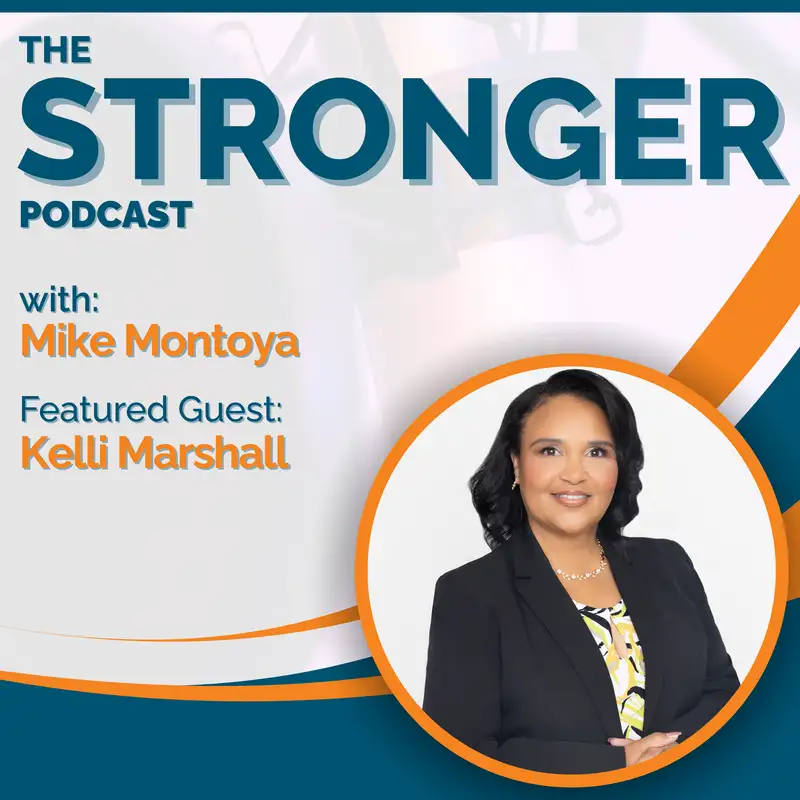
The Shiny New Penny Problem: Data-Driven Courage for Lasting School Change – with Kelli Marshall
Mike Montoya: 00:00:00
Welcome to the Stronger Podcast. Each week we have honest conversation with education and social impact leaders about their leadership and career journeys.
We talk about their origins, inflection points, and the work that they're doing today.
The conversations are honest, human, and practical.
If you're here for real stories, and real takeaways, you're in the right place.
Let's jump in and let's get stronger together.
Good morning and welcome back to the Stronger Podcast.
In this episode, I'm talking to Kelli Marshall, longtime friend and colleague, about what it really takes to lead through the constant shifts in education.
We get into the tension between the shiny new penny and what the data actually says and why high-quality instruction has to stay the North Star and how leaders can build the trust and capacity to make stick.
Let's jump in.
Before we dive into today's conversation, I want to give a quick shout out to podcastmatter.com.
Their mission is to help impact driven voices get the visibility they deserve.
If you want to share your message with the world, check out their website in the show notes.
Good morning everybody.
I'm with Kelli Marshall who's been a friend of mine for about three or four years now.
We met through some work in Indianapolis a while back and I'm super excited to have her as part of our conversation today.
Kelli, welcome to the Stronger Podcast.
Kelli Marshall: 00:01:25
Thank you so much.
I'm excited to be here.
Mike Montoya: 00:01:30
It's awesome.
Um, so I I like to always start with a little bit of like giving people like situationally like where whereabouts in the country do you live and then then we're going to jump into like where did you grow up?
I want to hear those two.
Kelli Marshall: 00:01:45
Listen, I am a proud Hoosier, a true Hoosier.
So, I'm in Indianapolis, Indiana.
And listen, I got to shout out of course our football team and I'm a proud graduate of IU Bloomington.
So, this is just a sweet time for me right now.
But born and raised here in Indianapolis, Indiana.
Mike Montoya: 00:02:10
Okay. Fair enough.
So, sounds like it you like it there.
That sounds my guess, right?
And lots of interesting things going on there.
What was it like?
What was it like uh growing up there as a as a kid?
Like what was your school experience like when you were where you're going to work?
Kelli Marshall: 00:02:35
So, I actually grew up in the Butler Tarkington area right by Butler University, right?
So, I thought that's where I would be going.
And at the time, I was in traditional public schools.
I had an amazing experience with great teachers at, you know, IPS Indianapolis Public Schools number 86, DeWitt S. Morgan.
I remember it vividly like that experience is why I pursued leadership in schools.
Mike Montoya: 00:03:00
Okay.
And so is uh so yeah, they numbered the schools in different parts of the country, right?
To keep track of that.
Kelli Marshall: 00:03:08
Yes.
Mike Montoya: 00:03:09
Yes. We had a name but it was known as 86.
Kelli Marshall: 00:03:13
86, right? Exactly.
And so is that school still in existence? Is it still functional?
Kelli Marshall: 00:03:19
No, it is not.
It has been Oh my goodness.
Cuz I would have loved for my kids to have gone.
It's been about it's been gone for at least 20 years.
The international school here purchased the building and it was at a time that you know charters had started to grow and you know the the enrollment in traditional public had started to decline and and you know they had to do some shifting around of school buildings which is still occurring.
Mike Montoya: 00:03:45
It's still occurring. Exactly.
Well and things change right and I think that's one of the the key features, right?
And and I think a lot of I mean I don't know what our full audience like thinks about, but like schools are buildings, but they're also communities, right?
And then they shift and change over time.
And the building can still be there, but the school community itself will have shifted or changed potentially.
Kelli Marshall: 00:04:10
Exactly. For many decades school.
Mike Montoya: 00:04:13
I remember, you know, have been around for centuries, right?
And and have a really long story history in the neighborhood.
I mean, have multiple generations going to that, but Indiana seems to have some of that going on.
They've been around on this.
I mean, it was kind of early people right in Indiana back.
Kelli Marshall: 00:04:30
Yes. Yes.
Mike Montoya: 00:04:32
Tell me a little bit about what your you said you got into leadership, right?
So, let's take let's take a little journey down your down your kind of your early early career path, right?
You I think you started out in in schools as a teacher.
Was that true?
Kelli Marshall: 00:04:50
I sure did. I sure did.
I had started my field experience actually in southern Indiana when I was still in Bloomington.
And I thought I was going to be a kindergarten teacher.
So, I was elementary certified.
got here, you know, graduated, came back in and could not get a job, right?
It's hard to believe back then you couldn't get a job.
But then I was offered a job in I think it was like first grade and I'm like, "This is so not me. What am I going to do?
I've got this degree in elementary ed and these kids are too small."
And so then I found my way up to fourth grade and then finally found my niche right in sixth grade math and had the time of my life, but I was in an open concept environment.
Kelli Marshall: 00:05:40
And so that at that point in time, we had like 300 to 400 kids that would rotate, right?
We had these makeshift walls.
And that's when I attribute like my classroom management and like all of that teacher educator presence came then because if I couldn't capture their attention and hold it then, you know, and and at the time I'm like, no one was talking a a lot about standards and everything, but I knew that I had had such a rich experience in school that like rigor became a thing to me and instruction became a thing to me.
And didn't realize that people were taking notice.
And it was that time in that open concept that the doors really started opening up for me.
And that's when I found myself, you know, at the, you know, having a lot of coffee with the superintendent and all this.
And I'm a, you know, I'm a teacher at that point and I'm just like, "Oh, you're listening.
Well, we need more of this and more of this and less of this."
You know, didn't recognize the experience that was placed in front of me.
But sixth grade math was was my jam and and I was getting results.
Mike Montoya: 00:06:50
Math teaching teaching math at all, right?
And then to sixth graders of all of all children ages, right?
They're what are they 12 or something like that?
Kelli Marshall: 00:07:05
They they sure are.
Well, yeah.
And and in some cases, they might they they might be a little older in some cases, right?
But no, sixth grade is just it's still that's where my heart was.
Mike Montoya: 00:07:20
That's amazing. That's amazing.
I think you know math is such an critical like piece of the learning experience, right?
And math and reading of course, right? And in the language arts and so did you feel like at the time kids were showing up ready in many cases or was there like a significantly learning gap in your experience when you were when you were a teacher?
Kelli Marshall: 00:07:50
You know it there there were still the gaps but we had not you know, embraced yet this this, you know, broader sense of number sense, right?
We had we were still in the drill and kill at that point, right?
Procedural math was a positive thing back then.
And I see it's coming back, right?
But we spent a lot of time, you know, just in in the basics.
And, you know, we weren't necessarily under the pressures of assessments.
Mike Montoya: 00:08:20
Yeah. And in Yeah.
Kelli Marshall: 00:08:22
Yeah. Yeah.
I actually was, you know, I was a teacher at a good time right now.
This is crazy.
I was trained in whole language.
That's how old I am.
That's when you turn the lights down and, you know, you let the learning happen.
Yeah.
That was not working at all and not for me at least.
And but I was, you know, a teacher at a really good time where you could really just take your time and and, you know, transfer the knowledge on to the kids.
Mike Montoya: 00:08:55
Yeah, that's that's interesting.
The whole language piece makes me a lot and it reminds me of like well and like schools of ed in the universities, right, kind of have experiments of sorts and they practice these in like lab schools and then they roll it out to their teacher cohorts as they train them and then it gets into the the work.
There's like maybe you could talk a little bit and I won't put you on the spot too much, but like talk a little bit about the tensions that you've seen over time, right, about like the push and pull between like constructivists kind of learning and these like back to basics type of things and and there's always been the like push and pull about what the curriculum should look like, what are the effective teaching practices, things like that.
How do you how do you I know you've had to navigate that.
So, tell me a little bit about how you've done that and then also like any reflections that you might have about like, hey, we're not there yet because we still have gaps, right?
So, how how are those things showing up in your practice now?
Kelli Marshall: 00:09:50
You know, I've always found it effective to just focus on like the what is the data saying?
And you know, it wasn't that I was just this this brilliant teacher that knew that whole language wasn't working for the population of students that I had at the time.
It was because I was looking at that data consistently.
And I and I think that is why we're seeing I think we're giving too long a runway right now to to try these things out.
And you you know the big ideas are absolutely important, but if you don't have that balance of the basic skills, you know, it It's it just creates frustration for the teachers.
And I think you know what I saw as a teacher, what I'm seeing with our our teachers now is they are trying.
They they are really trying, but it's like education has always been the new shiny penny.
What What is it that we're going to gravitate to right now?
Mike Montoya: 00:10:55
Yeah. And and there's like an attraction to it, right?
Like like.
Kelli Marshall: 00:10:58
Yeah.
Mike Montoya: 00:10:59
We pick it up and it's like a moth to the flame type of thing, right?
And we get closer and closer to it and then we're like Oh wait, maybe not right sort of things.
Do you feel like do you feel like there the science of science of reading is now the hot hot thing maybe three or four years in now to this this me?
Kelli Marshall: 00:11:20
Yeah. The sci the science of reading which if you ask my mom she's like yeah that's how I taught you to read like you guys with that you know. So.
Mike Montoya: 00:11:30
so we're we're learning to maybe to like operationalize it a little bit more.
I mean this I mean one of the huge challenges looking at it from a national perspective is that there are so many different pockets of humans right in different cities with different educational experiences and the the the adults that are showing up to teach children right are highly varied in terms of their own experience as well right and so is there in your work in in Indiana did you find opportunity to kind of level set and bring kind of everybody in your region or to different places kind of to a common place of of capability in that regard like is there any like common standard happening in Indiana now like that it's been achieved?
Kelli Marshall: 00:12:15
you you know it was like I my previous position with The Mind Trust our local education nonprofit here and our funder that backs a lot of the charter and incubation work
I I remember vividly like right around 2014-15 they were extremely instrumental in bringing back quality instruction to you know to the discussion
and you know it was at that time that the work was extremely intentional about bringing leaders together.
I remember that was one reason why I did some work with Instruction Partners like you know it's like they were bringing education experts to the table and teachers who were and educators who were hungry were gravitating to it.
Kelli Marshall: 00:13:00
In the past I'd say five to six years you know it's been less of that.
It's been less to that.
Now, it could be because our state has gone through so many changes with a new we now have will be adopting or readopting our accountability framework from the state that hasn't been up since 2019.
We've had changes in the standards, changes in the test, and we've just recently adopted a new graduation diploma, or high school diploma.
And so, I think it was and and these are things were needed.
You know, I definitely don't want to say that they are these were the changes that were needed but it kind of you know pressed pause on these mass convenings of learning that were happening.
And the data showing it.
Mike Montoya: 00:13:50
Yeah.
Kelli Marshall: 00:13:51
Yeah.
Mike Montoya: 00:13:52
Yeah. So there wasn't like a a kind of a course or a road map or even a calling that was really clear where you were headed for a few years and so it kind of like hijacked right the practice practice for practicing right and gathering together schools communities practice right.
Okay.
And I feel like you're telling the story that it's like common it feels like over, you know, 30 35 years in this work, right?
Like there's been like five years of solid work and then a pause and then like five and then there's a pause because the policy stuff is super uneven.
How does that you know you're I know you were like a superintendent of of a set of schools for a number of years.
Like how does the as a superintendent like how do you navigate that, right?
And how do you coach people to navigate that stuff now? Because it sounds like it's still happening in some ways, right?
So,
Kelli Marshall: 00:14:45
one, you've got to be courageous, right? You've got to be courageous.
You've got to be a like a constant learner and you have got to embrace the idea that school is ongoing like school improvement, right?
And and when these things happen and you've got to make those pivots, you've got to make sure that you have clearly articulated the why to keep people bought in.
And you've got to like you got to invest the time and the dollars into the training because it it is navigating it as a superintendent was extremely difficult.
I I laugh with a former colleague of mine and I'm like do you know or do you remember in 2017 when we just threw out all the curriculum and started over like that was crazy.
It was crazy.
But we needed to because it was at the time that we're like our curriculum is not aligned. It's not you know EdReports is not high quality.
And so we're like, throw it away. Like it.
So you have to be courageous.
Mike Montoya: 00:15:45
Yeah, that makes sense to me.
I mean I I and I I think that whole idea of pointing people towards the thing that is the thing and then bringing them along, right, is so critical because you know teachers because they can close their doors and kind of become resistant in some cases, right?
So like the changes and I remember working in San Diego city schools, right? And you know large 130 school district or something at the time. and and making change across that system was super tedious because teachers would literally be like I don't care and kind of shut the door on it, right?
And not that they were bad people, but they have seen so many changes that they're like, this too will pass and this too shall pass. Yes.
Kelli Marshall: 00:16:30
So, so we all know what that we all heard that.
So, so that sounds like not just in California but also in other states as well.
So,
Mike Montoya: 00:16:40
exactly.
Kelli Marshall: 00:16:41
So, if you look back over your time like what are some of the things like that you feel have been like critical places in your career that you felt very I call it powerful or impactful
and then also where were some things where you felt like you were really like I don't know maybe the maybe the pull of that is like not effective right um as a human or as a leader right can you give me a couple reflections on those things?
Kelli Marshall: 00:17:10
I think I've got a few examples you know I mentioned before like when I first started teaching I I I've felt and and there was evidence that I was being extremely impactful in providing a a space for learning. Right?
I think that it wasn't until I was in the Tindley network and founded the all girls school where I had a safe space but I was making an impact as well like we it was a machine at that point a positive machine and and I had learned you know through the the successes and failures from before, how to to be that collaborative leader that brings people on.
But it again, I keep going back to data like it was the I am most effective or I found myself getting the best outcomes for everyone when I am courageous enough to pivot when necessary.
Mike Montoya: 00:18:10
So you see something not working and you're like, okay, make a change.
Kelli Marshall: 00:18:15
Make a make a change, but make it make sense and it has to be in digestible doses, right?
You know, it was crazy when we we threw out the baby with the bathwater, right? And so it worked because we had a relationship.
We had a rapport with our staff and they were bought in.
But I I definitely wouldn't encourage that with any leaders that I'm working with right now.
It's you've got to be strategic.
You've got to keep the standards and skills your North Star.
And you have got to provide support and and development, you know, to to just ensure that you are constantly what is it?
You got you got to feed the teachers. You got to feed the teachers.
Mike Montoya: 00:18:55
Well, and there's not seems to be a lot of variation in the amount of professional development that people get once they're in place, right? as as a professional in the field, right?
They're working and they get snippets of it during the school year, maybe monthly, sometimes weekly.
Some places have really overly they call it organize their scripts so everybody gets like half a day of PD every afternoon Wednesday or something that like it's all sorts of all sorts of models out there like have you found any of those like the frequency necessary like is there a magic is there a magic amount of time and like a bare minimum of PD time that teachers need in order to keep growing and changing?
Kelli Marshall: 00:19:40
well first of all you're absolutely right we've not seen like that type of consistent ongoing touch points for development since the what the No Excuses model, right?
But I think what I found most effective is putting the time in on the front end, right?
That that two weeks prior to the opening of school and then really making use of your weekly data meetings to get those, you know, you know, those immediate touch points.
You got to do those.
But I think also the same I am an I'm an advocate for intersession and not just so those holiday times, you know, not taking everyone but not just for kids but also for staff.
So I always found it effective to get the staff's you know input on what day during these breaks can you know can I grab you and now we're virt you know you can do it virtually but I think it has to it has to be at the front end it's got to be embedded weekly it you got to take advantage of some intersessions and you know I know teachers want to leave you know that last day of school
But then then start still feeding them literature.
Kelli Marshall: 00:20:55
Feed them, you know, over the break so that they can look at it at their leisure.
Mike Montoya: 00:21:00
Yeah, that makes sense.
I feel like there's like one of the unlike other jobs or careers, right? Like the that you can get really good at because you're like I do basically the same thing all the time, every day, every week, every but with teaching the variable of course the children, right?
Right.
And that that that they're changing ways, right, of of activity coming through all the time.
And so like you may one year get like a class of youngsters that are like formed a certain way and and ready in a certain way.
Another the next literally the next season you can get a different group, right?
And you may throughout the day have four or five different types of student throughout the day, right?
So like teachers have to be super facile, right?
And so like they're they have to build like a lot of muscles, right?
That's the hard part.
That's the hard like is there like is there I know that you've been in the charter space for a while, right? And and and Indie has a kind of a interesting model of like maybe you want to describe it just a little bit.
Kelli Marshall: 00:22:15
That that's a way to put it.
Yeah, we have an interesting model to be evolving still.
So, can you describe what's going on in Indianapolis in the last 10 years roughly and how that's looking now?
Kelli Marshall: 00:22:30
That's a loaded question, but right now we've we've got your traditional public schools and then you've got those that are independent charters.
And if that alone you know didn't create some interest you know some interesting scenarios.
There's also a set of schools that are considered the innovation network models and they some of them actually have a charter as well but they receive they partner with the traditional public predominantly our Indianapolis Public Schools and they share resources predominantly in SpEd transportation any of the ops
and then there's also another layer of innovation network schools that don't have a charter but they do have their own governing board as if they did and they partner with our Indianapolis Public Schools.
Now I won't even go into what's what's you know in in legislation right now the ideas but that is definitely evolving and the the state is exploring ideas to take away the the stress and pressures that come with facilities and transportation and allow schools and the governing boards to then prioritize their focus on just the academics and the day-to-day of the school.
So, we'll we'll see how this turns out.
Mike Montoya: 00:24:00
I'm going to pause the conversation here for just a second to talk about Books That Matter.
Every entrepreneur or leader needs a book that elevates their business, builds their credibility, and makes an impact.
If you've got more money than time, a ghostwriter can help you build your story.
If you've got more time than money, a great book coach can guide you step-by-step through the writing process.
If you have already written a draft, these folks can save a lot of trouble and money by shepherding you through the publishing process.
Head to booksthatmatter.org and get the custom support you need on your book idea or manuscript.
Mike Montoya: 00:24:45
I mean, there there are a lot of physical plant things that can be highly distracting, right, from plan, right? Because they need but you need to have a lot of heat working in the well rolling, right? and food, right? Or whatever.
We're all like creatures, sleep and all that kind of stuff.
So that's a function.
But you know, school teachers and leaders are not necessarily built to be physical plant operators, right?
That's not like their training or other background.
Kelli Marshall: 00:25:20
Listen, I I learn I learned that, you know, from I was in heaven as a school principal and like I said with that all girl building and then, you know, was afforded the opportunity the board, you know, calls and you you answer the call and then I'm sitting in a supe seat.
And I'm like, "Wait, I'm not walking classes." Like, "Well, I got to walk classes."
They're like, "You got to keep the lights on.
You You got to find out how to get the rent paid, you know?"
And so, it's it definitely will pull your eye, you know, off the mark.
Mike Montoya: 00:25:55
Yeah, for sure.
And I think I was having an actual conversation with somebody actually from The Mind Trust who I won't name, but yesterday talking about like the the challenges of standing up independent or small like upstart charters and things like that, innovation schools, is that like you're asking a lot of school founder, right, to do all these things well, right?
And that there's, you know, there's models where like you pair them with an experienced operator, right? That basically just holds the space together, right?
And allows them to focus on the instructions, the teachers, the professional development and those features.
And once you get that stuff spinning, right, then it can call it becomes more cohesive in the experience of the child, right?
Um, and I feel like, you know, we talked about that at length yesterday and it was interesting to hear him reflect on that.
He's like, "Yeah, we don't have that ops thing figured out. yet, right?"
And so I'm like, okay, fair enough.
I mean, at least you're not alone in that in that mode in that regard.
It sounds like you have reflections on that.
So, what are you what are you doing now?
I know you moved on from The Mind Trust and so what are you doing now?
What are you looking forward to in 2026?
This is the start of the year. So, it's exciting times in that regard.
And I'm curious what you're headed into.
Kelli Marshall: 00:27:10
Well, I am so excited.
So, I after years and years of working in schools, working for schools, and supporting leaders, I started to recognize and especially in these last, you know, six to seven years that I was spending a lot of time building capacity in school leaders and I enjoyed it.
Then I, you know, did some adjunct work at Butler University and these aspiring leaders and I'm like, you know what, I might actually be pretty good at it.
You, you know, at least am enjoying it, right?
So, I stepped out and started Vine Elements LLC.
So, it's a coaching and consulting organization and I thought I was going to just be working with school leaders, but I've had the opportunity to in addition to working with school leaders, also supporting some of our education nonprofit leaders.
I do target my work though specifically, you know, with the leader.
And I think because there's so many experts out there that, you know, are doing this this work, but the need continues, you know, to evolve and and it shows I go back to it shows was in the data, right?
We're we're making progress, but our schools and and our ed nonprofits, I mean, our leaders need help.
Mike Montoya: 00:28:40
Yeah, that's very true.
And I think like that's the thing that also like I talked about children changing every day or every every year, right? But the leaders also evolve and change, right?
They move on other things and then you have a new crop of individuals leading and doing things that they haven't done before.
So So you're engaged now in a way to support them and and help them be more successful in their work. Right. Okay.
Well, congratulations on the move.
First of all, I want to say that.
I'm super excited about that.
So, you're also welcome to make a plug.
We'll make sure that we we get people to understand where they can find you.
Vine Elements LLC, right?
So, maybe there's a website.
If not, there is show notes for sure.
What's the website?
Kelli Marshall: 00:29:30
It is www.vineelementsllc.com
.
Mike Montoya: 00:29:35
So, Kelli Marshall.
Okay. In Indian in Indiana.
So, let's talk I'm gonna I'm gonna shift gears out of the career stuff into the personal side a little bit here.
Like because I'm going to call it we're both grown-ups now, right?
Experience.
So, I feel like I can ask these questions with a little more without, you know, sounding too too I've had to do my own work myself.
So, what is anything that changed your trajectory as a as a as a leader, as a human, right?
That and it could be on the personal side or like I have a personal reflection on this, but I'm curious if there was like a pivot or point in your life that you're like, "Hey, like this is a a shift for me. I think I
Kelli Marshall: 00:30:15
So I've got two kids, two adult kids that are doing super well.
Both were really bright.
My son, however, required like more consistency, more and and he he was he was my my like high achiever, extreme high achiever, right?
My daughter is just as brilliant, but he was my math guru.
And what I found was I had to bring both of them into my schools to make sure that their needs were being met.
And it was at that point that, you know, when you have your own kids and I'm just like, one, you recognize the challenges that schools have to meet the needs of all students.
But it also made me realize the responsibility I had to make sure that each one of the kids that I came across got the unique targeted assistance that I was able to give my kids.
Now, they'll complain and say, "Mom, we never had a home base, right? Because they went wherever I went."
And it wasn't until high school that they separated.
And my son did not graduate from my high school, but my daughter did.
But it really changed the way I thought about the responsibility.
And, you know, I said in a a previous podcast, I said, you know, it's it's difficult when, you know, some of our educators that are coming out there, some don't have a kid.
So they they live for themselves, you know, and but it's it hits different not just when you have kids, but it hits different when those kids require different things.
And and that's how I approach, you know, lead in the same way with leaders now.
You know, I I figure I'm working with all high-capacity leaders, but they require different things and that responsibility, it just it weighs heavily on you.
Mike Montoya: 00:32:00
So I am a differentiation all down to the single child, right?
Really became evident when you had your own young, I don't know if they're the same age, but similar age kids
Kelli Marshall: 00:32:10
a year apart. A year apart with you.
Well, and and that's like the responsibility of all the parents, right?
And parents have a really super hard for parents to like navigate schools because those things are not necessarily aligned and and as you said, you had to like as a educator had the opportunity to, you know, I call it highly specialized things with them, right?
Because you knew what was possible and you had the ability to attend to it in some way.
So that's that's a bonus.
And so like maybe there's a lesson in there for all of us who don't have children in the spaces, right?
Is that like the individualization for an individual kid really matters because their life course, right, is significantly impacted, right, by these the yearly experiences that they're getting.
Is that how many years I mean I don't know what the data used to say like if you got three years of consistent high quality teachers, you were like doing pretty well.
I don't remember if that's exactly true, but it's right.
But I I've heard that too. Right.
So we we read the same articles or something.
But yeah, you get three years of of consistency.
I I think Mike, the other thing is just owning it's that responsibility.
Mike Montoya: 00:33:15
Yeah.
Kelli Marshall: 00:33:16
You know, I think when you feel responsible for for something, no matter what it is, you know, you learn different.
You you put a little more intentionality in the planning and and so in addition to, you know, just the differentiated differentiation that's needed, it's recognizing the responsibility that you hold as an educator.
Mike Montoya: 00:33:40
Do you feel like that can be taught or is that just I mean I don't know and something you're trying to like help leaders experience and discover this for themselves.
I would say that there's a lot of folks that are doing call it for the for the good work, right?
And but and they get into it for a reason that is mostly about I say like they have a why, right?
So that piece is there and then there's and then they can morpher change into like they're responsible for like an organization who people have outcome as a board you know all this stuff tons of money budgets huge budgets things like that right that becomes like a pretty heavy lift right
so like how do you help leaders sort of balance that responsibility right and and fill that because it's a lot right and I mean I know that you experienced this as a as a a school superintendent I'm sure right
so what what are some of the things you're helping leaders to to to do for themselves that helps them to be responsible for the things that they have to be responsible for.
Kelli Marshall: 00:34:40
I I think you know it comes with that why getting really clear on their vision right what what is the desired outcome that that you're seeking and and you ask the question can that responsibility be taught I don't know if it's taught or or brought to reality and experienced right
because if if the first thing that I do when I sit down with with any educator I'm like what do you want what do you want to happen right and then we go from there like what what would make the greatest you know make your why come to reality
and you know some can immediately say well I want to hit this mark and d okay well then let's talk about your role in getting there before we talk about anybody else's
what is your role in the work that you've got to do the changes that you've got to make or the things that you've got to adopt to make that h make that possible.
Mike Montoya: 00:35:40
Got it.
So centering around their their driver, right? I thought about that and then also about like their role.
I love that your their role the role of the individual, right, in this work, right?
I feel like that's like something that I haven't heard recently is is how how much personal ownership and power we have as individual leaders, right, to show up in certain ways.
I mean, sometimes it is work and sometimes it's very natural.
right to just like just like that's who you are and it works perfectly and other times it's like work to become the or to be the person that you know the the role required so much right and so do you feel like I mean I don't know you don't have to talk about specific clients that you're working with now but like having seen the variation I'm talking about in in the the leadership role
Kelli Marshall: 00:36:30
yeah it's role versus title right and and and I think when when people realize that that title comes with a role and and I think the the challenging part is when it's not the role that they thought right or that they had intended.
Mike Montoya: 00:36:45
I just want to say that if you're a leader, entrepreneur, or business owner who needs some support, there's an easy way to get a think tank behind you in your vision.
The Genius Discovery Program at Thought Leader Path is like having your own one-on-one incubation and accelerator program.
They'll help you develop an approach based on your own story and your plan for impact and offer the tools and thought leader assets needed to really amplify your message, including launching a podcast like this one.
If you're ready to stop grinding in the dark and start making real impact with the right support, check out geniusdiscovery.org, right?
Then it feels off, right?
Then they're like, "Oh, yeah, hand type of thing is feeling like it'll fit."
Okay, let's talk about I mean, so I sounds like you have a some f some kiddos from the personal standpoint like what is like can you Now that you're going to grow up, can you articulate your why?
And is it different is it different now than when you were a young professional?
Kelli Marshall: 00:38:00
You know, I've always wanted to make a difference.
I just I think that I having spent my entire career in public education and you know, I was afforded opportunities.
You know, people always say, "Well, you know, Kelli, how did you grow up?" I grew up really well.
you know, and and so we weren't rich by any means, right?
But I had my needs met and and so I have always found value in like engaging in work that can change the life of someone else.
No, you know, no matter where they're coming from, right?
I'm not saying that that I would not entertain, you know, working in affluent areas and all that.
I'm not saying that I'm saying if I can make someone's life better then I'm successful.
I feed off that.
I feed and it has it served me well.
I'm tired.
Definitely tired, but it's it's like I enjoy this.
This is cup filler work to me and and it is just it's really rewarding.
It's challenging though. It is.
Mike Montoya: 00:39:15
Well, and I think that that I appreciate that the like making a positive effect, right, with with the people that you encounter either professionally and personally.
That's like fills your cup.
And it's it's like almost I think about that for myself as a gift almost like it's a gift that I've had a whole career, right?
Where most of the time 85 90% of the time I'm able to do stuff that I love, you know, and then there's always like stuff that I'm like, I got to do that, right?
But but most of the time I'm doing something that I love and I've never had a job and I just had to make a widget, do a thing, right?
So that I've been grateful for that.
Maybe that's by choice.
race as well, right?
And you know, I'm not like a a rich man or whatever that is, but to say that I've had a rich life, right, around these experiences that I've had and I could point to different humans, right, that I've had very maybe a very specific positive impact, but just more generally, right, like Stronger our company like provides for the livelihood of a bunch of people and their children and that kind of stuff.
And that's like an immense responsibility and it's super fun too, right?
And it keeps me pretty motivated, right?
And I'm getting you said tired sometimes, too, in that regard.
So,
Mike Montoya: 00:40:35
When I think about the people though that have made the most impact in my life, they're educators, right?
So I'm like, aside from my home, right, or my grandma, right, when I think about people, I'm like, man, Alicia Coleman, well, she was my first grade teacher.
Dr. Santry, tell you,
Kelli Marshall: 00:40:35
oh, listen, Alicia Coleman said I was going to be a teacher.
Dr. Santry was my kindergarten teacher.
She said I was going to be a teacher.
And I was like, rebelling.
No, I'm not.
I'm going to be I at that point in business, right?
I'm I'm going to own a business.
Well, hey, now I am.
But again, it is it's all educators.
Even when I was having those coffee chats with superintendents, I just recently saw one of of my previous superintendent.
And for him to extend his hand and say, "Me, I know you."
And I'm like, "Yes, you do."
You know, Dr. Eugene White, he was he's he's a beast, right? a good way.
And but when I think about the individuals that have poured into me, they were educators.
And so maybe I'm I'm doing this because they poured into me, so I pour into others.
I I never had a bad experience.
Mike Montoya: 00:41:25
That's incredible. Never had a bad experience.
I I can name a few that I'm like, you're not qualified.
Kelli Marshall: 00:41:35
I had a learning experience, but I never had a I never I had a learning experience, but let me tell you, my entire time in schools, I I didn't have a bad experience.
You know, even through failure, even through challenges, I wouldn't equate that to a bad experience.
Mike Montoya: 00:41:50
I feel like someone needs to use your language and part of even just your story, right, to talk about like how how education is a I guess noble profession.
I'm going to use that word.
It's a profession that's very fulfilling, right?
And it can be incredibly impactful, right?
And if you want to fill your cup for 30 or 40 or 50 years, you can do this work.
I don't know if like recruiters know this out there, but we were trying to build teachers, but like you know, it sounds like your first grade teacher was like an inspiration of sorts, right, for you to say.
Kelli Marshall: 00:42:25
Oh, so much.
Mike Montoya: 00:42:27
So, thank you for that.
I like to I like to do the reflection moment.
And, you know, sometimes people think about an actual younger self like, you know, when you were a child or a younger young woman or sometimes you think about like someone that's in your life now and you're thinking about advice that you want pass along to to the next generation?
Like is there are there a couple of things that you like wish you could share that or that you feel like would be valuable for for our audience here?
Like our whole audience is like widespread so who knows kind of hear it but I think it'd be curious impart some ideas here.
Kelli Marshall: 00:43:00
I I think a couple thing I always say I always say this to people that are especially those that are like considering leadership.
Leadership is lonely but you don't have to be alone.
You don't have to be alone in it.
Leadership is it It's lonely, but you don't have to be alone.
I think the other thing is, you know, it you've got to identify who, and I've I said this before in in another podcast, you got to know who your front row is.
Who are the individuals in any setting that you're in that you can call on?
Like, if I were to start a school right now, right there, there are five to six individuals that I know I can call on and I wouldn't ask them to leave their jobs, but they would be right there with me as thought partners, you know, to get this stood up.
So, I I think just a couple things.
One, be comfortable being in a space of leadership, be unapologetic about what you know is right, but it is lonely.
And then the other is identifying those individuals, your front row, who are going to walk alongside you and and share and are aligned to your beliefs.
Maybe there's a third one.
Don't try to work outside of your beliefs.
It's never going to work. Right.
Mike Montoya: 00:44:15
Congruency, right? Right.
Yeah, that one's super powerful.
And so, front row, be conviction.
Be convicted in your beliefs.
And then the third one was like stay congruent basically with with your kind of core value element, right?
Which is like if you try to work outside of that, it's going to feel like a a funny fit for a while.
I think I had another guest that that spoke about like, you know, like when you're young, try a bunch of things so that you can know that the thing you land in for a while is the right thing, right?
And don't be afraid to be like, "Hey, I tried this.
Doesn't feel great.
Time to make a shift, right?"
And I think sometimes like we we expect people to like have it all figured out when they're 22 or 25 or 30 years old, right?
I don't think I don't think I sort of slotted into my career path until I was about 30 31, right?
And and didn't really clear like if I was going to move forward, but you know, the first 10 years I was like trying stuff, right?
When it was always doing stuff with kids, and used and and around supporting and and helping people, right?
At the same time, I was trying to find another lane to play that was effective.
So, the leadership lane has been productive for you.
Sounds like you love it and and we talked a little bit about 2026 and so I don't expect you to like peer around the corner, right?
But if you if you think about like, you know, maybe even 10 years down the road, right?
This idea of like a life well led, right?
Is it more of same what you're doing or is there like still something on the horizon that you're Hey, I gotta I want to I want to achieve or tackle that in the next 10 years.
Kelli Marshall: 00:45:25
Well, so I'll never retire, right?
But I'm I am looking forward and and I'm starting to see like some some remnants of it now.
I'm looking forward to the day that I can walk into a room and the leaders that I've poured into have built all this up, right?
So that they are, we talked earlier about, you know, what are the major education shifts and who's bringing these people to, you know, educators together to truly, you know, scale the the next bit of work, right?
And 10 years from now, if I could walk into a convening of leaders that I've helped to support, develop, and learn from who are bringing broad like networks of people to move the needle here.
And I'll take just Indie right now.
Of course, I I would love it to be more broadly, but you know, I'm I'm really wed to the to Indiana.
So, that would be something I'm hoping and working for.
Mike Montoya: 00:46:00
fruits of the the fruits of the work, right? Sort of come.
Kelli Marshall: 00:46:05
That's right.
Mike Montoya: 00:46:06
to maturity in some regards, right?
And well, that you have enough time, right?
You're going to see a next generation of leaders turn into those individuals.
The kids that are in kindergarten now, right, are going to grow up and you're still going to, right?
So, as you said, if you're never retiring, which is an ambitious goal, so
Kelli Marshall: 00:46:18
I want to volunteer in a school that I don't feel the need to take over.
Mike Montoya: 00:46:21
There you go.
Right.
Because there's sometimes you walk in, you're like, "Oh my Gosh, this is a project, right? Project."
Kelli Marshall: 00:46:25
Yeah.
Mike Montoya: 00:46:26
Yeah, for sure.
I hear you there.
Okay, fair enough.
Well, I want to I want to thank you for your time.
Thank you for your work.
And I don't know, I try to say this to to leaders because I don't know if it gets said often enough, right?
Like we I value you for who you are and for the work that you're doing for children in Indianapolis, right?
And I know that we've done some ventures together.
I look forward to doing some of those in the future now that you're I call it not held by The Mind Trust.
There's for us to work together and I'm looking forward to that and I I'm grateful right for having you in my life and thank you for being here.
Kelli Marshall: 00:46:33
Thank you so much and thank you for having me and again I always take a moment to say I'm so grateful for the work that we did together because when when I can see you know those leaders are still there.
They are still working hard and the kids are in a better place because of it.
So I you know it's I appreciate your work.
Mike Montoya: 00:46:37
I gotta call that place.
I got I won't name I won't name the school right now but I'm you're on my list.
So Maybe I'll I'll stop the recording and then we'll we'll go to race to the bottom.
Kelli Marshall: 00:46:38
Okay.
Mike Montoya: 00:46:39
Thank you very much, Kelli.
Thank you so much.
Kelli Marshall: 00:46:39
Thanks. Thanks so much,.
Mike Montoya: 00:46:40
Kelli. Thank you for being here and for the way you named it so clearly that leadership can be lonely, but you don't have to be alone.
I'm taking away your focus on building a front row of trusted thought partners, staying true to your beliefs, and having the courage to pivot when the data shows something isn't working.
If you want to learn more about Kelli and her work, you can find her at vineelementsllc.com.
Thanks for joining us and tuning in today.
To find out about other podcasts that matter, visit podcastsmatter.org.
Thanks for listening to the Stronger Podcast.
If this conversation inspired you, we invite you to follow the show and share it with someone who's on a journey to become a happier and healthier version of themselves.
Links and resources are in the show notes.
See you next Thursday, 9:00 a.m. Eastern time.
Have a great day and
Stay strong.