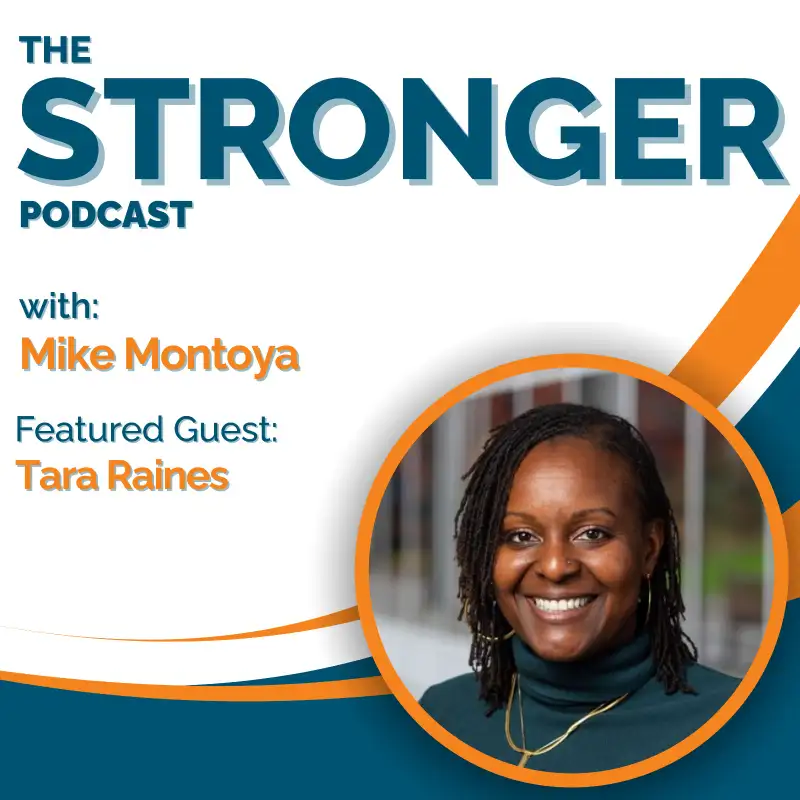
Charter School Boards Should Keep Their Noses In and Fingers Out: Rebuilding a School the Community Co-Owns with Dr. Tara Raines
Welcome to the Stronger Podcast. Each week, we have honest conversations with education and social impact leaders about their leadership and career journeys. We talk about their origins, inflection points, and the work that they're doing today. The conversations are honest, human, and practical. If you're here for real stories and real takeaways, you're in the right place.
Mike Montoya:Let's jump in, and let's get stronger together. In this episode of the Stronger Podcast, I sit down with Tara Raines to talk about what it really means to rebuild trust and opportunity in a community through education. As the board chair of the Democracy Prep Nevada and a national leader in children's behavioral health policy, Tara brings a powerful perspective on equity, prevention, and why schools have to become more than places students attend. They have to become places communities can't believe in again. Let's jump in.
Mike Montoya:Good morning, everyone. Good afternoon. Some of you will be hearing this at different times of day. I am here with Tara Raines, who's the board chair at Democracy Prep Nevada and a current member of the Stronger Consulting client family. And Tara, it's great to spend time with you.
Mike Montoya:Thanks for being here.
Tara Raines:You too. Thank you for inviting me. This is wonderful.
Mike Montoya:This is one of the privileges of the work that I do is getting to talk to individuals, right, who are like, I call it on the ground doing really critical work with kids and families. And so I wanna hear, like but there's always a backstory, like like, how you got to this thing that is part of your life. Tell me tell me a little bit, like, where where did you grow up? And how did you get to Nevada and and such? And tell me about that.
Tara Raines:Yeah. So I grew up military. My dad was in the Navy for twenty six years. We moved around a little bit. And, he was stationed last in Jacksonville, Florida.
Tara Raines:And so that's where I went to high school. I went to college in North Florida at Florida State, the the best university in Florida. And, was a special education teacher for a little while in day treatment, self contained day treatment, decided I wanted to get on the front end of the interventions. And every time I had a question about my kid's case, someone say, ask the school psychologist, ask the school psychologist. So I was like, I'm gonna become the school psychologist.
Tara Raines:So I got my specialist in school psych at Nova Southeastern, worked as a bilingual Spanish speaking school psych for a little while in some district just outside of Atlanta, and then decided I should do more school. So went back to school at Georgia State, got my PhD in school psychology, did an internship at Children's LA in pediatric psychology, and then got my first faculty offer at UNLV. And so that is how I landed in Las Vegas was as faculty in their school psych program. But then I left. I was in Las Vegas for about three years and I got poached up to University of Denver and was in Denver for six years and had my pandemic life crisis like many people.
Tara Raines:And was like, what am I doing? I'm writing papers for my dad. You know, like this this this tenured faculty life doesn't feel like I'm having an impact. And so started playing with the idea of moving back to Las Vegas. Most of my research had been based in Las Vegas, and I had a lot of community connections.
Tara Raines:And so as soon as things opened up after the pandemic, we moved back to Las Vegas. And, in my announcing that I was gonna make this transition back, folks reached out to me to be a part of things. And one of those things was the DPAC board. So the board chair at the time reached out and said, hey, we're really trying to get some people together to figure out what we're gonna do at Democracy Prep. Like, you be willing to help?
Tara Raines:And I was like, absolutely. Spent a few years as a board member, and then last summer got promoted to board chair.
Mike Montoya:Selectively promoted. Have you board chair on many things? I'm like, oh, yeah, you get there by how long it's hold. Sometimes it's how long is.
Tara Raines:Essentially what happened. I was caught off guard in the meeting and I was like, aren't we supposed to have back channel conversations about these beforehand? So I just kind of was the last one to put my my finger on my nose. So, But it's been good. I've learned a lot.
Tara Raines:It's been a steep learning curve. You know, we announced in the fall that we were going to separate from our charter management organization, which is a Democracy Prep Network. And so, have learned a lot. I've learned a lot.
Mike Montoya:Right? It's like you put on I call it you put on a different outfit, right, to be a board member and then the board chair individual, right, is another set of responsibilities. For our audience to know, all these roles as board members are very life fulfilling and are volunteer. So, in addition to whatever board members are doing with their professional lives or their families, they're also serving you know, by choice, right, on these volunteer Yes. DPAC, Nevada has a nonprofit, set up as a nonprofit, right, organization, and then it has a charter authorization from the is it from the state of Nevada, or where?
Tara Raines:From the state. Yes. So we are we are authorized by the state public charter authority.
Mike Montoya:Okay. Got it. So, yeah, that's great. I wanted to kinda meet people sometimes get misnomers about charter schools and how they function. So they're publicly funded, and they're run by volunteer boards and they have oversight from the government in different jurisdictions, etcetera.
Mike Montoya:Tell me about Democracy Prep. It's on a very storied location in a neighborhood and on a campus that people will know or hear about. So tell me about that.
Tara Raines:So Democracy Prep was originally Agassi Prep. And so it was founded by the Andre Agassi Foundation in the late '90s. They put a school in our historically black neighborhood in Las Vegas, the West Side. And I think it's important to know that Las Vegas was incredibly segregated for a very long time. And there's the famous story of Sammy Davis Jr.
Tara Raines:Not being able to be treated in Las Vegas and having to go to Los Angeles for treatment. And as a result, like lost vision in his eye. So, know, like just to set the context, it's not a place where people of color, particularly black people, were receiving equitable treatment for a very long time. And so to address the educational inequity, the Agassi Foundation invested in a stunning building, seated squarely in the center of the historic West Side. And it really was a place of academic excellence.
Tara Raines:People will talk about Agassi Prep still to this day, even though Agassi Prep hasn't been a thing for about twelve years. If I say if I say Agassi prep, people like light up and get excited. I met with a parent recently and I was like, how did you even find our school? And she said, well, I had just moved here and I was talking to a taxi driver and he told me Agassi Prep was the best school for black children, you know? And so, you know, there's a lore around that.
Tara Raines:And then in the mid two thousands, we saw a transition, where Agassi Prep brought in a national charter management organization. And so what that did is it allowed the school to be managed and run by this, by an entity that was based in New York and, moved away from local governance. Well, there was still the local governance board, but moved away from local management. So outsourced it.
Mike Montoya:And that sort of changes things, right? Like there's a, there's like a, and distance is a real thing, right?
Tara Raines:And
Mike Montoya:in particular, and I have just been learning, I mean, and I've heard some of the stories that you've shared before about, the West Side, but I don't think most people are familiar with that in Nevada, right? And it's just like a lesson that a lot of people don't know about, right? And there's a huge service class of folks in Nevada because people know about the industries that's there. But I also think people don't really recognize that people live in Las Vegas and have families and have Yes.
Tara Raines:For generations, right? Multiple generations of people who live there. Yeah. Yeah. So, go ahead.
Mike Montoya:Keep going. I want to hear more. Keep going.
Tara Raines:No, so I think, so it did, it changed the culture, it changed the tone, it changed the tenor to have folks who were not from the area running the school, you know, we saw a dramatic shift in enrollment, we saw dramatic shift in leadership, we saw, you know, different performance over the last few years at the school. And it's it kind of, you know, from my perspective, from when I I joined the board, it just it looked like, the democracy prep folks were working to kind of get their footing and find the formula that was gonna work in Las Vegas. Right? Because you can't New York and Las Vegas are are different in like so many like the the overlap on the Venn diagram is small, right? Like they both have humans.
Tara Raines:That is true. And, there are lots of things culturally that are that are just really different. And so in the fall, the decision to separate, New York, decided to close all of their, I don't know, I don't want to call them franchise schools, but they're satellite schools for democracy prep, which gave us the incredible opportunity to lean in to what was in the past and build something new, through an independent school. So standing up an independent school, really leaning into community, leaning into voice, leaning into, you know, what do students want? What do families want?
Tara Raines:What do community members want? How do we get back to having a school that taxi drivers are excited to tell people about? You know, where, you know, we're not at risk of closure, you know, currently, we've got an elementary school that is performing so low, it's at risk of closure by the state, if we don't demonstrate the appropriate amount of growth, you know, and for me, that's criminal. It's criminal to be the charter school that serves the highest proportion of black children in our state and have it performing so poorly. The state's like, should we close you?
Tara Raines:So really wanted to lean in with this independent charter opportunity, really wanted to lean in to how do we create a school where that's not even part of our narrative, that's not something that that's even on the table anymore, you know, where we we create a solid foundation in the culture of excellence so that, you know, it it's we're having a a we're celebrating, you know, how well our students are doing. We're celebrating, you know, you know, how many of our students are going to college with scholarships. I mean, we're we are doing that, you know, like our high school, it's currently a three star high school on the state rating. And over 80% of our kiddos are going to four year universities and have scholarship packages. So we are seeing excellence, but how do we make that the rule and not the exception and not the in spite of?
Mike Montoya:Yeah. Sometimes people kids will make it. Some kids will make it in spite of everything that adults do to get in their way, I call it. But most children need a solid structural experience that they can get through and navigate. That's not Black children.
Mike Montoya:It's like all children need structure and support to kind of grow up to be healthy adults. And I think, as you said, it's a difficult thing to be in a community and noticing that that's not working well for kids and then not do something about it. So back to you got invited to the board, and now you're responsible. Board chairs have this very special role. They're not professional, but they have responsibility of a significant And the main job is that they have to hire really great people to start with so that the management of the organization can be high quality.
Mike Montoya:Back to hiring excellent people that have an excellent attitude about it. So, like, tell me what you've been thinking about as you guys are headed into this, curve of of change with leadership, and and what do you guys kind of make call it, prioritizing with with regards to new opportunities?
Tara Raines:Yeah. So for me, you know, I feel like the role of a good board member is to be noses in, fingers out. Right? So watching what's happening, seeing what's happening, but really trusting the folks who are in place to execute on the vision and execute on the mission. And so we wanted to make sure that we had the right folks in the right places.
Tara Raines:And part of that was looking at how we made a final decision around our executive director. We decided we were gonna have a board conversation, you know, do we just extend a contract to the person that was in place? Or do we do a search and allow that person to demonstrate to the board crystal clear? Right? And so in those conversations, or the leader who was at the the campus decided to resign.
Tara Raines:And so that did leave you know, that eliminated one of our options, and that allowed us to launch a search. And, launching the search, first of all, Stronger, you have been so impressive on the search. This should be also a commercial for using Stronger Consulting. We'll take
Mike Montoya:the commercial, Molly. Yeah, for sure. But
Tara Raines:I, we wanted somebody who knows how to turn around and run a strong organization that happens to have education as their service delivery. So so took an approach that I think a lot of schools maybe don't consider. But for me, I was like, we're at a time where we can have innovation, right? Like, I don't necessarily need someone who has run a school for twenty years because for them, looks a very certain way. I'd like to have someone who has been a part of the community, who has led organizations, has been successful in the nonprofit or for profit space, and can bring those tools, bring idea generation, bring openness to innovation to our school so that our education service delivery can really meet the needs of the folks who are in the buildings.
Tara Raines:That said, we were also really intentional about hiring strong principals. So so that that education and that kind of school ness knowledge is also on campus.
Mike Montoya:Well, I appreciate that because I mean and I think we have this discussion, you know, when we were like starting this conversation with you on the search, you guys already had a strong point of view about this. It's like the need to, I call it, galvanize the community, right, and kind of reinvigorate it, right? I call it build security and safety and connection with community is like a really huge feature. People will be listening to this after the decision is made, etc. So this will all be in the past tense.
Mike Montoya:But the moment is also to say you've also prioritized really high quality principles and instructional leadership to make sure that I call it the bread and butter or or boots on the ground people that are doing the daily operations of the schools are, like, highly qualified. Right? That's kind of what this is. Right? So
Tara Raines:A 100%. Because from my perspective and and I could be wrong. Like, Google us after this airs. Right? But from my perspective, the executive director should be functioning as an executive director.
Tara Raines:Right? Like, they should be overseeing the structures. They should be involved in development. They should be involved in community building. Like, they should be the last stop.
Tara Raines:Like, the principals, if there's principal roles and assistant principals, like, they are the ones who should be checking lesson plans and, you know, organizing teacher coaching and right? Like, so I really wanted to create a structure where our executive leader could sit in that role and really build out the vision and and and the mission of the school and and not so much be in the day to day. I mean, they can be and I know I need them to be aware of what the day to day looks like. Right. And I don't know that this is the person who should be, I don't know, having parent conferences because someone forgot their lunch.
Tara Raines:Right? I feel like some of those Yes.
Mike Montoya:Yeah. I mean, it's such a wide And I've seen this model that you're talking about, which is the qualified organizational leader, working with qualified instructional Sometimes instructional geniuses. They're really good at teaching kids how to learn, or teaching kids subject matter stuff, especially when it's K-twelve. There's a wide range of subject matter expertise that's necessary and experience that's required, especially when you're dealing with, I call it, kids and families that just haven't seen what high quality looks like. Yes, And so you have I agree with to bring people that can really show and bring the up level, There's 60 or 70 adults running around a school campus making this thing function.
Mike Montoya:So they have to lead adults and build lots of families and kids. So those are really important principle roles. And then there's like, hold this organization together with all of bells and whistles and strings, right, that are necessary. And like the board chair needs a really good, I call it, a partner, right, from the executor. Yes.
Tara Raines:100%. It has to be a partnership for it to work. And somebody who, from my perspective and my experience on other boards, uses their board chair as a thought partner, like really intentionally. And so that's one of the things I'm excited about with our executive director candidates is, they're both folks that I'm excited to learn from. And I'm excited to, you know, strategize with and and think through challenges with, right, and offer thought partner type support, not offer like, you know, coming down, like directives.
Tara Raines:So I'm excited to have a peer in our executive director.
Mike Montoya:Yeah. Well, and this is a good I think even though you've only been doing it technically for a few months, right, as a born I
Tara Raines:can't believe it's been a lifetime. And it's even lifetime here. Yes. Oh, man.
Mike Montoya:But your instincts are, I think, quite strong. And I know you're getting some support and coaching from other folks that are friends of the Stronger community as well. But the idea that you're such engaged but also willing to partner and learn. When we produce this, I want other board members to hear, this is a good model, it's a good way to think about how do you structure a good entity so that it can function well and that board members can participate, but don't control everything because it's like a lot. Right?
Mike Montoya:It's a lot to do as a volunteer for sure. Right? So
Tara Raines:It's so much to do as a volunteer. It is my, like, volunteer part time job. And, there was a moment where I was doing so much work for Deepak, my partner, he goes, you can't charge for any of this? And I'm like, no, I can't charge for any of this. He's like, it's a lot of time.
Tara Raines:I was like, I know.
Mike Montoya:I know. And now you know why I'm not on any charter boards anymore. Yeah. Know. I because I was like, You're doing a
Tara Raines:lot free time. Of For sure.
Mike Montoya:So, okay. So, you have an exciting moment, right? Yes. By the time people hear this, there'll be a decision, there'll be a new person that's been, I call it, appointed or selected, offered a job, and will be coming into place soon. Can we kind of wind back a little bit about kind of core motivation for you about the, I guess I call it like because you're investing a lot of your personal time.
Mike Montoya:Right. But there's multiple don't do that for free. But you're but you're like amongst a group of doing this by choice. Right. So what's the ethos that you bring to the table?
Mike Montoya:And how have you galvanize your board members to, I call it, share a common cause in that regard?
Tara Raines:I think personally and professionally, everything I'm involved with revolves around equity and access. And so those two pieces are really important for me. I don't, I don't want to say it so flippantly that I don't care. It's not up to me what people do, but that folks have equitable access to do whatever that thing is that they want to do. And so for that reason, I really feel passionately about education.
Tara Raines:Because that that does give folks the tools and the exposure to figure out like, what is that thing? I'm I'm really passionate about teaching kids to think. I think that's something that has gotten lost. And so, you know, that plus folks have knowing the history of the school, right? People remembering Agassi.
Tara Raines:You know, we've got people on our board who attended Agassi as students. We've got people on our board who taught at Agassi when it was a school. We even on our board, I've got the executive, person who's executive director when it transitioned from Agassi to Democracy Prep. And so there's a lot of historical knowledge and remember when on our board. And I think that drives people to try to want to get back to the former glory.
Tara Raines:And I, what I appreciate about my board members is an openness. So everyone while they remember, they're also open and recognize that it will look different going forward. And so there's no- there's none of that, well, we did it this way. Like I haven't heard that from anybody. And that's one of the things I was nervous We did for Was going backwards, right?
Tara Raines:And I think everyone squarely got their feet, their toes pointed forward. And so that has been been really helpful. And so I I don't feel like I have had to do a lot to inspire people to be involved in this. Right? Like, it's one of those things where people see babies falling into the water and they have just gotten into action to get them out.
Mike Montoya:Well, I think in part, because there's historical experience with the campus and the location in the neighborhood, and the fact that there's just not a lot of, I call it, not a lot of really great solutions on the table in many neighborhoods like this. And so when you do have, I call it, this giant asset of history as well as the campus, right, that you can and people like, schools can be such powerful galvanizing moments in a community because they're large, they take up space, there's humans going and coming all the time, people drive by them all the time, etcetera. Schools can be these really, I call it, energizers for a strong community. Churches can be that way too sometimes. Like, those kinds of things can happen.
Mike Montoya:And so, like, I feel like the the campus itself, right, and the opportunity that you guys have is, like, really bright because it gives people, like, something to think about. Right? That's exciting. Right?
Tara Raines:Absolutely. And it's a beautiful campus. The Agassi Foundation is leasing us this really stunning campus. And so I feel super lucky in that. And there's a lot of work going into revitalizing the community.
Tara Raines:And I've talked to a few elected officials and they're like, hey, part of this revitalization revitalization is having good schools, right? And so like no pressure, but like get this done. And so, recognizing that that our school is poised to be kind of a beacon or a center point in the community. When I was in Las Vegas on my first round, before going to Denver, when I had meetings with, black community organizations, those meetings were on the campus. That was my first introduction to the campus years and over a decade ago.
Tara Raines:And so wanna get back to that place where the campus is a place where community meetings can happen. I just spoke to our local, the folks who do the summer school distribution, summer school food distribution said, hey, can we be a summer meal site? You know, like how do we get people to get back on this campus and see the campus as a place where people come, right? Where a place where people learn and a place that's open and is co owned by the community.
Mike Montoya:Yeah, this idea of like a community, like kind of nexus, right? It's like a powerful one. I was talking to another client in Arizona, and they have this vision for community centers as their hubs and their schools. And there's a lot of things that people can do to make them that way, but a lot of it starts with the attitude of the leadership to say, we want to be part of this community, and we want it to be a vital place, a place that's alive. Yes.
Mike Montoya:So, this is exciting. I can't wait to tell this story. In a year from now, we're going come back and say, Okay, this is where we got. Because you guys are making significant progress in media even in a short time. And there's lot of transition stuff to go through organizational change.
Mike Montoya:Is there something that you're hopeful about? And then do you have any, I call it spaces where you're nervous? I'm going use that word. Maybe that's not the right term.
Tara Raines:I will use terrified instead of So yeah, I think anytime you're not doing the thing that everyone expects you to do, it is a little terrifying, right? And so I think there's, there's several pieces where we're taking approaches. And I've had folks who are really smart say to me like, oh, don't do this. And I'm like, too late. So, you know, I think, in the transition to becoming an independent school, I am terrified that things will fall through the cracks, right?
Tara Raines:Like I no longer have a democracy prep that has a full staff and, you know, multiple people doing lots of roles to kind of backfill. So like, what does it look like? How do I make sure my meeting agendas are posted on time? Right? So like, there are moment points of a million points of terror for me right now.
Tara Raines:And I am looking forward to the thought partnership of my new executive director Yep. To help me kind of think through some of those structures and systems. I love a good system. Don't know
Mike Montoya:Enough making people, right? Yeah.
Tara Raines:Yeah, yeah, yeah. So that's what I'm most excited about is getting a new thought partner in this and somebody who wants to roll up their sleeves and wants to put the systems in place so that I don't wake up at, you know, 3AM like, oh, snap, the agenda's due today. You know, somebody who either there's a staff person who's working with me on the agenda or can help me figure out to make sure I have the alarm set on my calendar to get things in on so that I don't forget. That's what I'm most excited about.
Mike Montoya:Yeah, no, that's good. I appreciate the systematic kind of thinking, right? The things that are necessary, you have to do them both for engagement reasons, but also for compliance and legal reasons, all It's that stuff like those things are really important. And a volunteer board needs a staff person, right? Or some version of a staff person to help support them because there are lots of boxes to check and ice across or ice and Ts, whatever you call that.
Mike Montoya:Many. So many. But a lot of people can relate to the responsibility that comes with the 3AM wake up moment, which is when your body recognizes that it's like, Oh shit, today's the day, kind of thing happening. So, you're probably not alone in that area. However, it's a real thing for you too, and I can respect that for sure.
Mike Montoya:I'm going to switch gears a tiny bit here and talk a little bit about I wonder if you can tell us a little bit about some of your research in, I call it, layperson's terms so that the audience and myself can understand what you focus on. And then in particular, how that's I don't know. It's basically making the world a better place, but from a different vantage point. So tell us a little bit about your research and your work there.
Tara Raines:So I can talk about my research and then I'll talk about my current role, which are slightly different. So my research, most recently, before I left University of Denver, before I left DU, I was really looking, I spent a lot of time looking at the relationships between school and law enforcement agencies. And then looking at school based pathways to the criminal justice system. And so really just saying, you know, we hire police. There are lots of police forces where on their websites, they identify as paramilitary organizations.
Tara Raines:And so we hire these campfires and we put them in schools and we say, now you be a candle because we're a candle factory, right? Even though you're coming in as a campfire and we're not going to do anything to help you transition from campfire to learning candle culture, right? Like we're just going to, throw you in there. And then when there's a huge fire, we're going to throw you out. And so I, particularly in the wake of, of the racial reckoning of the pandemic, you know, really took some time to start looking at.
Tara Raines:And I actually started this before the pandemic, but just really looking at like, how are we how are we as schools, how does education culture kind of create this cycle where law enforcement becomes the heavy and we criminalize behaviors and criminalize things that at one point were just handled by a principal. Know, like if you got in a fight in a school in 1987, like you would have got suspended from three days, the principal would have handled it and like you would have been done. If you get in a fight in a school now, there's a good chance you'll be arrested, which puts you on a very different trajectory for life. Just looking at that because it was something that I was seeing over and over. I started out doing research on mental health screening, and this kind of emerged out of what I was learning in my screening work.
Tara Raines:Now my current position, I am, doing policy work around mental health policy for children with various states. So, the Baumer Institute where I work, we are launching a new profession. So a bachelor's level mental health professional who is focused on prevention and early intervention and health promotion. And so right now we know schools also, but pediatric offices, community mental health centers, we don't have folks who are trained consistently in a standardized way to do that prevention and early intervention work. So kids have to reach a diagnostic threshold before they get support.
Tara Raines:So how do we keep kids from reaching that diagnostic threshold? How do we support them? You know, I used the analogy earlier of, you know, there's kids, there's babies falling in the water, and so we're all rushing to pull them out. Right? So this new profession is an opportunity to go upstream and keep them from falling in the water altogether, While we also have professionals who are downstream who can catch them if they fall.
Tara Raines:And so it's really sexy. It's really fun. It's based on a model, out of The UK, and there's several other countries that use this model. We just don't have it in The States. And so my role is to work with states to stand up licensure and training programs for this model.
Tara Raines:And so right now we've got, licensure and training programs in Nevada and in Oregon, and I'm working with five or six other states to kind of get this rolling too.
Mike Montoya:That's super exciting. I feel like, I mean, so there's a couple of threads here. One is like the school to prison pipeline is a real thing, but it starts with like the disciplinary structures, right, that are in schools now and what happens when a kid gets, I call it, documented in a way that then they get documented again in the future and then they get it again and it starts that cycle. And so there's lots of data science behind that. So you've also picked up on the thread of like, okay, now you have the opportunity to get ahead of this in the behavioral space with kids.
Mike Montoya:Because I think my view is that children are learning to navigate the world and they're kind of doing it based upon the models that they see in front of them and the adults that are responsible for their well-being. And those things have to be kind of, I call it working together to help them be successful. And sometimes they can be working against, right? Lots of times, like, the systems are working against children's success because they're like, You're not doing it right. We're not doing it in this very strict way.
Mike Montoya:Like, there's a very narrow pathway sometimes, right?
Tara Raines:100. And we've and we've criminalized childhood in so many ways, right? And we particularly see that with black and brown children. Like they don't get the opportunity to be to be children, right? Like I even there was a study, it's probably ten years old now, but someone had looked at preschool stuffies to see, based on race, whether the racial demographics of the early childhood center, if kids were allowed to bring personal belongings to school and found overwhelmingly in schools that were predominantly black, predominantly Latino, like it was a no stuffy, no blanky, like you show up, like you are a small adult in a little body who's about to learn to use a toilet.
Tara Raines:Right? And then in schools that were predominantly white, like the kids could bring stuffies, they could bring blankies, they could bring their favorite cup, they could bring, right? Like just, and those little things like erode childhood, you know? And so, I don't know. I'm on a tangent, Mike.
Tara Raines:I could talk about I this all
Mike Montoya:took you there. So I appreciate you going. Because, I mean, this is, I think what I think people, you know, in our audiences, like, you know, broad enough for them to like recognize what we're talking about, right? Because a lot of them are in schools and functioning with that. So they've seen the way that children And I would also say that there's a wide variety of how people are adapting to changes in society.
Mike Montoya:Certainly before the pandemic, there was a certain set of behaviors. We've seen a shift in the ways that children are treated and disciplined and cared for, right, in schools. So that's a pandemic. And, like, it's maybe it's not a good shift. Right?
Mike Montoya:But we're, like, all trying to figure some of this stuff out. Right? But it didn't wasn't just the pandemic. Right? But it's like it's little bit of, society is taking this turn towards, like, as you said, criminalizing things that are, perhaps, you know
Tara Raines:Typically, they're developmentally appropriate. Like, we're criminalizing the developmentally appropriate in a lot of different spaces. So like, how to like get back to childhood.
Mike Montoya:I know. I was thinking, don't know, I grew up in the 80s, right? So like, I think about like, it was tough. I know it was tough in the 80s, right? Or whatever.
Mike Montoya:But I think there was like, there was a lot more, I call it, of kids on kid on kid action than there is. And that was part of it, but it was kind of within some boundaries, things like that. There were no school shootings before I got out of high school that I'm aware of in the country. Maybe something happened, but nothing on the Columbine level. And, like, things in our society have taken, like, an amplified view of, like, of danger of of young people.
Mike Montoya:Right? Yeah. And I think what it the onus is on adults, right, to be like, actually, we're responsible for creating this culture and society where children are, dangerous to themselves, danger to others, right, that causes everybody to react, right, in a way that, like, they call it overkill. Right? Yeah.
Mike Montoya:Kids. Right? Yeah.
Tara Raines:For sure. For sure. But we have to get the adults healthy. I'm a huge fan of Sean Jen Wright's stuff. It centers on, how do you make your adults healthy in your school building so that they can show up fully for the kids?
Tara Raines:And so that healing the healing centered work. Because if you've got people are bringing their trauma into work with them, and there's no way that that won't ooze out to the kids. And so how do we create a space where they can be whole so that they can show up whole?
Mike Montoya:Yeah. Well, and I think you made a point here, and I've certainly noticed this in our practice, right? That a lot of leaders that choose to be in schools where especially urban schools work or underserved low income schools work, they've come from those environments as children. And even if they're doing okay in society, right, like being successful from all the markers of like, you have a job and those kinds of things, They often show up with more pain from their youth than I would say an adult that didn't come from those environments. And so when you compound all those adults together in an environment, it can then this is probably somebody's probably studied this.
Mike Montoya:I need to find out whoever you are out there that's studying school adult culture and all of the threads. Is maybe it's Mr. Jen Wright, but I don't know that work very well.
Tara Raines:It's done a little bit of it. Yeah.
Mike Montoya:Yeah. So we got to find out who they are because I think there's Again, it's just a noticing and anecdotal, but I'm confident that there's a compounding effect of this happening in our school systems and showing up for children in really hard ways. We're So adults working out their stuff with kids in
Tara Raines:the room.
Mike Montoya:It's a real, real treat.
Tara Raines:It's bananas. It's bananas.
Mike Montoya:Real treat. Yeah. And this gets back to the under resourced nature of our work. It's under equity. And I like to talk about equity work, which is we've been on this equity improvement bandwidth since the '60s, with massive investments from the federal government into Title I schools, etcetera, basically trying to write things that are centuries old.
Mike Montoya:And it's taking some time and people are resisting obviously now in a really strong way. But I don't think that it's going away. We haven't resolved the issue and the pain.
Tara Raines:And again, I think we're throwing money at it, which is great. Cash is always fantastic. And if anyone wants to to donate to Deepak Nevada, I'm setting up a Zephy soon. And we're not getting to the root of it, which I think is that we've got we've got kind of this this soil where we're breeding adults that are hurt and harmed and traumatized. And we're, we're growing them to come back and teach our kids right without, like you said, addressing the hurt and the and the trauma.
Tara Raines:And so, you the number of times I've heard an adult say, well, when I was in school, yada yada yada, right? And it's like, yeah, and that was wrong then. Or I worked at a school where the principal did this to me, and I'm like, and that was wrong then. Right? And so let's do it right.
Tara Raines:Like, let's not accept what was terrible in the past.
Mike Montoya:I think we have to keep growing in it. Noticing and measuring and paying attention to it, right? And talking about it honestly, right? And not being like, all this stuff that's happened in parochial schools historically, there's all sorts of terrible stuff from our history. It doesn't mean that we should be, I call it, carrying it forward into the future.
Tara Raines:Yeah, we don't have to do it. We don't have to do it.
Mike Montoya:We definitely went down an interesting rabbit hole there for a minute.
Tara Raines:Sorry about that.
Mike Montoya:Thinking about, I'm gonna pull up here and as we head towards close, is that putting back your board member hat on, and thinking about what would you say to, I call it young professionals, who are interested in and care about being involved in their communities? Like, how can they get engaged and involved in in some kind of work that's meaningful from a a leadership level, like a board member? Tell tell us, like, how that might happen.
Tara Raines:I think showing up is huge. You know? Like, I have been excited. I've seen the attendance at my board meetings steadily tick up. It's it's largely people who wanna know what's happening with the transition.
Tara Raines:Yeah. But I I try to give lots of praise. I love when I have people who don't have kids. Like, I've had a couple of, young folks who don't have kids, aren't teachers, who've just come by the board meeting. And I love that so much.
Tara Raines:I think it's huge to to show up and figure out what's going on, so that you can see how to plug in. And my other suggestion would be like just ask folks for coffee. I, I and I know that that is extroversion leaning. And I I appreciate when people reach out to just kind of learn what we're doing. And I I think other board folks do as well.
Tara Raines:On one of the other boards that I sit on, I I yeah. And offer solutions. Right? Like, don't and and know that, like, they might not work or might get shut down. Like, that's perfectly fine.
Tara Raines:It's part of the human experience. But I I think making sure you're not showing up to glorify the problem, for me, that's one of, the things that irks me the most. I'm like, okay. Thank you. And and what's step two?
Tara Raines:Right? Like, if you notice, like, I notice this thing is on fire. It's like, yes, it is on fire. You know, the second part of that should be like, and here are three different ways to put the fire out from my experience. They might work, they might not work.
Tara Raines:Right? But here's a couple of I'm just gonna throw a couple things on the table. I think that's always helpful to come with solutions, even if they're not fully baked, like being solution oriented is
Mike Montoya:always helpful. I love that. That's what I expect from my team as well, which is like, you come up with a problem, you better have like three ideas, right, about how we can make it better or resolve it somehow, right? They don't need to be perfected, right? They need to be like something, right?
Mike Montoya:Because otherwise I have to do all the hard thinking, right? I'm like,
Tara Raines:that's Exactly.
Mike Montoya:So I appreciate that. All right, Tara, thank you so much. Have a great afternoon. Tara reminded me that meaningful change rarely comes from simply preserving the past. It comes from honoring what mattered, listening to the community in front of you, and having the courage to build something new.
Mike Montoya:From revitalizing the historic Las Vegas school campus to helping launch a new model for children's behavioral health support, this conversation is really about what becomes possible when people start designing solutions together. Thanks very much. Thanks for listening to The Stronger Podcast. If this conversation inspired you, we invite you to follow the show and share it with someone who's on a journey to become a happier and healthier version of themselves. Links and resources are in the show notes.
Mike Montoya:See you next Thursday, 9AM eastern time. Have a great day, and stay strong. Podcaststhatmatter.org.