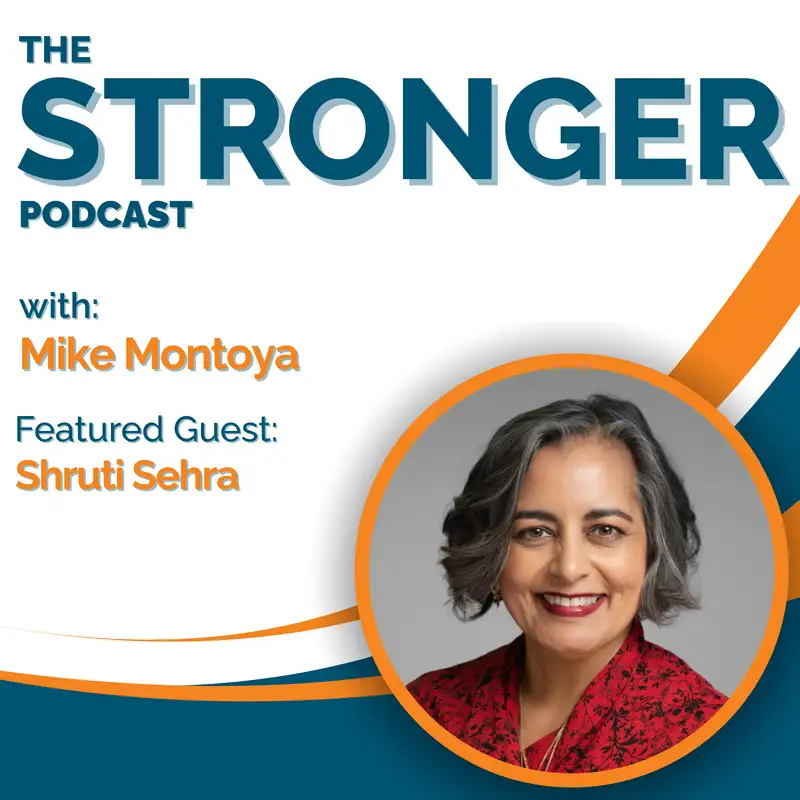
The Future Is Not Something We Predict: Venture Philanthropy and Systems Change in a Global Realignment with Shruti Sehra
Welcome to the Stronger Podcast. Each week, we have honest conversations with education and social impact leaders about their leadership and career journeys. We talk about their origins, inflection points, and the work that they're doing today. The conversations are honest, human, and practical. If you're here for real stories and real takeaways, you're in the right place.
Mike Montoya:Let's jump in, and let's get stronger together. My guest today is Shruti Sehra. She has spent two decades helping social entrepreneurs tackle some of the country's toughest challenges. As the CEO of New Profit, she's thinking beyond today's headlines and asking the bigger question. How do we create a future where opportunity, innovation, and community come forward and move together?
Mike Montoya:This conversation is about leadership, systems change, and why the next chapter is ours to write. Good afternoon. Good morning to everybody out in the Stronger Podcast land. Mike Montoya. I'm here with Shruti Sehra.
Mike Montoya:Sarah, I'm gonna mess up her name, and she's gonna have to correct me. We just had this conversation before we got started. But Shruti is a friend, and she's the CEO of New Profit, which is a national nonprofit focusing on social impact and and I call it good things in the world. And she's gonna talk about that, but the first thing I'm gonna ask her to do is tell me a little bit about, like, where she's at, in the world, and also, like, you know, kinda let's jump into, like, where where you grew up in that, like, origin story if you're willing to share about that. That'd be awesome.
Shruti Sehra:Yes. Yes. And actually, that's apropos to your question. Where I'm calling in from now is Cambridge, Massachusetts, where I live, and it's actually the first place we moved to in this country. And though I've left Cambridge for multiple stretches, I keep on finding my way back here.
Shruti Sehra:So it's a little bit of a magnet for me, as it draws me home. Moved to Cambridge when I was 1.5. And I have a story that's a little bit a story of paradoxes.
Mike Montoya:My
Shruti Sehra:father came to we came to Cambridge because he was admitted to and and decided to pursue doing a PhD at MIT. And we came with the clothes on our back and very little more. My parents sold a bunch of stuff so that they could afford the plane tickets for us to come over. There were other people who helped us along the way. Somebody else who had already come to this country paid for, my dad's applications for PhD programs.
Shruti Sehra:And yet with all of that, we also came with green cards in hand. It's not your typical immigrant story nowadays. In fact, for Indian folks, green cards the average waiting period for a green card from an h one b is something like a hundred twenty two years, so it's not gonna happen for Indian folks in their lifetime. And we came with green cards in hand. So it's a little bit of a story of paradoxes.
Shruti Sehra:We came with very little from a financial perspective, and my dad was working on a PhD that set set us up to grow up in an upper middle class kind of environment. So there's many examples of this throughout my history that I think really shaped me. You know? It's kind of the combination of privilege and not coming from much, and that challenge that we that I was always kind of navigating and and experiencing without even understanding that.
Mike Montoya:Right. So there was, like, a tension. And some of this was timing. Right? Like, it was just the era Yeah.
Mike Montoya:Right, when when The United States was, like, welcoming in in, I call it, like, actually trying to capture intellectual capability, right, from across the planet. I mean, and I call it investing in that by by attracting talented people like your father, right, to come into the space. And then you got to come along. Did they give you a how old are you? How old are you when that happened?
Mike Montoya:I was
Shruti Sehra:a was 0.5. So my green part has a baby picture. Picture.
Mike Montoya:You should go regardless, probably. You didn't have a hangout, a choice to come home or not.
Shruti Sehra:Yeah, didn't have a choice, but yes.
Mike Montoya:Okay. So I came over as a very young person. And at what point in your in your childhood did you realize that like, I mean, or maybe maybe it came, like, when did you realize that, like, this was like the circumstance of your life, and it was like not like every other kid maybe in your neighborhood or something like that. But I mean, growing up in in a faculty or university environment, right, like those kinds of things are maybe there were lots of kids like you. What was that like?
Shruti Sehra:Yeah. I I honestly don't remember most of those early years because we moved out of Cambridge when or or out of Massachusetts, I should say, when I was five, and we moved to Indiana. And so I joined kindergarten in Indiana, and we lived in a town where there were four brown families. They were all brown like me, so Indian Americans. We became very close friends with those four families.
Shruti Sehra:In fact, we're still friends with them to this date. Even my generation, I'm friends with the kids, and we stay in touch, which is just interesting because it shows that there was a bonding experience, of being in an environment that we were not very welcome in in many ways. I remember, in those days where we'd be on a playground and kids would play cowboys and Indians, where the cowboys chased the Indians, and I was chased. And I'm like, I'm not that kind of Indian. One.
Mike Montoya:It's too rude.
Shruti Sehra:What is this? I was made fun of for not being baptized. A very interesting thing. So because it was a very religious, you know, Christian religious kind of place. Something.
Shruti Sehra:One of my friends, when I was about six, invited me to go to her church. And it was one of these bring all your friends to church days, and the person who brought the most number of friends to church got, I don't know, a record or some some Price. Some something some prize of the time. And my mom had no problem with it because in India, you know, my parents, most most people went to Catholic or Christian schools. So the education system was largely, you know, kind of more of a parochial system.
Shruti Sehra:But the so my mom had no problem sending me because she thought, well, what what bad can happen? And I came home in just devastated. I was crying uncontrollably, six year old crying uncontrollably coming back from church. And my mom said, what happened? And I just kept on saying, we don't have a phone line.
Shruti Sehra:We don't have a phone line. And she picked up the phone. She's like, nope. The phone works. You can hear the dial tone.
Shruti Sehra:She's trying to talk to me, but I wasn't in a state where I could actually spit out what I had heard. But I remember distinctly what the, whoever was preaching said was that there's only one phone line to God, and it's through this church. So this is a moment where kids have been asked to bring all their friends who don't belong to this church to this church. Frankly, almost all of them are Christian because I was in a very religious area. I wasn't.
Shruti Sehra:And I was being told that there's only one phone line to God who is like, I didn't know what God was, but I knew he was important. He whatever that means.
Mike Montoya:All the praise. Yeah.
Shruti Sehra:Was important, and I didn't have a phone line because I and we didn't belong to that church. So we were missing out on an opportunity. So there were so many ways like that that just again and again and again, I was reminded of how different it was. I was the only one, you know, outside of those four families who didn't have blonde hair and blue eyes. So I named every single one of my dolls Sally, and I wished I had blonde hair and blue eyes.
Shruti Sehra:Because it's a
Mike Montoya:belonging part. Right? That that's like a that's like a very common thing for almost all children. They wanna kinda be part of the group and the peer group and and and with people and not feel differentiated. Right?
Mike Montoya:Because it feels kind of did did it have a feeling? Did you did you feel I don't know. What did have a feeling?
Shruti Sehra:Yeah. I I felt very, very excluded. I did not feel belonging. I mean, it happened every first day of school or every time a new teacher showed up and they were going through the roll call.
Mike Montoya:The roster.
Shruti Sehra:Yeah. In the classroom. And they come to my name and they just throw their hands up and say, I can't say this name. I'm not even gonna try this person. And I'm like, oh, you know, because I get nervous when we'd start to get to the s's because I knew that my name would come.
Mike Montoya:I mean yeah.
Shruti Sehra:And I'd have to explain my name. It's the reason you and I were talking about this before we started the podcast, but it's the reason that I mispronounced my own name until I was in my early forties because I was trying to make everybody else feel comfortable with me as a human and, and not be that person that disrupts the roll call at the beginning of every class. So of, like Yeah.
Mike Montoya:Did you were you cognizant of that, as a young adult that that was happening, that you were doing that kind of almost like masking or pleasing of of the larger culture in order to fit in? Or
Shruti Sehra:Yeah. I became a little bit cognizant of it, but it was because my mom, who I considered to be a closet social justice warrior, meaning she recognized that we were different and we were we were naturalized citizens. We were invited guests into this country. So she didn't wanna shake things up in really public ways, but she knew that we were missing out on some opportunities by being in such a nondiverse community. So my mom signed me up when I was nine, the year I got naturalized, to be a volunteer at the Indianapolis Children's Museum.
Shruti Sehra:So what we found when we went to the museum is that there were two kind of wings of the museum. One was the natural sciences. The other was the, physical sciences wing that had kids who would lead things with visitors. So in the natural sciences wing, kids would hold pets, animals like ferrets and snakes, and have visitors, you know, hold the ferret or pet the ferret. And in the science, the physical sciences wing, you'd run science experiments for visitors.
Shruti Sehra:And we were at the Children's Museum. My mom saw these kids doing this, and she was like, this is perfect. Because she looked around. She saw how every person of every walk of life would come to the Children's Museum. And then she started asking in both departments, how does this work?
Shruti Sehra:What would it look like? And she found that the volunteer coordinators who were paid adults in the physical sciences wing, the volunteer coordinator was a black man. And K. Remember, there were only four families of color in my community. They were all brown like me.
Shruti Sehra:We didn't have black people around. In fact, the headquarters of the KKK was about half an hour from where I was growing up at the time. So my mom had me work for a black man because she said, I want Right. She didn't say this out loud to me at that time, but it was part of her closet social justice warrior. Like, I want you to have this experience and for power to look different than what you've experienced in your in the town that we live in just outside of Indianapolis.
Shruti Sehra:So that experience was incredibly formative, and I was living two different lives. So on the weekends, I'd volunteer at the Children's Museum, and on the weeks, I'd be in school. And when I was volunteering at the Children's Museum, I was able to be a fuller version of myself. I was doing less of the masking. I was still mispronouncing my name because that's what I thought I had to do.
Mike Montoya:Yeah.
Shruti Sehra:But I was doing less of the masking, and I was just showing up. And people were seeing me in a different way. And then I'd go back to school, and I'd be see seen in the way that I was seen always there.
Mike Montoya:Yep. So yeah. Talking to to kids like, and code switching is like a thing. Right? And and kids are really good at it.
Mike Montoya:Right? Because they have to because they're trying to protect themselves all sorts of ways. But when they actually find a safe place, right, then they can be like, oh, like, parts of you that you didn't even kinda know were there were starting to emerge, right, in that regard. So smart of your mom, I would I'm gonna call her smart for for being call it planning for that, right, and getting you engaged in that way. So thank her for that.
Mike Montoya:I'm curious. I mean, do you remember that that guy's name, the the the leader of the music?
Shruti Sehra:Eric. I think it was Eric Adams.
Mike Montoya:Okay.
Shruti Sehra:Which that's interesting now that I say that because obviously we know some other people with that name, but his name was Eric Adams.
Mike Montoya:Right. Well, mean, yeah. I mean, and yeah, names are names. It's so much fun to do, like, what do you call it when you do, like, the the the the background work on people's names or where they came from. Yeah.
Mike Montoya:They, you know, there's all sorts of creative ways that people got surnames and things like that. You know, they were the kid of somebody else or things like that. So Yeah. Do you and how long did you guys live in in in Indiana? Did you eventually move to I mean, somehow you ended up in California.
Mike Montoya:I know that. So
Shruti Sehra:Yeah. So we moved when I was in seventh grade. So it was about seven and a half years we lived in Indiana, we moved to Connecticut. And that was actually kind of shocking because I don't think a lot of people think of Connecticut as the most diverse place, it was much more diverse than where I was coming from. And I was coming from a really well known, like, high achieving school district in Indiana.
Shruti Sehra:I also went to a good school and school district in Connecticut. It was something my parents always prioritized and will always prioritize. But one of the things I found when I went to the school in Connecticut was there was what they were teaching, you know, on the one hand, felt less technically challenging than what I had been learning in Indiana. Like, in Indiana by seventh grade, eighth grade, I had been I had read, like, multiple Shakespeare plays, and, you know, that's complicated text.
Mike Montoya:Texture.
Shruti Sehra:And I went to Connecticut, and they were reading Elie Wiesel, Cry the Beloved Country. They were reading Anne Frank. They were reading texts. They actually read a portion of the bible, not as a religious text. Yeah.
Shruti Sehra:It it was all about culture and human rights and understanding different communities and struggles across the world. So I just found it fascinating because initially, I was like, this is super easy reading. You know? This book is not hard.
Mike Montoya:Yeah. The the actual language. Right? But the the themes were different for sure.
Shruti Sehra:Yeah. And that's what I got exposed to for the first time in Connecticut was like, oh, you could actually have a conversation about human rights in a classroom. That wasn't ever gonna happen in my classroom.
Mike Montoya:In a public school classroom. It's public schools. Right? Both of them? Yes.
Shruti Sehra:Yes. Yeah.
Mike Montoya:In Connecticut. Very forward
Shruti Sehra:to Indiana. Yeah. My very diverse Connecticut experience. But I will say the other thing is there was a larger Indian population in Connecticut. And whereas in Indiana, not just our four families in our town, but the broader area at the time didn't have as many Indian folks.
Shruti Sehra:And so there wasn't as much division within the Indian diaspora community in Indiana. So, you know, Gujaratis and Punjabis, like these subcommunities, all hung out with one another. And what I found in Indiana in Connecticut was that there was more differentiation. And I didn't really understand what it meant to be a Punjabi, which is, you know, where my parents are from. I didn't understand what it meant to be a Punjabi until I got to Connecticut.
Shruti Sehra:And then I was told that Punjabis drink and gamble, none none of which my friend and family does, by the way. But I was told that that's what you do as a Punjabi. So I was too Indian in Indiana, and I was not Indian I
Mike Montoya:heard Indian enough. For sure.
Shruti Sehra:Yeah. In Connecticut. So
Mike Montoya:complicated. And it's all fascinating to me, just like these discoveries that you're making as a young person, right, in The United States as a result of the immigrant experience that your family is going through and the exposure, I call it, to your native home culture, right, in a totally different country, right, like how that is evolving. Right?
Shruti Sehra:Yeah.
Mike Montoya:So and I think anybody that's like a first or early generation, you know, immigrant family, right, they have stories that are kind of perplexing in some ways. Like, you're like, this this is different. Right? And it's unique, for sure. And it and it's and it's actually it's your story, right, which makes it valuable and powerful in that regard.
Mike Montoya:And do you do you as you got as you grew up, did you, like, tell it did you ever develop a sense of, like, power from this thing? I mean, at what point I mean, I know you enough now to be like, clearly, you have a sense of that self worth, right, that came from somewhere. But where did did it did it have anchors in some of the stuff that you experienced as a kid?
Shruti Sehra:Definitely. Definitely had anchors in it. And so in some ways, it was more subtle when I in my earlier years. My parents always had a perspective that we should not overly anchor or hold on to the past. We should think about the future, and we should think about the present.
Shruti Sehra:And what that meant for when we were growing up, and they always said this, is we have to integrate. We have to and that doesn't mean assimilate. What it means is we have to take the best of American society, some of the things that are extraordinary about this nation and the culture here. And we have to take the best of our Indian society and culture and bring them together. And it's actually a very different kind of immigrant experience.
Shruti Sehra:So a lot of immigrants, they hold on to the country that they left at the time they left it. So they hold on to 1976 India, and that's their perception. That's their full perception. There is nothing in India that's like 1976 India anymore. You know?
Shruti Sehra:Nothing. Literally. You know? Culture is a constantly moving thing. So holding on to anything too tightly would not be helpful.
Shruti Sehra:So my parents That's it. Always brought that kind of mentality in. So there's certain elements of, like, the way that we engaged with family, the way that we thought about our house. There are things that I do now that are part of what I saw growing up. So when I was young, living in Indiana, my grandparents, my dad's parents, lived in Kentucky.
Shruti Sehra:It's about two, two and a half hour drive. We were at their house maybe every other weekend, maybe, you know, at at the least once a month, we were at their house. I spent a lot of time with my grandparents growing up, and it was always the way that it would be. Anytime somebody new was coming through The US, even though Indiana wasn't wasn't very close, they would always come to Indiana and stay with us. And when we were in Connecticut, it happened even more so because we were so
Mike Montoya:I'll start.
Shruti Sehra:Close to New York City that and we were living in Southern Connecticut. So we people would come through New York, and I had cousins that would stay with us for a month or two at a time over and over again. Yeah. My mom, fun fact, taught every single one of my cousins from India how to drive in The US, which involved many times getting onto the wrong side of a divider, and my mom keeping her calm while she was like, you have got to stop to pull over because we're on the wrong side of the road. You're gonna die.
Shruti Sehra:Yeah. But I say that to say so now fast forward and we think about now. There are people who my my parents live with me more than half the year now, and that was a choice we made during the pandemic. And we all looked at it as a choice. My parents are still physically able.
Shruti Sehra:We decided to to make this choice while they were still physically able, that they would give up their house and live with me a portion of the time, live with my brother a portion of the time. When I shared that with some people, they were shocked and said, gosh. Like, that's that's too bad that you have that. And I'm sitting here thinking, that's amazing that I have that. What a gift it is for me to be able to share space with my parents as an adult with a very different different way of seeing the world, with different things we can learn from one another.
Shruti Sehra:I just love it. Not to mention, like, I get really good food and I can cook, but boy, can my mom cook, you know? I get really good food from my mom. I get really good lectures on philosophy from my dad. Again, whether or not I ask for both, I get them both.
Shruti Sehra:So I see that as a huge gift. My house is a place where so many people know that they can come at any point in time. I had a friend I was out of town, and, a friend was in North Carolina. There was some hurricane coming through North Carolina, so she decided to get out. And I was traveling for work.
Shruti Sehra:She texted me and said, I'm thinking of coming up to Boston so I can escape this hurricane. Are you there? Can I come stay with you? And she had never stayed with me. And I said, I'm not there, but, yes, you can stay with me.
Shruti Sehra:I have a lockbox. I can show you how to get into my house and tell you which bedroom to stay in, but I always have a guest bedroom that is ready to accommodate anyone.
Mike Montoya:That's good to know, actually.
Shruti Sehra:Yeah. Anytime you're in Cambridge. Never know. I don't know if all the podcast listeners could come, but yes.
Mike Montoya:You won't give me address.
Shruti Sehra:Yeah. On Sunday mornings, so I'm a meditation coach and practitioner in my free time. And on Sunday mornings, we have group meditation at my house. Literally on Sunday mornings, I don't know who's gonna show up. There's gonna be people who I might not know who practice our our meditation, who somehow got my address through a friend.
Shruti Sehra:And they show up to my door, and they come in. They meditate. And afterwards, we have breakfast, a light breakfast Right. And good conversation, and they leave. And there's, you know, 20 to 30 people showing up every Sunday.
Shruti Sehra:So that kind of revolving door that I have in my house is is something that is very much enculturated into me from from my parents and that
Mike Montoya:Came my parents. So that that piece came with your parents and and your grandparents, it sounds like as well because that, like, sense of community of sorts. Right? Some of them might you needed to be with each other. Right?
Mike Montoya:Circle wagons type of thing when you were first early here, but then it just kinda stuck as a as a methodology for kinda being connected. Right? As you said, integrated, right, without being, they call it, enculturated or assimilated. Assimilated. Everything.
Mike Montoya:Right? So Yeah. That's super powerful. I and I appreciate that because it's, like, it's kinda different than some other stories that I've heard, right, where people like, people have had to, like, I call it, separate themselves, right, in some cases, right, from society and ways to protect themselves. Currently in our society, right, there's a lot of, like, people hiding from, you know, administrative attacks, right, from ICE and things like that.
Mike Montoya:So, like, there's some, like, real real danger for some folks out there. So it's it's really nice to hear about, like, how you guys are kind creating that space for people in in in Cambridge. Right? So, again, address unknown, but, like, we know that you're there, so that's a feel actually, it feels like, oh my god. Feels like I know someone in Cambridge.
Mike Montoya:That's good to know in case something happens like that.
Shruti Sehra:So Yeah.
Mike Montoya:That's kind of lovely.
Shruti Sehra:Anytime you wanna come over.
Mike Montoya:Do you so you have a it sounds like you have a rich family life, right, in in in a home and a community that you you you built. Your career has been interesting because you have been at new profit for a while. Right? Almost a couple twenty years, roughly.
Shruti Sehra:Yeah. I think last week was my twenty year mark. And I started when I was eight, but I'm I'm sticking to that story.
Mike Montoya:Right. We're just yes. They they them up early, but you went right from LA grammar school into into new profit. Okay. So for our listeners, help them understand just like in the and and I know you're the organization's going through evolution, which is part of the the change that happens when leadership changes.
Mike Montoya:But tell us, like, roughly kind of what the purpose of New Profit is. Right? And then, like, call it, what are you excited about in the next six to twelve months? Because you're gonna go through planning and thinking about the future. So tell us what you guys are thinking about even if it's, like, not baked, but it's kinda, like, you know, out in the world a little bit.
Mike Montoya:So
Shruti Sehra:Yeah. Yeah. Yeah. Yeah. Happy to.
Shruti Sehra:So I think you started with a little bit of an introduction to New Profit, but I'll revisit that. So we are a national nonprofit venture philanthropy organizations. And in that capacity, we are trying to increase access and opportunity in The US for all Americans. I use that term Americans not to be a legal status, but for all people in this country.
Mike Montoya:Yeah.
Shruti Sehra:The way we do that is through providing unrestricted capital to social entrepreneurs, the kind of breakthrough social entrepreneurs, the people who are extraordinary leaders in their fields in education, economic mobility, and democracy. Along with that capital, we provide capacity building support. So we help them think about and provide real, like, very serious engagement to help them think about how to grow and scale their impact. We are in service of them, though. We are not coming in with an agenda.
Shruti Sehra:We have a certain set of skills. We have some know how. We have some pattern recognition, but we are coming in in service of their mission and their interests. And along with the the capacity building support, we provide access to a community, a community of social entrepreneurs, a community of philanthropists, and and like minded field leaders who are trying to also provide increased access and opportunity in this country. So I've been at New Profit twenty years.
Shruti Sehra:We've been alive for about twenty eight years. So I've been here for a good chunk of New Profit's history. And as you can imagine, I've worn a lot of hats, played a lot of roles during that time period. And it's interesting to be at a place for twenty years and be CEO, become CEO. When you both know the place, you've created and contributed to creating the great things.
Shruti Sehra:You've also contributed to creating the mistakes that we've made along the way. So it gives me an opportunity to to really lean in and and kind of help shape the future of the organization. We are at the end of a current our current strategic plan. So we're taking a moment to to think about where do we go next. And as opposed to a lot of philanthropic organizations, we're not stopping our work en route to thinking Yeah.
Shruti Sehra:About what we do We're not doing a strategic pause, but we are taking time to think through our our our strategy. And I'd say what's grounding what what I'm grounding this in is just thinking about this moment in time. It's a really interesting moment in time for not just for us, new profit, or us as a nation, but worldwide. We are experiencing the largest realignment, global realignment we've experienced in our lifetimes. And this is not a hyperbole.
Shruti Sehra:This is this is a known pattern. Every eighty to a hundred years, the world reorganizes and realigns in a certain kind of way. And so there's some things that are knowable and predictable. History teaches us about this. And there's some outcomes that are not knowable and predictable because that depends on what you do.
Shruti Sehra:So what history has taught us is that during these moments of realignment this one is probably being driven by emerging technology. But during these moments of realignment, you're gonna experience greater levels of inequality. So we are at gilded age levels of inequality. Check. And it's at a time period when we have, a 124,000,000,000,000 transferring intergenerationally.
Shruti Sehra:So the intergenerational wealth transfer we're experiencing globally right now is of extraordinary historic proportions. So huge inequality.
Mike Montoya:Ever been in the history of the world roughly. Right? That's like it's it's a huge number. Right?
Shruti Sehra:It's ridiculous. It's ridiculous. Our brains aren't even designed to be able to conceive that kind of number. It's not it's it's it's literally our brains are not designed to conceive that. So we have, extraordinary inequality, huge intergenerational wealth transfer, huge amounts of innovation that are happening in the world, which are leading to some of this realignment, And we have huge amounts of conflict and polarization.
Shruti Sehra:So that's another one of the negative things that history teaches us, that, we have the the trust in in all all manners of institutions, is is at low points across the nation. We have polarization domestically. We have wars globally. It is a that that conflict where, you know, kind of check, check, and check. History is showing us this path, and we know where we are.
Shruti Sehra:It makes sense if you look at the historical cyclical pattern of this this thing that happens every eighty to a hundred years. What history can't tell us is what happens in the future. And by the way, nobody who tries to predict the future, you know, don't buy snake oil from them, is what I'll say. There is no way of predicting the future. We create the future.
Shruti Sehra:And that takes intentionality. That takes, community. It takes innovative thinking invention, but we create the future. So what happens? Where do we go from here?
Shruti Sehra:And how do we navigate this really challenging moment in time where on the one hand, the the levels of inequality and the levels of conflict mean that people are hurting. Communities are hurting. They're feeling it. And our natural instinct, our rational instinct in these moments is to run towards helping people who are feeling it now, and we need to do that. But we can't do that without losing sight of what the future
Mike Montoya:Where we're going. Yeah.
Shruti Sehra:Where we're going. What are we trying to create? So how do we hold those two things in tension right now? Which is, you know, another way of putting it is how do we hold the tension of the fierce urgency of now with the long arc, and bending it towards justice? It's tough, but that's what we are being called to do.
Shruti Sehra:That's what we, new profit, are being called to do. That's what the field of philanthropy. That's what the social sector. That's what our social entrepreneurs. That's what we're being called to do in this nation right now because this nation and we, as communities within the nation, succeed or fail based on our actions that we take now.
Mike Montoya:Well, and I appreciate the way that you're describing it as a bothand things need to happen concurrently, right, in this dealing with the inequality, and the struggle, right, the suffering that's happening in some cases, in many cases, and then this future that we can create or not create. Like, we we don't keep our eye on that, so other people will create it, right, for us, right? And then we're going to be subject to like, what those powers have achieved. And I think like, just for grounding people, like, the scale that we're talking about is like, the revolutionary period that happened in the late 1700s, right? And then the industrial revolution that happened in the eighteen hundreds.
Mike Montoya:Right? Like, this is at that scale. Right? And none of us were, a, alive back then, or b, really couldn't anticipate what the ramifications were of those massive, as you said, realignments that were happening across globally. And I guess, both of those cases, though, we ended up with a richer, more complex, interesting society, right, where humans have populated the earth in much more, you know, high number of ways, right, and created some more challenges for the climate and other and other things like that, pressure on food.
Mike Montoya:But we have also fed a lot of people and like people are not in poverty in the way that they were even fifty years ago, right? Like, we're we're able to keep evolving, right, as a as a civilization or complex set of civilizations. And so I I guess I'm I'm personally optimistic about it. At the same time, I'm living in the same tension that you're talking about. Right?
Mike Montoya:Where it feels
Shruti Sehra:Right.
Mike Montoya:Crummy for some. Right? And really hard.
Shruti Sehra:Right. That's exactly right. That's exactly right. And and if you take a look at the last time this happened, it was what was one of the results of the last time was getting to the other side and creating the new deal. And, look, I'm not saying the New Deal was perfect by any stretch of the imagination, but it was a moment that we as a nation thought about how do we serve our neighbors and serve our communities in a more fulsome way than we had been thinking about.
Mike Montoya:Yep.
Shruti Sehra:So we are in a very individualistic moment. We need to come to the other side of this. I would like us to come to the other side of this caring about community, caring about one another, caring about our neighbors in a different kind of way. And we can do that, but it's gonna require us putting that intentionality into it. So there there there is a negative outcome that could come out of this, and we don't have to talk about, like, the dystopian future.
Shruti Sehra:But there is a negative outcome, and if we don't bring that intentionality in. So that's mean, the be lucky if we yeah.
Mike Montoya:We will. I mean, I mean, luck and we talked about luck, right? Like, luck is something that, like, part of, like, it happens, but it's also something of our own making. Right? Like, we Yes.
Mike Montoya:Kinda create the circumstances in which we thrive. Right? And sometimes we can do that with each other and, like, you can, I call, accelerate the experience where you can jump ahead over problems or challenges because you just happen to be in the right place at the right time or things align in a certain way? And like those things are intentional though, right? They don't just happen because we're sitting around doing nothing.
Mike Montoya:Right? Most of us are kind of working towards something. Right? And the more I call it the the powers of good working towards something yields something positive. And if there's people who are detractors, you just have to hope that, like, the tension it sort of slows things down sometimes.
Mike Montoya:Right? Or maybe it moves in a slightly different way. But, you know, as you said, arc does bend that direction. And I I have to I personally believe in that that piece that if you look back and what the world has changed over time, like, have opportunity here. It's and It's exciting to me that profit and such are taking the moment to kind of assess what options are, right?
Mike Montoya:But also not to stop, right? And when I say it's the funders and the venture philanthropists and stuff like that, now is not the time to give up, right, on the things that matter right now because there's real people living in the moment, right? And it's important that we don't, like I call drop people on their heads. And so the call is to encourage people to kind of keep going. Because I think we can do both, right?
Mike Montoya:It is possible to do both, right, without having to, you know, do nothing, right, for a while. And that's that's a hard part when we do nothing and when we might end up in a pickle in the future. So
Shruti Sehra:That's right. That's right. I couldn't agree more. We have to hold these tensions, and and we have to do both. I mean, that's our that's what we're being called to.
Mike Montoya:If we could, wave a magic wand over the next, two to three years, right, what what's what is, and I'm not gonna hold you to it, but, like, what's a prediction that you might have about, like, where what you would hope for for new profit to lean towards. Right? Like, if you were, you know, putting your thumb on that scale, is there something that you want to want them to really wrestle with and try to achieve in some ways?
Shruti Sehra:Yes. I mean, there's so much. And I would say, in general, we lean into, one of our coaches, Carla Montarosa. She's also a social entrepreneur we funded over the years. She talks about the triangle of tension that leaders have to make really tough decisions where they're weighing and balancing tough, maybe even painful choices that are around impact, culture, and sustainability.
Shruti Sehra:So there's some element of we're gonna have to wrestle that at new profit over the next two to three years, and we're gonna have to wrestle it with that big that larger arc context in mind. What I'd love to have us do is set ourselves up, and it's really the foundation for this this this cycle that we're going through, the eighty to a hundred year cycle. It's probably not gonna resolve. We're not gonna start to see the other side of it maybe for ten years, which is a while. But how do we set up the foundation so we were moving with full intentionality and alignment in service of that while also being thoughtful about how our culture and our sustainability align and and to enable us to make that kind of impact.
Shruti Sehra:So so, yeah, the it it really is in the next couple of years. It's setting the foundation to be able to do what I I'm hoping we can see as part of a legacy we contributed to in ten years.
Mike Montoya:Yeah. And I think you're right. I think it's gonna take ten to twenty years, right, for this thing to emerge. And I think about the industrial revolution and then the stock market crash and things that happened in third nineteen thirties. Like, it was a tough moment.
Mike Montoya:Right? It and it lasted, you know, a generation. It affected the next three generations. Right? Like, the the kind of tales of that work.
Mike Montoya:And so so all of us are still living with that legacy in some ways of our parents and things like that. And so it's important to do it well. Right? And right. But you have so many lessons from the past, right?
Mike Montoya:So you have this, I mean, the way you're speaking, the way I'm interpreting this is like, you're picking up on like these, I call it these moments of success, and and learnings, right? And if we look back at all the struggles that have happened in the twentieth century, right, essentially, that we're like trying not to repeat exactly in this century, but you know, it's hard, right? How do you view this idea of like, learning from our past, living in the present, and this idea of, like, we gotta struggle, and and we're probably gonna screw it up a little bit. Right? So
Shruti Sehra:Yeah. We have to do all of the above. Learning from our past is critical to being able to, get to the future that we want to get to. And we have to understand the current contextual the current context and adjust appropriately within the current context. So that's the that's the tricky part is you can't just take the same playbook and apply it here.
Shruti Sehra:You have to say, what are the thematic elements of that? And then what do we do now as a result of that with the current playbook that we're living in or or the current circumstance that we're living in to create the playbook for the future? So that that's the touch challenge that, that we're feeling right now and and that we're our our social entrepreneurs are feeling. So we it it is the thing that we're aiming at, and we don't have the answers. But we've gotta keep in mind the past and the future we're trying to achieve.
Shruti Sehra:Again, I'm not trying to predict the future, but how what are we trying to create?
Mike Montoya:Yeah. Yeah. For sure. I think but but you can and you can decide, right, to engage, right, in a way that's purposeful, meaningful, community connected, right, and aware, right, of the history in the past. So
Shruti Sehra:100%. And we have to think about it in this as a whole system. New Profit has a role to play in the system, but we are one player of many. And systems change has never happened in isolation. We have to think about this across not only across different organizations or different sectors, but across different communities.
Shruti Sehra:We are inextricably linked from one another. Our interdependence is as
Mike Montoya:high if we haven't noticed recently. Right?
Shruti Sehra:Exactly. Exactly. Our interdependence is incredible. We have to think about how we can be stronger together, and and how do we align our actions at least to some degree in service of the future that we're trying to create.
Mike Montoya:Well and I love that you just landed on my magical catchphrase, which is Stronger Consulting and Stronger Together work. Right? And this idea of, like I agree. Right? We're on the we're on this path, and we're we're reliant on each other.
Mike Montoya:We're interdependent with each other, and the things that I do affect other people. Right? And and same goes in my direction, of course. And it's it's good to be in community with you. It's wonderful to spend time with you today.
Mike Montoya:I I'm I'm gonna have you back in a few months as your strategy starts to become more clear. Right? And you start to I call it meat on the bones in in those creative things. And, yeah, we invite you to the future that we're creating together, and I appreciate you taking the time with me today.
Shruti Sehra:Well, thank you so much, Mike. I look forward to continuing the conversation.
Mike Montoya:Shruti challenged us to hold two truths at the same time, respond to the urgent needs people face today while never losing sight of the future we're trying to create. Whether you're leading a nonprofit, a school, a business, or your own community, that balance between immediate action and long term vision may be the one defining leadership challenge of our time. Thanks for listening, and we'll see you next time on The Stronger Podcast. Thanks for listening to The Stronger Podcast. If this conversation inspired you, we invite you to follow the show and share it with someone who's on a journey to become a happier and healthier version of themselves.
Mike Montoya:Links and resources are in the show notes. See you next Thursday, 9AM eastern time. Have a great day, and stay strong. Podcaststhatmatter.org.