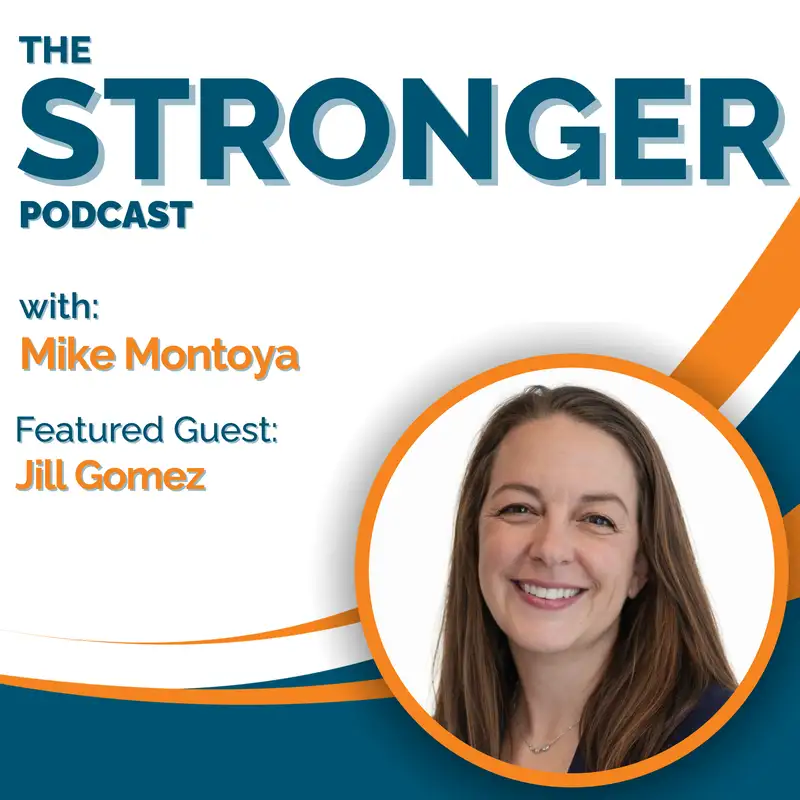
Schools Are Necessary, but Not Sufficient: How the Poughkeepsie Children's Cabinet Rallies a Whole City Around Its Kids (with Jill Gomez)
Mike Montoya: Welcome back to the Stronger Podcast. My guest today is Jill Gomez of the Poughkeepsie Children's Cabinet. Her team brings the whole city together around kids from early childhood all the way through college and careers. The goal is to reach 5,000 young people by 2033.
Mike Montoya: Let's jump in. Good afternoon. Good morning, everybody, in the Stronger Podcast land. I'm here today with Jill Gomez, who is the inaugural executive director of the Poughkeepsie Children's Cabinet, which is in. Up in New York.
Mike Montoya: And I'm going to let Jill say hello and tell us where Poughkeepsie is because a lot of people don't have a clue where that is. So let's talk about that. Jill, welcome.
Jill Gomez: Thank you so much, Mike. Thanks for having me today. Poughkeepsie is in the beautiful Hudson Valley. We're about seventy five miles north of New York City and where the terminals stop on the Metro-North line. So if you're ever in New York City and you want to take a day trip, it's beautiful, particularly in the fall.
Mike Montoya: And if you happen to fall asleep, you will end up in the right spot, is what I understand if you get on that train. So thank you for thank you for being part of the stronger community. And tell me a little bit about.
Mike Montoya: I want to hear just kind of where for our folks to get grounded is like like How did you end up in upstate New York. or call it just north of the city. E everything is nor upstate in my head from there. How did you end up there?
Mike Montoya: And maybe tell us a little bit about where you grew up and what the childhood life experience was like for you.
Jill Gomez: Yeah, sure. So I I'm the product of the almost Midwest. I'm from northwestern Pennsylvania, very rural area. I grew up in the second largest school district in Pennsylvania, so we had folks coming by 50 minutes by bus across three counties. Um so very rural and very early on When I was about 14.
Jill Gomez: My mom and grandmother and I took a weekend trip to New York City and I absolutely fell in love. And I knew that it is where I needed to be. So as soon as I was looking for colleges, I applied to NYU and I was lucky to get in.
Jill Gomez: And so I went to NYU, spent four years there. Left for about five years, and then went back to New York City for twenty. And during that whole time that I was in New York City once I moved back as an adult, Um my husband and I always said that if we were going to leave New York City, we were going to move upstate to the Hudson Valley.
Jill Gomez: in New Paltz. And so right after the pandemic, We had a young child and we just decided it was time. So I was actually coming off of a long maternity leave and moved to New Paltz. And I thought once we signed on our house, I thought, boy, well I should probably get a full time job again.
Jill Gomez: And I was so lucky it happened to be the week that they posted the job description for executive director, the first executive director of the Poughkeepsie Children's Cabinet. And it just as I read the job description, I had this feeling that it was a combination of all of the different pieces of my career.
Jill Gomez: And it was really where I wanted to be and I was lucky enough to be selected.
Mike Montoya: Did you In retrospect, are you happy that that was the pathway? Right? Like, almost like this seed got planted as a kid. I don't know how younger you were on that trip to New York, but like, did it pan out the way you thought it might?
Mike Montoya: And what were the surprises maybe along the way?
Jill Gomez: Sure, I mean You know, we're speaking now on on uh September fifteenth, so just last Friday was September eleventh. The reason that I left New York City for five years after I graduated was because I was a senior and I was living below Fourteenth Street on September eleventh.
Jill Gomez: And so that was a really difficult time. Very difficult to be entering. You know, thinking about graduation and thinking about entering the workforce, thinking about beginning. My adulthood. at a time where there was so much introspection and so much Um global unrest.
Jill Gomez: Um and so I think that that that shifted a little bit about uh A little bit. How I felt. But I also felt That New York City was so resilient. in the weeks and and years following September 11th, and I felt like there was an energy there.
Jill Gomez: An energy that you couldn't find anywhere else. And so it was really important to me to move back and to be part of that energy. The truth is though, and I should say this for any of my upstate Friends that are listening, is that Poughkeepsie's actually not upstate?
Mike Montoya: That is me, Talia. So don't I own that. You don't have to respond to that.
Jill Gomez: No, I said it too. I said it too. Two. But yeah, I think that being in New York really helped myself look My self-confidence. I think that coming up professionally within New York City and being able to build bridges between Many different Groups of stakeholders, being able to see the way that children were moving through the education system, seeing the systemic barriers that they were encountering.
Jill Gomez: encountering and then feeling a sense of agency in some ways. One of my one of my favorite examples of this is there was this A juvenile home that was in the neighborhood that I worked in. It had been built in the 70s. And the city decided that it was going to tear it down finally after 50 plus years.
Jill Gomez: and it was a brown field and the city was unsure whether any one would bid on it. And So They had a a group of em city employees come up and do a community session. and everyone in the community was providing ideas and feedback on the slides.
Jill Gomez: And then the following day, because I was a board member of one of the affected early childhood centers that were going to be part of the development. I got to go downtown and be part of the development meeting as well. And it was literally twenty four hours after the community meeting.
Jill Gomez: and there were changes in the deck. that they had made in between those meetings based on the community input. And that was the first time that I really saw the power. Of community charrettes and the power of when a city listens. That there's this ability to create amazing things that are forward-looking that really also honor the history and the voice of the people that live in the neighborhoods.
Mike Montoya: Yeah, it was surprising that they did the updates. I mean it is possible to do those things, but usually it goes into like the magic policy machine, right? And it comes out like almost all exactly the same as it was before. So like people were actually listening.
Mike Montoya: They actually wanted the input. They actually listened and they made some changes. And did it did it pan out? I mean, I don't know what the project was and what the focus was, but like, did ultimately the work that you guys were thinking about then, like, how did it play out?
Mike Montoya: Did it play out in a way that you're like, oh, I. Positive about it over handling off.
Jill Gomez: Yeah, it did actually. The the design that they ultimately selected, although two years after those meetings. with seven hundred and twenty units of affordable housing plus a brand new child care center plus community space. And I actually was driving back home from New York City last week and I went on the highway by the neighborhood and The skyline was completely changed because those buildings had been built and there are now people living in that space that used to be such a shame on the neighborhood and now it's a point of pride.
Mike Montoya: Well, so that's kind of incredible because there's a lot of like civic projects that like kinda like promise something Um, that kind of fall short, or they kind of end up in the favor of the developer or something like that. And not in the favor of the people that live there.
Mike Montoya: So it feels like that's a success story. Do the Did you feel like That was part of your trajectory into the nonprofit leadership work that you've been doing? Like how did you end up I heard the story, you got the job, right? But like, why did you decide that this work at Poughkeepsie?
Mike Montoya: And maybe you tell people what Poughkeepsie Children's Cabinet is about so they understand like what you're trying to do there now, so that we have a context. But like, did that? I mean, are these things linked together, these earlier experiences with the current stuff?
Jill Gomez: Yeah, absolutely. So the the North Star of the Poughkeepsie Children's Cabinet is that by 2033 We want to see 5,000 youth from the city of Poughkeepsie and their families connected with a cradle-to-career continuum of services that leads to pathways to post-secondary credentials. and ultimately socioeconomic mobility.
Jill Gomez: And social economic mobility is really the key point there, right? The 5,000 can be our output, the number of kids that we want to see. That would be about 60% of the population aged zero to 24 in the city of Poughkeepsie. What we want to connect them to these programs for is so that You know, they are moving forward economically in their lives.
Jill Gomez: And this used to be called the American Dream. I mean, this used to be the idea that if you worked hard, you had access to a free, high-quality public education. that there would be jobs, there would be opportunities, there would be opportunities for housing.
Jill Gomez: But we're seeing with the affordability crisis that that's less and less true. And one of the things that I think we've seen over the last twenty five years, particularly you know, during the the the education reform and this uncovering of all the disparities through a through the ability to see through the data what's really happening.
Jill Gomez: is that Students are not moving through school achieving different benchmarks. And so when they're not hitting those benchmarks, those are often predictive. predictive factors of social economic mobility. So if you're not finishing high school, if you don't have a post-secondary degree, then that makes it harder to reach a thriving wage job.
Jill Gomez: And so what the Poughkeepsie Children's Cabinet does is that it says Schools are necessary to make that shift. but they aren't sufficient. Because so much of what happens in a child's life is actually part of their family, their community, what access to resources they have.
Jill Gomez: There's research that shows that students only spend about 20% of their waking hours in school between kindergarten and age 18. And so we need to focus on what's happening inside the school, but we also need to connect that school's trajectory with everything that's happening in the community.
Jill Gomez: and make sure that it's coordinated and it's mutually reinforcing. So that's what the cabinet does. We convene a leadership council that is co-chaired by the mayor of the city of Poughkeepsie and the Superintendent of Schools. And that is something that has been in effect for five and a half years.
Jill Gomez: And we are now on our third mayor and our Second, Superintendent. And so we're changing the way that things Done in Poughkeepsie so that if you become mayor, if you become superintendent, there's an expectation that you're engaging with the other. And what we're looking to do is create this cross-sector table underneath the leadership of the mayor and the superintendent.
Jill Gomez: That is looking at all of the different elements and programs and resources that exist. and trying to avoid duplication and increase. alignment and cooperation so that we have one single vision. I think that the work that I did in the past that really drew me to this is an understanding that we can't program our way out of the disparities that we see.
Jill Gomez: And that really hit home with me. To me. when I was working as a fellow in the Bronx family court. I'm actually a licensed attorney in New York, although I've never officially practiced. And right after law school, I had a fellowship in the Bronx Family Court where I was clerking for a judge who was just incredible.
Jill Gomez: One of the things that she had me do was look at all of the education statuses of the kids that were before her, whether they were there because of of a juvenile Criminal case. or if they were the subject of an abuse or neglect case.
Jill Gomez: And S she would ask me questions to to research. And one day she handed me an IEP, an individualized education plan. and it was the first time that she had asked for one from the From the caseworker, and so she handed it to me.
Jill Gomez: And she said, read this and see if you can figure out what they're talking about. and let me know what questions I should be asking. And this young this young boy. was eight years old
Mike Montoya: Yeah, I know. It's like we have to see where this is going. I want to see where it goes if you're telling me to tell me.
Jill Gomez: So this young boy was eight years old and he was in foster care and His IEP was solely medical. Right. He didn't have any educational Delays or concerns, but he had very, very severe asthma, and so he had missed a lot of school.
Jill Gomez: And as I'm reading through this, I realized that his His promotion criteria? Would that he get a twenty five per cent? on the state test. That was that was all he needed. And so this is a young man who's not getting the supports he needs because, first of all, there was not a lot of the medical support written into the IEP.
Jill Gomez: But secondly, the expectation for this young man was so low. There was no reason why he couldn't have completed second grade work. at a second grade level. other than the fact that he was chronically absent. And It was really this like insight into this idea that These are systems that are failing children.
Jill Gomez: Right. And the systems have been built in a way where it is really hard for individual advocates Two. to insert themselves and to to support more than one kid at a time. So what we really need is systems change.
Mike Montoya: Well and the the touchy stark example of like Low expectations. I call it basically putting a box around children, right, of all sorts of shapes and sizes and backgrounds, right? And saying, like, this is how you're going to be in our society because this is what we've decided your limits are.
Mike Montoya: Right. And this is like one of the greatest criticisms at all about public schools is that, like, we have. Chronically low expectations of children, right? Especially when they show up looking like somebody special, looking like a particular color of skin. And like it turns into an actual, like almost like a backpack that we put on the back.
Mike Montoya: It's like, this is your. saying for life, good luck, right? And I don't think anybody in particular would do that to a kid. Right, on their own. But when we put it inside that system of that IEP, right, for example, right?
Mike Montoya: The way that we operationalize education, it has really chronically made certain populations like struggle, right? In particular, right? So, like, okay, so this is a driver for you, right? And then you get into systems work, right? So now you're at Poughkeepsie.
Mike Montoya: And so I'm happy. Thank you for making the bridge, right? Because you said a lot about what the children's camera is trying to do, which is like. Coordinated effort, right, of a lot of agencies and places that are part of the system, right?
Mike Montoya: They're all aspects of this. But I love where you went. And I have to, I'll be reflecting on my own career journey while you were sharing about that, because when I got out of graduate school, post 9-11, right? And I was in California at Stanford.
Mike Montoya: We I was part of an agency called the John W. Gardner Center for Youth and Their Communities. And it was all about community youth development, which is exactly what you described: kids don't just grow up in schools. They grow up in all these spaces and places that are connected to each other, right?
Mike Montoya: And it's the kind of fabric, right, of a community that allows for a child to be successful if it's. Appropriately woven together, right? And so it made me think about like, oh, this is a really great career moment for me. Cause I'm like, 20 years ago, I was like thinking about this stuff.
Mike Montoya: And now I get to work with people who are operationalizing it on the other side of the country, right? And this is really fun for me. So I appreciate you going there. So tell me about, so the cabinet hasn't been around a long time.
Mike Montoya: Right, and so you guys are kind of building them. I remember, like, I think Stronger was doing some team development work with you guys, right? And we started to do some like um like thinking about how do we help organization and you guys build a team.
Mike Montoya: So can you remind me a little bit about like what that work was about and share a little bit about like what what we're what you guys are trying to accomplish in terms of team development and team building up there?
Jill Gomez: Yeah, so we've really enjoyed our work with the with the team at Stronger. One of the things that we had been thinking about a lot is, as I mentioned, I was the first employee three years ago. And so two years ago, I hired my second employee, but now we are at nine.
Jill Gomez: And so about nine months ago we were at five and we knew that we were going to continue to grow. And we have such a strong culture within our team, such a strong culture of. thinking about youth first, thinking about how we're using data to drive decisions.
Jill Gomez: thinking about how we're creating inclusive spaces. And these are all the values of our organization. And so as we were thinking about growing I knew that we needed to move from just a compliance HR to a human resources component that would really. think about who we wanted to be and would make sure that any employee that came on understood what the culture was and that we could maintain it.
Jill Gomez: And so we worked with Stronger in our first engagement to do an eighteen month strategic plan around HR. The second engagement, which is the first part of this, which I'm so excited about, is something that. Natalie from your team was talking about. In terms of Thinking about culture is a set of behaviors.
Jill Gomez: and how those behaviors reflect the values that you want to see. And so what we're working on right now is thinking about the different competencies not just in terms of the technical work that My team needs to do their job, but also in terms of the behavior and the way that they interact with the community, the way that they share the vision in every conversation that they have the way that We're making sure that every convening or even our office is a space of inclusivity and belonging.
Jill Gomez: and really like parsing out what does that look like on the day to day. So that when folks join our team, they can understand what it looks like to actually live our values.
Mike Montoya: Well, and I remember this conversation that you're talking about is that like Like one of the things that you guys wanted to include was like the way that we show up for each other. as team members when we're doing the community based work right which is like We're all in a room together.
Mike Montoya: People got to put tables and chairs together and take them down. Like that, that like core community. Grassroots stuff. Like, but you wanted that to be kind of an ethos, right? Of sorts, right?
Mike Montoya: Where people Um feel like, hey, this is part of our job and this is how we do it. Is that, I mean, this is kind of where we're going right here, which is like, this is what builds the community fabric, right, that I was talking about, right?
Mike Montoya: Where people feel. Like, oh. When I show up to these things that this place is known to put together, I feel like I belong in a way that I can participate. And I think that's like a huge barrier to some of the public systems interaction right that we were talking about before. Um
Jill Gomez: And also, you know, in order to build that fabric, we really need to rebuild trust as well. trust in our in our civic institutions. I mean, this is a little bit of a rabbit hole, but you know, I think that. Because we no longer have local newspapers and we're all getting our own news, it's hard to kind of have a real sense of what's happening.
Jill Gomez: Yeah, and so I think that that erodes trust. And so when we are bringing folks together within the community, we want to make sure that those spaces immediately feel. like a space that they can that they can open up in that reflects who they are that reflects the community that they're part of.
Jill Gomez: not just, you know, what I thought of that that morning. Also think it's important that yeah, everyone on my team Puts together tables and chairs, including me. And I think that's really important.
Mike Montoya: Yeah, for sure. Well, I mean, it is it is a little bit of like we're humble enough to be here. We're we're we're also like all super educated and lots of experience and things as well. But like like the the basics of like, you know, making people feel welcome, it really matters, right?
Mike Montoya: And because it allows for the other things to come together. Um I'm glad I remember that story that you were talking about because I did want to sort of see how this played out over time. Do you feel like the team that you have, the nine, right, is starting to like norm up around some of this culture work?
Mike Montoya: Are you excited about it? How's it feeling?
Jill Gomez: Absolutely, yeah. I mean, we have a really incredible team. And one of the things that's really unique about this team and why we needed To have some sort of evaluation process that was looking at behaviors and keeping the culture as opposed to technical.
Jill Gomez: is because we do a lot of capacity building work. with our partners. We do a lot of Positive youth development. professional development. We have folks on our team that are experts in early childhood.
Jill Gomez: We have a researcher. So folks are really doing different things during the day. Um And I think that the team really Appreciates the fact that they're all coming together, that even though they may be doing completely different things. they understand that there's this thread that moves that moves through it.
Jill Gomez: You know, it's It's keeping that vision, keeping that North Star. Really, really visible. It's making sure that even though I'm having a conversation about early childhood and you're having a conversation about post-secondary success. That really the ingredients are the same and there's more commonality between here because it's really about how are we building trust?
Jill Gomez: How are we talking to families? It's not about who's an expert. It's about how are we making information available and operational. for folks in our community.
Mike Montoya: Do you feel like there's I call it a competition for resources, right, in this continuum work because They're not not all the chains of the of the UK through college post. system are similar in terms of funding, right? So How do you guys think about like utilization of resources?
Mike Montoya: And I call it make more out of the whole than the individual parts. Like, how are you guys doing that?
Jill Gomez: Yeah, that's a great question. I mean, that was something that when I first started, I think folks were a little bit nervous that the cabinet would become a competitor. And so, you know, there are certain local pots of money that I don't apply to.
Jill Gomez: just because I don't want to become a competitor in that way. And then there are others that we do. Um I think that things really changed, you know, during About 18 months ago, there was so much upheaval in federal grants. And a lot of our partners lost federal grants.
Jill Gomez: And so there was a shift. And I think that during that time there was a a willingness to collaborate in in a different way. I also think that it's taken a lot of socialization of the idea that because we are not a direct service organization.
Jill Gomez: We really are providing the technical assistance around thinking about data, thinking about professional development, thinking about community engagement. Um That I think that we've been able to create tables where folks are making decisions about the direction that they want to go and then we're filling the gap.
Jill Gomez: So we're not coming in and saying this is what you should be doing. Um You know, a great example of that is when we first started our out of school time professional development. we adopted a model that had about eight different domains. And we spent three sessions talking about strengths and weaknesses of of the Poughkeepsie ecosystem as a whole.
Jill Gomez: And then worked with the programs, these development programs that were there to select three. Domains that they everybody wanted to work on that they thought would raise the bar for all students. And so then when we started offering the professional development sessions on that.
Jill Gomez: They had already bought in because these were areas that they themselves had identified.
Mike Montoya: Oh, that's good. So you're finding like ways for people to cooperate without being in competition with each other, right? Because of commonalities, right? I think that whole building on top of. What are we trying to achieve together?
Mike Montoya: Right. Language can be really helpful and powerful. Also, appreciate the fact that you have, like, I call it boundaries about where you're going to compete for funding or not, right? Because sometimes the big dog in the room can absorb all the money. And then there aren't people doing direct service.
Mike Montoya: And it's a fact a lot of administration and a lot of like Bureaucracy, et cetera, right? You guys are purposely choosing not to operate like that, right? You're kind of trying to like leverage. um the institutions and organizations some capacities and and help them build them up.
Mike Montoya: Um, do you feel like there's out of school time is a great example, though? What are the other I call it the bright spots that you guys are excited about that you're thinking about like supporting and how that, how's that, how's that going?
Jill Gomez: Yeah, so when we think about the cradle to career continuum, our our four game changers or priorities are early childhood education. Um and right now we're thinking we have initiatives that are talking about expanding access to childcare as well as kindergarten readiness, We have the out-of-school time work, and I would be remiss if I didn't mention that Poughkeepsie in the Children's Cabinet was selected as one of seven communities nationwide.
Jill Gomez: By the Wallace Foundation to participate in their Advancing Opportunities for Adolescents. That was a really big deal. That's exciting. Um the third piece is our Northside initiative. So we worked very closely with the city of Poughkeepsie, who applied for a HUD grant for a Choice Neighborhoods Initiative planning grant.
Jill Gomez: And so over the last two years, Been supporting the city as they've thought about how to transform to public housing sites. into mixed income communities and really create that thriving community that can support kids. And have been doing a lot of community organizing and community outreach.
Jill Gomez: around that. And then the fourth area is actually policy and advocacy. So we think that really we need to shift the way that folks are thinking about How to provide kids what they need, right? And so like, Programs are key. I'm not saying that they're not.
Jill Gomez: Programs are so important. Those are. The direct service individuals that are building true relationships with kids. But what we're trying to do is shift the way that people think about programming as sufficient and not part of a larger ecosystem. So that every child can be sampling different programs and still be connected to a larger ecosystem.
Jill Gomez: And so that policy work has been really exciting as well as Brian Lewis of ROC the Future and I co founded the New York State Place Based Policy Coalition. And we've been getting Ton of technical assistance from StriveTogether. In fact, New York State was just named one of their new states that's going to be part of their official community of practice.
Jill Gomez: And we have just an incredible group of New York State place based programs from Buffalo to Brooklyn. That we've been talking with and trying to advance policy at the state level.
Mike Montoya: Yeah, so you guys try to cooperate across the state from your kind of smaller community. Groups, right? There are other cabinet-type places in New York, right, that are doing incredible career work, right? That you guys are now. Working together to like kind of focus on some of the state potential policy where, like, because the money does, I mean, there basically there's always the potential for new money, right?
Mike Montoya: And, and And call it more coordinated resources, right? To fill in gaps, as you talked about, right? Like, I remember looking at the crazy charts. It's like, here's all the cash flows that flow into the community work from the state, local, and federal level.
Mike Montoya: And they're all over the place, right? And I think that that part is like getting to be more. promising where people are cooperating about this, right? feels like yeah so so this is new work that's StriveTogether which and for people who don't know, StriveTogether is kind of like a national collection.
Mike Montoya: of Cradle to career networks, right? That are out in the world doing the work that Jill is doing at Poughkeepsie and her team. And so StriveTogether is I'm sort of organizing, helping people organize in ways to then focus on state level policy work.
Mike Montoya: That's just I'm trying to see if I get it quite right. I'm not like their I'm not their spokesperson, so I'm not. getting all the words right, but help me help me make sure we frame that correctly.
Jill Gomez: No, that's right. That's right. The the goal of the goal of StriveTogether is to scroll up all of the different seventy plus collective impact organizations across the country to put four million more American youth on a pathway to socioeconomic mobility. And so, you know.
Jill Gomez: Poughkeepsie is 5,000 of that 4 million. We're proud to be part of that movement.
Mike Montoya: That's awesome. Well, and I think it does like it does take a lot of Um decision right as a part of leadership and levels right to make to make cooperative efforts like this right and it's really fun to have a goal right one that one and but you said like five thousand is like sixty percent of the college or excuse me the the The youth, I want to call it that, right?
Mike Montoya: I don't remember the age groups, right? But like, that's about that's not the full population, right? So How did you guys get to the place of like, hey, 5,000 is a great goal? It's not the full spectrum, but like how does that how does that play out like in terms of like the way people have conversations around that 5,000 kids? Yeah.
Jill Gomez: Well, we did that as part of our strategic planning process, which we actually did with the William Julius Wilson Institute at Harlem Children's Zone. They had an incredible team that. that helped um our co-founders create a really really strong 10-year strategic plan. And the way that we got to that number is we were sitting around with a bunch of grass top leaders.
Jill Gomez: And we looked at all of the different age groups from 0 to 24 and looked from census data how many students or youth there were in each of those. And then we cross-referenced that with the number of out-of-school time programs that were already in existence.
Jill Gomez: And so it started to To plot that out and like what percentage increase each year did we think was possible, and where the different scaling in terms of our strategic plan would look like. And 60% was the number that was identified. that we believed would be a tipping point.
Jill Gomez: Because, you know, as I mentioned, a lot of this is a lot of this is mindset. The mindset that every child in Poughkeepsie should expect and deserves an out of school time seat. That every child in Poughkeepsie can and will graduate from high school and move forward to post-secondary.
Jill Gomez: So 60%, we believe, is the tipping point, at which point that just becomes, like I said, the way we do it. Normal.
Mike Montoya: Yeah. It's like that becomes the normal. Okay, fair enough. That's super helpful. And I'm glad to hear about that because I do feel like there's a lot of data about the tipping point mechanism, which is to say, like, hey, once you reach the threshold and get over it, then it's like, oh, this is normal.
Mike Montoya: And we all just function like this. And then there's another challenge that we have to go tackle somewhere else, right? But like that, it'd be great to get to that 60%. So you guys have a goal of doing that over the next about eight years, right?
Mike Montoya: Over time. And so do you? have ways of telling stories, sharing a success, helping other people get involved. Like what are some of the things that you guys are doing that's like super, I call it attracting right more people to the table? Like how is that working? Mm-hmm.
Jill Gomez: Yeah. I think that, yeah, we have we have a couple different strategies that we're working on. I mean, one of them is to think truly about the coordination with the with the school district. Right. And so what What is the role of the school district in out of school time?
Jill Gomez: And what is the funding mechanism? Same thing with they know the city and the county and some local philanthropists. There's lots of money that's going into out-of-school time and after-school opportunities. Where do we reach the economies of scale? And so we've been talking a lot about What we call the Poughkeepsie Promise City, which is based on the federal promise neighborhood.
Jill Gomez: that we believe that we could braid those dollars that are already being spent. On out-of-school time programming, but brand them together and by scales of efficiency and reducing administration, reducing the grant administration. that we would be able to serve more kids at a higher level of quality.
Jill Gomez: And so that's one of the things that that we've been really excited about. And I think that that brings more people to the table as well, right? I mean, we know. that Americans as a whole are so generous with their dollars. Our entire philanthropic Um sector is so large in the United States as compared to other places in the world.
Jill Gomez: And a lot of that is individual giving. But people want to know that their dollars are being used wisely. And so that that's that's a way that we're that we're trying to bring more Both national philanthropists as well as local community members to the table.
Mike Montoya: Yeah, I know that's good. I appreciate the strategy too, right? Which is like, I mean, I do feel like There's like a basic premise here that like we should be responsible as community members for the places where we live. Right. And so we should be finding ways to contribute.
Mike Montoya: financially in other in other in other ways right to support things but we also want to make sure that it's not like just Tossing money out the window, right? I live in Oregon where we toss money out the window all the time. I laugh at it.
Mike Montoya: I'm like, what are we doing? I don't know. But it seems like everybody gets involved. So I appreciate as a citizen, I appreciate that you're being judicious about the utilization of the resources and planning to tell people stories about them. So do you have And I don't want to put any single kid on the hot plate here, but do you have a story or something that you can relate about?
Mike Montoya: like I call it an affected a positively affected youth that you guys have Experience. I mean, you're not doing direct service, but you certainly know some stories, right? So,
Jill Gomez: yeah, sure. You know I think I mean, we do have a a middle school advisory council, which is helping us design some of the out-of-school work that we're pursuing with. with the Wallace Foundation and the Advancing Opportunities for Adolescents initiative. And they've been incredible because they've been part of the design process right from the very beginning.
Jill Gomez: But I think that the one of the youth that that I would mention was a young woman who was the valedictorian at uh Poughkeepsie City High School two years ago. And she she had been the board liaison, so she went to all the board of education meetings.
Jill Gomez: And she was You could tell that she was shy, But she was not afraid to lean in and make the student voice known when the board was talking about things, you know, like. prompt. Right. That the board might not have like a strong opinion on, but she did.
Jill Gomez: And she was speaking for the voice of the students. She actually received a full scholarship to Prominent liberal arts. University. Yeah, right around here. So proud of her and Um We hired her for the summer.
Jill Gomez: so that she could, you know, get some work experience and also, you know, she would have a a a paying job before she went into school. And she was one of the Best employees that we've ever had. You know, she was so eager to learn.
Jill Gomez: She was so excited to be part of to be part of the work. You know what, I'm gonna say we talked about low expectations before and I Have to call myself out on this when the person that was going to be supervising her showed me some of the research that they wanted her to do over the summer.
Jill Gomez: I was a little worried. I said, well, she hasn't been to college yet. This looks like college level work that you're asking her to do. And boy, was I wrong. And so shame on shame on me.
Jill Gomez: Shame on me. But She just blew it out of the water. And that was a really, that was a really incredible experience.
Mike Montoya: Oh, that's a great, and that's a great story. And I'm glad. Thank you for circling back on like what we I mean, it's like we're a little all conditioned to be like that, right? We're like, oh, like we have our own. Um, restrictions on what we think the ceiling can look like for people.
Mike Montoya: I'm constantly shocked at like what some of my younger employees can do. I'm like, I'm like, where did you come up with this? And they're like, oh, I just came and they have this whole methodology for how they got there. And I'm like, Whatever.
Mike Montoya: That's amazing. Great job. I mean, clearly they had a great somebody taught them something to like go figure it out, but they're also like digitally native and savvier than me, right? For sure. And the stuff that they can get out of the AI machine right now is much more.
Mike Montoya: Expansive than I can possibly imagine. Like, oh, you did all that research based upon your like ingenuity of like getting stuff out of Claude or whatever our friends are, right? That kind of amazing stuff, Claude. He's like, he's like on my shoulder all the time.
Mike Montoya: So. Jill, I know I prepped you to kind of think a little bit about your own um leadership journey and some of the things that lessons that you learned And one of the questions I have is that, like, you know, can you reflect on a struggle or if I use the word failure, which is not sometimes a better word, it's like an opportunity to learn, right?
Mike Montoya: The lesson. Like, do you have a lesson that you're from a from a struggle um career wise that you that you'd be willing to share?
Jill Gomez: Yeah. I mean I actually loved the way that you Phrased it on the sheet, your favorite failure.
Mike Montoya: Yes, many of them.
Jill Gomez: I don't think any of my failures are my favorite. Um but the one that the one that stuck with me the most and the one that still has a l a little emotion attached to it is that I worked very closely with a founder.
Jill Gomez: for many years. Um and there came a point where She was ready to retire, but And so there was another senior leader and I, when we were both, you know, in our early to mid-30s. And We had worked with the board. To hire a transition consultant.
Jill Gomez: And the idea was that we were going to transition and that the two of us. Would be the two senior leaders. And so we were going to have this two-day strategy session where we A talked about what the transition looked like and then B kind of parsed out the different roles that were necessary.
Jill Gomez: um for the top leadership team and and figured out who would who would do what moving forward. And as we got closer, you know, we'd been working with a consultant and our board had been working with the consultant. The day before the two days were supposed to start, We myself and myself and the other leader got an email that said you don't need to come on the first day.
Jill Gomez: Um And so, you know, alarm bells are ringing. And they said, why don't you come? After lunch on day two. So We show up. After lunch on day two.
Jill Gomez: And they sit us down. And They tell us both that we don't need to worry about our jobs. Which is always a terrible find, right?
Mike Montoya: Oh shit. Yeah.
Jill Gomez: basically what they had decided in in their discussions was that They didn't feel that either of us, mostly because of our age, had the experience to take on the leadership. Capacity. And so we were going to stay in the roles that they that we had, and then they were going to hire another CEO over us.
Jill Gomez: And we were both shocked because we had been working on this transition for months. And Neither of us really said anything. We just kind of listened and nodded and Um And then after everyone left, I turned to this founder who I'd been very close with and I said, you know, I kind of I got emotional, but in like a And I can I was angry.
Mike Montoya: Right? It was an emotion to show you.
Jill Gomez: What is this? What are you you know, what are you thinking? Why did why did you do this to us? And she turned to me and she said Why didn't you react like that in the meeting? And it floored me.
Jill Gomez: It really floored me because it told me two things. It told me that you know. I needed to stick up for myself. And for what I knew I was capable of. and for what I wanted.
Jill Gomez: And not depend on others to decide whether or not I was good enough or whether I was ready. And She and I had a long conversation still in that conference room, and then I ended up calling the board chair. And I said, I think you're really making a mistake and I want to have another meeting.
Jill Gomez: And So they did and you know After Three very, very difficult fights and multiple presentations to the board and. winning her back over to support me once I showed that I had that backbone. I ended up becoming executive director and leading the organization.
Jill Gomez: For many years after that, And growing the organization. But I think that that was that was something that was really when I think back on my career, that was the most difficult moment.
Mike Montoya: Yeah, that's a I mean it it turned out favorably for you on the career moment, but also like it was probably very h I mean, I'm gonna use the word hard, right? Just to like. have almost like a version of betrayal. Um And I don't know.
Mike Montoya: I could imagine why you couldn't say anything in the first meeting because you're a little bit in shock, right? um right and and then there's like all the positional power stuff going on in those environments, right? Which especially when you're not when you're not used to Being the like bull in the china shop, especially if you're like a female leader, right?
Mike Montoya: I imagine there's all that stuff that starts piling in. I don't know. Did it so was there moments of self-doubt? I mean, I'm I'm Super interested and if you don't have to go there, it's okay. I'm just curious like if you can tap into that.
Jill Gomez: No, there absolutely were. They're ab the it absolutely. And I think that what the big switch was is, you know, I had expected her to stick up for me. To such an extent that That I wasn't ready to stick up to. And you know, and I think that that's that's really the big the big learning there is you know, when when I think back of it now as a more mature adult, I think like why would I expect her to stick up for me if I wouldn't do it for myself, right?
Jill Gomez: I I should have expected her to back me, which she did once once I was more vocal about it, but Um yeah, but I needed I needed to to talk about to talk about who I was and to show them. That I was capable because basically, by not saying anything, by not sticking up.
Mike Montoya: Prove that you weren't, right? You weren't quite there.
Jill Gomez: Yeah, exactly. I was being the person that they were telling me that I was. But the CEO in me was ready to say, no, we're going to have breakfast tomorrow morning and I'm going to lay out why. I and hopefully my partner too, but definitely I am the right choice for this role.
Mike Montoya: Well Um I can almost have a similar experience, a couple of them that I could back to like my favorite ones, but there are versions of that. So, like, you're not alone, right? But I think that's a really good thing for our listeners and for especially younger leaders to think about, right?
Mike Montoya: Is to recognize, like, I see people in, because we have a whole executive recruiting practice, I see people being ready for leadership roles much earlier in their careers than. Yours and my generation, right? In the regard. Like, I think people are really moving into significant.
Mike Montoya: Um Responsibility zones, like much earlier, like 10 years earlier than was typical. And I think there was a cap on this by, I call it older, senior, wiser board people, blah, blah, blah, right? Because of their own versions of how they thought leadership should work.
Mike Montoya: Right. And so, like, I feel like there's like, Kind of pushing through it. And I've had to learn to check myself as a leader too, which is like, I got to give people opportunity because like I'm constantly surprised that we talked about the young woman that you spoke about, right?
Mike Montoya: Like I am surprised at like the capabilities of folks. I'm like, you are light years ahead of where I was at 25 or whatever it is. Right. And I'm shocked. I mean, and I'm pleasantly surprised that I'm also like, oh, how many times have I gotten in the way of somebody by being like putting the lid on the thing?
Mike Montoya: Right. Um It's an interesting question, so.
Jill Gomez: I mean, I also think that there's there's real generational component, like you said. I think that you know, the generation that's retiring today Um I'm not sure that they mentored folks, you know, you're my age in the way that we would have wished they did.
Jill Gomez: And you can see it. I mean, look at Congress. There's lots of people over 70 and then there's lots of people over 40. I'm between forty and seventy, you know, and I'm I w I keep thinking, where are my peers? Where are we?
Jill Gomez: Where same thing if you look at like a lot of civic volunteerism, right? If you look at like boards of education or city councils or all of these things that make our Make our local governments work? It's often people over sixty five and people thirty five.
Jill Gomez: But it 30 to 38 ish. And I think that's good. You know that the that the younger generation is coming up and that they're ready and they're ready to take over, but I wonder sometimes about what folks our age missed out on? Like, were we Were we not told that we could take over that we that we had that value Or did we miss the mentoring?
Jill Gomez: Or was it just part of, you know, the whole like Late 90s Gen X, this is how they are that was never overcome.
Mike Montoya: They love to say, like, Gen X will be worth nothing. That's what that's what the story was. When I was like, that generation is never going to accomplish anything, right? And you know, back to the greatest generation, whatever, all these labels that get put onto the older, wiser folks.
Mike Montoya: And not to disrespect folks that are more senior and have lots of experience, right? But I do feel like. Like, there is a responsibility, and I think for leaders, regardless of when they're at, is that we should always be pulling. And supporting other people to come up with us, right?
Mike Montoya: As we get more experience, we should be looking for opportunities to like. Like how they create create the bridges between generations, because I do feel like there's a lot of knowledge and experience that can be shared back and forth, right? But I think it just gets skipped.
Mike Montoya: 'Cause it's just does it feel normal or natural right to do it and i think like there's an opportunity there where like we could do a better job. That's just not just you and I, right? Probably, but like all leaders should be doing a better job of mentoring the next groups, right?
Mike Montoya: But behind us. And it's a good call to it's a good call to action on that. Um as we kind of as we kind of wrap thank you for sharing that story and for being vulnerable about it because I feel like Sometimes we don't hear the pain.
Mike Montoya: That was great to hear. I mean, not that I want you to re reload the suffering, but it's good to hear. Like microphone's being not my friend. And The The out the out question here is if you're looking back. with young people.
Mike Montoya: That are coming into this work, including some of these. folks that are part of your team like Is there anything that you would encourage or have them share and think about, um, for The you know, their own future as leaders. Hmm.
Jill Gomez: You know I mean, I think that that goes back to what we were just talking about. I think that I would I would encourage everyone to adopt a servant leadership. model and and really to make space. for others and to think about Think about what everyone's highest and best impact can be.
Jill Gomez: You know, as I mentioned on our team, we have folks from lots of different disciplines. And so it's fascinating to hear folks talk about. what they're doing and their perspective from their different educational backgrounds and lived experience backgrounds. But I think that that That is a skill?
Jill Gomez: That more organizations need to practice. It's a leadership skill, but it's also an organizational skill. Um and so I think stay curious. And really wonder about what folks can bring to any conversation that you're having that you don't already know. would be what I would what I would offer younger employees.
Mike Montoya: That's awesome. Well, and that's the invitation, right? Is to show up. Right, with all your call it authenticity and experience and and Enthusiasm. Uh, is one thing I think I get a lot of energy from people who are like idealistic in ways that they haven't been crushed by the system yet.
Mike Montoya: Yeah, they want them to be crushed, but it's like it's like a thing. Like you get kind of like a little like put people put rocks in your backpack. You're like, oh, here's a little more stuff to carry until you get downtrodden. But so young people have it they haven't they haven't really hit enough resistance yet, right?
Mike Montoya: And that's really important. I think it also makes the system work better, right, type of thing. That's right. Jill, thank you for your work. Congratulations on the Wallace grant and the work.
Mike Montoya: I mean, it's huge to have that momentum and that wind and also the acknowledgement of the work that's happening. And Poughkeepsie. Um, uh, and someday I'm going to learn how to spell Poughkeepsie without having to look at it on my worksheet. But And also, apologies to all my upstate New York friends that I know Poughkeepsie is not upstate New York.
Mike Montoya: My husband's from upstate New York, so I have to like always acknowledge them like, hey, I get it. But I get the plan and I appreciate that for sure. And Jill, we're going to see you in Baltimore. probably after this thing gets produced, but we're going to see you in Baltimore hopefully for the StriveTogether conference.
Jill Gomez: Yes. I'll definitely be there.
Mike Montoya: Thanks, Jill. Thank you so much.
Jill Gomez: Thanks a lot, Mike.
Mike Montoya: That was Jill Gomez. Her big lesson, speak up for yourself. Don't wait for someone else to say you're ready. And for young leaders, stay curious about what other people bring to the table. Thanks for listening, everybody.
Mike Montoya: Have a great day. Thanks for listening to the Stronger Podcast. conversation inspired you we invite you to follow the show and share it with someone who's on a journey to become a happy healthier version of themselves. Links and resources are in the show notes.
Mike Montoya: See you next Thursday, 9 a.m. Eastern Time. Have a great day and stay strong.
Creators and Guests