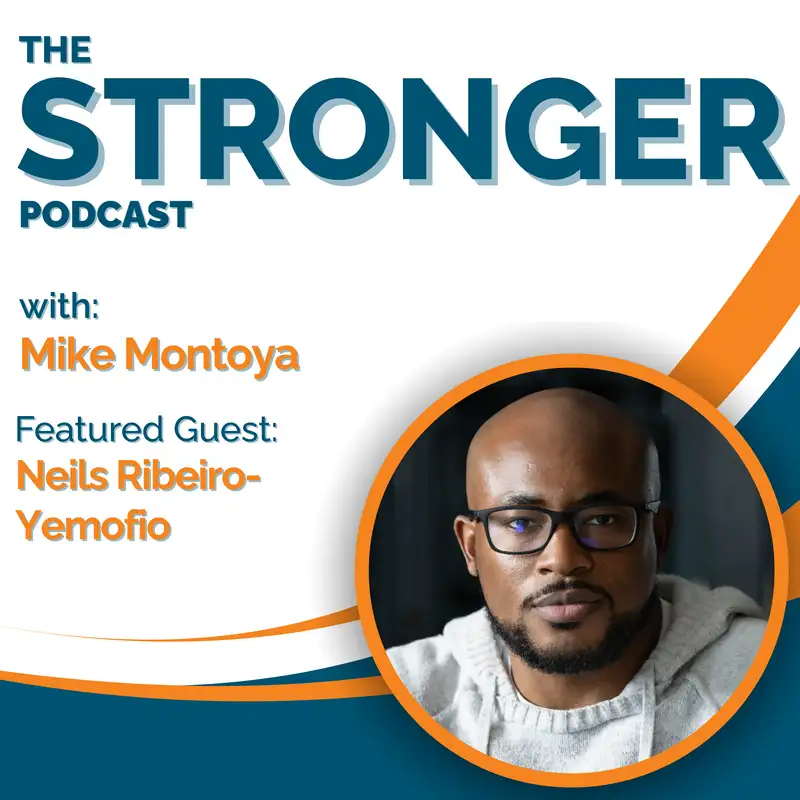
Parents Are the CEOs of the Household: Why Cash and Coaching Break the Cycle of Poverty with Neils Ribeiro-Yemofio
Welcome to the Stronger Podcast. Each week, we have honest conversations with education and social impact leaders about their leadership and career journeys. We talk about their origins, inflection points, and the work that they're doing today. The conversations are honest, human, and practical. If you're here for real stories and real takeaways, you're in the right place.
Mike Montoya:Let's jump in, and let's get stronger together. What does it really take to break the cycle of poverty? According to my guest, Neils, it starts with believing in parents. In this conversation, we explore by combining cash, coaching, and genuine trust to create lasting economic mobility and why people closest to the challenges are often the ones with the best solutions. Let's jump in.
Mike Montoya:Good afternoon. Good morning, everybody in Podcast Land on the Stronger Podcast. I'm Mike Montoya. I'm here with Neils, who is a friend and a colleague and a former employee and a and a all wrong good guy. So, Neils, tell us where well, first of you have to tell us how to say your last name appropriately so I don't murder it because I'm really good at doing that.
Mike Montoya:And then also tell us where in the where in the world you are these days.
Neils Ribeiro-Yemofio:Okay. So Neils Ribeiro-Yemofio. It is Portuguese and Ghanaian. That's that's where the last names come from. And then I am based out of the DC Metro Area, or what I affectionately call the DMV.
Neils Ribeiro-Yemofio:Live in Maryland, Prince George's County, Maryland, but spend almost all my time in DC.
Mike Montoya:Okay, so, and I think you're never leaving the DMV is what I remember. Is that like, it is like home?
Neils Ribeiro-Yemofio:At least for the immediate future, I'm probably gonna stay in the DMV, yeah. It is home. I was born and raised in Alexandria, Virginia. I've lived, I often joke and tell people I've lived in the D, the M and the V. So, and raised in Virginia, after college lived in DC for many years and worked in DC for many years and now live in Maryland.
Neils Ribeiro-Yemofio:Yeah, I'm Mike, I'm pretty I'm pretty hooked. This is this is home.
Mike Montoya:So Well, and and you have the call it inertia, right, which is like, family and kids and and a a person, a partner in life. Right? So like, those things are all made kind of stickiness. Right?
Neils Ribeiro-Yemofio:Yeah. Community. There's definitely community here. I'm pretty invested.
Mike Montoya:Yeah. Well, and it's been there's good things and bad things about being part of a place a long time. Right? Maybe that's not the right firm. It just makes it it's it's the story of your life, right, that's unfolding here.
Mike Montoya:And, like, if you think about, like, some of the things that are, like, most exciting to you about living in the region and and stuff like what what kind of things show up in your head? It might be work focused, but also might just be like, hey, man, the weather's great, which is arguable, but
Neils Ribeiro-Yemofio:I would say the the funny thing about home is I can spend a lot of time talking about the stuff that gets on my nerves. And, like, a lot of the reasons I do the work that I do and I am who I am is because of home. It's because of being from the DMV. So, if I was really thinking about what I enjoy, I do love that, Like, I was I hate I am a I am the kids of immigrants from West Africa. And, like, looking around, that wasn't a weird story at all.
Neils Ribeiro-Yemofio:Like, that was the case for, like, the majority of people I grew up with. Like, either they're from somewhere, or their parents are from somewhere, or their grandparents are from somewhere. And so, like, if people picked on me, they probably picked on me because they wanted to pick on me for being nerdy. And like, if they were picking on me for being from somewhere, it's because like they actually understood where I was from. And so, they were picking on me with a sense of understanding versus a sense of ignorance, which is a very jovial way to pick on somebody versus like, I don't know anything about you, but you're different, so I'm going to pick on you.
Neils Ribeiro-Yemofio:So I think that's like a joy that I get, is just the richness of cultures in the DMV. And and Mike, as you might knowremember, your boy is a foodie. So, there's all the different kinds of foods here. I won't say quality wise, Baltimore probably got better food, but whatever you want is here in the DC area, and I appreciate that. Well, and so you're highlighting some of the things.
Mike Montoya:I don't think I would have, like, thought about that experience of, like, how you as as an immigrant, kid with our connections, right, like, would experience life in a really complex culture rich environment. Right? Because not every place in The United States is like that. And as you said, sometimes kids get othered for looking slightly different or whatever, skin color, etcetera. And then it, like, becomes a complex for them.
Mike Montoya:Right? And it, like, shadows their life in some ways or another. But, like, in your case, like, you I just had a different experience. Right? Like, there was lots of kids that looked different and accurate and and came from different families, right, in in your in your environment.
Mike Montoya:So did you recognize that as like, like valuable as a kid? Or is it just like, that's just what you knew and that's when did you make sense of that?
Neils Ribeiro-Yemofio:I think it had me pay attention to, like, the differences even more. Like, less on the the cultural differences. I saw richness in that, like, growing up, having a best friend who's Peruvian and getting introduced to Inca Cola, like, that was cool, right? Like, I saw the richness in that, but I also noticed, like, the discrepancies of like, Wow, when I lived in this neighborhood, this is how I was treated. And then when I moved to this neighborhood, I was treated differently.
Neils Ribeiro-Yemofio:What's up with that? Like, I just paid a lot more attention to some of the, like, societal changes and some of, like, the resource discrepancies, because the cultural stuff was just something I considered standard and and, like, rich.
Mike Montoya:Oh, yeah.
Neils Ribeiro-Yemofio:But the other stuff, I was like, Oh, there's something more to this. And I actually, I think it really maybe being able to have such a rich experiences with culture had me have the opportunity to pay a lot more attention to the other societal differences, and it's probably what had me focus more on, like, Well, how come where I live determines, like, the quality of resources that I have, or the quality of, like, why my teachers are treating me nice or mean, or have higher expectations or lower expectations. Like, it gave me a opportunity to pay more attention to those kind of
Mike Montoya:things. Were comparing You guys, like, points at comparison, right? You can see some differences in a short period of time. Sometimes when you live and you only spend all the time in one school or one school system, you may not notice it as much until later, but it sounds like you're getting that exposure at different stages in your young life. Did you feel like Yeah.
Mike Montoya:Overall, you had a like, your like, your did you go to public schools mostly or not?
Neils Ribeiro-Yemofio:Went to public schools. All off from from from the Ruta to the Tuda. Oh, public schools.
Mike Montoya:Yep. Was and would you say that well, did you notice any Oh, wait. Preschool.
Neils Ribeiro-Yemofio:That's not true. I did go to a private school for preschool. Preschool? A little bit. A little bit.
Mike Montoya:Yeah. Then you're kind of like, what the hell is this that I'm out there?
Neils Ribeiro-Yemofio:Yeah. Yeah. We can't afford this anymore. That was a cute idea. You're going to public school.
Mike Montoya:So and public schools are and we talk about this a lot on this podcast, like how varied they are in terms of experience. Right? As you said, there's literally, like, across the street, there can be a totally different game. And certainly across the city or a different city, right, or a state, there can be barely different resources. So did you do you feel like you were kind of reasonably well equipped for university life, etcetera, through your schools?
Mike Montoya:Or did you notice something significant when you got to university?
Neils Ribeiro-Yemofio:Yeah, I mean, part of my story was, just like my experiences growing up, I So, I moved six times between kindergarten and ninth grade. So, I think, like, my K-twelve experience was a little different because, mostly for financial reasons, I was ending up moving from different places, different communities, and eventually, ended up in different schools. I think it did While, of course, giving me some resilience, it did have me notice when I had a good teacher to really lash onto that good teacher. And so, like, I can tell you for a fact, I had some amazing teachers. Because I know what it's like to have a bad teacher.
Neils Ribeiro-Yemofio:And so, when you have a teacher that, like, believes in you, like, I've had, like, my kindergarten, my first grade teacher believed in me. My my my sixth grade teacher was probably one of the first adults outside of my family to tell me I was smart, and to really, like, have me believe that I can do well academically. Having a counselor in I had a counselor in tenth grade say that I couldn't get into my dream school, but not really give me a reason why. And then the next year, I had another counselor tell me, like, Not only can I get into that school, they were going to help me get into that school? Like, I've had such varied experiences because of all the places that I moved that I've really latched onto those adults who actually believed in me, who poured life into me, and wanted to help me out.
Neils Ribeiro-Yemofio:So, like, I truly treasure those those, adults and those some of those strong school structures. And I think they did set me up to at least, like, have the perseverance and the grit to do well in university. But I don't think I'm not gonna give everybody credit for having me be ready for college. I think the ones who were strong helped me get ready for college. But there were there were I had some I had some adults in those K-twelve spaces that were not good and and, you know, were not that strong.
Neils Ribeiro-Yemofio:But I think it more so speaks to the ones who did a great job to help set me up to get to the school that I want to go to.
Mike Montoya:Oh, right. So they do well there. Don't have to have perfect teachers all the places all the time. But if you can get a bunch of them in a row at critical times, then you can do okay. And a lot of it has to do I I always think I'm a fan of
Neils Ribeiro-Yemofio:like, you
Mike Montoya:know, if we don't if we kinda stay out of the way of children in some cases and don't mess it up for them by kind of being racist or pushing down on them or, you know, kinda causing them harm, then most kids are gonna find a way if they have, you know, sufficient resources. Right? And then some kids will accelerate because they have more and they have greater teachers over time, right, things like that. And it's the inconsistencies and the quality of the experiences are kinda wild in in my view. So
Neils Ribeiro-Yemofio:It is helpful having at least one adult to believe in you, though. Like, having at least one believing in you and speaking life into you and saying that you can accomplish the things that you want, or even the things that you could never imagine that you want, makes a world of a difference. It's part of the reason I do the work that I do, because I always gonna say,
Mike Montoya:one hell. Do your life, right?
Neils Ribeiro-Yemofio:To tell people how this like I need to be that one.
Mike Montoya:How's that playing out? What are you doing now? -:
Neils Ribeiro-Yemofio:so now I'm the executive director for an economic mobility nonprofit called LIFT. I LIFT is a national, anti poverty economic mobility nonprofit organization. It is headquartered in DC, and I'm the executive director of the DC affiliate, but we're also located in LA, Chicago, and New York. And the entire premise of LIFT is to break the cycle of poverty by investing in parents. And we do that through direct service, technical assistance, and policy and advocacy work.
Neils Ribeiro-Yemofio:And yeah, it's, it's, it's, like, one of the most amazing places I've ever worked because, like, it is not us saying, Hey, we know the answers. We know exactly what you need to do. Parent who's experiencing financial hardship. If you do these five things, you will succeed. It's not like that at all.
Neils Ribeiro-Yemofio:If anything, we believe parents. We believe parents are the CEOs of the household. And we believe if you provide them with cash and coaching and support and connections, that they will get to where they want to go. They will accomplish the things that they want to accomplish, not just for themselves, but for their families as well. And so, you're seeing two generations navigate out of poverty and into economic mobility.
Mike Montoya:So, that's a little bit of a different take than people who are just focusing on young children, right, for example, right? You're kind of taking an additional layer, right, of saying like, hey, let's support the family and the family unit of the parents in particular. Do you feel like you work a lot with single parent households and and mothers, etcetera? Is that, like, part of the like, your experience with with the work you're doing?
Neils Ribeiro-Yemofio:Yeah. Over 90% or I will say even more than that, over 90% of our our members, which is what we call our clients, are women. And as you can imagine, a significant portion of them are single mothers. So, there But I will name that, while the majority of our, our members are, women of color, are single mothers, we also accept anyone and anyone who is a parent or caregiver. And we've noticed, there is a, there is a range in where they're located, there is a range in even their educational background.
Neils Ribeiro-Yemofio:We have some members who are, have master's degrees, who are still needing services of LIFT. So, what it's opened my eyes to is that this works. If you provide cash and coaching, and you believe in parents, regardless of their background, regardless of their life experiences, this will support them on their journey towards economic mobility. And that has been breathtaking, because now I feel like, in all settings, with anyone, especially those who are farthest away from resources, like, if we can provide cash and coaching, they'll be on the journey to support them and their families.
Mike Montoya:Well, I think that's, I mean, it almost feels like that's one of the things we're missing in the larger public kind of support systems and safety nets and welfare systems, etc, is that there aren't some of these things are not paired together, right, in in ways that are, like, call it efficient, and, like, and people are getting cash for some food and support for, you know, job training over here, and they're kinda getting things in piece meals and pieces. Right? And there's not like this integration of a I call it like a mentor slash coach, like someone that can help them learn how to weave this stuff together. Right? And some of the things I think that all of us have benefited from over our lifetime through our through our own our own parents or, like, our communities or some of these, like, these key people that have helped us, like, thread it together.
Mike Montoya:Like, you guys are providing this coaching thing, right, that just doesn't exist in public the public service sector. Right? It's just not not a thing. Right? Not yet.
Mike Montoya:So are you guys advocating for this? Not yet. So let me just assume that that's kind of what's happening here, right? So tell me about that.
Neils Ribeiro-Yemofio:Absolutely. So there's, there's two parts to it. One is technical assistance, where we work with other social service organizations to get their interactions with families to model how our coaches work with our members. So, whether it's early childcare, higher ed, medical institutions, government agencies, wherever there is a lever towards economic mobility, workforce development, will say like, Hey, what does that look like if you embed financial capability coaching into the everyday work that you're doing? And nine times out of 10, it makes those interactions better, because they're rooted in dignity.
Neils Ribeiro-Yemofio:They're rooted in goals versus it being very transactional. Oftentimes, with a lot of these government agencies, it's like, Turn in these five documents, and then if you don't turn them in, you're not gonna get any of these benefits here, and go, I have 300 people I gotta talk to for the rest of the day. Like, instead of that being the foundation of the conversation, it's like, now it's, What are the hopes and dreams you have for yourself and your family? And how can this benefit support you in reaching those goals? Like, if we rooted all those conversations like that, even, like, in the different settings, like pediatrics, like if you're trying to get a higher degree so you can bring in a larger income for your family, like early childcare, let's imagine the transformational effect on it has for a community, let alone an individual family.
Neils Ribeiro-Yemofio:And I believe that's what our technical assistance work, does and allows for. Like, just including financial capability coaching can be transformational in a family's life. And then the other part is policy and advocacy, where we elevate the voices of our members to those of decision makers so that decision makers are hearing directly from families what changes they want to see in the legislative, opportunities and aspects of government. And so, like, a best example I have for that in D. C.
Neils Ribeiro-Yemofio:Is our members have been advocating for a child tax credit. There is the federal child tax credit, but they saw an opportunity to have a local child tax credit. And once our members heard about that, that has been the policy agenda. And I've been like, Hey, can we do something easier? Like, I'd love to do just something, like, easier, but it's not up to me.
Neils Ribeiro-Yemofio:It's completely up to our members. Like I shared earlier, we don't tell our members what to do. Our members tell us what they want to do, and we provide the coaching and support to help them get there. And that's the same way we do policy and advocacy work. Our members determine the policy agenda.
Neils Ribeiro-Yemofio:We just provide the training and the opportunities for them to talk to decision makers. So, it is something that we'd want to see, play out in government agencies, whether through technical assistance or, for example, with the, with the, child tax credit, our members were able to see that get written into DC's budget. And I thought we were done. And our members said, No. Our experience at LIFT showed us that cash is part of it.
Neils Ribeiro-Yemofio:But cash and coaching together is what's transformational. So how do we get a coaching component embedded for those who are receiving some type of tax credit? And so, that's what the current fight is now that we're doing here
Mike Montoya:in D. Are you trying to get
Neils Ribeiro-Yemofio:it in? -How do we show some type of coaching support for folks -Okay.
Mike Montoya:Well, and, I mean, it feels like It's almost like this is an innovation that you guys have been practicing, right, for a while, and now it's starting to, like, capture people's attention in a way that people are like, oh, how do we do this at a scale, right, at a level of, like, I call it attaching it to some of the other resources that are out there. And so do you are and you may not know, but like, are other cities that LIFT is operating in also kind of finding opportunities to kind of build this into some of the government structures or not?
Neils Ribeiro-Yemofio:It all depends on the different city, like, because each member or each group of members are determining what their policy agenda is, it looks different in different cities. For some cities, it's like, we know that, cash transfers work. How do we fight for guaranteed based income? How do we fight for other type of cash transfer programs? Because we know cash is an important thing.
Neils Ribeiro-Yemofio:For other cities, it's like, we know that coaching is the way to go. So how are we incorporating coaching or involving the way that a caseworker operates in TANF so that it is rooted more in dignity? But the cool thing is, it looks different in every city because the members are deciding what they feel like is the fight that is needed in every city. Well, I think what we're seeing more and more now to to name that this is becoming more of a thing is like, I think we're getting to a place where we're done doing pilots on past transfer programs. Like, we know they work.
Neils Ribeiro-Yemofio:And sometimes I'm like, Why are we still doing pilots when we know it works? Pilots are supposed to test if something works. This works.
Mike Montoya:We just need to do it.
Neils Ribeiro-Yemofio:And I think now the evolution of that is like, Well, now we know it works, but we need guidance on how to make it real and tangible. And I think the best person to ask are the folks who are going to benefit from it. The folks who are actually experiencing the financial hardships and need the resources and support to help them get to where they need to go. And I think our policy and advocacy work is evolving that stage to really have folks who have experienced direct service support from a nonprofit organization, who have tangible results to explain what works and what doesn't work, and now have the training and skills to be able to articulate it to those of decision makers so they can tangibly take away what is needed to make those changes happen.
Mike Montoya:Well, and for those of us who have been doing social impact work for our lifetime, right, Twenty or thirty years. Like, the whole, like, listening to communities and humans, right, that are closest to the you know, where the where the challenges are and where the opportunity exists. Right? Like like, we all know that, like, closer we listen, the more likely we are to get it right. However Yep.
Mike Montoya:It just feels like it's like such a giant gap between, like, the policy decision makers and, like, this, like, core knowledge that we've already I mean, it seems like to me, like, it's no duh. Like, we should be doing that all the time, only time, that should drive all of the activity. Right? Which is what you guys are talking about. But like policymakers seem to like forget or just that's not true.
Mike Montoya:Not all of them are like, I call it tone deaf to some of that stuff, but some of them are, or they never experienced it or they still are removed from like reality about like the lives of people that their constituents are, that they just don't pick up on it until they get hammered on it a few times. Right? And I think that you hear the same message about a 100 times for them to like pick up on it and be like, oh, we can act on this, finally. Highlights are not necessary for every single thing forever. Policy research exists, etcetera, things like that.
Mike Montoya:So, there's opportunity I think for that continuing to work. Do you feel
Neils Ribeiro-Yemofio:Yeah.
Mike Montoya:Do you feel I mean, it sounds like you're excited. I mean, but you're an excitable guy. I know you write well enough to write. Yeah. It's it's not easy be excited, but you're excited.
Neils Ribeiro-Yemofio:You're wondering, I'm excited about the new Spider Man movie coming out. Yes. So it doesn't take much for me to get excited. You're absolutely right.
Mike Montoya:So you're excited about your work. I'm I'm really pleased to hear that about what you're doing. You do some other stuff, though, on on I call it as as a side hustle, I'm gonna call it that, and maybe that's not actually what it is because it's, a really important component of work. You do this other work, which is, like, you help kinda nonprofits or or social entrepreneurs kind of ideate and imagine and incubate an a a thing that they wanna bring to the world. And then you wrote a book.
Mike Montoya:Right? It's called vision to reality, which is published in about 2024, but there's an audiobook that came out of the same thing. Did you do the audiobook? Yeah.
Neils Ribeiro-Yemofio:Okay. I did do the audiobook. Okay. The live It's a live live audiobook. In case you're wondering.
Mike Montoya:Tell me about so tell me about that work and tell me about the book and and so and we'll we'll make sure we put the book in the show notes so people can pick it up.
Neils Ribeiro-Yemofio:I wanna say around 2017, I was getting asked by a lot of my friends who saw me, be a startup executive director for I was working at City Year at the time. And they were like, Oh, so you know how to start nonprofit organizations? And I'd start to explain to them, Well, technically, I was helping to expand a current nonprofit organization. I wasn't starting a nonprofit. And they're like, Yeah, I don't wanna hear You know how to start things.
Neils Ribeiro-Yemofio:Can you help me start a nonprofit organization? And when the request started to multiply, I realized, Oh, clearly folks are seeing some, seeing something in me, and so maybe there's something I'm supposed to do. And so, several years, I, created an LLC where I would straight up support people in turning whatever their idea is that was tangible and made sense, and I saw was a benefit for others, into a fully functional five zero one(three) organization. And then, at a certain point, as my career continued to grow, I didn't have time to do the technical one on one support. And I also realized that there was just a need and desire for folks who had been working in social impact their entire careers, not actually understanding the tax code that their organization operates under.
Neils Ribeiro-Yemofio:Like, people don't really understand how nonprofits work. They know they have a board, they may not know why they have to report to a board. They know that when someone donates to them, tax exempt, but they may not understand what a tax exemption is and how their organization became tax exempt. I took all those years of consulting and consolidated it into a less than 60 page book, so that anyone who had any just wanted to know anything about nonprofits, or even wanted to start a nonprofit, all they'd have to do was pick up that book, it'd take them about an hour to read it, and on the other side, they would be able to have a fully functional five zero one(three) organization. So, it's kind of started from there, and now it's at a place where, I'm talking with folks who either have an idea or who have been working in their nonprofit, usually a small nonprofit, for two or three years or five years or so, and now the questions are a lot more tangible, like, Okay, I have a founding board.
Neils Ribeiro-Yemofio:How do I transition this into an actual traditional board? Okay, my board chair is getting on my nerves. How do I support a board chair? Like, Hey, I really Like, I need to grow this from Right now, it's a $150,000 organization. What's it gonna take for me to become a 500,000 or a million dollar organization?
Neils Ribeiro-Yemofio:Like, it's evolved into, like, a place where, like, people are actually thinking about the questions that, yeah, maybe you can ask AI, maybe you can Google it, but it'll be great to talk to somebody who's actually done it before. Or talk to somebody who can talk to somebody, who can talk to somebody who's done it before. So, that's- that's where it's kind
Mike Montoya:of evolved. Well, and it's been- like, this work is like so important because it is sort of like, well, before AI, it was like- it was like clear as mud, like, what all the moves were to, like, get a thing to come to life. Right?
Neils Ribeiro-Yemofio:You know? It's like That's real.
Mike Montoya:If you screw it up, you screw it up, you're in trouble or, like, somebody like, they're you can mess something up. Right? So it and Stronger does some of that work, but not very much of it because it takes, like, a little bit of technical support, but it does just take a little bit of elbow grease to kinda get it growing. But it's such a passion. Right?
Mike Montoya:When people decide to, like, take on a challenge, right, in their community or something that they're trying to address in society, they have to want to do it in order to bring it to life. Right? So this idea of vision, right, vision and passion, right, are kind of married with some of the technical support, right, and that makes it possible for people to kind of, I call it, move towards and through the processes, right? But they're not terribly onerous. They just take, I call it, diligence, right, and focus for a little while.
Mike Montoya:And I feel like those are things.
Neils Ribeiro-Yemofio:Yeah, call it like, these are your babies. Like, if you're starting something like, Mike, you're an entrepreneur. Like, this is your baby. And so, you there's only one so many people you'll trust with your baby, right? Yeah.
Neils Ribeiro-Yemofio:And then two, like, you care about this idea so much that, like, if you're not all in or you're not, like, wanting to do it, then like, I'm not gonna push you. Because this is like a really important thing. Like, Some folks have had an idea about an organization for ten years, and they haven't told a soul. Because, like, it's just something that they, like, deeply care about. And my push is, like, don't let anything stop you from doing it.
Neils Ribeiro-Yemofio:If you believe this idea is good enough,
Mike Montoya:and you believe it will
Neils Ribeiro-Yemofio:help folks, and you feel like there's and especially if there's nothing else happening that does it, then, like, if this book is gonna help you do it, then read the book, right? Or talk to someone. I think the point is talk to someone. Don't let the idea just stay in your head. You should give it an opportunity for it to let it grow and to let it impact the lives of people that you care about.
Mike Montoya:Yeah, breathe some life into it, right? Think so that's the call of action, People that give, you know, if you have an idea, right, I guess they're worth exploring, right? To see if you can, you know, and there's like, I call it the startup struggle and then there's like, then it starts rolling and sometimes it explodes and you're like in a in a positive way, like, oh my god. Turns into a thing really fast. Other times it takes time and years.
Mike Montoya:Right? It can it may plot along for a little while. But I always call it like the the unit of one is kinda how I think about this stuff. It's like if there's a single thing that benefits from the the work that you're doing, right, it can be it can be beneficial. Right?
Mike Montoya:Because, like, people's lives change because of, like, single individuals, single experiences, things like that can make a huge difference. And even the, like, you know, the idea of mentoring and supporting, you know, people through this process is kind of exciting to me because it feels like there's not enough knowledge sharing and support that's available to people because, you know, we're all busy or whatever that is. Right? And that's like a lot. So
Neils Ribeiro-Yemofio:do you
Mike Montoya:feel I mean, you feel is there anybody that you wanted to highlight as like you're like, oh, I'm really proud of not to say you're not proud of them all because they're all important babies as you just discussed, but like, is there an example that's coming in your mind that you're excited about?
Neils Ribeiro-Yemofio:There's too many. Too many to name. But I'll give, like, some cryptic folks just so I don't embarrass them. There is one person that I talked to, it was one of the first people I ever talked to, that she was telling me her idea. Like, we were at randomly, like, at a coffee shop, and she was like, I have this amazing idea.
Neils Ribeiro-Yemofio:And I was like, Do something about it. And I remember two years later, she was, like, on the Forbes, like, like, under 30 list for the nonprofit that she started that is still thriving and going well. And then I had, another person, one of the first people I ever worked with, dealt with mental health issues, overcame those mental health issues, and, like, wanted to do something about it. But after talking with so many people, he didn't think that it could be a thing. And then him and I chatted, and I was like, Oh, no, not only is this a thing, I'm gonna help you make this a thing.
Neils Ribeiro-Yemofio:And now his nonprofit organization has been in existence for for a while, has won national awards, has partnered with every celebrity on this planet, including Chance the Rapper. Like, it has grown into a movement now. And now we talk about the importance of mental health really casually. Back when he was doing it, it was, like, something that folks just did not feel comfortable talking about. So, I've got to see folks not just grow an idea, but to cause a ripple effect that is leading to the change that I don't even think they could imagine have happened.
Neils Ribeiro-Yemofio:So -MICHAEL: Too many to name.
Mike Montoya:I don't
Neils Ribeiro-Yemofio:want folks
Mike Montoya:I to got to him on the podcast. So, afterwards, we're gonna talk about him, because I want I mean, I wanna tell some more of those stories. Right? Because I feel like people don't know that the stuff just starts because people's invested energy, right, and and effort, and they've chosen to lean in into a project or or a problem, and they wanna, like, try to tackle it. And it sounds like, you know, there's some examples.
Mike Montoya:So thank you for that, Neils. Right? So, like, this is the magic stuff, folks, out in our world that's happening behind the scenes that none of us necessarily know about. Neils has got another some other things that are interesting to me that I'd like to that are, I call it, like, tangible because what I remember about you is that you had a comic book thing, a Marvel Addiction.
Neils Ribeiro-Yemofio:Your words, not mine. But, yes.
Mike Montoya:So where did that start? What's that just tell us about it because I think I think the inner nerd of a lot of us will appreciate this because a lot of us I saw the heme I move was coming out and I was like geeking out about this like, oh, I remember how like important that was to me as a child. Right? But tell me about this this addiction as you call it. So.
Neils Ribeiro-Yemofio:You know, when you're moving a lot, so I, like I mentioned earlier, I moved a lot. You're yearning for consistency. And the one thing that I found as consistency, for my consistency was superheroes. Like, I There's the Spider Man cartoon, the X Men cartoon, Superman, Batman. And so, it started with the love of Saturday morning cartoons and watching those, regardless of where I was living.
Neils Ribeiro-Yemofio:Like, we always had TV, and I always had Fox and and and Kids WB. Like, I was always able to watch those things. But then as I got older, I evolved to, like, wanting to actually read the source material, so I started to read comic books. And while I've had moments and times where I'd stopped reading comic books for maybe a year or two years, you know, once I got to high school, started caring about football, stopped reading comic books for a bit. I would say one of the most consistent things that I've had throughout my life was just a desire for comic books.
Neils Ribeiro-Yemofio:And I I think part of the reason that I fell in love with it was like even though the good guys go through so much hard stuff, they never give up. Right? Like, even if they lose their powers, or or the supervillains are all teaming up with each other, or something happens, their best friends gets captured, or anything like, no matter what the obstacle is, like the one consistent thing that they had is hope. Hope and faith that they can figure it out and save the day. And I absolutely use that mindset in the day to day work that I do now.
Neils Ribeiro-Yemofio:And so, like, I definitely get inspiration from reading superheroes and the things that they overcome. There's some amazing leadership lessons from, like, a random comic book. And I think it's helped fuel definitely my optimism and positivity, I would say, but also just, like, my ability to believe in the concept of faith and hope and joy, and how that can fuel how you show up as a leader in this work.
Mike Montoya:Well, and I appreciate that. I feel like there's another book in here somewhere about leadership lessons from from the the story, the annuals of comic because comic book series have been around for decades. Right? Or more. Right?
Mike Montoya:Half a half well, fifty, seventy years,
Neils Ribeiro-Yemofio:some of them. Remember, man, it's gonna be a hundred years soon. Yeah. Okay. So there
Mike Montoya:we are. So we're we're all grown up. Most of us in this place are under a 100, just barely. But, you know, like, that's like a that's like a thing. And, like, a lot of us I mean, certainly, the movies have brought those things to life in television, but, like, a lot of a lot of children, again, read stories.
Mike Montoya:And, like, anime is, like, a real thing across the planet now. Absolutely. Caught on. But it's an interesting way for people to express and also find, like, kind of hope in characters, right, in things that are like, I remember my comic book histories were things like, well, I found that there were characters there that couldn't be talked about or that weren't popular in press, Right? And weren't popular in, like, in, like, the larger, you know now it would be social media, but, like, like, they weren't on television, but they were in these stories, right, about these peep particular people.
Mike Montoya:And I think about the X Men were always a thing because Yeah. Mutant children with all these gifts, right, that were sometimes seen as problems and needed to be, you know, wrestled down. And and it felt like that was like a struggle. And I found like a lot of, I call it, safety in some of that stuff as a
Neils Ribeiro-Yemofio:kid. Absolutely.
Mike Montoya:And I also learned some things that I probably didn't need to learn as a 10 year old, from some of those books too. But like, you you gotta learn it somewhere, I guess. You know, your parents might be learning. So so
Neils Ribeiro-Yemofio:We didn't read the age sticker. Oh, it's like, what things you should pick up at what age. Yeah. We we kinda ignored all that.
Mike Montoya:Yeah. I don't think my parents knew that there were adult themes going on in some of these cases. Right? And it just made sense, you know, they're like, it's a comic book. It must be safe or whatever it is.
Mike Montoya:But
Neils Ribeiro-Yemofio:I'm like, it's fine. Give me can't sit a kiddo.
Mike Montoya:Yep. Absolutely. Absolutely. So Well and so but that passion for you, it sounds like it was like a it was like it it kinda kept you grounded as a kid, but also then it turned do you do are your own family members your I know you have some young young people in your life. Are they also picking up on some of this stuff?
Neils Ribeiro-Yemofio:No. Mike, they, like, love sports. Like, they rather much watch the NBA playoffs than watch a Spider Man cartoon. It's actually frustrating. I'm like, Oh, I have jocks for kids.
Neils Ribeiro-Yemofio:Versus liking the nerdy stuff. But one thing I do notice, just to kind of give my kids some credit, is they While they love sports and and, like, realistic shows, they love the storylines within it. So, like, they'll talk about, like, my oldest son, who's eight, will talk about, like, Oh, well, Tyrese Halliburton for the Pacers, he, like, really cared about X, Y, and Z, and that's how he was able to win this game winning shot. And when you look at Jalen Brunson in the Knicks, he was told so many times he couldn't, and now he couldn't. So, I'm like, Oh, so, like, you're getting themes from watching these the athletes play the sport, and it's, like, feeding to your inspiration to, like, not give up, to try your best.
Neils Ribeiro-Yemofio:Like, Alright, I'm cool with that. I'm cool with that. They're able to take or
Mike Montoya:What do you call it? Overcoming impossible odd stories, right, that exist for sure. And you think about some of the great coaching stories that are out there from sports over time. Right? That they're and I'm not a sports nut either.
Mike Montoya:Like, I don't, like, you know, have a conscious awareness of it necessarily. Like, I know the Knicks one, which is actually surprising if you're a Knicks fan, although this will come out in a few months and people will still be celebrating probably. But
Neils Ribeiro-Yemofio:Yeah. Still. Oh, yeah. Yeah. It's gonna happen for a while.
Mike Montoya:Better hold on to it as long as you can. I I was one of my colleagues was like, someday the Podcast will win their World Series. And I'm like, this is very unlikely that the Podcast will ever win the World Series in our lifetime.
Neils Ribeiro-Yemofio:You can never say never now. I don't know. The the the Knicks after fifty plus years, you can never say never now.
Mike Montoya:That's right. That's right. It's everything is possible. Right? Including World Peace, so you said for these things like that.
Mike Montoya:So, you know, universal vehicles that can come, you know, things like that are coming around eventually. Did ask you to think a little bit before you came about, I call it leadership leadership moments, and part of our audience is folks that are entering into nonprofit space or work that is meaningful and purposeful in life. And I always ask our guests to share something that would be advice to your younger self, right? As people enter this work, and or like a lesson that you're like, hey, the next generation would do well to hold on to this given your experience. Like, is there something that you'd like to share back with folks?
Mike Montoya:And it doesn't need to be the most, I call it, the most consequential thing, but it could be something that you just rely on on a regular basis too. Right? So
Neils Ribeiro-Yemofio:Yeah. I I would say probably, if I was to talk to my younger self, and I always talk to myself, like, as I was starting this work, I would say believe in yourself and don't give up. Because it's society will tell you that it's a lot easier to just focus on you and not focus on helping others. And society will tell you that the problems that you're trying to work on will never get solved. But a life well lived, in my opinion, is working on things that you care about.
Neils Ribeiro-Yemofio:And if this is what you care about, you probably care about it for a reason. Whether you believe in a higher power or the universe or whatever, there's a reason this was put on your heart and your mind. And it probably means you're supposed to do something about it. So while everyone else or everything else, or society or the government, whatever, is telling you not to do this thing, believe in yourself that you should do this thing. And that's probably what you should just hold on to when it's the dark days and when you feel like you're not making a difference.
Neils Ribeiro-Yemofio:You are. You are by just caring and by showing up. So, just continue to believe in yourself and believe that this is what you should be doing.
Mike Montoya:So, yeah, to hold on to your truth, right? Hold on and I call it jump in to it, right? Find, like, mentor support and Neils book, that you can find the easy way. Find I mean, that's kind of the thing, though, is like, don't try to reinvent the wheel, right, if you don't have to in some cases. Right?
Mike Montoya:But also, like, like, the way that you see and solve a problem, like, there's tons of ingenious things that are needed in the world that that that individuals have a sense of because they are close to it, right back to like, what is the experience that people are bringing to the to the conversation that has not been tackled by government or society yet. Right? And there's, you know, we just, as humans, we just continuously create both. We find new problems, we also find new solutions, right, by choosing to participate, right? So, alright.
Mike Montoya:So, Neils, final question. What are you looking forward to? Now, by the time this comes out, it'll be fall or it'll be end of summer. So, if you're looking forward to But the end of think about, like, the next the next six months. Like, what's ahead for you?
Mike Montoya:What are you excited about?
Neils Ribeiro-Yemofio:I am I'm excited about all the things that we're doing at LIFT. I think in the next six months, you are going to see some really large partnerships happening, some large entities starting to talk about economic mobility and starting to talk about the power of cash and coaching and connections coming together. And I'm excited about, like, not hearing it from folks who are employed at LIFT. I'm gonna be really excited that you're gonna hear elected officials talk about it, hear higher education folks talk about it, hear early childcare talk about economic mobility, like, that's gonna be really fun and exciting. Because, I mean, yes, part of me is gonna say, I told you so.
Neils Ribeiro-Yemofio:But the other part is just gonna be excited that there's a movement talking about stuff that, like, I think deep down, all of us who work in social impact care about, which is like I see. Believing like folks can thrive. Like, they have an opportunity to thrive, that we can maybe live in a meritocracy, a true meritocracy. That sounds really cool. And I think we'll see even more of that in the near future.
Mike Montoya:That's right. So, and I appreciate it. It sounds like you may be foreshadowing some things that you're working on as a group. Maybe. So, when this starts to happen, we'll come back around.
Mike Montoya:I feel like there's obviously a much like, more robust and rich conversation that can be had around this. Like, because we we're just kinda glossing over, like, this important thing that's that's kind of, like, core to, like, the things that you do and that I care about. And but I think we should get some of these people that together in in the future and, like, I mean, let's let them talk about it, right? And let's let them use the opportunity to share about the work that they're doing. And I would say like the more civic leaders can hear from each other about what they're doing, then they're like, oh, I can do that over here.
Mike Montoya:Because it's been done here. Once you have coverage in DC, you have coverage someplace else, right? And that gives you more room to run, right? So these policy windows are Exactly. So, make sure we come back to this in a few months.
Mike Montoya:And I will make a note to follow-up with you about it so that we can, again, tell more stories about the work that's going on. Neils, thank you for being who you are, for staying in the DMV where it's safe, and for
Neils Ribeiro-Yemofio:and for Somewhat safe. Yeah. Somewhat safe. Right?
Mike Montoya:And and also just for being part of this the world that we live in, the world that I'm a part of, it's been great to spend time with you. Okay?
Neils Ribeiro-Yemofio:Well, thank you for being you, Mike. We appreciate you. We appreciate you having opportunities like this where we can hear from each other.
Mike Montoya:That's awesome. Thanks so much, Neils. Have a great day. I appreciate Neils reminder that every great movement starts with someone willing to act on an idea that they care deeply about. From investing in families and helping nonprofit leaders turn vision into reality, this conversation is ultimately about hope, the belief that people can thrive when we give them the resources, relationships, and support to do so.
Mike Montoya:Thanks for listening, and we'll see you next time on The Stronger Podcast. Thanks for listening to The Stronger Podcast. If this conversation inspired you, we invite you to follow the show and share it with someone who's on a journey to become a happier and healthier version of themselves. Links and resources are in the show notes. See you next Thursday, 9AM eastern time.
Mike Montoya:Have a great day, and stay strong.
Neils Ribeiro-Yemofio:Podcaststhatmatter.org.