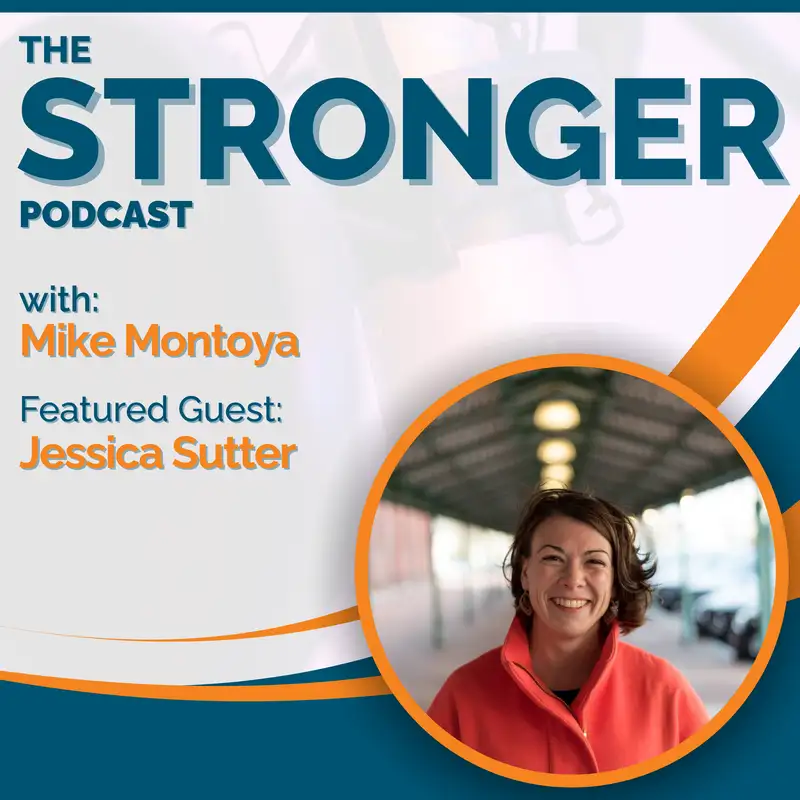
Mergers Aren’t Failures: Protecting Impact Through Trust and Strategy – with Jessica Sutter
Mike Montoya: 00:00:00 Welcome to the Stronger podcast. Each week we have honest conversations with education and social impact leaders about their leadership and career journeys. We talk about their origins, inflection points, and the work that they're doing today. The conversations are honest, human, and practical. If you're here for real stories, and real takeaways, you're in the right place. Let's jump in and let's get stronger together.
Mike Montoya: 00:00:35 Good afternoon and welcome back to Stronger Podcast. In this episode, I'm sitting down with Jessica Sutter from EdPro Consulting, one of those leaders who brings both heart and rigor to the work. We get into what it means to build trust in education, why relationships are real infrastructure, and how leaders can reframe mergers and acquisitions as a path towards protecting impact, not a sign of failure. Jessica also shares about how teaching middle school prepares you for just about everything in leadership. Let's jump in.
Mike Montoya: 00:01:10 Before we dive into today's conversation, I want to give a quick shout out to podcaststhatmatter.org. Their mission is to help impact-driven voices get the visibility they deserve. If you want to share your message with the world, check out their website in the show notes.
Mike Montoya: 00:01:44 Hello, good morning everybody. I'm not sure if it's morning or afternoon or where you'll happen to be listening to this this event and podcast at, but welcome to the Stronger Podcast. Today my guest is Jessica Sutter, who has become a friend over the last year approximately, and we've gotten to know each other and spent a fair amount of time in meetings and conversations about some of our work together. So, Jessica, it's wonderful to have you. Thanks for being with me.
Jessica Sutter: 00:02:18 Yeah, glad to be here, Mike. Thanks for having me.
Mike Montoya: 00:02:22 So, let's let's I like to center people a little bit so they situationally understand where things are at. So, I live in Portland, Oregon, which is on the West Coast. And Jessica, I think you're in just tell me where you live and kind of maybe where you grew up. I'd love to hear where people kind of started their their life journey if you were willing to share about that.
Jessica Sutter: 00:02:46 Of course. Of course. So, I live in Washington DC and have lived in Washington DC for the last 20 years. This is my 20th year in Washington DC. I grew up in New York though. My whole family is from New York. And if you ask people, you know, and where you're really from, my entire family will tell you they're very proudly from the Bronx in New York City. So, I was born in the Bronx, lived in Westchester County, New York, and then moved to Maryland when we started high school and have considered the DC area home for all of my adult life.
Mike Montoya: 00:03:22 Adult life. Fair enough. And so, that means you're only 25 years old with those or something like that.
Jessica Sutter: 00:03:28 Going with that, Mike. I'm going with that. You know, we're getting closer to double, but I'll I'll go with that.
Mike Montoya: 00:03:35 Fair enough. Fair enough. So, well, so East Coast, born and raised, we in if we think about it like that, the Bronx is a maybe there's a lot of people that have grown up and lived in the Bronx, right? Historically, currently, right? So, what was it like growing up there? I mean, I can't I've been there and spent some time there, obviously, as a as a young person, but I've never lived in that space. Um, what was it like when you were a young person there? What was your school experience like?
Jessica Sutter: 00:04:15 Yeah. Yeah. So I we lived in the Bronx when I was a very little girl and I started school in a Catholic school just outside the Bronx in Yonkers, New York. And so I will say like my family raised me Catholic. They all went to Catholic school. My mother's siblings, my father's siblings all went to the same high schools. So we have been an interknit family for years. There's really in-laws and my family sort of fall away because everyone's known each other for so long. So living in the city, the city was a big part of life. Traveling public transit. I joke around that some people's grandmas baked pies and sewed things. My grandmothers knew where the really good Chinese takeout was, how to help me navigate New York City public transit and where to find all the really good shopping deals.
Jessica Sutter: 00:04:55 So, I was very much a kid raised in a city family and we moved out of the city to Yorktown Heights, New York, really for the schools. When my family was able to buy a home, they looked and researched where the best schools they could get to in their price range and Yorktown Heights was it. So, they moved there for the schools. And then ultimately when we moved to Maryland for my father's job, we also made that decision based on schools. And I went to high school in Howard County, Maryland, proud Centennial High School graduate. Same thing. So a lot of my family's life decisions, a lot of my upbringing revolved around where will we make decisions about schools for our kids. That's part of the reason I ended up as passionate as I am about school choice because I think school choices have always been a part of my family story and certainly colored my childhood.
Mike Montoya: 00:06:05 Sure. Well, at And that's like almost a pretty it's a common American story of sorts, right? To be like choosing the place to to raise the family based upon like opportunities for schools and quality schools. Not everybody has a choice of course, right? Not everybody has opportunity. So, but it's a common one for people who are creative enough to make it happen um and are committed to making it happen, right?
Mike Montoya: 00:06:32 And Catholic schools and I'll just reference this because they're not parochial schools are not as common in the west, but east coast is much more common, right? For people to go to the Catholic schools and parochial schools, especially in K through K through 8, K through 12 experiences, right? That's like a like a lot of people do, right?
Jessica Sutter: 00:06:58 Yeah.
Mike Montoya: 00:07:00 Do you do you still are you still attached to to religion as an adult with your with yourself to now?
Jessica Sutter: 00:07:08 It's it's a funny question, especially in this moment in in our world where so much is swirling. I will say I am no longer religious as a Catholic, but the teachings of social justice that came to me through my Catholic upbringing are like the foundation of how I think about the world. of why I do what I do. I went to a Catholic college. I went to Loyola College in Maryland. Now it's Loyola University of Maryland. And the Jesuit ideals of men and women for and with others are probably my own life motto. How do I leave the world a little better than I found it? How do I live in this world not just in service to others, but in service with others? So, not a churchgoer anymore, but very much connected to that. And I find myself pulled back to the teachings of folks who still talk a lot about social justice. So, Father James Martin is a pretty public Jesuit and I listen to a lot of his podcasts and pieces. I read what he's writing because that sort of notion of of social justice teachings still very important to me.
Mike Montoya: 00:08:22 Yeah. Well, I appreciate you bringing that into and you're maybe one of maybe two or three guests that have anchored their social commitments right into their religious experience as kids. And I I think I find myself there too. And when I told my leadership story often, I used to start there because I also grew up Catholic and and actually had a Jesuit priest as like our primary guy at at our church when I was a kid and like Jesuits are a special kind of special kind of priest right they're kind of like the
Jessica Sutter: 00:09:02 they are
Mike Montoya: 00:09:03 we believe in intellect above some other things right and you know scholarship and and things like that so the there's a really rich tradition around that and then the I think when I was young the there was a pretty liberation kind of theology was like a a pretty significant piece of push right from South America etc. Just coming back from South America, I was thinking about this um how much liberation is still unfounded in the world.
Jessica Sutter: 00:09:40 Yes.
Mike Montoya: 00:09:42 How important that is still as a message, right, for for for all of us. I think sometimes as an American, I'm like, oh, like I kind of got my choices and options, but it was like on the backs and and through the work of hard work of others, right, for for many generations. So, so thanks for sharing about that.
Mike Montoya: 00:10:08 Okay. So, grounded in that area and and reflecting on a more recently maybe there's we call there's a lot of angst going around like plenty to share so it's sometimes nice to be grounded in something with some I call it density
Jessica Sutter: 00:10:25 yeah
Mike Montoya: 00:10:26 right some thick
Jessica Sutter: 00:10:28 that's lovely do you did you have brothers
Mike Montoya: 00:10:30 sounds like you have them but are they are they in the region where do they also are they still doing well in their lives
Jessica Sutter: 00:10:40 yeah it's a great question so I have one brother my parents were high school sweethearts and I came along early in their lives so they waited a little while before they added my brother to the family. So, we're eight years apart. We're still close. And he lives in Connecticut with his family. He is also the proud dad of my favorite little people. I have a nephew and two nieces, all school age, all preschool through fourth grade right now, and they're just deeply important kiddos in my life. So glad to do anything in the same realm. He works in finance. I work in education, but our work has begun to converge a little bit more lately in that his finance work is focused on mergers and acquisitions and my own work in the ed sector is really looking at what's happening in this moment as so much is changing for the conditions around nonprofits around schools financially and economic other economic and philanthropic pressures. So it's it's weird that our work started very far apart and has begun to converge in this moment. But his children are also always on my mind when I'm thinking about what all kiddos deserve.
Mike Montoya: 00:11:58 Right. Because you have a like you're you're sort of watching them go through it now, right, as children.
Jessica Sutter: 00:12:05 That's right.
Mike Montoya: 00:12:06 Which makes a lot of sense. Like usually we have proximity to somebody in our lives, right? That that keeps us grounded in truth about what it's like, right? And it keeps us kind of real.
Mike Montoya: 00:12:21 I don't have kids, so I have lots of kids through my friends, right? And that and I watch them change and grow, and I'm like, "Oh my god, what is going on with that child's schooling experience, so won't name it."
Jessica Sutter: 00:12:35 Well, I'm I'm in that same position, Mike, that I am I I don't have children of my own, but I've made a a career out of being an auntie, both an honorary auntie and auntie to my my nieces and nephew. And one of the things that is fascinating to me is like all the things that have not changed in education, but all the things that have changed in the world for these young ones. And what does that mean for them? So, right, like social media did not exist when I was in elementary school, but now social media is something even my seven and nine-year-old nieces and nephew are aware of. And I think, oh gosh, that was not something had to tackle until I was a fully formed human and now I'm we're asking young people to manage these very complex realities of changing technology and the world coming in from the outside much earlier for them. So thinking about that is is also something I I always have in mind.
Mike Montoya: 00:13:38 Yeah, I think we used to and I back to the parochial school things like it kind of kept people a little bit more protected in some ways. That's what I remember thinking about was like my my friends who went to parochial schools were like sent started to be sheltered a little bit more right from right the outside world and now it like is as you said ever present right in our in our reality at a very young age through the media and the the magic box are everybody owns I I sort of was shocked that like everybody on the planet has a smartphone not quite but like a lot of people have them
Jessica Sutter: 00:14:18 and insane how much flow of information is through there so
Mike Montoya: 00:14:23 and I think I if I recall you also you're a dog mom maybe in addition
Jessica Sutter: 00:14:30 I just saw my window my husband said dog for a walk. Yes, I have a a rescue dog named Gus. He is my third rescue dog. Only one at a time, but three in my lifetime. I've always been a dog crazy kid, and we just didn't have pets growing up. I think for a long time I thought it was because my my parents didn't want to be responsible for it, but they are now proud dog grandparents. And when you watch them with the dogs now, you realize like they treat the dogs like children. So, they just didn't want another another child around. But yeah, Gus is a Gus. is an 80 lb couch hound and he's a
Mike Montoya: 00:15:15 Yes. Sup super small. He thinks he's very small.
Jessica Sutter: 00:15:20 No, but he's a he's a a good boy. And part of the reason he he came as a foster and I foster failed, which I've learned that I have a tendency to do. But part of the reason Gus fit into the family so well is that he is really just very patient around children. So nieces, nephews, friends, children who come over, Gus is an incredibly good dog pal for toddlers and active kiddos alike.
Mike Montoya: 00:15:48 That's awesome. Well, that's maybe not sure what happened to him before he came to you, but they sometimes can be gentler, right? Because they have had hard times. Awesome. So, Gus is alive and well. It sounds like you're a smart dog fanatic, which is you don't have 10 of them right now. Just one.
Jessica Sutter: 00:16:08 No, just one. Just one.
Mike Montoya: 00:16:11 Balanced. Balanced. Good job. Congratulations. I have a sister with a few dogs and I'm like, so kind of what I It's kind of what it goes. So, okay. So, we started talking about school choice as a passion, right? Let's let's just kind of do a walk through your career in a brief brief way. I know you started out as a as a educator, as a teacher, right? I think so. Tell me kind of the chain. You don't have to do every single piece, but like highlights and maybe if there's a I call it a inflection point, right, that just happened and it changed the course a little bit or informed something. Tell me about that.
Jessica Sutter: 00:16:55 Yeah, sure. So, I started as a teacher. I did a couple of years of post-college service after college. So, Lots of people that went to Loyola did post college service. Some did like Jesuit Volunteer Corps, Mercy Corps. I did a program in Chicago that was most similar to Teach for America.
Mike Montoya: 00:17:15 Y
Jessica Sutter: 00:17:16 where I got my teaching certification and I got the opportunity to teach in my own classroom pretty quickly after getting some training and alternatively certified. So did that for two years after college and loved it. But as it turns out, Catholic school teachers in Chicago were not getting paid a lot of money. So I took a look at what else was out there and I wanted to also keep exploring the world. You know, you noted I grew up on the East Coast. I'd always lived close to family and I really wanted to spread my wings a little bit. So, I took a job in Los Angeles, California, working for a civic education nonprofit. And I got to travel the country training teachers in civic education materials. And it was so much fun, but it made me think that I wasn't done with classroom teaching yet. I loved training teachers because I loved being in their classrooms and I wanted to do that again. So, a friend who I had met in Chicago told me about, as he put it, a startup middle school he had started working at in DC. He's like, "It's called KIPP. I hear they're opening all over the country." So, in 2003, I in fact found out that I was close to a KIPP school that was opening and I was a founding teacher at KIPP LA Prep. I did that in Los Angeles, moved back to DC to teach for that friend, and finished classroom teaching in 2008.
Mike Montoya: 00:18:48 So, 03 to 08 you were in the KIPP sphere.
Jessica Sutter: 00:18:52 Yes.
Mike Montoya: 00:18:54 Where and KIPP LA is is a good and KIPP SoCal I think that is is a merger of the of the southern region right of California. I think um so they're like 20 something schools roughly I think and 10,000 kids maybe. So it's like a a thing thing right it's like a real thing and you were at the beginning. So
Mike Montoya: 00:19:12 I was about that like would if you reflect on that time did you get your fill of teaching and was that a good space to start in in reflection?
Jessica Sutter: 00:19:30 Oh yeah. So I don't know if I got my fill of teaching. We'll talk about now I teach college students, but I it was absolutely the right place to start for for a couple reasons, but one of them is you have a very narrow perspective on education when you're in a classroom. You've got the 30 kids in front of you or the 60 or 90 kids who come through your classroom every day, but you get to know them deeply and you know the situations they're facing, the pragmatic realities of what it is to deliver education. and to be a teacher of children all the things that come along with that the sort of emotional management the academic management the family communication and now what I do is more removed from that but if I hadn't had that grounding if you don't get the start in really feeling what it is like to be present with these children during the day in connection with their families working on the technical aspects of education the caring aspects of education that come with being a classroom teacher I think I would have missed out on a lot so I'm glad I I did that I also think it's funny to think about having started at KIPP in 2003, we were literally in the basement of the Boys and Girls Club.
Mike Montoya: 00:20:55 Yeah.
Jessica Sutter: 00:20:56 So, starting from a really scrappy organization of super dedicated educators and we were young, right? I was 25 when we did this. So, we were young and energetic and we were giving it our all and we were each other's closest friends because who else did we have time to spend with? But the the building that from the ground up and seeing what it's grown into feels really special. to be like, you know, I I feel like now I sound my age, but I can say back like, well, I remember when we were in the basement and we were recruiting students outside grocery stores to help their families understand what we were trying to do with building a middle school in a very different model than what was currently being offered to them in the school district. So, I'm very proud of it. I'm also mindful that like what we thought was this thing we were starting with our, you know, all of our energy and all of our time has really grown into a system of its own, a school district of its own. And that I don't know that I could have envisioned that when I was, you know, 25 sitting in my classroom with my founding 90 students.
Mike Montoya: 00:22:15 Yeah, sure. That's a huge I mean, well, I mean, there's an arc of time and the story has has grown and expanded.
Mike Montoya: 00:22:40 I always I don't know if you keep in touch with any of children that you may have met or had as your students at the time, but like oftentimes people remember their teachers. They probably remember you whether you remember them, right? But also to know or you know enough time has passed that these kiddos are in like they're adults right they're they have they are families and careers or jobs or whatever they're doing right but how does that feel to like know that do you keep in touch with any of them
Jessica Sutter: 00:23:05 I do I do I mean this is one of the things that like there are days that I think h social media and then there are days that I'm like without social media I would not have nearly the window I get to to keep connecting with these young people that I met on home visits when they were nine or 10. So I'll give you one story A few years ago, I went out to Zion National Park to run a race. So, I had to fly in and out of Las Vegas. One of my former students from KIPP LA was going to school in Las Vegas. And so, I messaged her on Facebook and said, you know, I'm coming through Las Vegas. If you want to meet up, I'd love to take you to lunch. And we had stayed in touch through the years. So, she said, "Yeah, I'll definitely do that." What actually happened was even more magical. She called some of her closest friends from elementary school who were still her friends, got them to drive to Las Vegas from Los Angeles for the weekend. And so I ended up having lunch with three of my former students and one of their children. And I mean, I think we went to Denny's. It was nothing fancy, but it was the most magical time to sit with these young women who had grown and done school and jobs and had family life changed so much over time and who were still interested in engaging with someone who they met back when they were 10 and who what a what an honor and a privilege it was to get to stay part of their lives in that way. So those kind moments are just pretty magical for me.
Mike Montoya: 00:24:45 Yeah, you can't write stories about this. I mean, you can write a story, but that's like it's a beautiful one to hear, right? And also just the impact that you have or you've had, right, with those young women right now is one that is really precious, right? I would say like it's it's it's part of what it fills your cup. Somebody else said this in another another conversation I was having. Fills your cup whether you want it or not. It's like feeding positive hopefully a positive way. Right.
Jessica Sutter: 00:25:22 Right.
Mike Montoya: 00:25:25 Augustus is Augustus is great, but
Jessica Sutter: 00:25:28 Yeah. Yeah. Well, and then and then even more recently when I came back to DC to work at KIPP, you know, being in DC now, I still get to interact with a bunch of my former students. One of the incredibly special turns of events is that one of my former students who I kept in touch with through the years, her husband and I now serve on a charter school board together. And so when you watch that, you know, these young people who've grown into their own people who bring other people into their lives as spouses or partners and then you're worlds connect professionally. It becomes another sort of like layer of you're now a colleague in addition to being an important part of of my life as a professional in the past.
Mike Montoya: 00:26:12 Well, and that's how I call it these these ties, right? These interweavingings of of people and life histories and stories like become the fabric by which like literally school boards, right, function, right, and get things done, right, is because they you have trust amongst adults, right, that can like imagine this future this opportunity, right? And that you guys are committed to the work, the volunteer unpaid work, right? That is required. Yes. of of charter school boards in particular, right? So I think sometimes people think that like charter school board leaders are getting paid dollars or something. And I laugh about that. I'm like, h if you only I mean mostly it's mostly everybody's coughing up money to support the whole enterprise, right? And it's it's part of a part of the necessary practice, I think. And so I'm sure that you've committed those energies to it.
Mike Montoya: 00:26:55 All right. So you uh Los Angeles and then you moved forward post-KIPP and into like some policy work I think right was kind of like part of your journey and you ended post again so
Jessica Sutter: 00:27:30 so I moved back to DC to teach at KIPP DC and I thought I was going to go get a two-year master's degree and go back to a classroom I was curious about education policy I came to DC at a time when Michelle Rhee was the chancellor of DC public schools DC just had a big legal change that put the schools under mayoral control and while It didn't affect my day-to-day life in the classroom much at all. I heard about it, I read about it, I saw it percolating, and I got very curious about education policy. So, I wanted to go do a masters in ed policy, fully expecting to come back to a classroom. And as these things happen, I ended up in a PhD program for education policy. And two years in, a friend in grad school mentioned to me a fellowship he had done over the summer called Education Pioneers. So, I applied for an EP fellowship. It was their summer 10-week fellowship. and they placed me in the state superintendent's office in DC. We call it OSSE. So I was in OSSE as a fellow for the summer helping create grants for public charter schools out of some federal money. And what was really interesting is within two weeks there I was really jazzed about it. I was like, "Oh, this is interesting. I had no idea what this work would look like, but this is fun." And a job opening was posted in the agency and I applied for it. So I ended up staying in grad school part-time, but working full-time in the same office I had my EP fellowship in. That led to a detail to the mayor's office to help the city apply for a Race to the Top early learning challenge grant and then some time in the mayor's office. So that was really my exposure to policy and I will say I think I fell into a lot of luck in getting into policy in that particular space at that time because there's a lot of energy around ed policy in DC. There's a lot of federal money coming in. So there's a lot of innovation push and I got to work with wonderful people, great people both in the office of the state superintendent and in the mayor's office that kept me engaged and excited about policy work. But it's funny because I had a moment when I was in Ed Pioneers where a lot of my classmates from colleagues from EP were business school students.
Mike Montoya: 00:29:45 Yeah.
Jessica Sutter: 00:29:48 so a lot of them had done management consulting or were thinking about going into management consulting after grad school. And I I laugh sometimes about the things learned in EP from my colleagues that I was like, "What's consulting?" I didn't know what that was. And they were like, "You'd be great at it. You have like good relationships. You talk to lots of people. You know lots of people. You'd be good at it." I was like, "I don't think so. It's not a thing I'd ever do." Fast forward two years when I stepped out on my own to start a consulting company. These moments, they stick with you. You don't necessarily know what you're going to do with them in the time. But at the that that exposure to policy that started in a grad school in the academic side of things, got really developed through EP and then you know the folks in in DC government who helped me learn the ropes of like what does policy look like from the grant-making side, what does it look like from the executive side, how does that interact with the legislative side, I got a a master class in implementation of policy in those couple years.
Mike Montoya: 00:30:52 I just want to say that if you're a leader, entrepreneur, or business owner who needs some support, there's an easy way to get a think tank behind you and your vision. The Genius Discovery Program at Thought Leader Path is like having your own one-on-one incubation and accelerator program. They'll help you develop an approach based on your own story and your plan for impact and offer the tools and thought leader assets needed to really amplify your message, including launching a podcast like this one. If you're ready to stop grinding in the dark and start making real impact with the right support, check out geniusdiscovery.org.
Mike Montoya: 00:31:33 Yeah. So DC at the time, I mean like 08ish some something like that 2000 like that's that there's a lot of activity as you said a lot of federal it was the early first Obama administration right and there's a lot of energy money flowing through and Michelle Rhee had a big bold vision that was climbing through right which include like a significant teacher union overhaul things like that right so like and know the charter footprint so yeah exciting times in DC so I think it's like I'll call the crucible I'll call it that like it's a place where like a lot of lot of folks who are still doing the work like yourself like got like really built their capacities right and learned a lot
Jessica Sutter: 00:32:15 Yeah,
Mike Montoya: 00:32:16 practice a lot and built relationships that are now trustworthy trustworthy of trust, right, as adults, really powerful things
Mike Montoya: 00:32:30 and that's exciting times. I think I had a few other guests that like talk about the DC era and there's folk folks that are operating charters that were kind of grounded in in that same era. So, and so well, you happen to end up being an education consultant sort of, you know, on accident. It sounds like you're like, "Oh, I don't think I'm going to do that, but here I am." Well, but what do you think it takes now that you're now that you're doing it? And do you have sort of what are the things that you rely on? on right in the work that you do.
Jessica Sutter: 00:32:55 So, I mean, I think relationships are a huge part of it. And I don't mean that to sound sort of cronyish, right? It's not about like, oh, I know so and so and they got me the gig. I think it's exactly what you're saying about trust. There is a notion of an organization says to themselves, we need help, and we don't think we need help in a full-time capacity, but we need help on this project right now, or we need help for this term limited time, and we want someone who understands is what we do, but we need someone who can be a little arms distance and we want to have trust with that person so that we're not wasting time and money building up the how we work, who we are, what we value, what we care about. So, I do think that relationships are critical for some of the kinds of work I've gotten to do in terms of getting up to speed fast, being able to enter in and being seen as a good faith partner and a good faith honest broker. So, I'm not necessarily going to tell you what you want to hear, but I'm going to tell you what I think you need to hear given the evidence and so I think relationships are a huge part of that I do think there's an element as an independent consultant of self-discipline that is really important like when I started out on my own I was like what am I going to do all day how am I going to decide how to schedule my time and as it turns out that that was less of an issue for me than I thought it might be like I'm pretty good if I make myself a schedule like my boss told me what's on my schedule for the day and now I got to go listen to my boss It's just that my boss is mean.
Mike Montoya: 00:34:25 Yeah.
Jessica Sutter: 00:34:27 So, as long as I'm telling myself what to do in a day, you know, that that works out. But I think there's also the self-discipline to know what you can't say yes to. Either because it would really put you over capacity or because it's just far enough outside your scope of context and information and expertise that it it you're not the best person for the job. And being able to say honestly in an effort of maintaining those relationships and that trust to say that's such an exciting opportunity. I don't think I'm the right person for that but I know some people that I can suggest you contact to know about that. So I think that level of self-discipline is important and then I think the other thing is like a constant curiosity because I think I would get bored doing the same kind of work all the time.
Jessica Sutter: 00:35:06 It's part of why consulting appeals to me but also getting curious about something digging in deeper learning who's in that ecosystem of work who knows who who doesn't know who that they absolutely should know because there's a great model they should be aware of. there's an opportunity for building, you know, an off the record trust group to say like, "All right, we're going through the same thing right now. How can we connect? Who can help me bounce ideas off of who can be my critical thought partner in this work?" So, I think that level of curiosity, that level of learning all the time is another piece of it. So, maybe those are my three relationships, self-discipline, and curiosity.
Mike Montoya: 00:35:48 Yeah. Well, you're kind of un underselling the the piece of like you have to stroke up with a set of experiences that knowledge that are worth sharing or buying, right? So, I mean, there's all this whole like, oh, I went to school for a long time and I studied a lot of things and I practiced it in the crucible that we talked about, right? Like all that stuff sort of prepares you for the capability, you know, I think embedded in the in the idea of trust, right, is also like there's a practice that consultants and for everybody who's out there thinking about this, right? Like like consultants are in order to do the job of more than just your friend or more than just your thought partner like there's there's a certain amount of data and investigation and process, right, that's required in order to like effectively distill truth, right, or facts, right, in ways that you can then digest them and be share them forward, right, as as like this is the evidence that you need to live with, right?
Jessica Sutter: 00:36:50 Yeah.
Mike Montoya: 00:36:51 And I think like that process of like discovery is like a scientific process, right? I was a biology chemistry major, right? It's like this whole scientific method of like figuring stuff out is like is at the core we do I think as consultants and like but we have to trust that there there actually is data and evidence that you can rely on in ways that make you can make sense of it. Right. So is that true? I think that's I'm reading into it for you.
Jessica Sutter: 00:37:20 I I certainly don't mean to suggest that you know you don't need expertise or experience to go into it. I I think that is a fair a fair addition and I'll say I think going back to the grad school experience that wasn't the two-year master's degree I thought I was doing but rather the much longer PhD adventure.
Mike Montoya: 00:37:38 Yeah.
Jessica Sutter: 00:37:40 One of the things I I do say to clients all the time, especially when I talk about things like strategic planning, I say, well, I bring my qualitative research expertise to play here because I did my doctoral work as a qualitative case study. I actually did eight nested case studies inside one sort of geographic case study. And the reality is case study is very good storytelling, but it's really good storytelling after systematic evidence gathering, thematic identification, and sort of case of this evidence I've brought together actually sustains these claims I'm making about it. And now I'm going to tell you a really good story of how it all fits together and what I recommend.
Jessica Sutter: 00:38:10 So I got that training in a PhD program that I'm now able to apply outside of academia in very pragmatic and practical ways for clients in addition to the lived experience of working in policy being in a classroom. I did a stint as an elected official. I ran for office. I was a policy maker. So I got I have all those life experienc es and that lived experience matters a great deal and when I pair it with the research training I think it does um add up. I'll say again not meaning to discount it but I claim that as a must-have and these relationships self-discipline and curiosity as things that help make the job more successful.
Mike Montoya: 00:38:50 Sure. Absolutely. Uh yeah. So yeah and we're I think in agreement I'm trying to expand on this just so that people understand like there's this like It's almost like the iceberg, right? And there's all this stuff underneath top, right? And you know, and there's all this stuff underneath top, right? And you know, and there's there I mean people are like AI is going to replace consultants blah blah blah. Well, in some ways it's replacing some analytics, right? It's supporting some of the work that's doing, but the integration and the experience and the problem solving like thing that's built into of a human of many years of experience, right, is like a real substantive element. And because we're doing human work, right?
Jessica Sutter: 00:39:30 Yes.
Mike Montoya: 00:39:31 We're not like making machines run faster or something like that right we're like dealing with the lives of families and children etc that it it's more complex than we can stick in the algorithm I think is what I'm kind kind of getting to so
Jessica Sutter: 00:39:45 100%
Mike Montoya: 00:39:46 you know let's talk about the trust thing and this gets into like how you and I became acquainted also like kind of some of the work that we're exploring with regards to I'm going to use the word the consolidation work that's happening in the ecosystem right now right there's been a lot of financial pressure across public school schools, all the all the education related I call it nonprofits or youth serving organizations, things like this, right? A lot of these things are under significant pressure because of changes in the federal federal funding landscape, etc.
Jessica Sutter: 00:40:18 Yep.
Mike Montoya: 00:40:19 You got to you and I got to start talking about this because we met um through a common leadership program, the Pahara program, right? So, and we had a conversation and we started like exploring things. So, talk to me about how like you're building trust with new people in Pahara, but also like how this a of working together around consolidations and and call it I call it keeping great organizations work alive
Mike Montoya: 00:40:34 and just how where this is going.
Jessica Sutter: 00:40:50 Yeah. So I I am in the midst of my Pahara journey. I actually just got my my latest seminar book. Very excited about that.
Mike Montoya: 00:40:58 A huge binder of like a 300 pages
Jessica Sutter: 00:41:02 all my all my readings to do between now and mid March. And one of the things that I think is very special about an experience like Pahara is the the organization seems to do a very intentional piece of work to curate the cohort they bring together. So I love all of the people in my cohort. I I got really teamed up with an amazing group. But inherent in that is you know that other people have also been part of the act of putting you together because they're trying to curate relationships that they think may have potential potential for furthering work that individuals in the cohort are doing. potential for furthering themes of work that bubble up in our education ecosystem and potential for building relationships across people who may have other things in common. So when you reached out and you know congratulated me on on getting to be part of the community, it was like oh well there's already a vetted connection which helps.
Jessica Sutter: 00:41:57 So there's like a there's a signal to it that says oh okay there's something we already have in common even though we don't know each other yet. I think the other thing that goes into that is that at the Pahara experience for me came at a really interesting inflection point in my work. We talked about going from a classroom to grad school, from grad school into policy and then from policy into consulting. I had taken a few years and left consulting to go and work back on youth civic work. World is in deep unrest. America is at an interesting point in considering democratic norms and democracy at our America 250th birthday celebration. And I have always felt passionate about how young people show up in that work, right? I was a middle school educator. Adolescence have such energy and interest in the world around them, but it's a deeply self-centered interest. And I thought maybe I should go back to that for a while.
Jessica Sutter: 00:43:06 So, I did I spent a few years working deeply on youth civic engagement. And I still have a corner of my work that is focused on that. But at the same time I was playing in that world, I started hearing things bubble up about the changes that were happening in education, funding changes, post-pandemic changes, things that were affecting organizational success and capacity to continue in the same way they had been for a long time. I wrote my dissertation on charter school closures and restarts in Washington DC and back in between 2012 and 2017 there were eight schools in DC that closed and five of them subsequently restarted under new operators and DC called that an asset acquisition. In 2017 I wrote about it and people were like oh that's interesting but money was flowing. There was still a lot of philanthropy. There was a lot of effort on growth in the charter sector and acquisition or consolidation was something that you know was less less on people's radar not so much in 2025.
Jessica Sutter: 00:44:24 So when I got into Pahara I was also coming back to consulting because I started to see that some of these consolidations and talk of organizations merging or partnering together to say I'm not sure we can do this on our own anymore but the work still matters. How do we find a path forward? Maybe we did it together. Maybe if we came under one organizational umbrella, we could do this. Or gee, our work still matters, but the model we've been trying to operate under isn't going to be sustainable anymore. Other organizations are trying to grow. What if what if we went with them? What if what if they grew by working with the same community we've been serving? What if they grew by working with our clients or our students instead of just starting something new? So, I watched that start to happen and I thought, well, I actually have some expertise in this. I should maybe I should back to that.
Jessica Sutter: 00:45:33 So, Pahara happened, you and I got introduced and what I'm seeing happen now is that there is a lot of talk and it it doesn't always make people comfortable to use the term mergers and acquisitions because it brings up, you know, Gordon Gekko, greed is good, the 1980s hostile takeover, and that is not at all what I think this work is looking like in the nonprofit and the education sector. Oftentimes, those are the legal terms assigned to it in statute or in policy. But the reality is there are a lot of leaders working very hard trying to figure out how do they keep their mission alive? How do they keep their organizations doing work that they in many cases founded to do or they took over leadership to sustain a mission that was happening while everything around them is changing. While philanthropy is reconsidering exactly what role it's playing and and how often and with whom and in what regions.
Jessica Sutter: 00:47:04 While the federal government's role in education funding is increasingly uncertain or cut back states are trying to reconsider and figure out their work. So I think there's a lot of changing conditions, a lot of organizations doing good work trying to figure out a path forward and maybe not a ton of infrastructure designed to help organizational leaders, organizational boards, funders, in the case of charter schools, authorizers all play together and say what are the possible paths forward. One of the things I think is so interesting is that we do encourage organizations to do strategic plans. We encourage them to think about succession planning.
Jessica Sutter: 00:47:55 This next conversation is really one more of those pieces. It's not something different. It's not just for this moment in time. It's just that in this moment of time, it becomes a much more important conversation to say as you do your next strategic plan, as you think about your succession plan, how are you also thinking about what role, if any, partnerships, merging, consolidating, growing via acquisition, being acquired as part of your organization's mission. How do those things play in? It shouldn't be an add-on. It should be one of those standard conversations that happen as part of good governance.
Mike Montoya: 00:46:12 I'm going to pause the conversation here for just a second to talk about books that matter. Every entrepreneur or leader needs a book that elevates their business, builds their credibility, and makes an impact. If you've got more money than time, a ghostwriter can help you build your story. If you've got more time than money, a great book coach can guide you step by step through the writing process. If you have already written a draft, These folks can save a lot of trouble and money by shepherding you through the publishing process. Head to booksthatmatter.org and get the custom support you need on your book idea or manuscript.
Mike Montoya: 00:48:25 Yeah, I I think um and I appreciate the kind of comprehensive nature of the of the conversation here because it's more than about survival, right? It it's really about like how can these entities that have like come out of both a need and a passion, right, for making the lives of humans better do continue their work, right? And as because circumstances change, right, as well as the needs and and and communities, right? And so those things need to continue to evolve. I think the the institution building, right, is not the game that nonprofits and school charter schools are necessarily in, right? They they my view, again, this is maybe counter to some others, but like the the intention behind these entities is to achieve an outcome that is a benefit to again a human, right? A person or or their family and that's that's the primary purpose, right? And then the other stuff is there to support that activity. And sometimes we make those assets as we talked about they become too important, right? And this is how we get huge institutions. This is how we got the public school system that we have with all the hundreds of billions of trillions of dollars of real estate that is like kind of locked up inside of these big institutions. And it's both the most powerful thing in my view of of how America evolved, right, is through the education and investment, right? And at the same time, it's one of our most highly vulnerable spaces in terms of equity and opportunity, right? Because not every place is the same and getting the same opportunities, right? And I think there's still and most, I call it, nonprofits and things in in cities are trying to fill gaps, right? Like there's there's always these little niches that are like underserved and underprepared or undersupported, right? That are not getting opportunities and like we're all like looking to find ways to make it better. And then
Jessica Sutter: 00:48:45 Yeah,
Mike Montoya: 00:48:47 sometimes we solve the problem. We're like, why are we still here? And something that that would be a great discussion as a board member, right? Be like, okay, we solved it. We're done. And so we can shut down or but mostly often it's more like, okay, it's getting harder to sustain this apparatus that we created and now we have to think about what the future is. And I think about this in like sort of the same era as the DC evolution. We talked about the policy environment that you were in like there's this like time innovation 08 to 2020 2022 where there was a lot of new incubations of new entities and things and in some cases in many cases exciting to see leaders that had been I call it pushed to the side who had a very different view I call them leaders of color in particular that just finally had an opportunity to like bring their idea to life right and so we incubated a ton of stuff right during that era right lots of again effort and energy from your philanthropy to do that and now we've literally engineered new opportunities and new ways of doing stuff for children and families and that's incredible And now the goal my view right is to like not lose the magic that has been created over the last 15 years right to help that still have it life right but to do so in a way that's sustainable right and not just I call it disappears right because the disappearing of new knowledge right is I call it like it's a loss in my view right and I think
Jessica Sutter: 00:50:20 oh sure
Mike Montoya: 00:50:21 that like boards and boards and programmatic leaders need to be disguising is like how do we keep the thing that we created alive right and I think this is the the fun part about the merger and acquisition conversation, right? It's like, how do we make this thing successful in the new version or a new version, right? And I like that you're pouching it in the succession planning conversation, strategic planning conversation. We do the same thing with us, our our clients, too. We're like, what's your plan for five, 10, 15 years, you know, all these different scenarios and it's often hard for people to get there, but it's it's fun, right? And it can also be I call it um generative, right? In a in a really creative way.
Mike Montoya: 00:51:08 So, okay. So, you're coming back to your Let me just see if I can see your back to graduate school expertise and practice, right? And that kind of rediscovery of this of this work, but I think I started with the idea of trust.
Jessica Sutter: 00:51:25 Yeah.
Mike Montoya: 00:51:27 As an anchor, right? So, how is trust playing into the conversations you're having with organizations to kind of count these conversations? So,
Jessica Sutter: 00:51:35 I think I think one of the key ways trust plays in is that you know, I mentioned at the beginning that my my brother works in mergers and acquisitions in the corporate space. And when you talk to folks and not just him but when you talk to other folks who work in that space there is a notion that an organization being acquired is often at a point of failure. My my husband works in tech and in tech acquisition is like a goal right like I started something I founded something now I get acquired and that comes with a payout in education we don't yet have a normative way of talking about what this work means for an organization is it a fail Is it a goal? And I think there is a tendency to think, well, if my organization needs to merge with someone else or if I'm looking to have someone acquire me, it's because I've failed. And I I think we've got to change the narrative on that in our space. And one way trust plays into that is who tells you that it's okay to talk about it in another way. Who tells you and do you believe them when they say to you, "Listen, one of the reasons I want to encourage you to think about this is not because you are failing. One of the reasons I want you to think about this is because you started something that is a new way of thinking about it. That work matters. That work's evolution and continuation matters. Is it going to be most possible for you to lead it in the current format where you are? Will it become more possible if you join a larger organization, get some economies of scale, and retain some intellectual property ownership over what you're doing? some actual day-to-day leadership over what you're doing. Maybe that's a way to see it as a success and a growth opportunity, not a failure. Or what if you say you came up with a really interesting way of doing this work and the way that the organization is currently structured isn't working. Another opportunity is for you to let that work continue in a larger organization as a piece of their work. What path does that open up for you?
Jessica Sutter: 00:52:40 What comes next for you? And what can you lead next? How can you take these ideas and run with them in a different format? you're no longer constrained by the organizational footprint you created in this one place. Is there a way to change that footprint? Make it look a little different so it frees you up. So I think inherent in that is vulnerability that leaders are having to offer to say something where I am right now isn't working in the way that it was. Isn't working in the way I envisioned it. Isn't working in the way that my board and I want it to. And we're considering our options. Don't think of them as options to fail. Think of them as like What are the options for success? What are the options to grow via this way? What are the options to be able to do something new and different? But that level of vulnerability does not happen just off the shelf.
Mike Montoya: 00:53:35 Yep.
Jessica Sutter: 00:53:38 And it doesn't happen naturally for everyone with all the same people. So it's it's interesting when I came back to this work and started doing it. I had a moment where I looked around. I was like, "Oh my god, lots of people are doing this. There's some big firms doing this. Like is it even smart for me to do this?" And then, you know, I had to have a talk with myself and say, "Yeah, because the way you're going to offer this, the way you're going to approach this will be different and unique both in who you are and how you come at the work, but also in the relationships you have. So, who will broker for me introductions to people who are like, I want to have this conversation, but right now I don't want to do anything about it. I just want to talk it through and have a sounding board. Great. Let's do that.
Jessica Sutter: 00:54:16 Or my board chair said they heard something that you put out there on a webinar or a podcast and they think that we to have a conversation. I don't know that I agree with that yet, but like I'll have a cup of coffee. And I think that that notion of trust is also about accepting that people's people who lead nonprofits, especially nonprofits that are community serving, children serving schools, they they didn't get into it to get rich, right? They didn't expect they were going to get acquired and get the big payout. They did it because something inside them, some element of their values, their soul, their, you know, their approach to life says, "I need to help." And and do this for my community. I want to be part of this work. So, they're being vulnerable and and welcoming that vulnerability, I think, is an important part of this. So, I think that gets back to some of the trust and relationship aspects of the work.
Mike Montoya: 00:54:55 Yeah. Well, you you I mean, you're doing like an incredible service, right, to the to all of us, right, by talking about this in ways that like are literally a reframe of like the negative, right, which is like it can be seen as like a failure, right? And that's often how it gets approached in many cases. It's like, oh, you're you're not doing the things right, but there's so many things that are beyond the control of a leader and that are part of the ecosphere. Let's just call it that, right? It's kind of hard. You can't navigate all the things when everybody when the government shuts down the funding and when the philanthropy doesn't call you back and like there's a bunch of other actors that you don't have any management of and so you can't take all that responsibility. I think this idea of being vulnerable and ultimately you know my view which is back to your brother's brother's work of like when something has value either you as a leader or the thing that you've created or the work that you've achieved with young people or schools is like when there's value then it deserves to expand, right? And the opportunity to take that valuable thing that has come to life in and expand it through partnerships or or consolidation or acquisition yourself, right? Like these are these are creative ways of doing that, right? And I think the idea of like you can see it as this thing I've got is a valuable thing and it needs to it deserves live on in a way that it can be still beneficial, right? And I think, you know, I would encourage leaders right out there to think who are struggling sometimes or thinking about this is like what is the value that you have and what is the value that you've created, right? You literally engineered this out of nothing, right? Probably you invented it out of your mind and and now it's a thing. And so it's incredibly valuable and it's important especially to children to experience this. And this is my whole story of the stronger why we came to be, right? I just had these incredible youth development people around me as a child that just created my life, right? And I there's huge value. I think I like to think of myself as valuable. Maybe, maybe not. But, you know, those are that's kind I'm happy with my myself and those kinds of things. And so, I appreciate the reframe that you you brought us here. So, trust vulnerability is a key, right? That's a hard one because people don't it's it's natural to be they call it guarded.
Jessica Sutter: 00:56:40 Yeah.
Mike Montoya: 00:56:41 With somebody and then hence the opportunity of being introduced by somebody else that is trusted to you, right? It takes time to build relationship, right? It's part of the work, right? Is relationship building as you talked about, right? So,
Jessica Sutter: 00:56:55 100%.
Mike Montoya: 00:56:56 So, it seems pretty natural for you. Does it feel like this is the right fit right now?
Jessica Sutter: 00:57:00 I think I think it is. And I think part of the reason it's it's so interesting when we're talking about consulting and like what goes into it. I also think there's something to, you know, the fact that I'm not 25 anymore. And I say that with love and respect for folks who are earlier in their careers. But there is a there's a set of experiences, a set of a set of life successes and a set of life failures that I've walked through that leave me in a place where one having worked in middle schools having worked in ed policy having worked both in DC and across the country there's I'm still able to be surprised but there is less that surprises me after my you know almost 30 years in public education and having failed myself I watch people struggle with what they think is a failure and I'm like I don't know that that's actually a failure like you're describing it in this way let me tell you what sounds like to me as I listen to you talk through that and sometimes when it's not a friend when it's someone who is new to you and you're like that's so interesting that you describe it that way that's not how I heard it can I tell you how I would tell that story if I were relaying it does feel like it comes a little naturally I also maintain that teaching middle school is great preparation for working in all sorts of difficult experiences with adults
Jessica Sutter: 00:57:11 because no one will make you feel the higher highs or the lower lows than a teenager determined to say something to your face.
Mike Montoya: 00:57:25 Yeah.
Jessica Sutter: 00:57:26 Whether they want to critique your fashion sense, which I got a lot as a teacher, or they want to tell you how important you are to them, you you really get a good exposure to the sort of emotional fullness of life when you work with adolescence.
Mike Montoya: 00:57:32 That's right. So, that's going to be probably a headliner here is like middle school prepares you for life, right? In some ways. And most of us have pain, right, from that period of our life, right, where we're like, and then you live through again as a as a teacher, as an adult, right? So, it's it's double whammy there.
Mike Montoya: 00:57:39 We're coming up on like just kind of paying attention to our to the arc of our conversation here. Like I'm going to pull up a little bit out of the the specific work, but and and see if you want to this since since you are a grown-up, I'm going to call it that not 22 anymore
Mike Montoya: 00:57:41 teacher. If you look back on on your career life like in and even if you peer a bit into the future, like what is like life well led for you now. It doesn't mean that this is like the anchor and it's going to go in your gravestone if that's something you do, right? But like I mean where where do you where do you sort of see this hope of legacy in a life well led? Is that is that something you've thought about?
Jessica Sutter: 00:57:42 Yeah, it's funny. I I it's such a good question. It's such a big question. But I think for me like I I always had a sense that I wanted a big messy life. So I did I didn't know what that would look like exactly. But I wanted it to be big. I wanted to, you know, really live life as fully as I could. I expected that that meant that I would not always make the right decisions and that there would be, you know, mess along the way, but that I wanted to leave the world a little bit better than I found it. But I'm thinking about this a lot because I'm very lucky to still have my grandmother in my life. She turns 96 in a couple of days. And one of the things I notice when I talk with her, and you know, I realize we're talking about professional leadership, but like how little work comes up in my conversations with her when we talk about life. So I hear a lot about family. I hear a lot about little joys like songs that have meaning to her, books that have stuck with her. I mentioned my whole family are lifelong New Yorkers. So my grandmother will tell me about a time when they used to play the national anthem at the opening of Lord & Taylor every day and how as she would walk downtown to her job at a bank, she would stop in sometimes just to sit, have a cup of coffee, and listen to the national anthem be played in the store. And I think these are the moments that make life memorable. They're the things that stick with you when you're in your 90s telling stories to your granddaughter. So, I think a lot about that as a life well-lived. I want to leave my impact. I want to do big work, but I also don't want to lose sight of the little joys, the things that that you know come to you when you're in your 90s telling stories to your granddaughter.
Mike Montoya: 00:57:50 Yeah. The the the the space in the middle of the work, right? This is the
Jessica Sutter: 00:57:51 That's right.
Mike Montoya: 00:57:52 That's what we call life. I've been accused of being like a little bit obsessed with my career and my work by everybody in my life. probably right. But at the same time, you know, it's afforded me like messiness as you said. I love that like a big messy life and I'm like, "Oh god, if you looked around in my closet, you'd be surprised." But um it's it's it's a fun it's a fun way to live, right? And without having children to raise, I have I call it the what do you call it? The freedom to make some
Jessica Sutter: 00:57:53 Yeah.
Mike Montoya: 00:57:53 avant-garde mistakes here and there with consequence in the same level as like I'm hurt affecting my own child's life and consequence. I think Gus will appreciate you taking care of him on walks and you'll remember him as you get older. So Jessica, it's been wonderful to spend time with you. Thank you for reflecting with us, sharing your career journey and I I call it we didn't get into too much pain, but there will be another conversation in
Mike Montoya: 00:57:53 there will be time to come and also just for um I call it like you know building helping us build the iceberg understanding what consulting looks like as a professional and and the work ahead around supporting I wrote V vulnerability amongst leaders, right, that are going through this this change that we're all headed into.
Jessica Sutter: 00:57:54 Yeah,
Jessica Sutter: 00:57:54 we appreciate you.
Jessica Sutter: 00:57:54 Thank you so much for having me and for asking really good questions to provoke answers I didn't necessarily know I had in me.
Mike Montoya: 00:57:54 They're inside of you. Hey, that's been great. It's my it's my privilege for sure. And um good luck with your work and be safe as the new year gets going. Okay,
Jessica Sutter: 00:57:55 thanks Mike. Take care.
Mike Montoya: 00:57:55 Jessica, I appreciate you for naming what so many people feel but don't always say out loud. Leadership requires vulnerability and trust is what makes hard conversations possible. This was a powerful conversation. I'll end with what you shared so beautifully. Build a big messy life, but don't let the little joys go along the way. Thanks again for being here and thanks for being you. Thanks for joining us and tuning in today. To find out about other podcasts that matter, visit podcaststhatmatter.org. Thanks for listening to the Stronger Podcast. If this conversation inspired you, we invite you to follow the show and share it with someone who's on a journey to become a happier and healthier version of themselves. Links and resources are in the show notes. See you next Thursday, 9:00 a.m. Eastern time. Have a great day and stay strong.