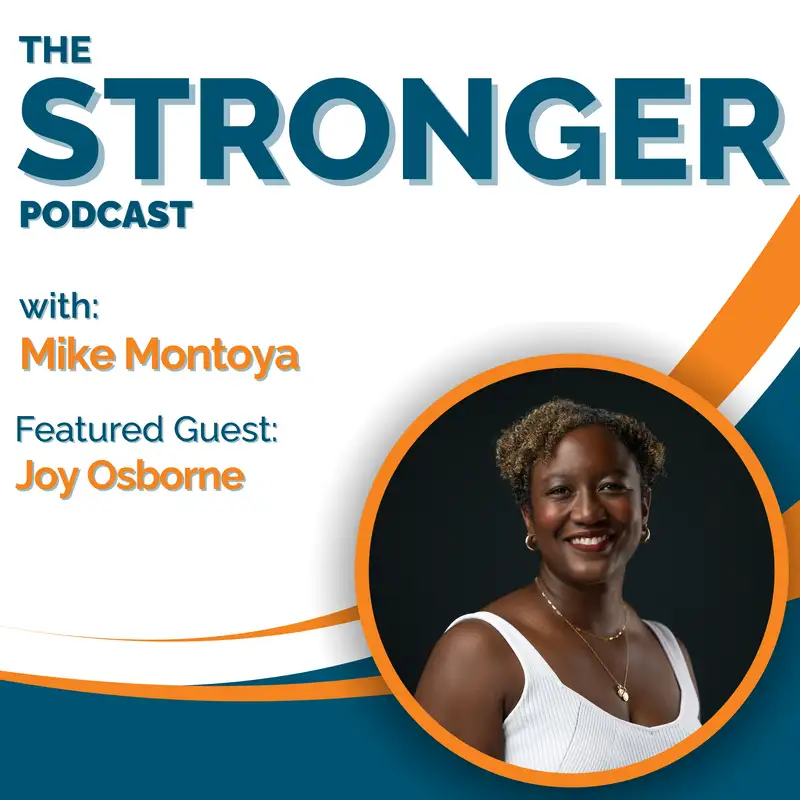
Better Curriculum Isn't Enough: Mapping the Gap Between Common Core and Student Outcomes with Joy Osborne
Welcome to the Stronger Podcast. Each week, we have honest conversations with education and social impact leaders about their leadership and career journeys. We talk about their origins, inflection points, and the work that they're doing today. The conversations are honest, human, and practical. If you're here for real stories and real takeaways, you're in the right place.
Mike Montoya:Let's jump in, and let's get stronger together. Welcome back to the Stronger Podcast. Today's guest went from teaching herself to read at age three in Miami Gardens to now leading student achievement partners, the organization working to operationalize the Common Core standards used in over 40 states. Joy Osborne is the president and CEO of SAP, and she's spending this episode on something bigger than standards, what it actually takes to turn better instructional materials into better outcomes for kids. Let's jump in.
Mike Montoya:Good afternoon. Good morning, everybody, in the Stronger Podcast land. Today, I'm here with Joy Osborne, who's the president and CEO at, Student Achievement Partners. And Student Achievement Partners is the client of Stronger Consulting, and I got to meet Joy a couple of years ago through our work. And I'm super excited to have you.
Mike Montoya:Thanks for being here.
Joy Osborne:Absolutely. I'm excited to be here.
Mike Montoya:I I think there's a there's an anchor here, which I love to hear all the time. It's like a little bit of, like, where in the world, are you as a person, living? And then also, like, where did you start, in your life? Like, and so everybody can kinda get a little context. So
Joy Osborne:Sure. Well, I am physically right now in New York City, but I live, day to day in Denver, Colorado. I've there for the last seven years or so. But I am originally from South Florida. I am from Miami, Florida.
Joy Osborne:Very proud South Floridian. Grew up in the eighties in what was then unincorporated Dade County. But really proud to be from a place that felt like a true melting pot at the time. You know, my family my my father's family is from Louisiana. So southern, you know, black American generation over generation.
Joy Osborne:But my mother's family immigrated from The Bahamas and just really experienced a very Caribbean and international childhood. Have always really valued diversity of experience, of language, of place in my work and in my life. And being a teacher and being in education has really allowed me to lean into that love in the long run. So really happy to be from where I am from.
Mike Montoya:Well, and it sounds like your family has roots still in Florida. Are your are your parents still in the region? Okay.
Joy Osborne:Absolutely. Yeah. And do
Mike Montoya:you and do you have, do you have a, experience of what k through five was like for you as a as a young woman, as a kid, child?
Joy Osborne:Yeah. Totally. Totally. I grew up in an area now called Miami Gardens, kind of Miami Gardens, Carol City. My grandfather was the first black mayor of a part of town called Opa-locka.
Joy Osborne:And these were places that were working class and full of really wonderful people with schools that weren't necessarily what we deserved. And so while I lived in a wonderful neighborhood and a wonderful community, lots of us were finding other ways to be educated than the school that was across the street from me. So some of that meant people going to, like, you know, parochial schools, Christian schools, things like that. For me, it looked like my parents finding ways to transfer me to better performing public schools in the system. And so I actually never went to school in my own neighborhood, kindergarten on.
Joy Osborne:I happened to be a good test taker. And my mother knew enough about the system to know that she could parlay those scores into schools with the kinds of outcomes she wanted to see for her kids. So I I always a commuter. I commuted from kindergarten on across town in various ways, k five. That was to a public school about thirty minutes away.
Joy Osborne:And then as a sixth through eighth grader, I was in independent school as a scholarship student. And that was more like an hour away from my home. And so I was the oldest of four. I sort of started this trend and then my siblings followed in in various ways.
Mike Montoya:It's a commuter family. Okay.
Joy Osborne:Exactly. Exactly. Not always to the same places. So my mom actually didn't work outside the home because so much of her time was spent trying to orchestrate our ability to get where she felt like we needed to go. I love school.
Joy Osborne:I skipped a grade, you know. I I took first and second grade in the same year. Just really loved to read. I taught myself to read when I was three. I still read all the, all the time.
Joy Osborne:All the stuff. All the time. I read like three books a week.
Mike Montoya:Most weeks.
Joy Osborne:I'm a reader. Yeah. And never liked math. Still don't think or see of myself as a math person, which is funny because I lead an organization that is full of math and literacy experts. But, yeah, I have always just believed in the power of education, not just to, like, change our outcomes, you know, economically, but also to just change the way we see ourselves.
Joy Osborne:You know? Like, I literally used to listen to, like, the reading rainbow Mhmm. Theme song and be like, you know what? Like, I do go new places through what I read. Like, I'm not gonna get on a plane for many years of my life.
Joy Osborne:I didn't I I rode my first plane in, like, sixth grade for a school trip. I didn't have access to travel or lots of extracurriculars or anything financially, but my books taught me lots.
Mike Montoya:You to explore. Right? Because I was thinking about, like, Homer's The Odyssey is out on film now Right. This summer. Mhmm.
Mike Montoya:And I remember them trying to help us read that book in, like, high school in the original whatever the heck English it was or something. And I'm like, this is impossible. Right? Because I I had no focus, but, like, I'm excited to see the film. But, like, that's a, you know, epic these epic journeys, right, that can come up from imagination that kids create in our heads when we're especially when we're young, we have we have less boundaries.
Mike Montoya:Right? We can just kind
Joy Osborne:of take
Mike Montoya:words and kind of go. Were you a fiction follower or are you a nonfiction?
Joy Osborne:What do you like? What do you what do you I hate nonfiction. I I do not read nonfiction. I read to escape even now as a as someone who can take myself places. I'd much rather read to learn about different ways of being and try on new ways of thinking.
Joy Osborne:I love, speculative science fiction. I love rom coms.
Mike Montoya:Okay. Yeah.
Joy Osborne:I all kinds Right? Of silly So like, okay. Yeah. Well, if my head can't stop spinning on work, it's really nice to jump into someone else's life and someone else's story for a little while.
Mike Montoya:Yeah. Yeah. I, I I bet any others can relate to that, but I certainly do because it like, it helps me in, I have like versions of myself, which is like, I need a, like an action thriller book sometimes. Then sometimes I think it's a super chill book. And sometimes I have characters that I, like, think about while I'm sleeping because I'm thinking about what's gonna happen to them next.
Mike Montoya:Oh, that's great. It's like a very common thing for me, and I have a very active imagination in that regard.
Joy Osborne:I love that. Sometimes I feel
Mike Montoya:that my husband's why are you so stressed? I'm like, it's because what's going on in the earphones right now? It's very stressful. So
Joy Osborne:Yes. It's a story for me when I was a kid. My mom always tells this story of like, was gathering baby clothes for someone at church. And I asked I don't even remember the name of the character, but I basically was like, well, we should give this stuff to blank. And it was someone I had been reading about in a book, but like they had become so real to me.
Joy Osborne:I was like, no, we should give those baby clothes to Claudia's mom, you know, in babysitters club.
Mike Montoya:And mom's like,
Joy Osborne:not a real person, but okay. You know? I I just I've I definitely inhabit books and find a lot of a wonderful escape in them for sure, even now.
Mike Montoya:Well, I feel like if you were a voracious reader, right, you have I I think your empathy things tune up. And I I definitely learned this in high school, like, the ability to, like, feel for a character's play and challenge. Right?
Joy Osborne:Like, there's
Mike Montoya:lot of hero's journey, stuff like that in
Joy Osborne:Yeah.
Mike Montoya:Literature. And I don't think like, if you don't read, I don't know how you, like, build those skills, right, with I mean, you could do that in your school or context. Right? Things like that.
Joy Osborne:But it's
Mike Montoya:really like books give you the way of doing that in other cultures and other places Totally. Time periods, which is just, I don't know. People I don't know if we recognize how important our brain to tell a story and create the stuff like It's an amazing thing like that.
Joy Osborne:Yeah. It's really beautiful.
Mike Montoya:Do you do you so you're making me laugh about not loving math, but you're in charge of you're leading an organization. Okay. So let's let's let's just transition a little bit. So like you you you got through school, did a lot of running around to go through school. Your your mom clearly thought that was important for you to be successful in
Joy Osborne:that Both my parents did.
Mike Montoya:Yep. Sound right. Mhmm. And so then you you went to did you go to university? And then No.
Mike Montoya:Of course. To be a teacher, or how did that happen?
Joy Osborne:Yeah. Yeah. Well, there's a funny story there too. So my kindergarten teacher loved me. You know, I'm so lovable as a student.
Joy Osborne:And, when I got to sixth grade graduation, someone came to me and said, you know, miss Cattison made this for you. It was a a pillow and it had pictures of different kids of different races around it. And it said kids love joy in the middle. And she said, you know, I think you're gonna be a great teacher one day. And I was like, no.
Joy Osborne:I'm gonna be rich. And that doesn't seem like what you're doing, man. But respectfully. Yeah. You know, exactly.
Joy Osborne:It's just like, you're gonna be a great teacher. Forgot all about it. Went through high school and then ended up going to college in Southern California. So I all I've always had an adventurous spirit, a massage, you know, and, wanted to get as far away from home as possible. And at first when I was in elementary school, I thought that meant I would go to college in China.
Joy Osborne:That's not what happened. I did go to California, however, which is as far as you can get basically in The U S from where I started, you know? Yeah. Yeah. So I ended up going to school in Southern California.
Joy Osborne:And when I was looking for my first summer job, I thought, you know, the way we got into our private school was through this program called Summer Bridge, which is now Breakthrough Collaborative. Yep. And I said, you know, I wanna give back. So I applied to summer bridges all over the country, ended up at Summer Bridge Portland, Oregon. Oh, then that's actually Oh, really?
Joy Osborne:Oh, cool. Don't think we do that. Yeah. Did a summer there and then just had been bitten by the bug. So all of my, like, volunteering during the school year was often with literacy organizations.
Joy Osborne:And then I did Summer Bridge every summer of college. Cambridge, Philly, Portland, like I said. And at the end, like, one of my superlatives in, like, the summer bridge yearbook was, like, most likely to open a summer bridge in every country on earth or something. Like, I had just, like, been bitten by the bug for teaching. Like, I just loved engaging with other people around books, You know?
Joy Osborne:Books are my thing. And I realized that teaching was a way that I could do that, but also advance my belief that education is just like an essential human right and also like a key piece of building and maintaining a democracy. That critical reading, thinking, and writing are key for us to be able to deliver on the promise of self governance that is, you know, The United States constitution. Right? And so I was bitten by a bug that really hasn't left.
Joy Osborne:I still teach outside of, like, my day job. I still, like, do college essay coaching because it really is like
Mike Montoya:Keeps you close.
Joy Osborne:One of my favorite things to do is to engage with a young person about what they're learning and what they're experiencing and helping them express themselves about it. So yeah.
Mike Montoya:Well, so, yeah, I was wondering if this book Passion was gonna be anchored to your life, which it clearly is. It's like an escape, but it's also, like, the pathway, right, by which it, like, helps you navigate, like, this this early adulthood experience. Right?
Joy Osborne:And Oh.
Mike Montoya:You went to the the Pomona the that kinda cluster of colleges. I went to Colorado College. So we we had this competition in Colorado and and those places because they're so similar. Right? They're kinda like master schools, and we used to go as as students there to travel and compete in sports and things like that.
Mike Montoya:And that was, like, a fun a fun thing, and I remember how beautiful the campuses were. And, like, all this is, like, you know, like, the liberal arts kind of curriculum and the approach, like, really gave you the opportunity to still kinda be immersed in, like, real texts and that kind of stuff. So that was, like, super about, super fun. So, yeah, Breakthrough Collaborative, they're they're great. Right?
Mike Montoya:And they're they're doing amazing stuff still in in the the country, right, all over the planet. And that that's an amazing kind of anchor. Right? So these these things got you through college and then but so did you did you just what was your did you major? What was your major?
Mike Montoya:Did you major?
Joy Osborne:I was an English and women's studies major.
Mike Montoya:Okay.
Joy Osborne:And I wrote, you know, my my thesis on black feminist fiction or something, you know, very, very esoteric, very
Mike Montoya:out That's when you came in.
Joy Osborne:Went And straight into an intern teaching program. So at Claremont graduate university, which is right across the street from where I lived my senior year of Started my master's literally the summer, like three weeks after I graduated and became a classroom teacher at the age of 21. And like literally just could never really imagine myself doing anything differently. I think one of the prep questions you asked was like, where does luck or something play into
Mike Montoya:your
Joy Osborne:work? And I think, you know, if, if you had, if someone had told me one, that the job I'm in right now existed and two, that there was a path there from where I started, I would have told them they were absolutely insane. Like, one, like, who are these people and what do they do? Like, someone decides what happens in textbooks and, like, helps coordinate, like, all of the policy and practical pieces that get to, like, what actually happens in a classroom. Had never even imagined or thought about that at all, which is what we do at SAP.
Joy Osborne:But then also this idea that I, as, like, a teacher, would be qualified to be able to support or guide or direct that work, like, an unbelievable to me. And so there have been so many moments when people saw something in me that I couldn't see in myself that have really led where I am, but it all sort of sits in the fact that I'm I'm a teacher at heart, and it is, like, the thing that brings me the most joy. You know? And I try to make it possible for other people to have that experience as teachers in our public education system, even as there are so many things working against that being the reality at this time. You know?
Joy Osborne:Yeah. Yeah.
Mike Montoya:Appreciate you kinda going there because, like, when you're talking about, like, how it's foundational to democratic functionality. Right? I feel like we have a pretty significant gap, and we we see it in our in in the, like, the way the polling data and all that stuff is, like, like, the certain like, the the highly educated, you know, folks are are getting, like, acting in a different way in our society than the the folks that have less education. It's really, an under like, a systemic challenge, right, that exists
Joy Osborne:Mhmm.
Mike Montoya:Across the country. And so and and I laugh about, like, how how the things that and I the older I got, the more I realized I'm like, oh, the history book I read in middle school, right, was not a whole history, and it was certainly, like, an incomplete history. Right? And it was so narrow. Right?
Mike Montoya:And as I go to other other states and the work that I do, I'm like, oh, like they have a whole different version of history than I have. And I'm like, oh my gosh, there's a gap, right, between these people that are like, we both are reasonably intelligent folks, but like just the basics. Right? We just learn different stuff. Right?
Joy Osborne:Yeah. Well, I think that's part of the promise that we wanted to address in the common core. But I think there's also the piece that, like, if you have the critical thinking, reading, and writing skills, you know, you're never limited to what someone chooses to tell you. Right? Like there's always going to be a choice made, right, by someone somewhere about what we're going to get to, whether it's on the agenda or not, whether it's in the curriculum or not.
Joy Osborne:There are time constraints. There are a million enabling conditions or disabling conditions that may keep you from getting there in your sort of state or, you know, school
Mike Montoya:mandated Yeah. Yeah.
Joy Osborne:Path. But if we're building the right kinds of of minds, right, the information is gonna be found when it's needed. Right? And that's, I think, the beautiful piece of now being a parent, right, is to both be able to say, like, school is a process that you engage in for the experience of learning together, and learning in context, learning in community, learning how to negotiate needs and experiences and points of view. And there's also like an inner life for yourself that you can cultivate that is about finding your own values and your own commitments and learning around those.
Joy Osborne:And like there's that balance that I think we're always trying to build the skills that allow for both of those things to be happening whether or not we dictate what the topics have to be. Well, right.
Mike Montoya:Like, that's the richest environment when when, like
Joy Osborne:Yeah.
Mike Montoya:Kids, right, and adults too, when we I call it struggle with stuff together. Right? And then we start to recognize that we do have different views and opinions, etcetera on Yes. On the things. And then we build empathy.
Mike Montoya:Right? And we build understanding, and we start to learn to think new knowledge. The whole idea, like, creating new knowledge is, like, so fascinating to me because I'm like, oh, like, you're the first human ever to think of this thing and write it down in a certain way. And so, like, that feels, like, exciting to me. Right?
Mike Montoya:And I feel like that's, like, the whole endeavor of scholarship, right, in particular, especially in higher ed and all that stuff. Right?
Joy Osborne:Absolutely. Absolutely. But you're, like, always trying to build kids and then people, adults, who are able to think outside of that which they've already experienced. Right? And and believe that there may be something that they didn't see or didn't consider and that those ideas could come back together in a new way.
Joy Osborne:Right? They could change their mind. They can continue to develop and evolve. So it's it's exciting work to do. And I think it's it's so important.
Joy Osborne:And just like creating the space for teachers to do that with kids, I think, is some of the most important thing, you know, stuff we need to do as a society for sure.
Mike Montoya:So I live near one of the world's largest bookstores. The Powell
Joy Osborne:The Powells?
Mike Montoya:Famous Powell bookstore. Right?
Joy Osborne:So I think right around
Mike Montoya:the corner here. So and I would have to go through there. I'm like, oh my gosh. Look at all this stuff I don't know. Right?
Mike Montoya:Or I don't I don't get to enjoy, I guess, too many things.
Joy Osborne:Right? So it's like,
Mike Montoya:we have we're very prolific, right, as as writers and producers of that stuff. And but I'm appreciating that, like, that idea of, like, the joy of learning. Right? And it all matches your name here. Right?
Mike Montoya:And and I don't know if if your parents
Joy Osborne:were Well, thinking about
Mike Montoya:but it's like it's I mean, it's like almost like, you know, fortuitous. Right? Though those things are aligned, and it comes across to the way that you're describing your work and what you care about. And so you you got to Student Achievement Partners, and you kinda came up through work there over some time. Right?
Mike Montoya:And, like, can you just help the listeners and people to understand, like, what is SAP about? Like, and, and like, does it exist in the marketplace? Like there was like, it's trying to solve a thing, right? Or it's still trying to work on a thing, but tell us about that.
Joy Osborne:Yes. Yeah, totally. Totally. Well, SAP definitely existed before I showed up very much so. SAP is one of the most impressive, I think, organizations I've ever had a chance to see up close.
Joy Osborne:You know, the founders of SAP were the primary writers of the common core state standards. And so they were the experts that developed and pulled together the knowledge base that informed the guidance that, 40 plus states took on as the basis for their state standards that would drive their textbooks, and professional learning for teachers, over time. So, you know, over a decade ago, we decided collectively at the state level that it made sense to try to align our expectations, for students k through 12 in literacy and math. Ultimately, right, that means that if a kid is, you know, going to elementary school in California and then they move to Ohio, they pick up in middle school. And what they learned in Cali is directly related to what the kids in their classroom in Ohio would have learned, and they get to sort of continue that learning.
Joy Osborne:When we think about a post secondary workforce or even the collegiate and trade school, you know, folks, they will all have been prepared in approximately the same way for those experiences. This idea that, like, The United States workforce couldn't, bear the kind of variation we were seeing across states that was political, but also, like, largely operational. Standards being revised on different timelines with different inputs and different experts at the table. How could we kind of, like, standardize and make it easy for states to choose similar sets of expectations to push down to their districts for public education so that we could be sure that as a populace, you know, The United States sort of workforce would have the same level of, like, baseline understanding and education regardless of where they were, what their background was, how much funding their school had. Right?
Joy Osborne:That all textbooks and all supporting materials would align to the same rigorous expectations. So SAP took on that gargantuan project back in 2011. And now, fifteen years later, we see a marketplace that really has aligned across the 50 states. Not necessarily always on the topics. Right?
Joy Osborne:The what we teach, but the skills behind that what are pretty much the same no matter where you are. And that's the work of SAP.
Mike Montoya:So the this is and this is a good history lesson. So the the and the common core was like a a cooperative effort, right, across states. Right? It wasn't mandated by anybody. That wasn't, like, a law that came down from federal government.
Mike Montoya:Right? Like, it was, like, governors and and state Uh-huh. Legislatures agreeing that, like, this was worthwhile to achieve for all the workforce reasons. Right? Uh-huh.
Mike Montoya:And almost like there was I always call these, like, magical policy windows occur
Joy Osborne:Mhmm. Occasionally.
Mike Montoya:Mhmm. Yes. You gotta go through them. And Yes. Then it takes some time.
Mike Montoya:Right? Because it as you said, it's, like, been fifteen years. And and in some cases, like, lot of people, like, abandon the core and, like, there was a lot of, and there was, like, some dueling dueling things for a while. Right? At the same time, right, would you share just, like, like, that largely we've achieved a skill set alignment agreement.
Mike Montoya:Right? Yes. Practical ways. Right? And then, you know, like, I I mean, I personally am in in the camp of, like, you know, I there doesn't have to you can learn in lots of ways and lots of lots of things.
Mike Montoya:The content can be rich in lots of ways. It doesn't need to be narrow and focused and, like, only one way of thinking. But, like, if we can all basically learn how to function, right, in a way that, like, we can interpret that information and think care critically about it, that's what we're trying to achieve. Right? And so, I mean, personally, I'm bored with it.
Mike Montoya:I don't have any kids. So I'm like I'm like, I don't care. I mean, I care because I care about the country and I care. But, like, I'm like, I don't have to worry about that wrestling of No. Totally.
Mike Montoya:Conversation.
Joy Osborne:Totally. And I mean, there is focus, right, in the skills and like, in math, we talk about focus, you know, procedural and conceptual understanding. Right? And so really thinking about how, there are lots and lots of topics you could learn about in mathematics. How do we sequence and narrow to the things that we think are most important in terms of the building blocks for who we want kids to be when they exit high school and what they need to be able to do?
Joy Osborne:So that's actually connected to one of our key initiatives right now, which is redesigning and rethinking high school mathematics because of the change in the workforce and the skills needed. Right? Data literacy is a much more central need now for every individual than it maybe has ever been to this point with the advent of AI. Like really thinking about when I graduate from wherever, you know, whether it's high school, whether it's college, whether it's technical school, when I sit in company or I start my own business, what are the skills and the concepts, the conceptual understanding that I actually need to have about things related to mathematics, numbers, quantities, economics, etcetera, and also literacy? And then what are the things that I am really likely to be able to lean on and rely on technology to do?
Joy Osborne:If that reliability is there and we believe it's going to stay there, there are things, of course, I should understand conceptually. I need to conceptually understand how compounding interest works. So before I sign a mortgage, I know, like, That's what's gonna
Mike Montoya:all I do. Yeah.
Joy Osborne:I don't necessarily need to do the calculations of how that turns out myself. I need to understand it. Right? Like there are some things that are changing over time about conceptually what we only like, what we only really need to understand conceptually versus what we need to procedurally understand with precision. And we at SAP are really thinking about across math, literacy, and just learning generally those distinctions.
Joy Osborne:I also said, like, this is something I mentioned I was telling you about the other podcast I was on recently. Like, the other thing I think about AI is like, it's kinda like transportation is like my analogy. Right?
Mike Montoya:Like Yeah. It's like infrastructure.
Joy Osborne:There was a point at which yeah. Like there was a point at which, like, we could only walk everywhere, you know? Then we figured out wheels and bikes and cars. Right? And now we have airplanes and jets and rocket ships.
Joy Osborne:And it's like, we have this full suite of transportation options in front of us, but sometimes I still just need to walk because it's good for my heart.
Mike Montoya:Right? Yeah. All the things. Yeah.
Joy Osborne:I could, I could take a rocket ship everywhere. I don't need to. Right? And so I think we're in this moment with the AI in education piece where it's like, where do we just need to walk because it's good for us? Where does it make sense to get in the car?
Joy Osborne:When does it make sense to get in the plane? And when is it like, you know, you're just gonna have to get on the treadmill? Like, there isn't really a way around what your body and your brain needs in this moment, even though you could get there a different way. Right? And so I think we're really trying to think savvily about what that means for what we mandate, as the skills and the experiences students should have in public education across the nation.
Mike Montoya:Well and you're touching on such a, I mean, salient relevant topic. I look at my my own AI stack of things. I have Thank you. So many tools now, and they do amazing stuff. And I'm like, oh my gosh.
Mike Montoya:I still, like, still at the core. I'm, like, just having to, like, conceptualize, like, what is this picture, right, that I want this thing to help me create? And then the thing helps me create it much faster, right, in that regard. I was noticing the University of Chicago just passed some internal structures, which is like, no AI in social sciences, no tech in the classrooms. Professors can't use AI to grade papers because they're trying to find they're trying to find this thing that actually help people still learn, right, and still Yes.
Mike Montoya:And still think for themselves. And so I think it's interesting when, like, big universities who are scholarship oriented, right, get into this game in a serious way. It hopefully will help sort of, I call it, tamp down some of the, you know, just excitement about it. Everybody is excited about it. And every we're also all, like, watching how afraid we are and what's gonna happen.
Mike Montoya:Yeah. Happening so fast. Right? So
Joy Osborne:Yes. No. Totally. I mean, I think that there's something about how do we reach clarity and conviction within ourselves. Like, I I've been thinking a lot about this.
Joy Osborne:Like, how do I get to a version of an idea that I know so inside and out that I can't be moved from it, I have to play with that idea. I have to know that idea. I have to play devil's advocate. I have to ask people to poke holes. I have to fill those holes.
Joy Osborne:And I'm finding that AI can be a really good place to hold on to my various versions of my thinking. It's, you know, it can be really helpful for that. Like, this is what I thought last week. Then I had these three conversations and now I think this. And, you know, people used to do tape recording.
Mike Montoya:Yeah. Yeah.
Joy Osborne:Say it's like the same thing kind of. Right? Like, you wanna be able to go back to your old tapes. Wait. What did I think?
Joy Osborne:When did my thinking change? How did it change? Except it's able to give it to me in a you know, I don't have to relisten to the whole tape. Right? It can listen to the tape for me.
Joy Osborne:But I do think there's still that process of, like, I'm in conversation with myself, not with Claude. Claude is a mediator for my conversation with me to get me to the place I need to go. And I think that's something that as an adult, I'm really able to value. I wanna make sure that we are, modeling for and helping students, younger people, children find that, you know, they are the ones that they wanna be talking to ultimately. Right?
Joy Osborne:You don't have to depend on this external entity to be the thing that's holding your thoughts. Your thoughts are yours. Yeah. It's here to mediate yourself back to you. And I think that as a mother of a four and a seven year olds who are entering a much different world technologically than the world I grew up in, you know, of rotary phones,
Mike Montoya:like eighties. Yeah.
Joy Osborne:You know, Like we're talking, you're, you're talking to yourself and when you make a choice, it needs to be one that you are confident in. I don't want to hear no excuses about Claude told you to, Nah. Okay. But you gotta know. The kids
Mike Montoya:know what Claude who Claude is or what
Joy Osborne:Claude Absolutely not. But they do know Alexa. They know Alexa. They know Siri. Siri's always showing up in conversations where she is not invited.
Joy Osborne:Invited. I agree. You know, they know they know AI.
Mike Montoya:Okay.
Joy Osborne:For sure.
Mike Montoya:Yeah. For sure. I mean, everybody's experiencing it regardless or whether we want to or not. Right? It's it's like it's almost like, you know, air now.
Mike Montoya:Right? It's everywhere we are. It's everywhere. We we kind of were gonna come become dependent on it. Like before there was the Internet everywhere, now it's everywhere.
Mike Montoya:Right? And so
Joy Osborne:Well And algorithms aren't new.
Mike Montoya:Oh, no.
Joy Osborne:Right? Algorithms that talk to you might be new, but algorithms are new. There've already there's always been ways that people decide who gets what mortgage rate. Right? Or who gets to live where or who gets that loan or, you know, algorithms.
Mike Montoya:I mean, MBA's analysis, like a magic computer in that regard. Right? For sure.
Joy Osborne:Exactly. If I if I
Mike Montoya:can make one argument for, or, I call it champion a cause of, like, please teach all children how to read a profit and loss statement. But that's in, like, eighth grade would be great. Maybe sixth
Joy Osborne:grade Financial would literacy. Yes. For sure. For sure.
Mike Montoya:We have a pretty big gap. I feel like this is kind of in the same vein of like, oh my gosh, if we could teach kids how to like do, you know, proofs and formulas for geometry, we should be
Joy Osborne:able to
Mike Montoya:teach them how to read a financial statement. It would Absolutely. Be And I'm like, oh my because like we all need geometry sort of to some extent in some part of our lives, but we also, you know, we should be able to I think we used to balance our checkbooks was a thing in the day. Right? That was our version.
Joy Osborne:Well, remember that was like an activity we only did in gifted class. I was in gifted and I went to gifted on Tuesdays and Thursdays. And in math and gifted, we had to bring in like an old checkbook from our parents and we'd get a catalog and a budget. And we had to like balance our checkbook and make sure we had money for groceries and all this kind of stuff. And then I came back to regular class and they're like, we were doing a worksheet.
Joy Osborne:Right? Like, we've always decided that some people get access to certain kinds of skills and not others. I say the biggest shift that happened to me when I moved to independent school was that people started to assume I would be in charge. And I was treated like I would be in charge. That is all all the things that happen at independent school are preparing you to tell people what to do, not to accept instructions.
Joy Osborne:And lots of things that happen in public school, especially depending on which public school and what neighborhood serving which kids, are about
Mike Montoya:cog. Yeah. Follow.
Joy Osborne:Doing what you're told, not asking questions, Not necessarily believing that freedom is something you're entitled to. And so one of the things I think has been most driving in my experience as an educator is to say like, I want every kid to understand that they have agency, that they have the choice, that they should ask questions. Now whether or not kids are put into situations professionally where they get to leverage those skills is one thing, but not even knowing that they're there, I think is a crime. So, you know, I think those are things that I think about on top of like, what math should you know? And like, can you read?
Joy Osborne:There's also like, in what context are you able to use these skills to better yourself and your community? And those are important parts of the puzzle for me as well. Yeah. Absolutely.
Mike Montoya:Well, and it's like, I mean, you're you're I mean, I'm gonna use the word, like, you're championing a cause in a social movement and social justice, basically. Right? In the sense of, like like like, we have basic human rights that need to be developed and and and achieved and experienced. And and, you know, when we sometimes we get really lost in, like, equity language, which is Mhmm. Like, you know, the firestorm right now.
Mike Montoya:Right? Yes. But it it's, on my note, is that, like, there's never been an issue with some people getting rich and having an opportunity. It's really about oftentimes, I got there by exploiting, by all the people that we talked about that just are told what to do and how to behave and just what role their job is to support the people that are getting rich. Right?
Mike Montoya:And it's not just about rich in the, like, financial sense, but, like, just all the the fruits of life, right, that it should be available to humans because they are, right, are are have been, like, captured and kept in a very
Joy Osborne:Yes.
Mike Montoya:Discreet little box. And, like, AI is a great democracy equalizer in many ways. Like, I see how fast people can build businesses and solve problems that they could never have done before, right, without a bunch of experience and training, etcetera. Now they can do it much more readily and accessible. So I I'm hoping right?
Mike Montoya:And we were talking about this with one of my medical friends recently. It's like, like, man, the access to medical data and information that, like, you could never get before is, like, sort of
Joy Osborne:off the charts.
Mike Montoya:Right? So, like, I guess there's promise here. Right? And so Yes. Let's let's shift a little bit to, like, okay.
Mike Montoya:SAP now has a very almost the challenge got bigger. Right? And you're trying to shape and move the market in a particular way. So what is the what is the vector or a couple of the vectors that you guys are really focusing on?
Joy Osborne:Yeah. So I think, you know, at at its core, the question is so SAP has had so much success in moving the collective conversation towards these skills that we should make sure every kid has regardless of where they happen to have been born, you know, within The United States. But the more that I work with SAP, I learned, like, this is actually a global thing. Right? People reference The United States education system outside of The United States very much.
Joy Osborne:Right? There's The UK system, the Cambridge system. Like, there's a European set of ways of thinking, and then there's the American one. And then many others countries are kind of aligning to one or both of those to prepare their people to be able to compete, in an economic reality that we kind of determine. So the work we do at SAP is not just US.
Joy Osborne:You know, it is really global. And I think right now, one of the things that keeps me up at night is like we've improved the quality of the products. We have said there is a floor that you need to meet that's higher than any other, you know, sort set of expectations we've had. Yes. Yes.
Joy Osborne:Right? Like, we've set up we've set a bar. What we haven't seen, though, is the wholesale and durable shift of student outcomes that comes from that. And I, right, as a kid who lived in that gap, right, whose school across the street wasn't wasn't getting to the student outcomes. So I just went and found another school.
Joy Osborne:Right? Because my mom had the ability and the network and the knowledge to do that. Yeah. They we're we're trying to figure out what what is going on in that gap. We did our we we did it.
Joy Osborne:We got the quality of the materials better. We aren't seeing the promise of those materials show up in student experience. And I think there's a there's a very studied but not capitalized upon, issue somewhere in there. What we're trying to understand right now is how to map that gap. Who knows what's going on?
Joy Osborne:How much of it is contextual? How much of it is a shared challenge? How much of it is about resources? How much is it about people not knowing what it should be? And start to, like, make collective shared knowledge about how we go from better stuff to better outcomes.
Joy Osborne:And so that's like the the vision for the next ten years of SAP's impact is how do we not stop at, well, we made the stuff better and actually get to, we as a system are better equipped to help students be successful. And that means, you know, lots of different pieces of the puzzle are coming together to work towards that coherent experience for students that actually leads to outcomes. And outcomes not just meaning, test scores either. Right? Like, how does that actually translate into people who are ready to enter the workforce and be successful?
Joy Osborne:Yeah. I'm like that is a much bigger and scarier question maybe than even moving the market this far has been. But I think it is one of the things that we are uniquely positioned to do, because we have connections, you know, at all levels of the system and really work with folks from individual teachers all the way up to state, leaders and are able to sort of align their needs to one another through the work that we do.
Mike Montoya:Yeah. And I, that's helpful to hear about the alignment bit in particular, because lots of times it, in my view is that like, it's, it is like a tangled web of things, right?
Joy Osborne:That
Mike Montoya:is, that take a long time to shift into a place where there's some alignment and kind of coherence. We use that word a lot. Right? And it's Yes. We do.
Mike Montoya:Yeah. Quite incoherent in many cases. And the movement of, like, big systems and big public systems is, a huge challenge. Right? Because there's so many things that get in the way of, like, just turning the corner.
Mike Montoya:Right? Etcetera. Mhmm. And so so, yes, I feel like I feel like our work is not gonna be done soon, Joy, in this regard. We have we have a lifetime's worth of work.
Mike Montoya:Right?
Joy Osborne:And We have ways to go.
Mike Montoya:It does take time, and it takes people's commitment over time, right, to focus on that. So I'm gonna shift gears to sort of towards we turned we rather I call it the last quarter mile on a horse track. Right? Yeah. We started thinking about, okay, we're coming into the end and thinking about, like, you as a human.
Mike Montoya:Right? You're you're a person who grew up in your experience that you've shared, and now you're leading in this space in a particular way. But, like, from a leadership standpoint, like, what are what's what are one or two things that you are, I call it, relying on now, right, that's helping you meet the moment, right, that we're talking about. Right? Like what and it's almost I know it's gonna be there's probably a really esoteric answer here too, but also, like, just what's the what are the things that are coming to you when I ask that question?
Mike Montoya:I
Joy Osborne:will say, you know, first of all, I'm gonna shout out my forties. I feel like being, I'm not afraid to say that I'm in my forties. You know, I don't I don't have any issues around my age. I feel so lucky truly to, continue to become. And one of the things I feel like I am more and more in touch with as I get older and give less Fs is my own central, like, moral compass.
Joy Osborne:Like, I I when I first took this job, I had a lot of impostor syndrome. I had a lot of self doubt, And I kept asking other people questions. Well, what do you think I should do? What do you think? Well, what do you think?
Joy Osborne:What do you think? And eventually I was like, oh my god. Like, I need to start asking me. And I I had to really actually find a trust in myself that, like, I am a smart person. I have a I have values.
Joy Osborne:I am committed to good outcomes. And I can I can find in myself my answer? Of course, I wanna get other people's feedback and I don't want to shut out the rest of the world. But if I don't find a central sense of confidence in my own perspective, I will never be able to do this job well. Like, I have to believe in myself.
Joy Osborne:And so I think the thing that my leadership sort of journey and story is really one of, like, beginning to trust my own instincts in a way that I, never had before. And and that it doesn't change. You know, when I was a teacher, I believed in my own instincts. But then I thought, oh, well, now I'm a principal. I don't know if my instincts are trustable anymore.
Joy Osborne:And, oh, now I'm a, you know, a leader of a national organization, and I sort of go into the loop of self doubt again. And just believing that, like, I'm the same person Yeah. Throughout all of that, and it's enough, has been life changing in many ways. Hard to find sometimes that quiet sense of confidence. But once I get there, it's always worth it.
Mike Montoya:Yeah. And I appreciate that. You're talking about, like my version is that, like, it's called, self actualization in the sense of,
Joy Osborne:like,
Mike Montoya:you're recognizing you've like, you trust yourself more wholly because you have a
Joy Osborne:much better
Mike Montoya:understanding of yourself as a person. And Yes. I think the, like, impostor syndrome is a thing that a lot of folks have. Right? And almost if you don't have it, you're very special.
Mike Montoya:Right? Yes. In most cases. And so but, but, but also a lot of like leaders grow through that. Right.
Mike Montoya:And they become, and they start to recognize that like there's power in who you are, power in your experiences. Right. And that, that, and then that alone, and we have lots of leaders who like lead without any moral compass, right? Like plenty of people that are doing that. So it's not about morality, but it is about like, being in yourself and being able to bring that, that to the world in a special way and, and with confidence.
Mike Montoya:Right. And I think you used the word confidence. I, I Totally. Second that in real hard. So, thanks for the reflection on that.
Mike Montoya:And I tried to put people on the hook and be like, yeah, I just but I wanna kinda hear where it's like
Joy Osborne:No. I was like, right here, like I'd sit literally, when someone the first time someone called me about taking this job, I said, but I'm just a teacher.
Mike Montoya:Just a teacher.
Joy Osborne:Like how, how could I do this? I'm just a teacher. Like, and I wasn't. I mean, I had been a, I had been a principal. I had been other things, but in my heart, I believe like I'm here to be a teacher.
Joy Osborne:Like that is my, my core purpose. And she goes, well, that's exactly why you need to do it. And I I just couldn't see that. And it took me a while to get there. I'm there now.
Joy Osborne:But like who I am at my core was actually plenty. And I just Yeah. If I think so many folks, when I talk to them about taking on new roles or stretching themselves, you know, I have to say like 90% of the time when I'm coaching people, it's like, who you are already is enough. Right? Like, of course you need to like refine, but you've got everything you need already in there.
Joy Osborne:So let's go. You know? And, the job of a great leader and I think coach is ultimately getting you to believe that. So it's it's one of my favorite things to do. And it's a teaching tool.
Mike Montoya:It was that it
Joy Osborne:that it
Mike Montoya:it was.
Joy Osborne:Yeah. Coach and teacher are
Mike Montoya:really close.
Joy Osborne:Exactly. Yeah. They're pretty much the same Yeah.
Mike Montoya:One is a little but sometimes teaching seems like imparting knowledge, and the coaching is about, like, eliciting, like, self. Right? And and some of that work. So I feel like there's a little tweak. I'm sure there's somebody out there who will shoot me for saying all that, but, know, like, I'll just I'm gentle.
Mike Montoya:I'm just using my own language. It's my show. So There you go. You know, that's kinda my my thing. Let me let me say this.
Mike Montoya:I wanna, a, appreciate you for, I call it, just being who you are and and stepping into this work that you're that you're leading through into. It's it's a pleasure to to have you as, you know, part of our Stronger family and and and and the work that we're doing. And I feel like I mean, you know, my life's journey has been about helping other people achieve great things by supporting their work. Because the things that you guys are trying to tack tackle, right, are things I'm like, I can know about it, but I don't wanna do it. And also, I'm not capable.
Joy Osborne:I'm not
Mike Montoya:trained that way. I don't know
Joy Osborne:the history. I don't know the stuff. But like
Mike Montoya:the it's about, like, the collective geniuses of of things coming together. And it's been a privilege to spend time with you today.
Joy Osborne:Well, thank you so much for having me. You said it would fly and it did. I'm like, oh my God. That's it. That was fast.
Joy Osborne:That wraps it up.
Mike Montoya:So talk everybody in Stronger. We'll see you very soon. Enjoy. We'll wrap up. Thank you very much.
Joy Osborne:Bye, Mike.
Mike Montoya:That's my conversation with Joy. What stuck with me most was her point about leadership, that trusting your own instincts doesn't change as the job gets bigger. You just have to keep believing that you're the same person who earned that seat. If you want to learn more about Student Achievement Partners and their work on literacy, math, and instruction, check out the show notes, and thanks for listening to The Stronger Podcast. We'll see you next time.
Mike Montoya:Thanks for listening to The Stronger Podcast. If this conversation inspired you, we invite you to follow the show and share it with someone who's on a journey to become a happier and healthier version of themselves. Links and resources are in the show notes. See you next Thursday, 9AM eastern time. Have a great day, and stay strong.
Mike Montoya:Podcaststhatmatter.org.