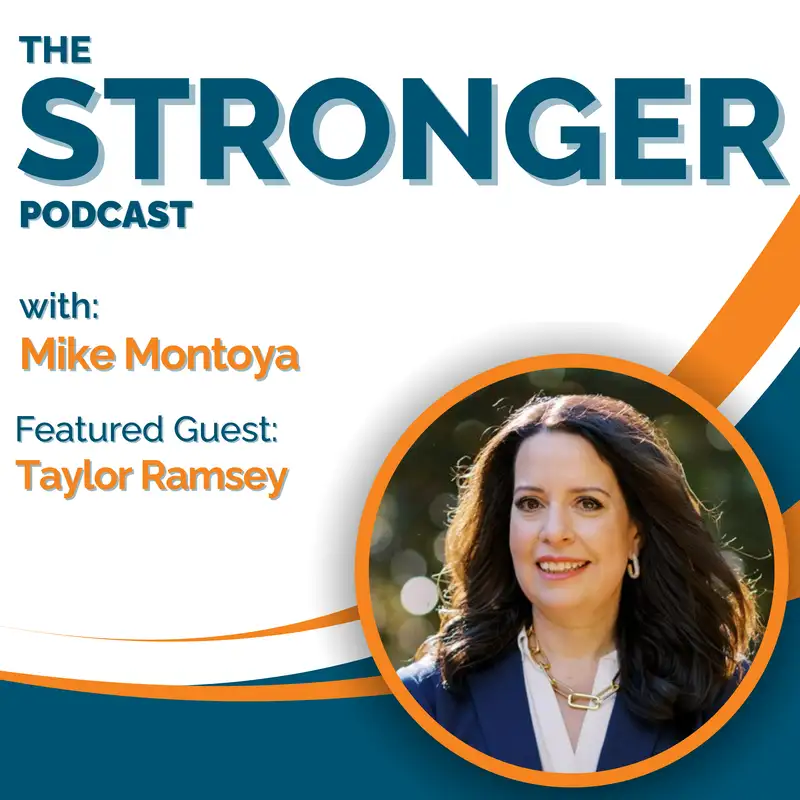
Focus on What Is Possible, Not What Is Probable: How OneGoal Georgia Walks Students From a Diploma to a Credential (with Taylor Ramsey)
Mike Montoya: Welcome back to the Stronger Podcast. Today, I'm with Taylor Ramsey, who leads OneGoal in Atlanta, Georgia. Taylor grew up in Honolulu, was raised by a single mom who became a local activist.
Mike Montoya: That shaped everything that came next. Let's get into it. Good afternoon and good evening to everybody in the podcast line and Stronger Consulting.
Mike Montoya: Here with Taylor Ramsey, who is the executive director of OneGoal in Metro Atlanta. Metro Atlanta is a gigantic place if you have never been there. But, Taylor, thanks for spending time with us. Thanks for being here.
Taylor Ramsey: Of course. Thanks for having me.
Mike Montoya: Taylor, I'd always love our guests to just start with, like, well, where are you physically today? Because, like, people move around a lot. And also, like, let's let's talk about, like, where where where were your childhood origins?
Mike Montoya: Like, where did you grow up? And what was the the K-12 early school's life like for you?
Taylor Ramsey: Sure. Yeah. Well, right now, I'm sitting in a fairly sterile conference room in Atlanta, Georgia in our office, which we do love.
Taylor Ramsey: But, yes, physically, I'm in the metro area, and they're... You know, a stone's throw down the way are places like Georgia Tech and Georgia State University and the high schools we serve. My family and I live in a a suburb about twenty minutes outside of the city.
Taylor Ramsey: And I name that because that is... Feels like a very long way from where I grew up. And sometimes I look around, and my husband's from India, and I say to him, could you ever imagine when you were a little kid that you would live in a suburb called Dunwoody, Georgia in this home surrounded by these other homes?
Taylor Ramsey: And for for both of us, the answer is no. I could never have imagined this, as where I would have ended up. My fun fact is always that I was born and raised in Honolulu, Hawaii, and I was not a military kid, but my mom did run away from home.
Taylor Ramsey: My mom actually grew up in the Ozark Mountains and dropped out of high school in tenth grade, growing up in some real challenge and ran away from home and through a whole series of events, herself in Honolulu, Hawaii. And if you've never been to Hawaii, I always say I grew up in Inner city Honolulu. And if you think there isn't one, there very much is one.
Taylor Ramsey: And I grew up in a 32 story apartment building surrounded by other 32 story apartment buildings, growing up in a very diverse community. So most of my classmates and neighbors were from all over the world. Right?
Taylor Ramsey: From China, Japan, The Philippines, Laos, Vietnam, you name it. And so I was actually in in... You know, growing up in such a diverse place, I think gives you an incredibly unique perspective on the world.
Taylor Ramsey: And I I think of myself as someone who can be a little bit of a chameleon because of it. And, I think a little bit about my origin story too would explain kind of how I got into this work. But, you know, I shared a little bit about my mom's background.
Taylor Ramsey: My mom had me fairly young, only having a tenth grade education, and was fortunate enough to be connected to a social worker who helped her get into a GED program and then eventually enroll in her local technical community college. And my mom would be in a job training program where she would study to become a medical transcriptionist.
Taylor Ramsey: And that profession is pretty much a bygone profession now. You know, in about a year, my mom went from having, you know, again, a tenth grade education to then a technical degree and could move from the service industry into the medical profession. And I always say, like, it wasn't a fairy tale.
Taylor Ramsey: We did not magically lift ourselves out of poverty, like very far from it. And there's dignity in all work, but it is certainly the case that some work affords more economic opportunity than others. And for my mom, being able to transition from the service industry to the medical field would honestly change the trajectory of our lives.
Taylor Ramsey: And my mom did not let us forget that. So she wasn't a person who... We were not unaware of our circumstances.
Taylor Ramsey: My mom always was... Made it very clear. We are the working poor.
Taylor Ramsey: Let me explain what that means to you. And that was an ethos that I think stuck with me forever and eventually would lead me to the work I've done in education.
Mike Montoya: So, well, thank you for sharing about your your family and your mom and and kinda how she got rolling into the world. Right? Like, it...
Mike Montoya: It's, the course and the path, right, for for young people is, I call it circuitous sometimes. Like, it winds its way through lots of different experiences and and circumstances. Like, I'm imagining the towers right in Honolulu, which I've been to, but also, like, in my head, I'm like, I I wonder what the...
Mike Montoya: What it felt like. Like, did you did you have a community of children and friends that you felt close to in that environment? It sounds like there was a very diverse space with our children. What was the schools like? Can you hear me still?
Taylor Ramsey: Yes. And... Yes. Are you there?
Mike Montoya: I'm still here.
Taylor Ramsey: I think I heard you. Yeah. Okay.
Taylor Ramsey: Yep. Yes. You know, my mom would my mom would live in Hawaii.
Taylor Ramsey: We... For twenty years, and I lived there right up until high school. And, you know, another, I think fortuitous thing that happened is that, again, by way of this social worker, my mom was, connected to a support group for single mothers.
Taylor Ramsey: And many of those women are still my mom's closest friends to this day. And we're like what we would call like Calabash aunties and uncles, Calabash cousins. And my mom did have this real unique community of other single parents that were kind of experiencing the same struggle.
Taylor Ramsey: But the other interesting thing that happened with my mom and I think very much connects to to where I am today is... And this is actually kind of an interesting story if we have a minute. I was going to Head Start.
Taylor Ramsey: And, you know, Hawaii is a very expensive place to live, And there's more working parents per capita than anywhere in the country, like parents work. And so affordable childcare is a really important issue in Hawaii, has been, always will be. And apparently, this was back in the early eighties.
Taylor Ramsey: There were about to be some cuts made to affordable childcare and the Head Start program. And so a local advocacy organization called the Hawaii Child Care Project went around to Head Starts and said, we need some parents to come and speak to the legislature about what it would mean if cuts were made. My mom had never voted, did not even know what the legislature was.
Taylor Ramsey: She was in her early twenties. And my preschool teacher, Ms. Hatta, who is probably no longer alive, said, you know, I got this real spitfire mom. I bet she'd be good.
Taylor Ramsey: And to hear my mom tell the story, according to her, she went to the Hawaii State Capitol and, quote, brought the house down. And if you ever meet my mom, she's probably right. That is probably right.
Taylor Ramsey: And so my mom found this really unlikely path into activism. So while my mom was kind of traversing her own journey to economic mobility, she also became eventually this pretty well known local activist. And, you know, you can imagine this is the time of, like, the first set of Gulf Wars and things like that.
Taylor Ramsey: So, like, what started with, you know, issues facing working women and children and families also then transitioned to racial justice and nuclear nonproliferation. And so, like, I spent a lot of my childhood sleeping in the back of, like, YWCA conference rooms where, you know, my mom and other activists are, like, out, you know, strategizing to all hours of the night.
Taylor Ramsey: So I still didn't say, like, yes, we had this incredible community and this very diverse community that my mom found herself a part of that clearly imprinted. Like, when I was little, was like, oh, I hate this. You know, I hate politics.
Taylor Ramsey: And then of course would find myself doing very similar work as I got older.
Mike Montoya: Well, was gonna say, it's, unconsciously, right, it's like shaping, your future because you're, like, picking up on all this information, right, from from the the women and they're strategizing, which makes sense. I mean, you know, it's it's super powerful to hear about that. Like, a person who who basically had no involvement in political life at all, right, became such an active, participant.
Mike Montoya: It's almost like this is what we wish for Americans' children all the time. Exactly. We try really hard to get them civically engaged and connected, but your mom chose to walk in that path.
Mike Montoya: Do you do... Did you did you ever have a discussion with your mom about this? Like, the, like, her motivations or, like, you know, the...
Mike Montoya: You know, why she did this? Because I I can imagine. Right?
Mike Montoya: But I'm wondering if you ever had chatted with her about that.
Taylor Ramsey: Yes. And that is the fortunate thing about my mom. We talk about everything.
Taylor Ramsey: Yeah. I mean, I think my mom will say, you know, I went from a person who felt fairly disenfranchised. She would not have had that vocabulary.
Taylor Ramsey: She would not have had that language at first. Right? Felt fairly powerless, fairly unknown, unseen to feeling powerful.
Taylor Ramsey: And what we've also talked about too, and it's interesting when it comes to leadership, I think to... For the first time, probably felt like a person of value. And so in some ways went so hard in that, like, my mom was working fifty plus hours a week in her day job and doing all this activism work.
Taylor Ramsey: My mom was exhausted. My mom was burnt out. We were eating out three times.
Taylor Ramsey: Our house was a mess. Right? Like, we've actually...
Taylor Ramsey: We've been able to kind of reflect now too that there were some downsides to that. And that's something I've had to struggle with, which is like, how do you get your value and your worth, not from all this, like, external validation? And it's not that my mom didn't care.
Taylor Ramsey: She really did. This was a part of her ethos. And and also, I think, you know, you can start to become where that's so much of where your self worth is coming from.
Taylor Ramsey: And, you know, again, back in the early eighties, like, concepts of balance and things like that, like, that wasn't on the... That wasn't in the lexicon yet. Right?
Taylor Ramsey: So there were there were some shadow sides to that. But all in all, a very a very powerful model that, yeah, was imprinting on me all along my childhood.
Mike Montoya: Well... And, like, yeah, it's... It is a privilege to have, like, the ability to be in that role, and not do it from a place of hard work and drive, right, that that it comes from just the need to participate and and be seen in many cases.
Mike Montoya: Right? Like, I think it's fun to hear you reflect on, hey, maybe we can do it differently now that we're the next generation of sorts. Right?
Mike Montoya: But I remember my mom also working really hard at things, right, that felt important and powerful to her at the time. Right? And I make...
Mike Montoya: I'm like, I could see that. And also, as you said, there's some draft that happens with that, where there's, like, consequence, right, to the family, to the house. As you said, I can remember my house being, like, imperfect because, right, my mom was always doing stuff, right, that was kind of in our favor as as children.
Mike Montoya: But I think I learned a lot about, like, hey. If you engage in something and you work hard at it, you can get something done. Right?
Mike Montoya: Which then gives you, again, strength in some regards. Like, it's not always the healthiest. Sometimes I call it intrinsic, extrinsic work.
Mike Montoya: Right? That kinda happens a lot. So Yeah. Do you feel... Go ahead.
Taylor Ramsey: Oh, well, I was just gonna say, I mean, so many... My mom has reminded me in a good way of, like, do you know how lucky you are to be able to do mission driven work and get paid for it and get paid well, right, as I've been able to progress? Like...
Taylor Ramsey: And, you know, I'd like to think that I do, that I do recognize that, that it is a real privilege. And, yeah, I think, you know, just a social justice sort of ethos where once you know something, you you have a responsibility to do something about it if you can.
Mike Montoya: Well... And I think you're right. I mean, if you picked that up, there's a Spider-Man quote about that great responsibility or something like that.
Mike Montoya: Right? There's a... I've been watching the Spider-Man movie come around, but, like, there's there's a question about, like, what happened after high school into college.
Mike Montoya: You went to a liberal arts school in the Northwest Of The US. Yes. And then what was the...
Mike Montoya: Did you did you plan on getting into social justice work? I know I know a little bit about your, like, pathway into Teach For America, et cetera, but tell me about, like, what that was like post-high school, post college.
Taylor Ramsey: Yeah. I mean, I will say if, if I had any resentment as a young child of just being dragged around to, like, one meeting and one protest after another. You know, when your kid is like not that fun, you're like, can we just like go to the beach on a Saturday?
Taylor Ramsey: Do we have to go to meetings and protest every week? That was pretty... That that was gone by high school.
Taylor Ramsey: And, you know, this sense that there was good to do in the world, there was injustices. I think I was very aware too of... My mom and I had very transparent conversations as I was getting older that my mom was like, it wasn't if I was gonna go to college, it was how and when and where.
Taylor Ramsey: And my mom was very clear. I want you to have a path that is different and easier than my own. Like, I've accomplished a lot, but still...
Taylor Ramsey: Like, we were on public assistance all the way until I was in college. I... We were on public assistance my entire childhood.
Taylor Ramsey: I remember deeply the shame of using food stamps at the grocery store and the cute boy from my school being the the, you know, the bag boy and the... Like, truly, like, the deep humiliation I felt. That was definitely a part.
Taylor Ramsey: And, you know, my mom said, like, I want something different for you. I want your life to be easier, frankly. I want you to have more margin.
Taylor Ramsey: And so going to college was kind of a no-brainer. It wasn't the easy path, but it was a no-brainer. I was, I think fortunate.
Taylor Ramsey: I loved school and I was good at school and I was a good student. And I got a lot of accolades for that, and a lot of support along the way. And then yes, when I found out about Teach For America, it was a no-brainer for me.
Taylor Ramsey: So like, you know, I'm 22 years old sitting in this interview. I tell the interviewer, I'm like, there's no plan B. This is my only choice.
Taylor Ramsey: This is the only thing I wanna do. I honestly don't know where I would have been without it. And it definitely did shape my life.
Taylor Ramsey: You know, Teach For America talk about, you know, nonprofits and leadership, high growth phase, young people, idealistic. And if you showed some talent and some commitment, like you could do a lot of things. And, and when I found Teach For America, I won't lie.
Taylor Ramsey: It was like, oh, I'm home. These are my people. And it was, you know, it was exhilarating. It was really hard and it was exhilarating.
Mike Montoya: Did you, did you do, so you were a core member and you, were you, where did you do your core member experience?
Taylor Ramsey: Baton Rouge, Louisiana. Baton Rouge. That was an education.
Taylor Ramsey: So growing up in Hawaii and then in high school on the West Coast in college, you know, I have, two brothers who are half black. So we have a same mom, different dad. And my mom growing up in the South, you know, I think I felt this kinship just through the stories I'd heard, et cetera, to maybe communities in the South.
Taylor Ramsey: I very quickly got there. I was not from the South. Then it became very clear very fast.
Taylor Ramsey: It's like hearing the stories that my mom told of her upbringing is very different than having ever lived in a totally different community. And Hawaii and the Pacific Northwest, diverse, but in a very particular way. Being a person who was white, moving to a community that was predominantly black, I realized very quickly, yes, you know, those of us who have biracial and interracial families, that's great.
Taylor Ramsey: It also does not mean that you understand the experience you're walking into. And that was certainly an education and a fast one for me.
Mike Montoya: Yeah. So... And so in Baton Rouge, right, at the time, so this would have been, like, like, the early two thousands or something like that, roughly.
Mike Montoya: Like, there... It was, like, going through a lot. Right?
Mike Montoya: And Katrina hadn't happened in the region yet, but, like, there was still, like, a lot of need with schools and communities there. I think there's still, like, an ongoing, like, you know, effort, right, to obviously to reform and improve the school systems. Like, did you...
Mike Montoya: So were you situated with a bunch of other core members? Did you guys, like, have a a camaraderie of, like, we're always together all the time kind of experience?
Taylor Ramsey: Yes. But I was the only Teach For America teacher at my elementary school. So the teacher was teaching at.
Taylor Ramsey: And I will say, you know, it was it was such a powerful experience. And there's some students that I still keep in touch with. They're now in their mid thirties.
Taylor Ramsey: And there were so many teachers. I mean, the teachers there were incredible. And it was actually a pretty diverse, teaching staff.
Taylor Ramsey: And it was really something to build relationships with teachers and realize very quickly how much I had to learn. It was a very humbling experience. I had an incredible principal, Ms. Garrett, and that was actually one of my like early leadership models.
Taylor Ramsey: She was very tough. Actually, this is another interesting story. Very tough.
Taylor Ramsey: She'd walk into a classroom if the if the school... If the student work on the bulletin board didn't reflect high quality student work, like, would take it down. And she'd be like, this is not good enough to be up on that bulletin board.
Taylor Ramsey: Like, this does not meet expectations. I was terrified of her most that year. And then that summer that summer, the executive director of Teach For America in Baton Rouge calls me and says, do you know that your principal wrote a letter to me about you?
Taylor Ramsey: And I was like, oh my god. What? What?
Taylor Ramsey: She wrote a letter basically saying like, miss Ramsey is one of the best teachers we've had. And I wish we would have more teachers like miss Ramsey. And I was like, totally flabbergasted.
Taylor Ramsey: I think I'm cut from a similar cloth, which is like a little bit like I'm a tough love kind of leader. I have high expectations. I don't know.
Taylor Ramsey: I actually never thought about it before. Maybe I got it from Ms. Garrett. I don't know.
Mike Montoya: Was gonna say it planted something and started there. Right? Yeah.
Taylor Ramsey: Because I could not believe. And I think that's... It was like, I have super high expectations of you, which means when something does not meet the mark, I'm gonna tell you that.
Taylor Ramsey: I'm not gonna hold back. But when something does meet the mark, I'm also gonna tell you that. And I was like, wow.
Taylor Ramsey: This is so instructive. Like, this is... And she just cared deeply.
Taylor Ramsey: Like, she was about kids. Yeah. And I...
Taylor Ramsey: Yeah. I haven't thought about her in a while. I have that letter in my office still.
Taylor Ramsey: I can send it to you. I have that letter sitting in
Mike Montoya: my you belong to that? Because... Well, I mean, that's...
Mike Montoya: I mean, sometimes when you, solicit letters from people that are mentors, et cetera, like, they will write them, right, because they they care about you. But when they just do it on their own, right, out of their own volition, right, and just like, oh, I'm gonna do this, and they bother to push it through the process of writing a letter and getting it done, like, that's... That says something that they're really
Taylor Ramsey: And I was not a perfect teacher. I think she was just recognizing, like, the heart I had and and how much work I put in. Like, and I think that is something about me.
Taylor Ramsey: I'm like, I will not be the smartest person in the room. I will not have the highest IQ. Will work really hard though.
Taylor Ramsey: And eventually that will will result in something noteworthy, but... And also you don't do it alone. You work with other people.
Mike Montoya: You have to learn to cooperate and be a part of a group. Well, and I mean, I wonder if these things are tied together, this like hardworking mother experience, right, that you had, like that showed up and she, you know, you know, was present for that activity in your life. And then and then you had this, like, powerful leadership experience, right, with that school experience.
Mike Montoya: Like, that's... I mean, these are the things that kinda shape us. Right?
Mike Montoya: And this is a little bit about, like, kinda what you're doing. I mean... And so I'm gonna jump ahead like the work that that you're doing at OneGoal.
Mike Montoya: Right? So I'm gonna give you a chance to tell people what OneGoal is and does. I know there's magic phrasing words, but I think it's important because it talks about, like, why, like, how you ended up here is important because, what you're doing is essentially what you just discussed, right, which is helping kinda shape opportunity for young people.
Mike Montoya: So tell us about OneGoal, kinda what its focus is, what you're trying to accomplish in in Atlanta so we understand that.
Taylor Ramsey: Absolutely. So... And I have been watching OneGoal for quite some time, so I felt very fortunate when I got into this role.
Taylor Ramsey: But simply put, kind of inherent in its name, we are about helping every student access postsecondary opportunity, knowing that still, right, a high school diploma alone for most students is not going to be enough to facilitate economic mobility. And it doesn't mean that having a college education is the only way to be a contributing member of society.
Taylor Ramsey: Absolutely not. But it is still the case that having some kind of continuing education, be it a four-year degree, a two-year degree, a technical credential, an apprenticeship is gonna mean a lot for people's ability to achieve economic freedom and resiliency. And that was certainly true for me, and all the data would bear out that it is still true and especially true for students coming from lowest, you know, economic quartile.
Taylor Ramsey: And so we work with high schools to make sure that students are getting the advising and support necessary to pursue and complete those postsecondary programs. It's really about trying to help high schools reimagine how they prepare young people for that next step. You know, we know that's like parents who are very high-income parents will often, you know, employ advisors, right?
Taylor Ramsey: They will hire people to help their children get into college. And these are likely students who already have every opportunity and probably have had a very strong K-twelve preparation. And yet still, because the pathway is so complicated, Imagine kids where they're likely to be the first in their family to go to college.
Taylor Ramsey: They're almost certainly gonna have financial barriers. They need support to get to those postsecondary opportunities, and that is what OneGoal seeks to provide.
Mike Montoya: Because high schools aren't really built to do that part well. Their goal is to get you through graduation. And I guess it's a big criticism I have about the public education system that we measure largely success by, Did you graduate from high school?
Mike Montoya: And now... And then... But for a while, right, maybe the last decade, we've been hammering on, did you go and matriculate to a higher ed institution or do something post-high school in a postsecondary experience?
Mike Montoya: Right? That... Because the pathway into employability, right, in this country, right, has changed, right?
Mike Montoya: It's not the same as it was in the 70s or the 60s, right, when high school was probably enough, right, in that regard, and, like, you can get a job and get going. But, like, now it's like a much steeper curve around the edge, right, as you get into it. So since kids can't...
Mike Montoya: Even the smart ones with all the help have challenges, right, to do that transition, it's a lot of stuff going on in the 18 year old head, right, and experience of life. Right? There's a lot of things going on.
Mike Montoya: So helping people... Having people, support you through that experience is, like, almost critical. Right?
Mike Montoya: So so OneGoal, like, kinda systematizes this. Right? You guys partners with high schools, and you guys have relationships, et cetera. I think is that right?
Taylor Ramsey: Right. We're embedded in the school day in our partner high schools. And so students actually take OneGoal as a class.
Taylor Ramsey: That's how you are in OneGoal starting their junior year. And what I will say is, yes, you know, some progressive states have actually tied high school accountability to what students do afterwards. Unfortunately, in Georgia, we have not done that yet.
Taylor Ramsey: So high schools are in fact accountable to preparation and graduation, but not actually what happens next, which is hard because therefore high schools aren't resourced to do that. What I will say is like, I haven't met a high school leader or a high school counselor that doesn't care deeply about this and doesn't see their mission as preparing students for what's next.
Taylor Ramsey: It really does come down to whether or not they have the resources to do something about it. Most counselors have four fifty, if not more students on their caseload. You cannot provide the kind of personalized advising most students are gonna get or gonna need to really help facilitate that transition.
Taylor Ramsey: Whereas my team works with teachers. We deliver our class, and we're walking students through every step of the way, including helping them the entire first year out of high school. And that's big because once a student leaves high school and before they're in whatever they're gonna do next, they're...
Taylor Ramsey: They don't really belong to anybody. They're, like, not on anyone's caseload yet, if you will. Right?
Taylor Ramsey: Like, who's responsible for that? And a lot of kids... It's called summer melt.
Taylor Ramsey: There's an actual name for it. Thousands of kids every year who intend to enroll and will never end up actually on campus.
Mike Montoya: They just don't.
Taylor Ramsey: Because a housing deposit fell through or they couldn't figure out how to register. Because it's actually, like, pretty complicated. And kids and families need help navigating it.
Mike Montoya: Yeah. That's true. Well...
Mike Montoya: And so, I mean, that's kind of a... And maybe a really important point, right, is that, like, the embedding of the program during the school day at the school, right, is part of what makes it possible as opposed to being like, hey, Has to be in the summer or has to be after school or it's before school.
Mike Montoya: Some of that stuff makes it, like, really hard for kids to participate in that work. So, like, the the cooperation with the high school to have you guys in as, like, a a support mechanism is really powerful. I agree with you about...
Mike Montoya: And I I don't mean to be overly critical of, like, school leaders and schools in general. Right? Just...
Mike Montoya: It's like like, the things that we're measuring are measuring kind of some of the wrong outputs or the final outcomes. Right? We could have to be thinking about, like, what happens to this kid at 25.
Mike Montoya: Right? As opposed to at 18. Right?
Mike Montoya: And I think that's one of the big challenges. So tell me a little bit about, like, what are your... What are you excited about?
Mike Montoya: That's... I mean, there's a lot of things that are also challenges, but I'm curious about what you're excited about that's coming around the corner with the work at OneGoal. And, like, what...
Mike Montoya: What's ahead for you guys in the next couple of years, you think?
Taylor Ramsey: Yeah. Well, and I love what you named. I think the secret sauce of OneGoal is I always say, you know, we don't wait for kids to come to us.
Taylor Ramsey: We go to them. Where are kids? They're in schools.
Taylor Ramsey: Right? That's where students are. So I would say the beauty of our program is that we're embedded in the school and in the school day.
Taylor Ramsey: The challenge of our program is that we're embedded in school and in the school day. You know, whenever you're... You know, would say, you know, large comprehensive high schools might as well be fortune 500 companies.
Taylor Ramsey: If you're the principal of a comprehensive high school in an urban setting or rural, I mean, you weren't talking about constituent management, public affairs. Like, I mean, you are... You have a staff of a 100 people.
Taylor Ramsey: Like, it's no joke. And you have a lot of competing priorities and, unfortunately, you know, always very tight resources. What I'm excited about is we're trying to really...
Taylor Ramsey: Basically, that has presented barriers to scale. Right? Just the, like, embedding in a school day, contending with even a master schedule.
Taylor Ramsey: How do you fit in? Are there enough teachers? We've been able to grow a lot.
Taylor Ramsey: We... Five years ago, we're in front of 300 students. We're now in front of 1,500 students.
Taylor Ramsey: And, you know, that's school by school growth, kind of brick by brick. But there have been barriers to scale. What we're trying to figure out now, what I'm excited about is how do we bring this kind of advising where it's not just a niche program, and a boutique program that's providing really good work to a small number of students.
Taylor Ramsey: How do we provide really good work to thousands, hundreds of thousands of students potentially, and become more flexible still in the school day because I think that's part of our... Like I said, that's kind of, I think, core to who we are. We're gonna go to where to...
Taylor Ramsey: Where students are. How do we help high schools transform the way they think about what fundamental offerings are that this isn't a nice to have? How do we help schools to say, like, this is a must have?
Taylor Ramsey: It's core to your mission that you care about. And now let's get a bit more flexible about how this advising can fit into your school day. And so we're developing different ways of delivering our advising program to students and actually starting in ninth grade.
Taylor Ramsey: We've always started with eleventh graders. And for many of our students, that's good, but in some ways, a little bit too late.
Mike Montoya: Little late. Yeah. There's a lot of things that have already been, like, sort of put into place in the eighth grade, ninth grade in terms of your class track and what your what your Exactly.
Mike Montoya: What your grade GPA looks like. Right? If you mess up a few times in ninth grade, it becomes a problem long term.
Mike Montoya: Right? So That's right. Okay. So the schools receptive to the flexibility and the Yeah.
Taylor Ramsey: That's what we're gonna find out. Okay. That's what we're gonna find out.
Taylor Ramsey: We've done a lot of, you know, focus groups and experimentation, and we think so. I But think it will take time. I mean, we're in a real period of organizational transformation.
Taylor Ramsey: A lot of our schools have been asking for years, could you start earlier? And so I do think that's... That that is part of why we're headed in this direction and affirming.
Taylor Ramsey: I think though we're about to go, it's gonna be a period of exploration of how this really works. And so we're gonna phase into it. We're gonna keep our core work as is for the next few years, and we're gonna start phasing some of our schools or new school partners into this new way.
Taylor Ramsey: And I think inevitably, whenever you do this kind of programmatic change, gonna be a period of learning. There's gonna be some things that work. There's gonna be some things that need to refine.
Taylor Ramsey: There's gonna be some things that don't work. But I think... You know?
Taylor Ramsey: And I think this is the challenge of so many nonprofits. It's like how do you transition from doing really good work, like I said, intensive work, with a small group of students, but then kind of recognize. But really, if we wanna reach our mission, which is to help students of all, you know, income backgrounds, racial backgrounds get into their postsecondary.
Taylor Ramsey: We've gotta, like, 1,500 students is good, but we have hundreds of kids that need this kind of support.
Mike Montoya: Yep. Yeah. Well...
Mike Montoya: And and we should talk about that together because, like, one of the things that we... We've done... I...
Mike Montoya: I'm thinking about a particular client that's in Los Angeles, right, that's... That had that core essential question of, like, how do we do this at scale, right, with 13,000 kids? Right?
Mike Montoya: Like, how do we do this at scale with 13,000 kids against 26 schools? Right? Like, what are the pathways and mechanisms that we have to have in place?
Mike Montoya: So we built, like, a whole college advising success department and division and et cetera and and built a lot of stuff. And so, like, after the podcast, we'll talk about that, hopefully, because because they do think, like... And it...
Mike Montoya: And there are a lot of lessons from the way that they've implemented that because it's not been super easy in some cases, but there are also a lot of, like, really important, powerful things that have happened with kids and their access. Their college going and matriculation rates are way up as a result of this work that's been five or six years now.
Mike Montoya: So it's really powerful stuff. So I'm excited about that. So now you're excited, now I'm excited.
Mike Montoya: So this is interesting work. So, and I feel like, you know, yeah, there are literally hundreds of thousands of kids in Metro Atlanta, right? That are...
Mike Montoya: And maybe if you're like focusing on a certain demographic type or type of background and experience, right? There's fewer of them. But like importantly is that there's, like, lots of need, right, that, sort of outruns that supply right now, right, which is part of the work that's ahead.
Mike Montoya: Do you feel like do you feel like, I don't know, society in general cares about this stuff, like, that it matters that we kinda get kids successfully launched into life. I know individual parents do, but I'm wondering if, like, globally people think about this stuff. So
Taylor Ramsey: Well, here... And one thing, we're actually... We're OneGoal Georgia as of a couple months ago because we are working with some schools outside the metro area, and that's something else I'm excited about.
Taylor Ramsey: Because, you know, so often we think about our large urban hubs, but, actually, there's equal number of students in our rural regions or suburban, exurban regions. And, you know, with changing populations, gentrification, a lot of people can't afford to live in the city anymore, so they're getting pushed further. So, anyways, I'm excited about that too.
Taylor Ramsey: It's actually expanding outside the metro area. And I think too for nonprofits, that's always like, how does the work get funded? And if we can figure that out, and I think we can, that will be really important.
Taylor Ramsey: I think there's a lot of schools that will be eager to partner with us. But, to your question, you know, this is one of the things I've been in this role for seven years. And the whole conversation about is college even worth it?
Taylor Ramsey: It was rumbling seven years ago, but it's the thing that has probably changed the most in my time. I mean, there is a full out, I would say... I mean, it has really changed in terms of what the public conversation is and their faith in the utility of a four-year degree.
Taylor Ramsey: And I would say a few years ago, I would have just defended a four-year degree to the nth, and I still will. The data will share that a four-year degree, especially of our public colleges and universities, which are like the workhorses of economic mobility. Like, I have to shout out Georgia State University here and Clayton State University here.
Taylor Ramsey: They are changing kids' lives and futures. And because college is so expensive and because it really depends on what you major in and whether or not you get a strong first job after that, like, it is actually too simple now to just say a four-year degree is always the way to go. It's not, actually.
Taylor Ramsey: It is also too simple to say that we should just get kids into technical, to trade programs, technical schools, technical college. And I will say this, we partner strongly with technical colleges. They are often designed for folks like my mom who were in their mid twenties, maybe just had a child or need a career change or have, you know, matured a little and realized, okay.
Taylor Ramsey: I really do need a set of skills. Most of the time, they're designed not for 18 year olds, which is who we're supporting. So that actually is what excites me too.
Taylor Ramsey: It's like, no. The the public conversation has never been more critical about the value of higher ed. And guess what?
Taylor Ramsey: Some good and important questions are being asked. I do believe that continuing education after high school is absolutely fundamental. I do think people care about it, but the conversation has definitely become more complicated.
Taylor Ramsey: And actually, I think that's a good thing because we need to truly be eyes wide open about the complexity, especially for students from low-income backgrounds. Because, actually, it is not the case that you just get a four-year degree, and then that means economic mobility is at the other side of it. And we have to be honest.
Mike Montoya: Yep. Yeah. These things are not equal inputs and outputs, right, or results of a...
Mike Montoya: Of effort and time and money. Right? There's a huge cost involved in the...
Mike Montoya: Getting through it. And there's a lot of data that shows that, like, sometimes kids don't complete degrees, and then they don't have the degree, and they have the debt. Right?
Mike Montoya: And then they have a bigger problem, right, in some cases, right, with, like, how do they pay off the debt and that kind of thing. And so, I mean, I feel like, you know, the the kind of... And this is not to, like, where...
Mike Montoya: You and I probably won't go down this whole road, but, like, the the question about higher ed and how it functions in The US is still... I think it should be examined carefully With intentionality. And I've seen, like, in Oregon where I live, like, there's a couple of universities that I've moved to three-year degree programs.
Mike Montoya: Right? Which is like... I'm like, You just saved, $30,000, right, type of thing, right, from a kid's perspective.
Mike Montoya: Right? That's a real number, in a life. It can...
Mike Montoya: You know, I would say you can buy a Honda for that much, but you probably can't buy a house for that much anymore. But, we have to all be thinking creatively about what does this really mean, and who are we building society on the backs of. And if we're not preparing our kids for success, then we're really causing trouble for them.
Mike Montoya: So I think we all should be thinking about that carefully. Do you feel like there are, let's just call it, young people that are craving the support more than others? How do you guys identify young people that might be good fits for the wonderful opportunity?
Taylor Ramsey: You know, I mean, from a most basic standpoint, we do recruitment events. We get in front of tenth graders. We tell them about OneGoal.
Taylor Ramsey: We have a very high rate of students saying, yes, that sounds great. We also work closely with counselors, high school counselors who will, know, we call it ball and nudge kids in. And I would say yes, for the most part, young people are certainly not averse to a program like OneGoal, they want that support.
Taylor Ramsey: What I mean, connected to the conversation we were just having though, is that young people are asking the tough questions. Because you just said something about, you know, students don't always complete. I mean, here's the difficult truth.
Taylor Ramsey: The more low-income students don't complete their degrees or credentials than do. Right. Is really troubling.
Taylor Ramsey: And, again, in the same way that I did not lay that at the feet of high schools, I also don't lay that at the feet of higher ed. And I work closely with higher ed leaders. You know, they need supports in the ways of funding for advising programs and more financial aid.
Taylor Ramsey: I mean, the the biggest reason students stop out is for financial reasons. Yep. And, yeah, Georgia actually just recently, like, literally within the last two weeks, passed something that might make three-year degree programs most possible.
Taylor Ramsey: I haven't done my research there. I wanna know more about the program. There's really complex issues on the table for this work, is basically the short way of saying that.
Taylor Ramsey: And so, you know, I'm part of... You know, yes, we provide programming to students, but I think OneGoal and other organizations also play a really important role in helping to elevate these conversations and really tease out the complexities. Because, again, just like a...
Taylor Ramsey: You know, this will work for all students and this will work. And if it's not for your... Let's just get all kids into technical programs.
Taylor Ramsey: That also is too simple. There's a lot of support, especially for students who are gonna be traversing this path for the first time. They're gonna be the first in their family to go to college, the first in their family to enter a professional setting.
Taylor Ramsey: What does it mean to support people to be successful? And not just kids that are, like, in the top 10% of their class. You know, those are kids that still need support, but will probably be fine.
Taylor Ramsey: But what about, like, frankly, just your everyday kids that have a B or C average, but also have a lot of aptitude and aspiration and, you know, continuing education after high school will be trajectory changing for them, especially them, actually.
Mike Montoya: Yeah. And so I think that's the the most interesting part about this conversation is that, like... And it goes back to how your mother, worked hard, right, to make the transition into the, mobility mode.
Mike Montoya: Right? Lots of times, will work hard when they're given a pathway that is possible, that they can achieve with some support and direction and clarity. They will put in the effort.
Mike Montoya: And almost like that's what they're responsible for, is their involvement in the... Call it degrees of their own their own skills and and commitment. Like, feel like sometimes we don't put them in the put them in the room with with the expectation that they can do it if we give them the space. Right? And I think that's an interesting problem. So.
Taylor Ramsey: Although I think, you know, again, my mom being a story of one, but emblematic of probably many. Like, the thing that's interesting too that my mom and I always talk about is, yes, my mom worked hard, but also she was connected to a social worker. Mhmm.
Taylor Ramsey: And then she was put in a job training program. Both those things, state funded, scalable strategies. Not altruistic stranger who helped.
Taylor Ramsey: Not one off angel and no. We talk about scalable strategies, right? It's like no, scalable public good that were there.
Taylor Ramsey: And actually, like, we we don't have time to get into this, but, like, there were arguably sometimes more of those things back in the eighties than there are now. Right? There was a lot of stripping away of those types of programs through the eighties and nineties. And so, you know
Mike Montoya: including Head Start, which you mentioned. Right? Like, well, so, yeah, we try to...
Mike Montoya: Yeah. And like this whole thing about, like, where are all the public goods going? Right?
Mike Montoya: Essentially, why are they being reduced in such significant numbers? And why are we choosing, the young people to reduce supports for it versus other parts of the population? It's a real challenge that we have in society.
Mike Montoya: And I think, ultimately, we're responsible for it as a group of voters and citizens. We need to be involved and decide where the resources go. But it does feel like a...
Mike Montoya: Like, we're a little bit misaligned on occasion right right now. Right? We're, like, running in circles a little bit.
Mike Montoya: So I'm gonna shift gears a little bit to have you reflect if you can, like... And because we talked a lot about the actual work that you're doing, but, like, let's think about, like, just leadership and how you've grown and changed over the years. Right?
Mike Montoya: You you you had this, like, mentored type of leader as a principal. Like, someone was your principal that you mentioned. And tell me about, like, what's the what are some of the things that you've learned about yourself that have helped you be successful and functional in this space for a long time?
Mike Montoya: It's not just like, oh, I did nonprofit work for a few years, and I did a good job or whatever. Right? You've made a whole career out of this.
Mike Montoya: So are what some of the things that you anchor on that's, like, most critical to your leadership capabilities?
Taylor Ramsey: Yeah. I mean, I do think, you know, Ms. Garrett was the first in a long line of mentors that I felt really lucky to have. And I think it's interesting because in education, it is a female dominated field in many respects.
Taylor Ramsey: And for me, that's been a benefit. I've had a lot of incredible, like, strong women mentors, and I think who modeled for me what it could look like to be both... Like, live into your...
Taylor Ramsey: You know, who you are, which is like, if you're hard driving, okay, be hard driving. And then also how do you round that out with empathy and care? And that those two things are not mutually exclusive, and I do not think they are.
Taylor Ramsey: I think also I then... One of the things I observed early is, like, you can't do anything hard without a team. And I can safely say, like, at my first critical hire when I was about 26 years old, I had two candidates, and I hired the candidate that was less intimidating to me.
Taylor Ramsey: And within a year, I had to exit that person. This is like, you know, twenty twenty years ago now, over twenty years ago now. That was a very important lesson.
Taylor Ramsey: I have now... I I am happy to say there are some mistakes I've had to make over and over again that I won't make again, where I'm like, I will hire the most competent person, including if I'm like, oh, they seem like they're better than me. Great.
Taylor Ramsey: Good. You know, you can be confident in your own skills. You have to build the strongest possible team around you.
Taylor Ramsey: And I observed that very often, like, actually, you cannot be in any leadership role and be successful if you don't have a successful team around you. You really can't. Even if you, like, worked a hundred hours a week, you will not be able to do it alone.
Taylor Ramsey: And I think was fortunate to have managers who were really good people leaders, and I'd like to believe not not perfectly, but that I I take seriously my responsibility and obligation that if you're on my team, you're gonna leave a stronger professional, that I'm gonna be able to identify your strengths and also help you think about your areas for growth and actually, like, maximize and minimize as much as possible those things to your own eventual benefit.
Taylor Ramsey: And, like, I've... I'm proud of the fact that there's a lot of people I've managed over the years who are now in roles more senior than me. And I'm like, yes.
Taylor Ramsey: That's exactly how it should be. That was the plan. Right? Talented. Yeah. And I knew that.
Mike Montoya: Yeah. Well, so, like, that's a very particular attack that you decided. Right?
Mike Montoya: Not all managers are good managers. We all know that. Right?
Mike Montoya: et cetera. We've all had some, like, less less great ones. Right?
Mike Montoya: But you've chosen that that was something that you want to do, right, with the people that that you mentor and that lead over time. Right? So, like, was it conscious?
Mike Montoya: Were you conscious doing that? Like, I know you had some leadership development experience in the TFA, et cetera. So, like, did...
Mike Montoya: Were you just kinda naturally attracted to that? Or did it... Like, has it become circumstantial?
Mike Montoya: Like, you've had to do it and you've gotten better at it?
Taylor Ramsey: I think a little bit of both. I think that, again, that early experience of... I knew at the time, again, twenty years ago that I was hiring this person that was less qualified, but that...
Taylor Ramsey: You know, the other candidate, I was like, I don't know. This person could be as qualified as me. Like at 27, I was like, well, what...
Taylor Ramsey: How will I be their manager? Like, JC... And I...
Taylor Ramsey: Again, I think one of the most... I'm so grateful that that lesson landed because literally the next person I hired, I was like, who is the most dynamic dynamite, skilled person I could find? And I got them.
Taylor Ramsey: And I poached them. You know? And, like, getting good talent is, like, you know, the most important thing you can do.
Taylor Ramsey: And I aggressively went after them. And I think I was... And I think because I had seen other people, I'm like, those teams are comprised of high performing people all around.
Taylor Ramsey: They all bring complimentary or similar skill sets. That is what the winning recipe looks like. So I need to do that.
Taylor Ramsey: And then I also think that, you know, I was lucky that in the early days, we took management really seriously. What does it mean to coach? What does it mean to develop?
Taylor Ramsey: What does it mean to give feedback? What does it mean to work across lines of difference? What does it mean to think about your identity and positional power?
Taylor Ramsey: I'm very grateful for those very explicit, like, trainings, workshops. I mean, it's... You know, I think sometimes we underestimate the need for explicit training, and then you have to apply it.
Taylor Ramsey: And then I think ultimately it's on you to decide if you're a person who's going to apply those things or just like, you know, throws them out the window.
Mike Montoya: Yeah. No. It's true.
Mike Montoya: I appreciate it. Like, sometimes we need... All need the cliff notes and the, like, the primer and the, like, how do you do it?
Mike Montoya: And then once we understand the basics, we're like, okay, I can run through that wall with this knowledge, right, which I didn't have before. Right? So training does help a lot.
Mike Montoya: Sometimes I'm like, and sometimes on my training, I want to fall asleep because I'm like, This is killing me because it's super slow or whatever. But when you were to apply it kind of recently or click quickly, right, then you can like, it kind of sinks in quickly. Right?
Mike Montoya: So as we head towards the end here, Taylor, I'm curious if you're thinking about your leadership journey. Is there a nugget of wisdom or thought or advice that you would give to a younger up and coming? Maybe it's a woman, maybe it's not, but just imagine that younger person that's kind of coming into the workforce and the work, how would you advise them to think about their career and what's ahead for them?
Taylor Ramsey: Yeah. Well, it's so interesting. Right?
Taylor Ramsey: Cause there's so many like competing, like you could just go onto Instagram and like see one idea and then see the polar opposite of that, like the total counterpoint. Right? And definitely I'm like, oh yes, I am, I am Gen X through and through, I guess.
Taylor Ramsey: Is that right? Is that what I am? Never...
Taylor Ramsey: Yeah. Yeah. Yeah.
Taylor Ramsey: So, okay. I'm old school. I mean, one, I do think, I do think when you're younger and you have that energy and drive, I don't think it's a bad thing to go hard.
Taylor Ramsey: And I probably burnt myself out even in my younger years more than was healthy. And I've had to learn over time that a burnt out leader is not an effective leader. But at the same time, when you are early in your career, if you have big career goals, you should be prepared to, like, work really hard.
Taylor Ramsey: And I think more than that, be in a learning posture. Like, be in a learning posture as much as possible. I think the other thing a mentor gave me this advice, and it has stuck with me.
Taylor Ramsey: I... We didn't really talk about this, but I've become somewhat of a, I don't know how, stumbled into like becoming a little bit of a turnaround specialist where I always sort of come into roles where the thing is like not quite where it needs to be, and you've got to turn it around. And I think even in those situations, but even not, I had a mentor that said, you need to focus on what is possible and not what is probable.
Taylor Ramsey: Because I think especially in social enterprise work, the data and numbers almost always point to the thing like not being possible, right? Like I just said, more low-income kids don't graduate from their postsecondary opportunity than do. So then like an analytical person will be like, beep, boop, beep.
Taylor Ramsey: Well, then I guess like, what are we doing here? And so it's like, but I think that just stuck with me. I mean, yes, it's a sticky phrase, but I was like, gosh, that is so right.
Taylor Ramsey: I've got to focus on what is possible and not probable. And as someone who kind of derives their motivation from, like, what's the hole to fill, the mountain to climb, the deficit to close, it's a... It's an important thing to focus on. What is possible?
Mike Montoya: Yeah. That's awesome. Well, I'll pull us out of this with that truth.
Mike Montoya: Right? Like, as you said, somebody probably has a counterpoint, but, like, this is your story and your experience, right, of like, hey. I don't think we get into things if we think it's impossible.
Mike Montoya: Right? Otherwise, we would probably get away, right? Because, you know, some things are intractable, right?
Mike Montoya: But it's almost like non human to not go after something that if you can imagine what might be possible. We're very ingenious as a species. We're like, Hey, how do we create our way towards this thing? Look at all the stuff that we've done.
Taylor Ramsey: That's right.
Mike Montoya: So Taylor, thank you so much for your work and for your story and for sharing about yourself today and and the work that OneGoal is doing. We are proud of we're proud of the work that OneGoal Atlanta is doing, and we're gonna call it OneGoal Georgia in my head. So whenever the whenever the...
Mike Montoya: As it bridges into the into the spaces beyond the city, that would be awesome, and it's super fun to spend time with you. Okay? Thank you so much.
Taylor Ramsey: Yes. Thank you, Mike. I appreciate it. Have a good one.
Mike Montoya: That was Taylor Ramsey. Her advice to young leaders, focus on what's possible, not what's probable, and hire people who are better than you. Thanks for listening, everybody.
Mike Montoya: Have a great day. Thanks for listening to The Stronger Podcast. If this conversation inspired you, we invite you to follow the show and share it with someone who's on a journey to become a happier and healthier version of themselves.
Mike Montoya: Links and resources are in the show notes. See you next Thursday, 9AM eastern time. Have a great day, and stay strong.
Announcer: Podcaststhatmatter.org.
Creators and Guests