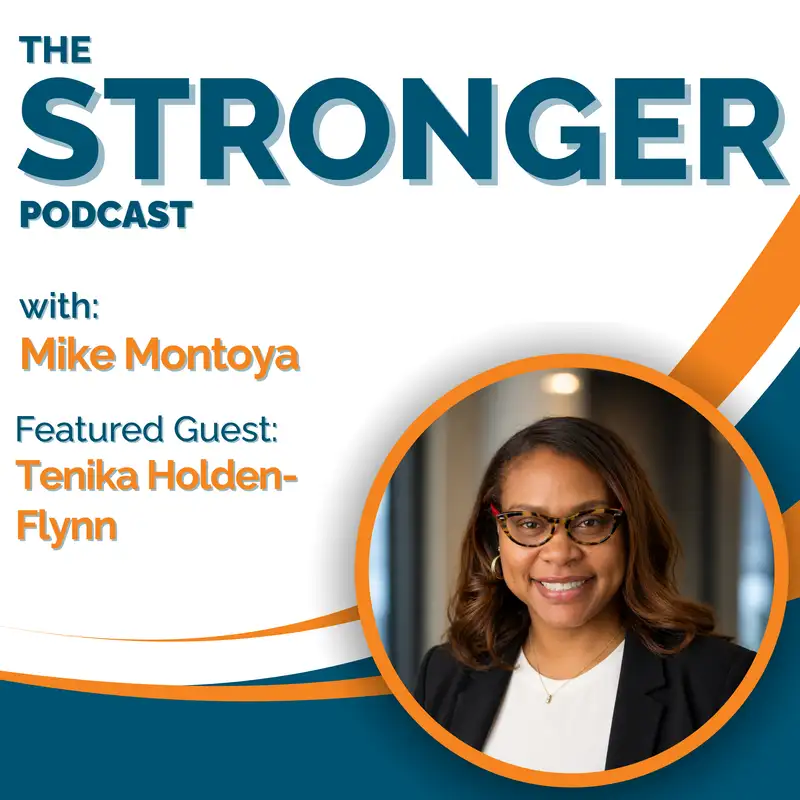
Belief in Kids Is Only the Start: How Teach For America Indianapolis Turns It Into Results with Dr. Tenika Holden-Flynn
Welcome to the Stronger Podcast. Each week, we have honest conversations with education and social impact leaders about their leadership and career journeys. We talk about their origins, inflection points, and the work that they're doing today. The conversations are honest, human, and practical. If you're here for real stories and real takeaways, you're in the right place.
Mike Montoya:Let's jump in, and let's get stronger together. Welcome back to the Stronger Podcast. Teach for America just turned 35 this year, and today, I'm with Dr. Tenika Holden-Flynn, who leads TFA in Indianapolis. We talk about how Indy is coming together for kids, how leaders get built, and why teaching might be the best training ground there is. Let's jump in.
Mike Montoya:Good morning. Good afternoon, everybody out in the Stronger Podcast land. Today, I'm here with Dr. Tenika Holden-Flynn, who is the executive director of the Teach For America, arm branch chapter Magic Space in Indianapolis. And, Tenika, thank you so much for being here with us today.
Dr. Tenika Holden-Flynn:Yes. Thank you so much for having me, Mike.
Mike Montoya:Welcome welcome to the Podcast Land. And I know that this experience is... Sometimes it's new for some people, but it's also exciting to always hear new stories. And I think I love to ask our guests to kinda, like, share a little bit about, like, like, what... How they got into the the world, into into their what was their childhood experience like in schools?
Mike Montoya:And so maybe we start there and let's see where it goes.
Dr. Tenika Holden-Flynn:Wonderful. Thank you for that question, Mike. So for me, yes, education, it goes back pretty far, honestly, me in terms of why I got excited about this work. And my story is, I was a kid who went to parochial school literally from pre K up until ninth grade. So my parents' education was shaped by that and what that looked like.
Dr. Tenika Holden-Flynn:And so I am a child that grew up with a single parent and single parent household. I had a sister who was four years older than me. And like I said, my mom worked really hard to make sure that my sister and I could have the best of everything. And so we both went to private school and my sister, like I said, she's four years older than me. So when she went to college, it was time for me to enter into high school.
Dr. Tenika Holden-Flynn:And so my sister also wanted to go to a private college. And so when we looked at our family finances, it really was not in the cards for her to do that and for me to continue in a private school. So we made a decision as a family that I was going to try a public school for the first time. And it different. It was definitely a different experience.
Dr. Tenika Holden-Flynn:Entering into that public school, I think from being used to being at private schools, some of the things that I noticed is that like the class sizes were much larger, some of the work wasn't quite as rigorous and there was not just as many activities, right? At private schools, there were so many different things that you could get into and some of those options were not there for me. And, you know, I recognized that immediately as a student and said, okay, I feel like there's something that I wanna get involved here. This doesn't make sense to me that when you're paying for something, looks different, right? Everyone should really have the opportunity for education.
Dr. Tenika Holden-Flynn:What I can say though, from my experience being at a public school system, while some of the things weren't equal in terms of what was provided for me at the private school, What was there was like people that truly believed in me, right? And once I got to my public school, I did have a lot more teachers who looked like me and who just had this unwavering belief and commitment that I could accomplish anything. And so I think when you have people that pour into you that way, it kind of just energizes you and it makes you want to like capture the world and be able to do more. So I do feel like I kind of had the best of both worlds from those experiences, but that is exactly why I knew that I was going to go to college to be a teacher.
Mike Montoya:In part because of the inspiration that was coming from and the encouragement-
Dr. Tenika Holden-Flynn:Definitely because of the inspiration and I think just the inequity of knowing that when you're paying for school, this is what you get, and knowing how important it is. Think like growing up, had a very wonderful childhood in terms of like, I had an amazing mom who really poured into me and I grew up in this really small community. The city was called Farrell, Pennsylvania, which there's like literally under 5,000 people there. Right? But like, everyone was really invested in children and like just making sure people believed in themselves.
Dr. Tenika Holden-Flynn:So it's like I would walk to school on the way. Had I people who were concerned, were asking me about how is school going? How are you doing with your homework? Right? People who really believed in me and wanted to see me succeed.
Dr. Tenika Holden-Flynn:So I think growing up in an environment like that, like definitely helped me to have a heart of service, for sure.
Mike Montoya:And so that's a small town, 5,000 folks. Right? Were... Was it was it diverse in that regard? Like, what...
Mike Montoya:Were there folks that looked like you outside of your school setting? Or what was that... What was your community like?
Dr. Tenika Holden-Flynn:Yeah. So, my community actually was pretty diverse, right, growing up. And there were just lots of different people. I remember, like, growing up, just learning about different cultures, right? So, like, we would have different events at all different types of churches, right?
Dr. Tenika Holden-Flynn:So we would have like the Slovak church and the Slovak home where you could go and you would learn about that culture and you would eat the food. Same with Italians, same with Greek, right? So definitely it was really diverse and I think that was just one of the things too, that it was like, no matter who it was that saw you on your way walking to school or just going about your life, people were genuinely invested and interested. And being able to go to private school as I did when I was younger, so many of those different families, you know, we were kind of all going to school together, learning from each other, learning about each other's cultures.
Mike Montoya:Yeah, that's awesome. Well, that's, I mean, that's kind of an amazing story though, that you were able to go from like a private school environment in a space where, like, there was, like, lots of resources potentially. Right? And then to a space that was, like, is more... Is just more...
Mike Montoya:I guess, I always call it, like, a public school, like, competition for resources. There's not enough not enough of them. There's more kids involved. There's, you know, everybody's kind of like competing for like fewer things. And so it's like a little bit of toughening up in regards like, okay, this is how like, what the world works, right?
Mike Montoya:Because there's like so many people running around doing stuff. And so it makes me think about like that was kind of preparing you for but then you went to on to university, right? And then, and then on to, I mean, did you go to school? I mean, was there an education program or were you just focusing on something that's specific?
Dr. Tenika Holden-Flynn:Absolutely. So, like I said, because of those experiences as a child, right? And like getting into, so it was like in tenth grade, was like actually my first year going to a public school. And like I said, just seeing that it's made me say like, I want to be a part of like making sure that every child gets what they deserve in education. So, yep, I finished high school and knew that I wanted to go to be a teacher.
Dr. Tenika Holden-Flynn:So I went to Youngstown State University in Ohio, which was very close, only about thirty minutes away from where I grew up. But, you know, so definitely, I always had to have a backup plan. So when I was an undergrad, I got two bachelor's, one in secondary education, integrated social studies, and another one in political science, just because I've always been fascinated by policy. And I think as I've kind of continued on in my career, those things have really kind of just intersected together nicely, right? And just in terms of like the leadership development and policy, I'm an instruction and being able to combine those things together.
Dr. Tenika Holden-Flynn:But yes, so that's what it was for me. Got to Youngstown State, enjoyed learning about education, did some amazing student teaching in that city, which has really got me even more excited about this important work and the role that I could play in it.
Mike Montoya:And did you did you... So you were a teacher and you became a school leader. Right? Essentially, know you were a principal, I think, some point in your in your career. I mean, what was the, what were the kind of the environments that you were teaching in?
Mike Montoya:What were the, what were the schools that, like types of schools, etcetera?
Dr. Tenika Holden-Flynn:Yeah. So, the majority of the schools that I have worked in had been schools that were really like schools that were in the midst of turnaround, right, when I entered into those school environments.
Mike Montoya:-Okay.
Dr. Tenika Holden-Flynn:-Definitely a lot of urban schools, and schools that really needed to kind of... To do better academically. And so I think I've of been drawn to that work, inspired by it, And I've learned a lot about like what it really takes to be successful in those environments, right? And so part of that is just going in knowing that like, you know, of course the first thing is like starting with that belief that all students can succeed and can do this work. Then really trying to figure out, do you then put strategy behind that belief to make sure that kids are getting what they deserve?
Mike Montoya:So, and now that because we're both in this work, there's like never a shortage of schools that aren't doing well enough for all kids, right? There's like a constant, like trough of those things that need support and innovation, right, and change. And so part of your work now, right, Teach for America, right, is really about, I call it, there's like a supply chain part on the talent side, Teach for America has always been trying to improve, right? And, and then also, there's, there's like, I think the more global community work that Teach for America alumni, right, people who have gone through the core are engaged in because they kind of stay in the cities or spend time in the cities and become leaders and adults in other sorts of fashions. That's part of the theory right around Teach for America.
Mike Montoya:It's like gifted adults who have experienced the public school system from a teaching perspective actually then become like advocates, right, for some of this change that needs to happen. That's my version of Teach For America. So like, that's, that's like, and, but it's been around. This is the thirty fifth anniversary coming up in like weeks, right, of Teacher So, everybody in podcast land, this will probably come out after we all went to Las Vegas for Teach for America. But it's important to note that.
Mike Montoya:And so Tenika, tell us about the, like your version of Teach for America today. Like what is it? What's its purpose and focus in Indianapolis and help us understand that a little bit more?
Dr. Tenika Holden-Flynn:Yes, absolutely. Yes, super excited about our thirty fifth anniversary coming up in October. But yes, I mean, Teach For America, definitely a lot of what you shared, Mike, right, about, I think, it's not just about recruiting teachers, it's really about developing leaders. I think we, Teach For America, has proven that we've been able to do that successfully. Certainly here in Indianapolis, we do that extremely well.
Dr. Tenika Holden-Flynn:And I think one of the things that I'm most proud of is the fact that, you know, we develop these amazing teachers who then go on to continue this amazing work in education in so many different ways, right? We have so many of our alumni that are continuing to stay in classroom and do great work. Many of them have gone on to found schools, to lead schools, to lead districts, right? They're in policy work, they're serving as politicians. And at the center of that though, is the belief that every child can succeed and every child can win.
Dr. Tenika Holden-Flynn:And so I think that's one of the things that is unique about Indy is that you see so many of our TFA alum leading at the highest levels. And they don't necessarily always agree about the best way to get there, but they all believe that students deserve to win, right? And so we see that, we see people just really pouring into that, and we're very fortunate to have that in our community.
Mike Montoya:Yeah, it's funny to think that like, yeah, there's a ton of alumni, right? Like that tens of thousands, right, of folks that have gone through the program over many, many decades. And they are all over the place now. And I think that they show up in the talent space a lot, right, with the work that Stronger does, because it like, we're like, oh, look at TFA alone, they've got some like core belief, right? That's like a magic way of thinking.
Mike Montoya:Like, it's very specific and clear that they're like committed, right? And so like, lots of times our clients like, find this reform minded people, I'm like, well, you know, if they have a TFA mark, right, then that's a positive in that in that box. Because like, they're more likely to be like engaged in like, let's make it better kind of work, which is exciting to me. So in Indy, though, there I mean, every community is different, right? And Indianapolis is like a big place and there's lots of things going on.
Mike Montoya:So is there work that TFA in your shop, right, is engaged in now that's like, guess, important, innovative, relevant? Like, what's going on there? Give us some context for Absolutely. Your Indianapolis
Dr. Tenika Holden-Flynn:I'm gonna talk about a few things here. Right? So, one, first, I'll just share with all the leadership development that we do, what we're really beginning to see in Indianapolis is at different levels, TFA alum leaders, from highest levels to middle level leadership. And so kind of like when we're seeing those individuals clustered together, like seeing real results for students, right? We had a RAND study that came out about TFA Indianapolis in the summer of twenty twenty three, which basically showed that it compared TFA teachers, TFA Indianapolis teachers to other teachers, and it showed that like we were able to move students further faster.
Dr. Tenika Holden-Flynn:So like in a given school year, we were able to move students one percentage point in an ELA class and about two percentage points in a math class. But when we actually were clustering our people together, that could go up to about five percentage points in a math class. So I think we're really excited to be able to see that like people are choosing to have chosen to do the poor in ND and then they stayed there, right? And so we've been able to kind of create these clustering effects, right? We're seeing great results for kids.
Dr. Tenika Holden-Flynn:Some of the other things that are happening in Indy that I would say are a little innovative is that through Teach For America, we are now also offering something that we call Learn Academies in Indianapolis. And so it is a way for us to think about like the amazing work that we have been doing with just TFA core members for years, and we're expanding that out to all teachers now, right? I think that we were really excited when we were able to get the RAND study, and so we knew we had been doing great work, but now like there's a proof point behind that. So, as we really want to make sure that all kids are getting what they deserve, we know that, like, we've got to make sure that our work reaches other teachers than just our core members. So, we're super excited about that as well.
Mike Montoya:Do you feel like there is, I mean, demand, in the marketplace for that kind of leadership support at the teacher level inside the public school system? Like, do they do they show up and participate and are they eager and excited? Like, how does that feel? Like, what's it feel like?
Dr. Tenika Holden-Flynn:Yeah. So, I mean, I feel like this work is fairly new for us, but we are definitely able to work with schools, like whether it's public school districts or charter schools, to actually get this work and get this development going for teachers. And teachers are super excited about it, right? They're really excited about it. And it's also a space for them to be able to come together and like learn from one another and share from each other as well.
Dr. Tenika Holden-Flynn:So yes, I think we have seen that people are wanting this. I think, you know, when you think about Indianapolis and like, you know, like our ecosystem and all the things that are happening right now, I think there's gonna continue to be more space for development needed, right? Like I know you and I had talked a little bit, Mike, about the Indianapolis Public Education Corporation, which is new, right?
Mike Montoya:Yes. New to this
Dr. Tenika Holden-Flynn:and we are super excited about it. I know personally, I see it as a real opportunity for our entire community to really get behind something that can be magical and really have a lot of momentum for kids, right? And I think if we take the opportunity to get this right, you know, ten years from now, we're gonna start seeing the results that our kids really deserve.
Mike Montoya:So is the Public Education Corporation, so that sounds like a company, but it sounds so like, which is such an interesting choice of words, but tell us a little bit about like how is it like a group of people collectively trying to achieve something in a, in a, like, agreed fashion or how does it... How is it actually functioning?
Dr. Tenika Holden-Flynn:Yes. So, you know, just a little bit of the background story there. So, it kind of came about as, as a mandate for my general assembly, right? Particularly to kind of figure out how, how things could be better and, for Indianapolis students, right? Particularly around transportation, facilities, and funding and how funding was shared, right?
Dr. Tenika Holden-Flynn:So there was kind of like a mandate. First, we established something from that mandate, was called the ILEA, which was the Indianapolis Local Education Alliance, right? And so there was a group of people who came together to kind of make decisions and vote about like what was going to be the next step in order for us to like figure out how do we really think about those three things, right? Transportation facilities and funding and joint, right? So that all schools can get what they need to really support kids.
Dr. Tenika Holden-Flynn:And so out of that, we did agree that they agreed that we would now have this Indianapolis Public Education Corporation. And so that is a board of individuals that were kind of put on that board by our mayor. We now actually have an executive director who is leading that work along with an executive vice president who is leading that work, is a TFA alum, Andrew Strope was in that seat. So at this point now, they are tasked with like figuring out what those things are actually gonna look like for our community, right? How do we come together?
Dr. Tenika Holden-Flynn:How do we actually make sure that we are sharing resources, right? Sharing our financial resources amongst those schools, amongst public, right? And charter schools. How do we make sure that we have a joint transportation system? How do we go about dividing up facilities and assigning facilities in a manner that everyone is getting what they need?
Dr. Tenika Holden-Flynn:So there's a large task ahead, right? And then on top of that, there's also then the accountability piece in terms of like, what ensures that a school is a successful school? How do we support schools to get the results that we want for kids, right? And what does that look like? How do we hold accountability?
Dr. Tenika Holden-Flynn:How do we come together as a community to establish what that looks like? So it's a really exciting time, right? In addition to the fact that our state actually just outlined a new accountability system that is being implemented, right? We had kind of taken a break with accountability just because of COVID, right? And so now we're kind of getting back into the swing of things.
Dr. Tenika Holden-Flynn:So really an exciting time for Indianapolis, lots of opportunity and lots of opportunities like to really get after it for students.
Mike Montoya:Well, yeah, you're talking about like the third rails of some of the Ed space, right? The stuff that like really derails the outcomes for kids, right? When we get... When people get stuck with like where where the money sits for the places for the buildings, in places for people to operate. I mean, that becomes a challenge, right, because like they're held largely by like this larger school districts and then like not all the kids are always in there and there's that shrinking enrollment and kids are moving around stuff going on.
Mike Montoya:Right? And so like I was talking with other folks about this recently about like it's a little bit of like making scrambled, like it's like fajita making, right? Like you put a bunch of stuff in the middle, and like, it's sort of sorting itself out, right? But it's still in the process of like making sense, right? But eventually it will start to, I call it, iron itself out and become, I call it potentially more equitable, right, in that regard.
Mike Montoya:I think that's part of what at the core of this thing, right? We're trying to like help kids basically at the end game, the things that they need as opposed to like, you know, the world resources being squirreled away someplace else for the future future state of somebody, I mean, in particular. So, okay, so it's it's not it's not brand, brand new, but it's new. So the the effect of it, will be a little bit down the road here. But so far, it seems like promising, right, that people are willing to sit down together, have these discussions, and start to, I call it, eventually make some decisions about how to make this happen.
Mike Montoya:Do you... Are are you part of that board? Are you part are you part of that board? Are you just sitting next to
Dr. Tenika Holden-Flynn:I am not a part of that board. I am hopeful to be able to provide some suggestions though in terms of like what accountability, will look like for our particular community as I think about that. Yes.
Mike Montoya:Okay. Good. Well, and so then... But at the core of this, though, you're like kind of doing your core advocacy work, right? Which is like that, like, back to like all kids deserve back from what you said about your own childhood experience, right?
Mike Montoya:Like deserving access to the opportunities, right? To like just grow up in a healthy, supportive environment, right? Like, that's kind of what we're trying to achieve. It seems pretty simple, right? In theory, right?
Mike Montoya:But it gets complicated in practice. I think that's like a common challenge across the country. But Indianapolis has like, this... I call... I'm gonna call it the coalition.
Mike Montoya:Right? This coalition of people, right, to, like, really start to galvanize around it. Is it is it largely may... Well, it sounds like it's assembly, the mayor is getting involved. There's some state mandates.
Mike Montoya:There's also a state framework. So you guys are trying to integrate that stuff within the context. Right? So... Yeah.
Mike Montoya:Okay. Awesome. Alright. So now... So we're gonna have to come back in, a year and have a conversation about how is this going because everybody's wanna know.
Mike Montoya:Right? Yeah. For sure. So that's that's super cool. But you guys have, like, a lot of other great actors, right, in the space, like the Mind Trust is in Indianapolis.
Mike Montoya:Right? And they've also been like strong advocates for sort of a similar approach. Right? Which I think there's TFA running Mind Trust, right, is what I remember. Brandon's over there.
Mike Montoya:So like so it's like you have allies in some cases, right, in in place that have similar influences, etcetera. Yeah. Do you feel like there's a healthy community of leaders that you're excited about and that, like, that are really, I call it, rowing together sometimes is how I think about it?
Dr. Tenika Holden-Flynn:Absolutely, I do, right? And as I had alluded to earlier, just about the fact that, sometimes we have TFA alum leading all different areas and sometimes they are on opposite ends of the spectrum, but that belief about what's best for kids really does bring them back together. So I think I am super excited about the leadership that we have within our city. In addition to that, we have leaders who have been in seat for quite some time too, right? And so I think that is part of our work at Teach For America is thinking about how do we make sure the next set of leaders are ready to step into those seats when those people do choose to, to move on, right?
Dr. Tenika Holden-Flynn:So I think we've been doing a lot of thinking that and working really closely with The Mind Trust in terms of like leadership development and preparing people for those seats, right? And we're very fortunate that we do have so many alum who are in those seats now and that they are willing to work with some of our other alum that are coming through, right, to really mentor them and to make sure that they can shadow them and understand like first hand what it means to lead in that seat and what it looks like to do it successfully.
Mike Montoya:Yeah, and that's, I mean, I'm glad you kind of moved, I almost like walked into that, like my little web of interesting stuff about like how leaders are developed, right? Like because because I mean, there's like a lot of leadership development programs and fellowships and training and all that kind of exists, right? And TFA has, as you said, been a leader in that area in our space. And in addition to that, though, you touched about like how people are sponsored and mentored over time, right? And this this idea of like that, like people learn and get engaged and work when they get connected to senior folks who are willing to share their experiences.
Mike Montoya:Right? So like, you guys have, like, a formalized program around that stuff, or is it just sort of like you're trying to pair people together? How's that...
Dr. Tenika Holden-Flynn:Yeah. That is a great question. We are working to to get a formalized program like that. Right? In the meantime, yes, we do have amazing people who are willing to share, to pour into other individuals, which helps out a lot.
Dr. Tenika Holden-Flynn:But I mean, as we think about all the things that are happening on our city, right, and like making sure that we're able to keep up with the momentum, right, and keep up with the demand, we've got to really start thinking about what that succession planning and what that, you know, that talent pipeline looks like. So we are working closely with The Mind Trust to try to get something more formal in place.
Mike Montoya:Yeah, that's true. Well, yeah, and it takes a lot. I mean, we built these things, right? It takes a while to get people to cooperate. But largely, people are willing to serve in those mentorship roles when they're asked.
Mike Montoya:It takes some, I call it, creative invitation making, right, inviting people to the conversation and the practice. And I think there's a willingness, but then you also have to make it accessible, right, for folks to do it so that they can do it with consistency. I think consistency is like one of the biggest challenges with like busy, busy adults, right? We're like, got like a lot of things to do all the time, and we got to find time to do the other things that are also important to us, right? That's kind of what I think is the challenge for sure, so.
Dr. Tenika Holden-Flynn:Absolutely. Yes. And I'm sorry, you went out a little bit there.
Mike Montoya:Oh. So, come on, kick the microphone here. So, I think I was... I think I'll... And I can restate it so people can hear it because they probably lost it too.
Mike Montoya:I think I think one of the challenges with mentorship work, right, is finding adults finding space for adults to do it well is consistency for them, right, and helping them feel supported. Like, Hey, here's some ways to be a good mentor. Here's some ways to show up regularly, right, for your people that you're working with, things like that. And usually people are willing, right, to do it. They just need a little bit of like, Hey, this is kind of what it looks like, so you can kind of get in a rhythm.
Mike Montoya:And once you get in a rhythm, you kind of make sense of it, right, type of thing.
Dr. Tenika Holden-Flynn:Absolutely, yes, I totally agree, right? It's just really helping people to organize what that time could look like. But I just think that that piece is so critical. I love the fact, I think there's so many things that we can read about and we can sit in the classroom and learn about and that's amazing and it really does help, it helps us shape our craft, but I think it's it's something to be said for like really actually having that time to be on the job of some... Someone seeing what they do, right?
Dr. Tenika Holden-Flynn:Or sitting with them and hearing about some of the most difficult things they've led through, you know, or worked themselves through and being able to share that with people directly just goes a really long way, for people that that wanna be in those seats and teach.
Mike Montoya:Yeah. That's awesome. Well, and now and now you wandered into my next web, which is about... It's about, like, your your leadership approach and leadership style. Right?
Mike Montoya:And so so you've been in lots of different spaces and led teams small and large, right, and schools schools, small and large. Right? So in in your... Over the time, like, has your own leadership approach, like, evolved? Right?
Mike Montoya:And are you having to use different, I'm gonna call it, capabilities now in this kind of coalition work, right, than when you were, a school leader? Right? Those are different environments for sure, but I'm curious, like, how you reflect on that leadership changes over time.
Dr. Tenika Holden-Flynn:Yeah, that's a great question. I definitely, I certainly feel like my leadership has changed over time. And I think, you know, I'm so grateful for all of the experiences that I've had, because I think like those experiences have really shaped me to be the leader that I am today, right? So I think just thinking back to the things that I learned in the classroom, about really being focused on instruction and being able to build relationships, those things really have been key and critical to help me in my career. And right now, even now, moving to the work that I'm doing now, being able to focus on the coalition building is huge.
Dr. Tenika Holden-Flynn:Coalition building and policy, and really being able to understand and to get after all of those things. And so, yes, I think I've had lots of experiences like working in charter schools, working in district schools, like serving at the central office level and being able to kind of take those experiences to help me understand how to really make those connections, right? To be able to build that coalition so that like when it's time to go after something that's huge, right? Like you're able to really rally these people to come behind and support to get those things done. So, I've been grateful for all of that learning.
Mike Montoya:Well, I mean, it takes a lot of practice, right? To like, I don't remember when you were discussing what you just shared about like the experiences that you bring to the table, it made me think about, like, how much background and and history in different systems builds trust. Right? Because people can observe that, hey, this person's been in my shoes in some time in the past, or this person has served in this organization type. Right?
Mike Montoya:But the fact that you're not like a call... A core only school professional district person, right, that you've had experiences as a teacher, etcetera, that gives you, I call it tremendous credibility. And I think... And sometimes I like to talk about the leadership stuff here because I feel like as people grow into this work in their careers, that they don't value teaching experience as much as they should, right, or could, because I think that's like such an... Well, especially in the ad sector, it's such a great training ground because of the capacities that you have to build, the things...
Mike Montoya:The number of things you have to manage if you're doing a classroom work or or teamwork, etc. And then just the fact that people start to trust you more when you've got that credentialing and experience, and you've especially been an effective teacher, right? If you've been an effective teacher, you can make the arguments about all the things much more strongly. Is that... Now I'm like interpreting a little bit what you're saying, but like, would you agree with some of those things?
Dr. Tenika Holden-Flynn:Oh, absolutely agree. I mean, I feel like teaching really is like, it is a job that can prepare you for anything, right? For any role that you want to go into, like teaching is the sounding board. You have to learn how to do all the things, right? You have to be able to communicate effectively, you have to be able to persuade individuals, you have to be able to explain things in a way that somebody else is going to understand them, right?
Dr. Tenika Holden-Flynn:You have to make sure that you're building relationships with parents and community members. I mean, like, it's just a job that prepares you to be able to do anything. And certainly, you know, one of the most important roles that I've held, you know, in my life and, you know, something that I love doing, right? Anytime that I have the opportunity to, you know, sometimes when I'm going around to visit corps members, try to jump in there a little bit, right? And I get back in front of the classroom.
Dr. Tenika Holden-Flynn:It's just, it's, it's an amazing thing to do to be able to sit with children, and help them learn something.
Mike Montoya:Yeah. Well, the way you're talking about explaining things, I was like, I... It popped in my head, like, we have to explain things to third graders, right, which which which is kind of like sometimes what you're talking about, right, in this work. Like, you're like, this is what it means to, like, do the things that you say you're gonna do, right, to, like, be accountable, quote unquote, for your behavior. Those kinds of things are are like are like third grade lessons, right, in that regard.
Mike Montoya:I feel like sometimes we as adults need to hear that again. In some cases, like, yeah, we're responsible. We're responsible for this community that we live in. We're responsible for the society that we're creating. We're responsible for these children that are here, right?
Mike Montoya:And I feel like sometimes we can get lost in the adulting part of life. Right? And and forget about like the basics. Right? Like, maybe there's a whole...
Mike Montoya:There's a book about what I learned in kindergarten. Remember that book? There was a book about that back when we were younger. Oh, I think I had it somewhere here, but it it made it made you like, oh, I learned all that shit. I just needed to remember it.
Mike Montoya:So we should all reread that book. Okay, so exciting times in Indianapolis on the precipice of like lots of potential, right? It sounds like, but also the fact that you guys have laid a lot of groundwork, it takes a long time to build momentum in this direction. Right? And I think, know, TFA has been there focusing on that for many years.
Mike Montoya:As we wind our way out of this, I want you to think for a minute, I'll give you a second to imagine this. If you're thinking about suggestions or advice or reflections to share with a younger self, so to speak? Like, another bright up and coming leader, you know, a few that are... That is sort of a few decades behind you in terms of their experience? Like, what what would be something that you'd wanna, like, hand down and across to them?
Dr. Tenika Holden-Flynn:Oh, thank you. What's what I want to hand down? I think going back to what I shared earlier, just about, you know, it's really important to make sure that, you know, we have unwavering belief in our kids and their potential. And that is, you know, like that is a huge part of this work, and what's really got me to this work. But I think just making sure that I would say to myself that when it comes to that, if you want to step into this work and be a leader in education, we have to make sure that we translate that belief, right?
Dr. Tenika Holden-Flynn:That belief needs to be translated into clear goals, strong systems, shared ownership, and measurable action. And I would just encourage people to like take their motivation, the dedication, their commitment, and to really figure out how to streamline it into those things so that we can get the results that we want for our children.
Mike Montoya:Yeah, like, yeah, and that's like you just described, thank you for that. And it's like you just described like basically strategic acting, right? Like this idea of like, some goals, make them discreet and specific, right? And then help them achieve them. And then you set new goals and keep going, right?
Mike Montoya:That's kind of the process of like moving through processes, strategies and initiatives, right? So like, like, yes, it's almost like the scientific method like you have to learn some of the basic things and then bring them into life and then do them consistently, right? And try not to take on more than you can chew because part of, you know, let's say big society, being part of a system, right, of folks trying to achieve something together is much more effective, right, than trying to do it all by yourself sometimes, right? That's So, that's super helpful advice, and I appreciate that. So if you're thinking about what you're excited about in 2020, we're coming into 2027.
Mike Montoya:I hate to say it, but it's coming. It's coming fast. What are you what are you what are you personally excited about in your in your, like, in your in your world outside of work? Right? And then also, is there something specific about work that you're like, oh, 2027, if we knocked this out of the park, I'm gonna be excited.
Mike Montoya:So.
Dr. Tenika Holden-Flynn:What am I personally excited about? Well, I I have a seven year old daughter, which has been like, you know, just a whole new experience in terms of, like, supporting kids in education, right? Like, actually having someone in your house twenty four seven that you are responsible for has been... Has been new, has been excited, it has been exciting. But I think like, I'm really just excited to continue to go on this journey with her, right?
Dr. Tenika Holden-Flynn:As she's going... She's in first grade now, right? So like going through this education journey with her, it's just like kind of opened me up to this whole different side of education that I'm exploring for the first time as a parent. Super excited to continue on that journey. And in terms of work, TFA Indianapolis, we set some really rigorous goals for our community in 2020 that we wanted to reach by 2030, right?
Dr. Tenika Holden-Flynn:And so pretty much what that is, it's doubling student outcome and third grade reading, fourth grade math and eighth grade math, right? And so I'm super excited about that because as we talked about IPEC and all the things that are happening in Indy, we are at a time where we have like so many people that are coming together to help us to get after that. So I'm excited to continue doing that work, right? Making sure that we are bringing in strong teachers, that we are developing teachers that are already in our community, doing all of these things to make sure that we get to the goals that we have for 2030.
Mike Montoya:That's amazing. Well, the the the journey is ahead for you. Congratulations on our first first grad... Like, you're gonna be employed for a while. That's good.
Mike Montoya:You know? So it means we got you focused on this important work for a little while because you had a young one to to kinda go through the whole experience. Right? So so good luck with that. And, you know, it's...
Mike Montoya:I mean, that's really interesting actually to think about it. I wonder if your commitment has, I call it, doubled down in some ways as a result of having a kiddo. Like would you... I mean, I'm using my language, but I'm curious if you think about like, has it gotten thicker and richer as a result of having a young one?
Dr. Tenika Holden-Flynn:As we think so, you know, I had the... When I was pregnant with my daughter, I was also like in the process, I was serving as founding head of school for Parent Preparatory Academy, right? And so I was designing this school and really thinking about like what it takes for a young person to be successful, right? While carrying this child, and kind of like just all the hopes and dreams that I had for my own child, I was able to really like put that on paper and helped and be a part of designing something amazing. So yeah, absolutely.
Dr. Tenika Holden-Flynn:I think it kind of has just like, really, like, even deepened my commitment to this work. Right? And just figuring out how I need to continue to show up. Right? And how, like, I can't stop getting after what needs to happen for our community.
Dr. Tenika Holden-Flynn:So absolutely, it strengthened my commitment.
Mike Montoya:That's awesome. Alright. Well, I'm glad you have, that young woman your life to keep it keep it motivated and keep it focused. Because, I mean, like, and I deeply... I say this to folks, but I want to say I deeply appreciate, right, folks who are doing like the on ground work, right, and and have, I call it, experience in the background that makes it the the right people doing the right job.
Mike Montoya:Right? And I think that's the the key thing that I'm kinda picking up from our conversation. And Tenika, thank you so much. Good luck. I know Indianapolis is going through some upheaval and change with...
Mike Montoya:Also with some weather, etcetera, and things like that. So good luck with those things in your community, and and we're thinking about you. I mean, we will see you whether this podcast or in in Las Vegas. I said there'll be the grown ups in the corner where all the young people will be in the middle, and we'll be hanging out. So we'll look for you there.
Mike Montoya:Should be a really good event.
Dr. Tenika Holden-Flynn:Thank you
Mike Montoya:so much. Have a great day.
Dr. Tenika Holden-Flynn:Thank you so much, Mike.
Mike Montoya:Thanks for being with me, Tenika. My big takeaway is believing in kids is the start, but you have to turn that belief into goals and systems and actions. Thanks for listening, everybody. Have a great day. Podcaststhatmatter.org.