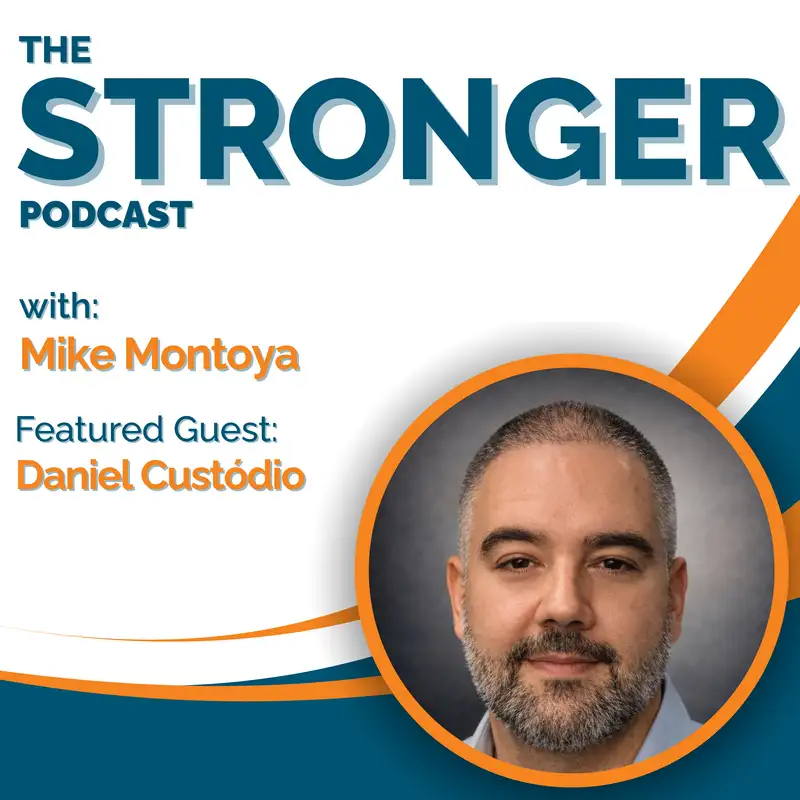
Latino Professionals in Corporate America Plan Further Ahead: Why Culture Is an Asset and Not a Liability with Dr. Daniel Custódio
Welcome to the Stronger Podcast. Each week, we have honest conversations with education and social impact leaders about their leadership and career journeys. We talk about their origins, inflection points, and the work that they're doing today. The conversations are honest, human, and practical. If you're here for real stories and real takeaways, you're in the right place.
Mike Montoya:Let's jump in, and let's get stronger together. Today, my guest is Dr. Custodio, head of the Process Center of Excellence at The Principal Financial Group. Daniel just finished his doctoral program and turned his dissertation into a book called Code Mastering about how Latino professionals navigate corporate America. Let's jump in.
Mike Montoya:Good afternoon. Good morning, everybody in The Stronger Podcast land. It's exciting to spend more time with you today. And today, my guest is Dr. Daniel Custodio, and he is a recent graduate school student who wrote a book that really caught my attention.
Mike Montoya:And the reason it caught my attention, well, twofold. One is I was part of the study, as one of the focus group members, was part of Daniel's dissertation work. And then the second piece was that the topic, and the reason I got involved, is the topic around Latino professionals in America, specifically in corporate America, was something that I was super interested in as an individual, having navigated a bunch of that space myself. And I was super appreciative of Daniel, like I call it, drilling down into a topic area that seemed like sort of underexplored. It's usually how it gets here, right?
Mike Montoya:So new knowledge in the workspace, in the world. Daniel's book, the name of his book called Code Mastering. I'm gonna just hold up for everybody to see this. You'll eventually get this on the show notes. But, Code Mastering, it's on Amazon and everywhere.
Mike Montoya:So feel free to reach out and and make a connection. I'll make sure that's in the show notes. So, Daniel, thanks for being here. I appreciate it.
Dr. Daniel José Custódio:Thank you, Mike. Appreciate it.
Mike Montoya:So let's let's ground everybody in in the same place, which is talking a little bit about kinda your origin story. Right? Like, kinda where you where you started as a young man, how your family evolved, right? And we just wanna hear from you, like, how did it get going?
Dr. Daniel José Custódio:Yeah, yeah. So my mom immigrated here from Belém do Pará in Brazil, which is in the North of Brazil where the Amazon flushes on to the Caribbean. My father immigrated from Portugal and they met in New York and had me. And, you know, one of my earliest childhood memories that really stuck out was my first day in kindergarten where, not only could I not understand the language being spoken, but I also didn't realize that I was near sighted and needed glasses. So I'm in a classroom, not able to really see anything and not really under able to understand anything.
Dr. Daniel José Custódio:And, you know, the school I went to in New York didn't have an ESL program at the time. So there's really no support structure, you know? And if you think about an impact on a five year old boy, you know, that that's kind of in a classroom, not understanding, not seeing, and nobody's really conscious or aware of my situation, It was pretty scary. You know? And I I remember going back home and crying with my mom and and never wanting to go back to school again.
Mike Montoya:So Yours you know, you're gonna find an empathetic audience in this crew, Daniel, that that is part of the Stronger community. That's a there's a bunch of folks that are immigrant kiddos, right, that have a story that starts in a similar place. Right? The the scene the glasses part made me laugh because I think I was in first grade and they were like, what the hell is wrong with you? Why can't you pay attention?
Mike Montoya:And I'm like, what am I paying attention to on that chalkboard that I can't see type of thing? Right? And they were like, oh, that's the first problem. That was the first problem. Right?
Mike Montoya:I didn't have the same language talent you're talking about, but I remember the glasses problem. That was a real thing. So okay. Yep. Public school in New York.
Mike Montoya:Right? Were you guys in the city somewhere or where were you guys at?
Dr. Daniel José Custódio:I actually went to school outside of the city in Westchester County. So I grew up in a town called Sleepy Hollow, which is the home of the Headless Horseman. So the original Ichabod Crane story, and Halloween's a really big, big deal there. And I'm a seventies kid, so around that time we had a big GM plant by the water side, you know, over the nineties and in 2000, that kind of gentrified and they built some really beautiful condominiums down there. But it was a working class town, if you will, filled with mostly immigrants, a lot of Dominicans, Puerto Ricans, but you had Italians, Greek, Portuguese.
Dr. Daniel José Custódio:But that was that was that was the vibe back then.
Mike Montoya:That was pretty it was like a commonplace thing to have a pretty big mix of folks. Right? All over the planet, literally, coming together. New York has always been the quintessential melting pot, right, in The US. And as you said, eventually, all those neighborhoods have been gentrified.
Mike Montoya:Right? So they feel different now. But fifty years ago, right? It was a thing. Right?
Mike Montoya:So people probably have heard that story. People certainly I I the Ichabod Crane reference, right, which we all know or a lot of us know that story in particular. And then you you let's just say you made it through school. When you you went to college somewhere, you went to college in in Upstate New York. Right?
Mike Montoya:So how was how was that experience for you as a as a as a young man kinda I mean, I'm assuming you were a first generation kid in college, right, is my my guess, but maybe not.
Dr. Daniel José Custódio:Yeah, no. Yeah, so that's right. First generation, you know, I remember seeing all my peers when I got to college and it was such a familiar thing for them. Like, they were expected to go to college. Their parents had gone gone to college, but I ended up going to Hamilton College in Upstate New York.
Dr. Daniel José Custódio:And, it's funny because a lot of people talk about diversity, but it was actually the first time I I actually was exposed to diversity because most of the kids where I grew up were Latino, you know, middle to lower, socioeconomic strata. And and now I'm in this environment where you have, you know, a lot of wealthy people, people with privilege, that didn't necessarily grow up like me. And and I think that's actually the first time I actually realized, man, I'm I grew up without a lot of money. So but I I needed that contrast in seeing how other people, how other people were to to really make that make that light bulb go off.
Mike Montoya:Yeah. That's an interesting parallel, and it's fun to hear you speak about it in that, I think I don't think I knew I was poor until I went to college, and then I realized how big of a difference income levels were were with our with our folks. And and, you know, my friends were awesome, and they were just really different. Right? They all showed up in fancy cars, and I showed up with a suitcase, right, trying get behind me type of thing.
Mike Montoya:So Yep. That was a an experience. And you, I think, started in the corporate world, though, kind of right after college. Right? So, like, just tell us what that I mean, you had, like, an interesting start and, like, did, like, I call it almost like almost like the things that are expected in, like, a good plan for a young man.
Mike Montoya:Right? Tell us about how that how that unfolded for you.
Dr. Daniel José Custódio:Yeah, a lot of my peers leaving Hamilton, they had internships during the four years and they had kind of a game plan. Worked as a janitor over the summers with my father, schools, and there was really no notion of internshipping and networking and all these kind of concepts, right, that for me were really foreign. So when I got out of school, I was lucky enough to reach out to a peer who had graduated the year before me, and he landed a job with GE in their information management leadership program. And I'll never forget part of the interview process was me going out to a payphone. I had this kind of, you know, start up starting a job at a at a software company that that, created software for printing.
Dr. Daniel José Custódio:And, but but it was just it was just to get my my, you know, my foot in the door and start doing something. But this job at GE was a really, really good one. You know, four year rotational program. And so I I remember at lunchtime, I left, and I I had to use a pay phone because back then, I didn't have a cell phone to do the interview, you know, and and that's pretty much how I got my foot in the door with this connection at GE.
Mike Montoya:Yeah. So and, like, literally a landline attached to a silver cord or something like that. Right? In a box. Well, and and the GE program is kinda famous.
Mike Montoya:Right? They they and I mean, there there are some, like, large legacy companies. Right? Like, Procter and Gamble, GE that, like, have these incredible leadership pipelines. Right?
Mike Montoya:And and part of how corporate America became so functional in some ways and also created a bunch of problems probably. But Yeah. Did you feel like that was like a a good boost for the for the start for the start of your life in the in the in the, I call it, capitalism in America?
Dr. Daniel José Custódio:Yeah. So it was so pivotal. You know, that's when I got introduced to Six Sigma. And I didn't have a framework going into corporate America. And I remember that was something I just latched onto because I said, this is structured, it makes sense.
Dr. Daniel José Custódio:So that to me really set the foundation of my career. Most of my career has been a continuous improvement. And, you know, even now when I teach as an associate professor at VCU and I teach a lot of my kids that you need mental models and frameworks going into the workplace to really empower you. So those were the best two years, two to three years starting my career because that foundation in Six Sigma thinking is really something that I continue to build build on throughout the the twenty three years now that I've I've been in corporate.
Mike Montoya:Well, and, yeah, Six Sigma is like a real thing, and there's a level of black belt and all that stuff. Right? So that's the the the the I call it crazy engineering geniuses. Right? I have behind making sure airplanes fly and don't fall out of the sky type of stuff.
Mike Montoya:Right? So we're grateful for the precision of that. Like, how did that feel to you as a a person? Like, it sounds like it gave you some grounding, right, and some structure, right, that you appreciated. But did it also I mean, I don't know.
Mike Montoya:Like, some your research, which we'll get into in just a second here, really about how you've had to, like, of, in some ways, initially fit in, right, to some of these things that were there. How did that just can you remember what the kind of experience was like? Like, there an emotion or something that kind of starts with there?
Dr. Daniel José Custódio:Yeah, for me, you know, it just made sense because it was so structured. At the heart of Six Sigma, it's all about defining the problem, you know, analyzing data, and making decisions with data and information. And it's interesting because from a standpoint of, you know, my book talks a lot about the cultural differences, but in many ways, the methodology doesn't care about your culture, right? It doesn't care about your gender, your culture, any of these things. So, in the workplace, there was a time when there was a lot of emphasis on diversity, equity, inclusion.
Dr. Daniel José Custódio:We may have lost a little bit of that in the last three to four years, but I think the Six Sigma framework, the Lean framework, they're really good in the sense of creating an equitable environment because they're, in theory, supposed to use data and really have the data drive how you make decisions and how you drive conversations. So I loved it. It made sense when I first got introduced to it. And the hardest part was actually leaving GE and and going to companies where people didn't think that way. That was the hardest part.
Dr. Daniel José Custódio:But but then I realized, hey, I can make a career and capitalize on this. Actually, that that's what I did.
Mike Montoya:So. Yeah. For sure. Well, yeah, exactly. It's almost like you stepped out of the the paradise, right, and into the real world.
Mike Montoya:And in terms of, like, how companies other companies, lots of companies function and have, I call it, processes and features about them that are less than ideal for both success and, you know, I call it taking care of human capital, right? Let's call it that. And so those are are it's like the Wild West in some cases. Right? And especially in startup culture and things like that, where tech now is like a whole different game than it was twenty years ago for sure or even fifty years ago.
Mike Montoya:I definitely so so you had a had a career. At some some point, you decided you should go to grad you went to MBA school, but then you also went and did a business administer doctorate. Right? So talk to me about, like, what was the decision making points around that so that other people can understand what
Dr. Daniel José Custódio:Yeah, when I was at GE, you know, after the two years, I was there for an additional year in a black belt role. And I really looked at senior leadership, and this is one of the things that, I really took away from my research, which is I started looking at the leaders who were successful, who were where I wanted to be. And there was two kind of unique paths. One was you went through audit path. And that was very rigorous, a lot of, you know, long hours, weekends.
Dr. Daniel José Custódio:And the second path was a lot of the leaders there had their MBA. So I decided I wanted to go the MBA route. At the time, I would say MBA had a lot of value. That was this was back in 2003. I I don't know if that necessarily holds holds true today with a lot of AI and and the direction that the market is changing.
Dr. Daniel José Custódio:But I also made a decision. I said, I'm only gonna apply to the top 10 MBA programs. I'm not going to anything that that's not top 10. And, I was fortunate enough to get into Northwestern Kellogg School of Business. That was a a very exciting day when I got the news.
Dr. Daniel José Custódio:I remember just calling my mom and dad and and how emotional that was. And, yeah. And I dedicated my next two years to be a full time MBA student. Had some internships while I was there, but it was a it was a great foundation as well just to get that that strong Kellogg brand name under my resume.
Mike Montoya:Yeah. And I appreciate that. I stepped here to live in Chicago where it's quite cold. Having gone to graduate school there myself, I can appreciate the call it toughness that comes from living in the region for a few years. The value of the MBA and just even degree programs overall, Like there used to be like universities had knowledge that nobody else could get to.
Mike Montoya:And going through the experience of getting a completely degree at a high, highly selective university or graduate program is like a was like a like a resume builder and a pedigree builder, right? And it allowed, call it my version was that it allowed access to places that other people would never have given me access to, right? And put a couple of brand names on your resume, right? And then have the world's kind of your oyster in some cases, right? And so did you feel like that was, I mean, worth the investment?
Mike Montoya:And then did it yield? Has it continued to yield for years to come?
Dr. Daniel José Custódio:Yeah, you know, definitely from a standpoint of confidence, you know, that I could be at a top ranked business school and I can hold my own. Like that was really important for me. But also when I got to Kellogg, it was a little bit different than Hamilton, which is I actually saw a lot more diversity. You know, I saw more Latino students. I saw students who were international from Brazil, from Peru, from, you know, different countries.
Dr. Daniel José Custódio:And it was a really good mix of diversity. But, you know, from a standpoint of also being, in a school where my peers were very successful professionally and just exchanging ideas with them and just being exposed to, to that kind of environment was really helpful. You know? And and I talked a lot about this in the book. You know, in the beginning, when you're coming from a background of of of marginalized people or or a culture that you perceive as marginalized, a lot of times, the the main issue is confidence, you know?
Dr. Daniel José Custódio:And and if you don't have that confidence, you really can't translate your background into something that's positive and productive. You actually look at it as a as a as a liability and a deficit. So being in in a school where other Brazilians were there, other Latinos, people who spoke multiple languages, seeing all of us in an environment where we were all succeeding was really uplifting.
Mike Montoya:Well, it makes you appreciate the reflection here. And we'll jump into your research next and to say that you don't know your I sort of you sort of take on labels, right, of that of the greater society in which you are functioning. Right? Not just you. It's not as specific to you.
Mike Montoya:Right? But like, we all kind of like, you know, get homogenized in some way or another, and we we kind of don't even realize that like it doesn't feel good, right, or right until you get around people that you're like, Oh, this feels more right, right? Get around a mix of individuals who reflects and thinks and maybe speaks and acts in a more culturally appropriate fashion for you. And you're like, Oh, this feels normal, right? And it's almost like a little bit like your self starts to come back around, is my view on that regard.
Mike Montoya:And maybe that's the power of the educational institutions, right? In addition to the degree program, right, is that it gives you the reinforcement right around some of this work, right? So that's my view, at least. You don't have to worry about it, of course, but that's kind of a couple years of experience doing this myself. So I'm kind of curious if you sort of reflect on that, if that seems similar.
Dr. Daniel José Custódio:Yeah. No. That that makes sense. You know, there's a lot of processing that goes on. And and one of the points I'll actually learn from from the Six Sigma kind of methodology is, you know, there's this continuous improvement where you're always going through an experience and then reflecting.
Dr. Daniel José Custódio:And I find that or we do that throughout our lives, find those reflection points and pause and really use that as a learning opportunity that really accelerates momentum and acceleration. But without, and, you know, even me doing my doc, my doctorate was, was in and of itself a way of pausing and reflecting and, and thinking about, what I had gone through as a Latino, not only in corporate America, but through my childhood. So, you know, Kellogg was definitely one of those pivotal moments where there was some reflection around how that experience shaped and molded me.
Mike Montoya:Let's jump ahead as much as we want to all live in graduate school as long as we can because it's fun too, right? The parts are fun, some parts of that's fun. Let's jump ahead to graduate school and the choice on your call it, research topic and research area, right? So like, I mean, you obviously came in with, like, I call it some fodder, right, from your experience in corporate world. Like like, how did you, I guess, land on on the concept and the idea?
Mike Montoya:Like, when did it start to shape up around identity work? Right? Which is how you describe it in in your TED Talk. Right?
Dr. Daniel José Custódio:Yeah. Well, you know, it's interesting. When I went to Kellogg, I was 25 years old at the time. I was, I only had three years of professional experience. I think I was one of the youngest full time MBA students at Kellogg at the time.
Dr. Daniel José Custódio:So when I ended up going back to school to get my doctorate, I was 45 years old, and I had three daughters. So I was a father, you know, at the time. I guess my daughters were 12, nine, and seven. So much different experience. But it definitely shaped my topic because when I got there, I I didn't have a topic at first.
Dr. Daniel José Custódio:And eventually, you know, I started thinking well, what would be useful? You know? And when I thought about what would be useful, I thought about my daughters as three Latinas. You know? Boy, I wish I would have had research that could have helped me some somewhat like like a map, right, they they could follow.
Dr. Daniel José Custódio:But in order to provide a map, you really have to understand your own experience. You have to understand others' experiences. So I really thought about what makes some Latino successful, you know, who enter the corporate world and why are others not as successful? And where did some of my success come from? And I didn't really have an answer for that, but I had the question.
Dr. Daniel José Custódio:So that was really the start. Inspired by my daughters and in my own experience thinking, could I leave behind something that, you know, potentially my daughter could read one day and it could it could give her a map?
Mike Montoya:So inspired by the both the the, I call it, state of affairs that were that you experienced as a corporate kid with your family, you're thinking for a pathway. That's a very that's a very that's a very altruistic approach, right? Which is like, how do I add something valuable back to the world, right? Versus versus just take something from it. So, I mean, there's a little bit of your culture pulling through there, I'm guessing as well.
Mike Montoya:So take us through, if you're willing, sort of like the major findings and the framework that you talk about. And some of this stuff is grounded in literature as well. But I'd love to hear you kinda like, kinda talk through your version of the identity, you know, kind of work pathway, things like that.
Dr. Daniel José Custódio:Yeah. So a lot of the work stems from Brown and Lent, who in 2013 wrote about social cognitive career theory and self career management, where they talked about going from passive kind of career management to more proactive career management. And specifically what they were talking about was, rather than following a linear path of identifying a career path, you know, going to good school, applying to jobs, how do you use the things at your disposal, right? The assets you have to really shape your career in a more proactive way. So that was kind of the foundation using Brown and Lent.
Dr. Daniel José Custódio:And my first question there was, this is very interesting research. How do I potentially build upon this? And does this apply to Latinos in a way that's unique? So the first part of my research was actually sending out a survey where I asked certain questions that aligned with Brown and Lent's theory and tried to just see other differences between how Latinos navigate in comparison to, for example, other minority groups or white non Latinos. And what came back mathematically was that there were some significant differences.
Dr. Daniel José Custódio:Latinos ended up experiencing about twice as many discrimination events in the workplace, whether that was related to their accent or, you know, at times it could have been their appearance appearing Latino. You know, there's also a lot of what's called intersectionality, where some of the things may have been related to them being Latino, it also could have been race related or other kind of factors. So that was the first thing that kind of stood out with the survey. Went through more discrimination events. The second thing that kind of stood out was they typically, were more forward looking, meaning they had to set plans ahead of time more than the other groups.
Dr. Daniel José Custódio:So simple things like imagine you're going to do an interview. They found themselves prepping for that interview. They found themselves having multi year plans. There was something about the the discrimination experiences that they went through that a countermeasure to that seemed to be planning ahead, right? Looking ahead on the chessboard, if you will, and really thinking about two, three, four, five steps into the future, whereas professional groups, not so much.
Dr. Daniel José Custódio:White non Latinos, for example, typically work more on the fly were less structured and less forward looking. But another finding that was really fascinating, and this is really where the second part of my research was inspired by, was that they also tended to use elements of their culture, especially the successful Latinos, as superpowers. So for example, I'm multilingual. That may have been a reason why they were discriminated against when they were young. For example, maybe speaking to their mom in Spanish at the grocery store and somebody giving them a look.
Dr. Daniel José Custódio:Now, what I found in the research was a lot of those Latinos when they became professionals said, I I entered finance where being multilingual allowed me to navigate multicultural international environments and settings. So that became a superpower. So that was that was really seeing the findings as well. And then kind of on on the on the output side of of the model where we look at what motivates people, it seemed like Latinos were more motivated by having autonomy in their careers and having more balance where they could, you know, take care of their family and really prioritize other things as opposed to just climbing up the ladder or getting financial success. So even their motivators seem to be different.
Dr. Daniel José Custódio:So that was a really good first start to the research because I just wanted to test out number one, does the model that Lent and Brown came up with apply differently to Latinos? The first survey really pointed to the fact that it does. They navigate the model much differently than other groups.
Mike Montoya:Well, and I appreciate the like, I call it your basically and I don't know the Lent and Brown research to the extent of, like, their full scope of and I'm sure that they've expanded on things over time as well. But, to bring a particular lens, right, there's not a lot of let's just say, the amount of Latino led scholarship in higher ed, etcetera, is let's just say it's quite limited compared to the full spectrum of everything available. Right? And so, to add on to a model that is like widely adopted, right, and quite applicable across like a lot of The United States, right, it's like really powerful. Because it's almost like, well, this is why we need scholarship, right, from people of color, right?
Mike Montoya:Because the whole country is not all uniform in that regard, right? Like the homogeneity or the imagined homogeneity that comes from scholarship sometimes can be quite limited. Okay. So, because when I read some of the book and some of the research, I'm like, Oh, yeah, that really resonates with me. Other parts I had questions about, right?
Mike Montoya:Which interesting. So, take us through, like you did some focus groups, as part of the second kind of part of the research. Right? And and you talked to a bunch just tell us what that part was. I think there was like a whole bunch of conversations with people who had navigated corporate life and and were open to work.
Mike Montoya:Right? So tell us about that.
Dr. Daniel José Custódio:Yep. Yep. Yeah, so I did a mixed methods approach to my doctoral research. So I started off with the surveys and doing some quantitative, but then I decided to do more of a qualitative second study, and it involved five focus groups across, I think there was 23 total participants, anywhere from like three to six per focus group. And the conscious decision there was that Latinos are just, we're communal.
Dr. Daniel José Custódio:We value community. So each focus group for me was like creating a little village and community setting where not only could Latinos that were invited bounce ideas off of each other, but they could build off of each other, right? And create this safe space to talk about discrimination events, to talk about how they use their culture as a superpower and really build momentum in that circle. So it was a real conscientious decision to do the focus groups because I think it aligned with the way Latinos value cultural settings. The watch out there was that myself being a Latino as a facilitator, I had to be very conscious on not being biased, not jumping in, right?
Dr. Daniel José Custódio:So how do I create the safe environment, but also not let my own background being part of the group I'm studying influence me and really allow me to tease out, from the researcher's standpoint, what needed to be teased out from the focus group. So the each focus group was about seventy five minutes, you know? I the the questions really, again, followed the model that Lance and Brown put forth. But there were certain areas where we we went deeper, and I and I really allowed the participants to kinda take the conversation in certain certain places more more organically based on where they found there was more interest. So and I'll give you the example go
Mike Montoya:ahead. Well, I just remember my my focus group, the group I participated in, right, was like the I don't know. We're eight or nine of us, maybe something like that or maybe maybe a slightly fewer. But yeah, we talked a lot, and then we also had follow-up conversations on email and things like that. But there was like a full spectrum of humans, right, from different stages in their careers, right?
Mike Montoya:And I thought that was really useful and powerful because I don't think I'd had a chance to interact at that level with a group of, what do you call it, experienced Latino professionals, right, for a while, right? So that was really like a gift in my regard. I'm like, oh, like, look at this, look at what we have done with ourselves, right? It's kind of how I thought So about that one's really encouraging for sure. So I appreciated that opportunity for sure.
Mike Montoya:So.
Dr. Daniel José Custódio:Yeah. And, you know, it was skewed more towards the directors plus kind of more senior leadership career Latino, but there were, you know, sprinkling of early on, you know, onset career Latinos who had just started. And the interesting dynamic there was, you know, you started looking at the focus group where the older Latinos were sharing kinda what they had done and the newer Latinos were sharing kinda how the environment had had changed, how the corporate landscape had changed, you know? And you had all this intergenerational kind of sharing of of knowledge and information as well, which I I thought was was really unique.
Mike Montoya:Yeah. I thought it was pretty fun because, I mean, there's a lot of, like, funny things in the Internet about, like, the Gen Zs versus the baby boomers and things like that. I don't feel like we got right into that in the focus groups, but it makes me think about like the workplace, right, is such a wide span of at least two or three or maybe four generations, like operating in the space now, which is a lot of complexity because a lot of things have changed in thirty or forty years, right? And just by the fact that you can do the focus groups via virtual environments made the whole even research possible, in that regard, because you can get people together, right? So that was kind of incredible.
Mike Montoya:Yep. So, yay technology on that side. And now that it's in the world, you have like a I mean, what kinds of uptake are you getting? Like, what I saw I know you're on I know you're on a tour of sorts and sharing the knowledge with lots of places and people. So like, what what kinds of reactions are you getting?
Mike Montoya:How's it feeling?
Dr. Daniel José Custódio:You know, it's really good. I've been reaching out to people on LinkedIn, mostly writing articles, sharing the stories. The ones that have been most meaningful to me are Latino professionals who say, who responded to me and say, listen, I just bought a copy of your book and started reading it. And I just bought a second copy for my daughter or for my son who are just entering college or about to go into the workplace. Because, again, the feedback from them is this is really gonna be helpful to them.
Dr. Daniel José Custódio:And that kind of goes back to my inspiration around my daughters. Them looking at this as a potential roadmap to guide their children, like, that's the biggest honor I could receive from the book. You know? Because a lot a lot of the book talks about this concept of identity work, right, which is how do we really reflect on our culture and not only reflect on it, but start thinking about strategically, how do we use our culture in a way that it is a superpower, right? And that it is an asset and not a liability.
Dr. Daniel José Custódio:So messages to me where people are buying it for their children really hit the hardest because that's that's exactly what the intent of the book was, to provide people with Yeah. Something they could use and and and and help them go forward.
Mike Montoya:Well, it's very it's got some practical components to it, right, where people can write both. I call it it resonates, right, with all of us who are doing living in this world. Right? And then it also well, you know, a lot of people have children, right, which it was your original intent with your daughters, right? And I mean, and the fact that there isn't a lot of, I call it accessible literature right out there about this experience in the world.
Mike Montoya:I think as soon as I read parts of it, was like, oh, yeah, this makes total sense. And it makes it just felt like right, right? In the sense of like, oh, a lot of things really hit home. And but I hadn't read about it before. I think I kind of knew parts of it.
Mike Montoya:And I've certainly done my share of identity work and navigated a bunch of those spaces. But it didn't, like putting it together in a, we'll call it a package, That was kind of almost made for us and for me, made me feel like more like seen, right? That's that's a really nice thing. So like, welcoming and thank you for doing that work. I know, I know graduate school can be hard, and tedious, or maybe some other things like that.
Mike Montoya:There was a moment maybe you want to share more about the moment where you're like, what the heck am I doing? Like, what was the struggle like? Tell us about that.
Dr. Daniel José Custódio:I'll tell you, being 45 and having to make sure dinner was on the table for my girls and work a full time job and then log on to a Zoom call or read research papers or put in the writing that was involved or running the focus groups. I can't remember your focus group, but one of the focus groups I actually ran from a hotel while I was making sure my daughters had a summer vacation, you know? So it was really challenging. And one of the individuals before I started the program that I reached out to, his name was Dr. Marcus Collins.
Dr. Daniel José Custódio:He's a very successful Fox School graduate who went through the DBA program before me. And, you know, the first thing I did was I said, listen, what did you learn? How am I going to survive these next three years? And he gave me some really good pointers around, you know, the time management, you know, making sure that every single day I was contributing a little bit to my overall work, whether it was reading a new article or doing a little bit more writing. So pacing myself through those three years, And to be honest with you, I was always doing my research for those three years.
Dr. Daniel José Custódio:There was never a point in time where I really shut it off. I was always looking for inspiration, always jotting down notes. But it was really difficult. Probably if I had to compare it to the NBA or to undergrad, it was the most difficult experience. But I also had more tools than I had when I had my MBA in my undergrad.
Dr. Daniel José Custódio:Part of the research was I realized I had done identity work. Right? I wasn't there with imposter syndrome, which a lot of people face, Latinos and African American and other groups, right? I knew I belonged there. Whereas when I was at Hamilton College in Kellogg, I couldn't say that I felt I belonged there.
Dr. Daniel José Custódio:Did feel like an imposter. You know, the fact that I had accents on my name, not a problem. That's how I, you know, that's how I, my digital signature had my full name, which is, you know, Daniel Jose Custodio with the accents on the E and the O. And so, you know, it was the hardest experience, but I also thrived and was more successful than I ever was. And realized that part of that was because of what my research was pointing to, that, you know, I did identity work.
Dr. Daniel José Custódio:I claimed my autonomy. I found learning experiences that allowed me to accelerate toward the end goal of where I was trying to get to. So it was very difficult, but I was also well prepared for it.
Mike Montoya:Well, it's almost like you recognize that you had, like call it, stepped in years, like this whole evolution, right, of yourself, right, that had happened over the twenty years, right, between school, doctor's As you think about what's ahead for you, like what is, do you have a, I mean, you're clearly still working in the world, right, and raising a family. So those are small things, right? But what's ahead on the scholarship front? What are your hopes and dreams in the long run around some of this work?
Dr. Daniel José Custódio:Yeah, well, in 2009, most people don't know this, but I was a spoken word artist, and I was actually a national slam champion. Actually did a- Did not
Mike Montoya:know that. We should start Yeah,
Dr. Daniel José Custódio:yeah, yeah. I performed off Broadway, and, you know, I had a poetry troupe, and we were, you know, top you know, one of the top five in the nation. And so I love performing. In fact, as much as I loved writing the dissertation, what I really loved was preparing the TED Talk because it was the first time I had touched the stage in over a decade, and that's just my natural environment. And there's something to be said around taking, research, which could be bland and, you know, academic heavy and not really of interest to everybody, and tying it to a story and and presenting that story and bringing it to life.
Dr. Daniel José Custódio:You know? So if you watched the TED Talk, which I know you did, the story I really connected my research to was this this orchestra in Paraguay, which took instruments that were made out of garbage, right? Like aluminum cans and just thrown away discarded items and they made this beautiful music. And what I see in the horizon, you know, going forward is I'd love to do more speaking engagements, whether it's colleges or ERG groups. I'd love to tell the story about that orchestra and really use that as a vehicle to bring my research to life and really inspire people to do the identity work, to be their authentic self when they show up in a corporate environment.
Dr. Daniel José Custódio:And not only in a corporate environment, in any environment, right? Embracing who you are and seeing the beauty in it and not feeling that your your culture is a a liability, but it is an asset.
Mike Montoya:That is such a powerful opportunity. And I'll include the TED Talk link in the show notes as well. It's about minute fifty seven is what Daniel gets going. And you I mean, I'm glad that you shared about the the stage experience in the in the poetry work or through the the slam work. Right?
Mike Montoya:Like like, I'm like, I don't I'm like, you didn't look like a first timer Tedder because there's a lot of times people who are first time Ted folks, you know, this is like a lot. It's like an intense experience. Right? So so you you look like a pro up there and there's some good, I call it, outdated engagement even going on in the conversation. So it's worth a watch.
Mike Montoya:It's about oh, it's only about six minutes. Right? Or five, six minutes. It goes pretty So people have some time. The podcast is longer than that.
Mike Montoya:Okay. Daniel, I love to ask guests as we wrap up to share, I call it like advice to your younger self. And this may be helpful for you. And obviously you can't go back right to that moment in time. But like, if there was something like now that you would coach the next generation to hear, right, about your leadership, your work, and that what you achieved and experienced in the world.
Mike Montoya:Is there is there something that you would hand hand down or across to that that group of people?
Dr. Daniel José Custódio:You know, one of the people that I interviewed, he he was in the one of the focus groups. His name is George Laudo, and he was the former CIO of Alexion, a Cuban American gentleman who's been a very pivotal mentor for me in my life. And I think about the amount of progress I've made in the last seven years professionally compared to the first fifteen years, and it's been so accelerated. And the reason why is, if I could speak to younger me, would say that mentor and that person who you could speak to, to really accelerate your journey by sharing what they know, giving you a roadmap and really helping you to navigate your career. That's one thing I would have told myself.
Dr. Daniel José Custódio:I I had a little bit of the machismo going on when I started my career. I said, you know, I got great grades, and I'm smart, and I'm just gonna talk to the world and, you know, and and accelerate. But, you know, just I would have told my younger self, find that mentor, have humility, go out there, you know, just reach out to people that that you're inspired by their career, make that cold call. You know, I share with a lot of my students, get on LinkedIn, write, write, introduction messages to people that are in the spaces where you want to be, who have careers that you want to have, and just be humble and say, listen, You have an amazing career. You've done some really impressive things.
Dr. Daniel José Custódio:I I just want fifteen minutes to just ask you some questions around how I could get started. You know?
Mike Montoya:That's awesome. I'm a huge fan of the mentorship, and I appreciate that that you circle back to that because it's such an important feature, and I have lots of stories myself about how relevant those things were and how people take me under their wing at various stages of their lives and supported me and grateful for that for sure. So Daniel published more about the book again for our audience. The book is Code Mastering. It's available all over over the Amazon, etc.
Mike Montoya:And other places. So check it out. And well, thank you for being you and for bringing your your guests to the world and for being part of my life. I appreciate you.
Dr. Daniel José Custódio:Thank you so much, Mike. Appreciate you having me.
Mike Montoya:Right. You're welcome. What stuck with me most was that this book started out as something that for his three daughters, a road map that he had wished he had, and his parting advice was simple. Find a mentor, lead with humility, and don't wait for permission to reach out to people doing the work that you wanna do. You can find the book Code Mastering on Amazon, and we'll drop a link to Daniel's TED Talk into the show notes.
Mike Montoya:We look forward to seeing you next time. Thanks for listening to The Stronger Podcast. If this conversation inspired you, we invite you to follow the show and share it with someone who's on a journey to become a happier and healthier version of themselves. Links and resources are in the show notes. See you next Thursday, 9AM eastern time.
Mike Montoya:Have a great day, and stay strong. Podcaststhatmatter.org.
Creators and Guests