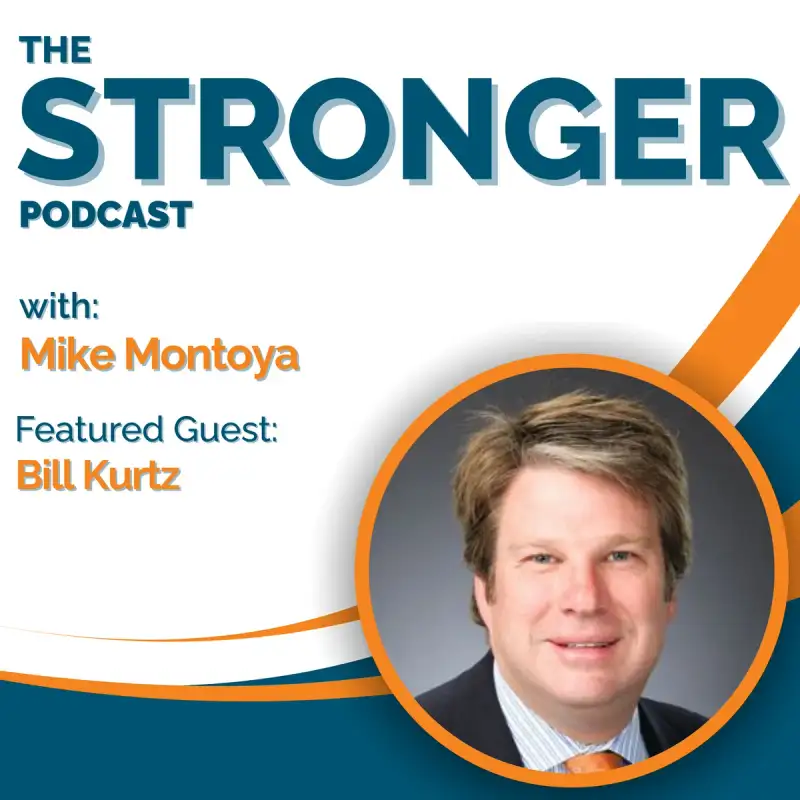
Education Leaders Don't Last Twenty Years Anymore: Lead Yourself Before You Lead Others with Bill Kurtz
Welcome to the Stronger Podcast. Each week, we have honest conversations with education and social impact leaders about their leadership and career journeys. We talk about their origins, inflection points, and the work that they're doing today. The conversations are honest, human, and practical. If you're here for real stories and real takeaways, you're in the right place.
Mike Montoya:Let's jump in, and let's get Stronger together. My guest today, Kurtz, spent more than two decades building one of the most influential public school networks in the country. In this conversation, we talk about the early days of Denver School of Scientific Technology, why Denver became a unique place for innovation and what it takes to create schools that prepare students not just for college and careers, but for lives founded in values. Let's jump in. Good morning, good afternoon.
Mike Montoya:Out in Podcast land. I'm here today with Bill Kurtz, who's a friend and colleague, and he's the founding CEO of DSST Public Schools in Denver, Colorado, and he's now a coach and advisor amongst the charter space. And Bill's got a long storied history, which we'll talk about a little bit, but it's important that we give him the chance to tell the story of what happened in Denver, how we got here. So Bill, thanks for being here with you.
Bill Kurtz:It's great to be here. Yeah. Thanks for having me today, Mike.
Mike Montoya:So what I know is that you were one of the, I call it, one of the early stage charter operators in Denver in Colorado. Right? Like, this is kind of the the, they call it, before things grew a lot. Right? So tell us, like, what was it like, in in I don't know.
Mike Montoya:What was it circa 2004 or 2003, something like that? How what was it like back then in in the landscape in the in the charter sphere?
Bill Kurtz:Yeah, it was a it was a great moment. I mean, I I think life is sometimes, you know, about timing and you know being in the right place at the right time, and I feel super blessed to be at the right place at the right time here in Denver in 2004 when I opened Bsst. It's just it was a moment where I think lots was possible, and I think there were much less of the politics, if you will, of of charter schools. Think interfering with what I think we would all hope would be to create schools that are great for kids. And so it's a time of possibility.
Bill Kurtz:And so when I opened dsst there were, you know, there's a few other charters around, but there's really an optimism that things needed to change in Denver. The Denver public schools was not succeeding by almost every measure, and people were ready for something new. And so we just had the opportunity to come in and work with the community and to to build, I think, a model together with Denver and ultimately Denver Public Schools that I think helped transform public education here in Denver and Colorado.
Mike Montoya:So I mean, it's a hard thing to say that the public school systems in a major city in The United States was failing on multiple measures, many measures for children. And that was the era, right? And charter schools were part of the, call it, solution in Anadol. Right? And so it became like a eventually became like a much stronger lightning rod.
Mike Montoya:Right? Like charter schools started to get market share in different big cities in the country. Right? And some of them got significant pushback and resistance from the districts and and the state. Right?
Mike Montoya:But Denver was able to kinda grow with some with some, like, pace and intentionality, right, so that that several operators came into existence kinda concurrently. Right? And you guys got got some momentum as well as, like, I call it, quality involvement from local funders and people that wanted you to succeed. So tell me, like, what were some of the features that helped you as an organization get rolling in the right direction in these days?
Bill Kurtz:Yeah. I I think one I think there was a recognition, as I said, that that change needed to happen, and I think we are seeing really disastrous outcomes for children in Denver around kids accessing higher education students reading and and including math at anything close to grade level, and the gaps between subgroups were massive between you know throughout the city. And so I think that there wasn't really a recognition at that moment in time that changed the to happen. Number two. I think Denver was a very collaborative place, and when I came here it was a city that was I don't wanna say apolitical, but it wanted to be a community that solved its problems together.
Bill Kurtz:And it there's a lot of collaboration in the city, and I'm coming from New York City and Newark where I came from that felt very foreign. Felt like the frontier and the possibility of working together with people from all backgrounds seemed like a naive hope back back east. But here it felt like no, we can do this. And so I think those conditions were in place. Then I think very quickly Denver public schools, I think, made a transition into a place of we can truly work together to serve our children here in Denver.
Bill Kurtz:And that was, I think, a sincere desire. And so you know rarely do you have a school district in a charter organization or charter organization saying we can work together on behalf of all children and families in Denver. But that was true for a period of time here in Denver.
Mike Montoya:Yeah. So there was I think maybe Michael Bennet was the superintendent in that era. Right? And and I think he went on to be a senator. Maybe he's still the senator, right, for Colorado.
Mike Montoya:Yes. But that was a a a rare stance to get from a sitting superintendent, right, to to kinda get a collaboration in the country. So did you have a relationship with with mister Bennet?
Bill Kurtz:I did. Yes. So we're still very close, and, yes, I think we developed a very strong working relationship and partnership. And then when Michael left, Boasberg came in, and both of those guys are good friends today. And yeah, I think there was a recognition that again, based on what I shared earlier that we can work together that there are, you know, it's a small enough city.
Bill Kurtz:We can build meaningful relationships with folks, and I think in the end you know it was a place where we knew that if we work together, we could make a much greater impact for children in Denver than if we did not.
Mike Montoya:Yeah. For sure. And and that just seems like common sense, right, to to there's some of us. To
Bill Kurtz:wish for common sense to reenter our civic life here in The United States, that's a nice wish, Mike.
Mike Montoya:I was thinking about, because there's a lot of founding of America stuff going on right now. Right? And I remember the Thomas Paine famous Thomas Paine article, right, the the common sense article, which is, like, the plain spoken, like, if we cooperate and we can be a better new thing. Right? And I think that that was made sense at the time to the common folk, right, two hundred fifty years ago or something like that, and it still seems to resonate today.
Mike Montoya:So Denver and the work that you did at DSSC, which stands for Denver School of Science and Technology. Is that right? Yes. So it was a STEM focused operation. Is it still it got a strong STEM focus?
Bill Kurtz:It does. It does. And my successor, Nella Garcia Urban, is doing an amazing job of carrying on that legacy. And yes, I think stem is at the heart of the sst. Always thought of ourselves as a as a a liberal art school with a stem focus, and I think that continues to be true, and we have some amazing partnerships across our schools with with stem organizations or campuses like the Anschutz campus.
Bill Kurtz:And you know I think we always felt like we wanted to prepare our students who had the least access to most everything to be to get the most access to the highest paid highest need jobs. And we wanted our students not to be the assistance serving the stem innovators, creators and designers. We wanted our students to be the stem leaders, innovators, engineers, and designers, and I think we had accomplished that. Mean, that's one of the things I'm most proud of is that we actually flip the script from our our young people seeing themselves as a part of the system that didn't always serve them to leading the system that that hopefully will serve them someday. And so I think that's been a really important part of the DSST story.
Mike Montoya:Yeah. Well, I mean, it's super fun that now that they've been you've had alumni, right, that, you know, now they're ten or twelve years out of even being in school with UX. You have, like, been around for twenty plus years, right, at DSST. So do you have any stories or you don't have to tell a specific name of a child, right, or an individual, but, like, do you have, like, anecdotes or something that you remember from your time about children who have gone on to be successful in a field or have have chased down a career that you're super excited about?
Bill Kurtz:How much time do we have, Mike?
Mike Montoya:I love the stories. I wanna hear a kid's story.
Bill Kurtz:I mean, we have so many great stories. I mean, alumni are incredible. I mean, I think the thing that I'm most proud of, frankly, to start with is that I think I think in the we have high forties in alumni now working at the S. Public schools. Okay, I can work for that.
Bill Kurtz:That is just a you know a legacy that that is remarkable that we are now, you know, we have so many alums back working doing the great work that dsst does, and and really leading the way. You know we just handed out an alumni award to Evan Sauls, who is, you know, went to the University of Colorado, Colorado Springs in engineering, is now working for Sierra Space System, helping build space shuttle. So I mean, like, you know, mean, the I mean, anyway nothing engineer. Awesome. We could go on and on about, you know, Greg Hatcher is an alum.
Bill Kurtz:Many people are familiar with Greg Hatcher, who has done a lot of work in education advocacy across, you know, the country, the murmuration, and a lot of other places. I mean, we could go on, but we have have a loves do it leading the way across all fields. One of the environmental education, know, environmental reporters for Colorado Public Radio is one of my former students, one of our founding class. He literally leads coverage for for NPR on on environmental issues in the State of Colorado. Mean, I I hear his voice on the radio a couple times a week.
Bill Kurtz:I mean, there's so many. So I think in the end we always wanted our students to have a stem background, such that they could understand the world that I think unfortunately in some ways has now become so stem that but but yeah we wanted them to be so literate that they could make choices of their life about where they spent their time and careers, and that didn't mean that all of them were going to go into stem, but it meant they all had the opportunity to. The amazing thing is that that background has helped them in so many other things they did if they did not go into STEM fields.
Mike Montoya:Well, and it's such a powerful if if if, for example, you taught them the scientific method, right, and trained them around some of the kind of core science concepts. Right? How do you investigate things that make sense of the world? Right? Like, those are, like, key features.
Mike Montoya:Right? This is I mean, that's my personal background. Right? So I'm like, of course, it's the best thing to do to study that stuff. Right?
Mike Montoya:Of course. So but you can make a really great life if you understand how the world works. Right? And you can understand why things fail or work in the world in that regard. Right?
Mike Montoya:And that's super fun. I wanna at some point, you and I will follow-up, but I wanna, like, get some of these alumni on our podcast because I think I'd love to hear hear their own experiences and especially the the space shuttle builder. I haven't had NASA engineer on my podcast yet, so it was an opportunity for me to call it future cast into the world. So thanks for sharing a few of those stories, but I think that's part of the essence. So the dream was imagine a place where kids can learn and then become become the the leaders in the field, right, that that are that are the future.
Mike Montoya:In in 2004, we were, like, looking into the future, but now we're there. Right? And now we're in a place where, like, science is running our life, right, and AI has become a real feature of everybody's experience. Do you feel like DSST is ready for that? I guess the next, almost the next generation of tech that's coming for us.
Bill Kurtz:I think the other thing I would just say is that DSST was always a values based institution. What I mean by that is we always subscribe to centering everything we did on a set of values, and I think that was one of the things that differentiated ourselves from some of the early chartered movement, which was a little bit more high compliance. And we really wanted to build a culture around values and living those values. And so I think one of the things I'm most proud of is I think our graduates will say that might have been the most important thing that dsst taught me was how to live a life centered around a set of values. And you know a lot of times our graduates will have their own values that they choose, but they learn the process of living in a values driven culture at dsst.
Bill Kurtz:I think you know, in the age of ai that is gonna be so important by them. So important and and so I think that you know as much as anything I'm proud of the fact that many of our graduates will say, I know who I am and who I want to be in part because of my time in Bsst. And in addition, it got me to college, and it got me, you know, into the stem fields. But I think those are so important. Those those that combination, particularly as ai becomes more and more important.
Bill Kurtz:We need people who can discern between right and wrong. We need people who understand that certain values are, you know, are sacred to them. And and I think that was a really important part of the bsst education was that we were gonna provide the opportunity for young people to be in that kind of community and develop those kinds skills. And I think you know lots of research and csgfs and a lot of research where you know dsst grads are leading the country in you know first jobs in first job salaries, and I think it's no secret. Because I think the package that we just talked about the preparation we gave them.
Bill Kurtz:I think it was not just about getting them into college. It was about preparing them for life, and I think we always saw that from the beginning, and I think that is where in the end, I think we're going to position our grads to be amazingly successful and fulfilled in life because they I think they have that full foundation.
Mike Montoya:Well, and I think it can be a much like I call it more rewarding life when you kind of live it in congruence with yourself. Right? And you're like aligned with the life that you've chosen and life that you've constructed for yourself. And it's not, I call it, riding the uphill or against stream on all cases of society. Right?
Mike Montoya:And, I mean, I feel like right now we have a bunch of leaders in our country that are not values based or maybe and, like, they're super capitalists, I would call them, right, in that regard. And they're very good at making the money the money mill spin, but they may have missed the mark on some of the other things that matter to the rest of us. So that's, like, a it's a kind of a nice nice to know, right, that there's institutions out there building for futures, right, that are, like, you know, tied to humanity in some ways or another. Right? And as you said, in the age of AI, it's gonna be a special thing to us all to survive this this in the next gauntlet I call it.
Bill Kurtz:Yeah, no, I, I, I couldn't agree with you more. And I think that, you know, we're in a place, I think we're in a place of massive opportunity in that I I do think who you are becoming, what are your values and and what and how do you live out your character? What feels greatly diminished in terms of the way the world values that right now. I think like all things it's cyclical. I think we we if we don't pay attention to that we are going to have a future generation of leaders that believe that absolute power and absolute you know market forces are going to be the only ways you get ahead in life.
Bill Kurtz:And I think that there's such an opportunity to now create a powder narrative that says, no, no, no. Who you become is actually really important. It's not just what you do. It's how you do it, and I think in the education sector, particularly this is such an important moment for us, because we are gonna shape the next generation, and I think that we have to continue to double down on creating cultures and communities and schools led by leaders who actually embrace this idea that who you are and who you're becoming is one of the most important things we can model for this next generation of leaders. So it does feel discouraging at moments.
Bill Kurtz:But you know every every situation provides an opportunity in some ways that the bigger the dip the bigger the opportunity, and I think that we sit at a moment in time where we can really make an impact.
Mike Montoya:Yeah. Well and I appreciate that perspective. Right? Like, we're we've lived through a couple generations now, right, where where we've seen the ebbs and flows. And I remember the seventies and eighties being such an abysmal, so crazy time.
Mike Montoya:Right? And, like, capitalism was on fire in the eighties as well. Right? And and then it it has I call it it balanced out a little bit. Right?
Mike Montoya:But we have a lot of, I call it, significant challenges ahead. So we need young people that are prepared for that. Right? Because, you know, we've got to get through it together in that regard, and I appreciate your mention around schools. Talked about you were one of the founders, but you built a team of people over time at DSST that built this culture.
Mike Montoya:But where did you establish, maybe I want to go back into your preschool years, but how did you get your own values based, and where did you learn to be a good human as a young person? What was that like growing up in your world?
Bill Kurtz:Yeah, that's I mean, it's a good question. Think I mean, like anybody, I think my parents were probably really impactful, and in this case for me, I was fortunate, I think very positively impactful. But I I I was raised in Maine and I was raised, you know, in a pretty sheltered environment, but one that I think taught me all the things that I just shared. I mean, me that character matters, taught me that who I am and who and my values are as important as what I do, and that you know in some ways we're meant to live in this world, not for ourselves, but for others. And so I think that was that that that those lessons and those kind of ways of being, I think, taught me through my parents, who I think did a great job of modeling that.
Bill Kurtz:But like anything you have to go out in the world and and you know and experience that for yourself and and decide what you believe. I think for me one of the most important steps I took in my career was working on Wall Street, and I loved it. You know people always ask me like, you're an educator. You worked on Wall Street. You must have hated it must been terrible.
Bill Kurtz:No, no, no. Loved it. It was a great challenge. I learned a ton. Let's be honest.
Bill Kurtz:The world revolves around money, so we can we can we can detest, you know all the things that come with that if you want. But you know the reality is that's that is the the way of the world. And so I learned a lot, but I also learned a lot about what I didn't want. And I think those are important experiences in life. Right?
Bill Kurtz:Is that we try things, and it's not that I didn't like being a banker. Just knew that that was not going to be the expression of who I am and the values and what I wanted to accomplish in life. And so I left and and you know people thought I was crazy. I left to go work at a small Catholic grammar school in the South Bronx, and you know all the bankers that I worked with thought I was absolutely crazy. They're like, what are you doing like you've lost your mind, and to me that was a reinforcing moment for me of like, no, I actually haven't lost my mind.
Bill Kurtz:I'm actually really clear about what I want to do with my life, and it's in no offense, but it's not it's not banking, and I like you people, and you're you're really smart and capable, and it's it's it's a exciting and and challenging kind of profession, but not not for me. And so I think that's through those kinds of experiences. I think I continue to understand what was important to me, who I wanted to be, and what I wanted to to to work on, and what were the kind of challenges I wanted to work on. And there's nothing better in the world than going to the poorest congressional district in The United States Of America and learning how to work and and create great schools for kids. And that was such a privilege and an honor.
Bill Kurtz:I love that community. I love the school I was in, and I just learned so much.
Mike Montoya:Do you how long were you a front of classroom or in classroom teacher? Let me just use those words gently because there's lots of ways to teach, but I'm curious. Like, how long were you managing a classroom with of kiddos?
Bill Kurtz:Yeah. Interesting. Like, I I talked for two years, and and I didn't I actually when I went there, I was not just a teacher. I I went there as kind of an assistant principal in charge of the business office, helping them to start to raise money. But I taught social studies.
Bill Kurtz:I was the basketball coach.
Mike Montoya:Sure, the
Bill Kurtz:principal of the middle school right? It was a Ka. I mean it was just a it was just a wonderful opportunity to grow and learn and take on new challenges. And I loved every bit of it, and I still, you know, I still have one of my fondest memories to this day is coaching the boys basketball team driving around as the Bronx, you know, to these gyms and Catholic schools that are like cafeteria on like the 4th Floor that were like half the size of an oral gym. Every gym was different size.
Bill Kurtz:They tucked it into some place in the building where they can afford it, and you know it was amazing. And and and you know we had a great team. We actually my my last team. We were undefeated and won the Catholic boys, you know, kind of city title, which was actually no joke in New York.
Mike Montoya:Say that's a real thing.
Bill Kurtz:But you know that those are the moments when you're like, I'm in this. I'm in this with our kids, with our families, and those are the kinds of things that I think really taught me what it means to be, you know, in community with young people in a really healthy and and important way.
Mike Montoya:Yeah. Well and, I mean, it's, like, when you get to do all the jobs, right, you get to, like, build a lot of different muscles. Right? You gotta be the responsible for the building as well as the lives of kids. And then, you know, have a winning basketball team is even more valuable.
Mike Montoya:That's probably something that, like, it goes a long ways in life is to have, like, I call it success at a sport, you know, as a kid in particular. So congratulations on that. And I can imagine yeah. I've been in a lot of schools in New York, and I yes. I can I can picture the gym in my head and the shapes and sizes of the the variety of them?
Mike Montoya:It reminds me of some there's some movies about those things I'm sure that are out there. But so so you taught and you and you got that experience. And then what did you I mean, why did when did you get the issue to move to Colorado? Did someone recruit you, or did you just, like, hear about this, like, opportunity? How did that how did that come into play?
Bill Kurtz:Yeah. I ended up going to to be a principal of a school in Newark for six years,
Mike Montoya:a
Bill Kurtz:school called Link Community School, which actually was the the model that North Star Uncompensable for Norman Atkins kind of took that model and said, let's create a charter school and Jamie Varelli, who is the principal at Link before me, went over and helped Norman start North Star Academy ten minutes away in New York. So I was the principal there for six years, and then you know I was just looking for the next thing. Mean I'm I'm I'm a believer that you know you gotta commit time and energy to a to a institution to help it be become great, and it's a process, and you you have to be doing if you've been that space for at least five years to do. I think a great job. And so I was at year six at length, and I was like, Am I gonna double down for another six years, or am I gonna go do something else?
Bill Kurtz:Just felt like it was the right time to do something else. So I actually got into this process. I just saw an ad for the you know the the the founding head of school for the Deborah School of Science and Technology, which is really an investment that the Gates Foundation made in this early small high school that you probably remember. You and I are old enough to remember these things. But anyway, so they were looking for somebody to lead the first Gates small school in Colorado, and I said that looks interesting.
Bill Kurtz:And you know the rest is history. I mean I got into the process pretty late for them, but they let me let me join the process, and the rest is history. I mean, I think that, you know, that was in August 2003, and I got hired in November 2003, and then we opened in summer of two thousand and four.
Mike Montoya:Yeah. So a quick process. Right? So, yeah, literally, that makes me laugh about, like, the and and Stronger does a bunch of, like, school founder jobs. Right?
Mike Montoya:We help people found schools and things like that. And I'm thinking about, like, what's gonna come from some of those people that are taking jobs right now, and, like, that's, like, what's twenty years out in there? Like, are we really retired by then? But it's it's like an amazing it's an amazing thing to put your your stamp on a community, right, as as a leader and participate with them over time to turn it into something for real. So and at some point, we'll have Nella on the the show and and have the conversation about the kind of current state of the artistic team.
Mike Montoya:But one thing that you and I chatted about before we caught on on our our recording here is that is the is the you know, what happens with leaders once they've done a big job for a period of their life, a big chunk of their career, and then they move on. They move on to the next thing, whether that's another big thing or not. You're doing a variety of things. You're doing some coaching and some advising and some board work and things like that. So tell us what's life like after being the CEO for so long?
Mike Montoya:And, like, how do you feel about it? And we'll get into some, like, I call it tips and pointers for the for future CEO retirees, if we call it that.
Bill Kurtz:Yeah. Yeah. Well, I mean, first of all, you know, a big, big, big debt of gratitude to Nella. I mean, she's been an amazing Ceo. I like to call her an upgrade, which she is, and you know none of what has happened the last couple years would be possible without her amazing leadership and the way she's led dsst and just conveying them and taking it to new heights.
Bill Kurtz:So you know when you found something that's hard to turn it over. And let's be honest, Mike. I mean about 50% of these things don't go very well right at least, especially if it's, you know, first generation founders in the charter movement of 80 higher. And so anyways that's a really hard place to be. I know lots of friends who've struggled through that, and to this day probably still are somewhat, you know, emotionally kind of pulled into the challenges of post kind of succession life.
Bill Kurtz:She's been an amazing leader. She's done amazing work. It's made my life so much easier, because I know dsst is in my hands, and so that's it. The gift right it's a gift of freedom, a gift of peace of mind, a gift that I know dsst is doing great. So without that we could be having a whole different conversation.
Bill Kurtz:So I just want to acknowledge that and just grateful to her. Secondly, yeah, I I think for me I mean it's an interesting place to be when you've spent twenty years founding, and then leading something it becomes a part of you right? I mean it is kind of your identity, and I I've done some writing on that, and and certainly a lot of work on that. But it can become very unhealthy because you are dsst and and frankly, to be honest with you, there's not a my kids used to get, you know, tired of going out to dinner with me. You're going out in the kids.
Bill Kurtz:There's always a person that would stop me and say, yeah, you're the founder of the St. Oh, my kid did this, or my daughter taught there this, or you know, I mean, and that's wonderful, and it becomes part of your identity, and you you become dsst and dsst becomes you in a way that's unhealthy. So I I had to work really hard. I started that work, I think, before I left around just trying to disassociate myself in some ways, because I'm more than dsst and dssts more than me. So anyways I spent a lot of time, you know, looking at that what I would say sabbaticals and processes and all the things around.
Bill Kurtz:How can I make a healthy transition? And I think that a couple of things I found to be true. Number one it's it is really important to disconnect, and I see folks struggle with that. I mean I literally disconnected for the full summer that first summer, and was traveling a bunch really. There was the time when I talked to Nella the least about what was going on, partly because I want now, and partly because I just I wanted her to have the space to make decisions, and we certainly talked, but but but I also needed the space for myself.
Mike Montoya:Yeah. Sure. That
Bill Kurtz:was really important. And then, you know, and then I think I just was very clear with people that I was not gonna rush into something and that I really needed space. I would say it takes nine months to decompress. And if you have the ability financially and that's a privilege to have, but if you have it, that's so important. And so certainly opportunities came along and you gotta say no, or you gotta have discipline around that.
Bill Kurtz:But you know I think what what I what I've kind of discovered is a couple of things around that one is it's great if you can find a few opportunities that can help you pay bills without having you to make some big life commitment next, because I think oftentimes we rush back in to be relevant, or you know, and we choose the wrong thing, and it's really hard to unwind that. So I feel really blessed that I've had that chance. Then I've really had a chance to really think about what I want to do next. As I said to people I'm very open to one more big chapter in my life, but it does need to be the right chapter, and it needs to be around a passion that I feel really important, you know, really significantly kind of committed to. It needs to be with great smart people, and you know it needs to be it needs to be a place that I think I can bring my gifts that actually can make an impact.
Bill Kurtz:I'm just not, know, kind of a plugging in exercise. So that's been you know I've had some opportunities I've looked at, but I think I felt the opportunity to not have to rush into a decision based on the fact that I've had the the privilege of doing you know enough work with other people that I haven't had to make a rash decision, because I needed to get back in either for my ego, my relevance, or for my you know kind of my bank account. So I think that yeah, I think rushing is is always sometimes you have to because of financial reasons.
Mike Montoya:Sure.
Bill Kurtz:Yeah. Avoid that. I think that's actually helpful, and it's been a process where I've learned a lot about myself and learned a lot about what's going on in the world in a different way, and I think it's I've been surprised by the fact that, hey, maybe some of the things that you thought would be great. Actually, you're not sure are the right things for you anymore, which I think I would may not have thought about two years ago when I just left the job.
Mike Montoya:Well, I mean, what you're talking about is this, like, period of transition, right, which which includes actual time away traveling, etcetera, and then just like spacing yourself to like almost and you use the words like your identity gets sometimes wrapped up in the role on the job, right, of being a founder or or a key leader, and it becomes like outsized in your life. And then you're like, something else shrinks, right, like the commitment to yourself or your family or or others that is in your life, this column that, like that it requires you to like kind of reintegrate with those things, right, where you're having a chance to be like, oh, what is my relationship with my family or myself, right, in that regard? And how do you give yourself the space to be that thing, right, and to discover that and to let it unfold, right, without jumping into the next thing that you can identify with? Because I think there's probably opportunities, right? And there probably still are opportunities like, come run another system, come take on another big messy thing, right?
Mike Montoya:People love to have, I call it seasoned CEOs come fix a big problem. That's a very common ask. So you haven't, like, chosen to tackle something like that yet. Are there, I call it, things that you're attracted to now that you hadn't thought about? Like, I mean, maybe you've discovered another passion, right, or something that you're pursuing in some cases, but I'm curious, like, have you been able to round it out now and start to to feel excited about something yet?
Bill Kurtz:Yeah. No. I think I think a couple of things that I've been able to do that are I'm enjoying a lot is I have been able to work with other CEO founders who are earlier stage, and I've I've gotten increasing amounts of joy helping other people succeed. And you know I used to be an entrepreneurial founder myself, and I was like, I always want to be doing the work, and you know that felt important to me. And now I feel like there is a little bit of a shift that says, No, no, I love actually helping other people do the work, and I don't I don't need to be the entrepreneur myself.
Bill Kurtz:And so I I I get to work with some amazing leaders in very diverse sectors for profit nonprofit. But it's been really fun to be able to to do that with them. The other thing I I do a bunch of writing, as you may know, and I write every other week kind of leadership post, and that has been, I think that has been fun to to share some of my learnings and lessons and struggles and challenges and failures with others. And it's interesting, you know, just fun to have it resonate with people. And I I do think back to our conversation around leadership.
Bill Kurtz:I think people are looking for new ways to lead, and and, you know, in some ways they're they're looking for a path through this current moment, and my path through is, I think, very much about who you are, who you're becoming, and their vulnerability that takes in a leader, which frankly feels very odd in this moment to be vulnerable when it feels like the opposite is actually being rewarded. But I like, as I say, I like writing and sharing and encouraging people to be countercultural. And I do think that that is that is what, you know, we need in this moment is people who are being willing to, you know, zig when everybody else is zagging. And so I found a lot of enjoyment writing that way, encouraging people to truly be countercultural in this current moment.
Mike Montoya:Yeah. I feel like it's a privilege, as you said, to, like, have had the moment to, like, breathe and be able to share some of that stuff. And then for people to, I call it, take it up, right, as information that and or learning some lessons that they can hold on to. Right? I think people are actually hungry for that.
Mike Montoya:Right? They're looking for someone who's, like, a little more grounded, right, who is not in the moment activated by all the things happening to us on a daily basis that can, like, pull some of the kind of key threads for us, right, and probably we can pay attention to them because, like, those of us who are still operating stuff on a regular basis, like, have a lot of stuff that is flying at us every day from the world. Right? And so it helps to have people, like, call it, like, boundary that if that makes sense, like like a boundary around us that kind of is like a little bit of insulation helps us to be stable regarding, like, a little bit of a dampening effect. Right?
Mike Montoya:It it kinda contributes in that way. And so I'm interested to see about your writing. So maybe we could feature you in a future newsletter or something like that where you can share some of those things because I feel like we talk to leaders all the time, right, where people are just like, hey. Who do you know that can tell me more about this thing or can that can, you know, give me some, you know, perspective, right, on some of the things that I'm experiencing as a leader because, you know, the stuff keeps flying. I mean, I'll use the word.
Mike Montoya:Yeah. The shit keeps flying.
Bill Kurtz:Yeah. Yeah. And I and I mean, you and I both know this. Like, leading in this current moment's really hard, and I have such empathy for those who are leading in this current moment, and I do think, yes, one of the things I can do is to support them by encouraging them and, you know, hopefully providing some some wisdom and some encouragement to to keep keep going because it's hard. I I
Mike Montoya:feel like some of the things that like, you know, the early charter movement wrestled with was like some technical challenges. Right? There was some like, really, like, how do you get these things to work in this manner effectively? There was obviously some advocacy work that was necessary, right? But they weren't quite as, like, call it in the face, almost like the place where people were assaulting, right, the concept of existing from an equity standpoint to serve children, right, who are didn't look and were as privileged as the rest of us to start with.
Mike Montoya:Right? And that's I felt like we're, like, really fighting a cultural war around that right now in our society. And it's, like, harder, right, for leaders who are leading in those types of schools to sort of stay stable. Right? And they're burning themselves out.
Mike Montoya:Right? They get burned out. We have a huge set of conversations around people like really hitting the wall earlier. Like they last like three to four years, right, versus like seven to ten. And so it's like a much higher turnover.
Mike Montoya:Right? We're seeing CEOs start to become a CEO when they're like in their 30s because the other person kind of flamed out earlier, right? It's just been so hard on them. It's been a lot. COVID on top of everything else, right?
Bill Kurtz:Yeah, think that's a really important point. I think that mean some of the the writing I'm doing and work I'm doing with leaders is actually this this idea that you have to invest in yourself, and you have to develop a sustainable way to live and lead. And and you know my my my my my subtype is called, you know, lead yourself to lead others, and I actually think it's it's fascinating because we do take the work so seriously, and the work is so challenging that so many leaders actually don't take the time to learn how to lead themselves. And you and I both know the highest performing leaders or the highest performing athletes actually are that because they learn how to take care of themselves. They learn how to invest in themselves, not actually when they're leading.
Bill Kurtz:Yeah. They're the best in the world at that time, which then enables them to be best in the world when they are leading or performing and doing things. I think as educators, sometimes we forget that because we are we feel called to be working twenty four seven to serve our students and families. There's always things to do because our work never ends, and my encouragement to readers is we need you in the work for twenty years. That's how you make sustainable generational change, but that takes different kinds of work, and that takes work where you actually are learning how to read in a sustainable way, where you are investing in yourself much more than you've allowed yourself to.
Bill Kurtz:And I I think that that is something I feel very passionate about. And I actually think it's a major challenge for the movement right now, because as you said, like, we're not getting twenty year leaders anymore. We're getting, you know, five to seven. And it's not because they don't want to. It's just because I think we haven't built the capacity to, and it's so much harder.
Mike Montoya:Yeah. It is definitely I mean, the job has changed for sure, and and, like, the way we take care of ourselves is not as available sometimes. Resources seem strained. Right? But and I like your athlete reference, right?
Mike Montoya:Because I noticed this in my work is that like, you know, people who are strong professionals have a really rigorous recovery experience, right? They take care of themselves. Like they they spend more time resting, right, than normal humans. Like they sleep longer, harder, they eat better. Right?
Mike Montoya:And they disconnect. Right? I call it from the technology in a much more intentional way than, than people who are in it all the time, because they just, exist. And whatever's your body and your mind needs that space, right, in that regard when you I call it inundated all the time with big challenges that you have to tackle. Right?
Mike Montoya:So I appreciate that. Bill, and I promised I would
Bill Kurtz:give you your make sure
Mike Montoya:you got your draft name together with your with with your next thing. So the the question I have for you as you as you kind of exit here is to think about, like, with that up and coming or new new newer leader in the movement, a CEO, like, is there something that you would suggest for them to either read or a piece of advice that you almost that you would have told yourself at the time, right, as as you were getting into this, like, in order for them to be successful, just something to hold on to? It doesn't have to be, like, the most sage advice ever, but sometimes it's very practical, like, don't forget to feed the cat, you know, like things like that too. Yeah.
Bill Kurtz:Yeah. Yeah. Yeah. Now I was literally talking to a a very prominent leader in the sector yesterday about this. I work with him, and I I said this to him, and I'll say, I think this is really important advice.
Bill Kurtz:You know, and he was just referencing the fact that, you know, fifteen years ago when he joined as a in the sector and as a leader, he was like, yeah, I had to be all these, like, who I was and value and vision statements for myself, and they seem to be less less important to me today, and I'm like, yeah, that's life. I mean, you know, we we live in a world that you know we get more experience. We get more jaded. We get a little more, you know, like this is the ways the world it kind of wears you down. And what I said to him, and I would say to you know young readers is you have to constantly come back to revisiting who you are, why you do the work, and who you're becoming.
Bill Kurtz:And that is a process that changes every year. And when we don't do that every year, wake up in five years and go, wow, I am. This is not. I'm not aligned anymore, and this doesn't fit anymore. And what happened is because you haven't been spending the time investing in yourself and knowing who you are because it takes we're always going to be changing, and we need to then change our own understanding of ourselves.
Bill Kurtz:We love fixing other people. We love fixing that leader that's not performing. Yeah, what we don't love is asking ourselves the hard questions and revisiting who we are, and that takes discipline. And so that would be my encouragement to you is is really to commit to a process that says, you know who I am is probably the most important thing for my organization in terms of am I healthy? Am I aligned?
Bill Kurtz:And am I able to lead to the best of my ability? And that's how you're gonna make the biggest impact as a leader. And yet we spend shockingly little time teasing that out because it's complicated and it's hard. And so that would be my advice to folks is really get into a routine of doing that, you know, you know, annually and and hopefully more than that, but at least annually.
Mike Montoya:Yeah. The idea of reflecting on the the year past and thinking about the year ahead is like a a a a takes protected time. Sometimes it takes guided time, right, with somebody. So like coaches are great for these kinds of experiences, right? People who have thought about, like, how do you help a leader be sustainable in that regard?
Mike Montoya:So Bill, can people find you and if they want to talk about, I call it support or I don't know if you're doing one on one things with people. I mean, is there a way for them to reach out to you that we can provide? We can we can get them your email or something like that. Is that something that you're open to for leaders if they wanna have a conversation?
Bill Kurtz:Yeah. Absolutely. I mean, you can find me on on Substack and Linkedin, leading yourself to lead others, and yeah, happy to have folks reach out to my gmail wrKurtz01@gmail.com. I mean, I'm happy to to to talk to folks. Perfect.
Bill Kurtz:And and yeah, that that's really something I'm passionate about right now is supporting leaders who are doing the hard work that that I'm not right now. I'm I'm passionate about that. The last thing I would say, Mike, on the point you made earlier is like that process helps you continue to be in a place of self worth, not self confidence. Right? And there's a big difference between self worth and self confidence.
Bill Kurtz:When you have self worth you you have something that's not based on comparison, not based on what other people think about you. It's a work that's that's innate as opposed to self confidence, which is built on what other people think about you and you in comparison to others. And you and I both know the education movement suffers from people worried about how they stock up with everybody else. And so Yeah. That's what that reflection process does, is it brings you back to a sense of self worth as opposed to basing all your your kind of chips in the self confidence bucket.
Mike Montoya:Yeah. No. That's super helpful. And it's a good it sounds like we could have another conversation about this, and maybe we should gather some people together and talk about talk CEO talk around, like, how do you keep it going and and keep it, I call it. I think the the reflection exercise gives you a chance to be, like, relevant, right, in the now.
Mike Montoya:Right? And it keeps you grounded in what what's necessary because, like, as you said, things change all the time, and and this year is not last year. And, hopefully, this next year ahead will not be last year. That's for sure. Let's call it that.
Mike Montoya:So, Bill, thank you for your time. Thank you for your service, for your founding work, and for the work you've done in Number, and we appreciate you, and we'll be in touch soon.
Bill Kurtz:Okay? It was great to be on. Thanks so much, Mike. We appreciate you.
Mike Montoya:One of the ideas that stayed with me from this conversation is Bill's distinction between self confidence and self worth. In a world that often measures leaders by results, recognition, and comparison, he reminds us that sustainable leadership starts with knowing who you are, what you value, and why you do the work. A lesson may be just as important as anything we teach our students. Have a great day. Thanks for listening to the Stronger Podcast.
Mike Montoya:If this conversation inspired you, we invite you to follow the show and share it with someone who's on a journey to become a happier and healthier version of themselves. Links and resources are in the show notes. See you next Thursday, 9AM eastern time. Have a great day, and stay strong. Podcaststhatmatter.org.