 Episode 20
· 50:14
Welcome to the Stronger Podcast. Each week, we have honest conversations with education and social impact leaders about their leadership and career journeys. We talk about their origins, inflection points, and the work that they're doing today. The conversations are honest, human, and practical. If you're here for real stories and real takeaways, you're in the right place.
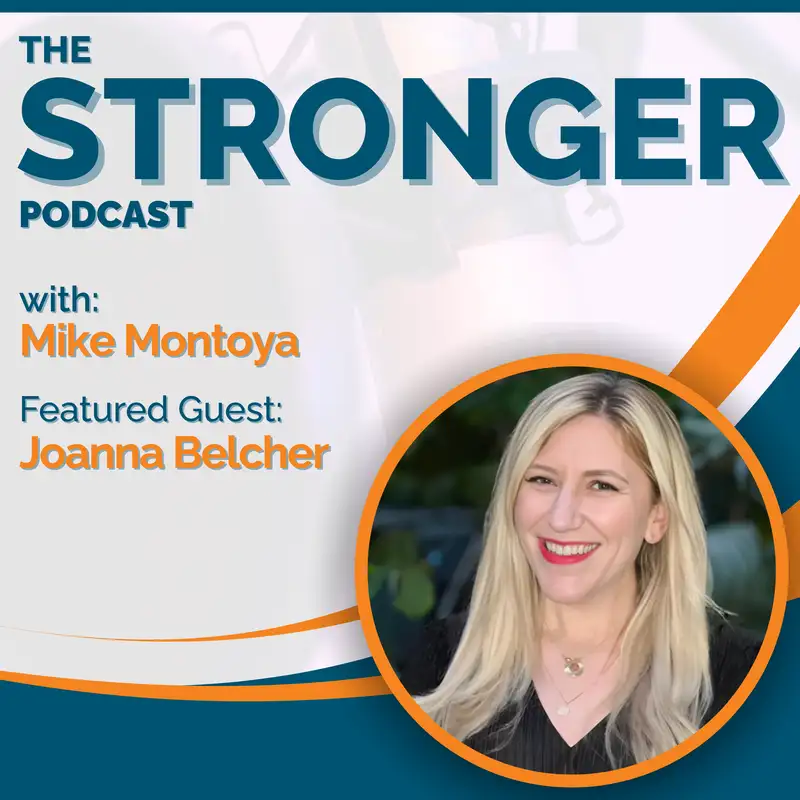
Mike Montoya:Let's jump in and let's get stronger together. In this episode, Joanna Belcher shares her journey from teaching fourth grade in Compton, where she saw her first fully aligned high expectations school to founding KIPP Elementary School in Newark and now supporting leaders nationwide. We talk about how seeing excellence changes your belief in what's possible and why curiosity is a leadership superpower and what it really takes to build teams that row in the same direction. Let's jump in. Before we dive into today's conversation, I wanna give a quick shout out to podcaststhatmatter.com.
Mike Montoya:Their mission is to help impact driven voices get the visibility they deserve. If you wanna share your message with the world, check out their website in the show notes. Good afternoon. It's wonderful to be with you. And today I'm with Joanna Belcher, who is a, I call it, I call it in my orbit for a long time, but we've gotten to know each other in closer in the last, I call it, year and a half or two.
Mike Montoya:Right? So this has been fun to see you. Thanks for being here.
Joanna Belcher:Thank you for having me. Of course, there's an ambulance going
Mike Montoya:outside On right now.
Joanna Belcher:Thanks for having me.
Mike Montoya:Let's help people understand where on the planet are you roughly, and let's just start there.
Joanna Belcher:I'm in Oakland, California right now, which is home. I'm very excited to be here. I've been traveling a lot the last year and a half. So some mornings I wake up and I have to remind myself where I am. So today I am home and I'm in Oakland.
Mike Montoya:Yeah. You're like, what time zone am I in? Where by? Like, did I get up? Like, I sometimes wake up when I travel online.
Mike Montoya:I'm like, which hotel? And I like lose track of where the light is and things like that. So I imagine that yours is. So you have one of those jobs, right? Where like you spend a lot of time on the road.
Mike Montoya:Tell people roughly like what your current role and gig is about and what you're doing.
Joanna Belcher:So I'm a regional superintendent at the KIPP Foundation now, which is a new role. It started about a year and a half ago and I was one of two regional superintendents who came on board. Now, thankfully we are four, and we work with our executive directors in our 28 KIPP regions across the country. So part of the travel, which I love, is being able to actually be in region side by side with our executive directors, seeing them do their day to day work and leading their regions. And I find that it's incredibly helpful in kind of both informing how we can best support them in their specific region, but what trends we're seeing, where we see differences based on context, where we see common themes that would be helpful for us to address.
Joanna Belcher:But our main role is to support, develop and hold accountable our executive directors across all of our 28 regions. And it's a new role that was created as part of our national One KIPP efforts, which as someone who's been at KIPP for a very long time, we have a new over the past couple years phase and chapter of KIPP where we've really been working on aligning a lot of our core systems and structures so that we can move in greater unison in our schools across the country, which is exciting.
Mike Montoya:And I call it ambitious and super challenging So work, for our audience, KIPP, which used to stand for Knowledge is Power Program back in the day, and it probably still does. But it's a federated model of charter school operators. The KIPP Foundation has been part of how more of these federated models have come into play over many, many years, decades now, and affecting positively the lives of, I don't know, a couple 100,000 kids a year that are in the KIPP network. Is that true?
Joanna Belcher:Definitely, yes. And I think one of the beautiful things about KIPP in the early days was that there was common training for all of our school leaders across the country through a program we had called the Fisher Fellowship. So we had these common pillars that we aligned around, but we kind of grew differently in each region. The flavor of KIPP in Massachusetts versus Miami versus New Jersey versus Texas. We had commonalities, but there were a lot of differences also in how we ran each of those regions.
Joanna Belcher:And part of the work over the past couple of years has been to say, that got us to a certain point. We have hundreds of schools across the country but now we're at a phase where our outcomes are not where we want them to be and where we know our kids are capable of achieving. And so we need to do more to streamline, align and work collectively to ensure that we can get all of our kids to be able to have the life choices we know they deserve.
Mike Montoya:The promise is opportunity in life that may not be available in their local cities or school districts, that KIPP provides an alternative for families that find it to be the right suit for them. And this is important work and also super challenging, as I said. But you're kind of well trained for this. And I was looking at your biography as I was getting ready. I'm like, this lady likes to travel because she goes back and forth across planet with your life and your career.
Mike Montoya:Like, but you started out, did you grow up in California? Are you a California native? When did grow up?
Joanna Belcher:Not at all. I grew up in a small town in Pennsylvania, and had never even been to California until I graduated from college.
Mike Montoya:Then you got the bug, right? You got the bug and I think they brought you into like a teaching corps, right? The Teach For America experience was part of your journey as well. Is that true?
Joanna Belcher:Yeah. So when I was in college, I knew adamantly that I did not want to be a teacher. My dad was actually a fourth grade teacher, so the one career I knew I was not going was to to be a teacher. Then I ended up teaching fourth grade just like my dad through Teach For America. And Teach For America is what brought me to California.
Mike Montoya:So your dad was also an educator as a profession. Was a Did he have a life career in that field?
Joanna Belcher:Yeah, so he was a fourth grade teacher my entire life. I think he maybe taught driver's ed for a couple years prior to teaching fourth grade, but he taught in a Title I school in my hometown in Pennsylvania. And it was really cool growing up as the daughter of a teacher in a small town. When we would go anywhere on the weekends, his former students would see us and kind of run up and be like, we've seen your pictures on his desk, but we didn't know. You don't envision when you're a kid that your teacher has a life outside of you and those classroom walls.
Joanna Belcher:But my dad has been such an incredible example because in his entire career teaching, even though he had been doing the same role for all of those years, he is the first person at his school every day. He ran the student council, ran all the intramural sports, was that teacher who would show up at his kids basketball games on the weekend. And so I think even though I didn't necessarily want to be a teacher when I was younger, something that I always really loved and admired about what he did is he, you know, threw himself into it so wholeheartedly and never settled for not, you know, changing and improving and doing more the next year, even though he had been in the same role for so many years.
Mike Montoya:So there's a special breed of humans that can do it for a lifetime, right? It's second evolution of humanity, people that can be teachers and kind of go at it for decades. So that was almost inevitable that you were going to become a teacher if he was, because whether you were not, it was like in the blood a little bit. And so but you were teaching in Southern California in one of the in one of the Los Angeles neighborhoods, right? So like people, lot of people have heard of Compton, right?
Mike Montoya:And it's been in the movies, like people make up stories about it all time. There's there's a lot of incredible people that have grown up and come from that region. So what was it like? Was it like the movies? Like what was your experience as a young educator in that experience?
Joanna Belcher:Yeah, so my journey to Compton was an interesting one because Teach of America initially placed me in Compton, but then we ended up, this is a very long story that probably won't have to,
Mike Montoya:you know, you may be too, but
Joanna Belcher:I moved to San Jose and taught in Alum Rock for two years as my core experience, which hadn't been my intention. I had been, you know, LA was my first choice, so had Teach For America application. I was so excited to go there and move to the Bay Area in October. So that was kind of an interesting path, but in retrospect, it all makes sense. I went back to Compton in my third and fourth year of teaching because I went to a Teach For America kind of alumni panel over a February break when I drove down to LA from San Jose and I met someone who's still my mentor to this day.
Joanna Belcher:I was texting with her earlier, Makara Solomon-Davis, had become principal of Bunche Elementary in Compton at a very young age and had moved it from one of the lowest performing schools in Compton to the school that had the highest gains for Black and Latino students in California in her tenure there. And I absolutely loved my time in Compton. Had it not been for some personal reasons that brought me back East, I would have absolutely stayed for many more years. I had the gift in my most recent role prior to the KIPP Foundation and KIPP SoCal of working a lot in Compton as well. And it's a really special community.
Joanna Belcher:There are so many veteran educators who I learned from at our district school in Compton, but it was the first place where I think I had a vision prior to going to Bunche, which was the name of our school in Compton of what an excellent classroom looked like. I did not yet have a vision of what it looked like when every single teacher in a school was aligned to a really strong vision of excellence. And I will never forget stepping onto Bunche's campus and immediately feeling like there is love, there are high expectations, families were very welcome on the campus, they were a part of our kids village And there was no question in the minds of any adult who worked there that every child could be college ready. And Makara had built these systems and these structures to ensure that all of us had very high expectations and that we live those high expectations in the way we approach our students, our classrooms, and our role as teachers. And so I am incredibly grateful for that experience because many people come to charter schools because they're like, oh, I want to come learn from a really high performing environment or I want to see what's possible.
Joanna Belcher:I'm very grateful because I saw many of the concepts and structures and systems that I brought to founding a KIPP school from actually a district school in Compton. And I'm so grateful for that experience.
Mike Montoya:Yeah, so charter and district schools kind of doesn't matter as much as it matters about what the leadership vision and potential is. And that in lots of I mean, sometimes charter schools have a little more autonomy, flexibility, ability to manage outside of the structures, right? And sometimes some district schools are really disconnected and like to let their schools do lots of things like that. So, I don't think that conversation is about district versus charter as much as great environments can be built by humans that care about it. And so that's super fun, because a lot of times we work with schools that are like, they have a couple of great teachers, or there's like the fourth grade is amazing, the other grades are kind of messy or something like that.
Mike Montoya:But how was it to be So you learned that it could be done, right? Basically, so there's a belief that it can be done where all the teachers are kind of rowing together, think is a word I use. That kind of set the stage for the next piece of your career. So you kind of got this experience, built some muscles. Those are my words.
Mike Montoya:I don't know if that's how you would characterize it. Like, what was the next thing? How did you know that you should then move into leadership and kind of take it to the next stage?
Joanna Belcher:I definitely did not want to move into That was definitely not my goal. But one of the amazing things about my principal in Compton was that she was a capacity builder, she was a developer. So when I got there, after the first few months, was like, you're going to become a principal. It's like, I do not want to be a principal. Then she's like, okay, great.
Joanna Belcher:You're going to run the writing curriculum for the whole school. So you're taking on this project, here's the goal, here's what we're trying to achieve. And from this, you're going to learn how to run school level systems. Part of why she was so successful is you kind of can't say no to her. She was so persuasive.
Joanna Belcher:And I think in addition to her seeing me believing in me, I also saw an example and I carry that with me today in my leadership role. I think a lot of times we want to tell people, but showing people experiencing excellence, seeing excellence is the most powerful motivator because while you might want something different or desire something different, seeing it helps you understand how you can actually get there. So she basically told me, you're going to become a principal. And then at the time I had some family issues going on and I knew I needed to move back to the East Coast to be closer to my family specifically at the time, my sister who was in Manhattan and they told me to go look at KIPP and I was very anti charter. I'm like, they kicked KIPP town out.
Joanna Belcher:See the power of an incredible district school, I'm not gonna go. And little did I know, here I am many years later, still at KIPP. And so my principal kind of set me up with someone who took me to visit the KIPP schools in New York City and in Newark, New Jersey. And I went to Newark and completely fell in love with the vision for what we were trying to accomplish both at KIPP and just in the city, in the greater city of Newark with education. There was so much potential in the energy around the school reform movement there at the time.
Joanna Belcher:I loved Newark because it felt like a community that you could really you know, immerse yourself in New York City is so big, there's so many schools and it felt like we can really make a difference in the options that are offered to kids and families in Newark. And they needed an elementary school at the time with KIPP, they had two middle schools, were opening their high school. They were like, we need someone to come open our first elementary school. And I think for me, the promise of we can have an excellent, not just elementary school for our kids, but they can go on to a middle school and a high school and be followed through college with people who believe in them and have that that same shared vision that I had experienced in Compton, not just in an elementary school, but in an entire K through 12 college and career system, that was pretty magical and I knew I wanted to be a part of it.
Mike Montoya:So I'll point it out. You said there's no way I'll do that. Then you became like, that's the magic, right? You just say, I'm gonna fly to the moon and then you'll be there in a few years, Whether it's you ready. So maybe that's your superpower, right?
Mike Montoya:Just tell her no and she'll do it somehow.
Joanna Belcher:Exactly. Yeah, I think my mom might agree with you. She'll be like, so stubborn. That's how you get her.
Mike Montoya:I always want to talk to everybody's parents and I get the truth. What was it really like? So, for sure. Well, okay. So, it's amazing that you found the opportunity to go.
Mike Montoya:Hopefully your sister is doing well, right? Like that you were able to go back east, be close to your family, and continue on this journey. And now it's turned into a career in a powerful way. You've helped build and expand KIPP in KIPP, New Jersey. Now it's KIPP TEAM, which includes schools in Florida and other places too.
Mike Montoya:Right? So it's like trying to do a real thing, right? How does it feel like to know and probably some of these kids are coming up to you now, And like, like, they're like, yeah, I remember her. She was our teacher, that kind of thing. Has that happened ever?
Mike Montoya:Has that happened to you since you've been kind of traveling around back in the school systems?
Joanna Belcher:Oh yeah. I mean, most beautiful thing is, and the gift of being in Newark for thirteen years, is being able to grow up alongside the kids and the families who come to your school. And so my first class of kindergarteners, we opened in 2009, are graduating from college this year. And so a few months ago, I got a text message from one of my founding kindergarteners, Leila, and she's at Spelman, she's doing an incredible job and she asked me to write her Teach For America recommendation letter. And she was like, Ms.
Joanna Belcher:Belcher, I want to come back and teach in Newark. And that's my hope. And to me, there's nothing more powerful and beautiful than seeing our kids go on and do so much. I mean, she's gonna be a teacher, the teacher I wished I was my first year, she's going to be so much better than I ever was. And I think it's just, it's so beautiful to see kids grow up and they still have those personalities that they had when they were five, but just see all the incredible things they're doing and the ways they're going out and changing the world and that's what keeps me in this work.
Mike Montoya:I'm going to pause the conversation here for just a second to talk about books that matter. Every entrepreneur or leader needs a book that elevates their business, builds their credibility, and makes an impact. If you've got more money than time, a ghostwriter can help you build your story. If you've got more time than money, a great book coach can guide you step by step through the writing process. If you have already written a draft, these folks can save a lot of trouble and money by shepherding you through the publishing process.
Mike Montoya:Head to booksthatmatter.org and get the custom support you need on your book idea or manuscript. Yeah. Well, and like yeah. And there's, like, literally thousands of stories, right, like that, these little bright spots that you kind of know it. Like, when they're when they're young, right, they kind of move around and they they have a lot of buzz and that kind of stuff.
Mike Montoya:And then they they get older, like, they're just bigger, but they still have the same buzz and have that all that life. And then all the skills and knowledge and all the things that they've, you know, built up as as they've turned into adults, which is that I think that's exactly the point. Right? That's the whole point. And that's like, I mean, you have a life.
Mike Montoya:I have a life. Right? We got here because we got like, had some good support and got lucky sometimes, right, in in many cases. But, like, if we could just do that from all the children, then we'd have an amazing world that we live in. Right?
Mike Montoya:And it's like, we have an amazing world. It's complicated sometimes for sure. But we can continue to do better by continuing to focus on this work. So help me understand what keeps And so I always like to see if you can pull a lesson out of that era of your life, that early stage, first ten years of your career phase, that you would say handing it back to the future generation of younger folks that's helpful for them to hold on to that you might be able to share with us. I
Joanna Belcher:mean, I think something that looking back was so powerful at that time was just the ability and the natural kind of desire and curiosity to learn absolutely as much as I could to make my school. And then after went beyond my school and it was our region, our network, our 14 schools in Newark, that ability to say, I don't have all the answers. I need to continually be inspired by what excellence looks like. I think there is nothing better that you can do than to go and learn from others who are doing it well. So at every stage in those first ten years, like when I left Spark, I was supposed to initially work with our elementary schools and manage all of our elementary principals.
Joanna Belcher:And I ended up also working with our high school. And I don't think I had stepped inside high school since I had been high school student myself at that point. And there are some things where no matter what people say, it's like, this is no different than elementary school. This is no different than running like an excellent organization. But there was so much I still had to learn and just going into finding out like, where are the best high schools?
Joanna Belcher:Who are the people who have led the greatest gains for kids? What are our alumni saying? Let me go talk to them and find out, you're in college, you're not in college, what worked, what didn't work for you? What do you wish you had had in high school that now that you're several years out, you would go back and do differently. So I think just like the desire and the curiosity to learn, sometimes I'm still, I see a big difference as I navigate you know, role I'm in now, the world I'm in now between people who are curious and people who don't exhibit curiosity.
Joanna Belcher:I think you should never lose curiosity, the desire to see excellence. And then I think the other big thing I would reflect on is the power of who you bring to your team. That was a lesson I learned from Makara who was relentless about finding the best teachers or brand new people who she thought had the best potential. And when I look back at, you know, the best times in Newark and where we got the furthest and where we made the most gains, it's when we had a team of people who was truly on the same page with the vision, who brought their unique kind of talents and strengths and identities and backgrounds to this like common challenge we were seeking to solve. We're doing a big reunion for everyone who founded at Spark with me in 2009 this May and I just like can't wait.
Joanna Belcher:I mean, see people have gone on, they're like leaving another KIPP regions, they're leaving another educational settings. They've all gone on to make such an impact and I think who you have, who you bring on board and how you help people work together to achieve your vision is incredible. And I learned a lot of lessons from the KIPP TEAM in New Jersey about that talent. We had a phrase people first leadership that we talked about a lot. And yeah, we said over and over outstanding teammates are everything.
Joanna Belcher:And I think that still remains true today.
Mike Montoya:Well, I mean, I'm making notes over here, like the being curious, right? That like in staying curious, right? That allows you to kind of like constantly learn. Right? And always, I call it almost integrate, right?
Mike Montoya:Those lessons because because then we can read stuff and so on and so on, but, like, curiosity, like, is a little more com like, complex. It, like, requires, like, investigation and, like, call it looking for rabbit holes, I call them. Sometimes you're like, let's go down this one for a little further and see how see where it goes. And then you, like, end up with, like, these other gems that are kind of hidden in different places. So that that that strikes me as like really compelling, right, for folks to remember that because I think it's also really easy to just not get curious.
Mike Montoya:We get lazy or we're like, we're tired or something like that. And it's really easy. You can't be curious about everything.
Joanna Belcher:This is just how it is.
Mike Montoya:Yeah, it
Joanna Belcher:has to be that way. Yes.
Mike Montoya:It's a it's a hard one to swallow. So curiosity kind of keeps that a little bit at bay. Being around kids also, like, if you can and we know this as educators, when you see the light go on, you're like, oh, those moments and you're like, we got it. And those things really light up teachers. But also kids remember that stuff.
Mike Montoya:They're like, oh yeah, I remember that time when I got interested in something for the first time. So that's powerful. And then the team is critical. So let's play with that just a little bit, because I'm curious, you've worked with lots of teams, all sorts of shapes and sizes. Is there are there are there So is there a lesson about, like, what it takes to kind of take a team from, like, with, like, onset of newness, right, to a place where it's high performing?
Mike Montoya:I'm use those words, high performing, high functioning, rowing together, things like that. Don't know, there's a lot of tricks here, but what's a trick that you found to be really I
Joanna Belcher:mean, I'm thinking, I think back to when COVID struck and I can still very vividly envision, I was executive director of our schools in Newark at the time. And I remember the room, we pulled everyone into this room. We had the whiteboard and we're just like, okay, here are all the things that could happen. Here's what we need to do. You are doing this, you are going to do this.
Joanna Belcher:I mean, we had people like there was one print shop in Newark and they were like, we can't accommodate all of these copies that you're trying to make to send packets home. So we had people, I mean, literally driving back and forth, dropping packets off at families' homes. We set up a system really quickly for understanding what families' needs were. I remember one family was like, their child had a particular disability where they needed clean water and they didn't have water. So we're like, we have to figure out how to get bottled water over here because it's out at all the stores.
Joanna Belcher:And I think, in reflection to me, my leadership team's experience during COVID reflected so much of what I think is just powerful generally. It's like you get really, really clear on what you are trying to accomplish and how you are going to get there. What are our values? What are our beliefs? We were very, very strong from the start of that moment about like, we need to know where every single child in our network is across our, at the time, 11 schools.
Joanna Belcher:We need to make sure we have supports in place for the different tiers and buckets of what families need. We need to figure out what our teachers need. And so I think when you get really clear at the outset about what your vision is, what you're trying to accomplish, and you have people in the room who are willing to do whatever it takes to get there, you can accomplish so much. You don't need to micromanage everyone's efforts because people are really clear on that overall shared vision. And so I think whether it was figuring out how to pull people together, to advocate, to get rid of a very problematic motel between two of our schools in Los Angeles, whether it was figuring out when we had a crisis, when we switched to the Common Core assessment and we saw actually our kids are not even outperforming the district in Newark in some grade levels and subjects like what are we going to do?
Joanna Belcher:I think unfortunately a lot of times we wait for like a crisis like COVID or really poor academic performance to get crystal clear on what we're going after and how we're going to get there. And I try to keep that in mind and bring the same level of kind of energy and vision to moments that aren't a crisis maybe, or aren't the most extreme but how can we figure out what is everyone on this team really strong at? What are we all committing to do? And how can we consistently monitor together how we are doing towards that end goal. And I think that requires lots of communication.
Joanna Belcher:It requires a lot of trust. It requires time together and really getting to know each other and each other's strengths and styles deeply. And then having an environment where people are really able to share feedback with each other, where they're really able to say difficult things to one another so that we can keep the work moving forward. I know if that makes, I feel like it's kind of all over the place. So I don't if that makes sense, but that's what's on my mind.
Mike Montoya:So, and I was responding to this idea that like there's clarity, and hopefully, not only in times of crisis, when it really can be life or death challenging, but also in times when it's less urgent and there's not an emergency, but keeping focus, maintaining focus, getting people to know where they're headed and letting people's gifts come to play. And I call it organizing resources in a way that people can be like, I'm part of this achievement that we're trying to tackle. And feel like books have been written about this, but you summed it up in a really nice way, which is it doesn't have to be overly complicated as long as people understand what the picture looks like and where we're headed. And what also, I call it the bar, what the measure of success is, so that we can say like, hey, are we getting there or not, and continue to make adjustments. Because humans are very adaptive, pretty capable of finding their way on things if you point them to something.
Mike Montoya:But without focus, they can be all over the place. That's just how we Exactly. You can have a lot of
Joanna Belcher:people working really, really hard and doing a lot of really good things, but the overall kind of some of those efforts isn't going in the right direction.
Mike Montoya:I'm glad. And I'm making my own, like, I'm just making my own self criticism. Get clear about with my team about this thing, because I'm like, I'm totally not sometimes about some of the things I'm thinking about. Like, I'm like, oh, I'm like all over the place myself. Okay, so now you now you work with a lot of leaders, right, who have, have to move systems in a direction, and they all show up with different challenges, right, without naming any of those specifically, like, how do you help leaders remember this?
Mike Montoya:And to leverage that lesson that you just shared with us, which is the focus and the intentionality and resource alignment. How do you help people get there?
Joanna Belcher:It means just echoing back and being a mirror for what you're hearing from a leader. I think I have received some of the biggest gifts when leaders who work for me say, you weren't clear enough about this, or here's what I took away. And I think too often when we are the one leading an effort, something might be very clear in our heads or we may feel like, oh, everyone knows, what to do and people are striving towards the same thing, but we haven't actually assessed whether or not we are on the same page. And so I think sometimes it's just being that listening ear and saying, okay, here's what I'm hearing you saying you're prioritizing. Is this accurate?
Joanna Belcher:I think sometimes it's going and just seeing and experiencing together because I I may work with five different leaders who have the exact same numbers on paper in terms of where they are and the kind of core outcomes we're working towards at KIPP. And there might be five different reasons that outcomes are in those places. And so that's where that curiosity comes in of like, okay, here's where we are. I heard where you're trying to go. Let's go see things together.
Joanna Belcher:Let's go visit classrooms. I'll sit in a leadership team meeting. I'll observe X, Y, or Z structure that you're working on. And just again, providing kind of an extra set of eyes that's not the kind of leader of the meeting, but it's kind of an objective partner in the work to be able to say, okay, like here's what I'm seeing. Here's where there are other places where I'm seeing the same thing you're working on move really effectively towards outcomes.
Joanna Belcher:Is that something you want to go see? Do you want to learn from that? Hey, I working with a leader this year, he's been so thoughtful about how he's phasing kind of the change he's leading his organization through. And at some point we talked about, okay, are a couple of core systems that your organization just doesn't have in place. So you've done a really great job so far of deciding what you can and can't take on so that you can execute really successfully.
Joanna Belcher:Here's like the couple of gaps of noticing which of these things is something that you feel like you can actually win on this year with your team. And I think both being able to hear, okay, this is where he and the organization are. So we don't wanna push too far because it's not going to be excellent and effective and fully operationalized. But one of these things, if we don't move on them, it's probably going to hold you back from achieving the outcomes you're seeking is really powerful. I think, it's a mix.
Mike Montoya:Mean, it's also just for listeners, it's hard to describe something without describing the thing we're trying to like, you know, like, take it down, you know, two hour conversation about a thing. The the, what I'm hearing is like this, ability to kind of be with leader, right when they're, going through the decision making process about where to focus energy and time. And then also helping them to see where there's opportunities and giving them a sounding board essentially, or a safe place to think through it. And it's only having two brains involved, at least in this regard. And leaders, one of the challenges with leadership, especially in school settings or any place where you're operating on a regular basis every day, that you get caught up in the everyday stuff.
Mike Montoya:And there's always a lot of things that can get really noisy and it can be really hard for leaders to pull back just enough to think carefully about deployment of resources and attention. And that's one of the things that coaches and regional sups can do is they can show up and be present and actually help leaders think through it and give the space for that. So that's a huge investment and worthwhile because I know some of the folks that you work with, and I'm like, oh yeah, they're so grateful for having some of the help. And I think that's not just you specifically, but it's like that people really appreciate having coaches and support in their life. Because the job is hard sometimes.
Mike Montoya:It's a lot of pressure. A lot of people want things and need things. And you're trying to do your best and there's an onslaught of challenges at the hotel between the schools. I hear, I know that story.
Joanna Belcher:Yeah. Part of One KIPP is we've been aligning and there's a lot of mandates and common kind of practices that we were not requiring before. And that's a lot of change for people. So I think some of the, there's the requirements, there's the must dos, but then there's the how you actually get there. And I think that's where getting to know someone, building a relationship with them, seeing their work in action, understanding their context is so valuable to actually be able to figure out how you move in that direction.
Mike Montoya:Yeah, for sure. You can't. It's hard to make decisions from afar all the time because you can't feel like there's not enough awareness right of that data. And the data inside schools is rich around some things, but not around other things. I used to work, when I was young, I worked in a hospital and the amount of information that they have in medical science in hospital settings is crazy compared to the amount of stuff we know in school settings.
Mike Montoya:They're still humans, still problems, still stuff. The hospitals gather so much data, sickening. And schools have less less ability to process this stuff. So the decisions are less informed and they're harder to make without kind of contextual awareness. So that's like a real thing.
Mike Montoya:That makes sense to me. Okay, I'm going to pull this up out of the technical part of the work and of love to hear a little bit about, I call it shifting gears as a professional and a leader and a human that's outside of your professional How are you now that you're a grown adult doing for more than a couple of years? How are you balancing this stuff? I like people to hear, especially from women leaders in particular, because people don't hear stories about how you're balancing life and work. How are you doing that?
Mike Montoya:What are some things that you're, call it, getting better at still? Or things that you've also been like, Hey, I'm really good at that. Let's pat yourself on the back. I think that's probably some practices that other people can learn from here.
Joanna Belcher:Oh, I'm still getting better at so many things. Yes, every year we're almost in March, but every year in January, I'm like, okay, what are all the things I'm going to do better this year? Sitting and thinking through that. But I think, when I was 32 and still a principal, I went through breast cancer and it was kind of out of nowhere, a huge, like no family history. Hit me really suddenly.
Joanna Belcher:And that experience shaped me in so many ways because I had always been really passionate since I was probably in middle school about working with kids, working with kids in really tough circumstances. And so I've always, my friends are like, you've always known exactly what you wanted to do. Maybe not the specific role or the specific job, but like you were always going to do something like with kids related to social justice, related to equity, that's always who you've been. And I think the reason that I reflect on my journey with cancer so frequently is it was a very clarifying time for me of, I care so deeply about this work I am doing that I have to figure out a way to be able to like get better and take care of myself and do the things I need to do because this work is not something that's like a burden or chore. It's something that I get to do.
Joanna Belcher:I'm really lucky to be able to do it. I am thankful every day that I am in a position to be able to do something that I believe so deeply in and love so much. And you know, if I ever get to a place where I'm resentful of the job I have or the work I'm doing like that, that is not a space that I would ever want to be in. And so from that experience, I think I learned a lot about how to prioritize my time. It's like if I only can get seven hours of good work in, in this day because I have to sleep for like fourteen hours today, then you know, what am I, how am I aligning my kind of energy and my responsibilities and my work in a way that lets me be my best at work?
Joanna Belcher:So one thing I've been working on lately this year, went to this, one of my friends had kind of had us all over to her house and did this kind of like goals workshop and we talked a lot about intention. And so one thing I've been doing this year is writing down, I have like a note on my phone and every day I look at my meetings, I look at what's on my plate, what my goals are for the day. And I think of like one way I want to show up in that day. So like today it was be clear. I had a couple meetings where a lot of big decisions were being made, where we're kind of in a lot of ambiguity.
Joanna Belcher:And I'm like, I really, my goal in these meetings is really to be clear. And then at night I go back to my phone and I look at what my intention was and I write down one thing I did well related to that intention, which in itself is a shift for me because I'm constantly like, what are the 25 things I did wrong? Like, what do I
Mike Montoya:need to agree? Yeah, we're always like,
Joanna Belcher:That's normally what I'm like writing about, but what did I intend to do? How did I intend to show up? And then what did I do well with that? I to I think that's like one example of a practice I'm taking on right now.
Mike Montoya:I just want to say that if you're a leader, entrepreneur, or business owner who needs some support, there's an easy way to get a think tank behind you and your vision. The Genius Discovery Program at Thought Leader Path is like having your own one on one incubation and acceleration program. They'll help you develop an approach based on your own story and your plan for impact and offer the tools and thought leader assets needed to really amplify your message, including launching a podcast like this one. If you're ready to stop grinding in the dark and start making real impact with the right support, check out geniusdiscovery.org. Yeah, well, that's a big one.
Mike Montoya:You mentioned the shift, right? Because so many of us are critical of the things that we don't do well. And we kind of know in our heads, whatever. I learned for certainly myself I'll speak to this which is to say like, know, the bar was never achieved. Was never quite feeling like I, you know, knocked you out the park.
Mike Montoya:If I work harder and do more energy and do more something, I'm telling you, so at the end of the day, have this list of things. And that's like, the worst way to go to bed is all the things that you didn't do well. But you know, and we all have like, you know, we can self reflection is very powerful, but it can also be at the wrong time when you're tired. Everything seems worse when you're tired, all that stuff. Right?
Mike Montoya:Right. So that's like a thing. So I applaud you for like shifting out of that.
Joanna Belcher:Practice. Trying. Work in progress.
Mike Montoya:Well, it's not easy. Is practice. Some days are better than others on these types of things. But I think that's a valuable lesson. So the practice was write down an intention in the morning, check-in with you and sort of set a way you're going to live that way today.
Mike Montoya:And then check-in with yourself around that particular thing in the evening. And maybe if you do that, even if you do it 20% of the time effectively, that's one hundred days a year that's better in many ways, because you're taking care of yourself in that way. I'll say this, motivation and thanks for sharing the story of your cancer journey, that clarity in those moments of life give you, I call it, motivation. And I don't know if people understand this about schools and kids and kids' work. It's more than just a job.
Mike Montoya:It's a passion for many folks, and it can be very fulfilling. It can take a lot of energy out of us. But it can also, in this case, be incredibly motivating because it literally gives you something to live for in a way that you want to do it. And maybe it's similar if you have children or animals or things like that that are also really precious to your parents, things like that. Schools and your work can be that important.
Mike Montoya:And I think sometimes it's hard people to get it unless they've done it, but I can respect that for sure. So thanks for sharing about that. As we wind our way out of this, and without being able to see around the corner for the future, what are you excited about in 2026 and beyond as we head into the, call it the end of the school year, but also there's a whole back half of the year and what's coming ahead? Is there something It can be again on the personal side or professional side, but what's got you anticipating something positive and fun?
Joanna Belcher:Yeah, I mean, there's so much ahead. I think, I have been a founder at many different stages of my career and time with Kipp and being in a brand new role, I think in the first year, it's just getting to know the new organization, trying to build a ton of context for all of the different regions and people across the country. And in the second year of this work, I'm really excited for the momentum that we've gained and trying to figure out how we can truly continue to build a strong community and team of people across the country and broaden our view of, okay, within this One KIPP region, how can we look across all of our regions and figure out how we can move together, learn from one another and be our very best. Like we have this aspirational vision of being the best K–12 school system in the country. And I firmly believe that it's possible to achieve that.
Joanna Belcher:And so that's to me is very exciting. It's very motivating. We have a lot of work to do to get there, but I also think we're in an exciting part of the journey and I keep thinking, okay, three to five years later, if people are going to write about this, when times feel really hard, when it feels like, what are we doing right now? What's happening? How are we going to get there?
Joanna Belcher:I don't think you ever get to those really beautiful outcomes without a lot of struggle and missteps and hearing that hard feedback and figuring out how to pivot and move forward. So that is something that's really exciting
Mike Montoya:to Well, the optimism come back out, optimism in face of really hard work ahead. It's the North Star that you've just shared, right, about like, being the providing best opportunity for kids in the country, right? Like, that's an aspirational thing at the scale that you're talking about, right? We're not just talking about like, every single school, right? We're talking about a couple 100,000 kids, which is a major equivalent of a major metropolitan school system.
Mike Montoya:And it's dispersed across the country. So the work ahead is for real. But you have a really talented team back to your magic stuff, the magic things that are important. Have a very talented team of people surrounding you. You have people that are very committed.
Mike Montoya:Right? And I mean, I don't think that their motivation can be any stronger than like the lives and the outcomes of these these children that you're working with and for. Right? So I'm excited for that for you because it's going to be hard work. There will be a case study about this.
Mike Montoya:I'm sure. I don't know if they write case studies anymore. They used to do this for business school.
Joanna Belcher:We can bring it back.
Mike Montoya:Well, I want to extend appreciation for the work that you've done to date and the person that you are. Please continue to, I call it, treat yourself gently on your intentions for the days. And we're looking forward to sharing more with you in the future. And so thank you for being my guest today.
Joanna Belcher:Thank you. Thank you.
Mike Montoya:What stands out in this conversation is Joanna's relentless curiosity, her commitment to learning from others, seeing excellence firsthand, and never assuming this is just how it is. She reminds us that outstanding teammates are everything and that clarity of vision can unlock extraordinary performance. If we're serious about building world class schools, it starts with people-first leadership and the discipline to stay aligned around what matters most for kids. Have a great afternoon. Thanks for joining us and tuning in today.
Mike Montoya:To find out about other Podcasts that matter, visit podcaststhatmatter.org Thanks for listening to The Stronger Podcast. If this conversation inspired you, we invite you to follow the show and share it with someone who's on a journey to become a happier and healthier version of themselves. Links and resources are in the show notes. See you next Thursday, 9AM ET.
Mike Montoya:Have a great day, and stay strong.
Listen to The Stronger Podcast using one of many popular podcasting apps or directories.