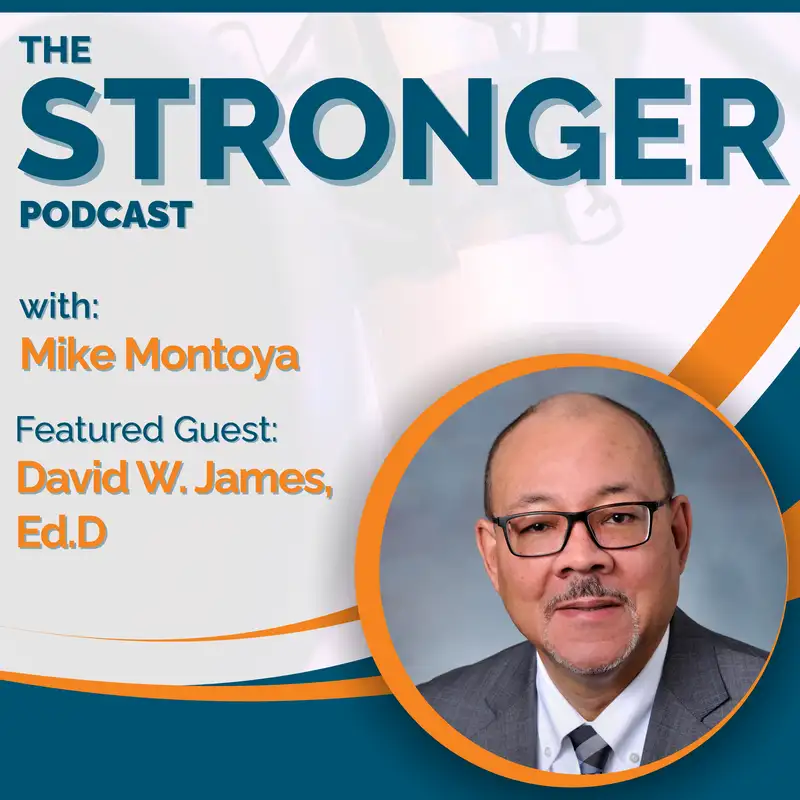
We’re Preparing Kids for the Wrong World: Economic Mobility, Coalition Building, and the Long Game in Public Education with Dr. David W. James
Welcome to the Stronger Podcast. Each week, we have honest conversations with education and social impact leaders about their leadership and career journeys. We talk about their origins, inflection points, and the work that they're doing today. The conversations are honest, human, and practical. If you're here for real stories and real takeaways, you're in the right place.
Mike Montoya:Let's jump in and let's get stronger together. In this episode, I sit down with Dr. David James, executive director at the Summit Education Initiative in Akron, Ohio. I talk with David about what it really takes to move the needle on economic mobility from leading a major urban school district to now curator data across 17 school systems. David shares why college and career readiness, trusted partnerships, and real world exposure matter more than ever in a world changing fashion than we can predict.
Mike Montoya:Let's jump in. Before we dive into today's conversation, I want to give a quick shout out to podcastsmatter.com. Their mission is to help impact driven voices get the visibility they deserve. If you want to share your message with the world, check out their website in the show notes. Good afternoon, good morning to our listeners out in the world.
Mike Montoya:I'm here with David James, is the executive director of Summit Education Initiative in Akron, Ohio. So David, welcome to the program. Thanks for being here. Thank you for having me. Help people center where you are.
Mike Montoya:So I just said Akron, Ohio, but a lot of people don't know anything about the cities in Ohio. Tell us where it's at and a little bit about the city and the town and the region that you're living in.
David W. James, Ed.D.:Yeah. Akron, Ohio is in the center of Summit County. We are just South of Cuyahoga County, about 30 miles south of Cleveland, where we grew up. And so they got its name Akron from, I think the Greek word Akron, which means summit. It was like the hot one of the highest points in Summit now.
Mike Montoya:Okay. Fair enough. So it's logical. And people somebody knew Greek back in the day, right? When they when they named it Cleveland.
Mike Montoya:Cleveland, if people know where a lot of people know about Cleveland, right? But this is where you grew up. Is this where family roots are and such? Did you go to K-twelve schools in that area?
David W. James, Ed.D.:Yeah. My mom still lives there. I have two brothers and a sister that live there. You know, grandparents migrated up there from the South, you know, in the thirties and forties. So some of my family on my father's side have been there since, oh, wow, maybe 1860.
Mike Montoya:Okay, got it. So significant transition, a great migration type of work, right, in your family history sounds like in some ways. What was it like to go to school in Cleveland? Like, was it as expected? Like, were you set?
Mike Montoya:Was it fun? Was it challenging? Was it terrible? Like, what were what was the range of things that came up?
David W. James, Ed.D.:So, you know, in elementary school, was pretty normal, you know, walk to school in elementary, junior high and high school. You know, I mean, at one time, Cleveland Public Schools is what was the name then, you know, had an excess of 100,000 students. Now today it's much smaller, but, you know, I mean, lot of rich history there. And to be honest with you, a lot of opportunity, you know, in terms of education, things that I experienced that I think I kind of carried that over, you know, in my accidental career of working in school, you know, after that.
Mike Montoya:So good experiences in a bigger school system at the time. Had a pretty pretty sizable 100,000 is the number of kids. And what you said accidental career. So yeah. Tell somebody will choose.
Mike Montoya:Tell somebody will choose to be something. You chose to be what?
David W. James, Ed.D.:Okay. Work, you know, as a person who was in job was in the co op program. So I did co op at NASA, at the time was called Lewis Research Center in Cleveland. Now it's called the Glenn Research Center. And so I kind of worked my way through college at the time.
David W. James, Ed.D.:And, you know, when I was in college, I got a job for an environmental consultant. So I was doing a lot of work in school at the time, you know, in different parts of Ohio, including Akron. And then, you know, later on, a position came open and asked for an environmental health and safety person. So I did that for a few years, became business manager in the district and then it would bring I had no clue that I would ever I mean, was not on my radar. So
Mike Montoya:did you have an interest in environmental work? Or it just because you had, call it, facility finances that it became an option?
David W. James, Ed.D.:It's just because of that, and I learned a lot, as business manager, I had all the support functions in the district. So it just happened that we were doing a building project, rebuilding all the buildings, and I was in charge of that. And, you know, when our previous superintendent retired, he said, oh, I think you can do the job. I looked at him like he was crazy. So my goal was to make sure that they hired someone internal but then it wasn't me, it was someone else that I gave them my, that's piece of my mind in my first interview.
David W. James, Ed.D.:I thought, you know, I wouldn't get called back when I got called back. And on the first day after I got appointed, I'm like, what in the heck did I do? Know, there was a huge learning curve of all that. But, you know, I always learn just around yourself with people who are a lot smarter than you are, typically things will be okay.
Mike Montoya:Okay, so accidental superintendent, what was the what was what was the steepest part of that curve, if you remember? And then also, like, what was stuff that you're like, oh, like, this is interesting, or that you really enjoyed in that early couple years as a superintendent?
David W. James, Ed.D.:Well, you know, like in engineering and architecture, you know, there's a lot of acronyms. It's on the educational side, educational speak was very difficult with all of the acronyms that you spoke to. And I would always say, look, you know, when we're talking to our customers, our parents, you know, we have to talk to them explaining English, they're not used all those, different backgrounds and perfect. And so my approach was really more from a customer service point, because when you work in consulting, are accrued to your customer. You have to really formulate that relationship to the customer and keep it going.
David W. James, Ed.D.:And so the learning curve for me was a lot of things in curriculum, you know, that I didn't know or understand, but I had a good assistant superintendent for curriculum and instruction. Then me, you know, I was the one who would bring up these crazy ideas about, you know, how kids could learn maybe what their experience could be, you know, things like that. But at the end of the day, I think it all was out. They didn't run me out of time.
Mike Montoya:Well, okay. So what I know about you is that you were there for a business manager role for a while, but then you also were there as a superintendent for thirteen years. So this is not just like a, Oh, a few years that seat and playing around with it. I think the average in the country on superintendents is like four ish years, give or take a little bit. So yours is two or three or three times that number.
Mike Montoya:So what is there? It sounds like surrounding yourself with good people was one feature of success. But also, how did you sort of like, call it stay vital and aware and I call it focused during that period of time? Because that's a long stint.
David W. James, Ed.D.:I mean, I think some of the issues that we had, you know, during that time, of course, you know, stages at the state level in terms of the requirement for, you know, the the full report card and, you know, some of the struggles and things that I would talk about, like we can get credit for growth. But, know, at the time that particular governor was like, no, I only want you to meet the bar. And if you don't meet it, it means this is gonna happen. And then of course, you know, building these buildings, we had a unique partnership with our city where the city increased their income tax and they gave us our portion or our local portion of the money that's what the state was giving us. So there, those buildings are co owned between the school district and the city.
David W. James, Ed.D.:And, you know, we had a very strong mayor at the time, and I don't know if anyone wanted to work with him. He and I really got along. I mean, we would argue all the time about things, but, you know, he wanted what was best for the city. I wanted what was best for the kids. And we came and met at that middle ground.
David W. James, Ed.D.:And so, you know, the relationship worked. And I think a lot of it has to do with relation And then also, you know, listening to teachers staff because they're on the front lines of working with kids and working with the community, you know, and just, you know, really keeping those things front and center in our work. You know, it was just a lot of, you know, a lot of different things and forming those relationships on both sides of the house, because a lot of times there's attention in organizations where you have one half that's responsible for a certain portion and another half that's responsible for watching kids. And, you know, I made sure that they worked together. We had what we call a lot of synergy.
David W. James, Ed.D.:So when, like for instance, when we're building buildings, the curriculum, because they're all the architect that was designing the building. I'm like, okay, time out. Okay. So far, they need your input. I need to know what kind of labs do you want.
David W. James, Ed.D.:That's going be based on the curriculum. You know, how do you want the building to flow? So, it was a lot of those types of things. So I formed a lot of relationships and listened to people. I think that's really being important.
Mike Montoya:Yeah, I call it coalition builder in chief or something like that, it sounds like, right? I call it the ability to hear multiple perspectives and components, right, and pull those things together and find common grounds, right? And I call it build trust, right? I don't know, I'm gonna use the word trust. I mean, do you feel like people trusted you to be a fair arbiter and have an opinion and drive things forward?
Mike Montoya:How does that did that show up a lot?
David W. James, Ed.D.:Yeah, it did. But, you know, I mean, we all have our, you know, we all have our issues. There's probably six people up here that fight with each other all the time. And so, would have to make sure that those relationships inside of my head are moderated because a lot of times my first reaction to something isn't the best and I've learned how to stop. You know, I would always say, you know, sometimes we have to wait for the other shooter ball because your initial rendition of something may not be what's actually going on.
David W. James, Ed.D.:So be patient. You know, I like some of the work that Ronald Heifetz did, you know, about adaptive leadership and that thing about getting up on the balcony and really trying to see all of the relationships that are happening. You know, I really took that approach, so I didn't like jump off the handle. The only time when I would jump off the handle and really take no prisoners is when, you know, like if an adult did something bad for a kid, you know, a kid was railroaded or not treated barely, you know, children have to process rights in school. So, you know, yeah, I would run afoul of like our teachers union President, you know, just like, oh, we just need to expel kids.
David W. James, Ed.D.:I'm like, well, wait a minute, there, you know, there were other witnesses to this who are children, and we could take their statements and look at that and the other mitigating circumstance. So that was the one place where that was like my line. Well,
Mike Montoya:yeah, the balcony article, which is to like, leaders need to be able to look out across, right, multiple constituents, right, kind of to sort of make sense of what's going on the pausing patients, right, I'm going to I'm going to highlight in these things, because I think a lot a lot of times we can cause conflict because we move too quickly. I'm not specifically right, but like, it's common that like we move quickly because we have an emotional response or a feeling. And we're like trying to in these and sometimes, sometimes there's appropriate safety issues, or when you're trying to do student protections work, etc. Like those things are critical components. So the and schools have a lot of things to hold, right, like schools and school superintendents, feels like superintendents get called into only a lot of things that are disjointed in some ways.
Mike Montoya:That's my experience. Do you feel like having six people in your head seems very normal, you're pulled in a lot of different directions. Do you feel like you got better at the job over time and a little more seasoned, like, given the tenure?
David W. James, Ed.D.:Well, I think what helped me is that whenever there was an emergency situation, when you had to call in the bomb squad to remove some crystallized picric acid that or the one time someone threw a jar of mercury at a building and the mercury pooled in the outside and I had to call the EPA in to help with the cleanup and some kids that walked through what they thought it was terminator and they were playing, you know, playing it. It's just ridiculous. And so, you know, I've always approached things in a calm manner. I might appear like I'm calm on the outside. Yes, when you go off the rough route, I'm recalculating.
David W. James, Ed.D.:You have to do that constantly. But my thing was if I panic, then what is that gonna do for the people that I'm leading? And so you, because of that experience of, okay, let's assess the situation, let's do triage. How do we mitigate the most dangerous circumstance of this event? How do we protect people?
David W. James, Ed.D.:So I kind of took that approach when no matter what I done, I had a lot of different things. You have HR issues, you have financial issues, you have to close buildings, merge buildings, staff, call a snow day, which is a no win situation to pass the other people are mad. And so I never, you know, I would tell people, would say, you know, part of our job is that we have freight trains that keep coming and they got problems that have to be unloaded. Some have to be reloaded and sent to another, but the freight trains keep coming constantly every day. And so we just have to be prepared for whatever comes at us and do the best, you know, the best that we can.
Mike Montoya:Yeah, well, and there's not a playbook for every single thing. Like mercury in the schoolyard is like a thing. No one thinks that that's gonna happen. And then it does, and then like, Oh, everybody should have thought of that, right? Right.
Mike Montoya:Yeah, for sure. And yeah, I have a lot of, I call it praise for superintendents because things roll up in weird ways in ways that are often unexpected. You can anticipate budget cycles and then those things are gonna happen, but it's like the daily emergency. Freight trains is a great example of like, they just keep coming, you gotta keep going and pull it together. So Accidental Career as a Superintendent and an Educator with some success in Akron.
Mike Montoya:So tell me about, I know that you guys did some special work with the Ford Next Generation Learning Centers that. So tell us a little bit about the context and like, what was that, like what was at the heart of what you were in your head trying to achieve when you kind of entered into that partnership with them?
David W. James, Ed.D.:So I was a member of our chamber of commerce, the superintendent, so I would go to their meetings. And a lot of times I would hear, when I have to go in front of them and make my cleat or support of a school levy, you know, support the district. And I just remember, you know, one person talked about, you know, like their little discount card at the grocery store and how they know all this information about people. And if they don't like the certain supply, like if they got scaries in the wintertime, were rotten from wherever Mexico, and they can go to Argentina and get another, you know, supply that's better quality. And I looked at them, I said, well, you can do all that logistics stuff with it, you know, and all your information you have, but I have to take everything that comes through the door.
David W. James, Ed.D.:I can't just say pick and choose which ones I'm going to take there. They all have to come and I have to do something to get them all up to speed or standards or whatever you want to call it. And so, you know, they would always say things like, well, your kids aren't prepared. Then when I would ask them to go deeper in that conversation, what do you mean by not being prepared? And many times they would stumble because they really didn't know what they want to They say, oh, yeah, well, I said, you know, do you need kids to solve the quadratic equation or do you want them to do this or this or this?
David W. James, Ed.D.:And they had no idea, but they all needed workers. And so, you know, my thing was how can you want to get workers in a pipeline when you can't even tell us what you want? And then how are kids going to get in that pipeline when they don't even know what jobs really exist? Because, you know, in the Midwest, you know, a lot of the old factories like in Akron with tire factories, those jobs are gone and they're never coming back. But what are some of the newer jobs that are going on?
David W. James, Ed.D.:Where are some of the needs? And so it was by accident one morning when I came in and I looked at a news article about Nashville and what they were doing, their graduation rate increased, and at the time it was called Ford Partnership for Advanced Studies. And so I looked into it and contacted some people, had a small group of people on our own schools, business advisory councils, went down to Nashville to take a look, learned a lot. And, you know, that was my God, that was like just before, it was either 2010 or '11. And so I came back and I worked with our community to have them come to Akron, do it for, you know, but in 2011, our business leaders and our political leaders weren't ready.
David W. James, Ed.D.:So I had to regroup and then we came back and did it. And then we were named before next generation learning community in 2017. And now it's a, you know, a kindergarten through 12 program. So it's a kindergarten grade. We have some experiences in the community with different venues, you know, museums and things like that, where they learn some behind the scenes parts about the careers there.
David W. James, Ed.D.:In middle school, it's all about working with philanthropy and how you can improve your community. And then in high school, you know, we have these academies and they all have multiple career pathways. And so we've really adopted the board model and it's still going today.
Mike Montoya:I'm going to pause the conversation here for just a second to talk about books that matter. Every entrepreneur or leader needs a book that elevates their business, builds their credibility, makes an impact. If you've got more money than time, a ghostwriter can help you build your story. If you've got more time than money, a great book coach can guide you step by step through the writing process. If you have already written a draft, these folks can save a lot of trouble and money by shepherding you through the publishing process.
Mike Montoya:Head to booksthatmatter.org and get the custom support you need on your book idea or manuscript. So it takes a while to I I call it ideate on an idea, right, that kinda you you notice in Nashville and getting people aligned in your neighborhoods, etcetera, right, to kinda to kinda get on the same boat together. But ultimately it turns out into opportunities for children in your cities and towns. The things that are practical and pragmatic for them to chart their course towards a career and opportunities post high school. Yeah.
Mike Montoya:I think sometimes we get caught up in the conversation around like, where are they going to go to college? Everybody thinks the only version of that is Ivy League something something, which is a very small percentage of the population of kids. So most kids are looking for opportunities that are accessible in their local within an hour of their home most of the time. And they're often going to settle and be close to their family, etcetera. So this is a practical way of sorts to give opportunities.
Mike Montoya:That's how I'm kind of capturing that. So that's interesting because I want to kind of follow this thread because I know that that kind of work of coalition building and getting people to achieve something together that is in the best interest of children has led you to this next stage of your career. So tell me a little bit about what you're doing now and tell people what Summit Education Initiative is, and we'll talk about that some.
David W. James, Ed.D.:Right. So Summit Education Initiative has always been concerned about educational attainment. And so we call them our cradle to career indicators. So we look at kindergarten readiness, you know, we'll go up to third grade in terms of reading and eighth grade math. Then at ninth grade success, includes their credit, their GPA, and then having a plan for what happens after high school.
David W. James, Ed.D.:So it's like high school graduation and beyond. And today, there's a little bit more finesse with it because now there's the opportunity for some of our young kids to get industry credentials while they're still in high school and be able to go into the workforce or they go into the military or they go to college or two year or four year or they get some other stackable certificate situation. So they end up in careers. Really it's not, you know, in years ago, we all, everyone needs to, more people need to go to college. And today I'm not saying that that isn't important because what happens in a career is that you may start off, let's say you get a welding certification, you do some kind of, you know, internship and get a job as a welder.
David W. James, Ed.D.:Well, maybe after five or six or ten years, you may wanna go into management. Well, you might have to get some coursework to help beef up your management skills. You're most likely going to have to take accounting, you know, and some other things, you know, some management courses. And so we want all of our graduates to be college and career And it's not just college ready, not just career, but college and career because nine times out of 10, if you want to move up, you're going to have to take some other kind of training, you know, regardless of whether it's in a college or the company's in house training, but you're gonna have to improve your skills that you wanna gain more economic mobility. And so that's the conversation that our organizations along with others who are members of like Strive Together and other networks out there, you know, are really talking about those, you know, around the country, you know, like if you look at some of the data and information like the Urban Institute, they'll talk about it and on mobility.
David W. James, Ed.D.:I have served on our community advisory council in the past at the Cleveland Federal Reserve Bank. I serve on the current community advisory council of the Federal Reserve in Washington, the Board of Governors. And a lot of that economic mobility conversation happens in those rooms because, you know, our economy can't be successful unless we have a good stream of qualified people to go on to jobs that are open. I think many of us heard the story, you know, like Ford Motor Company for the lack of technicians. And those are important jobs because many of our cars are advanced computers that you need a different kind of education.
David W. James, Ed.D.:In the past, it's not about just pulling one drain plug and putting some more oil in it. That's it. There's a lot of ton of sensors, a lot of automation with vehicles, and a lot of brake systems, a lot of different monitoring and you have to be like an electronic genius just to diagnose some of these things. You know, so like I said, it's important. You know, I've always said this, and I would say this to a lot of our teachers because I would hear from students that, you know, they're saying they've got theirs and we need to get ours.
David W. James, Ed.D.:And I would tell teachers that they look, we're not preparing kids for the world we came from. We're preparing kids for the world that they're going into. And to be honest with you, none of us knows what that looks like because everything changes so fast to them. It isn't, no one knows what that, people can dream or think about what the future is going to be, but the rate of change of just information and technology is like at an exponential pace. And we have no idea what three months, let alone three years down the road is gonna look like.
David W. James, Ed.D.:And so I think kids need to be prepared for that. They have to be able to flip on a dime when it comes to how their future is done.
Mike Montoya:Well, and so we're talking about economic mobility now, and we're talking about the reality of life in The United States in the twenty first century, right? Like that technology is moving at a warp speed, to use a phrase from a science fiction show. To say that you said we don't really know what's ahead. But we do know that we have these kids now and that they need to be able to do the basics of reading and numeracy and things like that. And then they also need to be able to think carefully and confidently.
Mike Montoya:And then they need to have options. Because we know that kids are motivated to achieve and they're certainly capable of achieving and learning over time. Just like all humans, most of us are able to pick up and learn stuff at different paces, etcetera. And so the onus is on us as adults to make sure that we're carving pathways that give people choices. Then eventually, young people become adults, and then they have to continue that journey for themselves.
Mike Montoya:But if they've been successful to date, and they've been able to have support and be, I call it, get some rewards for the work that they put in, then they can continue that work. Because all of us have been working most of our lives to be, know, whatever we are doing right now, right, we keep learning and keep growing. Do you feel like so Summit Education Initiative is kind of a hub of sorts, right? You guys are sort of like, again, coalition builder, working to, I call it, hold the bar high about what these milestones are in terms of attainment for education. And then so how do you do work with like, different school districts and folks in your region?
Mike Montoya:I just want you to describe this a little bit more because some people know what Cradle to Career stuff is, more like help us to understand it because Drive Together Networks has different features and pieces around the country, right? But you guys are unique in your own right.
David W. James, Ed.D.:Yeah. So a big part of what we do is we have data sharing agreements. There are 17 public districts in our county, and they represent approximately 64 or 65,000 people. And so what we do is we collect all their data. So there's a lot of data set that, you know, our students have to take as they move through the system.
David W. James, Ed.D.:And so we collect all that data and then we report it out in aggregate across the town. And so we'll look at, you know, where are we at in a trajectory from the third grade reading or kindergarten readiness or high school graduation. Now we're going to be looking at how can we tie that K-twelve data to like the post secondary data? So we'll use like the national food clearinghouse, so we can practice, you know, kids leave, where are they ending up? And so that's the work that's in progress right now.
David W. James, Ed.D.:Working with some of our post secondary partners, working with our team members. So we get a good snapshot of where it is on and then work with each individual district in terms of what are some of the things that they're seeing in their data that we can work with them one on one to help them solve. So in one district, we did a study of chronic absenteeism. You know, at certain grade levels, it was a big problem. So now what are you going to do about it?
David W. James, Ed.D.:Because we can highlight where, you know, they probably need to parachute the resources in and deal with this. So it's, you know, those types of things. Another district we're working with will be on it taking a career assessment and then having a career navigator embedded in that district to help kids decide and link up with some industry partners to provide them some experiences on what some of those careers could look like. So I think today, you know, they're okay, so I'm going to go into my senior home. You know, but I think today, yeah, kids are very creative, but, you know, they have to see it in order to be it.
David W. James, Ed.D.:I think that's really where I think the hands on experiential learning is really important because if you just show them, like I said before, the quadratic equation, they're gonna like, when am I ever gonna use this? What is it for? And I think we need to give real world examples of how that can help you or whatever it is, know, being able to understand ratios because if you're gonna cook in a kitchen and you have to make a recipe that was originally paid for 50 and you have to make it for a thousand, you better understand ratios or you're gonna fail, you know, that fast and be able to do math in your head and not wait on a computer screen to tell you how much change a person is gonna get. So, you know, and those are some of the things that, you know, I just remember in my family, the things that was always, you know, the things I will remember, you know, measured quite at once. You can't lead a horse, to wall or something like you can't lead a horse to water.
David W. James, Ed.D.:Water on don't cry over spilled milk. It's water under the bridge. You know, those types of things.
Mike Montoya:Yeah. Sure. And it goes yeah.
David W. James, Ed.D.:Still makes sense today. But kids, you know, they would probably put it in some YouTube video or video or some technology there, a fake video or whatever, you know, but that's what worked for them. You know, with us, it was more of these up in your face, you know, just kind of a real thing that you could understand.
Mike Montoya:Yeah, I think, I mean, it is interesting to be like an older and grown up, right, a couple generations ahead of the kids that are in school, right, and trying to lead and guide towards outcomes that are fundamental about like, again, the basics and the pieces. And absenteeism is a perfect example of if they don't show up, then we have less chance at supporting them in general. There's some personal responsibility in there too, but there's also there's usually a reason why kids aren't showing up. I mean, it has something to do with, I mean, do you know much about like some of the causes of the absenteeism that are showing up in your community now?
David W. James, Ed.D.:Oh, yeah. I have an example for almost everything. So I met with a physician at our children's hospital, we were talking about, you know, he was interested in some data, you know, that we were collecting and he said, you know, I don't, had a problem with, you know, people who would cancel their appointments. And I said, well, are they towards the end of the month? He said, you know, matter of fact, they are.
David W. James, Ed.D.:I said, well, at the end of the month in some, you know, part of our community, people have to leave their home because they didn't pay their rent and they have to move or, you know, if they have multiple children, they may need the older kids to stay at home and watch the younger ones while they, the parent goes to a hunger center or a food bank to get food because a lot of times at the end of the month, they run out of resource, you know, and, you know, a whole lot of other issues. Many of our kids are being raised by grandparents who might have medical issues and they need someone to stay with them if they're a diabetic, if they, you know, have congestive heart failure or whatever. So, you know, there are a lot of, you know, issues in our society that has to be addressed particularly in underserved communities. And those are some of the backstories on, well, why can't this day get poor, you know, not to mention our homeless population, you know, so there's a lot of things that we have to take into account now, but I'm going to counter that by saying schools can only handle so much.
David W. James, Ed.D.:And so my approach has always been partners. So back when we would have mental health people come in and be able to see their clients who are students in the schools during the school day or partner with a lot of churches who would provide, you know, past at the end of the month. We had one of our schools and one church in downtown that would at the end of the month would, you know, come to the school and give out bags of food towards the end of the month because they knew, you know, that, you know, families had had needs and it's, you know, it's a lot of things like that, that it may not have been on, you know, a radar screen, but there are absolutely things that are necessary. And I think we can accomplish more by having partners instead of saying, well, I'm gonna pull a teacher out the class and warm my hands with counselors, and these counselors are already over our direct spin. So we had a lot of partners that do some of those.
Mike Montoya:Yeah. So the idea of kind of they're all our children and we have collectively a bunch of resources that are sometimes just not in the right place at the right time. And the to the story that you share about, in the several that you shared about, like, where kids and families focus their time and energy when they have to, often as they do with like aging folks or food access, things like that. And there's the plethora, the number of challenges is innumerable in that regard. And the number of solutions is quite high, too.
Mike Montoya:And so it's a little bit about getting things aligned. So this cooperative work that you guys are trying to do, the data elucidates that it's up to you to see where these challenges are, where in the community they might be showing up, where can we then focus the energy and time versus like spread it everywhere all the time, right? And the data sharing. So data sharing is not a very easy thing, right? So let's talk about that just a tiny bit, because getting people to cooperatively share data across systems, right?
Mike Montoya:There's a bunch of privacy laws and things that are in place, but some technical problems. Have you felt like the data sharing work has been well received and are people able to contribute effectively?
David W. James, Ed.D.:I think with our school district, that has not been a problem. You know, we don't care. We share their individuals through data. We only share data. So like we'll generate a report for each district and they only get that report.
David W. James, Ed.D.:We don't rack their records back. And we just report out overall the whole county in aggregate. And so that has never, that has not been a problem. Our organization has been in existence for this will be thirty years. When I was superintendent, I was on the board and about three years after I retired, became executive director.
David W. James, Ed.D.:But we've had longstanding data agreements with our public schools. We are getting into other agreements with different organizations like the YMCA Headstart because at times they want their data analyzed and looked at. And so, you know, I think we have become like a trusted data partner that they know their data state with us. We're not sharing it with other people unless they agree because many of our school districts will have partners that they may want us to look at some data with that partner to see, hey, you know, how are things going? We're starting a new organization in our community, Youth Success Summit, which is going to be focused completely on out of school accounts and out of school time providers.
David W. James, Ed.D.:And so there will be some data sharing, you know, between that organizations and the college school time providers. And then we can connect that to like academic dependence and things like that. But it won't be based on individual students. It'll be based on an Azure.
Mike Montoya:Right. So you can kind of get it without the student identifiers, right, and make sense of it based upon that kind of stuff. Okay. Yeah, that makes sense. I felt like data sharing has gotten better in the last ten years, right, versus when I know I did a lot of that work back in California, and it was like pulling teeth with the MOUs and the agreements, because all the interagency agreements were really hard to get established.
Mike Montoya:All right, so let's shift gears. I want to move into a little bit of the personal and some of the leadership lessons. And you pulled a few of these already around patience and pace of work. Now that you're, again, I'm going to say more seasoned, you said retired, so I'm going use that word. Now that you're retired but doing this new work, how are you leading?
Mike Montoya:Are relying on different kind of leadership skills now than when you were younger, in particular because some of the staff and teams are a different generation? So what are some of the things that you're doing now as a seasoned leader to just kind of continue to capitalize on your skills and and bring kind of your wisdom and knowledge right to the space?
David W. James, Ed.D.:Well, you know, to be honest with you, so most of my team are fifteen, twenty or more years younger than I. And that's difficult because it's almost like raising kids all over. They have different expectations and they approach me. But what I try to do is, you know, to really slow down on my initial response of what they're saying and try to use examples of how, you know, sometimes you might wanna wait before it is a lot of times, you know, our younger generations want to jump right in and things don't bad. Well, I look like that, you know, at those ages as well, but, you know, when you fall in and knock the tooth out or broke a bone or something, know, you learn your lesson to be a little bit more careful, know, not to the point of like analysis paralysis, but you know that there's going to be a pothole in the road somewhere.
David W. James, Ed.D.:You see that water sitting there, you better be careful about driving through it. And so, you know, I really do enjoy their voice and what they bring to the table, but I also have to make sure that they're channeling their energy in the right direction because sometimes, you know, they move a little too fast, but the balance to that is I don't want to be in a position where I'm telling them what to do and they're just following, you know, what I, what my thinking is, and I always try to pull their ideas out instead of just saying, well, we need to do it this way, because I can say that, but that isn't going to help them develop their leadership. And that's a very important lesson for them to learn because, you know, in any organization, I think the mistake in my career that I see lawyers make is that they over identify with their role and they think they're going to live forever. And neither one is going to help you. So you have to make sure you're developing people who can run with things and let them run with it because that's how they build their capacity.
David W. James, Ed.D.:So if I just sat there and issued out orders every day, I'm just going to have a bunch of robots that I don't work with robots. I want people to think, bring their best things to something because solutions aren't based on one person. They're based on a lot of people who bring different types of expertise to the table. And a lot of times, you know, they will help illuminate blind spots that we all have. And I think it's important to acknowledge that we have blind spots and to lean on each other so we can solve the issues that we're facing on a daily basis.
Mike Montoya:I just want to say that if you're a leader, entrepreneur, or business owner who needs some support, there's an easy way to get a think tank behind you and your vision. The Genius Discovery Program at Thought Leader Path is like having your own one on one incubation and acceleration program. They'll help you develop an approach based on your own story and your plan for impact and offer the tools and thought leader assets needed to really amplify your message, including launching a podcast like this one. If you're ready to stop grinding in the dark and start making real impact with the right support, check out geniusdiscovery.org. Yeah, I appreciate that.
Mike Montoya:And I just want to spend time with the reflection on the multi generational leadership roles. And people come at work with different experience, of course, as we talked about. So leadership requires, I call it different amounts of peace and flexibility, right, where we can hold our breath, and also listen, right? Because as you said, we do have blind spots as folks that have done it a long time. Sometimes we I think I know the answer all the time, but which I'm like, I just keep my mouth shut, because I'd rather let somebody else figure it out.
Mike Montoya:Because like usually and usually they have a better answer than I that I would have thought of it in my own moment. Right. So those things, I think those things make me I call it I try to keep myself young in those regards, because I'm like, these people are coming up with brighter ideas, I think, in some cases, and they're using technology certainly in much more effective ways, and then maybe I would do it. And so that's the potential, right? And I think like, that's the pace of the work to kind of stay out of the weeds on some of the details and cases.
Mike Montoya:So that makes sense to me. Okay, as we wind our way kind of out of this, I want to like, I'd love for you to share a little bit about if you have any habits or things that you do now that keep your, I call it keep you young and keep you vital in this regard. Things that I call it help you be successful in your work now that you're, again, paced at this. I'm sure any of those habits or practices that you're like, Hey, I rely on those things, I think.
David W. James, Ed.D.:Well, I mean, to be honest with you, in my career, I never had time for that. It was just moving from one thing to the next, and it was just relentless. And, you know, when I retired, I had another job coming up for Columbus School, the Deputy Superintendent of Operations. So in the state retirement system, you have to set out X number of days before you can work. And I set out my sixty days or whatever it was.
David W. James, Ed.D.:It was the worst I think ninety day, whatever. It was like the worst time of my life. My wife was ready to kill me. I was ready to kill her and bury her in the basement. You know, I love her to death, you know, but it was like, you know, it's like, I can't do this.
David W. James, Ed.D.:I don't know how people do this. And really what it is is that, you know, when gear shift, sometimes you need to think about how you're gonna downshift before it happens. And I really didn't give it much consideration, but, you know, it was, I was lucky because another opportunity came in, you know, and I took it and then this opportunity came. So it was, you know, now I'm in a different place because, you know, they were, I used to be able to jump out of bed in the morning. Now I have to determine which way I'm going to move to get out because I'll have to be clean or something like that.
David W. James, Ed.D.:So, I mean, I just realized that I can't do as much. So, have to be very, you have to get thoughts of what you're gonna do. And so one of the things that, like my ritual in the morning, get up, get ready, get dressed. And I always have my cup of coffee and sit and relax Because when I was in the school was like in the wintertime, I'd have to be up at four in the morning and listening to my grounds department, looking at roads and looking at parking lot, whether school is going to be open and in Northeast Ohio, you know, it's a crapshoot. You know, we just got, we just got over like the deep freeze when snow was still on the ground, even though the sun's shining, you know, and then just being on edge all the time, because when the, the, the thing that was really, you know, get me was when the phone would ring and it would be someone, you know, one time I remember the summer we had a lot of thunderstorms and one of the oldest buildings in the district, the fire alarm would go out every time lightning would strike and there would be thunder.
David W. James, Ed.D.:I had to beat these guys up there, like, 02:30 in the morning. You know, they let them in the building because we couldn't reach anyone else. You know? And so it's like you're on edge, and I don't have that anywhere. That's gone away.
David W. James, Ed.D.:Okay? Because I don't get those calls like Your
Mike Montoya:blood pressure is probably down a little bit.
David W. James, Ed.D.:It it is. Basically, it is. And then I would tell people, and it's a joke. It's I would say, you know, I went from 13 antipsychotic medications to one, you know, because it was very you know, it's very stressful. And so it's a lot different now.
David W. James, Ed.D.:The pace is a lot slower, but the other thing, you know, that, you you come to this realization that you can only do so much, but the one thing I came from an organization that had almost like 4,000 employees. So I had a bunch of human shields running around. I don't have that anymore. There's only seven people that report to me in our organization. So I'm the eighth person.
David W. James, Ed.D.:And so I'm front and center on a lot of things. And so I just learned, you you breathe a lot slower, you take your time, you know, make sure you take time off to enjoy the world. And, you know, I'm in a position to do that now when I was with the schools, it was not always possible because there was always something going on.
Mike Montoya:Yeah. So mean, part of the I'm going to pull on this to see if I can kind of pull the lesson here, which is like, there are seasons of life that require the peace. And sometimes the body can actually respond and thrive in that environment for a period of time. You did it for many, many years. And as you said, that period of interim was painful.
Mike Montoya:What am I going do with myself? So the doubt, preparing me and for folks that are like, I call it headed into this stage of career in life, like where you're going to downshift maybe out of this high stress job, take the time to think about what that off ramp is going to look like and how you're going to do it. That's one sort of lesson. So there's some, I think we should have a group around that probably, where people like learn from each other, how to do it. And then the other thing I turned is that like, now that you're not in that high stress experience all the time, still doing really important work, and still, I call it moving the needle on the important things for kid outcomes, you're just doing it from a different point of view.
Mike Montoya:But you don't have to have a whole career where you're only doing the high stress work all the time, and you still have purpose and meaning. Is that fair? Is that like a balance that you can find the balance over the course of a career life?
David W. James, Ed.D.:Yeah, you can. Because my predecessor told me, you know, that there are different life cycles and we all have multiple ones in our career. You have a cycle where it's high strung and you're beating around all the time, and then you jump off that treadmill, then you go to the other one that's more of a walking pace and you're not just running around and your attention is limited to fewer problems or issues. So, you know, in this role now, I don't have to worry about, you know, so many things like, you know, I really don't have to worry about how many times I'm going to get sued in my professional and personal capacity related to a work issue or, you know, all of the things that, you know, running a large organization has. I'm not saying that there aren't challenges in a smaller organization because there are particularly in the nonprofit sphere because they're funding, you know, you're really up in your face dealing with people issues at times, you know, even culture, you know, in a larger organization, you know, people can talk about their, Oh, there's one coaster.
David W. James, Ed.D.:No, there's many coasters and you have to be in tune and try to tie them together with some magic screen. So people are going in the right direction, but, you know, there are challenges, but they're not, they're not as heavy as they are much larger complex or. And so it's helping me learn more. I come from the theory that leadership is more about introspective pieces of work that we have to do with our intels than, you know, being out there and, you know, you're on stage and doing the, those are all part of it. But I think a lot of it has to do with understanding yourself, what motivates you, what your buttons are and how do you, you know, like if you look at that mindset work, a lot of it is, you know, Carol Dweck's work or the artwork, all mindset.
David W. James, Ed.D.:It's a lot of that. And so it's like self therapy now.
Mike Montoya:I want to say thank you and just like appreciation for like people who get in the work and do it for a long time. Right? And I call it like, if you if you manage through without, you know, a crisis where, you know, there was a significant harm caused to life experience, like, That's like success in some cases when you're running these big public systems. It's just a lot of moving parts and a lot of things that can go wrong. So thank you for the leadership during that time.
Mike Montoya:And also for coming back to the work and continuing, call it, it's always hard when we lose significant experience and wisdom, that is especially based in a community because you have depth and relationships. And those things can be capitalized on in a significant way. So your work and the continued work in the greater region that you're in is really important. And so I want leaders out there in our audience to kind of know that it's okay to go through seasons, it's okay to go through paces of life. And there's plenty of space for meaning and purpose still.
Mike Montoya:And this is an amazing conversation. I learned a lot personally, because David, you and are like a little bit contemporary or I think a couple years older than me. But like, I know, I picked up some things that I haven't thought about for a little while today. So in particular, I'll reflect on those myself. And appreciate you appreciate your work doing.
Mike Montoya:Please, I won't record the part about you love your wife to death and bury her in the basement. We'll just ignore that part. I appreciate you for everything that you've done. Thank you so much for being part of my life and my experience.
David W. James, Ed.D.:Well, thank you. I enjoy it. All right. Thank you so much. Bye bye.
David W. James, Ed.D.:Okay. Bye.
Mike Montoya:David also makes something clear that schools can't do it alone, whether it's tackling chronic absenteeism, connecting kids to career pathways, or addressing barriers families face at the end of the month. Progress happens through partnership. Data matters. Relationships matter more. Communities around kids and relationships opportunities expand.
Mike Montoya:Thanks for joining us and tuning in today. To find out about other podcasts that matter, visit podcastsmatter.org. Thanks for listening to The Stronger Podcast. If this conversation inspired you, we invite you to follow the show and share it with someone who's on a journey to become a happier and healthier version of themselves. Links and resources are in the show notes.
Mike Montoya:See you next Thursday, 9AM eastern time. Have a great day, and stay strong.