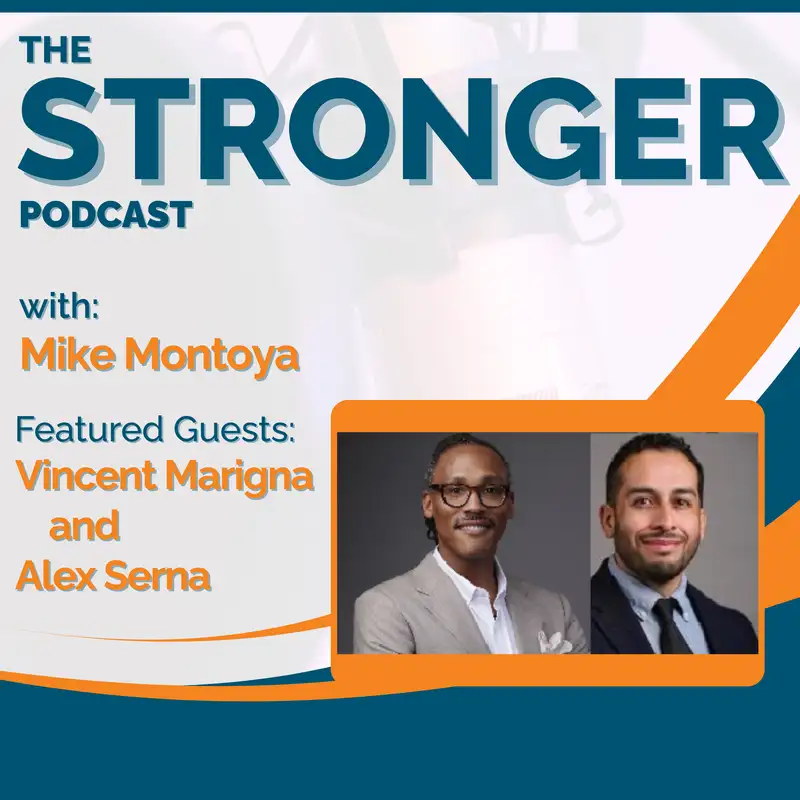
Vision Is Not Enough: How a CEO and COO Scale a National Nonprofit Together - with Vincent Marigna and Alex Serna
Welcome to the Stronger Podcast. Each week, we have honest conversations with education and social impact leaders about their leadership and career journeys. We talk about their origins, inflection points, and the work that they're doing today. The conversations are honest, human, and practical. If you're here for real stories and real takeaways, you're in the right place.
Mike Montoya:Let's jump in, and let's get stronger together. Today's conversation is with Vincent Marigna and Alex Serna of Breakthrough Collaborative, two leaders whose educational journeys have shaped how they serve young people across the country. In this episode, we talk about what it means to scale opportunity with intention and how a strong CEO, COO relationship can help turn vision into impact. Let's jump in. Before we dive into today's conversation, I wanna give a quick shout out to podcastsmatter.com.
Mike Montoya:Their mission is to help impact driven voices get the visibility they deserve. If you want to share your message with the world, check out their website in the show notes. Good afternoon, listeners. This is Mike Montoya. I'm here today with Vince Marigna and Alex Serna.
Mike Montoya:They are part of the leadership team at Breakthrough Collaborative, which is a national nonprofit focusing on opportunities for young people, middle school through college. And I'm going let them talk about their core work. But part of why we want to invite these two together, which is my first time doing a co hosted group, that they have a very special relationship as the CEO and the COO of this company or the organization. And so we're going to talk about that as well. So welcome, gentlemen.
Mike Montoya:We appreciate you for being here.
Alex Serna:Thanks for having us.
Vincent Marigna:Great to be here. Thank you.
Mike Montoya:To center the group, and this is part of the context is like, you two are both on the road literally now, and I think maybe both in different hotel rooms, but in the city. So what's going on in your world today? And how did you end up doing what you're doing right this second?
Vincent Marigna:Yeah, so what's going on in our world today is that we're just navigating scaling our organization. And so we're out in the Bay Area meeting with stakeholders and funders, securing the revenue we need to expand our impact across this country. Ultimately what brought me to this work, Mike, is the fact that I myself am a first generation college graduate. While I did not have a program like Breakthrough growing up, I had programs that, you know, my family kind of cobbled together. And it was through those experiences that I realized that, hey, college is possible for me.
Vincent Marigna:You know, went on to college, graduated, became a teacher because I wanted to ultimately pay it forward because I also had amazing teachers in my life. And so this work is really important to me because I am very much one of our breakthrough students, and I have seen the transformative power of a college degree in terms of social or economic mobility. And I just see it as a responsibility to support more students with access to these opportunities as well.
Mike Montoya:Yeah. So your journey and my journey are similar. And I also think Alex has a similar story, right, slightly different. So tell us, Alex, how did you get here? Because I know a lot of your career has been in California, and and now you're doing, work that's kind of just an expansion of where you started.
Mike Montoya:Tell me about that.
Alex Serna:Yeah. I mean, I am a product of a community that really valued education, but we never had anyone graduate from college in my family. And I wasn't on the track to graduate either. I I tell the story a lot, so Vince has heard this like a million times. But, like, I used to literally gamble, play dice in the back of geometry class, like, in the because I just wasn't engaged in school.
Alex Serna:Graduated with a 2.1 GPA, and my plan was going to go my plan was to listen to go into the military after graduating high school. And then I found out I was going to be a father at 17, and so went on a completely different track. Like Vince, I really found education as the thing that could change my life and my family's lives. So fast forward six years after transferring and going through kind of higher education, I had four daughters by the age of 24, And for me, was both like this moment of reflection around like my daughter's lives are markedly different than mine was. And the ways that higher education impacted me kind of brought me to Breakthrough.
Alex Serna:And I didn't have a program like Breakthrough either, but there were people and adults around me who just truly invested in me. That's what Breakthrough does, like, on a scale across the country, you know, really impacting so many lives. And that's what brings me to the work. So it's both personal, but also we know that there is a model that exists that really truly makes an impact on people's lives.
Mike Montoya:And thank you for sharing your personal story. Mean, that's a lot of stuff going on in Dave Boutine and twenty four. We could probably spend a couple hours unpacking that moment.
Alex Serna:We only got time.
Mike Montoya:But the common thread here is that opportunity comes through the educational experiences, especially for young men who don't have models of higher ed completion in their backgrounds, right? And like, somebody has to be the first, right? And you guys will, in that case, for your families. Has the dream played out in a way that as expected? Or would you say there's been like twists and turns and surprises along the way?
Vincent Marigna:No, it did not come as expected at all. And in positive ways, right? You know, like don't I'm not certain that, you know, 22 year old, you know, high school English teacher Vince thought that he would be the national CEO of a nonprofit serving over 11,000 students each summer and exposing 1,100 college aged students to the joys and rigors of teaching. It was not even in my calculation. But I think what I have learned along the way is this idea of being open to possibility.
Vincent Marigna:You know, I thought I went into the classroom. I I joined teaching through a program called Teach for America, and it's a two year commitment. I went into the classroom and I, you know, I'll be honest, that first half of the year was really tough. It was really tough. But I learned a lot about resilience, getting up, showing up each day, treating each day as a new day, leaning on, you know, my network.
Vincent Marigna:And when I say network, I mean really my family. You know, I used to call my grandmother on the way to school sometimes because I would just the previous day was so tough, and I needed some encouragement on the way to school. But, you know, I and, you know, after that six month mark, I really started to find my groove and then went into my second year and had an incredible experience and just thought that I would be a teacher and possibly move up through leadership in a school based way. So I I never would have thought that I would be where I am right now, but what I was was open to possibility. Right?
Vincent Marigna:Open to possibility to become a better teacher, to learn ways to become a better teacher, open to possibility around various opportunities to expand my leadership. And that's ultimately what's led me here today. And so, you know, I I am a planner, if you will, but I never could have planned this. And I think that is, you know, when you think about beliefs that sort of change over time, you know, I do think it's important to have a plan. But I think what has, you know, as I have matured both, you know, chronologically but also in my career is that there's this idea of being open and flexible and being able to move in the direction that, you might not have expected.
Mike Montoya:Yeah. I mean, like, because because there's lots of things in life that don't go as planned, and some people can take that as like, oh my gosh, I'm off track. Right? Which is can cause a lot of stress and duress and other things too. But and and at the same time, if you can, I call it wear your plan kind of loosely, like a jacket, right, and then you can go lots of different places?
Mike Montoya:And sometimes it's quite surprising, right? So, Alex, your story is slightly different, right? You kind of were a breakthrough kid almost, right? And in some ways, but have built a whole career within an organization that has just blossomed over many, many years. So would you say your plan has played out in a way that you even anticipated in any way?
Alex Serna:No. I mean, I'm happy I'm here, for sure. I mean, I never wanted to be a teacher. Like when I was in in high school and in my early years in college were like, should be a teacher. You'll have the summers off.
Alex Serna:Knowing later, breakthrough is actually the most intense in summer, that that never that never panned out. And I end going to school as a pre law major, I wanted to be a lawyer. And I think there was this like, I want to be a lawyer and I want to make money. I want to be a valued person. And there was this perception that I had in my mind around what a valued person meant.
Alex Serna:And so that's what I wanted to pursue. And I ended up teaching or not teaching, I was tutoring Spanish in East Oakland at Castlemont Academy. It was a field study class I needed to take at Berkeley, and I begrudgingly was like, I'll be a tutor, fine, I will go do this. And I I just absolutely loved it. Like, there was a student who I could see myself who I could see myself in, and I was like, this is what I wanna do.
Alex Serna:And there's something else about it. And I'm and I think Vince and I shared this too. Like, we like to do hard things. Like, we wanna achieve we're achievers. We wanna, like, meet the goal.
Alex Serna:We wanna do the thing, and it's gonna be hard. And and that's probably what drives a lot of our work, you know, at like, when we're thinking about what we're trying to really do. And I think it was that. That was, like, I wanna do something really hard that is really meaningful, that is gonna change lives. And then I I mean, breakthrough has been basically my entire career.
Alex Serna:I started at one of our sites in Southern California as a program director and working my way up to the regional like, that site's executive director before joining the national office. So, yeah, breakthrough is in my DNA. Like, I it's just it's it's all wrapped up in everything, which I think sometimes is, you know, harder when you're trying to balance work life, but, you know, it is what it is. You know?
Vincent Marigna:And, Mike, I'll just add quickly to Alex, I mean, in terms of being open to a plan. Alex started at our national office as the chief program officer and then shifted into the chief operating officer. And I'm and I imagine, Alex, I don't want to speak for you, but that that was not necessarily in your plan either. Right? Like, plan was to drive programs, support the evolution of the program.
Vincent Marigna:But, know, Mike, as Alex and I work more closely together, you know, he has the skill set and program, but I felt like he had this expanded skill set in operations that would make him a strong partner in the areas where we needed to, you know, move the organization forward.
Mike Montoya:Yeah. So a little bit of opportunity and necessity, and then also, I guess, willingness, right, Alex, that you were like, okay, yes, to operating role. So let's talk I mean, so one of the things that we want to talk to, and Alex mentioned this ahead of time, Rich Band just put out a report about the role of CEO and COO and how these two things interact with each other inside of especially social impact organizations, etcetera. So me a little bit about how you two have learned to balance each other's responsibilities. And without going through job descriptions as much, also what are some of the traits that you guys rely on as individuals that allow you to be cooperative?
Mike Montoya:Let's call it that. Because both roles have controls of lots of things, right? And do you guys agree on everything all the time? And if not, how do you guys get to what are the traits that you guys rely on to, I call it, smooth the waters and still make progress, like these achievable things, right?
Vincent Marigna:Yeah. I mean, I think, you know, first, as you know, it starts with self right and an understanding of your own strengths and areas of growth. And I think for me early into the role, yeah, I have a strength in both planning and also executing. And, you know, the idea of, like, casting a vision and working through it has been familiar to me, particularly since outside of teaching, every role I had has been, you know, I've created that role and I have developed that role. So I'm used to being responsible for, you know, casting the vision and then working toward executing.
Vincent Marigna:And then when I moved into this role, it was about the vision, but it was also about the execution. But given the breadth of the organization and even the depth of it, I couldn't feasibly be the full time executor. And so what I would say is that Alex is, really strong in helping to execute or bring the vision of the organization and ultimately where we wanna go to life. And I would describe our relationship and how we work with each other as sort of passing the baton between each other, right? So I say, here's how I'm thinking about this or this is what I think we can actually be.
Vincent Marigna:You know, let's take, for example, navigating the change in the recent presidential administration is really challenging for nonprofits. And, you know, there were a lot of moments where we had to pivot to retain federal funding. There were moments where we had to really think critically about certain decisions. But at the end of the day, what I wanted us as an organization to do is believe in a future brighter than the present, you know, and in order for us to be able to do that, how can we keep our students at the center and think about the world we want them to inherit. And so how can we ensure that we have strong programs?
Vincent Marigna:We are connecting with our students and, you know, we have 25 executive directors across all of our sites and ensuring that they are getting the things that they need. And so to really be able to communicate that and then sit down with Alex and say, here are the ways in which I'm thinking about it. What are your thoughts? And then we go back and forth on that and then to trust Alex to bring it to implementation. And then to check back in a little bit later down the line, like, what about this is working?
Vincent Marigna:What would you change? Alex knows that I appreciate, you know, I think conflict is healthy, right? Like, don't very early, you know, I just shy away from the notion of groupthink. And so, you know, I share with Alex, like, what what do you really think? You know, don't tell me what you think I want to think.
Vincent Marigna:I want to hear, like, the things that are keeping you up at night related to this. I want to understand where you think that this could potentially go wrong. And then then I use my opportunity to, like, help navigate or make adjustments accordingly based on some of the input of Alex. But but I don't know, Alex. What would you would you add?
Alex Serna:Yeah. I mean, I completely agree. And I think the the foundation for me because in the execution, there is and I think maybe this is, like, at the level like, our executive at the level that we're at, there is no clear a to b or c on something. Like, there's no deliverable that is measurable all the time and clear. And I think, you know, with Vince Vince being able to really provide a vision that is clear and and I have the utmost trust and admiration for Vince, that and that's that's years of us just, like, working together a lot that built that up where I'm like, oh, I I see what you I see what you wanna I see the end goal.
Alex Serna:Let me and you and Vince and I have this you know? Like, I know I can get there in the way that makes the most sense, and I could adjust if I have to because it's not gonna be clear. Like, because we don't know the world is shifting, and so that that underlying trust and foundation is critical to be meet we need to be like, okay. I see where you wanna go. Let's get there.
Alex Serna:It's gonna be a little like security sometimes and we're gonna go ups and downs and I trust Vince and I trust him being able if I make a mistake we'll learn from it, fix it, and move forward. And I think that does help a lot because the level of decisions we have to make aren't always clear. There's no clear set of conditions that are going to be perfect, trade offs that are perfect to really make a call, and I think that makes a big difference.
Mike Montoya:I'm going to pause the conversation here for just a second to talk about books that matter. Every entrepreneur or leader needs a book that elevates their business, builds their credibility, and makes an impact. If you've got more money than time, a ghostwriter can help you build your story. If you've got more time than money, a great book coach can guide you step by step through the writing process. If you have already written a draft, these folks can save a lot of trouble and money by shepherding you through the publishing process.
Mike Montoya:Head to booksthatmatter.org and get the custom support you need on your book idea or manuscript. Well, so there's a lot of unknown parts around doing anything new or doing expansion, where you're trying to do, call it things that have not been done, right, and helping such a large diversity of young people navigate this crazy time of life. Middle school through college is not the easy developmental period of life. No,
Vincent Marigna:it is not. Arguably one of the most important too, because it shapes the direction, I should say, of a student potentially. So Yeah. There's lot of And there's lots
Mike Montoya:of Well, maybe that's part of what you're relying on. Right, Alex? Is this, like, experience of, hey, I you navigated all that time. And now you've gotten more years under your belt, so to speak. Then just knowing, I think there's, for me, when I think about and when I work with some of our clients, etc, we talk a lot about their confidence right, in knowing that they will get through the unknown parts, right?
Mike Montoya:So, I mean, is that word confidence apply to your relationship in any ways? Or am I just like inventing something?
Vincent Marigna:No, I think there's a high degree of confidence. I think there's confidence in each other. I have a ton of confidence in Alex and, you know, I think what we as a partnership can accomplish together. You know, I think the other piece that I would just add too is that, like, working with someone like Alex is that I I have a high tolerance for ambiguity. Right?
Vincent Marigna:You know, I'm comfortable kind of making my way through it, and you just can't run an organization in that way. Right? And so for me, he's given me the capacity to kind of bring shape to ambiguity as quickly or as humanly possible given the current context. And then once I am able to bring some shape to ambiguity, then he sort of supports the sort of build out of the direction that we wanna go in. And so and I think even for for and he has a comfort with ambiguity as well, which is why I think it works really well with each other, you know, because we we I I can say, you know, hey, Alex, I am thinking this and we're kind of like, you know, tossing things around a little bit.
Vincent Marigna:And then, you know, I go off and come back and then we work it through a little bit more. And then he's able to kind of work it through different stakeholders within the organization. And because this is the way that we work, there's a rhythm to it where because, you know, this could sound like this takes forever. Unfortunately, it doesn't. We don't have time, right?
Vincent Marigna:Like, each moment matters, as I'm sure folks in other industries know. Each moment really matters. And so we've been able to develop a strong enough rhythm where, you know, when we have to bring shape to ambiguity, we're able to do so pretty quickly.
Mike Montoya:Got it. And and and, I mean, would you Alec, he's, he's sharing his side of this story. So, are do you like, how do you how do you feel when he's, like, and kinda got this, like, I call it, bright a light bulb goes off. Right? And then you're like, okay, here comes the light bulb idea.
Mike Montoya:Right? So how does that how does that land with you? Have you gotten good practice with him?
Alex Serna:Yeah. And I think it again, it just goes back to our entire journeys. Like, we were I mean, our for at least for me. Right? And I think this is true for Vince too is that we we have this vision, we have these goals, and we have to navigate them in this very ambiguous way.
Alex Serna:And I think there's been enough reps of of, like, moments of, oh, that's a fire. We gotta go do we gotta go put this fire out, and then there's this fire. But then it it's that being in that mix of we both are okay with the ambiguity of it. We're both we both can navigate that change. But there's also this that that trust that we fall back on of of you know, that I think helps at least helps me and this is never gonna reduce, like, every you know, the, like, anxiety of something, right, happening, but it reduces the sense of ownership that we we both share.
Alex Serna:Like, we both have that ownership and the responsibility of both leading the organization, supporting our staff, supporting our affiliates, and like all the stakeholders that we manage. And you know, I think that's just something that is built over time and it's just, you know, we've had moments where like, oh, this is one of those moments like the one a year ago, and we build those patterns and we understand like what to look out for and that just takes time to do. Again, like, and I also think, you know, and this is I think a testament to Vincent's leadership where like, able to be at that altitude where you're able you start you know, the the the thing where people say, I could see the puck where the puck is going around the corner. Like, I don't know what the right metaphor is, but it it's just this ability to think maybe a little bit farther ahead than than I can right now because I'm executing where I'm in it. From like, oh, Vince has seen this out here, like, six months from now.
Alex Serna:Let me start to, like, figure out what signals am I looking for because that's gonna be a moment that will come to a decision we have to make. Or so, you know, when we're looking at our car budgets, we're looking at things, we're looking at numbers, but there's something out there that I don't see yet, but Vince sees it, and I trust Vince. So let let me start to build the pattern recognition to see how we make adjust course. And then and then I communicate that as often as I have it with Vince where I'm like, I think this is what you're seeing, and I'm seeing it here. Like, let's make sense of it.
Alex Serna:And then what do we got to do? Nothing. And then we kind of keep going. And I think that that relationship helps really navigate a lot of ambiguity, but also helps us take opportunities where they may just come up, and I think that's been the other side of it. It's not just trying to make the organization be sustainable and operate, but it's also like the moments when there's an opportunity that we could seize right now and we've built enough an understanding around what it could be that now we can make a decision that is more not necessarily all fleshed out, but there's at least the contours of what we think is possible.
Mike Montoya:Yeah, this ability to anticipate with some degree of certainty what the hell is coming around the corner. Some people have that superpower, right? Something Vince has got part of that. And that's almost like a trait of a CEO, Especially when we talk about people who are not in corporate CEO, where there's so many numbers and so much bottom line power, right? In this case, you're talking about outcomes for kids, etc.
Mike Montoya:And it requires, it does require you to kind of be on your toes, right? Because that should hit the fan all the time, feels like right in our space. You guys have so maybe even wins about four. How many years have been working together? Multiple?
Mike Montoya:Five? Almost four years. Four years. Now you've got some practice under your belt, right? You've been exercising this.
Mike Montoya:In terms of like, what are some things that you've done to, it sounds like practice builds trust, right? But do you remember the time when you kind of started getting to know each other? Like, how did you initially build trust between the two of you so that you had some foundation?
Vincent Marigna:I think it's to you, Alex.
Alex Serna:Thanks for that. I mean, I would say I trusted Vince from day one. This moment. No. I I think, you know, I remember early in the interview process, like, we had a we had a conversation before Vince made the, like, tipped the offer to to and I won't share any confidential bits of that.
Alex Serna:But it was early on, and I just got this sense of, like, the questions you're he was asking, the way he was thinking about the organization. And I was like, oh, this is like, this sense of there's almost a sense of comfort and, like, security in that that, you know, Vince would potentially join and, like, bring that mindset to the organization. And there was, like, I think a couple I mean there was a couple years where we were doing a lot we do retreats, like our executive leadership team retreats, and then Vince would bring like frameworks and ways to think about decision making and ways to think about like culture, and I think that I think that really helped build and cement some of that early alignment around what we were trying to do. And then and again, through the repetition, you build that trust in that practice. And it's just, like, really transparent communication.
Alex Serna:Like, I told Mitch from the start, like, one of my prereqs is I need to be challenged. I also don't like to be super micromanaged, but I will tell you what something's gonna be wrong. And I will take ownership and make mistakes, and I will try to fix my mistakes. And I I'm not gonna hide that. And I think the and and that helped me bring some of the, like, angst in me where, like, I also, Vince, like, thing got messed up, and I messed it up.
Alex Serna:And this is what I'm gonna do to fix it. This is my recommendation. And I think that just helps build out where you know, because the things that we have and the decisions we have to make, we can't hide information or try to like color it. It's like this is the thing. What are we going to do?
Alex Serna:And I think that just comes through that early trust and relationship building. And it's also not just all work, Right? Like, being able to just get to know Vince as, like, a human and his life and his kids and and his family. All that, I think, also helps, you know, kinda make this relationship really strong.
Mike Montoya:Yeah. The the stickiness, right, of the reality of of being a real person versus just like a I call it job description or something like that. So, Vince, other other thoughts that you had about trust building in the early stages?
Vincent Marigna:Sure. I mean, I am someone who, if someone does what they say that they're going to do consistently, they have my trust. You know? Now some will do it, but maybe inconsistent because they're building a muscle. And it's not that I distrust them, but it takes a little bit longer to, like, develop that real sense of trust.
Vincent Marigna:I would say in the case of Alex, he was consistently, like, completing what he said that he would do. And, you know, to the point sometimes I would be like, you know, you don't have to do all of this right now. Like, you you can tell me, like, what you would like to slow down on. You know, the joke across our leadership team is like, moves, like, really fast, you know, but he gets things done. And so through that, I think that builds built trust.
Vincent Marigna:And similarly, like, on the personal side too, I mean, like, you know, I jokingly say, like, Alex is the hero of the team as he has, you know, four children. I have two, you know, and our other teammate has has three, but it's just like, woah, how how did you do that? Like, you're on the other side nearly, you know. And so, you know, I think the way that the other piece that I will say, and I think that this is part of, like, the consistent, like, execution, but Alex operates with a high degree of integrity. And I think that, that integrity in my how I define it or how I think about it, only be demonstrated through action.
Vincent Marigna:Like, you can talk the talk all day long. But if what you're talking about and what you're doing match, then it's a strong demonstration of integrity, which for me, like, builds real trust. And so that's why when Alex you know, I can't even and and I know that they're there. I can't even real I can't I have no running list of, like, the errors that or mistakes that Alex has made because he brings them, we talk about it. He's you know, I say, what are what are you gonna do about it?
Vincent Marigna:He walks me through it. Am I intervene and say, you might wanna consider x, y, or z? You know, go take care of it, and then we'll talk a little bit more about we'll we'll debrief. And so, like, the fact that he can just bring those things to the forefront early, it just, you know, allows the trust to build.
Mike Montoya:Yeah, for sure. Well, the consistency integrity, I think your nervous system, not yours specifically, but I think nervous systems pick up on that, oh, I can rely on this person. It's almost like they just get used to the reliability part about it. And then you're like, able to try to call it trust each other more because you're like, Oh, I know this guy is going to be there. Right?
Mike Montoya:And we'll get done or whatever that is. And like I said, we hate using the word mistakes, but it's just like human to be doing new stuff and not doing it perfectly. Right. It just requires like practice and things like that. Right.
Mike Montoya:So yeah, pretty common. In terms of like, how you all I call it, I mean, how you all listen to your team in a larger way, right? Because there's lots of humans and lots of constituents, right? So you have board members, you have all these executive directors, you have your own staff, right? So you have a lot of, I call it stakeholders to manage, plus all these children that you imagined, like are part of your life, right?
Mike Montoya:And so you're gonna go see programs today. So like, you know, kids are gonna kids can know kids can tell you, right? They're really honest, right about like, they're like, this guy.
Vincent Marigna:They're very honest.
Mike Montoya:So I mean, do you bring some of those those, you know, now you're now you're like the figureheads in many ways, like people see you as these images, and they maybe create personas around you, do you live up for that? Right? Because that's like a lot sometimes, especially when you get kids involved, or like, hey, there's this tall guy, and he's got all this stuff. And like, what do we do with that? Like, how do you how do you do enjoy that part about it?
Mike Montoya:And tell me more about it. So
Vincent Marigna:I mean, it's Alex, I'm gonna share the story for the visit to Saint Juan Capistrado. So I was doing it was my first year, and so I was doing several site visits, and we were Alex joined me on a site visit in one of our southern it was actually his former site in Southern California. And I show up on on campus, and kids were literally asking for my autograph, which I thought was hilarious because I'm like because at the end of the day, I'm I am I am Vince. Right? Like, I am Vince.
Vincent Marigna:I have two kids who I struggle to get out the door in the morning when I'm home, you know, like I am Vince who, you know, sometimes has to, like, sneakily pull out my calculator to help my daughter with her third grade math homework because they're teaching algebra now. You know? Like, I that's just how I see myself. Right? But then it's important for me to understand that others see me differently.
Vincent Marigna:Right? And I don't I don't find that daunting necessarily as much as I do, take it as a responsibility to show up in a way that is relatable. I mean, I I can't explain how much I enjoy students. Right? And because I see what is possible for them.
Vincent Marigna:And so for me to get to hang out with them and to have them talk me through what they're learning or what they're experiencing, that energizes me, right? Because, you know, a good portion of my day to day is like how to problem solve, right? And over time that can be draining. To me, this is like the reinvigorating part of my role, right? And so I think for me, like this idea, so when the student asked for it, it was like, okay, sure.
Vincent Marigna:But what's the bigger piece here, right? The bigger piece is is that for some of these students, I look like them. I offer possibility to them, and, you know, I take that very seriously. And I I appreciate it. I don't take it for granted.
Vincent Marigna:And, yeah, and even though I struggle with third grade math from time to time, like, I understand that how people see me matters, and to show up as myself is really important.
Mike Montoya:I just want to say that if you're a leader, entrepreneur, or business owner who needs some support, there's an easy way to get a think tank behind you and your vision. The Genius Discovery Program at Thought Leader Path is like having your own one on one incubation and acceleration program. They'll help you develop an approach based on your own story and your plan for impact and offer the tools and thought leader assets needed to really amplify your message, including launching a podcast like this one. If you're ready to stop grinding in the dark and start making real impact with the right support, check out geniusdiscovery.org. Yeah.
Mike Montoya:Well, and I appreciate the reflection. I mean, that you have a responsibility and people I mean, you take on this mantle of sorts when you're a leader in some ways. Kids don't know you or not everybody knows. There's an Undercover Boss, that show that's on
Alex Serna:Oh, yeah. Yeah.
Mike Montoya:Like, know, whole crazy thing that goes on. But like, I think it's really happening because people don't have real life experience with each other. So I always wanted to say, Alex, I want to volunteer to come be the ED at St. Juan Capistrano, because it's one of the most beautiful places on the planet. So someday invite me down for a site visit, I'll come down and check it out.
Mike Montoya:I think for me, the question is, in the year ahead, and we're just sort of turning gears here a little bit, in the year ahead, what are you excited about? About both the work that your organization is trying to achieve, but also about the new way that you work together to do that because there's always opportunity to be like, Hey, this year we're going to be a stronger team with intentionality. So, have you thought about that at all? Maybe I'm putting you on the spot, but just think about that for a second and think about how are you investing in yourselves as a team to move that forward, and then what are you trying to accomplish?
Vincent Marigna:Mean, think with that question, my mind goes in several directions, but what I will say is this, you know, what excites me not just about the team, but also about the work is that Breakthrough's been around for forty eight years and has a demonstrated track record of results and has a model that has proven that it can get results both in terms of what's possible for kids, but also what's possible for the future workforce, know, for educators. And so what excites me is the opportunity to scale while also maintaining outcomes. And so, you know, the moment we are able to open a new site and there are a number of conversations that Alex and I are in and they're progressing really well. The moment that we're able to do that, it just brings us one step closer to the realization of what's possible for kids and the future of education. And then I think for the evolution of the team is that, I know the conversation is between the CEO and COO, but we have an incredible Chief Program Officer who is relatively new to the organization or not new to Breakthrough, she was a Breakthrough executive director as well, and she's new to the CPO role.
Vincent Marigna:And it just rounds out the team very well. We have an exceptional CFO as well. And so, you know, I feel like, you know, we had this conversation, and I still think about it probably once a week, Alex. We had a team retreat in October in Asbury Park, New Jersey, where we were really digging into growth and really thinking about what would it look like to grow in a disciplined way. And I remember leaving that retreat just so thankful to have the team that we have.
Vincent Marigna:And so way I'm what excites me is like, we have we will have had a year under our belt operating as this team. And then I'm excited for us to go into year two as this team and then take on this next stage of scale as an organization.
Mike Montoya:It's awesome. Well, yeah. And when you have your, I call it, your crew around you, right, you get I call it, you operate from a very powerful position essentially in the sense of, like, there's potential that can be realized without the struggle, right? Because sometimes people think that this work is super hard. And it is super hard because it's, you know, we're trying to like deal with like, actual lives of people, right?
Mike Montoya:But the rewards are very strong as well. So worth it. Usually the hard work is worth it. You know, and Alex, does that make sense to you too? Now you have a team that you can get a lot more out of once you guys are rowing together is the way that we would say it sometimes.
Alex Serna:Yeah. No. Absolutely. And just in your mind a moment, like, that the vision setting Vince just said, that's it right there. That's why you see know?
Alex Serna:Like, that's it. And then it's like, alright. That's that's the charge. That's the charge. Now let's go do it.
Alex Serna:And then they to the to yeah. I mean, we have that team and, you know, we luckily, you know, have such a unique opportunity in this moment when, you know, it's not hard. Right? It Irving's hard. It's hard in schools, hard in the world, hard in the country, nonprofits like the sector, can go on and on about how it's hard.
Alex Serna:And there's these moments in history when like there's these potential changes on the horizon, this growth and scale we could have and achieve. We have a forty eight year old history and we have these affiliates. Our affiliates are like the core of our work. They're the ones executing day to day on the ground with students and families, and so the more we could enable them at the national office to go and just do that, they can go do that because they're best positioned to do it. The national office and our leadership team, we could see just how we need to continue to develop our services and our programs and the quality of the program.
Alex Serna:As we talk to new stakeholders and new communities, here are the things that Breakthrough could really you know, bring to this community and, like, how this community can both serve, like, the kind of the greater mission that we have. And that and that's exciting. Like, it just there's not really a day in our in my in my job at least where I feel like, oh, we're I'm gonna do I'm gonna do the same thing over and over again every day and just, like it's just like, no. There's things we do that's, like, really important and big, and it's fun too. And so when we get to see students, you know, and and they're asking Vince for his autograph, it's like, this is it.
Alex Serna:Like, this is this is what I was here. You know? So
Vincent Marigna:Yeah. And, Mike, I think one other quick thing that I just wanna share, like, going back to, like, the nature of the relationship between, you know, a CEO and COO is that I was fortunate enough to have I mean, I've been really lucky. I've worked for two very amazing CEOs with whom I was really close at the growth of the organization, right? And so one of the things that my first CEO would do is just make his thinking visible. He would think out loud.
Vincent Marigna:He would say, like, you know, work through different hypotheses and, you know, different scenarios or, you know, and nothing, I mean, not completely, but nothing was fully baked. Right? And so I got I got to be a part of, like, understanding how he thinks so that I could best support, like, the execution of the vision. And I think for me, you know, doing that with Alex is, you know, it's sometimes it's so, you know, random. It's like sharing the taxi ride from, you know, the board meeting to the airport and just being saying, you know, okay.
Vincent Marigna:That went exceptionally well. Did we miss something? You know? And here here here is what I'm thinking through. Like, it's probably fine, but, like, here's what I'm thinking through.
Vincent Marigna:This is what I'm anticipating. And so and I think not holding back till everything's perfect and a memo that I can share with Alex, that also enables the speed of our work together.
Mike Montoya:Yeah. That's awesome. It's almost like you can model it inside the safety zone of trusted folks, right, that you can then refine it right together. And it's almost like it's better to refine it together Than it is to invent it all by yourself and hope that everybody buys into the whole project, right? It can go sideways.
Mike Montoya:Well, you know, gentlemen, this has been interesting, because, like, part of what I want our audience to hear is that nonprofit work and work with kids in schools can make for powerful careers and very meaningful careers. And people think you're famous, and that's really good. So that's super great. But what I hear you saying is that there's always this more potential, right? Because I don't think in our work that we've solved all the problems, that all children are doing well and have endless opportunity.
Mike Montoya:We're not there yet as a society, and we have endless amounts of work to do. We'll probably all kind of retire or die, not having achieved everything. But that's the struggle. I think that's why we have it. It's really fun to spend time with two men of color, to think you through this stuff, because traditionally, that hasn't been done by anybody else.
Mike Montoya:It's been done by others, to others. And so I appreciate you both for showing up in the world like that. And I'll ask you both this question and we'll kind of wrap it. Is there a nugget of advice that you give to the, I call it your, I don't know what the generation is that's coming into the workforce now. We're calling them Alpha maybe.
Vincent Marigna:Alpha, I think, yeah.
Mike Montoya:They're going to be the future, right? They're the future for all of us, right? So a nugget in terms of career or just navigating that that's useful to share.
Vincent Marigna:For me, it would just be stay curious. Ask the questions. Just be curious.
Mike Montoya:Yeah. Great.
Alex Serna:Yeah. That's a great one. I mean, I I would I would add, like, talk to people about like, use your curiosity to learn and talk to others about, you know, what they do and why they do it and find mentors and people to support you.
Mike Montoya:Yeah. For sure. Yeah. I think that power of mentorship in itself, I know Breakthrough has a ton of, like, sort of organized work. But, like, you know, the magic the magic, they call it that happens when you have an interaction with a kid, right, is like a really powerful thing.
Mike Montoya:And they they it all affects them, right, in both positive ways most of the time, right, if you can do it well. So thanks for that. Good luck with your work today. I'm super interested to spend time with you as we get into the growth with intentionality, as maybe has been said it right, structured growth. And it's really fun to see the future of this program coming to life.
Mike Montoya:That's awesome.
Vincent Marigna:Awesome. Well, you, Mike. We appreciate this. Thank you for your time.
Mike Montoya:Vincent and Alex remind us that strong leadership is not just about vision and execution, but also about trust, integrity, and a shared commitment to opportunity. Their story and their partnership offer a powerful example of what's possible when leaders stay open, they stay curious, and keep students at the center. Thanks for joining us, and have a great day. Thanks for joining us and tuning in today. To find out about other podcasts that matter, visit podcastsmatter.org.
Mike Montoya:Thanks for listening to the Stronger Podcast. If this conversation inspired you, we invite you to follow the show and share it with someone who's on a journey to become a happier and healthier version of themselves. Links and resources are in the show notes. See you next Thursday, 9AM eastern time. Have a great day, and stay strong.