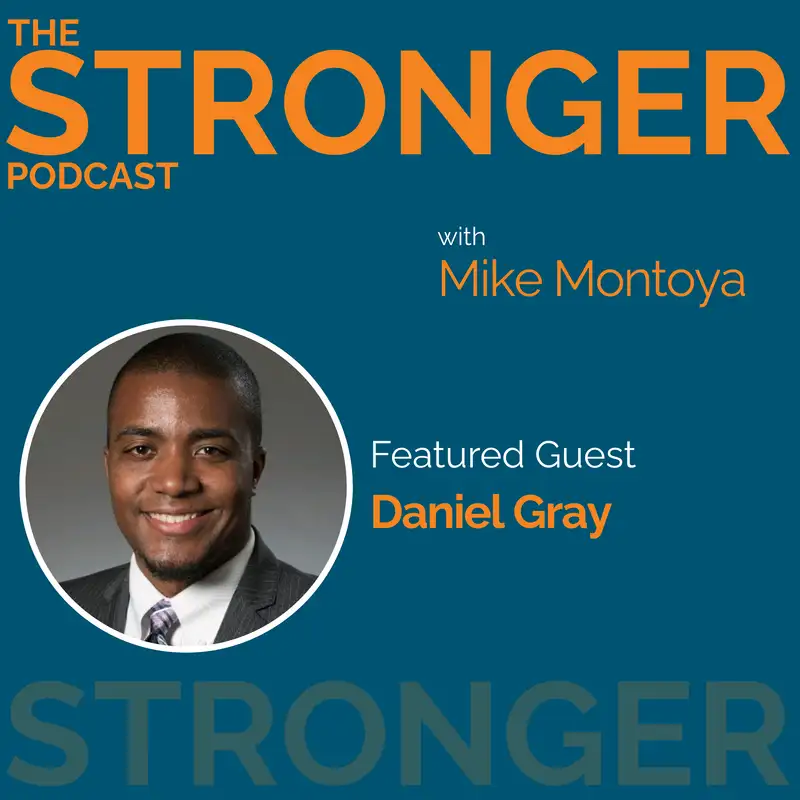
Transforming Education: Giving Every Student Real Choices and Career Confidence – with Daniel Gray
Mike Montoya: Welcome to The Stronger Podcast. Each week we have honest conversation with education and social impact leaders about their leadership and career journeys. We talk about their origins, inflection points, and the work that they're doing today. The conversations are honest, human, and practical. If you're here for real stories, and real takeaways, you're in the right place. Let's jump in and let's get stronger together.
Mike Montoya: (00:00:00) My guest today is Daniel Gray, a leader who's moved from higher ed through the Texas Charter School System and into the school district offices in Houston, always maintaining a singular focus, expanding access and options for young people. As the **Deputy Chief for College, Career, and Military Readiness at Houston ISD**, Daniel is designing a continuum of readiness and support so that 11,000 seniors each year can step into lives of choice, not just chance. We explore his journey and what it takes to build a district-wide college and career ecosystem at scale. Let's jump in. Before we dive into today's conversation, I want to give a quick shout out to podcastmatter.com. Their mission is to help impact driven voices get the visibility they deserve. If you want to share your message with the world, check out their website in the show notes. Good morning, Daniel. Thanks for being with me.
Daniel Gray: (00:01:05) Yeah, thanks so much, Mike. Happy to be here. Excited.
Mike Montoya: I'm with Daniel Gray. And Daniel and I have known each other for I don't know 10 years or more give or take a little bit and largely because of some college access work that you're part of right.
Mike Montoya: (00:01:18) Tell us tell us a little bit about the.
Daniel Gray: Go ahead. Sorry.
Mike Montoya: No, go ahead. No, sorry.
Mike Montoya: (00:01:22) Tell us tell us a little bit about the the place where you came from and how do you grow up?
Daniel Gray: Yeah. So, originally from Southern California. Grew up, like I said, had both my parents in the house. My dad was a My mom was an elementary school principal. And so for me, there was always a space of wanting to be both connected to the community that I was in, I think, from my dad, but then also wanting to help uplift that community for my mom.
And so, whatever we could do to be supporters of the community that we were in, be connected to the folks that were around us. And I think really trying to do what we could to help better the lives of everyone around us, I think, was really a huge part of it. You know, and my family, you know, a lot of my family's from Mississippi and Texas, and we have folks who have been, you know, mayor and you know politicians and school teachers as well too. And so I think for for me it really was sort of thing inside of me that said actually our job is to help make things better if we possibly can and so do whatever you can. I think on top of that just you know growing up in a place like Long Beach like LA where you see sort of wild amounts of financial disparities I think it really became even more of a push for me just recognizing that there are lots of incredible people who have lots of incredible all sorts of talent but just not the opportunity to get where they want to be.
And so, how do we create space and places and opportunities for folks who may not have those to find those and really push to get as many people as possible into really amazing careers and lives and jobs and whatever it may take to help them move that. And so, I think that was really a big push for for me that I think as again from my family having some of that, but then also just I think growing up and seeing some of that disparity and wanting to figure out like how we make that better, how we remove as much as that we possibly can.
Mike Montoya: (00:03:00) So, your your parents and your family the the the call the extended family had some history of getting involved right in in leadership types of ways and like but as a sort of as a young man or maybe middle school, high school or college kid like did you like when did that light kind of turn on for you in terms of like oh I can imagine a pathway into this work like like was there a moment or a time when that started to become more like real and and possible?
Daniel Gray: Yeah, I actually remember there was a moment when I remember I think it might have been in Santa Barbara with my parents on vacation. And I was there with my mom, my dad, my brother, my sister or some place. And I remember thinking very clearly and having a very clear, I actually know what I want to do. And and what I want to do is help people in some way, shape, or form. I don't know exactly what that is. I don't know exactly what that looks like, but I know that that's what I want to do. And I know that that's what I'm called to do, and I've got to just figure out what is the right pathway for me to get there.
And so, I think in so many ways, it started me off on this just different kind of a journey to figure those things out. You know, I started off started teaching when I was younger. Actually moved into the private sector for a number of years and then when I was working in the private sector just really having this pull of I what I'm doing is not where I'm supposed to be and and helping make folks who already got tons of money make more money. Like yeah, I want that but actually yeah, it's just not what I want. It's not and there's a lot of folks who are being taken advantage of by the work that I'm doing. And how do I make sure that that's not the case?
And so I actually, you know, I left left working in their private sector with a you know pretty good job and started working at the University of Houston and really from there it was sort of a you know I think from there I think that was sort of the start of like how do I continue to find myself in places where I can help more and more people. You know I think even when I was at U of it became this thing of there are so many students who aren't making it here. Like as many kids as UH has uh is you know nearly 50,000 students an incredible school does a lot for access there are still a bunch of students who aren't making it.
And so I think for me it really became a question of how do I get on the other side and help to create strategies and systems that allow students to not just access you know universities not just access college but actually be successful while they're there. And so I think that really became just a push for me of how do I continue to find opportunity to get on that other side. And you know I think you know even in that time that I was at University of Houston it really was this I think I tried different things there. I worked on the student side. I worked on the alumni side and really just you know I think trying to figure out like okay where should I be and just recognizing that that no matter what I was doing, it wasn't the the the access that I wanted to create wasn't being created from that side.
And so for me on this side now, you know, now this is, you know, I was at Uplift for a number of years now at **Houston ISD**, but there's a real opportunity to create access and space from this side by by sort of understanding the system that I was in and trying to help, you know, break some things open, break some walls down and push from that side.
Mike Montoya: (00:05:07) Yeah. So you so you spent a number of years in the higher ed kind of exploring sort of exp experiencing this. Obviously, you went to to college at some stage and had that had your own personal experience, but the opportunity to then sort of switch sides to the the K12 at the feed side, right? The supply side, right, I call it, right? Where there's like opportunities where like there's a lot of kids that are like getting ready to make that leap, right, the over over the edge into the the higher ed space. Um, it's where you've been focusing for the a good chunk of your career the last 10 years roughly, something like that is what I think my estimate is. Is that right?
Daniel Gray: (00:05:44) Yeah. Yeah. The last 10 years I've been sitting on, you know, whether it be college access. I think a lot of I do right now is career and CT related, but so much of my work over the last 10 years, really the last decade, has been truly on getting kids into great careers and into great colleges and and creating those access opportunities and making sure that when students leave our K12 education system, they have a really great plan, a really great idea of what they want to do and who they want to be. And then ensuring that there's a a clear objective for them to get there and that they have the resources and the knowledge base and the connections and whatever that might be to get to that space.
I think a lot of times when our students leave our schools, I remember even for myself when I left high school. I had parents who were incredibly wellconnected. You know, my I guess like said my dad was a pastor, mom was a principal and you know was able to go to a really great school. But I do remember leaving college and and and even leaving high school and being very confused about what it actually meant to be in these places like what does it mean to go to college and who am I going to be when I'm there like and then leaving college itself and saying what am I going to do now. And I think, you know, again, like I mentioned earlier, like there became a clear point of I know I need to help people, but what does that actually look like?
And so I think a huge part of what I'm trying to do now is I think maybe on some level, right, the the the gaps that I had in my own life growing up of yeah knowing exactly what I wanted and and how can I help more kids understand what they want and really help push that and push those conversations and push those opportunities and and and push that access. And I think that really has been a huge part of what I've been trying to do, like you said, over the last 10 years is just create access and opportunity whether it be you know in the charter space or right now in the district space by by you know I think ensuring that students know what's out there and ensuring that students have the opportunity to get where they came to where they want to be.
Mike Montoya: (00:07:22) Yeah. I mean there's so I app I mean it's like such a daunting experience and like the opportunity to sort of like give people I call it people like a visibility right to what's potential what's out there. Um I feel like we know everybody has a like career days when you're in elementary school or middle school and they like they're like they bring in the firefighters and they bring in the doctors and like like the the obvious like career things, right? But nobody really says like you know there's all these other components, right? The whole economy and society runs on so many different things and none of us really know anything about that when we're young, right? For sure. And even as adults, we're like the number of jobs and opportunities that are out there that are just, you know, unbelievable, right? It's like a crazy amount of stuff. I feel like maybe a teenage mind is not really ready for all of it, right? But they also are like like I guess at the perfect time to be giving the the seeds, right? To be thinking about like here here's all the potentials, right? And then they get drawn towards that.
Mike Montoya: (00:08:24) And do you guys do you have like like how do kids learn about opportunities these days? Like what are the I mean obviously there's social media and all that kind of stuff, right? But like how are kids actually learning about things that are out there?
Daniel Gray: (00:08:34) Yeah, I think a huge part of what we're trying to do here and we did it at Uplift and we're running I think a similar but obviously you know different at scale here at **Houston ISD** is really pushing a lot of just work-based learning programming. So whether you're in a a CTE program or in a more traditional sort of like high school and really work in a build how do we build internships, apprenticeships and and do it at a scale that allows a significant portion of our students to understand you know. I think one of the things you touched on was we don't expect students to pick their exact career now but for me I think it's a win if a student says actually I know that I don't want to do that thing. You know, if they take an internship or take a you know do a small work based learning opportunity and they go actually you know I can't this is not what I want to do. I don't want to sit in an office all day long. I don't want to do whatever that might be. I think that to me is just as valuable because it means that there's something they can say like actually I thought I wanted this but actually I don't and now I can figure out what it is that I do want.
And I think that's so much of what we're trying to do is just create these small instances where students can get information that allows them to say I do love this, I don't love that. I do think this is interesting. I don't think that is interesting. And I think you taking it step by step. So really a lot of our workbased learning starting it in middle school and really trying to build on that so that by the time a student is in 11th or 12th grade they they're into, you know, an internship that pays them. They're into an apprentichip that's getting them prepared for a role for for a more trade-based role for when they leave. And so I think that is the push is trying to create this sort of longitudinal system that starts as early as we possibly can. Getting students that that like those little bitty p pieces of of what different careers look like and scan that all the way through to 12th grade to where they they can then make a clear decision of like this is what I want this is what I don't want. And I think for us it it it is hard to do it I think at this level trying to find the number of partners and the right types of partners but I do think that taking that time to understand what students want and listen to them you know we're doing a number of different surveys throughout the course of the year to try and understand that as well too and I think using those answers to then create the kind of opportunities that our students might want or need.
Mike Montoya: (00:10:43) Yeah I feel like yeah the systematic approach to it is like what has always been missing right the ability for like us to do that on a scale right at at the place where like most kids get a visibility interview and a view like a lot of kids get it from their parents right sometimes but not that's a small portion of and if you don't have the right parents doing the right stuff you don't get it and you know maybe your maybe your mom or dad is not even present in your home and so like you have a gap in that regard and maybe you can pick it up from your uncle or something like that right those are like how most people get there.
I remember I was I think I went and spent like a lot of time interning like at a hospital when I was in college and I was already like almost a senior right. I already suffered through like biology and chemistry and all the premed stuff. And I was like, one of the physicians was like, "You know what? The hardest thing about my job is I basically wipe noses all the time. And that's all I do is like solve like the common cold thing, the virus thing, which is an impossible solution. There's no solution to that, right?" And so he's like, "That's all I do all day long with kids, right?" And I'm like, "That sounds like the worst thing ever in the world to do the same thing over and over and over." And I don't think that light turned on for me till I was like, you know, 22 years old, right? Almost finishing college. And then I was like, "Okay, Now what? Right? That was a huge it was almost like a crisis moment, right? But at the same time, I wish I had had those conversations, you know, five or 10 years before, right, to have a picture of that. So kudos to you for kind of getting that system rolling.
Mike Montoya: (00:12:00) So tell me a little bit about like where do you think I know you've talked in the past with me about like CT opportunities, right? And it sounds like this is a little bit of what you've been working on in Houston. So like can you tell us a little bit about some of the like kind of exciting or potentials that you guys have been getting for?
Daniel Gray: Yeah, one of the things that we're trying to do is is I think to your point, I think be really systematic about how we're creating opportunities for students. And so, you know, I think for us, we're thinking about what does that continue of of experiences look like? What should a seventh and eighth grade experience look like? What should an experience look like for a ninth and tth grader? And then what should look like for an 11th and 12th grader? And so, one of the benefits of Texas, of being here in Texas, is that there's a really robust CTE environment. I think it happens in a lot of different states, but I think Texas has done a lot of work to really be supportive of really strong CT pathways.
Daniel Gray: (00:12:57) And so what we've tried to do is really align to one what Texas has defined as high quality careers, but I think also working with our partners in the city and saying what is it that you actually value in a profession? What do you what what certifications do you want? What career opportunity what what career opportunities do you need? And what sort of skills and training do students need to be successful in whatever it is that they're doing? And so I think our thought is how do we start working on you know if it's soft skills I feel like you know a lot we always hear you know students need more soft skills or not it's not something they they see a lot. And so I think what we try and do is think through how do we start to build those sorts of soft skills that are really really really hard and challenging for many people. Build those up as early as we possibly can in seventh or eighth grade.
Daniel Gray: (00:13:46) Get students those opportunities to to interact with other folks and you know connect with professionals and do those types of conver have those types of conversations. And then look at ninth and tth grade as almost that next stage in that opportunity. It's seventh and eighth grade you worked on sort of the basics. Nth and tth grade we actually want to really push to how do we start to get you to what the actual career you might be interested in is. And then 11th in 12th grade really is that like we want you to go out there, find the internships, find the opportunities and really take advantage of that and and really do that work there in a real environment as best we possibly can.
And so I think about it from like a healthcare perspective and seventh and eighth grade. We're helping our students, you know, just understand like do you want to work in healthcare? What what aptitude what skills do you have and why you think healthcare is the right thing for you?
Daniel Gray: (00:14:38) In ninth and tth grade, a lot of it is deep invested learning in CTE courses where you're understanding more about what it will look like going on trips, doing some of that basic work. And then in 11th and 12th grade, really pushing to make sure that we're actually allowing practicums where students are going into the hospitals and they're taking that time to learn and train with professionals and understand that. And so really again building sort of a cohesive system where a student is understanding who they are, developing more of a context of what it may look like to work in this field. And if a student says actually I still do have an interest in this field, then 11 and 12 could actually putting them in a real space where they get to work and and and you know have that lowrisk learning environment.
Daniel Gray: (00:15:23) You know I think often times if we wait until college to start having students really understand more about who they are the risk is the student now is the person taking all the risk to the person who's paying the money. So if they do three years of studying for something and they go actually I do not want to do this anymore. I don't you know kind of like you said I don't want to this like you know wiping noses all day long is an awful thing. That sounds terrible to me but that's three years of learning and three years of push that that that isn't necessarily down the drain, but is but is, you know, is is now maybe not as aligned as you might want it to be.
And so I think our hope is really to create a system where let the risk be on us. Let the risk be on the be on the employer in terms of training people up and then when that student is then says, you know, I'm a 12th grader. I've gone through all this stuff. I've had all these experiences. I know that I want to be a doctor.
Daniel Gray: (00:16:16) I know that I want to be a nurse. I know that I want to be a certified medical assistant. They then can now take that step and say, here's how I'm going to get there. Here's the steps I need to take. And then from our side, that's where we, you know, working with our top graders to help them, you know, apply to the schools that that best align to what they're looking to do. If they want to work, if they if they want to go and be a doctor, we're the schools that have the strongest premed programs. And I think, you know, we've we've implemented some, you know, I think one of the the things that you see in a college access basis like the two plus, you know, target, two plus reach, two plus safety types of models. And I think that's something that a lot of times within, I think, large school districts isn't always a thing that happens, but that's something that we're implementing here. This at Houston to make sure that our students are applying to a wide variety of schools.
Daniel Gray: (00:17:05) We don't want our students just applying to, you know, what's here in state or what's here in the city. Even though there's some really great institutions, we actually want our students to try and figure out like what are the best schools that I can get into that have the best graduation rates that, you know, take care of the most financial aid for me. And then really pushing our students to do that as well too. And so, and then again, even for our students who aren't going to college, if they say they do want to be a CMA out of high school, we're the hospitals that are hiring CMAs right now who are hiring medical assistants. since, you know, are there places that we can help place them right now that allow them to get that really, really fantastic experience so that they can get those roles before they even graduate.
Daniel Gray: (00:17:47) And so, I think those are things that we're trying to really push pretty aggressively right now to make sure that when our students leave us, they they are prepared for whatever that journey is, whether it be the really great institution, the four-year institution, two-year institution, or the really great job offer they've already got in hand prior to graduation to make sure they've got that job. That's that's so much of the work that we're trying to make happen right now.
Mike Montoya: (00:18:11) I'm going to pause the conversation here for just a second to talk about books that matter. Every entrepreneur or leader needs a book that elevates their business, builds their credibility, and makes an impact. If you've got more money than time, a ghostwriter can help you build your story. If you've got more time than money, a great book coach can guide you step by step through the writing process.
Mike Montoya: (00:18:40) If you have already written a draft, these folks can save a lot of trouble and money by shephering you through the publishing process. Head to books that matter.org and get the custom support you need on your book idea or manuscript.
Mike Montoya: (00:18:55) It sounds like you're giving you're sort of like a little bit agnostic about like the opportunity pathway in terms of like they could go to college, they could go to kind of direct to employment of some sort, right? So, do you have a this is a controversial topic in our space, right? This like college for all versus a career opportunity and choice times like where do you how do you navigate that?
Mike Montoya: (00:19:23) Like as a leader, right, you have a certain point of view probably, but maybe there's a personal one as well, but like just talk to me about that because I feel like it's useful for our our audience to like hear from like one of the you know kind of pre-eminent guys doing the work right like how do you navigate this actual reality right that kids are facing every day right tell me about that.
Daniel Gray: (00:19:42) Yeah well thank you for those nice words I appreciate that. I think it's it's it's both I think. Um we can't think of students as being college students or career students. Every student that we have as a college and career student. I think really part of our role I think is to create the opportunity as best we possibly can for every student to know that they have an opportunity to go to college or they have an opportunity to go to career and then give them the experiences and the resources they need to make that choice on their own.
You know, I think if we, you know, all of us, you know, we all went to, you know, you and I both went to four-year colleges, the vast majority of educators, you know, went to four-year colleges, got their bachelor's degrees. And I think if we sat there and thought about ourselves as either a college or career kid, there's sort of a limiting piece in that it actually falls a lot of what college for. You know, so much of college is about understanding more about who you are as a person, understanding more about what you want to do. and and I think leaning into that and more deeply. But I think we also want to make sure that we have a clarity of understanding that as we're sending a student to college, we're sending them to get a stronger career and to help them with that as well.
I think again for me so much of it and whether it be personally or professionally, it is how do we make sure that every single student knows what they're capable of and has clarity on, you know, if I've got a a GPA that I don't think is all that strong or an SAT score that may not be that high, there are still schools that will will help me that will, you know, bring me in and and help me go there. And I think we want to make sure that students have that awareness. And I think part of our role is to just create the the the cir the circumstances and the situations that allow students to say, I can go to college, but I want to go I want to go work right now or I can go to college and my family needs me to work right now or going to college is going to be a stretch for me, but I know that it's what I want to do and I know that that's what I need to do to get where I want to go.
Daniel Gray: (00:21:40) And so I think again it's it's so much about creating opportunities for students and creating knowledge and our students to help them understand more about what are the decisions that I'm making as if I'm making those decisions what are the trade-offs that I'm making with that. If I if I choose college what's the trade-off in terms of you know debt in terms of starting my career you know a few years later. What are those things? What are the trade-offs and understandings that I have things I have to understand in making those moves or if I say you know actually I'm going to go into a career right now and I'm going to go get that job and and make whatever that amount of money is what are the things that I'm giving up by doing that? I'm giving up you know the the flexibility that college allows you some of that autonomy to just, you know, learn, live and learn and understand more about who you are. And helping students understand like there are trade-offs either way. There are benefits either way, but what are the things that happen? And I do, again, that's why I think it goes to we we just we can't we can't push students into one path or another. I think often times that that sort of just leads to lots of problems around equity and and.
Mike Montoya: (00:22:52) they're all kind of in the bigger pool for a longer period of time, right? And helping them to kind of like have choices amongst the the things. I feel like I feel like this is and this is dating me right back in the 80s or whatever it was and like that you had to choose college prep basically when you were in like seventh grade right? Like they're like okay if you take this algebra class and I talked about this with other guests right like take this algebra class and it puts you on this track for this math blah blah blah blah blah so that you finished calculus by the time you're in college and like that pathway right was pretty narrow and I felt like a very high pressure. And I I think I I personally discarded a lot of the stuff that maybe was beneficial for me right because I was like on this very narrow path right of like college readiness in college prep for that kind of thing. And I don't know who made that decision for me. I think it just got made for me, right? Something somebody said like this is your path. And I'm like okay. And then you get on it. And that was like I and I know there were tons of other kids that did something else, right? Because I was with the same like 20 25 kids for my whole high school career, right? And like that's what we did. It was like our little crew and just kept moving through, right? So that that tracking stuff I think is now a little more muted. So it sounds like, but also it's still like high potential that we're making choices for kids that may be limited. opportunities, right?
Daniel Gray: (00:24:08) I think that's I think that that's sort of the hard balance is I think that you know as you're trying to make decisions and and create opportunities I think a lot of times the the the choices you have to make the trade-offs that adults have to make or that adults not not have to that adults make often times like you have to think through like what is the actual thing that I'm trying to get to what are the benefits that I'm trying to create and what are the opportunities that I'm trying to create for every single student.
And I think the moment you stop thinking through through what is the impact to to every single student and you start just thinking through like actually here are these students we need to just do a thing that helps all these students in this certain way I think that's actually what gets you into more trouble. I think you have you really do have to think what impact of every decision that I make what is the impact on the individual student that I'm in that that is there in a school in a school building that's sitting in the classroom right now how am I creating opportunity or removing opportunity in a way.
And I think that's something you have to that's sort of the trade-off I think you have to make. I think trading creating as much opportunity as you possibly can is I think the push we want to continue to make and I think that's the just one of those challenging pieces with with any sort of you know senior administrative role is that on some level you have to figure out like what trade-offs are you okay with what you know what what bars what bar do you you know hold yourself accountable to and then how do you think through how you impact every single student that's in your care and every single family member that's in that you know part of that.
Mike Montoya: (00:25:47) That sounds super tough because like it sounds like You're saying individualization is high value and then being part of a school system like a large one with lots of humans and lots of kids, right? That there's always a push for efficiency, right? And grouping things, right, into into subgroups and and and pathways because it's just cleaner, right, in that regard, right? And that that feels like an interesting tension.
Mike Montoya: (00:26:23) So, how do you I mean, let's talk about the human capital side and the adult side, right? There's a there's an argument out here that says like, okay, if we had the right kind of adults thinking about this individual student experience, all the time like that is I think it gives you a better shot right at achieving that and so how do you go about thinking about your staffing and the people that are kind of in front of kids over time and thinking about the programming like how have you built your team tell me about those kinds of things I'm super interested so?
Daniel Gray: (00:26:56) Yeah I think people are you know I'm a big believer in like the importance of culture and the importance of having the right people. You know, you know, there's that that quote you hear sort of around which is you know I think culture each strategy for lunch. I think.
Mike Montoya: That's right. Yeah.
Daniel Gray: Best strategy, but if your culture is terrible, that's that it's almost impossible. And I think it's the same thing with people. I think if you have really really great people who want to do great work, who are are there for kids and who want to make things better for kids, it's so much easier to do good work in that in that instance because you're aligned on beliefs. You're aligned on outcomes. You're aligned on on how you can help students. And I think the moment that it becomes something different, I think that becomes the the a bit more challenging.
Daniel Gray: (00:27:50) And so for me, I am firmly in the space of like get the team right and have the right people with you. And I think there's a a huge part of it is it's just tied to trust. You have to trust the folks that you have on your team. And I think any lack of trust, no matter how talented you may think a person is, is just not going to be successful. You know, you have to make sure that the people you have, even if you know, I think sometimes there are times when you take on someone who maybe you're like, well, maybe they're a little bit less talented, but I trust that their heart and mind is in the right place and that why they're here is the right reason.
And I think you know that's that's sort of a decision that you have to make I think as a leader pick like what are the things that matter most to you and and what do you care most about and then building a team that's tied to those values and you know and I think leading with values and leading with you know what matters most is how I built my team and how I built the people that I work with. I I and you know what I when I have whether it be me hiring or the folks that you know I manage hiring I think we always look to make sure that it's they are and I hate the term culture fit because I think that's another way to you know to remove I think often times folks of color.
Mike Montoya: (00:29:00) Yeah.
Daniel Gray: But I think it is like when you say culture I think if culture is tied to values and I think if if if we can be aligned on values if we can have values that allow us to see each other as as humans who are pushing towards the same thing and who want the same thing and want to benefit our our schools and our communities and our students in a way that lifts every one up. I think that to me really is the the big push there. I think that's the part that I'm always looking for is making sure that like, you know, I who it is is, you know, I'm agnostic to who the person might be, but I'm not agnostic to their values. I'm I'm I care deeply about what they care about and I want to make sure that I have clarity on that before I bring anyone into the team.
Mike Montoya: (00:29:55) That's awesome. Well, and I appreciate it's it's a super like as you said, culture eat strategy for lunch. How do you build the culture that is in that line right? And I think sometimes that on the hiring side, we can get into the into the of like yes, are they the fit for this team? Are they the fit quote unquote right for this place? And then as you said, it kind of leads to potential like decisions that exclude certain types and groups of people to come into the space to do the work, right? And often times I think like you know in our practice like the push is always to like get more kids, more adults that kind of have come from and look like kids that are in the system that we're serving, right? Because there tends to be like I call it a greater commitment to achieving outcomes. So it's a little bit like your story where you talked about like you picked up the pieces of being like, "Hey, this matters to me and I want to help right and like those kinds of people are then I call it they go the extra mile many times to do that to do the extra work right and to think more creatively and to act in with more intentionality things like that."
Mike Montoya: (00:30:57) And values alignment I think it's as a leader it's like one of the hardest things to achieve consistently because you don't know where people are until you know them right or you can kind of see their work history and some of their results and then you have to like sort of like get a sense of like oh are they going to be values aligned to this work right and that's I think one of the things that like we coach a lot of clients on that stuff because it's tough, right? To do it well on a regular basis is like it's coming from all directions, right? Sometimes you're like, I need a body, but I also need them to be values aligned and very committed on that work in general, right? So, it probably matters. I feel like it matters more in this in this I call it the endgame of of the K12 experience, right? It matters more that the people that are sort of framing the outcome, right, and pushing the opportunity picture, right? They need to be I call it more inspirational about this, right? Because like you know what the kid shows up ready for, right? Starts obviously way back in their in their childhood, right? And like the whole school system has responsibility for getting them prepared for that, right? And sometimes I don't know if people know where they're going, right? Certainly, I'm not sure the kindergarten teacher is thinking about like college necessarily, right? Or the opportunity thing. Um, so how I mean, how do you paint that picture? Like what kinds of like how are you talking about this in your in your system? How have you talked about it in the past? I'm super curious about like like what what are the things that you've put out there that have allowed people to sort of see themselves on a path to something, right?
Daniel Gray: (00:32:30) Yeah. I think you you know you I think in the answer that like you've touched on sort of a couple different parts which I think is it is ensuring that you know I I spoke to my whole team. We did an all hands about a month ago now actually. And one of the first things that I had folks do was talk through their values and share their values with someone next to them because I think that so much like why why do you do not just work in K12 but why do you do like postsecary exit work like students are leaving our schools and going someplace else? Why is this work so important to you? And in so many cases the stories are about I had someone who believed in me who cared about me and who helped me get where I was or I didn't have someone and had to figure it out on my own. And so because I didn't have someone I want to make sure that I can be someone who can help other folks. And I think that is such a a huge part of it.
And I think I think tapping into that desire to make sure that every single student leaves a system, no matter how big or how small it is, with a clear idea of what they want to do and who they are, I think becomes a way to to to tap into values of what people care about. And I think that's something that I I would say I I try to lean into with this work. I think lean into the the empathy, lean into the care of you care deeply about making sure that students who look like you, who had experiences like you, who grew up in communities similar to yours, leave incredibly with incredible plans and incredible ideas of who they can be and what they can be and what they will be.
Daniel Gray: (00:34:03) And so I think that becomes really I won't say like a it becomes sort of the basis of of it's it's the floor that we sort of build things on. It's the it's the foundation of what things are built on. It's ensuring that everyone that's in the room has a story that can tell them more about what they want to see and who they don't want to see. No one wants to see a student leave our school and and struggle for the rest of their life. That is that is heartbreaking when you see that kid who's, you know, working at the fast food restaurant 10 years after graduation and you're going, "Man, that's I want more for them. I want more for that child." Those are the things that I think helps people like push that that next little bit further because they don't want to see that happen to any more kids. And so, whatever they can do to help in those instances is always helpful.
And I think that for me is often why like you can build from that. You can build a lot of different things from that. Like folks may have different beliefs about college or career or where kids should go after they graduate. But if they understand that that that initial foundation of our job is to create clear paths and clear opportunities for kids and make sure that every kid leaves us with a clear plan, a clear idea of what they want to be and who they can be. I think that becomes a pretty strong unifying force.
Daniel Gray: (00:35:16) It's also, I think, one of the weird things about like working in that college and career space. You're sort of the one really the one team in the organization that's looking backwards. So you're everyone else is sort of like looking like what's next? What's next? What's next? What's next? And really we're saying what what has happened and how do we use what's happened to now create a better pathway forward? And so there's actually an opportunity I think a lot of times for us to to have conversations with curriculum to have conversations with the schools teams to really say our students are still coming through with these sorts of conversations, these sorts of concerns. How do we create a system that better supports that and better supports these opportunities and really pushes for these different things?
And so I think building upon those two things of actually we're we're the back stop in a lot of ways. We've got to make sure things work out well. And then we also don't want kids to end up in a really negative space. So, how do we build from there? And so, I think I think using those two sort of I think foundational pieces of what do people care about and what do they want to see for kids as the way forward I think is the way to to sort of build a a culture and build a team that pushing for.
Mike Montoya: (00:36:34) Yeah. I mean, you have a that's a super challenging job because I'm just thinking about all the number the huge number of humans that are touching the lives of these over many many years, right? And that they spend so much time like you know in that English class and in those in those science classes in high school or middle school like like those teachers have a huge influence right on like what a kid imagines their potential is right and so like always kind of they call it inspiring like children to towards the opportunity that's out there right it's like a real dance right? I think like that's like that's like that falls to the school principal that's you know that falls to the the hiring team on the school side like there's a whole bunch of people that are involved in this right? Um I do I do think it's kind of shocking, right? And if you think about the scale of this stuff that this works at all, right? That we get kids engineered towards an opportunity of their lifetime, right? And like I know we don't do it perfectly yet, right? We're clearly have some work to do as a as a society, but like I feel like there's a group of people like at as you said in the school system, right, in Houston that's like working towards this, which is frankly I don't you know it didn't exist like these jobs that you're doing now like these things did not exist in the past, right? This is like almost I call it like the new division of work, right? Um and departments, right? These there aren't departments, right? Like there there's there's like four or five of them in the country, right? Maybe something like that. There's not a bunch, right?
Mike Montoya: (00:37:57) So, do why do you think I mean is there a reason for that? Like is there like do you know enough about like the the kind of space to be like hey like these things are missing and and there's a understanding of why bigger school systems aren't aren't doing that more frequently?
Daniel Gray: (00:38:15) I think it's I mean I think there's a couple things. One I think is it's hard work. You you sort of you said it earlier it's it's it is hard because it is there are you know 12 13 years of of conversations that our kids are having with a variety of different adults before they ever exit our schools. And and those conversations can be all sorts of different things. You know, I mean, if if there's a bad experience in kindergarten, that that can very easily impact a student for the rest of their life. And so, I do think that often times school districts are are more focused on ensuring that the K5 or or early middle and high school experiences are are much more effective. And I think that's where a lot of folks if they're making a trade-off in terms of what they want to make sure they get 100% right. Getting the the early pieces right is is more helpful I think can or can feel more helpful if you're you know if you're a superintendent you're probably thinking actually if I get K5 literacy locked in and I get K5 math locked in I feel good about like what will happen to kids after that. There's also a lot of data that says that.
Daniel Gray: (00:39:19) I think on that on that high school or post-secary exit space it's it's just a harder space I think for districts to wrap their hand around and wrap their arms around because I think it is just it's it's complex. I mean, there's more complex 11,000 seniors at at in HISD this year and and on some level all 11,000 will have a different exit experience from the from everyone else. And that's just like an incredibly hard thing I think to grasp and to navigate and to think through. How do I strategize for for this? You know, every third grader, you know, on some level you can create a more similar experience for every third grader because they're, you know, going to be in your system for another, you know, nine years after that. But creating that exit experience and making that effective, I think it's really, really challenging. And so, I think if you're a school district, you just may not do that.
Daniel Gray: (00:40:22) I think the one thing I think that's helpful is that I think a lot of charters sort of lean into this space really heavy. If you've got, you know, if you think about, you know, some of our different charters, so yes, Prep here in Houston, Noble in Chicago, there's a number of these different charters that really only were high school only. Yeah.
Daniel Gray: (00:40:48) And I think they started building up that like college to that college pipeline type of model where you start to see more students going to college and having higher college both attendance but also graduation rates from those schools. And so I think what's happening now is I think that as you saw charter start to do that and get good at that districts have slowly sort of started to to build from there and now built some of those systems up themselves. And I think that's part of what's happened here in Houston is is you know we've sort of done the thing where and I think HIC still does focus I think there's a lot a huge focus on what's happening you know K8 and a little bit less or looks different in high school. But I think trying to take some of those systems that a charter may have built up around and not saying that we're not a charter model obviously, but what are the things that we can learn from charters in terms of helping students get to college in terms of having like really robust career options and and then implementing those things in a high school so that student a more district high school so that students have options in terms of where they can go to college. You know, I think so often and I think in a lot of cities that have big school systems. It is what's the community college, what's the large public college, and then that becomes where people apply.
Daniel Gray: (00:41:59) And so I think it's it's taking that step a bit further or maybe a couple steps further and saying what's a much more diverse opportunity that we can create and and who are the schools that we can have kids work with. And I think so it just becomes building a system and a model that aligns more with the 11,000 different students and creating pathways for all of them rather than just saying like let's create a couple different ways for us to get there. You know, like I think doing 11,000 different ways of supporting students at scale is hard. But I think trying to create those systems, you know, we can sort of create much more alignment and get a little bit better with that.
If we work directly with higher ed, which I think is a part, you know, that I think we're trying to do here at HISD is instead of just hoping for the best when a kid leaves us, which leaves us, we're trying to say like actually how do we work with our higher ed partners, you know, across the state, across the city, and get really and have a really great relationship with them where they say actually, you know, we'll we'll accept, you know, every students like this and so do that. So I think limiting some of the variance that can live within 11,000 students and creating more more straightforward systems for students to think early is the push but it's it's it's hard to do that because requires partnership requires you know I think a a way of thinking that's thinking about that's that's thinking about students when you when they leave you not just when they're with you. You know, it's it's really easy to think about students when they're in your doors but to help to have a plan for students when they leave you I think becomes it's a bit more of a challenge.
Mike Montoya: (00:43:40) Yeah. And like like where's the focus going? I mean it sounds like that the marketplace approach that you're talking about which is like to involve more on on the other side right of of the graduation experience right and and involve and you know and they have teams and resources right as well right like massive amounts higher ed has lots of resources compared to sometimes the K12 systems right and and as does employers right there's so much money in and free like space in the health care systems and the market and the places where you're creating these CT pathways right like those I think folks can be more involved. I think they don't know necessarily know either, right? That that's a thing to do, right? And it takes I call it how can do you have a story? I'm curious. You don't have to throw anybody under the bus, but I'm curious if you maybe it's like a highlight of a of a partner that's really shown up in a way that's been really I call it productive and and helped you like I call it they've leaned in in many ways, right, to make the possibility of a of a scale type of thing possible. It sounds like you have some ideas. I'm curious if you have one that you want to tell us about.
Daniel Gray: (00:44:50) Yeah, we have a a pirate partner who I think just has been willing to to I think sort of dream with us and dream as big as we are. You know, I mentioned we have 11,000 seniors. Like trying to find a place for all 11,000 is tough. But I think having a higher department who's willing to say actually we'll we'll we'll do this. We'll say any student who's an HISD student who has, you know, this GPA or above, we'll we'll we'll accept them and and we'll accept them before they apply. So we will directly admit them, let them know they're financially as best we possibly can, as fair as we possibly can, and create a a clear floor for what they can do.
So, if I if they know that if nothing else, this school is available to me, this is the kind of financial aid that I'm going to get. So, this is a fantastic option that a student may have that they may not have even applied for before. I think that's really how we're trying to solve some of that is is, you know, I think if we can find a hired partner and find more, again, we have this first one who sort of, you know, I think really has sort of dreamed with us and said like, "Yeah, we actually really want to do that with you. We see the value in doing this. We see the value in what we're they're interested in growing, which is awesome for us, but they're also interested in creating a deeper relationship within the city of Houston with with a school system that's doing really great really great things." And so, I think trying to create that connection between this school and that institution and just saying like we can build together and we can create opportunity together in a way that has never really happened here.
Daniel Gray: (00:46:27) And I think it takes, you know, you touched on It takes finding a partner who wants to be creative, who wants to solve big sort of challenging problems and is willing to to take those steps to figure out how to get there and is willing to take a, you know, a risk. You know, it's a risk on their side. I think, you know, I mentioned earlier that often times the risk is on students once they get to college.
Daniel Gray: (00:46:57) And I think this is a time when, you know, us as a school system and and they and you know, this hired partner as a school system are saying actually we we can take on a little bit more risk and hope for a little bit different out. And by doing that at scale, we can try and create more opportunities and let us own the risk. Let's let us own the challenge instead of the student owning that. I think that's that's the part for me that's been really exciting is that it means that it's not it's not the kids doing that. You know, it's the school saying we want to try as best we possibly can to create that.
Daniel Gray: (00:47:32) And I think, you know, I think our hope is that we find more higher ed partners who are willing to do that. I think it is a it's a push though. You know, it requires them having someone who one has the authority to to make that call. all. But then I think too someone who has the creativity to say actually this this is interesting to me. I I can go with I can run with this and and make that happen. I want to see this happen for for Houston and and and make that work for all of us.
Mike Montoya: (00:48:10) I just want to say that if you're a leader, entrepreneur, or business owner who needs some support, there's an easy way to get a think tank behind you in your vision. The Genius Discovery Program at Thought Leader Path is like having your own one-on-one incubation and accelerator program. They'll help you develop an approach based on your own story and your plan for impact and offer the tools and thought leader assets needed to really amplify your message, including launching a podcast like this one. If you're ready to stop grinding in the dark and start making real impact with the right support, check out geniusdiscovery.org.
Mike Montoya: (00:48:58) Yeah, I feel like thanks for expressing that. I mean, I feel like this if there's a call I call myself like a champion, right? I think want more people to know about like the need, right, for these partnerships to exist, right? And there's a number of I think you know, cities have come up with these like promis experiences, right, where like there's an opportunity. I think there's probably one in the Dallas Fort Worth area, right? And there's probably one in Houston maybe. But like the chance of like, you know, many kids going towards a thing, right? And the mayor gets behind it and the city gets behind it and the the regional, you know, higher ed places all kind of get on board because the presidents in places have aligned in some ways, right? So like there's some experiences like that across the country. I feel like, you know, but they maybe there's 10 or 20 of them, right? But there's not there's not 200 or 500, right? Not yet. And I think there's like lots of choices and opport the scale of this thing is like it's so massive right when we think about it and I feel like that's that that you just nailed it for me right which is to say like hey there's like multiple things in play here and it's not all on the child and it's not on their family only right like we have these institutions and systems that like we're all investing in in some way or another right that should be right feeding back towards right the the betterment of our society but that's like you know like my little liberal philosophy right of course not everybody agrees with me but but I think there should be there should be more right so I think yeah I think that's the.
Daniel Gray: (00:50:35) that is the the to your point it's it's a little bit of a a little more like liberalistic philosophy of saying like we can create opportunity and it it just because just because one opportunity is created doesn't mean an opportunity is taken away. It means that there's another opportunity created and I think so often times I think we can we can get caught up in the if it's not mine it has to go to someone else and really it's like it can be both mine and someone else's and someone else's and you know however many others how many other elsees out there too.
And I think that to is uh is is how we fix some of that is is you know getting past like creating a more egalitarian system where everyone has these opportunities across the board. You know unfortunately Houston does not have a promise system.
Daniel Gray: (00:51:30) Not yet. I think we're we're trying to essentially I was telling someone this the other day like part of why I feel like we're trying to do here is almost build like an HISD promise type of a model. I'd rather make it like all of Houston. I think that's a much more impactful system and a much more impactful model. But you know if I if we can drive from here and you know push across the board. I'm all open for that as well too. But I mean I saw you know being in Dallas for the last eight years at uplift. I saw the impact that having a model like that can do on increasing even just college awareness for kids and creating opportunity. I mean you know Dallas has a has a higher in terms of like young alumni. So six years or fewer from graduation the income that students in Dallas are making is higher across the board than than the former alums here in Houston. I think so much of is a program like you know like commit like the Dallas County Promise because it says we are investing in this community and trying to raise all ships by doing this.
Daniel Gray: (00:52:43) And I think that's something that I'd love to see here again and I'm trying to tap a couple people that I that I know to say like, "Hey, let's can we do it here too?"
Mike Montoya: Yeah.
Daniel Gray: Because it does I think it does just do so much for for a space and so much for our community.
Mike Montoya: (00:53:02) That's such like inspirational potential, right, to say like we as a society has decided, right, that like we want to have, you know, robust opportunities for all of our children. And I think most people can get on board of that, but Not everybody, but you don't need everybody to be on board. You just need like enough momentum, right, for people to sort of see the potential and sort of recognize that like once you start building economies based upon children that have been well educated and have choices in their lives, then you end up with like happier society, right? You end up with like more productive people love the productive part of this, right? Like there's a piece of let's say like we're all doing better because like the economy gets bigger, right? Because kids and families are doing better, right? And that's I think it feels like it's such an opportunity for politicians, right, to get board with this stuff. So like whoever is out there listening to this at some point we want to talk to you. There's there's lots of potential here. It's exciting. There's there's lots of great models, etc.
Mike Montoya: (00:54:10) So Daniel, I want to be like super aware of of kind of like pulling this back to the personal side, right? So like as you you're you're in the middle of your career and doing some really important work. And so like if you am looking back, right, if there's a piece that says to you like you know the driver is towards this future opportunities for children and amilies that you're talking about like like in the end like how do you know like ultimately that you're doing the right work that you're happy with right and that you're I call it like your life is well-lived so to speak like do you have a a way of like measuring that for yourself and how do you think you're doing all that very hard?
Daniel Gray: (00:54:47) Yeah I think that for me you know and I I I think when you asked the sort of the question at the start about like what what was the reason why I got into this this sort of work it was how do I create more opportunities and and access for as many people as I possibly can. And I think that's really been just like the driving force of like what I've been doing over the last decade is really just trying to create as many spaces and opportunity for kids as possible.
I love the work that I was able to do at Uplift in terms of driving opportunities. You know, we we saw incredible numbers of kids going off to college and and you know had like incredibly high numbers of students earning really strong salaries in at a pretty young age. And that's something that I was like, "This is exactly what I want my life work to be." And that's what we're pushing for here, you know, and what I'm trying to push for here is the same thing. It's it's how do we create space and opportunity to ensure that students who are in whatever school system it might be are working towards having **lives of choice**, lives of impact where they get to make their own choices and they're not forced into into things that that may not benefit them as as much as I as they could. as much as they might like.
Daniel Gray: (00:56:01) And so I think that really for me is the the most critical piece. It's creating an opportunity where students can, you know, have lives of choice, have lives of opportunity, have options. You know, you know, we mentioned earlier the idea of like a student saying that if I know that I have a GPA of this number, I have this option. And if a student can say, I've got this option and I've got this option, I've got this option all when they leave, that to me is an incredible opportunity. That that means that we've done our job as a as a school system. If a student can say I've got three really strong opportunities, is to when I leave this this place, leave this school and each one of them would lead to a fantastic life for me and my family.
And I think that for me is really what I what that to me is a life well lived. That to me is is the work that I want to do and the work that I want to continue driving for the rest of my life. And and I feel like I've done some some good work already, but nowhere near done. I still think there's way too many communities where kids don't have those options. They don't have those opportunities. And so whatever I can do to make sure that happens everywhere or that be not just Houston but you know across the world even across the country especially across Texas too whatever we can do to make sure that happens really is what I'm trying to push for.
Mike Montoya: (00:57:33) Yeah, that's awesome. Well, thank you so much for sharing about that and I think like I'm going to end with that in in the sense of like you know I think options and opportunities sound similar right when you when they roll off the tongue and I feel like if you've never seen a kid's like face light up when they're excited about their what their future might hold, right? And then then take the opportunity to do that because it's a kind of I call it kids are hard to defeat when they're on a momentum of excitement and and and and pulling being pulled towards that. So, um Daniel, thanks for your time. We'll wrap up here and we'll see you very soon. Okay.
Daniel Gray: (00:58:19) awesome. Thank you, Mike.
Mike Montoya: (00:58:21) Daniel reminded us that culture and values aren't nice to have in college and career work. They're the foundation. When adults are aligned and why this matters, it becomes possible to individualize for thousands of students, keeping equity at the center of every decision. Thanks for spending time with us today. Have a safe journey. Thanks for joining us and tuning in today. To find out about other podcasts that matter, visit podcastsmatter.org. Thanks for listening to The Stronger Podcast. If this conversation inspired you, we invite you to follow the show and share it with someone who is on a journey to become a happier and healthier version of themselves. Links and resources are in the show notes. See you next Thursday, 9:00 a.m. Eastern time. Have a great day and stay strong.