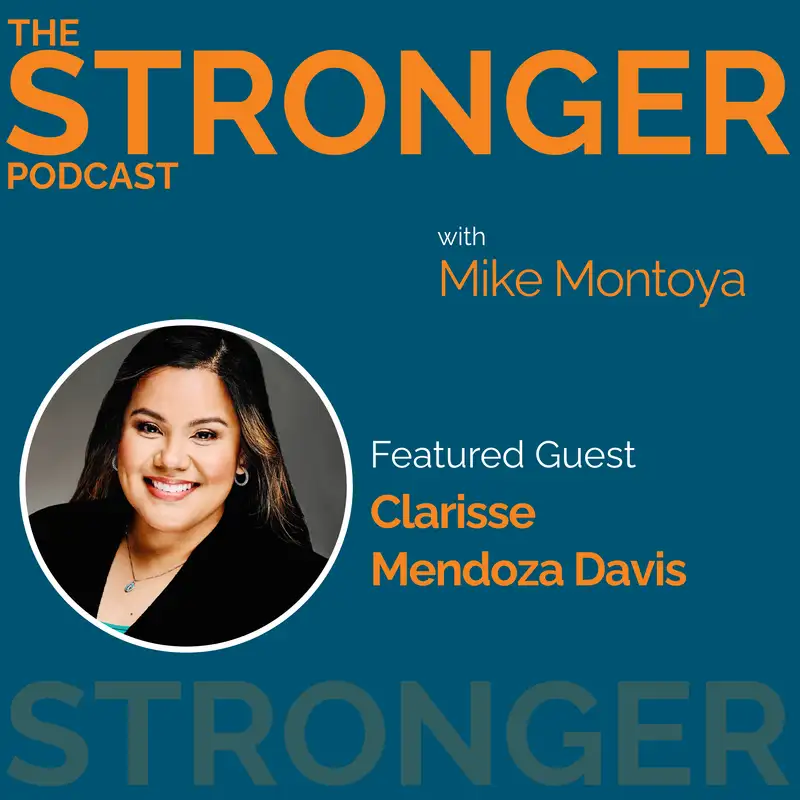
The Kindergarten Lie: How We Miss Kids Long Before High School – with Clarisse Mendoza Davis
00:00:00 Mike Montoya: Welcome to The Stronger Podcast. Each week we have honest conversations with education and social impact leaders about their leadership and career journeys. We talk about their origins, inflection points, and the work they're doing today. The conversations are honest, human, and practical. If you're here for real stories and real takeaways, you're in the right place. Let's jump in and get stronger together.
Today I'm with Clarisse Mendoza Davis, the CEO of the Maya Angelou Public Charter Schools and the See Forever Foundation in Washington, DC. Since her days as a first grader tutoring classmates, Clarisse has always led with service. We talk about early learning intervention centers she helped launch in DC public schools and we learn about what it takes to serve opportunity youth across five campuses at Maya Angelou Public Charter Schools in DC. Let's jump in.
Before we dive into today's conversation, I want to give a quick shout out to podcastheader.com. Their mission is to help impact-driven voices get the visibility they deserve. If you want to share your message with the world, check out their website in the show notes.
Good afternoon, Clarisse. It's wonderful to see you. Thank you for taking the time with me today. I'd love to hear the beginning of your journey into the education space, or if you want to go back to where you started even as a child. I don't know that about you. I love it when people give me a little bit of their origins.
00:01:25 Clarisse Mendoza Davis: Yeah, absolutely. Thank you, Mike. Good afternoon, and I'm happy to share a little bit about my experience as a leader this afternoon and some of my reflections. I'm glad you mentioned childhood because I think that's actually where my calling to education started. My mom always tells this story, especially when I introduce her to colleagues or coworkers.
I was in first grade and she had come by the school to drop something off or she was volunteering with something. She peeked through the classroom door window and didn't see me immediately. She said she kind of panicked and tapped on the window. Mrs. Grahams, who was my first grade teacher, turned her head and pointed to the back of the classroom. My mom leaned closer to the window and saw me at the back at the kidney table working with a group of peers.
Later, at parent-teacher conference a few weeks later, Mrs. Grahams told my mom that Clarisse was really great at supporting her classmates. Those were some classmates who needed a little bit of help with reading, and Clarisse was there. I was an early reader. So there was Clarisse teaching at age six or seven, however old I was.
As I went on through the rest of my K-12 journey and through college, I've always been deeply committed to helping others and serving others. Through education, I've really been able to fulfill that calling. I come from a family of immigrants and they made incredible sacrifices and prioritized my education and the education of my siblings. From where we lived to how we structured our family life, everything revolved around our education. They wanted great education for us, and I think that's what families and parents want today. That promise still lives on through education. Over the last 21 years as a public educator, it's been really fulfilling, but also a privilege to be able to help.
00:03:08 Mike Montoya: There are so many pieces here that I want to dig into. You're an early reader, an early adopter of texts, and an eager helper as a young person. You built that muscle somewhere as a kid. Did you grow up in Chicago?
00:03:32 Clarisse Mendoza Davis: Yeah, I'm originally from Chicago. As I was getting closer to school age, as was my younger brother, my parents decided that where we lived in Chicago, the public schools were okay but kind of mixed results. The way their families were structured, everybody kind of lived in the same area. So they decided to move out to the southwest suburbs, very far out to the southwest suburbs.
00:04:03 Clarisse Mendoza Davis: To one of the best school districts in the state of Illinois. I grew up out there and attended public schools there. That was my experience, but we were always in the city spending time with family and enjoying what the city had to offer. Like I said before, everything we did was about our education. Their family was like, "Where are you going? Just stay here. We'll figure it out." And they said, "No, we're forging off on our own." I think they were really brave for that.
00:04:41 Clarisse Mendoza Davis: I'm a Midwest girl.
00:04:43 Mike Montoya: Chicagoland is a huge place with so many things going on. There's a lot of complexity in that environment. As an immigrant family, were your parents the first generation here or were they also growing up here?
00:05:03 Clarisse Mendoza Davis: That's a really fun story. My dad is originally from the Philippines, so that's that part of the family. My mom is actually Chicago-born to her father who immigrated here to the States in the mid-1950s from Lebanon. I know, eyebrows go up like how did that mix happen. So Lebanese grandfather, and then her mother was also American-born to a Black mom, my great-grandmother, and to an immigrant from Mexico, my great-grandfather from Guadalajara in Jalisco. Put them together and it's like ancestry DNA just all over the map.
00:06:05 Clarisse Mendoza Davis: So first-gen, deep deep deep. Literally from every corner of the globe. People ask, how did your parents meet? What do they have in common? It was their prioritization of family values, including education, and also their faith. I think that really brought them together.
00:06:40 Mike Montoya: My estimate is that they might have been Catholic or something like that. I always say they all got together because they all went to church.
00:06:44 Clarisse Mendoza Davis: Yes.
00:06:44 Mike Montoya: They all went to church.
00:06:54 Clarisse Mendoza Davis: They all kind of crossed paths that way.
00:07:00 Mike Montoya: I appreciate you sharing some of those elements. You have these various cultures coming together through marriage, with an ethos around betterment of your family and opportunity through education, which clearly has caught fire.
00:07:22 Mike Montoya: You've had this whole journey. I saw that you were TFA. Is that true? Is that kind of your exit from college into the ed space? Did you just get recruited by the campus people or how did that work?
00:07:40 Clarisse Mendoza Davis: Yeah, absolutely. I'd heard about Teach for America and I wasn't an education major, although all the volunteering I did throughout my time in undergrad was very education and teaching focused. I knew I wanted to teach even though I was a double major in English and music. So this seemed like a way to get into the field. That's how I connected with Teach for America. Washington, DC was my first choice. I thought it would be really exciting to begin teaching in the nation's capital. I ended up here 21 years ago.
00:08:31 Mike Montoya: That would have been like 2005 or so?
00:08:42 Clarisse Mendoza Davis: 2006.
00:08:43 Mike Montoya: In 2006, it was a really different space than it is now. Any highlights or takeaways from your first couple years as an educator in that space?
00:08:58 Clarisse Mendoza Davis: Yeah, absolutely. I came at a time when there was major education reform beginning to take root in the city, accompanied by a ton of gentrification. I taught at Cardozo Senior High School in Northwest DC. I remember looking for a coffee shop to do my lesson planning and grading at. There were new little places and restaurants opening up on blocks around the school that had been boarded up for a long time, where there hadn't been a lot of economic activity.
That was against the backdrop of change in leadership and control. We went to mayoral control of the school system, shifted away from the school board, new superintendent Michelle Rhee during my time as a teacher in DC. A lot of the training and support we were receiving as TFA corps members made sense with the push for rigor and emphasis on standards-based assessment and teaching and learning. But there was a little bit of a rub for me.
00:10:37 Clarisse Mendoza Davis: A little bit of tension as all these changes came down. I watched peers and colleagues around me, many of them long-serving, grapple with that. As a new teacher, you're trying to form really good, strong working relationships with your colleagues and trying to figure out your place in the school community. It was an incredibly formative time for me very early on in my teaching career.
It's also worth noting that I met my husband at the school I taught at. He's a DC native and a product of DC public schools. All these reforms were happening, I was part of enacting them, and on the flip side I was hearing about their impact, both positive and not so positive, on the broader DC community.
It's an interesting space to live in, but I tend to live my life in this sort of gray area. We just came back from Pahara last week where we talked about living in values tension. I feel like my entire life has been one whole tension. There are cultural tensions and values tensions. Here you are as a young teacher starting her career, feeling the tension of reform that is incredibly necessary given where student achievement was back in 2006 here in DC, but also trying to navigate finding your place in your school community and the DC community.
00:12:47 Mike Montoya: There were a lot of things happening all at once in your personhood as a young professional getting started. I remember the era of the DC reform, the massive reform movement, the union work and all the changes. High-pressure changes that were, as you said, necessary in many cases because of entrenched test scores. That was almost the era when the No Child Left Behind legislation really started to shine a light on all the subgroup stuff. All of us knew it was there, and people who studied achievement gaps for decades before knew it was there, but it just wasn't in law and practice to do anything about it. Then it started to get some momentum in that era. But it probably felt like a lot. I was coaching and teaching at that time too, and people did not like the pressure of the spotlight.
00:14:13 Clarisse Mendoza Davis: Yeah.
00:14:14 Mike Montoya: That was hard for the adults, and many of them left the work. Which maybe was the point in some cases, but it's also hard to see your colleagues go through things like that.
00:14:38 Clarisse Mendoza Davis: Definitely. Especially when some of my most valuable professional and life lessons came from those same colleagues who said, "You're this new person and you're part of this organization, part of this reform, but your heart seems good and in the right place. So I will share my wisdom with you and some of my teaching moves that work."
00:15:11 Clarisse Mendoza Davis: I really learned my craft there.
00:15:13 Mike Montoya: I'm going to pause the conversation here for just a second to talk about Books That Matter. Every entrepreneur or leader needs a book that elevates their business, builds their credibility, and makes an impact. If you've got more money than time, a ghostwriter can help you build your story. If you've got more time than money, a great book coach can guide you step by step through the writing process. If you have already written a draft, these folks can save you a lot of trouble and money by shepherding you through the publishing process. Head to booksthatmatter.org and get the custom support you need on your book idea or manuscript.
00:16:04 Mike Montoya: One of the great losses of the reform work is that we've lost some of the gentle nurturing that happened with a lot of educators. There were a lot of unmeasured supports happening with kids. This almost gets into some of the work you're doing now. There are so many things that are necessary for children to be successful. If we focus only on math and reading, we can lose some of the other things. That's the tension we talked about. Both of these things have to be true at the same time. You can't not become literate and numerate, but you also can't forget that you're human living in this world.
00:17:15 Mike Montoya: You survived. Well, not my words, not yours. You navigated.
00:17:23 Clarisse Mendoza Davis: That's accurate.
00:17:26 Mike Montoya: You navigated the classroom for a while. What happened next? What's the next big thing you reflect on, a pivot or move either professionally or personally that helped you continue to develop?
00:17:46 Clarisse Mendoza Davis: Yeah, absolutely. After a few years in the classroom, which I really enjoyed, I still keep in touch with many of my students today from those years. Now they're reaching their mid to late 30s, having kids and families, but we still stay in touch on Facebook, Instagram, and phone.
I was a ninth and tenth grade English teacher during the day. At night school for credit recovery, I taught eleventh and twelfth grade, also in summer school. My first year of teaching, I had two sections of tenth graders. My principal called me in the middle of first quarter and said I needed to switch out my sections because another colleague was having a hard time with the ninth grade repeaters. She said she would give the other teacher my tenth graders and I would get the ninth grade repeaters. I was 22 and didn't know anything, so I said okay, even though it was kind of weird that we were switching them out in the middle of first quarter.
Especially with those two classes of ninth grade repeaters, what I was really grappling with was how my kids were coming to me and some of them really couldn't read. I was an English teacher. Incredible gaps and incredible deficits. It made me think about what was happening earlier on. Where could the intervention be, or where do we need to improve earlier on, so that when kids are getting to high school, they're not coming with such substantial gaps?
That grappling and wondering led me to continue to work for DCPS, but this time I went to the other end of the spectrum. I joined a transformational team as part of the education reform movement at DCPS that was supposed to greatly improve early intervention for ages three to five in the district. It so happened that a big class action lawsuit had come up because all these three to five-year-olds had gone unidentified for intervention, supports, and services. Families and parents were incredibly upset with DCPS.
00:21:28 Clarisse Mendoza Davis: Our leadership at the time, Dr. Richard NanKivell, hired me and a few other really amazing folks and said we needed to fix this. We needed to go from this massive gap and backlog to opening and operating world-class diagnostic centers for early intervention for three to five-year-olds.
00:22:04 Mike Montoya: That's a pretty big idea.
00:22:06 Clarisse Mendoza Davis: I was like, this is it. Even before students formally get to school, if parents are doing early screening and we discover that there are some needs, whether fairly minor or substantial, academic or otherwise, if we can address those needs now, we can make sure that every kid has a strong start to kindergarten. When Dr. NanKivell said we were going to do this, I thought it was really feasible.
But going out into the city to find kids who aren't in school was a challenge. This is when I learned about all these home daycares and how childcare before kindergarten in the three to five range really works here in the district. We ended up opening two centers. In the first two years of operation, after a huge gap in serving families, we served over 3,000 families. Of those families, the great majority of students did end up needing some type of intervention services, and we were able to provide those for them.
00:23:55 Clarisse Mendoza Davis: Some of the folks I hired in my leadership position there are now the executive director and associate director of the early stages centers in DC all these years later. I crossed paths with them maybe two or three years ago. They shared that the initial group we had served had a school trajectory and academic success that was so different as a result of that early intervention.
That's what was next for me. It made sense. I saw this problem as a teacher in the high school classroom, so I went to the other end of the spectrum, even before kindergarten, and tried to present a solution. I learned so much about how incredibly important and urgent those early years are.
00:25:21 Clarisse Mendoza Davis: In DC specifically, the first center we opened was in Northwest DC, but we made a concerted effort to open a center east of the river to serve Wards 7 and 8. Majority residents of color, families of color, historically underserved, to make sure that all students in this age range in DC had access to this type of screening.
00:25:50 Mike Montoya: I remember this, and Dr. Richard NanKivell, that name. I have a nascent relationship with him that I haven't touched on for a while, so I need to get back in touch. It's good to hear his name because people were trying stuff then. Trying things that hadn't been done. Clearly you found a niche of need and expanded across the river. There's so much underserved stuff that's been happening for a long time in our urban centers. Nobody cared or focused on it, but they kept showing up in kindergarten behind in the early childhood years.
Now we know after tons of research that we should be spending time and energy on these kids soon, reading to them even before birth. All that stuff is commonplace now, but we didn't know it 20 years ago. We were barely getting a sense of it. People asked if it was worth investing in. We had to get philanthropic money to do that kind of stuff. It wasn't a plan. I think we've definitely made progress about what kids need and when. Now it's about doing that stuff with fidelity and consistency.
00:27:54 Clarisse Mendoza Davis: Yes.
00:27:55 Mike Montoya: Do you feel like that's gotten easier? Have you seen these reforms that were early bright ideas start to take effect? Have you seen that change with the kids you're working with now? Are they showing up in high school better prepared or are we still working our tails off?
00:28:20 Clarisse Mendoza Davis: What I hear from other colleagues who are serving and leading in non-alternative settings is that especially here in DC, those reforms from two decades ago, 15 years ago, have helped DC make some really great gains academically. We were set back with the pandemic, but to hear that early stages continues to thrive, that the centers continue to thrive, that they've refined processes and are still serving just as many if not more families, I think that's proof that those ideas and innovations have really taken root and are making a difference.
00:29:31 Clarisse Mendoza Davis: I've been reflecting a lot on how you go about introducing, implementing, and investing an entire community in those types of changes. In some instances, they felt very top-down or mandatory, and there was reason for that. But in other instances, we did a lot of community work to socialize this notion of these new diagnostic centers. People were wary. There wasn't a lot of trust. People had been burned by the system before.
00:30:33 Clarisse Mendoza Davis: We had an entire team we called our child find team literally go out into the community to find families and children, connect with them, and build relationships with them. You're not just offering a service, but you're getting to know the grandmother that operates a home daycare so you have a relationship with her. As soon as she starts to observe things, she can suggest to parents that they go to early stages. That community connection was something I really appreciated. We got a lot of input and feedback. We gave so many surveys, we did so many interviews, and it was a lot of work.
00:31:47 Clarisse Mendoza Davis: But it was worth it. We were able to establish trust, really build relationships, and let the community know we were serving them because of what they were telling us.
00:32:15 Mike Montoya: That grassroots, connected, village-creation work sounds fundamental to how you lead. Do you feel like this is a thread you've developed over time?
00:32:51 Clarisse Mendoza Davis: Yes, absolutely. Being that type of leader that operates with that particular value at the forefront of your practice can make you unpopular among some of your peer leaders who say just get it done, this is what the data says, we don't need to listen to anybody. Or if you do listen, you just check a few boxes, do a town hall, do a little survey.
To be deeply in community and to actively listen and almost co-reflect with community members or stakeholders is a huge part of my leadership now. It's also helped me be very effective. Sometimes it takes a little more time and it's a lot of work. You're going from school to school, neighborhood meeting to neighborhood meeting, coffee shops to meet with people. But I think it's time that's really well invested because whenever you're sharing back, saying this is what I heard and here's our plan moving forward or how we can improve or change, people see and hear their needs being addressed, their ideas or interests being addressed.
00:34:31 Clarisse Mendoza Davis: Most of my work has been turnaround or transformational, and even though it's more work on the front end, it's made the change happen way more effectively and smoothly because of that initial investment in rapport building, relationship building, and really active listening.
I still do focus groups. We have working groups. I have office hours. I've been at the Maya Angelou Public Charter Schools for 10 years, and even my board asks if I still have to do that stuff. I tell them yes, I still have to listen. Some of my greatest takeaways or learnings have been from focus groups or sitting at the lunch table with students and talking over lunch. It's been really helpful.
00:36:12 Mike Montoya: Some people use the word proximity. It became popular about 10 years ago. Maintaining that with your stakeholders, groups, people, and communities matters a ton. It also feeds the fire inside that allows you to keep this stuff going, because there's a lot of resistance in the marketplace and in the work. You're constantly climbing another hill.
The fire-burning piece keeps you going. I've seen leaders lose track of that sometimes because they get too busy or pulled away. Then they're not enjoying themselves, and they're less effective because they're not feeling it anymore. That can really change their effectiveness as a leader.
00:37:41 Mike Montoya: That's why the proximity stuff became so important. Take board members to school so they can see and feel the thing. Take donors to schools so they can see and feel it. Otherwise we get detached.
00:38:15 Clarisse Mendoza Davis: Proximity isn't easy. We went from three schools with 115 staff members and maybe 600 students to five schools with 250 staff members and 1,200 to 1,500 students a year. But as long as you prioritize it, you can still make it happen. It does keep your fire lit. It feeds the heart part of your leadership.
Some of the gems I've gotten over the years come from talking to our scholars. At one of our secure site campuses, a student said he really liked his teacher and asked what we were doing to make sure they stay.
00:39:26 Clarisse Mendoza Davis: I'm having this conversation with him about teacher retention and care for staff, which was already top of mind for me and our organization. I told him we're really aligned in terms of compensation and other perks and making sure we celebrate staff. He nodded his head like I was on the right track, but he just wanted to let me know that this teacher can never leave.
00:40:24 Clarisse Mendoza Davis: You get these gems, but you also get affirmations from the most unexpected places that you're actually on the right track and doing a good job.
00:40:41 Mike Montoya: Kids and young people come from a much more honest place sometimes because they're more in touch with their feelings and emotions than we are after we've ground that out of ourselves over time. If you hear it from them, it's probably true in a real sense in their life. It's something to pay attention to if they're at the center of the work.
00:41:22 Mike Montoya: Can you take me into what you do now? For people in our audience to learn a little bit about the specific set of kids and types you're working with, tell us a little bit about that and how you got into that space.
00:41:45 Clarisse Mendoza Davis: Sure. Here at the Maya Angelou Public Charter Schools and See Forever Foundation, our mission is to serve opportunity and justice-involved youth and emerging adults. Across our five campuses, two are charter schools out in the community and three are schools in the city's detention centers, two for youth and one for adults.
The bottom line is that students who have not succeeded in the traditional K-12 system come to us. Because they haven't succeeded, they've gotten suspended multiple times, been expelled from school, dropped out and become disconnected. They've been in and out of the juvenile justice system, incarcerated and then out and then reoffending and back in. There have been major disruptions to their education. Those are our students.
00:43:03 Clarisse Mendoza Davis: We're in our 28th year of service here in the nation's capital. We are a network of schools with one common service model that focuses on a holistic approach to serving students. Personalized learning, mental health and other wellness support, extensive planning and support preparing students for after they graduate with a diploma or GED or workforce credential. All of that is part of the Maya way.
We do it for alternative students at our high school campus. We do it for young adult learners at our young adult learning center, ages 17 to 29, that emerging adult group.
00:44:03 Clarisse Mendoza Davis: At our secure site campuses, we serve students as young as middle school and students who are 22 and still exceptional learners. They're currently incarcerated and serving their time but have prioritized their education and are interested in graduation.
00:44:32 Mike Montoya: I just want to say that if you're a leader, entrepreneur, or business owner who needs some support, there's an easy way to get a think tank behind you and your vision. The Genius Discovery Program at Thought Leader Path is like having your own one-on-one incubation and accelerator program. They'll help you develop an approach based on your own story and your plan for impact and offer the tools and thought leader assets needed to really amplify your message, including launching a podcast like this one. If you're ready to stop grinding in the dark and start making real impact with the right support, check out geniusdiscovery.org.
00:45:21 Mike Montoya: America is the land of second, third, fourth chances. You have to meet kids where they are. The idea that all kids are going to be on the same path, as the system has developed, is unrealistic. It sounds like Maya Angelou has been created as a place that allows for all these things to exist together. It's almost like equity in its purest sense, doing the extra stuff we need to do with this group of kids that can easily not happen in the more traditional system.
00:46:21 Mike Montoya: Give me some highlights, one or two, things you're proud of or that give you heartwarming moments around some of what you've been successful with in this space.
00:47:04 Clarisse Mendoza Davis: I'll start with a big student achievement-oriented success and then there's one individual story that recently happened that comes to mind.
In DC, between DCPS and the public charter school sector, there are about 12 alternative high schools. Maya's high school is number one in terms of graduation rate for alternative students. We are number one by a margin of 50%. On one hand you're like, what are the other alternative schools doing? All respect to my colleagues because it's incredibly hard work. But the fact that we are in first place by a margin of over 50% is a testament to our work. We're also still pushing ourselves in terms of our graduation rate. We give our students a little more time. It's a six-year adjusted graduation rate.
00:48:19 Clarisse Mendoza Davis: But the fact that we're number one, after going through the pandemic and after scaling and adding two new campuses, we're super proud of that.
That's something we're incredibly proud of. Our current high school principal started here at Maya as a science teacher 15 years ago at the same campus. We celebrated with the whole school community and the board and families. She was in tears and said this is proof that the Maya way works. We're really proud of that accomplishment. That's the Maya impact on a really big scale.
00:49:28 Clarisse Mendoza Davis: When we think about the impact of the Maya way student to student, there's one student in particular who was a scholar at our Maya Angelou Academy at DC Department of Corrections at the adult jail. He had been in and out of the youth juvenile justice system and then transferred into the adult justice system. By the time you get to adult jail, it's optional if you want to go to school. He decided to enroll at our Maya Angelou Academy campus even though he was facing a 13-year sentence in federal prison. He said if he was going to go, he might as well go earning his high school diploma and having as much under his belt as he could.
While he was there, he did an incredible job. Certainly academically, but also forming really excellent relationships and rapport with his principal, teachers, classmates, and peers. He was getting ready to go to his final sentencing. He didn't know that our school team had sent the judge a package with documents and letters and data that tried to highlight just how much this scholar had changed. He graduated, finishing his diploma requirements right before he was set to return to court for his final sentencing.
There were recommendations and letters and affirmations from his peers who said this guy is a leader, someone they looked up to. Our scholar went before the judge and the judge said he had a chance to hear from his school at Maya. The scholar looked surprised. The judge said it seemed like he had really decided to make a change. Given all that he did to change while enrolled in school, including graduating with his diploma, the judge said he was going to change his sentence. He reduced that 13-year sentence to just two more months at the DC jail and a return to the community as long as he enrolled in one of our adult programs and offerings.
00:52:30 Mike Montoya: This is a big deal.
00:52:37 Clarisse Mendoza Davis: He's the one who decided to enroll himself in school. He's the one who stuck with it because nobody's getting you up in adult jail to walk over to the school unit. He's the one who decided to step up, be a leader, make the changes. That literally changed his trajectory from going to the Bureau of Prisons to coming back home here in DC. He's doing really well and we're so proud of him. What's really amazing is that there are so many more stories like this.
00:53:23 Mike Montoya: That's the fire. That's amazing.
00:53:31 Clarisse Mendoza Davis: Yes.
00:53:32 Mike Montoya: I wasn't sure where that story was going. It could have been one of those heartbreaking things, but it sounds like it took him showing up for himself.
00:53:51 Clarisse Mendoza Davis: It is a him, yes.
00:53:53 Mike Montoya: And it took the school showing up for him to produce the materials and sign it off. That's extra effort to show up with the justice system in that way.
00:54:11 Mike Montoya: Kudos to the team. Whatever you're doing at Maya to create the space, it's clearly working.
00:54:33 Clarisse Mendoza Davis: Yes. Every story has these elements, which is what I love about the Maya way. It's our student who decides. You mentioned second, third, and fourth chances. That's literally what happens with some of our students. They enroll, they unenroll, and we're here with open arms. No judgment. Come on back. You can pick up where you left off. We understand you weren't ready to receive or start. They decide to make the change. We accompany them along the journey. They're still very much in the driver's seat. By the time they're done, they've accomplished this milestone goal and have the fuel and the tools they need to keep going in their life beyond Maya and to see forever, which was the original mission.
00:55:54 Mike Montoya: That's awesome. You've expanded with new schools and the number of kids served. You have this legacy of 28 years. There are literally thousands and thousands of children who have turned into adults, who have turned into productive members of our society. I'm a big fan of whatever the pathway. If they're happy most of the time, they're doing okay.
00:56:40 Clarisse Mendoza Davis: Right.
00:56:41 Mike Montoya: A lot of us owe it to our schools and educators and teachers, including the one you mentioned, your very first one, where your mom was looking through the window. We all remember those earliest grade people as highly influential in our journey. Clearly you've created that in your space.
00:57:33 Clarisse Mendoza Davis: Thank you for that.
00:57:34 Mike Montoya: I don't know if we can end on a better note than that. I'm going to tie it off there because that story, I think our audience will be curious to see how they respond to it. Thank you for having that thread to pull with us this morning.
00:57:59 Clarisse Mendoza Davis: Thanks for having me. I'm glad you helped me fulfill one of my leadership goals, which is to share more about Maya through opportunities like this. I told my board I was doing this podcast. This is actually my first podcast. I've never done one before. So thanks, Mike.
00:58:33 Mike Montoya: That's the goal. Getting to share more about you and the work. I mentioned when we got started that I don't know where these things go. The beauty of the opportunity is that I'm learning in this experience. When I talk to people who have been colleagues of Stronger or have worked with me over the years, I'm learning that I'm so honored by the incredible stuff that leaders I know are doing and have accomplished. There's no chance I could do the things people are doing in their world and space, but if we can bring more of that to the world through our work and support, that feels exactly like what we want to do. So thank you, Clarisse.
00:59:43 Clarisse Mendoza Davis: Absolutely.
00:59:46 Mike Montoya: Here's what I'm taking away from Clarisse: start early, listen hard, and stay close. Early screening services can change a child's whole opportunity arc. Community voice is at the center of this work. When schools pair rigor with real wraparound care, young people who've been pushed out can come back, graduate, and choose a different future.
Thanks for spending time with me today. Thanks for joining us and tuning in. To find out about other podcasts that matter, visit podcastsmatter.org.
Thanks for listening to The Stronger Podcast. If this conversation inspired you, we invite you to follow the show and share it with someone who's on a journey to become a happier and healthier version of themselves. Links and resources are in the show notes. See you next Thursday, 9:00 a.m. Eastern time. Have a great day and stay strong.