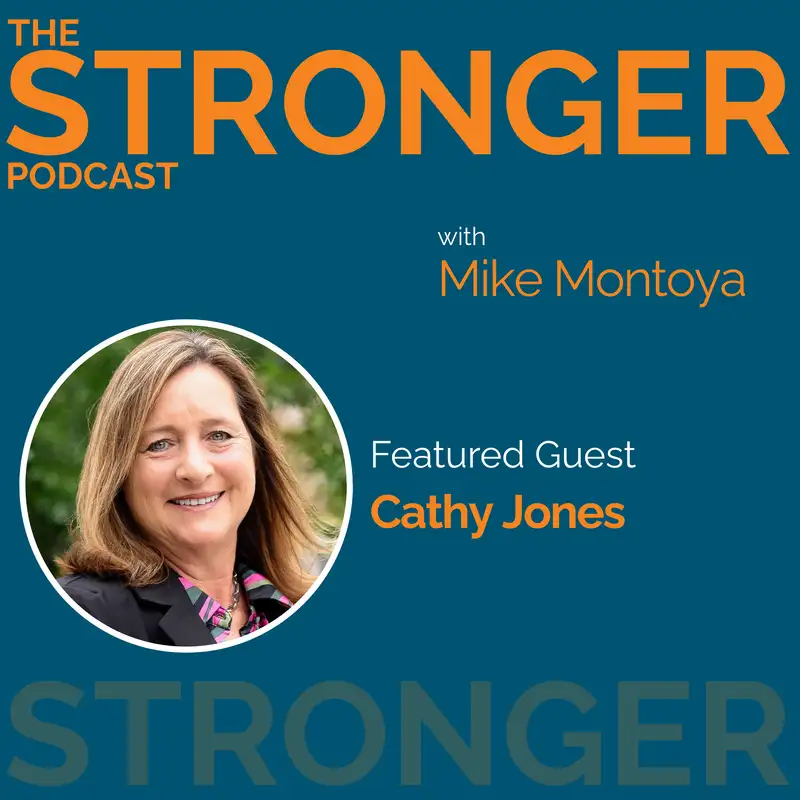
Test Scores Aren’t the Whole Story: Rethinking Accountability and Impact – with Cathy Jones
Mike Montoya: 00:00:00 - Welcome to the Stronger Podcast. Each week we have honest conversation with education and social impact leaders about their leadership and career journeys. We talk about their origins, inflection points, and the work that they're doing today. The conversations are honest, human, and practical. If you're here for real stories, and real takeaways, you're in the right place. Let's jump in and let's get stronger together.
Mike Montoya: 00:00:30 - Hi, it's Mike, the host of The Stronger Podcast. In today's episode, I'm talking with Dr. Cathy Jones, the CEO of the UP Partnership in San Antonio, Texas. UP Partnership is a backbone organization aligning more than 120 partners around the future ready plan for Bexar County. Together, they're working toward an ambitious goal ensuring that 70% of the county's 500,000 plus young people are on a meaningful post-secondary pathway by 2030.
Mike Montoya: 00:01:05 - We'll get into what it really takes to coordinate districts, nonprofits, and funders and systems so that young people don't just have services, but they have real choices and opportunities in life. Before we dive into today's conversation, I want to give a quick shout out to podcastmatter.com. Their mission is to help impact driven voices get the visibility they deserve. If you want to share your message with the world, check out their website in the show notes. Good morning. Thank you, Cathy, for joining us. It's really great to see you this morning. How's the week been going for you?
Cathy Jones: 00:01:45 - It's been a great week. We've been very busy and very productive.
Mike Montoya: 00:01:55 - And when you say we, who is the we? I understand that you're a new leader of an organization that we've worked with for a little bit and excited to have you here. So tell me about how you got into this gig at UP Partnership in Texas.
Cathy Jones: 00:02:15 - Yes. So the collective we is UP Partnership. We are here in San Antonio, Texas. And UP Partnership is a nonprofit that functions as a backbone network of support for right now about 120 partners throughout the county and we are supporting this really amazing initiative called the future ready plan.
Cathy Jones: 00:02:45 - It spans all across Bexar County which has about 550,000 youth and so our goal is to help ensure that at least 70% of the youth in Bexar County are in a post-secondary enrollment experience either at local college or university or a certification program by the year 2030. So that's the collective we doing this work.
Mike Montoya: 00:03:15 - So it is a bunch of partners like school districts and other kind of youth serving organizations, and probably also philanthropy and contributors, right, part of the whole gig. And you have this vision of 600,000 kids—it's not a small number; it's a lot of humans going through the experience. Did you like just happen into this work? I know a little bit of your work history, but you've been doing youth focused work for a while. So, tell me a little bit about like the last couple of roles you've had. Let's just start with there and we'll go back a little bit from there.
Cathy Jones: 00:03:50 - Okay. My whole career has been serving youth. Most recently, I was the executive director of a nonprofit in Austin, Texas, and we served the Austin Independent School District and worked with about 2500 students every week in the Austin school district. I did that for 13 years, but I actually just kind of fell into the nonprofit work a little bit by accident, a little bit by luck.
Cathy Jones: 00:04:30 - I think I had previously always worked for a school district and so had been a teacher, assistant principal, human resources, administrator, and then ultimately an assistant superintendent in a fast growth school district just outside of Austin. And I just kind of lucked into this job. It was kind of a series of fortunate events that led me to this.
Cathy Jones: 00:05:05 - But, you know, it was just it was really difficult working for the school district in terms of legislative mandates coming down, accountability testing and accountability measures that were pretty intense and really harmed the student population that I had always worked with. And then just budget cuts and budget constraints. And so it got just increasingly difficult to really have positive outcomes for our students and our community with all the constraints that we found ourselves in.
Cathy Jones: 00:05:45 - And so it was kind of one thing led to another and this opportunity to work at a nonprofit came up and I was like, "Okay, yeah, I'll do that." And it really was very liberating. It was just something magical about being in the nonprofit space that still very much filled my bucket in terms of what I wanted to be doing as a professional, but also just as a human being and making a difference, a positive difference with students and with their communities. And so, yeah, it's been 13 years that I didn't expect in that space and then this opportunity to come to San Antonio and really expand the work to a countywide regional level. So, that's been very exciting.
Mike Montoya: 00:06:40 - So, multiple school districts now in San Antonio that are sort of like partners in this work. Maybe let's go back to the liberating piece. You mentioned that word. I love that word because it's like such a powerful image, right, to sort of be free from some of the things. And what I think I heard is about how public school systems have a lot of responsibilities and commitments and then also very much resource constrained in many cases.
Mike Montoya: 00:07:20 - It becomes almost impossible to navigate both all the desired outcomes as well as make it possible with the dollars you have. Are there other things about the public school systems that you're like, hey, this is hard work on their part and it's nice to be partnering with them versus right inside the system?
Cathy Jones: 00:07:45 - Yes. Well, and I worked for the public school systems for 21 years of my career, 14 in Austin and seven in Manor ISD. And yeah, it's the hardest work I've ever done in my career. And again, when you are measured by the scores on a test from your students who have been a marginalized community, a marginalized population, an underresourced community, even though we might have made double-digit gains on those accountability assessments, we still were not where we needed to be.
Cathy Jones: 00:08:30 - Unfortunately, that is often front page news for the public and now in Texas, we rank our schools A through F, which is a really difficult environment to be in when communities and parents believe their schools are failing, when there's often just so many other good things happening that aren't measured by that assessment or by that grade. So, yeah, I think those things make it really difficult and can make it hard for those of us who really care about the whole child to continue to engage in that system that is, in many cases, harmful to students.
Cathy Jones: 00:09:15 - And so going into the nonprofit world, it was very liberating. I call us the icing on the cake, right? The school districts are doing the heavy lifting again, all the lesson planning, the meeting with parents, all the differentiation of instruction, and making accommodations for 504 plans. It's so many things that school districts and teachers in the classroom have to do to provide the foundation.
Cathy Jones: 00:09:50 - As a nonprofit, we get to come in and be the extra on top of all of that. We get to bring in often more interactive and engaging and fun type of activities. We did an amazing job of engaging the community and bringing in thousands of volunteers every week to work with the students and really helping students know that there were other caring adults out in the community for them and other people that look like them in these professional careers.
Cathy Jones: 00:10:30 - So making sure students had additional caring adults and mentors showing up for them on a regular, weekly basis was really such a rewarding experience. It really filled my bucket to be in that space and to see how can we be a value add on top of what school districts are already providing and where can we fill gaps. And then ultimately in my career, where can we really measure impact and help school districts see that nonprofit partners can really help them move the needle in some of the metrics that they're being held accountable for.
Mike Montoya: 00:11:15 - Yeah, I love that idea of partnership and you kind of walked right into my own history with this work myself. My personal story is like I had okay schools and some great teachers and then like a bunch of okay teachers and I worked really hard but most of my development was happening in these non-school related kind of entities and programs like I was a Boy Scout and I was a swimmer and I was part of my church leagues. Those elements were like part of the glue that kind of held me together as a person, and school was there but it was focused on the subject learning.
Mike Montoya: 00:12:00 - But the developmental things are really happening in these other spaces. I think that's part of why I love the partnership work because it's really about how these two things work together or can work together. So, it's exciting that you're on a similar journey as myself. It fills my cup because it does feel great when you see like little sparks go off in kids' experience and they start to pick up on, "Oh, this is something I can do as a career." Then everything else is easy because once they're turned on, they can just go. Most great educators are like hey I want to turn that light on for kids.
Mike Montoya: 00:12:45 - Do you feel like there are sufficient resources happening around children and families in San Antonio now? I know you're sort of new to the space directly but I know you're getting familiar with it. So, give me your thoughts about that.
Cathy Jones: 00:13:05 - Well, I think need is universal. I think there's always more need than there are resources. That's just kind of the state we're in as a nation. The needs far outweigh the resources that we have readily available. Beyond that, it's also making sure we get the right resources in the right places at the right time. That can also be very complicated due to bureaucracy and the different layers that systems have in place that we have to navigate around.
Cathy Jones: 00:13:45 - I do know here in San Antonio, the city has a deficit budget and several school districts in the area have deficit budgets. There are a lot of school closures happening throughout San Antonio and Bexar County for various reasons. In the state of Texas, we're a little unique in our school finance funding system. Some people refer to that as Robin Hood, where wealthier districts give money to support the smaller, less wealthier districts.
Cathy Jones: 00:14:25 - I think those of us who are on the sidelines watching this see that as problematic and something that could be improved upon moving forward. We don't believe our public school systems are being funded adequately and that really puts the onus back on the school district to be creative to come up with that additional funding. I don't know how else they can do that other than increasing their attendance and that's where partners coming in can help improve attendance or behaviors so that students are in school more.
Cathy Jones: 00:15:10 - I will say we've been so fortunate in San Antonio around this future ready plan in that we have some incredible funding partners helping us fund this work through 2030. As long as we continue to meet the milestones along the way there will be a big influx of resources in terms of money which we then translate into whatever resources need to look like, capacity building, professional development, training, or creating new positions out in the school districts to support their needs. I think we're very fortunate right now with this future ready plan and all the partners we have supporting and funding this work for us to truly make a difference and really help lift all youth in Bexar County.
Mike Montoya: 00:16:10 - So the partnerships are working collectively towards this 2030 goal, and this plan has got some funding of additional non-public resources. That's part of the leveraging of the experience. This backbone idea is really about making sure that there's an agency or agencies coordinating and collecting as well as monitoring and milestoning the pieces that are necessary in order to get kids to move in the right kind of positive direction.
Mike Montoya: 00:16:45 - Lots of times when there's not a backbone, it's just disconnected. There's lots of moving parts, but they're not aligned in a very cohesive manner. Places like the UP Partnership are intended to bring some cohesion. Is that fair?
Cathy Jones: 00:17:10 - Yes, absolutely. In the early stages of this, we've had two years since original agreements and MOUs were executed, but really it's about saying who's coming to the table and also coordinating those partners to make sure they are talking to each other. We also don't want to have duplication of effort and I think in a city as big as San Antonio, there's going to be overlap and duplication. Also, there's some areas of town that are a bit of a desert that don't have a lot of partners coming in and engaging.
Cathy Jones: 00:17:55 - How do we get partners to talk and organize them to make sure we're aligning around these goals and executing in a way that is showing impact? Are we aligned and are we seeing impact? Where are we seeing impact? How do we then double down our resources in those spaces? Now we're also in a place where we can be identifying gaps across the spectrum here.
Cathy Jones: 00:18:35 - Again, where might there be a school district that's not getting college advising support or helping with access to dual credit? Some districts may not have very many teachers that are eligible to teach or have the credentials to teach dual credit. What can our role be in helping move that work forward and making sure resources are available for teachers to get that certification and credentials so that they can teach dual credit in their own school district?
Cathy Jones: 00:19:15 - That allows students the opportunity to start taking those dual credits while in high school which we know is a game changer for whether or not students persist and complete a post-secondary credential. It's all connected. It all starts with just coordination, organization and alignment which is complicated.
Mike Montoya: 00:19:40 - It is complicated because humans are involved and systems and bureaucracy are involved. There's sometimes a little tiny thing you need to do, which is like increased certification for post-secondary supports and then 30, 60, 90, 120 kids get opportunities that they didn't have. Those are real lives. I like to think about what would happen if all kids had those choices and opportunities that some kids get.
Mike Montoya: 00:20:20 - Is there a piece and a passion? At the core of you, is there like a drive somewhere? I'm trying to understand kind of what's the DNA inside of you that's helping you be committed to this work.
Cathy Jones: 00:20:45 - Yeah. Well, it started young. I always loved school and learning and had some teachers that I really loved and admired and just thought, "Oh, I would love to be a teacher someday." But I am the first in my family to go to college and get a degree, so that wasn't necessarily talked about much as growing up. So I will just say from my own lived experience, getting a college degree was life-changing for me and opened the door to so many opportunities.
Cathy Jones: 00:21:25 - I grew up very poor in a very small rural town and there just weren't a lot of resources. There wasn't anyone really pushing me to go to college or do something beyond high school. For me, education was the game changer. I have seen that it truly is the greatest equalizer; it opens the door for opportunities that were not there for me or members of my family prior to that.
Cathy Jones: 00:22:05 - When I did become a kindergarten teacher, I loved it. I would do it for free if I could afford to. It was 10 years of my life that just really filled my bucket and made my life feel so meaningful. Kindergarten was so wonderful because you make sure they are starting off on the right foot as a 5-year-old in this system.
Cathy Jones: 00:22:45 - The spark within me was like, oh wow, if I can do this with 22 students in my classroom, how cool would it be to be an assistant principal or principal and have a positive impact on a whole building? That's when I went and got my master's degree and became an assistant principal. Then again, it was like, well, wouldn't it be awesome to be a superintendent of a whole district? So that's what inspired me to apply to the University of Texas in Austin and get into the cooperative superintendency program.
Cathy Jones: 00:23:30 - I was on the path to be a superintendent and was an assistant superintendent for several years in that fast growth district. It was very fulfilling work but it was also just very hard for me to manage that job where you were on call 24 hours a day, seven days a week in a small district. It was hard as a wife and a mother of two young children to manage that. Even though my career aspirations in the early 2000s were to be a superintendent, other pieces of my life said that that's not going to work right now.
Cathy Jones: 00:24:20 - I needed more time with my own children. My own children were getting old enough to say, "Mommy, you're never home. You're always with other kids." It started to gnaw at me that I needed to carve out more time for my own children. It's kind of a sad story, but one time on my daughter's soccer team, they didn't think she had a mom. They thought she only had a dad because I'd never gone to practice.
Cathy Jones: 00:25:00 - When the coach met me, he said, "Oh, we didn't know she had a mom." I just went to the car and cried. I had to reshuffle some things in my life so that I had more time for my children. Being on the path for the superintendent was not going to allow that. So by a stroke of luck, I landed in nonprofit. It provided more of a work-life balance for me and enabled me to bring my children to different things we were doing and have them be more involved. I was able to find more balance and really be more of a mom for my own two kids.
Mike Montoya: 00:25:45 - I'm going to pause the conversation here for just a second to talk about Books That Matter. Every entrepreneur or leader needs a book that elevates their business, builds their credibility, and makes an impact. If you've got more money than time, a ghostwriter can help you build your story. If you've got more time than money, a great book coach can guide you step by step through the writing process. Head to booksthatmatter.org and get the custom support you need.
Mike Montoya: 00:26:25 - Well, thank you for sharing that part of the story because I feel like lots of times we don't go into the actual humans behind the work. There is the public life in the roles of being a teacher or school leader where there's a lot of demand on your time. That realization with your own children is an important one. Let's talk about women in leadership for a little bit because I want to hear your perspective on how you think about it.
Mike Montoya: 00:27:00 - There's one piece of culture where you can have it all, and another is that you have to balance these things. I'd love to have your perspective on women in the workforce and how they can kind of do two things or multiple things if they want to.
Cathy Jones: 00:27:30 - Right. Well, I really appreciate that question. It's a perfect segue into what my dissertation was about actually. In my PhD work at the university, I was looking at women in leadership and specifically women who were middle school principals. I followed for a semester a campus principal from a rural, suburban, and urban school district and just documented their stories.
Cathy Jones: 00:28:10 - One thing is that women are expected to do it all—be a great mother, wife, do the grocery shopping, laundry, and make meals. I'm talking about 20 or 25 years ago when I was doing this research. I do believe things have gotten better. I do believe we've shifted out of some of those stereotypes that were harmful. I think we were expected to do it all, and if you couldn't, then it was your career that needed to go by the wayside while you raised your kids.
Cathy Jones: 00:28:55 - A lot of people choose to stay home, but I was the breadwinner in my family, so that was not an option for me. What my research showed was that women leaders were absolutely very nurturing and caring and they also carry the stress of leading their staff and problems at school. They take that home with them. Stress levels were high and we saw things like physical hives because they were having a meltdown or a really difficult time.
Cathy Jones: 00:29:35 - Because women tend to be nurturing and caring, we hold a lot of that with us, which comes out physically in terms of other physical ailments and mental health and wellness issues. Interestingly, one of my principles felt like she could not have children of her own because she just could not give up the time from her job. So I feel like those are really big things that women as leaders grapple with.
Cathy Jones: 00:30:15 - It's real and I do still think there's a glass ceiling. I think we've cracked it a little bit, but when you look across the nation the number of superintendents is still predominantly male. When you look at leadership roles, they still tend to be predominantly male. So we still have some work to do.
Cathy Jones: 00:30:50 - I do think women leaders bring a lot to the table in terms of compassion and nurturing that add to other skill sets like being smart, thoughtful, and making tough decisions. I would love to see more women in leadership roles and I always try to support and mentor women that are coming up. Your success is our success but I think we still have some work to do.
Cathy Jones: 00:31:30 - We've come a long way in terms of some of the stereotypes in our society. I love that many men are equal partners in parenting children or doing grocery shopping or cleaning the house. It is a true partnership and I think those are the healthier relationships. But I just think it's been a hard place for women to get into leadership.
Mike Montoya: 00:32:05 - It's taken a while for us to bend the curve as a society to accept women as having both the capability and potential to do these roles. I still run into it with some of our executive search work where they ask why we have a slate of nine men and two women. That's what the field has produced so far because women are forced to make hard choices about family and are often not given the space—it's almost like you get to do three jobs at once extremely well.
Mike Montoya: 00:32:45 - It's just crazymaking and it's an unreasonable thing to expect women to be loaded up like that. I see the physical stuff you talked about a lot; people are not healthy mentally or physically because they're overloaded. You talked about mentorship for women. Is there an individual in your mind that you've seen blossom as a result of some of the work you've done with them as a mentor?
Cathy Jones: 00:33:20 - Oh, yes. There's several people that come to mind over my career and especially my last role in Austin overseeing a nonprofit. I was in that role for 13 years and saw so many people fresh out of college in their first professional job. To bring them into the organization and lift them up and offer coaching to help them grow has been such a rewarding experience. I used to refer to them as little birds in the nest and at some point, we want them to fly away.
Cathy Jones: 00:34:05 - A lot of them go get a master's degree or go to law school or move up in ranks for a promotion. Certainly some of the directors that reported to me, I enjoyed giving them new things to help them grow and new opportunities. In our organization, we were trying to send folks through the Leadership Austin program. I felt that was a great opportunity to help people grow and see beyond just the educational landscape.
Cathy Jones: 00:34:45 - When people left for a promotion, I was always so proud and would tell them they aren't burning a bridge. I want you to go to the next big thing. It was so rewarding to watch them grow and I've had so many talented people coming in and out of my life and just doing what I can to help them learn and grow and be prepared for the next step.
Mike Montoya: 00:35:20 - I just want to say that if you're a leader, entrepreneur, or business owner who needs support, there's an easy way to get a think tank behind you. The Genius Discovery program at Thought Leader Path is like having your own one-on-one incubation and accelerator program. They'll help you develop an approach based on your own story and offer the tools needed to really amplify your message, including launching a podcast like this one. Check out geniusdiscovery.org.
Mike Montoya: 00:36:00 - I can imagine that one of the best things about this work is the opportunity to support people to be successful besides just the children. Being able to say I want you to do your job really well and then go on to the next great thing that inspires you is magic. Leadership development is a constant necessity because people don't always have good pathways. When leaders allow for that and make space for it on their staff, the impact has a ripple effect.
Mike Montoya: 00:36:45 - Do you feel like you have enough support from the boards you've worked with to accomplish these ambitious goals? Does the board function well enough in a way that's going to help you be successful as a leader with your team?
Cathy Jones: 00:37:10 - I think there's always room for growth. I've been very blessed with the two boards I've worked with in the nonprofit space, with amazing human beings who believe in the mission. What was similar with my last role and my current role is we have very high level people on our board, like CEOs of companies and nonprofits, presidents of universities, and superintendents.
Cathy Jones: 00:37:50 - While that is amazing to have such expertise and influence, it's a slippery slope because those exact same people have very little time to invest or engage in a really deep way. That is where the struggle is. As either the executive director or the CEO, it's my job to figure out how to keep the board engaged in a meaningful way in the easiest way for them. I meet them where they are, doing meetings at a time that works for them.
Cathy Jones: 00:38:35 - I text them or call them in between meetings so we stay connected. I know they care about the work or they wouldn't be on our board. Just finding the time when you have such high level people has been a challenge. Sometimes it's an early morning breakfast or an 11 p.m. phone call. I just try to find what works best for different board members and get to know their personalities and communication styles.
Cathy Jones: 00:39:15 - We are about to do some strategic planning, and putting more meetings on their calendar is an unrealistic expectation. So how do you find a win-win where my team is getting information and support but we're not taxing the board and their schedule? It is a delicate balance. I do feel all boards benefit from some training and strategic planning. We get so busy doing the work that we forget the board needs updates or retreats.
Mike Montoya: 00:39:55 - You were talking and I felt like there is a parallel thing going on here with meeting people where they're at. We do it with kids and that's one of the best practices in youth development work, to help them grow from wherever they are. With adults, thinking about how you meet call-in demand humans who have a lot of responsibility on their plate is similar. The early morning breakfast crowd happens a lot.
Mike Montoya: 00:40:35 - Great leaders find ways to navigate that and make it possible for people to participate in ways that are really powerful. It does open up doors once you get people aligned and coordinated. You might have learned it as a kindergarten teacher, hurting children in the right direction.
Cathy Jones: 00:41:00 - Well, and in my previous role where I had 13 years to work on this, we implemented a mentoring system where new board members were assigned a mentor from the board who had been there for a while. We built out some expectations around that and there would be a check-in before every board meeting, whether that was a meal together or a phone call. That meeting was between the board members and didn't involve me.
Cathy Jones: 00:41:40 - I felt there was another level of expertise sharing and buddying up to help that board member feel comfortable asking questions. They might be embarrassed to ask something of me that they feel they should have already known. Having a mentor between board members was really impactful and effective. They were buddied up for a full calendar year and all the different seasons of our work.
Cathy Jones: 00:42:25 - We always got positive results from that. When you get into the board meeting, that's a pretty formal space with a packed agenda, so there's not a lot of time for discussion and question asking. You need to come in prepared having reviewed documents. Relying on other board members to lean in really made a remarkable difference.
Mike Montoya: 00:42:55 - That's a great idea, the board buddy thing. It gives the nonprofit leader the space to not have to be responsible for every single piece of that experience. I know CEOs often get bogged down with the monthly board meeting cadence; it's a huge job to produce a meeting of 25 people every month. It's super smart to distribute it. Let's shift gears. Tell me a little bit about Cathy, who is this human right now.
Mike Montoya: 00:43:40 - Give me a couple of vignettes from your life experience outside of the work that have been rewarding as a person. Things that you're like, "Oh, I'm really proud of myself" for having had these experiences as a person. Anything you'd like to share?
Cathy Jones: 00:44:05 - Thank you for that opportunity. I am very proud of being a first-gen student and having made it this far. No one in my family would have expected me to have an advanced degree. I never even really knew what a PhD or a doctorate meant and was able to achieve that. I'm wired to be an achiever, so it makes sense I was able to do these things.
Cathy Jones: 00:44:45 - But to come out of the zip code I was born into, you would not have predicted I would have landed here. Moving to Austin was a big step from a small panhandle town. I loved everything about it and spent 36 years there. After my two kids were grown and out of high school, you have that time in your life where you're entering another season or chapter. What might that look like?
Cathy Jones: 00:45:30 - I am proud of myself for taking a risk and seeing what else was out there after 13 years in my previous job. I could have stayed there and retired, but I was ready for a change. I'd actually been really prayerful about it for about two years. What is the next calling on my life? I was open to going wherever that led.
Cathy Jones: 00:46:10 - To leave Austin after 36 years, sell my house, move to San Antonio, and start a new chapter is not for the faint of heart. I am doing it at 59 years old. It has been so rewarding. It's a fresh look at my job and the work I'm doing. Meeting all new people and friends. I'm searching for my new church right now as well and getting to know this new community.
Cathy Jones: 00:46:50 - You may not realize you're in a rut until you push yourself out of your comfort zone to say, "What's next?" The calling is certainly there for something more and a new challenge. I haven't had a lot of downtime but I enjoy exercising and I'm going on a snowboarding trip with my children over the Christmas break. Yes, at 59 years old, I will be on the slope on a snowboard.
Cathy Jones: 00:47:35 - That alarmed some people but I'm doing this; this is life and I'm living it. I'm so grateful for all the opportunities in the last year and to be in this new phase of my life. There are days it's overwhelming and intimidating, but you just have to lean into that. Everything I've done in my career and life has prepared me for this moment. I can do all things and the sky is the limit.
Mike Montoya: 00:48:15 - That's amazing, Cathy. Thank you so much for sharing about yourself. I want to follow up on the snowboarding trip in a few weeks because that's one of my own passions. San Antonio and the UP Partnership team are lucky to have you. It's wonderful that you joined us to share your story this morning. We deeply appreciate people in this work for the long term.
Cathy Jones: 00:48:55 - Oh thank you so much. Mike, this has been fun.
Mike Montoya: 00:49:05 - I'm so grateful to Cathy for sharing her personal story. From growing up in a small rural town as a first-gen college kid to stepping off the superintendent track to be more present with her own kids. At 59, she's taking exciting risks to move to a new city and start a new role. Her journey is a reminder that the people leading this work are human and that women in leadership still face real trade-offs.
Mike Montoya: 00:49:45 - If Cathy's story resonated with you, take a moment to reflect on where you're being called to grow. Thanks for joining us and tuning in today. To find out about other podcasts that matter, visit podcastsmatter.org. Thanks for listening to The Stronger Podcast. If this inspired you, share it with someone on a journey to become a healthier version of themselves. See you next Thursday, 9:00 a.m. Eastern time. Stay strong.