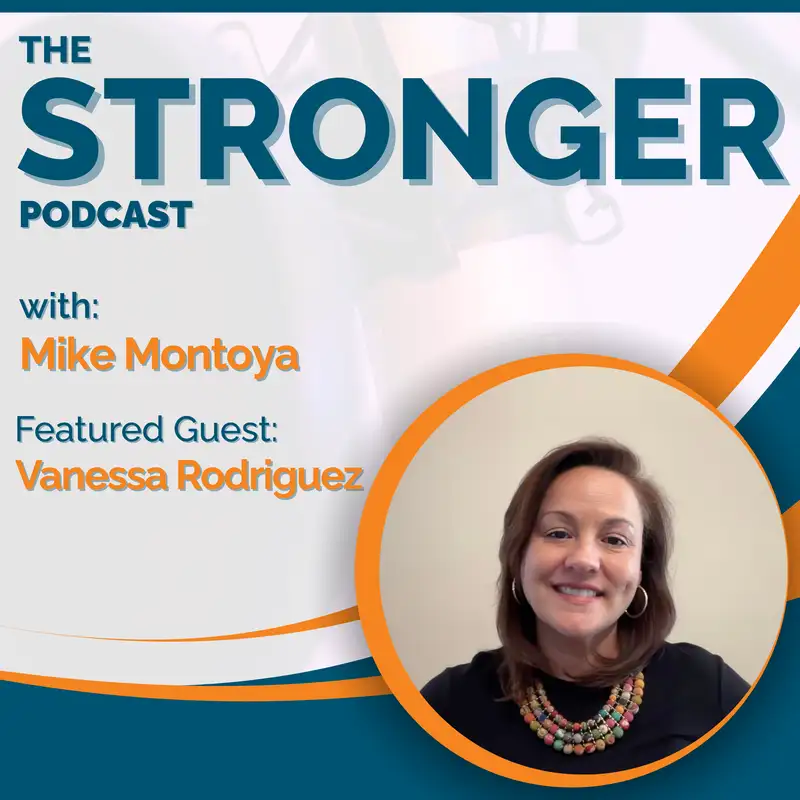
Stop Grinding and Start Sustaining: What Education Leaders Actually Need to Last with Vanessa Rodriguez
Welcome to the Stronger Podcast. Each week, we have honest conversations with education and social impact leaders about their leadership and career journeys. We talk about their origins, inflection points, and the work that they're doing today. The conversations are honest, human, and practical. If you're here for real stories and real takeaways, you're in the right place.
Mike Montoya:Let's jump in, and let's get stronger together. Today's guest is Vanessa Rodriguez, Executive Vice President from the Pahara Institute at Lone Rock. Vanessa shares a powerful story, from her parents moving from Puerto Rico to Hartford, Connecticut for better opportunities, to navigating school as a Spanish speaking child, and how that journey helped her find her voice and commit her life to expanding opportunity for young people. Let's jump in. Before we dive into today's conversation, I want to give a quick shout out to podcastssmatter.com.
Mike Montoya:Their mission is to help impact driven voices get the visibility they deserve. If you want to share your message with the world, check out their website in the show notes. Good morning, everybody. I'm here with Vanessa Rodriguez, who is a I won't give you her whole title and story because you can read about that in our show notes, but we'll talk about that today. But Vanessa and I met probably, I don't know, twenty ten ish, right?
Mike Montoya:A little bit ago in our lives. And so we were just enjoying the fact that I call it smarter, wiser, and I think better looking than we were when we were ten years ago. I celebrate that between the two of us. Vanessa, thanks for being here.
Vanessa Rodriguez:Thank you for having me. I'm excited to have this conversation.
Mike Montoya:Can you start us off in just helping people to center like where on the planet you are and kind of like where maybe your roots are from? That would give us a sense of like, hey, this is the sprout and the tree that you come from.
Vanessa Rodriguez:Roots I come from. So I will say, Soy Boricua. My parents were born and raised in Puerto Rico and came to the Mainland because they wanted my brother and I to have a better education and better opportunities in life, and they felt like we would get it here. And so little did they know when we landed in Hartford, Connecticut that, yeah, the education system And isn't great in lots of so I ended up, you know, going through lots of different school experiences, but that's what put me on the path to wanting to work in education. And I'm now in New York City, and I've been here for most of my life because I came here to teach through Teach For America.
Vanessa Rodriguez:So that's where I am today.
Mike Montoya:So you came as a kiddo from the island to the mainland, as we call it, and in Hartford where it's also freezing. Cool. Schools, I mean, as a kid, did you know schools are kind of weird or screwy? I mean, did you figure that out? Were the kind of messages or the pieces that stood out to you?
Mike Montoya:Like, this is crazy.
Vanessa Rodriguez:Yeah, well, my first language is Spanish. And so I distinctly remember, literally, I was having this conversation with a good friend recently, about, how in first grade I would answer in Spanish all the time. And my teacher would then, when I did that, she would make me go stand in the corner and face the wall because she wanted me to answer in English. And so that was like a big introduction to like, what is happening? Like, what is wrong?
Vanessa Rodriguez:But that did define like a lot of me, spending a lot of my, I think childhood, like being quiet, not feeling my, that I had a voice. And so it was a journey for me to find my voice and to feel like I could be a leader in the work.
Mike Montoya:So you picked that up as a kiddo. Funny, the era right before when we were kids, probably they used to smack you on the hands with a ruler. And also not so many happening in our country. I feel like we still have attention, maybe not as much in schools in New York City than in region, but they're still like, this is the right way to speak and be and assimilate and all that kind of stuff, right? It's still like a component of our society.
Mike Montoya:You feel like you still notice and witness that in some of the work that you're doing? Is it still a prevalent concept going on?
Vanessa Rodriguez:I think there are small areas where, yes, that definitely exists. I mean, I think we all still hold biases in our work. And so I think that shows up in different ways and in different places. I also feel like I work with a lot of leaders and I know a lot of leaders who create really positive experiences for young people. And so that to me is motivating, it keeps me in the work, and it's exciting to see that we're creating better opportunities for kids who are like me.
Mike Montoya:Yeah, that's great. And, yeah, I appreciate you sort of twisting to the asset based kind of concept, right, because there are like all these amazing things happening that we don't know about necessarily. I had a conversation with Daniel Velasco, who does work with multilingual learners. There's an enormous number of schools and school systems that are doing great work intentionally with kids that don't speak English first language, Which was great. So I think I had a similar experience.
Mike Montoya:I was not a Spanish speaker, but my parents forbid us to learn it basically because they didn't want any of that stuff, like the baggage that came with it in the 70s and 80s to be on our backs. So we were like, no Spanish. They wouldn't let us take Spanish in school. It was just like a whole thing, which I regret, of course, well. But I appreciate it at the time.
Mike Montoya:I'm like, oh, they're trying to protect me, I think, which is Yeah. Sure. Okay, so now you've gotten to Teach For America. And you've had a storied career. You've worked a lot with kids in schools in the New York City Metro Area.
Mike Montoya:Right? So New York City public schools is enormous, right? There's like a million kids, right? There's also districts that I know that the work in District seventy nine was like an anchor for you though. So tell people a little bit about that school district and like kind of what some of the work was there.
Mike Montoya:Think that's like an under discussed population for sure.
Vanessa Rodriguez:Yeah. I mean, that work that we did, I was there seven years and I loved it, loved it. We worked with under over age, under credited young people across the city, so it was across all five boroughs. And what that means is that young people who are on a different path and not like the usual high school path, So they are either going through GED programs, they've either been incarcerated or in suspension centers. We have a lot of detention centers across the city.
Vanessa Rodriguez:Or they're parenting teens, so they had to take time off and they came back. Or they left and came back as an adult. Right? So it was, I think at the time that I started D79, we had like across the five boroughs, 40,000 students that we were responsible for.
Mike Montoya:Wow. Okay. There's a lot of people. Yeah,
Vanessa Rodriguez:And you know, the work was really focused on how do we ensure that they either complete high school, even if it's a fifth year, with a fifth year, or they get their GED so that they had access to other opportunities, whether that was work programs or college. Because
Mike Montoya:not having a completion certificate of some sort is really a barrier to people.
Vanessa Rodriguez:Yeah, limits your opportunity. Any
Mike Montoya:job that is not just a service level type of thing. Absolutely. Yeah, so I feel like places like District seventy nine were way ahead of their time, I mean, in some place because of need, but also because they actually managed to find great ways to get kids the credit that they need to get through the process. A lot of places don't have any system around that. I was talking to folks Houston, they're like, we're still building that shit.
Mike Montoya:And I'm like, okay. Yeah.
Vanessa Rodriguez:We came up with some like critical things. Like we created referral centers. So they were like hubs in each borough where young people or their parents or families could come to get resources and support and identify, okay, what's my next step? What should I be doing if I've been out of school for a year and I want to come back? And so those referral centers, they're still in place.
Vanessa Rodriguez:They have been critical at really giving young people and families an opportunity to access what's available and to feel like they're supported. So they're staffed by teachers, but they're also staffed by social workers and other folks in the system who understand what it means to try to work the system to get what you need out of it. So it's been that was really, I think, one of our best actions as we were there doing that work and one of the things I'm most proud of.
Mike Montoya:Yeah, for sure. The navigating the complexity of public support, right, is like you need multiple humans that are really skilled at doing it because the bureaucracy can be daunting, especially if you're doing other languages and things like that or your parents aren't available. It's a problem.
Vanessa Rodriguez:Absolutely. It's completely overwhelming otherwise. Yeah.
Mike Montoya:Yeah. I'm like, I just got my driver's license, and it was like a thing.
Vanessa Rodriguez:Oh, I'm sure, right? All the steps, all the forms you need to complete, that in itself is-
Mike Montoya:Like print out your bill. I'm like, what bill? Print what? So, I mean, this is like, I'm sort of diminishing the complexity, I'm trying to keep it a little bit lighter. But like it's- Yes.
Mike Montoya:We all have things to navigate, but it's really hard, right? It's real stuff. And those kinds of things can really hijack a whole life, Yes.
Vanessa Rodriguez:It can deter people from wanting to complete their education or come back. For
Mike Montoya:sure. Kids can get discouraged, but they also have incredible resilience, right? I mean, almost like if we can get out of their way a little bit more.
Vanessa Rodriguez:Exactly. Yes, absolutely. It's always the adults who stand in the way of kids being able to flourish.
Mike Montoya:It's very true. I feel like sometimes if you could just put them in the space and let them go, they keep them safe kind of things, a really kind of fundamental component. One trains people for that kind of work, right? Maybe social work school trains for some of that stuff, right? But educators are not necessarily trained specifically to work with special populations of kids that are not the typical kid going to a typical school.
Mike Montoya:In terms of leadership and growth in those times, what were the things that you relied on to build the skills, build the capabilities that you helped to be successful?
Vanessa Rodriguez:Yeah, I mean, I think some of the things, well, actually, a lot of it was just coming from the classroom teaching, like what you do in the classroom, right? Like, you have a good plan, right? You figure out what's working, what's not working, you assess it, and then you create a plan around it. And so when we entered District seventy nine, one of the things I did first was, look at staffing, who are the people that were there and how effective were they, how long were they there? And so, you know, like things like that really helped create plan for us to execute against, but to also really create a culture and an environment that was focused on the values that we wanted to ensure were embedded in the district, but also the goals that we wanted to meet for young people and the type of experience we wanted our young people to have and the opportunities we wanted to create for them.
Vanessa Rodriguez:And so we spent a lot of time that first year assessing what was working, what wasn't working. I spent a lot of time talking to young people and hearing directly from them their experiences and what was difficult, what was helpful, what was successful. And then we just executed as quickly as we could against that.
Mike Montoya:Yeah. I mean, what you just described in situation is basically what we think about strategic planning, right? Is like listening to the paperwork, making sense of it, sort of choosing your goals, right? And being really clear about those things and then mapping your way towards that and then doing it consistently.
Vanessa Rodriguez:That's absolutely right.
Mike Montoya:And so, I think a lot of places seem like it make it more complicated than that, but it really isn't. Mean, there are a lot of there's a lot of steps and a of technical kind of things happening in the pathway there. But the process of listening, making sense of, and setting goals based upon achievable things, right, is
Vanessa Rodriguez:Yeah, and building a team that is values aligned and goals aligned and is clear about what the imperative is at that moment. And so I think we were fortunate to attract great talent and people who really cared about this population. This population really reminded me of where I grew up, my cousins, my peers, the opportunities that some of us had but others did not. And so, yeah, I think we really brought together a strong team of people who really cared deeply about this population and creating the opportunities that they deserved.
Mike Montoya:So I'm going to pull on this thread a little bit, right? You referenced kind of like where you're from and some of that familiarity, like lived experience in some cases, right, with friends and family or people that were close in your neighborhood, etcetera. Like, does that add an extra dose of motivation and commitment? I mean, did you find that in your folks? I mean, that's almost like you were looking for that in your talent that you were bringing into the system.
Vanessa Rodriguez:Yeah. I mean, definitely. Like, it definitely motivated me. I I went into education because I wanted to create better opportunities for young people, but particularly because I saw the impact of not having those opportunities, what that meant for for my community. And so in the work that I've done, that has always been a motivator.
Vanessa Rodriguez:It still is today. And, I would say when we were hiring, I think it's the like, what grounds you, what motivates you, what moves you, what values do you hold. I think that was definitely a huge part of our interviewing folks and bringing folks to the work. It's like, what what is that motivation? What is that like drive to support a population like this?
Vanessa Rodriguez:Because it can't just be, I need a job. The work is too hard. It's too hard to just like want to do.
Mike Montoya:You can't just come in and kind of push one thing to the next. Right? You need to actually figure stuff out and and like it requires a lot of brain power and lots of extra time, right? Oftentimes, yes, in some cases, right? And I want to, you know, Vanessa and I'll list for the audience, Vanessa and I are both talent people, basically.
Mike Montoya:I'll claim it for myself at the core, right? Like, we listen and pay attention to the humans that are doing the work and what kinds of ways that they show up and skills that they develop and call it motivations they have. It's hard to measure motivation and commitment during an interview experience. Do you have a trick or two that you're like, Yeah, this is how I get to it. Because I think a lot of people in our space are like, Yeah, we know it matters, but we have a hard time identifying it before we know people.
Mike Montoya:And then we get to find it in people that have sometimes the hard skills. Like a finance guy has to be motivated by the thing. We can measure the finance skills, but the other thing is harder. Any tips and tricks there? Because I'd love to be
Vanessa Rodriguez:I love that question. I think there are a couple of questions I ask in every interview that gives you a sense of the person and what drives them and who they are. And I think the first is tell me your story and how your story motivates you to do what you do. Right? Like you learn a lot about people from that question.
Vanessa Rodriguez:And then also, what values do you hold most dear and how do they show up in the work that you do? I do think those two questions have given me a lot of information about what motivates people, why do they come to this work, why do they want to do this, what keeps them in It's a very open question, but it gives you a lot.
Mike Montoya:Yep. So you're looking for like, do they have values that they can express, which is like one piece, right? But also there are those things logically tied the things that they're doing in ways that they can be leveraged or feel meaningful, right? Because I think we know in our space, in I call it, the ed and social impact space, that values driven people are all around us, right? But getting them to show up and leverage those things it does take leaders that can identify them.
Mike Montoya:The gifts, I call them the gifts that people have, these things that they show up with that are intrinsic to their core for whatever reasons that they want to play with in the professional work that they do. And if we can identify those things and build on them, we can get both a lot of great work together done. And then also you can keep them around a long time. The retention on it matters a ton.
Vanessa Rodriguez:It does. And also, what happens when those values are intention in the work? How do you deal with that? I think that's also a big piece of
Mike Montoya:Yeah. They kind of well, give me an example. I want to riff on this a little bit because I know that we're going to use this word values tension, because it shows up in another place that we're going to reference here in a second. But tell me a little bit of an example of something like that.
Vanessa Rodriguez:Yeah. Like I think I like to ask folks, you know, when do you see that your values have been intention and what have you done with that? And so for me, it's how do people manage through difficult conversations? How do people negotiate through challenging moments? And are they learners?
Vanessa Rodriguez:Are they self reflective? Are they able to name why it's a challenge for them and what they're doing to work through that and still build partnerships and collaboration with others who may have a different point of view, right? Is that part of our work is that we're we all come to it from very different perspectives, and so we have to be able to bridge across those differences, especially in the most heated moments because we're trying to make the best decisions for others, for young people, not for us individually.
Mike Montoya:Right. Yeah. I mean, that's the responsible as steward of major public good, of public education, for example, because we need to serve a super wide population, a whole set of people that come from different places. And so as leaders, can't just choose. We're going to do it great for this group and not this other group, even if we don't really And know those people can live on the other side of the street or whatever that is, right?
Mike Montoya:The thing that is different about them can make us be like, Hey, we're not going to service them an effective way. And so, as leaders, we have to figure out a way to bring a cohesive picture to the whole path, the pull pull. And then you're hiring people that have different value sets and then they have to work together to achieve.
Vanessa Rodriguez:Correct. Yes.
Mike Montoya:Yeah. We look for values allowing leaders and then we're like, oh, well, you know, we're kind of like aligned in these very, you know, things, but the the end game is, like, sometimes not always the same, and so we have to get to the same place.
Vanessa Rodriguez:That's right.
Mike Montoya:It's it's interesting work. So I'm gonna reference this. I when you said the value tensions work, we both have experience and work with the Pahara network, which is part of your professional life now. But tell people a little bit about what Pahara is. And then this value tension thing is like a core to learning and practice there.
Mike Montoya:So share a little bit about Pahara, the work that you're doing there with.
Vanessa Rodriguez:Yeah. Pahara Institute at Lone Rock is now, it's a fellowship for leaders in education, and it's also hosted and thrives at Lone Rock, so all of the seminars as a part of this fellowship are there. So now Lone Rock, which is a location in Bailey, Colorado, and Heart Institute have merged into one organization this past year. It's an exciting time for us because we now have a place where we can do all of our work, and it, you know, it's in collaboration, but now it's one organization doing it. And I would say our fellowship is focused on bringing together leaders in education who are focused on creating impactful opportunities for young people to thrive.
Vanessa Rodriguez:And thrive can be defined in lots of different ways, like thrive in whatever that community needs, and whether that is, you know, ensuring that young people can, you know, live a full and thriving life. Right? And so we work with leaders who come from across the country who are doing lots of different work, either in schools or their work impacts positively schools, whether it's charter schools or district schools, and we're looking for leaders who are innovative and are thinking about what is it going to take to make education better and are willing to collaborate with others to create better and more opportunities for young people to have that success. Our fellowship is designed into three seminars, so it's a year commitment. And as you said, we do lean into the values tension.
Vanessa Rodriguez:Each seminar has a focus. One of them is values tension because we know as leaders, we're challenged. Our values are challenged on a regular basis. We're making very difficult decisions on a regular basis. And knowing when you need to lean in with your values, and when maybe you need to step back and listen and learn from others is a really key component to the work that we do in the fellowship.
Vanessa Rodriguez:And we focus that around, you know, folks really self reflecting on who they are, who they are as a person, and then also what is, how does that show up in their leadership? And what influences them in their leadership so that that awareness can support them in not just being an effective leader in their work, but also being able to thrive in the work and sustain over time. We also spend a lot of time putting together cohorts. So it's a cohort experience and that component, I think, is one of the most important aspects of the work we do, is we take a lot of time. So our process is a year long process to get selected.
Vanessa Rodriguez:We ask people to be really patient with us as we look to ensure that we match folks to a really strong cohort, and that they're amongst peers who will support them, but also will challenge them, challenge their ideas. But alongside that, making them stronger leaders and better leaders. And also, you know, through that challenge and that connection that they're building, you know, lifelong friendships and lifelong partners in the work. And so that's our ultimate goal is that folks feel like they can be a part of Pahara for their life and they can come and circle back around when they need to, burn away something that's not serving them or they need to reignite their like passion and work life or they just need a place to pause and reflect and rejuvenate. So our hope is that, we can create space for leaders who are doing some of the most difficult and challenging work in education but also some of the most impactful and innovative work in education.
Mike Montoya:I'm going to pause the conversation here for just a second to talk about books that matter. Every entrepreneur or leader needs a book that elevates their business, builds their credibility, and makes an impact. If you've got more money than time, a ghostwriter can help you build your story. If you've got more time than money, a great book coach can guide you step by step through the writing process. If you have already written a draft, these folks can save a lot of trouble and money by shepherding you through the publishing process.
Mike Montoya:Head to booksthatmatter.org and get the custom support you need on your book idea or manuscript. Yeah. So, thank you for the description and some of the details, right? Because some of these people are like, what is going on in that place and this thing, right? So, Lone Rock is a campus.
Mike Montoya:It's a beautiful campus in the mountains in Colorado, a couple, like an hour outside of Denver ish. And so, and it's a great place to kind of be circumspect, right, and have some space from, you know, it's like a little low tech. It's very poshy. So, a little low tech. It doesn't have like, know, it's full of screens and computers and things like that, right?
Mike Montoya:And there's a lot of time to be outside and with yourself and with fellows, etc. I think it has like 400 living rooms. I'm just kidding. Doesn't have that many, but it's a
Vanessa Rodriguez:lot of beautiful spaces.
Mike Montoya:Yeah, beautiful spaces. And I appreciate it, right? Because the fact that this whole thing exists because folks that are doing work in cities and towns with kids I and schools and the hard work of think the premise of this is that we poorly believe that education in The United States has some great things going on and that it doesn't serve all kids in an equal or fair fashion, nor does it necessarily need to be the same in every place, but that it doesn't give opportunity in an equal fashion. So, there's lots of room to keep getting better as a society in this work and that most of the folks that are Pahara fellows are committed to, let's make it better for all kinds of kids all over the place make sure that people are getting chances. So I think that's the work.
Mike Montoya:And it's exhausting. And it's usually a lifelong thing. It's a whole career. Most of these folks are doing this career thing. I've done it for, I don't know, thirty something years.
Mike Montoya:And I felt like we've made a lot of progress. And there's still tons of things to do. And if you don't take a pause and have a place to be safe and control supported, right, then you can kind of burn out, which is like a thing in our space, right?
Vanessa Rodriguez:Absolutely. I mean, there's a lot of statistics around superintendents leaving after three years because the work is so hard, right? And so we want to create a space where folks who are doing the hardest work and having the greatest positive impact can sustain and continue to do that and feel like they're living a full life as well, right? Like it's not that you have to have full balance, but that you feel like you can show up fully as you and take care of yourself while you're giving so much to this work.
Mike Montoya:Yeah, because otherwise people, I call it, just grind away and fade away. Some cases, my version, I'm not going to blame it for para, but those are things that I see all the time. People like leaders show up, they're like, I'm tired. And I'm like, Okay, how do you find space? And that the ability to be yourself and be your whole self comes from the work and support.
Mike Montoya:Just like we all need it, right? We all need humans and things in our life that help us be healthier. Sometimes we need people to mirror things back to us, right? In some ways, you're like, Oh yeah, that's why the cohort building is so valuable. Cohort building, as you mentioned, is a complex thing.
Mike Montoya:You're going to try to get 25 ish people balanced in some ways, you have a good experience. I always want to say, Hey, you ever built a bad cohort? But we're not going to talk about that because I'm sure everybody's a story that we don't want This
Vanessa Rodriguez:one's perfect, let me just say that.
Mike Montoya:Every cohort is the best cohort ever. That's it.
Vanessa Rodriguez:That's exactly right. Every cohort is the best cohort ever.
Mike Montoya:Yes, I
Vanessa Rodriguez:agree with that. You know, it's funny because I think back when I started in this work, and I'm sure you felt the same way, Mike, is like, it was like if you weren't grinding, you weren't doing the work, right? If you weren't pushing and you weren't like working crazy hours, like, then you weren't working hard enough, right? And that was, you know, as you said, thirty years ago. And I think we're in a different phase of life.
Vanessa Rodriguez:I think also generations have shifted what the work looks like. They're not buying it. And the truth is they shouldn't, right? Like, I think a lot of what we're thinking about at Pahara now is, like, how do we do this work with vitality? And so we're talking a lot about what is vitality, what does that look like, what does it mean?
Vanessa Rodriguez:We have decided to really build that into the fellowship experience. And this is what I love about the work that we're doing and about Pahara. It's like thinking about what do leaders truly need not just do the work, but to be present in life around the work. And so there is a focus now on vitality and living your life in a way that makes you feel full both emotionally, physically, as well as within your purpose, whatever that may be. And so, yeah.
Vanessa Rodriguez:This
Mike Montoya:is super exciting. I'm excited about like what the you guys are kind of on a curve. You're going around the curve here, right, with the emergence of merger. And there's, they call it, the need has never been diminished, right, greater, right, in our society as we look at what's happening politically in our society. The tension is real for all of us all the time.
Mike Montoya:Absolutely. It's a real thing. So we have plenty of work to keep doing. I think that there's maybe we'll just call it out here because there's a application period, right? Yes.
Mike Montoya:Where the new cohort is coming up, right? So you wanted to say a little bit about that and then we'll put links in the show notes and stuff like that for folks.
Vanessa Rodriguez:Absolutely. We will be launching our application for cohorts that'll start in 2027 at the end of this month. So the week of February 23. It will be on our website. You can access the application.
Vanessa Rodriguez:You can also right now go to our website and nominate if you've been a fellow or you are not necessarily a leader in this space and don't, you know, but you know folks who you think are great, who could really benefit from an experience like this, you can go to our website and nominate those candidates, and they will receive an email from us with the application once it opens.
Mike Montoya:That's awesome. For folks, I'm going say it's pahara.org, which is pahara.org. And so that'll be in the show notes, but people will be like, How do you spell Pahara? What does that mean?
Vanessa Rodriguez:I know exactly.
Mike Montoya:But go check out the website and learn about it. We're looking for people that I think are committed to quote unquote the work. If you don't know what the work is, you may not be taking some time to figure out what that means for you. And also think about people that are, I'm gonna call it emerging leaders. I know that there's been a little bit of spectrum expansion.
Mike Montoya:I'm gonna let you say more about that so that people can understand, like, what does it mean to be a leader? What leader type level, things like that?
Vanessa Rodriguez:Yeah, and we're looking for folks who We have expanded the definition of leader, right? Like there are folks who are running their own things. They may be the CEO or the principal, first in the org, or they may be part of the C suite or connected to the C suite and leading really big bodies of work that have great impact on the K-twelve public school space, right? And so that could also be not just running schools or, you know, charter schools or district. We do have a focus on charter schools.
Vanessa Rodriguez:We want to support particularly principals who are in the seat, but we also want folks who are supporting schools. So you could be in the funder seat, you could be in tech, you can be in talent, you can be in other areas of the work, but have influence in a positive way on what K-twelve public schools are experiencing.
Mike Montoya:Perfect. Thank you for that. And so, yeah, and if you're not sure, then apply and then you'll get more information.
Vanessa Rodriguez:That's right.
Mike Montoya:Great about the kind of context and level. But I think it's important for folks to know that there is a place out there that's supporting leaders' growth and longevity in the work. And Vanessa's part of a team that's, I call it the vanguard right now, tip of the word, which is great. Couldn't be in better hands, I would say. So let's talk a little bit.
Mike Montoya:Let's shift gears. I'm going to sort of shift to the personal side a little bit, because we're not talking kind of career and kind of current activities on the professional side. But you grew up in the Northeast, right? And you had your roots in Puerto Rico. Some of the things around, what has your journey as a human?
Mike Montoya:I know you're also a mother, right? Yes. And so talk about maybe what was your own family mom dad experience, if you want to share? And like, how did Sometimes we try to do things better than our parents or different than our parents or whatever. Like, what's been your interest for raising and being a parent these days?
Mike Montoya:And how did that help as an adult?
Vanessa Rodriguez:Yeah, I mean, I am a Latina woman who's a single mom, right? And so like that is such a huge part of my identity. And Devin, that's my son, he's been the best gift. Like he's 18 now. And I think I've approached parenthood by what I experienced with my parents.
Vanessa Rodriguez:Like some of the richness and culture and love that I received from them, I've definitely passed on to him. Then there's definitely was a different generation, right? My parents were very much like, we got to work hard. They worked a lot. So they weren't as present at certain things like school events and, things that were important to me.
Vanessa Rodriguez:The idea of college was like, go to college, but like try to do better than what we did, was definitely what they taught us. Education was so important to them, so my brother and I had a lot of pressure to do well. And as I think about, I definitely have passed that on to my son about, like, education is important, especially as an educator. But I've also, I think, tried to, like, not put the same pressure that I felt. I've worked really hard to also build more communication with him.
Vanessa Rodriguez:Think my parents were working so much that, like, we just didn't have that. We didn't have that ability to just sit and talk a lot about life and choices, and it felt much more like you have to just go and do really well and they would work and I'd be in school. And so I think I made the choice to really figure out how I could be as present as possible, especially as a single mom, like for him not to, for him to always feel the support and that there was someone there. So for example, he is a basketball player. He loves it.
Vanessa Rodriguez:It's a passion. It's been an outlet for him. It's been really great, a great experience. He's done travel basketball and has also done team at his school team, basketball team. And so we spent, you know, lot of time traveling for basketball and I made a lot of sacrifices to be present and be present at all these games or take them to tournaments and to like, just support him and show up in ways that I know my parents just didn't have the ability to do because of the jobs they had, right?
Vanessa Rodriguez:And so I do think he and I have a really good relationship because of that, because I've been very present and we communicate a lot. He shared that back to me, so -Is that right? It's like, no, he said it. Yeah, it's been a journey and I think parenthood also has, and Devin has also kept me in the work, like just wanting to ensure that all young people have the opportunities that I'm trying to provide Devin, I think has been really important for me.
Mike Montoya:It's like a grounding. It's almost like it's like a core motivator, even if you're not trying to achieve it with only him, right? You're trying to
Vanessa Rodriguez:achieve
Mike Montoya:for others because he's like a centerpiece, right? Well, I want to just take a moment and appreciate that, right? I think in some ways, you were able to focus on education, your parents encouraged that so strongly. And you got to a place where like, you achieved enough autonomy. I'm going use the word autonomy in a way that you have ownership of your time and direction, etcetera, that you can be like, okay, I'm going to go do those things, which a lot of our parents, my parents included, did not have that kind of autonomy, right?
Mike Montoya:Which is a real thing that professionals can achieve. Not all of them choose it, right? But some of them can achieve great things professionally, but then also still not be present with their families. Correct. Right?
Mike Montoya:So there is an inflection point here where you can't manage yourself in home in a way that you can be there, right? So that's like something like an intentional piece. Sometimes, well, single moms, there's a wide range of, again, people and circumstances, right?
Vanessa Rodriguez:Sure. But
Mike Montoya:they're a special group into themselves because they have to carry a lot of stuff without their partner or without a partner or group of people. But then who are the other supports in your life, though? Because you probably didn't do this all by yourself, right? You've gotten other people that have cared about you and have been part of your family. Tell me just a little bit about, sometimes people feel like, Oh, single moms are on their own all the time.
Mike Montoya:But some of that's true, but not always true. And so I'm curious like how that really played out for you.
Vanessa Rodriguez:Yeah, I mean, I will say that's where my parents were very important. They showed up when, especially when Devin was little. And if I had to travel for work or do other things like that, I wasn't able to be a 100% present, they would support and they would show up and they could at this point in their life, right? Which I'm grateful for. And then also we created an extended family in our community, and as I said, he played basketball and we spent so much time with these families traveling to these basketball games on the East Coast and that they just became family.
Vanessa Rodriguez:Now we all live in the same area and we do vacations together and even holidays together. It was really interesting, because my son really gravitated to these three families, and they're all families of five. So these parents, these couples who I'm really good friends with, have three kids. I'm like, Devin, are you trying to tell me that you want these big families? He's like, Yes, when I get older, I'm going have a big family.
Vanessa Rodriguez:But it's beautiful because they have really leaned in and the dads have, you know, given Devin some of his first experiences, like taking him fishing or taking him, you know, to do other things that otherwise he wouldn't do, like snowboarding and like things that I'm definitely not doing. They're just not my thing. But he's gotten this like real village who have expanded what he's been able to experience and see, and it's been wonderful to lean in with our friends and our community here. So I feel really blessed to have them.
Mike Montoya:I just want to say that if you're a leader, entrepreneur, or business owner who needs some support, there's an easy way to get a think tank behind you and your vision. The Genius Discovery Program at Thought Leader Path is like having your own one on one incubation and acceleration program. They'll help you develop an approach based on your own story and your plan for impact and offer the tools and thought leader assets needed to really amplify your message, including launching a podcast like this one. If you're ready to stop grinding in the dark and start making real impact with the right support, check out geniusdiscovery.org. It sounds like you made a decision that that was going to be a feature what we And wanted to so congratulations on that.
Mike Montoya:18 is a big thing. It's a moment. Well, maybe typically some kids will move towards university or something, then that's going be a life shift for you as a mom. Yes. Are you excited about that?
Mike Montoya:Like, what's your interest?
Vanessa Rodriguez:This is the thing, as parents, at least I think, I've always wanted to build his experience around schooling to create opportunities for him to feel ownership, autonomy, agency, and independence. So a couple years ago when he was midway through his junior year, he came to me and he said, look, mom, I missed a year because of COVID. I would like to transfer to a boarding school to do redo my junior year and do senior year. And I was like, We don't do boarding school. I was like, what is happening?
Vanessa Rodriguez:And he gave me really compelling reasons. He said, Look, I feel like I missed a year of school. I want to do my junior year over. Two, I want to go away now because it's been just you and me. I want to do it in a place where I know I'll have the support before I go away to college.
Vanessa Rodriguez:People say, You have all this freedom, and I just want to be able to figure that out beforehand. It was like, All the things you want to hear as a parent, like, He's driving this, but at the same time, I'm like, don't do this to me, you're leaving early. But we did, we just, I leaned in with him, I followed his lead, I supported him, and so he, last year, transferred to a school in Connecticut, and has been away at boarding school and will be graduating this May. And I've seen the growth in him as a young man, like how much more independent he is, how much more like agency he feels over his life and his decisions, making decisions, especially in this college process. He has leaned in a 100%.
Vanessa Rodriguez:He came to me with his list of schools and the why and what he appreciates about each of the schools that he's applying to. Just, it's been a really amazing experience to see him develop in this way. So I feel like he made me ready.
Mike Montoya:He's in the right company.
Vanessa Rodriguez:And I think part of it is just who he is as a human. But it's amazing to see once they get to this stage of like, I don't know, like adulthood in some ways, the beginning of adulthood. So it's powerful. Well,
Mike Montoya:and thanks for sharing about that because yeah, it's a slight tweak on a path, right? Can be a little bit unexpected, but also like very rational. Like, we didn't have COVID when we were kids, thank God, right, or whatever. So, there's a whole generation of kids that have these interruptions. That's not the only story I've heard, but it's a recent one where I've heard about how folks are navigating this time because that's happening.
Mike Montoya:There are lots of kids that were deeply affected, including kids that were in college and things like that, that are like, heck, I can't get right in some way. Like an office, an incredible choice. And it sounds like, like you said, you're successful, The success that all the things you wanted with for him are coming to start to, like, blossom, if not means that word. But in the sense that he's taking the reins, I don't know what they call it. So I think you should be with him maybe.
Vanessa Rodriguez:I think I should try it somewhere. You can. You should get Mike.
Mike Montoya:You should at least get a nice outfit and go stand on the you know, hang out.
Vanessa Rodriguez:That's right. That's exactly right.
Mike Montoya:Instagram books. That's incredible. Okay. We're going to pivot up. We're going to roll out of this.
Mike Montoya:We're going to kind of pivot into the kind of wrap up here around habits, I love it when people can share daily or recurring things that you do to keep the stuff together. The things that you found that have been part of helped you be successful. Tips and tricks. I'd love to hear about any of those. That'd be awesome because I think people are always like, how does that person with all that stuff going on do all those things?
Mike Montoya:What kind of works for you? Like, do you have any habits Yes, that are really
Vanessa Rodriguez:I do. I walk every day. I find it just a way of clearing my head. I try to do it both in the morning. And at the end of the day, I hit over 15,000 steps a day.
Vanessa Rodriguez:It helps a lot The mind mostly, but I know it's helping us so physically. So that's a great thing. I have recently started to lift. So that's also really, I, it feels really good. And I drink a ton of water.
Vanessa Rodriguez:Like I know people are like, that's but it really makes me feel clear. Like there's just something about, like, I have like a 100 ounces of water a day.
Mike Montoya:You have a tally cup. I'm always. Yes.
Vanessa Rodriguez:I used I was like, no, I'm not. I have I don't even know what I have. Like, it's one of those thermo whatever, but it's huge, and I fill it every day, and it's awesome. And then I try to at night, I meditate before bed. Like, just no technology, like for at least a half an hour, like, just try to like because I used to be in front of the phone, but I find like the just clearing of the day is really powerful at this stage and it gives me more energy.
Mike Montoya:Yeah, well, yeah, those are three great and they're achievable tips like walking, hydrating, right? Meditating, breathing, like the pieces, especially the wine out at the end of the day, right? They can the peace of life can take you, like, just take a lot of energy. And so, resting well and taking care of your physical body, right, is Correct. Routine, right?
Mike Montoya:And it should the mind, I call it the mind settles when it's got some movement and
Vanessa Rodriguez:less
Mike Montoya:inputs occasionally, I have a lot of input.
Vanessa Rodriguez:I had a vitality coach share with me that the five most important things to living with vitality are in this order. The first is love. Love is really important. Second is movement, like moving on a regular basis. She doesn't say exercise, just movement.
Vanessa Rodriguez:Sleep is really important. Like so, so, so, so, so important nutrition and then purpose. It's like you operate with a lot of the purpose. Can we get some of the others? Equal amounts.
Vanessa Rodriguez:So yes, it's love, sleep, movement, nutrition and purpose.
Mike Montoya:That's awesome. Well, that aligns with some of the research and data out there, like blue zones and some of the where people have community, which is the love component, and they have wellness surrounding them in various ways.
Vanessa Rodriguez:And do
Mike Montoya:those things in a similar order. And so I think there's lots of, I call it, evidence out there that of pull So that for folks who are out there living with lots of purpose, other important things, including the love, the eating and sleep. Those are all
Vanessa Rodriguez:things that
Mike Montoya:we do. And if you do enough of them on a regular basis, then the habits can become kind of part of who you are. Okay, Vanessa, I want to say, A, thank you for being a guest and for being the human that you are and for
Vanessa Rodriguez:raising,
Mike Montoya:sounds like a wonderful young man who's going to come into the world and be part of our life at some point. And then thanks for your work at Bihar, building leaders, helping leaders grow, develop, exchange into new selves and expand. And we look forward to, I call it your next chapter because you're not I call it I don't know how old you are, but you're not old enough to be done, done.
Vanessa Rodriguez:No, I'm not done.
Mike Montoya:Twenty or thirty more years of this, you'll be eating a chicken.
Vanessa Rodriguez:Hopefully.
Mike Montoya:That's right. If keep hydrating and moving, you're going make it.
Vanessa Rodriguez:That's right. Thank you. So,
Mike Montoya:thank you so much, Vanessa. Have a
Vanessa Rodriguez:great Thank you. I really appreciate this. Thank you. It was a wonderful conversation. Take good care.
Mike Montoya:Vanessa also named something leaders need to hear. This doesn't require constant grinding this work. It requires vitality, love, movement, sleep, nutrition and purpose. If you're a leader who wants to grow and sustain this work, Pahara's next application cycle opens in February, and we'll share the details in the show notes. Thanks for joining us and tuning in today.
Mike Montoya:To find out about other podcasts that matter, visit podcastsmatter.org. Thanks for listening to The Stronger Podcast. If this conversation inspired you, we invite you to follow the show and share it with someone who's on a journey to become a happier and healthier version of themselves. Links and resources are in the show notes. See you next Thursday, 9AM eastern time.
Mike Montoya:Have a great day, and stay strong.