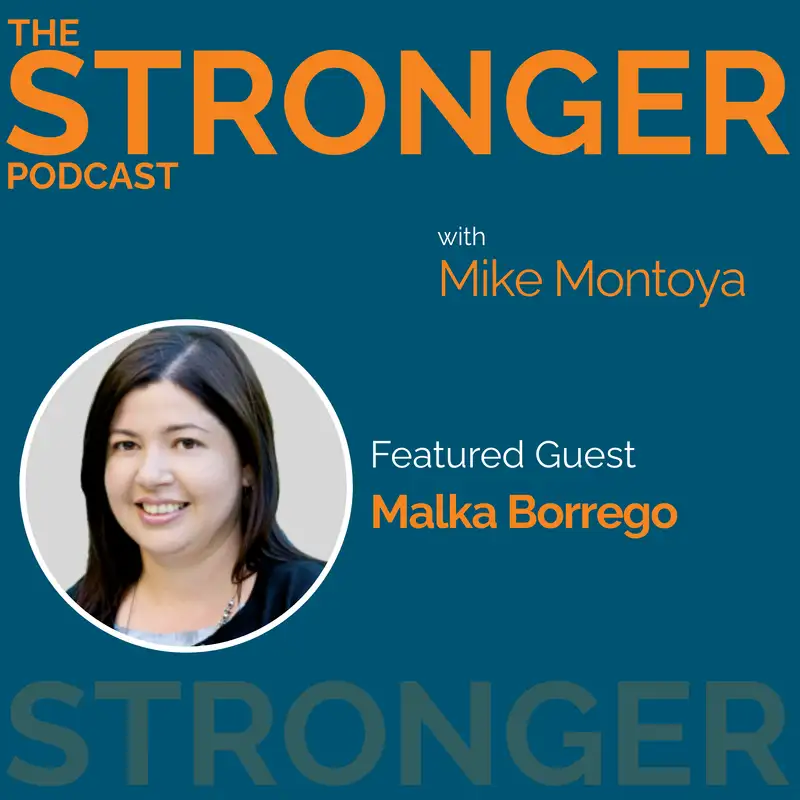
Schools Weren’t Built for Us: Reimagining Education From the Community Up – with Malka Borrego
00:00:00 Mike Montoya: Welcome to the **Stronger Podcast**. Each week we have honest conversations with education and social impact leaders about their leadership and career journeys. We talk about their origins, inflection points, and the work that they're doing today. The conversations are honest, human, and practical. If you're here for real stories, and real takeaways, you're in the right place. Let's jump in and let's get stronger together.
Hi, it's Mike, the host of the **Stronger Podcast**. In today's episode, I sit down with **Malka Borrego**, a third generation Angeleno who turned her deep love for the **Pico Union** community into the founding of **Equitas Academy**, one school that grew into a thriving K- through-12 charter school system serving thousands of students. We talk about what it means to redesign school with community at the center where only 5% of the residents once held a college degree and how Malka transformed that reality through proximity, purpose, and possibility. Let's jump in.
Before we dive into today's conversation, I want to give a quick shout out to podcastmatter.com. Their mission is to help impact-driven voices get the visibility they deserve. If you want to share your message with the world, check out their website in the show notes. Good afternoon, Malka. It's wonderful to see you. Thanks for spending time with me.
00:01:10 Malka Borrego: Excited to be here, Mike.
00:01:13 Mike Montoya: All right, so you and I have known each other for a little bit. Maybe I don't know, coming up on 10 years, give and take. Right. Yeah, that sounds about right. We were just children when we met. So, it's been fun. Tell me a little bit about where you're living now and maybe how Los Angeles is part of your roots and your home.
00:01:28 Malka Borrego: I am in Eagle Rock in Los Angeles right now. Los Angeles is my home. I'm a third generation Angeleno. I'm excited that my kids will be fourth generation. So, I was born and raised in the community called **Pico Union**. I was raised in the home that my grandfather came to Los Angeles to purchase and where my mom was raised. So, I have lots of love for **Pico Union**.
00:02:15 Mike Montoya: Got it. And this neighborhood community, right, has we call I call it was an anchor for your life for many years, right? In terms of a big chunk of your career. So, let's talk a little bit about Equitas and and that founding relationship and and the growth of that community. Tell me the arc of that story if you don't mind.
00:02:35 Malka Borrego: Yeah. I had the opportunity to found and lead **Equitas Academy** in **Pico Union**. Growing up in Los Angeles, I saw the difference it makes for kids when good schools are in the neighborhoods where kids go and they're designed for student success. And it was hard for me to understand and place words to what I was experiencing growing up in **Pico Union**. But schools weren't at that time designed for us to be successful. They weren't designed for the community where I was raised. Most of my families, most of my cousins, my friends were bussed out for hours to go to a school, and so, you know, that also drained the community having people leave at 6:00 in the morning and come back at 6:00 or 7:00 at night. You know, that's what was happening in the 80s.
And so when I had the opportunity to graduate from college, I'm a first gen college kid. I came back to teach and I thought we could really redesign this to create an experience for kids that really set them up for success. And so that's where **Equitas Academy** was born. It opened in 2009 with one school. I was able to grow to six schools under my leadership. They just opened a high school. I left in 2022. We have a wonderful successor continuing the great work. And so now it's a K-12 school system in Los Angeles.
00:04:15 Mike Montoya: Yeah. And everybody basically almost gets to walk to school now, right, in that neighborhood. So this you built a bunch of buildings, right? That was a huge effort in California for everybody in our audience. Building school buildings is like a herculean feat to get done. But you managed to kind of navigate that. A lot of folks, you said you came back to teach and thought it could be done differently. A lot of people have that idea, right? They're like, "Oh, this could be done better. This could be done differently". But you took an action on that part. Like where do you think the fire or the commitment came from for that? Because it was not an easy thing to kind of go from like busing, which was like integration focus, to like this community schools focus. So then why did you like how do you think you did that? I'm super curious like it's a big job.
00:05:45 Malka Borrego: When I was researching the idea to build **Equitas Academy**, I went to the data and in **Pico Union** we had 5% of our residents with a college degree and I thought it's really hard to have such a low number. What is really going on? How do I understand the data with the experience of what was happening in my community? And really I don't believe that our community was placed at the center of the design of the work and so expectations, understanding, and proximity weren't a part of how the school system was functioning for our community.
And when I even just took one more slice of the data, we had large schools, we had a lot more enrollment back then, and we had our largest high school that was serving 5,000 students. Only 5% of those 5,000 students had the coursework to apply to a Cal State or a UC at the time. So the numbers and the design showed you where the trajectory of our community was going to go, and I thought let's just start at the beginning and redesign it so that folks have a choice. I don't think college is the end-all but it is a necessary pathway and the quickest pathway for our community to be educated, to have choice. And so I thought, how do I bring together a group of folks who see this vision and want to work with me to change that 5% to maybe at least 50%? But just not accept 5% as the reality and wanted to do something different.
00:08:15 Mike Montoya: Yeah. So I think the national attainment rate for bachelor's degrees is maybe 30 to 40% roughly. My data could be a little off now because I haven't thought about this for a second, but there's a big gap between five and 30, five and 40, right? So, it's huge. Is **Pico Union** largely a Latino immigrant community still, or is it evolving, changing, gentrifying like other places?
00:08:35 Malka Borrego: I haven't checked the latest data, but from what I know, we are not a gentrifying community. When I spent a lot of time trying to bring capital to build the buildings that we did through **Equitas Academy**, I was asked that question like who do you serve and is this a gentrifying community? And I said, "We don't have a Starbucks yet". So, we'll see how that goes.
But it's a community that welcomes new arrivals from places like Mexico, Central America, and South America. My family had been in Los Angeles for quite some time, so I'm Latina. My family had been there for quite some time. So, it's a mix of both new arrivals and families who've been there. It's a community that welcomed folks who wanted to work. So there was a lot of manufacturing in the 70s, the 80s, and the 90s. Obviously, that's changing, but it still continues to serve a mainly immigrant and Latino community.
00:10:00 Mike Montoya: Got it. So there's a lot of stability in the community kind of type and in the kind of maybe DNA that's there, right? But the humans have grown up. Some of us have grown up. You grew up certainly there and built this kind of school operation. Do you feel like there's still I mean, is it sufficient? Have we saturated that community yet? Does it have enough of what it needs, or is it still like a project and work to be done over time?
00:10:30 Malka Borrego: That's a good question. I mean, I'm somebody who never thinks we're doing enough, so, you know, I took a pause before I answered. I think that **Pico Union** is a community that had to live without many of the structures or infrastructures that many communities take for granted like grocery stores and banks and gas stations that, you know, we just didn't think through. We had more liquor stores probably to this day than other types of businesses. So I think that there's a lot more work to be done in affordable housing and community spaces that are staples in other communities and so we're still not a community that has what other communities take for granted. And I think that we need it's still a very population dense neighborhood that continues to need more investments and supports to serve the people that live there.
00:11:45 Mike Montoya: Yeah. Sure. So, it's like it's not as much of a desert as it used to be in some cases, but it still lacks some of the things that like I don't know. So, I don't know where I live like there's a plethora, probably more places to eat than you can shake a stick at basically, right? And things like that. And it's just got a lot of complexity to it, right? But there's people that have I think in many cases achieved success on economic mobility kind of scales, right? And then they go out and spend money and then that sort of creates this whole ecosystem. In some cases, communities that are lacking those opportunities don't have the engine quite in place, right?
So schools are a piece of that. I don't know if you and I talked about this, but I certainly talked about it with others. The idea that in order for us to have richer places to live in terms of thickness and creativity and opportunity, then we need to be having great schools, right, and having kids and families in those neighborhoods functioning as normal humans with access and opportunities. And then they go out and they're part of this economy that we're a part of, right? I think we're laughing about the 80s, but that was like 40 or 50 years ago, right? In my head, it was like, oh, that was when I was born, so a lot of things have changed but a lot of things are also sort of the same. In recent years you've moved on from leadership at **Equitas Academy**, right, and have started to use your experience for good in other ways like what are you doing now? What are you focusing on?
00:13:45 Malka Borrego: Yes, so I spent I'm going to date myself again after talking about the 80s. I spent nearly 30 years in public education, started as a teacher then founder and CEO, and now I see myself as a **leadership and governance strategist**. I think that combination gives me a unique lens. I understand what it takes to build something from the ground up to scale systems responsibly and now what I'm doing a lot of is leading people in moments of pressure, uncertainty or transition.
The work has gotten harder and so I'm looking to put myself in places to help walk alongside leaders as the chaos of our world grows and as it gets more difficult. Leadership after COVID took a really different turn. It's harder to be a leader. There are less resources and the uncertainty of it all I think weighs heavy on our leaders. So that's where I've positioned myself to do work that moved me from my local focus of where I was born and raised to a more national one.
00:15:30 Mike Montoya: Got it. I agree, right, it definitely the roles of people who are running schools or working with communities has changed significantly since COVID, right, like and there's that generation of kids that will always be affected by that whatever we called school during those two or three years which was really hard. Kids were trying to do stuff remotely, there was no internet stuff for services for many kids. And so there's big gaps in learning experience. Are we still recovering from that? And is that kind of what your experience is that there's like really we have still a chasm to cross for many kids that missed things during those two or three years?
00:16:30 Malka Borrego: I definitely feel like the learning effects continue and I think the circumstances by which leaders are leading through continue to be rocky and chaotic and uncertain which only adds to the work getting harder and the conditions becoming more constrained.
00:17:00 Mike Montoya: That's helpful, right, like no one's delivering more stuff to make it easier to put things back together, right, in that regard? I feel like there was this big influx of money for a couple years that came from wherever it came from, and then all that money went away and now we're kind of back to feeling like less, and less support, and still the mountain is there in front of us, right? We're still kind of trying to climb it. Do you feel like I don't know was is it fulfilling to work with leaders doing this? I mean it sounds hard. Is it hard? Is it fulfilling? How do you feel about that?
00:17:45 Malka Borrego: I focused my work in schools because of my love for my community and I really do feel like it's the game changer for kids. And so if we can equip leaders to support them to do more with less, right, to do more with less resources, to do more with more chaos out in the world, but to continue to deliver for the kids that may not get beautiful learning environments, I think it's the most important work out there.
00:18:30 Mike Montoya: Yeah, for sure. Do you have have you had the opportunity with some of the folks you're working with to go into their schools and see some bright spots and cool stuff going on? Like can you have any do you have an example of some place maybe?
00:18:45 Malka Borrego: I got to go back to **Equitas Academy** after a few years of handing over the reins. I was supporting a group of leaders from Colorado who were looking to start schools and wanted some inspiration. And so our successor, Dr. Sophia Roditi, invited us in and did school walks. And it was great to see an idea that started, you know, with one school and a hundred kids back in 2009 to be a system that continues and continues to lead and has stability in the community and is an institution that will live past a leader.
And I was able to see kids back in spaces. When I left my role as the CEO we were still just getting out of COVID, I left in 2022, so we were just starting to come back. The normalcy of having kids in classrooms interacting with real humans live and just to see the connection with the adults and kids and the new spaces that **Equitas Academy** created was amazing for me to see the work continue.
00:20:15 Mike Montoya: Well, I mean it's that's an interesting thing as a founder that was there for a long time, saw it go through a whole massive growth as you said from zero schools to six functioning populated schools with actual kids and teachers and things like that. That's a huge thing. And then for it to be successful enough to transition to a new leader, right, and I'm assuming an evolved board of directors, and certainly new circumstances? So kudos to you for achieving what you did, right? So that's super exciting to hear about. Do you I don't know, do you have another giant swing inside of you that you're going to aim for like your next moonshot for 2030 or 2035? You're still a young professional in my view. So you have lots of opportunity. Even though you've done it for 30 years, you still got a lot, right? So, I'm curious like have do you have a vision for this bigger picture long term?
00:21:15 Malka Borrego: Wow, Mike. 10 years from now. I don't know if I've done the discipline work to think 10 years, but maybe five. I think I could swing towards five. In the last, you know, from leaving in 2022 to today, I've been really focused in on supporting leaders.
So in the last few years, I went to a coaching leadership program through **Coaching for Healing Justice and Liberation** and I became a trained liberation coach. I use that anti-oppression lens in the work I do and I think it's some of the hardest work I've ever done personally just even in the skill building to be a good coach, to be in community with other coaches to push, but also to make sure that when I'm connecting and coaching folks that I'm really grounded in where they see themselves and where they want to go and that I am holding the container for them to envision and create that work. So I find that to be amazing life-shattering work for myself and really life-giving. It brings me a lot of energy.
I also facilitate learning spaces for boards and for new CEOs or organizations in some sort of transition or uncertainty and to hold space for folks for their learning, for their dignity, for the emotional space to be able to go through whatever change is being brought, whether that be they're needing to transition from one leader to the next or they're handling a crisis. I feel fortunate to be able to hold the space for them and move them past that. So, this work continues to push me and my skill and I spend lots of time focused in my craft and also making sure that I'm ready to support folks to help them through those times. So, I'd be pretty excited to do that for the next 5 years and continue to get better, if not longer.
00:24:30 Mike Montoya: Yeah. Well, I mean the you said it you said it coaching others towards I'm going to use the word greatness, right, towards their impact, right, is like an amplification of who you are as an individual and you're getting to kind of harness all those skills and experiences. I bet you have some war stories from your time as being a school leader that you have been able to bring to the table. Do you feel like it sounds like it's fulfilling, right? It sounds like there's no lack of need for this in our space, where people need support and boards need development in order to be good at what they do. Does the liberation approach, right, like how is that different than some other things that we see in the space in terms of the way that we're developing schools and school leaders?
00:25:30 Malka Borrego: Yeah, I love that question and I think it was a pivot because I did not use a liberatory stance prior to being trained. You know, I might have had the ideals. I've always been grounded in equity. **Equitas Academy** is Latin for justice and freedom, and so I had the orientation, but maybe not the practice. This liberatory coaching helps ground me using an anti-oppression lens. So, I'm supporting leaders who look at what are the systems that might be harmful. How do we unlearn them, redesign them, or align them with the clarity that you're looking to put in?
And so, I spend a lot of time reconnecting leaders to their wholeness. Who are you? What do you want to accomplish? How do you get really clear about that? Because you cannot build something that you can't envision or name. And so, where do we spend time really getting clear on naming who you are? I have a whole coaching strategy on **authenticity is strategy**. So let's go back to the wholeness of you as a human and then look to bring out that clarity for collective liberation. So I very much ground myself in these are not coaching individuals; this is about coaching systems. This is about being in community with others as we move the work forward.
00:27:30 Mike Montoya: Got it. So it's a you had some de facto experience in this and now you got more formal training and support to create almost your craft, your toolkit, your approach to supporting people, and it's become like the Malka way. So the idea of authenticity just struck me, right, which is leading as an authentic individual, right? Or in real circumstances, like do you feel like authenticity is a superpower for some people? Is it lacking in some leaders? Is it buried underneath some of the other call it buttoned-up stuff we have to show up as in order to participate in the economy in a certain way? But authenticity often gets kicked to the wayside, right? Do you feel like leaders are getting more comfortable being authentic and leading with that?
00:28:45 Malka Borrego: I think I was part of the first or second wave of charter school leaders when I was proposing my school and I just didn't see folks that were training me that looked like me that had my background. You know, the numbers of Latino leaders who are college graduates are not as high as we want them to be. But in the charter movement I felt it to be particularly steep. I think it's 3% of Latino leaders are leading currently in the charter space. 20 years ago that was not the case.
And so, I learned from people that didn't look like me, didn't have my story and I emulated what I thought was the learning. And some of it worked and some of it actually was harmful for me. And so, looking to see where I could be really clear about what I need, what I am proximate to my community. So I do know and understand and just have an affinity and love for what my community needs. If I could translate that into my own leadership pathway as well as serve the community that I love and understand, it's just a formula for making things better. And there just weren't enough ways for me to even see how to do that. And so in coaching I have the opportunity to unlearn the pieces that I've learned and do it a bit differently and show a pathway that actually is quicker, faster, and more efficient for what folks want to accomplish.
00:31:00 Mike Montoya: Well, right. So then if we can tie when people lead with authentic self and their centeredness as people, they can probably make more progress more quickly. And I'm wondering if there is an effort, right? And you talked about the lack of Latino leaders in the charter space; it's a very small percentage of people. I don't know what the numbers are like in terms of kids of Hispanic descent in schools now, but it's growing, right? But we don't have very many educators that are in seats of control and power, certainly not on boards and leadership. So what kinds of work have you been doing to address that concern?
00:32:00 Malka Borrego: In 2021, after spending much of my career as a CEO and complaining about lack of community, lack of being able to recruit folks at my own organization so our kids could see educators that look like them, I decided to work with a handful of other Latino leaders I knew across the country to start a nonprofit called **LEAL**, or Latino Educators Advancing Leadership. And we began to build community. We began to talk about the need for more Latino educators. I think it's 8% of teachers are Latino when our population is getting close to 50% of the students in public education. Charters and districts hold these numbers at about the same amount. There's slight variations but very similar. And 3% at the helm or at boards. And so **LEAL** was started with the idea to build community, to call out that number and to increase visibility and have families who are picking charter schools see themselves represented in the folks making the decisions for them.
00:33:30 Mike Montoya: Yeah. And this is particularly a big mountain to climb, right, because it takes time for all these kids that are going to school now to be in a place of leadership. There's a time component. But there's also a bunch of Latino leaders that are emerging like bright spots across the country that just nobody knows yet, right? They're doing hard work inside their communities, but they're not recognized on a national scale. And so I think one of the things that I know **LEAL** has been working on is getting some of those people together, right? And you guys have had some success in that area, right?
00:34:30 Malka Borrego: Yeah, we started El Camino, which was our first cohort of Latino leaders that we brought across the country together to build community, to strengthen identity and to support them in their leadership growth. And it was one of the pinnacle experiences of my career to be able to create a fellowship. I've been a part of many fellowships as well as ran fellowships, but being able to do it for my people with my people and using culturally appropriate practices really rooting in remembering who we are and then celebrating and amplifying that has been an amazing part of my professional journey.
And I continue to see the need to do this work. Race work has been particularly difficult to fund at this time and so **LEAL** has had some trouble continuing that work but the need, desire, and community continue while the board looks to raise resources so that we continue the fellowship work. So the fellowship work is on pause, but the work and the need is not and so we'll continue to figure out what the next iteration is.
00:36:15 Mike Montoya: Yeah. I had the opportunity to join one of your cohorts at one of the events about a year and a half ago and having been a part of several fellowships and run a few myself, I'm like, oh my gosh this is so different and it was so welcome. It felt like almost home in some ways to me. I wish they had had this when I was 25, right, the opportunity to be part of a place that culturally gets where I'm coming from would have been super powerful. So I'm a huge fan of the work that's been trying to be achieved and I agree, the marketplace has not been that supportive. Maybe this is one of the challenges of our country right now, where we're in almost a backlash moment, or a continued period of time where we felt like we made too much progress and the people in charge got upset and now they're coming for us. That's kind of like the temperament in society right now, Los Angeles in particular. So I'm wondering, how does it feel now as a leader to be living in this moment, right, where we're as a society struggling to reconcile the realities of being a multicultural society while some would like to go back to a time when oppression was stronger?
00:37:45 Malka Borrego: Yeah. I see this moment in time as an opportunity to get clear, to get stronger, to get more focused. I was thinking about what advice or what do I do differently as a leader? How do I use that to resource myself to live through the difficulty of what's happening in our world politically, culturally, and the idea that we can't even continue this amazing fellowship work that we can show outcomes for? But in this moment in time, because it's really focused on race work, we're needing to take a pause. And the thing that I have noticed that I teach or lead differently is—and this sounds even maybe even a bit corny—but is something on **boundaries**.
00:38:45 Malka Borrego: It's a real focus on, if I got to go back in time—the Christmas past—if I got to go back in time and gave myself advice, what I'm doing now is I set **boundaries** sooner and more explicitly. And the reason I do that is I am spending more time knowing what I want, who I am, what I need, and I'm being a lot more clear with myself and others. And that is really allowing for alignment to happen. And so in this time where there's nothing more than I want to be doing than continuing El Camino and the work with **LEAL**, knowing that that's not possible, how do I resource myself to be ready for when it is? And how do I get really clear so that I am ready for the moment? I'm strategic and I'm clear about what I'm going to do. So, it's not I'm obviously mad about this work, but I'm sitting and waiting and ready for when we can continue in the future.
00:40:15 Mike Montoya: Right. So, it's almost like gathering the stores and getting ready for the moment, because there's always these windows like 2020 as a society with the Black Lives Matter movement that happened that summer. It was a chance for all of us to run through this window of opportunity. I personally got super excited about this. I'm like, "Oh my goodness, this is the moment of my generation's time where we're going to make some big strides". And I think we ran through a lot of things that people had been in wait for.
I think people were ready and they took advantage of it. So I think the time is actually coming. I have a little bit of solace in like the whole world's kind of messy right now, and we have our own version of that here in the United States, of course, but it's not unique and specific to us. I feel like there's still a lot of opportunity in California in particular, where there's momentum in many cases and the race work actually hasn't gone anywhere. California feels like it's on fire in a positive way, still continuing more progressive work. Is that your view?
00:41:45 Malka Borrego: I really love that you picked up the word momentum because I think I even checked in with that word this morning. I think that's the key piece. While the news would have us believe otherwise, and we know this world is in a chaotic moment, there are still folks who are fighting the good fight, ensuring that our kids of color are being educated in beautiful environments and there's momentum forward to make sure that the adults are supported to do that. And so, while it might not be the headline right now, it is happening each and every day. How do we continue to gather and build momentum? While it's not the lead story, it's the foundation by which we will be the lead story again soon.
00:43:00 Mike Montoya: Yeah, for sure. I think it's sometimes better to be out of the spotlight because there's less people hunting for you in some ways. When you can do it a bit more subversively, it's not as shiny, but it's also so important. One of my privileges of working across the country is that I get to go into a bunch of schools and see really great stuff happening. I'm like, "Oh man, someone should be telling these stories because the stuff happening in this particular school is really powerful," and you see kids excited about their futures. I love that about the school's work we get to be a part of. So, you have a couple of kiddos yourself, is that true? How is it raising kids in this time and place? Do you feel like you're in a place where these things are closer together than they've been?
00:44:00 Malka Borrego: When you were talking about the young people, I have a 14-year-old who's in her freshman year of high school, and I just love the scrutiny and the side-eye she gives me about the world and our decisions and how we've screwed things up and just the intellectual rigor she brings to her arguments. It just lights me up that my daughter is one of those young people that are bringing in change. She also went to **Equitas Academy** and matriculated through our flagship school. So, I'm double proud in her perspective and also her intellectual abilities.
And then I have a third grader. I started my professional career as a third-grade teacher. So, I have lots of things coming up as he's reading and growing and 8 years old. And I just think it's such a beautiful time where they move from that primary education and really become thinkers and readers and writers and artists. And so, I'm getting to relive both my professional career and my connection with them as their mom. And so, it's been truly amazing to also just have some time to be with them and their growth this year as well.
00:46:00 Mike Montoya: Sure. Well, and your job is complex and different than it was when your first daughter was quite young. So you're getting to spend a little bit more flex time with kiddos, that's a real treat. I'm going to seed this conversation about privilege and where it comes from. I think you're a first-generation college-goer, right? Do you see college as the major economic mobility mechanism of our time? That's how I see it; for folks who have never had the opportunity to go to college, it's the game changer. Do you feel like that is still a powerful mechanism, or are we losing the value of college because it's become a hot-button issue where people say go learn AI or code skills and college doesn't matter?
00:47:15 Malka Borrego: I understand all of the arguments and I still don't know what is set up to support students of color in a way that moves their economic livelihood and educates them in a way that brings them knowledge and choice. Why can't we do AI or whatever other skills kids want to learn and go to college? Why does it have to be an either-or? And when you look at the pathways, it's still the one that will lead kids of color through economic mobility the fastest. And so I don't like an either-or; let's not throw anything out until you can actually show me data that shows differently.
I'm going to be a proponent. I also just learned intellectual rigor in college. And who doesn't need that? Who doesn't need access to good writing and reading and community around you to push your thinking? And our young people need safe spaces to be in community to learn and grow. And college offers that as well.
00:48:45 Mike Montoya: Yeah, I think that's true. I think there's a lot of things America is this land of second chances and continuous learning. If you have the opportunity to read some good books and have discussions about stuff you never would do once you leave college, that's powerful. We're always so busy; reading a book takes time. We just listen to it while driving on audio because reading is a hard thing to do, but college gave you that opportunity, I think. I hope they still read books and have discussions in college. So as a Californian, do you still see that the UC system is meeting the needs of the population?
00:49:45 Malka Borrego: I don't know that I know enough to speak with data and points. I mean, personally, my belief is it's doing its job and it could do it better. But there's been a lot of changes in who they're accepting and how that's happening. So, I don't feel like I'm an expert on it to date.
00:50:15 Mike Montoya: Yeah, not to put anybody on the spot. Higher ed is still going through its own evolution and change, where the kids keep coming. The job of the K-12 system is to get more kids prepared for those more rigorous environments. Do you have aspirations for your own kids in terms of their own long-term education?
00:51:00 Malka Borrego: That they have choice, that they can define the community of learning that works for them and they're able to pick and choose from a plethora of those environments. And I wish that for all kids.
00:51:15 Mike Montoya: Choice is a hard one. Most of us don't have that many choices. Having multiple choices would be a really nice outcome. We need a national standard for what is college pathway readiness, basically. How do we measure the fact that we got all kids into one college or five colleges? Can we make it such that we're not just graduating from high school, which has been the standard since 1950?
00:52:00 Malka Borrego: I mean, if we're talking pie in the sky, I want kids to name their life trajectory where they're going to thrive. So, college graduation is just one step in that. College graduation that opens up pathways for where you see your life thriving is what I hope for for all kids.
00:52:30 Mike Montoya: And I feel like young people have a much broader picture of what's possible than they did in the 80s because of the internet. We just didn't know before. Does your daughter have a picture of what's possible for her? She'll probably be mortified that we're talking about her.
00:53:15 Malka Borrego: She will be mortified that we're talking about her. She's just in her freshman year overwhelmed with the demands of a rigorous education and she's at the point in her life of, "Do I want to be a serious athlete? Do I want to be a scholar? How do I spend my time?" She's just at the early stages of, "How am I defining myself?" And knowing that if she walks through the athletic door and really takes on a sport seriously, that does limit what she can do in other realms. And so, I love that she's wrestling with that. That's my wildest dream for her is that she gets these choices, they're safe, and they're helping her determine who she is and what she wants.
00:54:15 Mike Montoya: That's awesome.
00:54:20 Malka Borrego: That's how **Equitas Academy** was created: how do we give people choice and experiences to really understand themselves and help project themselves into the future that they see themselves thriving in?
00:54:45 Mike Montoya: I appreciate your approach to parenting in that regard. I'm going to switch gears just a tiny bit and talk about the personal side. How do you balance your work life, your family life, and your own personal health and well-being?
00:55:15 Malka Borrego: I do think about what it means to be grounded, to be focused, clear, content, and I don't want to use the word "balanced" because I don't think about balancing every day, but I do think about grounding so that I'm clear and centered. Sometimes I'll be traveling across the country supporting leaders for a week that throws my whole life into a whirlwind, but then I'll come back and think, "What do I need to do to balance myself, my family life, and my work life?" I think about it in a holistic way.
I think about managing my energy. I use this analogy sometimes: when I'm coaching, I almost see myself like in a video game where you have like your **life force** and I think about where is my **life force** and if it's below 50% I'm doing something wrong and I need to course-correct. I move myself to make sure that my **life force** is always strong and that I'm being thoughtful to what I need spiritually, physically, and mentally. Sleep is a big thing right now for me. I need at least 8 hours, if not more, so that I can just truly be the person that I want to be and that I aspire to be. Without that focus in on, "Do I have my **life force** with me?", I won't be able to do those things.
00:57:30 Mike Montoya: Do you have any words of wisdom for the future leaders of charter movements and charter schools?
00:57:45 Malka Borrego: Yeah, I thought long and hard about this. My hope is that leaders hear this and know that they can build extraordinary things without losing themselves in the process. So, it's possible and you don't have to give up yourself in doing it. Actually being mindful of who you are, what is your history, your identity, your beliefs, your humanity, and your wholeness is all part of it as well.
00:58:30 Mike Montoya: Yeah, that's the authenticity piece, right? Malka, thank you so much for taking the time with us today. We're going to put lots of things in the show notes to our audience, so keep an eye out to hear more about Malka and the works that she's doing.
00:59:00 Malka Borrego: Thank you, Mike. Thank you for the opportunity. It was great to talk to you today.
00:59:15 Mike Montoya: As we wrap up, I'm struck by Malka's insistence that even in a moment of political and cultural backlash, the momentum for equity is still moving quietly, persistently, and powerfully. Her work through LEAL, her liberatory coaching, and her presence in Los Angeles all point to a future where more Latino leaders shape what comes next. Thanks for listening to the **Stronger Podcast**. See you next Thursday, 9:00 a.m. Eastern time. Have a great day and stay strong.