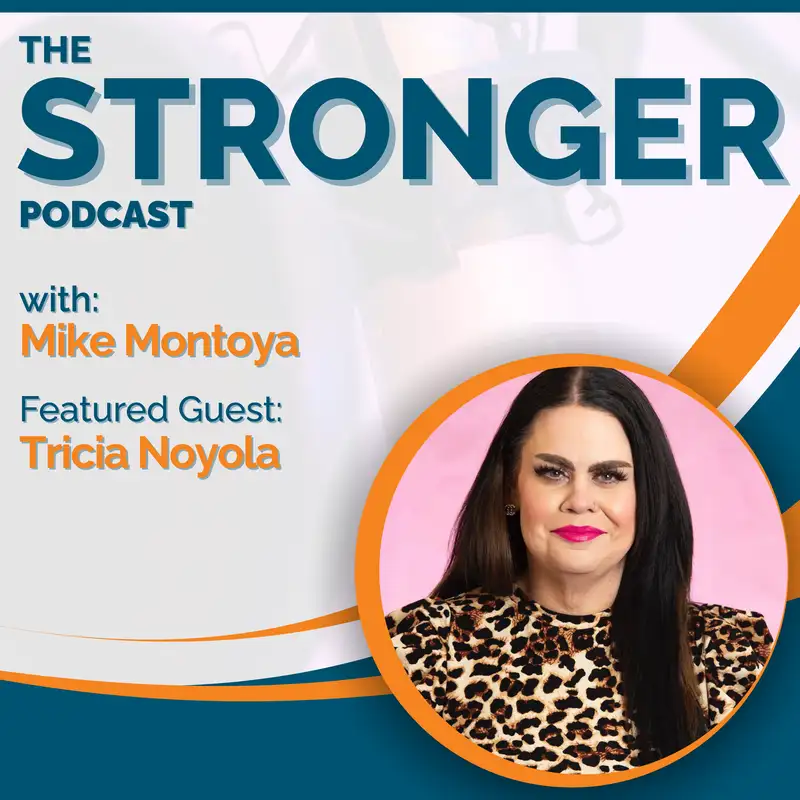
Schools as Love Letters: Identity, Boldness, and the False Binaries Holding Education Back with Tricia Noyola
Welcome to the Stronger Podcast. Each week, we have honest conversations with education and social impact leaders about their leadership and career journeys. We talk about their origins, inflection points, and the work that they're doing today. The conversations are honest, human, and practical. If you're here for real stories and real takeaways, you're in the right place.
Mike Montoya:Let's jump in, and let's get stronger together. Today's conversation was with Tricia Noyola, the regional superintendent at the KIPP Foundation, and someone who brings full color to everything she touches. Tricia grew up in the Rio Grande Valley on the border, where identity is fluid, culture is bright, and community is deeply woven. We talk about what it means to stay true to who you are, why that matters in leadership, and how schools can be love letters to the communities they serve. Let's jump in.
Mike Montoya:Before we dive into today's conversation, I want to give a quick shout out to podcastsmatter.com. Their mission is to help impact driven voices get the visibility they deserve. If you want to share your message with the world, check out their website in the show notes. All right. Good afternoon.
Mike Montoya:Good morning, everybody. Not sure where you're at or what time zone you're in, but I'm here today with my friend and not too long of a colleague, Noyola, and she can say hello. Nice to see you. Thanks for being with me.
Tricia Noyola:Thank you so much for having me. It's great to be here.
Mike Montoya:It's awesome. Thanks for being you. Let's just start there because there'll be like a screenshot of this somewhere and there'll be like these really cool backgrounds. You tell me, like, just tell me about the color in your life? And I know this is a way that you like to show up in the world.
Mike Montoya:And so just tell me about that. And maybe is there a why there?
Tricia Noyola:Sure. Yeah. So my mom, God rest her soul, would say that I just sort of came out of the womb this way, pretty colorful and opinionated and having the way that I wanted to see the world. So I, you know, grew up in the Rio Grande Valley and I grew up on the border And, you know, our culture is just so full of color and brightness and, you know, not a beige in sight. And so from the time I was really little, I have always gravitated towards, you know, painting my life in color.
Tricia Noyola:And I've always tried really hard to not see things for what they are, but what they could be. So when I see, you know, a blank white wall in a house, I think, what might it look like if it were cosmic pink? And then I just sort of do it and try it. And, you know, my my clothes and my fashion is much the same way. I have been waiting for this time when people told me that I would, you know, grow up and mellow out and not want to wear, you know, a shirt with the cowboy hat on it, but that hasn't happened yet.
Tricia Noyola:And I just think everything I do from, you know, the colors I choose or, you know, to what I choose to do with my time. I try to look at it as an expression of who I am. And I've tried really hard my whole life to not be anyone other than who I am. And I can look at times in my life where I, you know, experienced a lot of personal and professional success and really tie that back to staying true to that. And conversely, right, when I have gotten away from that, like it has not served me well.
Tricia Noyola:But you know, life's too short to not paint the wall pink if that's what you really want to do.
Mike Montoya:Yeah. Well, appreciate it. And thanks for going there right off the bat. I almost there was a thing in my head. Was like, oh, it's like asking the first lady about her fashion and not talking about something serious.
Mike Montoya:Right? So I didn't like mean to like. Huge, it's a huge industry, be we all think about what we're worried, not not everybody, but a lot of us think about what we're worried, and how we present ourselves and how the world is. And what I was picking up from your comments were, like, there was, like, a bright child. I would imagine this, like, really bright, like, kinda shiny, sparky child in a in a positive sense of, like it was like a Christmas bulb kinda going off in my head.
Mike Montoya:And I was thinking like, oh, what would it have been like to be part of your household? I used to pay.
Tricia Noyola:My dad right now, he has a lot he has a lot of thoughts and opinions on that. Sparkly is part of it. Really loud is is another one. Yeah.
Mike Montoya:Yeah. It's good that people notice, I think, as well. Because I think about like, yeah, the world is, it can be pretty basic in some ways. Right? And so growing up on the border, between The United States and what is now Mexico, But like your, does your family, are they rooted in that whole area?
Mike Montoya:Like, is there like long term connections into the region?
Tricia Noyola:Absolutely. Yeah. You know, we are, I come from a family of native Texans. Right? So we've we've been here for a really long time, and we've lived life on both sides and when there was no border, right?
Tricia Noyola:When it was just all Mexico. So this is, you know, where our roots are and, you know, that that life. And I tell my kids now, you you know, this was pre 09/11. I'm dating myself, obviously. And we didn't there was a border, but there was not this separation that you see today.
Tricia Noyola:I mean, we didn't even need an ID or a passport. I didn't know what a passport was until I was older. Right? Because I had no need for one. I didn't I didn't know one needed one to go to a different country because we would just walk and drive back and forth.
Tricia Noyola:And so our my life was always really fluid. And so it wasn't until later on that I got an understanding of, oh, this this is like a different way to live than the way most people live in this country. And there's just a lot of misconceptions and stigma and fear, particularly today, that people have around what it means to live life on the border. But, you know, I always say, like, it this is gonna sound corny, but, like, it calls to me. I I physically when I go back to the Valley or even when I'm in, like, San Diego, there is something different that stirs at me like a knowingness because that that is that is home.
Tricia Noyola:Like, that that is who I am. And that's who my husband is. Like, that is who we are. And we try really hard, even though we're in the Austin area now, to make sure that's still reflected as much as it can be in our daily lives today.
Mike Montoya:Yeah. Well, I mean, I think I have a sense of what you mean with the transnational experience, right? Which and for everybody who has not ever lived close, I lived in San Diego and Arizona, and never lived in Texas. Actually, my sister lived in Austin, but that doesn't count, as he said, a little bit. But like, the experience is really different.
Mike Montoya:It's just more it's just more fluid. Right? It certainly it was before before the wall and all the politics and the stress that's coming after post nine eleven kind of work. Right? Like, it was a really different experience, especially as a young person.
Mike Montoya:And you kind of go like, this is more kind of normal. It kind of feels like home. You're like, oh, this is kind of how it is. And it was fun. Super fun.
Mike Montoya:To kind of have that and having friends and relationships across both sides. Right? It was kind of like a normal thing. Right? For sure.
Tricia Noyola:Well, this whole idea that identity is not my own personal identity and our identities too, particularly on the border, were not one thing. And, you know, when the movie Selena came out, right, which was like a huge watershed moment for for a number of reasons. But one of the biggest ones is like this depiction, right, of what that meant and that it's very fluid and it really isn't that confusing to people that are living it. Right? It's it's you don't learn to be confused until other people tell you that it's confusing.
Tricia Noyola:But that is the way like, that's just the way the cultures are woven together, and it is uniquely wonderful. And, you know, we think about that a lot too in the context of the messages and the sort of dialogue that students and families and people are getting today about what that means, which, you know, I can say like that is not what I ever heard or learned. And I think that is like one of the saddest parts of the time that we're in right now and why it is so important that people like us talk and speak out and speak about our experiences.
Mike Montoya:Yeah. Well, the othering thing that happens in politics and stuff like that is a powerful tool. It's been used as a weapon for centuries across many, many cultural barriers in borders before they existed. And it's just a continuous thing. It's almost like there's a piece of us that is human that knows that there's somebody different.
Mike Montoya:Yes. But we're like, sort of built to be open to it, and a little bit skeptical. But if you pour some, you know, fuel on the skepticism, right, then it can amplify, right? It gets it gets turned into a big scary thing, which is, the other side of that. It's like, well, if you just kind of get to know them, you're kind of like, oh, this is kind of normal.
Mike Montoya:And it just diffuses, right? It's just not a thing, right?
Tricia Noyola:Well, you see that in kids, the way that kids interact with each other. It's like, oh, you have this different thing about you. It's like, yeah, okay. And then we just sort of like move on. And it's way more honest, right, than what we do as adults because usually they'll immediately like call it out.
Tricia Noyola:But then you work through that and you keep going. And I think that's why I always drew so much inspiration from working with kids around kids being in schools. Because when I think about, you know, where we are at our best, particularly in this country, it is when we are in community with each other, learning from each other, working things out, not perfectly because human's human and they're messy, But kids just always give me so much inspiration and hope for who I believe we are when we strip away, you know, all of the stuff we've learned as adults.
Mike Montoya:That domestication of us as people, right? Like, it's a thing, happens. It's just like part of life. Like, we kind of like pick up pieces and start carrying baggage and start judging things. And it, you know, turns into like, this is our life.
Mike Montoya:It gets started, like restrictive, right, in that regard, if we're not careful. Anybody if you haven't gone, I don't recommend that you just go to a school ground and just hang out there without permission. But if you ever go, like, hang out and like watch kids on a playground, or if you have that opportunity to see that, right, they they have a way different experience. And it's almost like that childlike thing, right? It's like something that like does fade with adulthood.
Mike Montoya:And but can be part of your life, right? Especially if you work with kids or have the opportunity to have your own kids, like you can see it happening, right? So okay, so you have this experience growing up on the border near the border, and then you have a partner, a husband, and then you have a family, right? So you have a couple of a couple of, I call it almost adult ish people in your home, both of your husband, right?
Tricia Noyola:Yes, I have a few. We have four kiddos. So we have two that are teens. I can't believe I have two teenagers. And then we have, I have one daughter that's like in sixth grade and then another daughter that's in fourth grade.
Tricia Noyola:So we have kind of a spectrum, yeah, right now.
Mike Montoya:Yeah. Well, yeah, it's hard to believe that they're teenagers, as you said, right? Like it's like, how is that possible? I've not been around them.
Tricia Noyola:Yeah. Well, and, you know, as a former middle school teacher myself, it is really interesting going through some of these things from the parent seat. And I have to remind myself, right? Like, you know what this stage of development is. Like, this is normal.
Tricia Noyola:This is what happens. Don't don't have a freak out, and you gotta roll with it. And the great probably the great thing about constantly being outnumbered by the children in our home is we do not harbor under any delusion that we are always in control, because clearly we would not. And they can collude against us, you know? And so when that can happen, you just gotta get real good at like hostage negotiation and other things and creative problem solving.
Tricia Noyola:And so those are skills definitely refine more as a parent and as a CEO. Like, I'm very grateful to all of those experiences.
Mike Montoya:Yeah, you kind of got to practice more with your family for the rest of the world. And sometimes the stakes are pretty high at home, though, right? Because like there's feelings and emotions and people are developing these relationships that are built on trust largely, right? And then you have to negotiate sort of sometimes what do call accountability and responsibility and other things that come as they get older, right? Which is like a middle school thing.
Mike Montoya:It's kind of like, that's the age they kind of get ornery, I call it. What my friend would say, like, you're ornery. So
Tricia Noyola:She was right. No. They they do. And you you have to remember two truths. Right?
Tricia Noyola:Which is both, one, that, you know, you are not the most important person in in their world right now, and you don't hold the the same sort of position that you did when they were younger, and what you say and do still matters a lot. They're just never gonna let you know that in this moment. And so you have to keep telling yourself that because it's still your what you say and do still matters, and they're not gonna let you know that. So you just gotta keep on keeping on.
Mike Montoya:Yeah. You have to sort of believe in the truth that you're still relevant in their lives. Right? Right. This this is fascinating.
Mike Montoya:I don't have children. I'm just riffing because I don't like how the experience. Right? But I've lived through plenty of the experiences of my friends and see the angst and the fun, right, that comes with the experience that you're in now. So much success to you and to them as they keep on the journey.
Mike Montoya:So you have this, I'm not going to say how long of a career, couple rounds of work in some charter school systems. So you started out as a teacher, is that true? As a middle school teacher?
Tricia Noyola:Okay. Yeah, my very first job in a school was actually I was a paraprofessional in an elementary school when I was still in college. So I've act well, I won't tell my age, but it's it's been it's been some decades that I have always worked in schools, worked with teachers, worked with leaders, I'm I'm really grateful for that.
Mike Montoya:Yeah. So you guys they caught you early, sounds like and you got the bug, the itch or something happened, right? And and do you do you remember, like, was there a moment as a young 20 probably that you were like, this is my thing? Or did that never really occur to you? Or did it just kind of happen?
Mike Montoya:Like, what was that story like?
Tricia Noyola:Yeah. No, I was one of those weirdos. I knew this was my thing. I when I went to college, I had the experience of understanding that the education that I had received was very different than clearly what a lot of my peers had gotten in the sense that, you know, they all knew how to do things I didn't know how to do. And those first few weeks, particularly of my freshman year, you know, engaging in conversations, you know, needing to participate and talk about readings, I just felt like the dumbest person in the world and realized, oh, we don't we don't all have it the same.
Tricia Noyola:And I knew that, you know, intellectually, but experiencing that disparity so starkly for the first time got me really interested in this idea that why is it, you know, in the richest country in the world that we can't provide access and opportunity to every single kid? And I just saw the greatest unit of change for that was school. It's the place where every kid in this country goes to. And so if we are, you know, to make changes and deliver on promises that we make to kids, that is the place to do it. So I knew I wanted to spend my life working in public education.
Tricia Noyola:But because usually this this question comes soon after I had no intention of being a leader ever. That was not on the agenda. It wasn't on the menu. I loved teaching like I was. I was good.
Tricia Noyola:It's good to do that. And to be honest, because I barely graduated high school like I was not a good student. I was thrilled to, like, have a bachelor's degree and a job with benefits. I was like, this is great. I I wasn't out here trying to to do a bunch of stuff.
Tricia Noyola:It wasn't until other people, like, invested in me and started pushing me in that way did I even think about that.
Mike Montoya:I'm going to pause the conversation here for just a second to talk about books that matter. Every entrepreneur or leader needs a book that elevates their business, builds their credibility, makes an impact. If you've got more money than time, a ghostwriter can help you build your story. If you've got more time than money, a great book coach can guide you step by step through the writing process. If you have already written a draft, these folks can save a lot of trouble and money by shepherding you through the publishing process.
Mike Montoya:Head to booksthatmatter.org and get the custom support you need on your book idea or manuscript. So maybe some mentorship or I'm gonna call it sponsorship, sometimes we'll call it that. People kind of pushing you towards something or inviting you towards something that's a that sometimes it happens that you're like a great teacher, then they're like, maybe you should do this job too. And they start stacking stuff up on top of your plate. And then you're like, Oh, shit.
Mike Montoya:And as you get paid more, like, So so did you so you stayed in the school, and then you moved into other, like, sort of had some leadership roles and you were you a school principal at some point and etcetera?
Tricia Noyola:I was. That becoming a principal was probably, like, the single most trajectory changing moment for me professionally. I had, you know, been a teacher. I had coached teachers. I had, you know, hired teachers, done a lot of cool things.
Tricia Noyola:And, you know, when I think about the one of the professional and personal relationships that really changed the trajectory of my life, it was with Joanna Gama because I worked at Idea and remember her. And if you know Joanna, like the story doesn't surprise you. She told me, she's like, hey, I need you to be principal of this school. And I was like, no, I don't I thought she was like joking. Yeah.
Tricia Noyola:I was like, I don't know. And I was like, I think we're really scraping the bottle of the bottom of the barrel here. And she was like, no, you you need to do this. You should do that. And I was like, I don't think that's for me.
Tricia Noyola:I think, you know, I I like these other things that I'm doing. But she was just insistent in what she saw in me that could make a difference for kids and families and staff in one of our in what was our lowest performing school at that time. And I said, don't you want someone who's like more qualified, who's done this before? Because I I had not I had no formal training as a principal at that time. And again, it wasn't my aspiration.
Tricia Noyola:So I hadn't really thought about that. But she's like, no, you need to you need to do this. And so I was like, okay. So that's literally how that happened. And I'd love to tell you that I walked in and year one, it was great and everything went awesome.
Tricia Noyola:That would be a lie. I was terrible effort, like legitimately awful. And I remember, you know, mid year, my first year, I told JoAnn, was like, I think you made a mistake. I don't I'm I'm not sure I can do this. And I think now we have, like, definitive proof that I'm not doing it.
Tricia Noyola:What she told me was is, okay. What does the coach do in halftime when the team is losing? And I'm like, well, they, you know, give them a talking to, pump them up, lay out the plan for the future. And she's like, so that's what's about to happen right now. What are you gonna do?
Tricia Noyola:Like, she never let me stay down on myself or even entertain the notion that I couldn't. And did a lot of reflection, did a lot of work, had an incredible team of teachers and leaders that I'm still in contact with and love to this day. Many of them are still there at that school. And together, you know, we created and cultivated what I still consider to be one of the greatest school turnarounds I've ever seen and is now the highest performing elementary school in that community. And I just learned a lot, not just about school leadership and academics, but what bold leadership requires and the the sort of ideas we have, the archetypes, right, of who would make a good leader and and who would do a good job in this.
Tricia Noyola:And I didn't check any of those boxes, you know. I had the still had the crazy nails. Like, I looked exactly as myself and it was it worked. It was very effective. I let it as me.
Tricia Noyola:And so to me that just taught me more than any like master's degree or fellowship or anything else. And to your point, having that sponsorship, Having that person who shares identity with me and who said like, I see I see this in you and getting to constantly see someone in senior leadership who I could identify with. It was it was just a life changing experience for me.
Mike Montoya:Well, congratulations on the hard work and I guess the win of helping that school make a journey. Schools are their own little houses and communities. And they're very special places underneath leadership and the team of people that you talked about, right? Like the imagining, right, of who those people are, like do it together. It's almost like in the rowboat or in the What's that thing where they do it on the river?
Mike Montoya:You know, that rowing thing on the river, like, like, trying to work together, right? And you have to be pulling together towards this common goal. If somebody bails out, it's hard, right? And you've got to pull harder with less people and things like that. Do you know what it was that or maybe you reflected on this, like, what it was that JoAnn saw in you that was her initial Kev, would you want to share that and help me understand it?
Tricia Noyola:Sure. I think first she'd say like the chola hoops because, you know, I'm a border girl and I don't know how to be anything else. So she'd probably say that first. But when we've talked, she would just say it's like this dogged pursuit that I have. So it's not that I know all the I clearly don't know all the answers, but it's this relentless drive to not give up, to get up when I fall down and my ability to, when I'm at my best, really connect with people and see them and see not just, you know, what are you doing right now, but like, what are the strengths that you have?
Tricia Noyola:Who who could we be together? What could we build together? And just the relentless pursuit to go after it. And I think something I've, hopefully, consistently done well too is break, I think, at times which can seem like insurmountable goals or concepts and just whittle them down and do one piece at a time. I did that really well as a teacher and then I've got where I could do that really well as a leader and really keeps folks jazzed on look at the momentum we've got.
Tricia Noyola:We did this thing. It worked. Let's go. And I always used to tell the leaders I ended up coaching is like success is the ultimate drug. Once people experience just a little bit, that's all they need.
Tricia Noyola:They will keep going. We all have that desire, right? And so when you're working with anyone who is down on their luck, hasn't experienced success, well, course, that sucks. That doesn't feel good. So it's all about how do you get those wins really fast?
Tricia Noyola:How do you shrink, you know, what you're looking at? Surprise. Dog. Yes. Down that path.
Tricia Noyola:And I she just saw, despite not having, you know, pedigree and sometimes like leadership acumen to always know, like the right thing to say. But I'm always obsessed with trying to do the next right thing. And even if I make a misstep or, you know, something blows up, I'm not afraid to say that learn from it and keep going.
Mike Montoya:Yeah, well, the resilience isn't there for sure. The picture of like, break things down into smaller parts, like almost like, it hijacking the human motivation system or rewards. All animals have this thing where you're like, you win, and you get more of you keep winning. And it feels good. And it like is self reinforcing, right?
Mike Montoya:You can't we can't burn everybody out, right, of course, but you can, you can get wins and get this wheel spinning. And people write books about this stuff. Once you get it spinning, people can feel success over time. And then it can just be self fulfilling. So it sounds like you innately figured this out.
Tricia Noyola:The school of hard knocks. Yeah. I wouldn't recommend that.
Mike Montoya:To go to graduate school or Yeah. I mean, yeah. I mean, practical note. Yeah.
Tricia Noyola:And I think, you know, I look back at that time, I just look back on it so fondly and I wouldn't be a tenth of the leader I am today without those incredible teachers, leaders, staff, students, and families that I worked with. And so I just have such appreciation to Joanna for many things, but that probably being the primary one.
Mike Montoya:Yeah, that's awesome. Well, I mean, a lot of us have like these moments in our lives when things happen, right? That happens to be like the one that you're sharing with us. Thank you for doing that. Because, you know, like, sometimes reflecting on like, the growth experience, like, you know, it wasn't didn't feel good all the time.
Mike Montoya:Right? Certainly. Right. And it was like, right? For sure.
Mike Montoya:Right. And there's probably I don't I won't, like, there's emotion involved at some point during the experience that it didn't always go as planned, right? So like those, you know, we all struggle, with the going through the new things and experiencing stuff until we get there. And, and do you have now that now that you're beyond that, right? Is there like a hippie thing that you would say, and maybe you use this in your coaching and the work that you do now, like, is there something that you rely on and say like, hey, remember, remember this moment or lesson that you can share back with folks?
Tricia Noyola:Yeah, the importance of being bold.
Mike Montoya:So
Tricia Noyola:when I was at probably my lowest point as a principal, and I can even think to moments as a CEO, as an ED, like you hit these moments where you're like, wow, this is pretty bad. And I don't know how we're going to get out of this or I don't know that I can see the way through. And conventional wisdom would tell you the way through that is incremental and is slow and is very deliberate. And don't get me wrong, there's a time for that. But the times that have paid off the most for me in my leadership is when faced with really difficult odds and sometimes even people telling me, oh, this is like not a great idea.
Tricia Noyola:I don't think it's going to work. What if it did? What if it did? Right? Would I do differently right now if I believed that it would work out?
Tricia Noyola:And if there's even like a stirring inside of me of like, go for it, as long as I'm not going to die, like, I'll be fine. I'll make it through. But if there's an opportunity that kids' lives are going to be even incrementally better on the other side of it, it's worth it. And so the questions I always ask myself and the leaders I work with now is like, well, what if it does? What if it does work out?
Tricia Noyola:What if it does do incredible things? And you know what? Even if it's not as incredible as we think and it's just better, that's still great. That is a net. And as a leader, you don't always get those.
Tricia Noyola:So that's okay. I don't know. I'm very I am a realist. I try to embrace the Stockdale paradox, but I am by default, I'm just a dogged optimist. I don't always you know, I'm relentless about pointing out and when I there's criticism or when there's feedback.
Tricia Noyola:But I am so bullish on our ability to make it through and to be better on the other side, regardless of how hard it is. I think it also helps, Mike, that I have always held the belief and I see this so often in so many great leaders that I admire, which is whatever's gonna happen, like, you are going to extract from it something that you
Mike Montoya:can make useful.
Tricia Noyola:Or you're not, and you're just gonna be really depressed and you're gonna lay down. And that's a choice too. Right? But that's just one I'm not gonna make.
Mike Montoya:I just wanna say that if you're a leader, entrepreneur, or business owner who needs some support, there's an easy way to get a think tank behind you and your vision. The Genius Discovery Program at Thought Leader Path is like having your own one on one incubation and acceleratorship program. They'll help you develop an approach based on your own story and your plan for impact and offer the tools and thought leader assets needed to really amplify your message, including launching a podcast like this one. If you're ready to stop grinding in the dark and start making real impact with the right support, check out geniusdiscovery.org. Well, the optimism is at the core of this, think.
Mike Montoya:But there's also maybe a belief in efficacy of people when they shut their mind to something with reasonable resources, right, that they can achieve things, even if it's not exactly as planned, right, or the outcome is not like, as amplified as we imagine it might be, it still is like an achievement achievable thing. And I think I learned at some point, just I decided that like humans are at core creators, right? And like, inventors of everything that is not just the natural world, right? Like, like everything that we experience in our lives, all the intellectual stuff, all the buildings and things, right? Like, humans just created it out of nothing, out of something smaller, of little pieces, literally the elements and the minerals, or whatever that is.
Mike Montoya:We've turned it into these amazing opportunities in our life. And I think if we can hold on to the fact that that's inside of us as humans, we can do incredible things. Sometimes it's a lot of work and it takes a lot of energy and resources. But it is achievable because we can be like, Okay, let's put these seven things together and we'll have this stack, right? Like Voltron, grew up in the era of like Voltron and these, you know, like, they all come together or the power rangers, like they come together and do shit.
Mike Montoya:Right? So that's kind of how I imagine like humans, like when they get together and decide on something that they can do it. And being bold is having, I call it, the guts to believe that you can do it. And you said about helping when it benefits kids. So your work is clearly focused on this achievable life for children.
Mike Montoya:Where did I mean, it matters to you, in some ways, I heard you say, because you didn't have the same education as maybe some of your peers when you got to university. Is there another driver there? Like is, I don't know, like, is there is or is that the core piece? And it's your soul trying to, like, repair your own high school experience, for example, right? But or is there is there more there that like, motivates you to keep the eye on the ball for kids?
Tricia Noyola:Yeah, I think so much of it comes from the inequity that I experienced and from this understanding that I am from this incredible beautiful place and we're not short on ambition or talent. Or short on opportunity. And opportunity is actually such a solvable problem. And the more I spent time in schools with kids and then with adults and figuring out actually what makes us all tick is pretty similar. It's got nuances but it's pretty similar and there is just so much we leave on the table when we're not thinking about what is the best way that we can optimize conditions for everyone to do their best.
Tricia Noyola:I think the other piece too is, you know, I was not a great student like at all, but one thing I was always really passionate about was reading. That was in large part, you know, my escape. And it was also how I learned a lot of different things because I school was just like not it for me. And so this idea too of we can go anywhere in a story, in a book, and being able to connect kids and schools and folks with with this idea of, like, literacy is not just about the tangible skills that you need to be successful, but it's also this way in which we broaden our horizons and go to different places and learn more empathy. Like I always tell parents, the number one SEL program you can invest in is reading.
Tricia Noyola:Yeah. Right. Before we, you know, in the eighties knew what SEL was. I'm fairly certain my parents still don't know what SEL is. There was reading like we read in books and we talked about them.
Tricia Noyola:And that's how we we empathize with characters. We we imagined ourselves in those shoes. We learned to see things from a different way. And so I think that has always been a constant for me as well and why I was so, you know, enamored with this idea how how do we create that in every school. And then the other thing I'd say is when I was a principal, I said, you know, once I got my CLEC under me and I was like, I could I could do this.
Tricia Noyola:I said that my school was a love letter to the community. It it represented my deepest respect, love, and hope for the people in my community, what I believed to be true about them and their kids and in our lives together. And I wanted every single Kin family every time they walked through my school to feel that. And that's just that's a different way to look at it. I wish I wish people talked that way more about schools.
Mike Montoya:Yeah, I mean, because they're they're like, it's incredible public investment and community asset, In a place where, whether you go to school there or not, your kids go, they're anchor in the community. They're a place where people pass by every day. They see children going and coming. They know that there's a full life experience. Everybody can relate to going to school, whether it was a great experience or not.
Mike Montoya:They kind of know what it's like, and then they're making a lot of assumptions about what goes on in the building and stuff like that too. But it's really a place that most of these kids are going to grow up and come back or spend their next ten or twenty or thirty years of their life in this neighborhood or region. And it's just part of the fabric. I think it would be interesting for people to, I call it, really treat the idea of public schools as the asset of the community that it truly is. And I call it like love into it as well.
Mike Montoya:Because sometimes we just get out where you don't think about it ever again. And that's like another version of life, I suppose.
Tricia Noyola:Well, and love, this version of love also demands, like, accountability.
Mike Montoya:Right. Sure.
Tricia Noyola:Well, I part of that love letter, right, to my community was this school's gonna be good, and I'm gonna be upfront and open and accountable to you all, not just because, you know, the state is telling me to, but because I feel deeply accountable to making sure that every kid is leaving here with exactly what they need. Right? And so that's why some of the well, a lot of conversations that people have in public right now bum me out. But one of the ones that just, like, really bumps me out is this whole idea of, like, accountability as this like dirty word or as something that's like deeply undesirable. And I'm like, in my most like functional deepest relationships, we are accountable to each other.
Tricia Noyola:That is not a bad thing. There's actually so much can be so much safety in that because, you know, we have a mutual compact that we're agreeing to and that we're agreeing we're going to be stronger together than if we go it together. And
Mike Montoya:I
Tricia Noyola:don't know. I I just think we don't need to choose. It's a false binary. Yep. Alright.
Tricia Noyola:Do we have high expectations or do we love kids? Well, I don't know how the hell you love kids without.
Mike Montoya:Want you to struggle the rest of your life because you can't really want to keep that language.
Tricia Noyola:Love? Like, that's not the love I want, and that's not the way I love my own kids. So, no, I I just reject that. Right? And I think, you know, we would all do better, right, to to every time we're hearing these false binaries or dumb dumb choices to actually ground it.
Tricia Noyola:And no, that's that it doesn't need to be that way. Someone wants it to be that way, but that's not the way it actually is.
Mike Montoya:Yeah, for sure. I mean, we try to put things into small boxes. And I mean, the core of this, I was thinking as you were speaking, as I get this accountability that's mutual, right, amongst two individuals or between institution and a community, right, is based in a relationship, right? And it's based on this, we believe we're going to have to coexist in the same space, and we're choosing to be part of each other's lives. Right?
Mike Montoya:And that requires us to, I call it actually have some version of a relationship, right? Even if it's not the one that's our partners all the time or something like that. So literally, have a relationship with your neighbor, you have one with the city, you have one with the gas attendant. There's all these relationships that we have. And if we can all learn to be decent towards each other through those experiences, because maybe that whole golden rule seems to apply in this case.
Mike Montoya:It would be an easier pathway because I don't know, it feels like sometimes we make it too hard. It's overly complicated, but it's really not in any way.
Tricia Noyola:It's not. I think the more life experience I get, I realize that, you know, what it really comes down to is the ability to, as a leader and as a person, to just be able to listen and understand what it is that that people want their desires for themselves and and what their dreams are and be able to connect that to find that common purpose. And if you are a leader of anything, I don't care what you're leading, to be able to create conditions that make it easier for people to pursue what they love and create a life that is choice filled and liberated. Whatever you do. I don't I don't care what you lead or what is happening.
Tricia Noyola:If that's how I try to measure every single day I spend on this planet, like, did did anything I do get people closer to that? And I think particularly in education, right, we have to constantly remember that every single parent and family has hopes and dreams for their child. You might not know them, might not understand them, you might not like them, but every single parent does. And I've been doing this for a while and that has not changed. And the words people use are a little bit different.
Tricia Noyola:But fundamentally, what folks still want is great opportunity for their kids. That has not changed. Yep. And so as as much, you know, hand wringing, I feel like as we're doing it, oh, everything's totally different. And sure.
Tricia Noyola:Yeah. It is. But some things really aren't. And in some ways, like, we've complicated it and we don't need to because fundamentally every parent, every family wants their kids to have a better life than the one that they have right now. Want that for my kids.
Tricia Noyola:And that is still a dream worth fighting for.
Mike Montoya:For sure. Well, I use the words choice filled and liberated. And maybe we'll kind of wrap with that in mind because it's such a powerful kind of statement of like in a collection of where where your journey started and where you're at now. Right? Is it like, are you in a place where you can really benefit tens of thousands of children across the work they do right on a on a regular basis?
Mike Montoya:And so Tricia, I appreciate you for the work that you've done for, I call it striving, striving through the early experiences of teacherhood and principalship, and into the leadership roles that you've played. And we invite you to come back in the future, bring your friends and your guests and other things like that. And also deeply grateful for being part of my community. Thank you so much.
Tricia Noyola:Yeah, thank you so much, Mike. And thank you for the conversation and thank you for being part of my community as well.
Mike Montoya:Absolutely. All right, we'll see you soon.
Tricia Noyola:See you.
Mike Montoya:What I'm taking from Tricia is a rejection of false binaries, love versus accountability, high expectations versus care. She argues that you can't truly love kids without believing deeply in what they can do, and she grounds everything in a simple truth: Every family wants a choice filled, liberated future for their child. Tricia, thank you for your leadership, your honesty, and for reminding us what's possible when we build schools with courage, clarity, and community at the center. Thank you. Thanks for joining us and tuning in today.
Mike Montoya:To find out about other podcasts that matter, visit podcaststhatmatter.org. Thanks for listening to The Stronger Podcast. If this conversation inspired you, we invite you to follow the show and share it with someone who's on a journey to become a happier and healthier version of themselves. Links and resources are in the show notes. See you next Thursday, 9AM eastern time.
Mike Montoya:Have a great day, and stay strong.