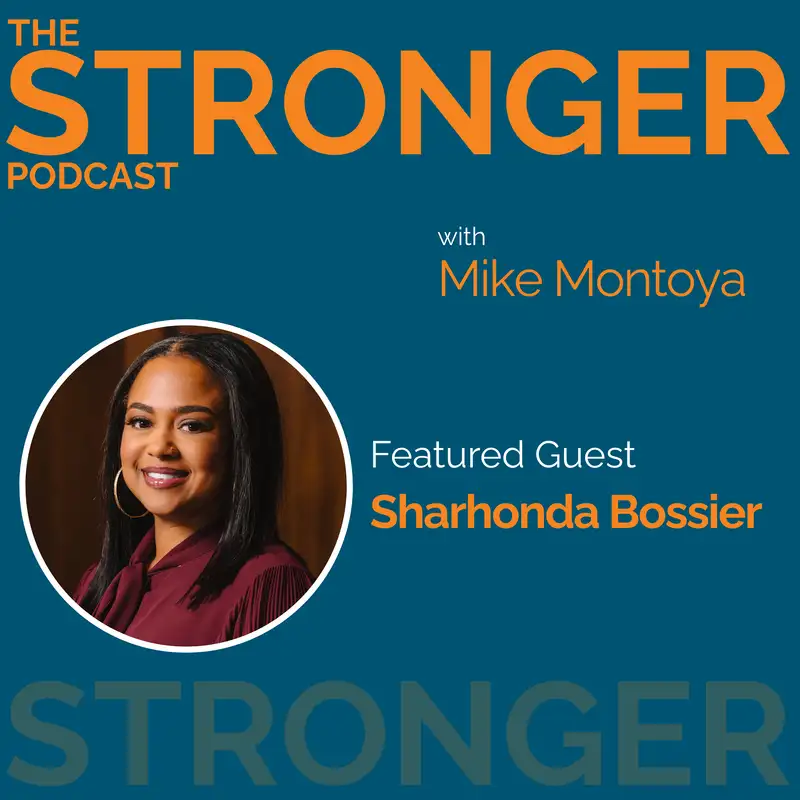
Purpose Shouldn’t Mean Poverty: Rethinking Service, Wealth, and Leadership – with Sharhonda Bossier
Mike Montoya (00:00:00): Welcome to The Stronger Podcast. Each week we have honest conversation with education and social impact leaders about their leadership and career journeys. We talk about their origins, inflection points, and the work that they're doing today. The conversations are honest, human, and practical. If you're here for real stories, and real takeaways, you're in the right place. Let's jump in and let's get stronger together.
Mike Montoya (00:00:30): My guest today is Sharhonda Bossier, a self-described reluctant leader who has become one of the most important leaders in our sector. In this conversation, we dig into her path from teaching to organizing to leading EdLoC's 1500 member network at the intersection of education and economic mobility. We wrestle with the hard questions, who gets to build wealth, who gets to serve, and what that means for the next generation of leaders. Let's jump in.
Mike Montoya (00:00:46): Before we dive into today's conversation, I want to give a quick shout out to podcastmatter.com. Their mission is to help impact driven voices get the visibility they deserve. If you want to share your message with the world, check out their website in the show notes. Good afternoon, Sharhonda. It's wonderful to spend time with you. Thanks for coming to join me today.
Sharhonda Bossier (00:00:54): Yeah, thanks for having me. I'm excited to dive in.
Mike Montoya (00:00:57): You're a podcast professional. That's what I just heard. So, it's really wonderful. I'm like I'm gonna be out of my I'm gonna I'm gonna kind of try to keep up with you today. So, thanks for thanks for Let's just say this, like you and I met in Napa or something like that at at a Pajara event like in 201 I don't know 13 or something roughly.
Sharhonda Bossier (00:01:14): 2013. Yeah.
Mike Montoya (00:01:16): Both a little younger. It's not as beautiful as we are now.
Mike Montoya (00:01:19): And and we and we've had we've had this journey right together a little bit in in our at least our professional career and some of that and we I kind of kept in touch over spaces. But can you give me a moment and and let's go back as far as you want into your early origin like Where did you grow up? I don't know if there's a a piece or a story or part of your early experience that you want to share about being a young person in America that you want to start with. I'm curious. All our audience doesn't know this part about you. So, let's learn about it.
Sharhonda Bossier (00:01:50): Oh, wow. Okay. So, my name is Sharhonda Bossier and I am from the Watt section of Los Angeles. So, I grew up in a community that is pathized in very particular ways and sort of the popular for American imagination, right? But for me, it was a home and community that was deeply rooted in showing up for one another, deeply rooted in sharing with one another, and deeply rooted in like doing the best you could with what you had. I was raised by my grandparents who both migrated to California during the great migration from Louisiana. And you know, my grandmother was a devout Catholic. And so you will often hear me talk about some of my early values and my commitment to racial and social justice being rooted in my Catholic upbringing and values. I'm a lapsed Catholic for the most part now.
Sharhonda Bossier (00:02:40): The values and the rituals stuck. I'm the eldest of my mother's eight children, which definitely like shapes a lot of who I am and and how I show up and how I think about my responsibilities to to others. beyond myself.
Sharhonda Bossier (00:03:00): And let's see what else is there to say. I started my career in public education as a classroom teacher. Really inspired by some of the teachers I'd had throughout my K12 journey and came to believe that education would provide me with the shortest and shest pathway out of poverty. I went to college planning to become a lawyer and then at the encouragement of one of my writing instructors got a job as writing tutor and that set me on the path to becoming a professional educator. I saw really quickly that like all of the kids who were coming into the writing center for academic support and intervention were my friends, right? They were the black and Latino kids who had gone to large comprehensive urban high schools, had made it to the University of California but were struggling to make it through.
Sharhonda Bossier (00:03:39): I spent five years in the classroom and then Mike, when you and I met, I was in my first sort of nonprofit leadership role. I was helping lead lead a parent advocacy and organizing organization based in New York that sought to prove that we could leverage the power of low-income families to force large kind of decentralized systems to be responsive to them and to their needs. Did that work for a few years and then tried to figure out who I really wanted to be. Did some consulting work where you and I stayed in touch. And then for the last almost 10 years this coming spring have been helping lead the team over at EdLoC, which is a membership organization comprised of senior leaders working at the intersection of education and economic mobility, trying to ensure that we are building a world in which every young person has the opportunity to build wealth and thrive. So that's me.
Mike Montoya (00:04:30): I just got the vibes in my body from that, especially the way you just tuned up the the intersection of education and economic mobility. And it I'm going to I'm going to trace it back here a little bit because I also grew up Catholic, right? And also I'm quite lapsed, right? I call it a scheme for hierarchy and patriarchy etc..
Mike Montoya (00:04:52): And and I I I I want to start with like the honoring right of our grandparents right for like doing the things that they knew how to do right and following like their path right to get to a place where like it gave us opportunity me in particular right and like like we had a choice to go to college right because like and an opportunity because that and I think it was rooted I also learned I I've often referred to my social justice journey has started in like liberation theology as well, right? The the sort of south and central America theologians and San Franciscans, etc. that also like basically populated California, right, to begin with. So, like there's all these like interesting pieces about California, right? And so, but I think it that thread that you just like kind of drew, right, is really just like the arc is like, okay, it's almost like this theology is alive and well in our personal and professional lives, right? I mean, it's almost like that the nexus of our work, right? Because what we're doing now is talking about children having opportunity.
Mike Montoya (00:05:46): through their education, right? And basically being set free literally, right, from I call it all the things that would keep us from being successful or have opportunity, right? Like that's that's how I would describe this. I don't know. Do you agree with sort of that way I'm weaving this together or is that like a little bit of a piece there?
Sharhonda Bossier (00:06:05): I do. You know, the the the Jesuits were the sort of the sect that ran my church and in the Catholic middle school I went to, right? And certainly, you know, when people are like, well, why are we talking about the need for young people to have access to, I don't know, housing or health care or food to eat, right, in this current moment, I just don't understand why people would have a pull pit or a platform and not speak to the realities of the people they say they care about and serve, right? So, every priest at every church, at every mass I've ever attended, right, has leveraged that opportunity at the pull pit to talk about the lived experiences and the realities of the people in the pews.
Sharhonda Bossier (00:07:05): And so if I in my secular capacity have a platform or a pull pit, I the only models I have are models where people have said, "Let's talk about what's happening for real in these communities outside of these doors, right? Mass was a safe place. Confession was a safe place, you know, but that our priests always recognized that we were going back to homes and back to communities that weren't and they saw it as their calling to do something about that, right? To be in service of the people who were in those pews week in and week out. And I that's the model of leadership I have, right? The only other model of leadership I have.
Sharhonda Bossier (00:07:30): are my grandparents, right? who were black people from the south who were born at the height of the depression and so also mutual aid was sort of baked into how they lived their lives. Right? So if my models for leadership are Jesuit priests and black people from depression era Louisiana, I don't know how I don't talk about the need to meet a person's needs outside of what might be immediately apparent to me in whatever capacity I've met them, you know?
Mike Montoya (00:08:02): Yeah. I mean that that makes sense. I mean I like the centering right of and we sometimes like the the kind of vernacular now is like proximity to right these communities that we serve and and for children and the experience right and I think it's it's like a fancy way of dressing up that like hey we should be taking care of each other.
Sharhonda Bossier (00:08:24): Yes.
Mike Montoya (00:08:25): right and and and I think that got hammered into my head as a person and I was at this like I went to this leadership it was like a stand children had a luncheon here in I live in Port and they had like all these high school kids that had, you know, basically overcome these impossible set of circumstances, right? Like,
Sharhonda Bossier (00:08:45): Yeah.
Mike Montoya (00:08:45): and the stories of these eight young people that their journeys and I was like absolutely shocked that each because they made like a really nice video of these kids kind of with people talking about them and the kids kind of telling their story and it was really powerful because every single one of them said, "I want to do something that basically helps people like me." Right? And these are all like first and kids, right? Kids that are going into this to university for the first time. And I was like, huh? I'm like, we need more and more and more of that, right? Of course, it's like, you know, these like kids that basically come from very few privileges, right? And taking that choice, right? And it's almost like I'm like, if that's the kind of group of people we're training for the future, then I think we have a little bit of hope, frankly, right? I don't know if you reflect on that at all in your work and like and I know you would do a lot of work with the EdLoC community in this people that are like purposely intentionally like built their whole careers around this idea, right?
Sharhonda Bossier (00:09:47): Yeah. I mean, I think I mean the short answer to that is yes, right? Like something like 72% of the EdLoC Network members were PEL grant recipients in undergrad. Right.
Mike Montoya (00:10:07): Right.
Sharhonda Bossier (00:10:07): And so, you know, the the leaders in our network are the grown-up versions of the kids you're talking about, right? And the the sort of gaps in their social capital don't disappear because they get a degree don't disappear because they get a big title or a fancy job, right? So, we're trying to continue to manufacture some of that social capital and network for our leaders. But, you know, Mike, I I'll be honest with you about a tension I'm experiencing in our work right now and I think has been sort of bubbling underneath the surface for like the last few years.
Sharhonda Bossier (00:10:43): And that is like, you know, all of the helping professions as we talked talk about them, right, are are noble, but they don't pay anything, you know? And if we think about public education as the sort of the the great equalizer or the sort of engine for economic mobility and and and you know, social capital in our in our culture, what does it mean to funnel young people who come from, to your point, very few privileges and certainly not any class privilege right into all of these service roles and and jobs that we know are not going to support them in building wealth which we know is one of the pathways to actually having power say and influence in our culture.
Sharhonda Bossier (00:11:24): And so there's a real tension for me in that right like if a kid is really passionate about being a math teacher because their math teacher like opened up their world and inspired a sense of curiosity and exploration for them I don't want to tell that kid to not become a math teacher. And right like that math teacher probably can't buy a home in most housing kids these days. Right.
Mike Montoya (00:11:43): True.
Sharhonda Bossier (00:11:43): And so there's a there's a tension there.
Mike Montoya (00:11:46): I agree and I'm glad you named it because I think this is worth exploring a little bit. We can keep going as long as we want this because I and I you know we did like a leadership thing for like Malcolm Burgago's LEAL group at some point. I talked to a bunch of again adults that had like chosen this profession of leadership and education and you know They're all stringing it together like one piece at a time, right?
Mike Montoya (00:12:12): And and at some point maybe maybe when I was like maybe I think it's when I met my husband. So I was like 30, right? And and he said he he came out of Proctor and Gamble and he was making as much money as a 22year-old graduate of of an Ivy League university as I was making 15 years into my profession. Right. He's like, "You need to go make some money." And I said, "You're right." So, so I shifted right from like direct service, right, work that I was doing with kids and families into like higher ed and philanthropy, right? And I just went down that road with intentionality, right? And and while the money is not as big as like sort of private industry could potentially be, etc. Like I started to catch up, right? But somebody had to turn my head on around that thing.
Mike Montoya (00:13:00): And I think that's a a truth and a fact and a challenge that like young people need to hear that they can do both, right? And choosing a profession that takes care of you and your family if you want one, right? As well as choosing to do good, right? Those two things can live together, right? But I also don't think that there's a lot of models for that either. And they sort of see like teacher, that's the thing. It's almost the only thing they're exposed to because that's the only adults that they're around, right?
Mike Montoya (00:13:30): So the social capital thing is a real thing, right?
Sharhonda Bossier (00:13:34): Yeah. I mean, what do I want to say about that? Look, when I got my first teaching job, right, I was I my first Let me say, let me say that slight slightly differently. When I I moved to Austin, Texas in 200 what year was that? 2006. Okay. I was a high school US history and government teacher. And my salary that year was $39,000. Right. And that $39,000 was the most money I had ever known anyone in my family to make. Right.
Mike Montoya (00:14:14): Sure.
Sharhonda Bossier (00:14:14): I was driving a used Volvo S80. Right. It was reliable. It was comfortable.
Sharhonda Bossier (00:14:21): Yeah. Right. It was I It was great. And even then, I could not buy a home in Austin, Texas, right?
Mike Montoya (00:14:31): Yeah.
Sharhonda Bossier (00:14:32): And I had a master's degree, right? And had majored in the subject I was teaching in undergrad. And so, I had checked all of the boxes on any available salary scale to get me as many points as possible to earn the top of the band as a second-year teacher. Right. Coming into a And I don't regret the five years that I spent in the classroom, but truthfully, part of what made me look at something else was my partner and I had moved to New York and in our 20s, you know, all of it doesn't really matter how much money you make because you're all kind of living the same, right? You're like, "Sure, we'll share a hotel room on vacation and you're not really trying to go anywhere that nice anyway, so it's fine, right?"
Sharhonda Bossier (00:15:15): But then toward the end of my 20s when my friends who had entered private sector or were in consulting start I was like oh wait a minute we live very different lives hold on here right and even as someone who had acquired at that point quite a bit of like privilege right there were still so many opportunities professionally that were unknown to me and I could not have told you as a 22-year-old first year teacher that a job like the job I have now existed I didn't know. No.
Mike Montoya (00:15:47): yeah, exactly. Well, and there's so few of them, right? The leadership roles. Maybe there maybe there's three at EdLoC and four someplace else and blah blah blah, right? Even looking at the top salaries of Chicago public schools chiefs, right? Like those people are still making not enough like nickels, right? Again, back to like what considering all the education experience and stress, pressure, etc., right, that they're doing, right? So, I agree that like and Almost in some ways this gets into this like really interesting conversation like public schools or government schools, right? Right.
Mike Montoya (00:16:34): Like and where does the money really go and and whose job is it to like uplevel, you know, most of society like the foundation of our society? Like whose job is that? Is it back to like is it a pull mechanism, right? Is there somebody that's supposed to pull us up, right? Or are we supposed to get there ourselves? And how do we get there, right? Without I call it getting crushed by the capitalist kind of approach, right? Which is like how are we Like I've had to learn to play that game.
Mike Montoya (00:16:59): for sure. And I don't love it.
Sharhonda Bossier (00:17:02): No.
Mike Montoya (00:17:02): But you know, no one's taking care of mine either, I guess, probably in the long run. So, you know.
Sharhonda Bossier (00:17:08): Yeah. I mean, look, I I am my family's safety net.
Mike Montoya (00:17:15): Period.
Sharhonda Bossier (00:17:15): Yep. And and and when I talked earlier about being the oldest of eight, right, I'm the only one of my mother's children to go to and graduate from college, right?
Mike Montoya (00:17:29): Yeah.
Sharhonda Bossier (00:17:29): So, that means that when I'm thinking about the professional choices I'm making, even though I do not have children of my own, right? I'm 100% thinking about my siblings and their kids, right? And in fact, three of my siblings have lived with me at different points in their lives, right? When when people need help with rent, when they need help with a utility bill, when a kid's birthday is coming up, when it's freaking summer camp enrollment time, right? Like, I get hit up. And so it's it's like Yes, it's al it's about paying me what I'm worth as an expert, etc., etc., but it's also about me understanding that there's sort of a floor for what I can accept given my responsibilities, right?
Sharhonda Bossier (00:18:21): So, so, so there's that. I think, you know, right now our public schools serve mostly as a sorting mechanism and not an economic mobility engine.
Mike Montoya (00:18:33): Sure.
Sharhonda Bossier (00:18:34): And I think some of that is I mean there are a host of reasons for that, right? But I I do think that You're never going to catch me saying that teachers don't deserve to make more money, right? And that we are trying to educate poor kids on the cheap because any person, any parent who can opt out of public schools, regardless of where they are in the country, is likely taking that route, right? Or they're buying into a district like the district.
Mike Montoya (00:19:04): Exactly.
Sharhonda Bossier (00:19:05): Right. And so I think we just have to be honest about the fact that what our public schools in most instances are proving ing is not meeting the mark for most families and that families with any degree of economic or political privilege are opting out and that tells us everything we need to know about the function our public schools for the most part.
Mike Montoya (00:19:28): I'm going to pause the conversation here for just a second to talk about books that matter. Every entrepreneur or leader needs a book that elevates their business, builds their credibility, and makes an impact. If you've got more money than time, a ghost writer can help you build your story. If you've got more time than money, a great book coach can guide you step by step through the writing process. If you have already written a draft, these folks can save a lot of trouble and money by shepherding you through the publishing process. Head to books that matter.org and get the custom support you need on your book idea or manuscript.
Mike Montoya (00:20:21): Yeah, for sure. And and the more urban they are, the more they sort of fall into that that kind of lower lower expectation trap, right, of like this isn't good enough for this part of the city or grouper kid, right? That this this sector of society, right? That the people who couldn't go out the door and around the corner, you know, 20 miles away or whatever that is, right? That whole that whole thing.
Mike Montoya (00:20:53): So, this is the story of America, right? Like you started with your grandparents and like depression era families, right? Which is like, you know, kind of the same as same as myself. And and this is, you know, we're I think a couple of generations out of that now. And we're getting better in some ways as a society, but like the differentiation, the gap in income, right, is is larger maybe than it's ever been, right? Yeah. It continues to grow, right? And the cost of living versus like basic, you know, I call it income. I have a one of my good friends, a kid that used to work for me, he's a nurse and he he went to college and then he went to nursing school and he makes like a $100,000 a year in San Diego and like that is below the median income.
Mike Montoya (00:21:46): Yeah. Yeah. There's like no there's no choice, no opportunity for him to ever buy a house. Not like really right and so it's like even that even like a healthy pathway into like a healthcare field which is a growing opportunity area in America right is not really a lucrative one right the pathway is super lean right so that makes me think about all the things we need to work on as a group a collective group but also obviously in our in our short term.
Mike Montoya (00:22:25): Do you feel like there's I mean where where are there any glimmers of hope happening in in policy in work happening around public schools these days or is it kind of like all mediocrity and kind of hanging out and just waiting for something brilliant to happen. So.
Sharhonda Bossier (00:22:42): No look I think there's magic happening in classrooms across the country all day every day. I just think that that magic is not happening at scale right and that so much of like what kid gets to see or experience the magic is left up to chance right like I had good teachers, not not every teacher, right? But I had good teachers almost by accident, you know, and so I think the the work that, you know, we are trying to do and a lot of our members are trying to do is like how do you create across schools, across systems, right, that magic at at scale.
Sharhonda Bossier (00:23:25): And I think what's happening might move us in the opposite direction. Unfortunately, I think we're seeing a lot of particular in education, philanthropy, people moving away from investing in talent in people and moving towards investing in like tools and platforms that they think are going to be the answer to the scaling challenge and I actually worry make young people feel more disconnected from school and more disillusioned about learning. So yeah, I think the places where you know we are seeing promise are in models that are centering people people and that are helping young people develop their critical thinking skills.
Sharhonda Bossier (00:24:00): The last thing I'll say is I think fundamentally as a country our values around shoring up the safety net for poor families are going to have to change as we see the bottom rungs of career ladders just like vanish. Right. Yeah. You know, people are like, "Oh, I don't need an analyst." You know, chat GPT will do the first round of like this you know, pitch deck for me. And I just think about all the at bats I got at making bad pitch decks, you know, and what I learned. Yeah. Right. What I learned through that process and those those at bats that young people are just not going to have.
Mike Montoya (00:24:22): Yeah. I don't think I mean I mean I I think you did answer the question which was kind of like you know is there a bright spot and there are as you said they're just in kind of like infrequent and unanticipatable places, right? And and I think like almost I can walk into almost any school in the country probably and find a brilliant thing happening on a given day, right, with some kids, right? And that's probably true. And so then it's just kind of it's like it's like all over the place. It's like twinkly lights and sometimes you catch it and sometimes you don't, right? And so that's that's kind of like the great inequity starts to happen that way.
Mike Montoya (00:25:01): And I agree like I I don't think any of us are really prepared for what's ahead with this AI. thing, right? I also feel like there's going to be a little bit of economic reckoning happening soon, right? And I was I was watching there was a good article in the Times, New York Times about like all the folks who went to coding school.
Mike Montoya (00:25:21): who Yeah. can't get employed and like are underemployed for sure. Yep. Right.
Sharhonda Bossier (00:25:31): And are now re-engineering their careers, right? Because they all the things they learned are done in seconds literally, right, by this thing, right?
Mike Montoya (00:25:38): Yep. Created our own our own little nightmare here in some way. So I feel like universal basic income is going to come back with a vengeance, right? In a strong way, in a way that like people have to really deal with it.
Sharhonda Bossier (00:25:54): I certainly hope so. Yeah. I hope I hope so.
Mike Montoya (00:26:01): Yeah. And there should be enough money. I mean, that's the thing. I think there's enough money to for all this to work, right? And there's plenty of models in the planet, right, where this thing does work. I think the United States is really struggling with getting over this hump, right? And probably will for a couple more decades is my is my read. Maybe.
Sharhonda Bossier (00:26:19): I think that's right.
Mike Montoya (00:26:20): Yeah. Let's talk about let's talk about leadership just as a general piece. Right. Now, you said you had you started you started as a teacher, right? And you you had a couple leadership models, right? Kind of around from your your parents and from from church or your grandparents and from church. What do you have a leadership philosophy of any sort like that you can coin or like give me a pillar of or a couple of foundational pieces? I mean, you talked about servants right proximity.
Sharhonda Bossier (00:26:55): Yeah, that's a really interesting question and you know I've been thinking of it a little bit through the lens of trying to develop my voice as a leader in this phase of my leadership journey and really asking myself who I want to who I want to be speaking to and like who I think I'm most resonant with and in working with some folks who have been you know reflecting things to me I I am a reluctant leader, you know, and I I think sometimes that's like a really funny thing for people who might see me from afar to to grasp, right? But I think so much of what is required, particularly of nonprofit leaders these days, actually doesn't feel or come naturally to me, right?
Sharhonda Bossier (00:27:44): I'm a deep introvert. I actually hate public speaking. And so much of like leadership in this moment feels like centering yourself, right? And feels like needing to be able to command a room and and needing to feel like a captivating presence when people, you know, spend time with you. And I'm like, I would really like to sit in the corner and not not. And so part of what I'm trying to think through is what it means to invest in the leadership of others and platform them. So I think the the moment in my leadership journey where I have felt the most confident in my in my leadership approach was when I was doing organizing full-time. Right.
Mike Montoya (00:28:34): Right. Yeah.
Sharhonda Bossier (00:28:35): I think I am a person who can see others power and potential and can really help them unlock that and support them in getting to where they want to be. I think people trust me immensely when they come to me at that point in their own exploration. And I think I'm a fantastic wingman in that way. And it's not that I don't have my own goals or my own aspirations. It's not even that in supporting people, I'm not getting some of what I want. It's just that my I think my version or vision of leadership is one in which I get to unlock the genius and collective power of other people, which is actually probably why I like the work at EdLoC. And that is because sure some of it is about me, but much of it is about the, you know, 1500 members in the network and what they represent and their reach and their impact and their influence. And my job is to help elevate and amplify that. And so, yeah, I would say I'm like I would say I'm an organizer leader. That's my.
Mike Montoya (00:29:43): That's a great That's a good I don't I wonder if that term exists as as a leadership framework for organizer, leader, let's coin it for the moment, right? Like, but it almost I mean, knowing you the way that I do, it makes sense because I do remember this piece around like the introversion as you've described it in the past, right?
Mike Montoya (00:30:17): And I think I am akin in some ways to this because I see myself as alongside some and the sensationalization of like the platform and the speakership and that kind of stuff which is like popular in social media now and all this like it just doesn't feel great to me. It doesn't feel natural to me, right? And because I'm I'm I'm like a little bit more like alongside with type, etc. And I think that that's a I mean I think that that that definitely exists in our society as leaders of right and leaders with Yes. Right. And I think that there's a piece of that that's showing up with this and in some ways it's a little bit different than servant leadership though, right? Which is like in service of others, right? Of service of others, right?
Mike Montoya (00:30:57): But there's it's it's this part about the key latch opening, right? And helping people to I sometimes call it seeing their genius. right? Um and kind of almost call it like um encouraging it the same way that you would encourage a young person to explore an interest or a curiosity, right? And to I call it nurture it, grow it, feed it, antagonize it a little bit, right? And I call it like it's almost like a the sprinkling of fairy dust in some ways, right? On when you see it start to show up, right? And then they're like, "Oh, that person noticed me."
Mike Montoya (00:31:26): Maybe sometimes for the first time and knowing some of my EdLoC friends, I'm like, Ah, it's the first time someone noticed me, right, as a human, as a whole, more whole person than this like title that I have or this job that I'm doing, right? Like this like, oh, there's this piece of me that someone like Sharhonda like notices, right? I think that's I've seen that a lot in that network, right? And as a kind of one of the members, it used to be smaller, now it's bigger. There's so many people I don't know, but it's been amazing, right?
Mike Montoya (00:32:00): Sometimes I keep I have several stories about people that I met. It's like an EdLoC conference in Chicago one time or something and I'm like, "Look what they're doing now." And I'm like, "Oh my gosh. Right. It's unbelievable. But but in some cases, the network that you're nurturing, right, has allowed for these folks to kind of step into, right? So I want to just like acknowledge that like that you you and the people that are around you that have like helped this thing to become a thing, right, are.
Mike Montoya (00:32:32): I think should be credited, right, for some of that success, right? Because like I don't think like a lot of us would be able to do the things that we do without knowing that like we have this like team of humans behind us, right?
Sharhonda Bossier (00:32:44): Yeah.
Mike Montoya (00:32:44): Myself and I appreciate that. I I think in hearing you talk about sort of your own reflections on your leadership style and then going back to sort of where my early values and worldview were shaped.
Sharhonda Bossier (00:32:57): I think one of the things I've struggled with, Mike, is wondering how much of my desire to be an organizer leader is because of my socialization as a black woman. black girl, right? And whether or not I was like the right level of ambitious, right? Like was I too ambitious in some moments? Was I not ambitious enough?
Sharhonda Bossier (00:33:31): And you know, the sort of the the meme that goes around every, you know, every so often, which is like, you know, God grant me the confidence of a mediocre white man, you know, like that that thing. And I'm like, should should I be trying to do should I should be showing up differently? Do I is this actually naturally who I am? Or have I been socialized to be this person as a black girl and woman? And then like if so, how do I fight back against that socialization if it's like limiting my impact and potential?
Sharhonda Bossier (00:34:04): And look, I I'll be 42 at the top of next year, and I still feel very much like I'm grappling with those questions on a pretty regular and consistent basis, particularly in this moment. where in the nonprofit space it feels like the investments and the kind of work that EdLoC does and that our leaders do is shrinking, right? And so everyone's reaction to that in some ways is to be more out in front, right? And to be louder about what they're doing. And that's not my natural inclination. And I'm like, is that costing me something, right? As a leader and as a leader of an organization.
Mike Montoya (00:34:39): Yeah. Well, it's a fair question. I don't have the answer to that, of course. I don't I I can't see that for you. But I I don't think it's unreasonable to think that you've been socialized like all of us, right? In some way with both the expectations and the limitations, right, that come with color of our skin, the neighborhood we grew up in, the degrees, the titles that and the where you went to college and blah blah blah. All those things like become part of who you are, right, as a person. Some of that might have to do with how you I mean 42 you just said, right? So, we're just getting to that. I call it you're getting to the magic decade. So, this is going to be exciting. I can't wait to see.
Mike Montoya (00:35:30): in 10 years where you're at because I feel like you just asked yourself one of the most important questions that anybody can ask themselves, which is like, who am I?
Sharhonda Bossier (00:35:40): Yeah.
Mike Montoya (00:35:40): Really? And where do I want to be given that I know myself better than I knew myself at 20 and 30, right? And I think the you know, I think the thing that has settled in is like all the stuff I know I don't want, you know?
Sharhonda Bossier (00:35:58): Fair enough. Yeah.
Mike Montoya (00:35:59): And trying to figure out all of the things I do want.
Sharhonda Bossier (00:36:03): Yeah.
Mike Montoya (00:36:04): Well, there's a lot of like I call it um noise noise in in life, right? A lot of things that family, work, distractions, I call it dogs, you know, things that are out there, right? That keep us that keep us busy when we're young. And then.
Mike Montoya (00:36:27): I I've I've definitely learned that like like some that stuff has fallen away as I gotten a little bit older. And I probably was about your age when I started to really ask myself similar similar questions like what the hell am I doing? And am I happy with this person that I am? And do I want I got this one pathway that I know about in this journey right now as a human. How long is that going to last? Right? Maybe 20 years, maybe 50 years, I don't know, right? But for the time right now, how much am I enjoying?
Mike Montoya (00:37:05): in living into my full self? And I don't think I was super comfortable talking about it like that at all. 10 years ago and now I'm like, "Oh my gosh, all this stuff that I let go of because I'm like I'm just like I don't give a f*** anymore, right?" You know? So,
Sharhonda Bossier (00:37:31): Yeah.
Mike Montoya (00:37:32): And now I get to be more focused on stuff that I actually care about, which is maybe% a little bit weird, right? Because I think there's a lot of expectations on us, right? Like, do people expect you to be a certain way? Do you feel like that sometimes?
Sharhonda Bossier (00:37:47): Oh, for sure. For sure. For sure. I think especially because I despite being an introvert have a very highly visible role in our sector, right? And so people will see me on a panel or will see me at a convening and will try to engage with that version of me. And it's not that that's an inauthentic version of me, right? It's just not the entirety of who I am, right?
Sharhonda Bossier (00:38:20): And so, you know, I joke all the time, probably inappropriately, that like my life goal is really to be able to do hood rasha with my friends, you know, like I want to go to brunch. I want to play games. I want to be loud. I want to hike. I want to run. You know, like that is that is how I really want to spend my time. And my values say to me that there is still social justice work to do. So, I must do that social justice work, right?
Sharhonda Bossier (00:38:52): But I people think I'm serious about everything and I'm probably the least serious person ever and like people so I it's people interact with sometimes like my representative and so I'm like I that's like that's CEO Shir. That's not like Sharhonda, Sharhonda, you know.
Sharhonda Bossier (00:39:10): and figuring out how to make people feel comfortable with interacting with me as a person and not as a ceremonial head of state, you know, is is sometimes the work. Yeah, it's sometimes the work.
Mike Montoya (00:39:24): Well, and yeah, this is really interesting to hear you talk about that, as you said, your representative, right? That that person that's out in front that like it does the things and, you know, shows up at the party. and does it the certain way and people go like, "Oh, she's got her name badge on. I'm I'm afraid of her or I'm excited to see her or whatever." They they put all this stuff on you. Back to back to that, right? Do you do you leverage that? I mean, it sounds like you leverage that largely like in a in a focus positive way, right? And then you also internally you're kind of enjoying part of it too, right? Which is like, you know, but do you feel like your whole self isn't going to show up sometimes? And how do you find the space that's safe to be the Sharhonda with about I call it all the ramifications, right, of being that person. Yeah.
Mike Montoya (00:40:20): Like if you dance at the EdLoC and you're there till 11, what do people think about that the next day when you get up on stage? Right.
Sharhonda Bossier (00:40:28): Yeah. Yeah. I think as I have gotten older, I mean, look, there are always parts of yourself that are not appropriate to bring to work, period. Right. But I think as I've gotten older, I've really tried to break down the compartments like that have existed, right, between the various versions of who I am. And I think you see that increasingly in my aesthetic actually. So, you know, I didn't pierce my nose until I was, I think, maybe 36, 37, right? Because I was like, "Oh my god, I can't have a nose piercing at work, right?" And then I pierced my septum at 40, right?
Sharhonda Bossier (00:41:14): And and then I used to wear like, you know, nude nail polish. What version of Sharhonda was that? You know, I never liked nude nail polish. And so I think some of that is starting to show up more in just like how I present, you know, physically or, you know, aesthetically. I think I also have gotten more comfortable with owning where I'm an expert and owning where I'm not, right?
Sharhonda Bossier (00:41:40): And I think I think that when I was younger, I felt more pressure to know everything, right? Because I wasn't sure that what I knew and felt confident in was enough, right? And now I feel like what I know and feel confident in is enough. And so I can say I actually don't know anything about that. I'm not the person for that.
Sharhonda Bossier (00:42:04): And I do try to to the extent that it's possible to tell people the values that are driving my actions, which I think I hope anyway creates a bit of grace even if I get it wrong.
Mike Montoya (00:42:14): I just want to say that if you're a leader, entrepreneur, or business owner who needs some support, there's an easy way to get a think tank behind you in your vision. The genius discovery program at Thoughtle Leader Path is like having your own one-on-one incubation and acceleratorship program. They'll help you develop an approach based on your own story and your plan for impact and offer the tools and thought leader assets needed to really amplify your message, including launching a podcast like this one. If you're ready to stop grinding in the dark and start making real impact with the right support, check out geniusdiscovery.org.
Mike Montoya (00:42:58): I appreciate that. for sure because I I feel like our society is void of values-based humans like especially in our leaders our international leaders like people like just do not make values-based decisions right they make like pragmatic or opportunistic decisions about things etc and and I think sometimes it's void of like people's like essence of like like why did I choose you to be a leader right or why did I.
Mike Montoya (00:43:24): why did I engage you to be my friend because I care about the things that you care about and we have that in common and we can believe and trust each other even if we're imperfect, right? And I feel like that's like a lost art. I would say like if anybody's out there listening like be a valuesbased leader and stick to it, right? And and live with them because I feel like that's a piece that like maybe people in EdLoC have figured out better than other networks I've been part of because they tend to be grounded in this like it's almost like that's their like.
Mike Montoya (00:44:03): where their energy source is, right? Yeah. values that they've had to survive on in many cases, right? And yeah, been galvanized through many years of work and hardship and pain sometimes. And I feel like that's something that's missing. And I don't think people talk about it very much though in our leadership stories, right? We don't really talk about the pain and the nexuses of those things, right?
Sharhonda Bossier (00:44:31): Yeah. I'll say though that like being rooted in values, even shared values, doesn't mean that there aren't moments or points of conflict, right?
Sharhonda Bossier (00:44:46): And I think even within the EdLoC network, right? There are people who are like, "We share values. Why do we disagree on this?" And you're like, you know, because values are one thing, but like then they're sort of the what, but the how is where the rubber meets the road, right?
Mike Montoya (00:45:03): Yep.
Sharhonda Bossier (00:45:03): But I think the reason we're able to push through those moments is because we are anchored in a set of shared values. For sure.
Mike Montoya (00:45:11): Yeah. I mean, it gives you a little more stickiness, right, or gravitas, right, to your your experience together that it's not as And I think, you know, I heard for President Obama one time talk about the gaff, right? Like the ability to make the gaff in the moment, right? And not without being held as like the like this is the whole essence of my being, right? Because I spoke it wrong the first time at class, right? And like like even the practicing I'm going to say this wrong this time and then I'm going to get it better the second time I say it. So hang in there with me as I go through it because so many of us don't get it exactly right because there's also like a lot of much more like sensitivity in some ways right to some of these.
Mike Montoya (00:46:11): For sure.
Sharhonda Bossier (00:46:12): For sure.
Mike Montoya (00:46:14): Especally because your gaff might live forever on the internet. We played a bazillion times on whatever blah blah whatever that is. That's the thing, right? Like everything gets amplified. Even the good mostly the bad, right? Gets amplified, right? Yeah. That's the crazy stuff. So,
Mike Montoya (00:46:33): you have a bunch of siblings and you have it sounds like you have a pup. I think I heard you say how do you and I know you were a runner and and it sounds like you're a hiker and maybe I heard something else about some other crazy fitness thing you were. So, tell me Tell me about like how do you take care of yourself physically? Like how do you invest your like how do you balance your energy with your work and your fun? Like tell me a little bit about like how do you what's your cadence like?
Sharhonda Bossier (00:47:05): Oh man. So first let me say that for the past maybe three years I was not doing a good job of this right like I feel like I'm coming back to myself in this way but and I think that's important to own because you know we repeat mantras like every day is a new day to recommmit right and then we we are hard on ourselves when we sort of fall fall off or fall out of our routines. And so, for maybe the last year, I've been like really back on my routine. And I feel good about that. Through therapy, I have learned that I am an endurance junkie. My best friend told me she could have told me that for free.
Sharhonda Bossier (00:47:50): But, you know, I I I ran my first New York City marathon in 2013. And so, I've run seven marathons. I've run New York City three times, LA twice, Vegas 200 miles in Vegas with my brother for his 40th, you know, just like random things. And then, you know, I do like to hike, which is why I'm grateful to be living in Southern California again. You know, I love to be out for like three or four hours just like I don't know, trapesing around, seeing what's out there, taking in the views, you know, smelling things.
Sharhonda Bossier (00:48:33): And my most recent sort of endurance I don't know obsession is this sort of fitness race this hybrid fitness race called Hierrox and so I competed in my first one last week in Mexico City which was tough.
Sharhonda Bossier (00:48:54): because Mexico City is 7 yeah it's super polluted but it it consists of like eight kilometers of running and some other exercises between each kilometer so there's like a skier gonna sled push and a sled pull and weighted sandbaged lunges and a rower and walls by travel. That's exactly what it is. And my friends have been joking that I'm a middle-aged man, you know, smack dab in the middle of his midlife crisis. But yeah, that's that's that's what I've been up to lately. I'm going to run the Roseb half marathon in January, which I'm looking forward to with a group of my friends. I ran it two years ago. It's a tough course, so I'm actually like, you know, I'm going to have to train for it.
Mike Montoya (00:49:40): Yeah.
Sharhonda Bossier (00:49:40): But yeah, I I try to get out of my head and into my body as much as I can. I think, you know, the other thing is that my mother died at 61. Her twin sister died at 62. My grandfather's youngest daughter died at 54. And so when I think about just the cost of being a black woman in this country and when I see how that showed up in my family. One of the reasons why I try to move my body, even if it's just for 30 minutes a day, and not training for high rocks, is because it feels like an act of resistance for me. That's like, if you're going to try to kill me, you're going to have to work a little bit harder. So.
Mike Montoya (00:50:35): you're I'm not going down, right? Yeah. Like, yeah, I think that now we wandered into health policy and and and you know, black people in America and like how upside down that is. right and and etc. Right? In addition to all the trauma that's you know experienced like basic like fundamentally like health care stuff that's not working well especially for women right in particular. So keep the movement going. I'm a huge fan of that. Right. Of course I laugh about like you being from LA and you're like Mexico City is polluted and I'm like.
Sharhonda Bossier (00:51:24): Mexico City has LA beat trust me on every front. Traffic and pollution every time I hear. Yeah.
Mike Montoya (00:51:33): Gosh, that's good. Well, this whole idea of taking on a new challenge, like a new thing, right? You're taking on new experiences, pushing yourself in different directions, right? Sounds like you're like starting to play with this journey of like what leader do I want to be in this phase of my life, right?
Sharhonda Bossier (00:51:50): Yeah.
Mike Montoya (00:51:50): And the opportunity in the moment of doing that, right? And I call it maybe determined to make it past the 70 to 80. You're gonna be like 110 because they're gonna start putting more stuff in our bodies forever, right? Um, so.
Sharhonda Bossier (00:52:13): yeah, I did see some women in their 80s complete the most recent Iron Man in Hawaii, and I was like, "Wow, now I don't Yeah, I don't think I'm going to do that. That feels like far beyond what I am both capable of and interested in, but I was like, all right, Sharhonda, like you can you can hit the treadmill for a few miles today, you know?"
Mike Montoya (00:52:39): That's fair. That's that's good. Well, and if you have the running component components, right, like you know how to move your body in a you know, symmetrical fashion forward, right? Then you have like like basics of all chemistry that necessary for the body to function. So you can kind of capitalize on that for a while, right? Okay.
Mike Montoya (00:53:01): And so let's let's shift gears in our kind of final final corner here that we're kind of coming around and.
Mike Montoya (00:53:09): yeah, talking about young people today, let's just let's just, you know, think about, I don't know, maybe the young woman you were getting out of college or center that can you imagine a human that you know that's kind of in this stage of life and like what are some things that you hope or wish that you can communicate to that audience right of of 20 20 25 right like who who maybe come from in many ways what you've come from right but are in a different decade of of their experience things that you would want to share with them.
Sharhonda Bossier (00:53:57): Yeah. You know recently I don't know if you know Alice Wong. She was a disabilities activist and writer. She passed away last week. And in her note to her followers, she ended it by saying, "Don't let the bastards grind you down." And when I think of, you know, a young person in in their early to mid20s, I think my sort of advice would be don't let the best ards grind you down. You know, it's so easy in that phase of life to lose hope and to lose perspective. I feel like that's probably the phase of life where I felt like I was supposed to get serious all of a sudden, right?
Sharhonda Bossier (00:54:50): And I've been an incredibly responsible person, but you know, at 26, my partner and I like bought our first place, right? Like we it just felt like we needed to like I needed to check all of these boxes, right? I knew I didn't ever want to birth children, but like all of a sudden doctors started being like, well, you know, 30's on the horizon, you know? So, it's like I was getting all of messages that were like, you're out here kidding around, kid, and like you're going to be 30 soon.
Sharhonda Bossier (00:55:23): And so, one, don't let the bastards grind you down. And then two, you still have so much living to do ahead of you. Like, I you could not have told me at 25 How many more things would happen for me? You could not have told me at 25. How many more opportunities would present themselves to me? How many more people I would come to love? How many more friends I would come to make? But there's just so much life, so much living to do ahead of you, you know, when you're when you're that age. And then I'll say like try it, you know?
Sharhonda Bossier (00:56:02): Try Try it. Try it. Why not?
Mike Montoya (00:56:07): Yeah. Well, I love I love that. Don't let the masters grind you down. Like I'm writing things down up here and then the whole like you you kind of you kind of dropped it in there which is like so many things that happen for you, right? And I love that because it reminds me about like like we as young people especially and certainly now like I'm you know whatever age I'm I am like the the picture not young but like like I don't know what's ahead.
Mike Montoya (00:56:46): Yeah. I can't see around that corner like none none of us can we can anticipate things and we we can like try to drive ourselves towards a certain thing right because and like society says do this thing by then and blah blah blah your 401k should be this big or whatever the hell it is right like all those expectation things but we don't really know what life has in store for us right and the or not, right? In the cases of dying early as some of our closest friends have, right? And.
Mike Montoya (00:57:32): should pay attention to, right? Because life is happening right now, right? And and the the little gifts that happen for us when we're in the moment, being present, sharing our lives with our people, right? Whoever they are, like those are the moments, right? This is your life literally unfolding. And it's not it's not out there. It's here, right? It's it's in this moment, right? This this thing we're doing right now. Yeah. I'll probably remember this probably as long as my memory works, right? Or whatever that is, right?
Mike Montoya (00:58:11): If I can remember 2013, I can probably keep on this for 10 years. I hope so. Yeah, so right. Any any parting words as we as we wrap this up? I I want to thank you for sure for your work and for who you are, right, as a person and for I call it like we've been good partners in in in work over the years and and yeah, I think I call you one of the people that I like like If I need something, probably gonna have someone that I can call, right? I haven't had to call you recently on something, but you know, like in in the past, we've had like so many great ways of supporting each other. Anything that you want to wrap up with and uh or zoom out with?
Sharhonda Bossier (00:59:17): No, just deep gratitude for the space and and and the opportunity to show up as a person probably more than as a leader in this conversation. I feel safe with you and so I Yeah, thank you for that.
Mike Montoya (00:59:30): That's it. We did it. All right. Thank you so much.
Sharhonda Bossier (00:59:34): We did it.
Mike Montoya (00:59:35): Yeah. Sharhonda is building more than an organization. She's building a values rooted community of leaders who refuse to let public schools remain mere sorting mechanisms. I'd invite you to sit with her questions. Whose needs are we really meeting? Who gets to serve and who gets to build wealth? And as she reminded us, don't let the pressure of the work or the system itself grind you down. Have a great day. Thanks for joining us and tuning in today. To find out about other podcasts that matter, visit podcasts matter.org. Thanks for listening to The Stronger Podcast. If this conversation inspired you, we invite you to follow the show and share it with someone who's on a journey to become a happier and healthier version of themselves. Links and resources are in the show notes. See you next Thursday, 9:00 a.m. Eastern time. Have a great day and stay strong.