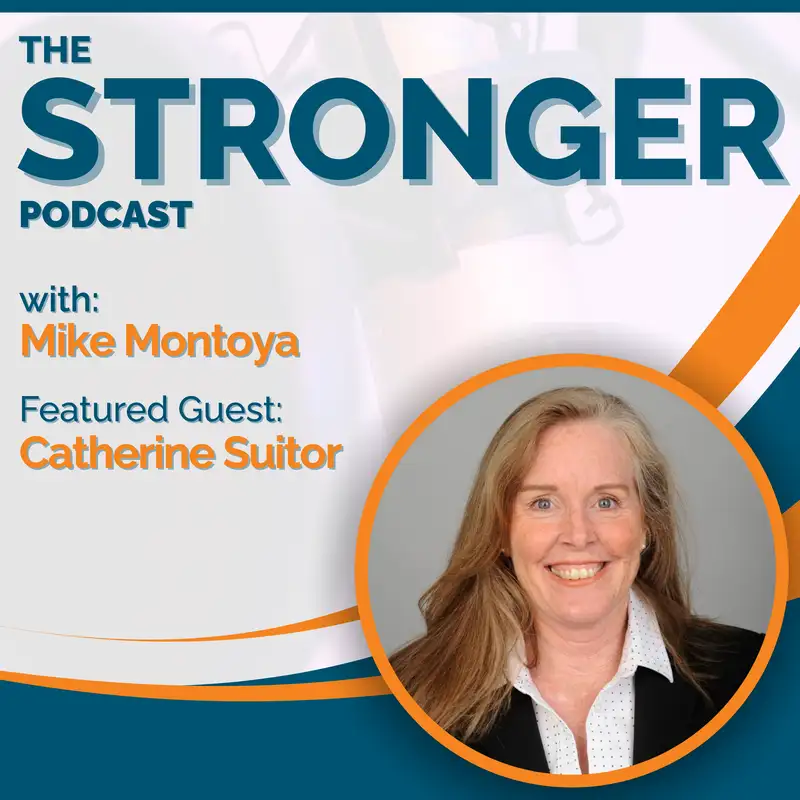
Proving Schools Can Get Better at Scale: Doubling Teacher Planning Time and Leading on Equity with Catherine Suitor
Welcome to the Stronger Podcast. Each week, we have honest conversations with education and social impact leaders about their leadership and career journeys. We talk about their origins, inflection points, and the work that they're doing today. The conversations are honest, human, and practical. If you're here for real stories and real takeaways, you're in the right place.
Mike Montoya:Let's jump in and let's get stronger together. In this episode, Catherine Suitor shares how a history major turned into a career shaping outcomes for thousands of students in Los Angeles. We talk about fundraising as storytelling, why equity is not the same as equality, and how Alliance for College Ready Public Schools is rethinking schools to better serve Black, Latino, and multilingual learners. Let's jump in. Before we dive into today's conversation, I want to give a quick shout out to podcastsmatter.com.
Mike Montoya:Their mission is to help impact driven voices get the visibility they deserve. If you want to share your message with the world, check out their website in the show notes. Good morning, good afternoon, depending on where you are in the world and when you're listening to this. I'm here today with Catherine Suitor, who is a multi year friend and colleague. Catherine and I met as part of her work with the Alliance for College Ready Public Schools in Los Angeles.
Mike Montoya:Catherine, welcome to the podcast.
Catherine Suitor:Thanks for having me, Mike.
Mike Montoya:It's awesome. So I kind of gave it away that you I think you basically live in Los Angeles now, right? But you're a California girl, I'm going to say that. Is that true? And tell
Catherine Suitor:us a little
Mike Montoya:bit about where you guys started, like where do you grew up? Like, your school? What was K-twelve like for you as a kid?
Catherine Suitor:Yeah, yeah, great question. Grew up in San Diego. I'm originally from East Tennessee, but I'm a California girl. I came here when I was five. Grew up in Suburban San Diego.
Catherine Suitor:Dad was a Navy doctor. Mom was a stay at home mom. I went to, I've like touched kind of every version between me and my kids, like every kind of education possible in K-twelve. So I went to parochial school, a really good Catholic school, K through eight. Tried out an all girls Catholic school in ninth grade and was not for me.
Catherine Suitor:Ended up going to a ginormous traditional public school in San Diego. Was a good public school, but there was 1,000 people in my graduating class. I mean, was crazy. Yeah. And I always say, if you've seen The Breakfast Club, that's where I went to high school.
Catherine Suitor:And then I went to college should at UC watch The Breakfast Club.
Mike Montoya:But if you haven't seen it, all you live it's a seminal moment. For sure.
Catherine Suitor:And actually, it's such a brilliant movie. This is complete sec non sequitur. But, like, I have like gone out and spoken to the kids in our schools, like in South LA and East LA, and I've done some presentations about my experience. I will say, have you seen The Breakfast Club? Kids today, every one of them has raised their hand.
Catherine Suitor:It still holds true. Like it is such a universal truth about like, trying to figure out who the heck you are. And that was my high school experience too. I was a surf girl. I was a stoner for a while.
Catherine Suitor:Was, you know, I was an athlete. That's kind of where I ended up at the, a cross country runner. I terrible at school, and then I decided to get it together, and I studied. And I did I did well my last two years. So, I was the quintessential trying to figure out who I was in high school.
Catherine Suitor:Went to college at UC Santa Barbara. Never in a million years would I have gotten in this today. It was because I'm like, I'm not gonna try for UCLA because there's no way. And had a wonderful time in college, you know? So, and then I moved to Los Angeles.
Catherine Suitor:So I've been to Southern California my whole life. And I swore off LA as I drove through it for years during college between San Diego and Santa Barbara. It's my adopted home. Yeah. Really I really love it.
Mike Montoya:Southern California, which is why it's so many people live there is like it has a lot of great things.
Catherine Suitor:For a reason.
Mike Montoya:Yeah. People people and and the opportunities in California, if people haven't noticed how, like, how robust the economy and and things are there because people, like, find it as a as a place to, like, really thrive and grow. And it's hard too in some cases, right, especially for as as a person without resources, right, which is one of the things we're gonna talk about. So but it's I was like, it's, like, been fruitful for you. Right?
Mike Montoya:You you're doing fine. And you're growing up?
Catherine Suitor:Yeah, know. I mean, I Yeah, I'm doing great, I guess. Yeah, I feel like very lucky, you know? I was a middle class kid, a white woman who had kind of the opportunities and privileges. It was not until I got in.
Catherine Suitor:Well, that's not actually true. In parochial school, you know, we took a religion class like we took, you know, math and science and English. And I think, you know, my first origins of like where I got this sort of drive to be of service came from that. You know, I always say, I it was Matthew, when I was hungry, you fed me. When I was in prison, you visited me.
Catherine Suitor:When I had to close, you clothe me. Like, I took it to heart. I actually believed it, you know? And it rang true to me. It spoke to me, you know, love your neighbor as yourself.
Catherine Suitor:Some pretty basic things. But I actually think that sense of service to others was rooted in that tradition. And I think that's where I first sort of got that inkling to serve others. So
Mike Montoya:Yeah. Well, it's good that they instilled that in some point in your education, right, because you're not the only guest that I've had that has, like, roots and connections to, why we including myself, like, why we do what we do, right, which is like doing our best to support the opportunities for children, but because we had a lesson, right, when we were kids that often comes from a Christian tradition in some cases. Right? But just like the idea that our parents or our grandparents or our society put that in us and said, like, you know, you're not here by yourself. Right?
Mike Montoya:And that there are others here who are not getting everything that they need as well. And so you can be part of a a better solution versus, like, I call it taking advantage of them, right, which is another part of our society, which, you know, capitalizes. Right?
Catherine Suitor:And I think there's a second half to that. And the second half to that, that's the positive half. The second half is, I was kind of picked on and bullied some. I was a flaming redhead, you can't tell now, frackled face to Dolore. You know, and it's like everybody else had a tan and looked amazing.
Catherine Suitor:And it's just like, couldn't tan to save myself. And so I think I gained some empathy for being on the other side of being somewhat of an outcast.
Mike Montoya:Yeah, sure.
Catherine Suitor:And then I actually in high school, one of my identities, I was in punk rock. This was in the early 80s. And I chose to put myself on the outside because I kind of wasn't let in in some places. So I think that's given me that sense of support of the underdog and those who are kind of pushed aside.
Mike Montoya:Yeah. Well, that makes sense. And I appreciate you sharing about that. I'm trying to picture you as a redhead now, but I imagine that you had to figure out the sunscreen thing and things like that in California.
Catherine Suitor:Yeah. Way too late did I figure it out. Met the dermatologist.
Mike Montoya:And they're like, fix these things right now. Right? Stay inside. Well but a lot of kids have an experience of being othered. Right?
Mike Montoya:This sort of being on the outside, and then they have to figure it out. Some of that's youth. Right? Some of that's society. Right?
Mike Montoya:And and then it gets easier, right, because you start to get Santa Barbara probably had, like, a plethora of children that didn't not only were they from Southern California, right, but they also had other kids from across the state as well. Do you feel like I mean, the UC system is, like, a flagship in the country with regards to public education institutions. Right? And and Santa Barbara is amongst them as well. And do you feel like it was, like, a a good preparation for life?
Mike Montoya:Career, like, was college more like because Santa Barbara also has a bunch of parties going on. I remember that too.
Catherine Suitor:Yeah. Know. Its reputation is true. But I was not a huge partier. Like I kind of got that high system in high school.
Catherine Suitor:So I actually studied in college. I did far better in college than I did in high school, which is pretty funny. But yeah, I felt it prepared me. You know, I was a history major. I went in thinking I was gonna be pre med.
Catherine Suitor:My dad was a doctor, and I took chemistry. I'm like, Oh, no, no, no. This is not for me. You know, it's the weeder, like they give it to you right up front. I'm like, Mission accomplished, Catherine weeded out of pre med.
Catherine Suitor:And then I just started like, and I did English, and then I had to take history as a part of my prereqs for that. I'm like, Wow, this is like a great novel, but it's true. And it's like, what makes humans tick? And why do things happen the way that they happen? And who shaped the way the world is?
Catherine Suitor:You know, and I still am interested in that, you know? And so did it prepare me? A 100%. Everyone's like, what do you do with a history major? And it's like, you learn to read, write, think, and analyze and be persuasive.
Catherine Suitor:That's all you like, I use the skills I learned all day, every day. I can
Mike Montoya:look at information.
Catherine Suitor:I can like decide. And if you think about my job, like, what do I do? I go out and I talk to people and I make sense of the world for people. And there's other stuff that I learned along the way or is intuitive to me, like connecting with people, and we can talk about that later. But, oh, absolutely.
Catherine Suitor:And you know, and it's funny, I've been thinking a lot, and I've always been, because I feel like it served me so well. And so I'm always looking for, you know, validation of why it was good to be a history major. But, you know, as we go into the world of AI, I absolutely believe, like, having the skills that I learned in college are, like, some of the skills you can't take away. It's like, how do you think? How do you communicate?
Catherine Suitor:And then there's other things, like, how do you, which is not really from the major, but like how do you connect with people? Like all the stuff that like, you know, before it was like computer science, it's like, that's the stuff that's going to, a lot of that's going away. Like a lot of the technical stuff, even legal stuff, you know? And it's like, but can I sit down and have a persuasive conversation? Can I make sense of what I'm looking at and make it make sense to somebody else?
Mike Montoya:And you picked it up back in back in the college days. Well and I rarely hear people say, like, oh, my college education was really the thing that I did. And, I mean, even though you're not studying history and applying history necessarily, right, in your daily experience, you're, like, leveraging, like, all these, like, human skills that that come from the left history are enormous. Exactly. And history is quite diverse.
Mike Montoya:There's a lot of things. Was there a history genre that you focus on?
Catherine Suitor:Well, I had two. The first one is hysterical, early modern England, the tutors and the stewards. Only because I love the professor and he had so much joy in teaching from that period. So I got into that, I actually wrote a thesis on the Irish rebellion of sixteen forty one. And how it prolonged Cromwell and those guys from taking over.
Catherine Suitor:Completely obscure. And then the second was I actually really got into Latin American history, and that took me into my That actually took me into my work. And out of college, I got involved in politics Central America. It was the '80s, right? And the wars were happening in Central America.
Catherine Suitor:And I got very involved in trying to change US policy in Central America. I had a lot of friends from Central America that had come here to this country fleeing the war. And so that was much tighter link for me.
Mike Montoya:Well, I appreciate you making that transition here because it's important for people to I mean, the eighties were a special time with The United States and foreign policy in in the in the Middle Americas. Right? And and that's like but it's like, we're still living with this, right, as a society now. Because I think my experience and my history lessons were, The US goes to war, we end up with immigrants from those countries becoming part of our society because it just causes the transfer of humans. Right?
Mike Montoya:And then we, as a society, are, like, kind of self perpetuating this stuff in a way that, like, we it's exciting, and it also causes all sorts of political strife, right, in our country because Yeah. Not everybody believes that that's the the pathway. Right? So I how did you
Catherine Suitor:think we have a special obligations to Salvador and the Guatemalans personally.
Mike Montoya:Well,
Catherine Suitor:yeah. And speaking about unintended consequences, know, they're always talking about MS-thirteen, the Mata Salvaducha gang. Well, guess where that started? MacArthur Park in Los Angeles. And then they deported them to El Salvador.
Catherine Suitor:That's how it became a transnational Oh,
Mike Montoya:it started, right?
Catherine Suitor:Yeah. And those were the kids of the refugees who some of them were latchkey or they didn't have parents or one parent working a bajillion jobs or whatever. And it's like that is like a direct consequence of our intervention in Central America.
Mike Montoya:Yeah. Well, and like, it's too bad that we don't I mean, this would be if AI could, like, integrate that stuff into our consciousness when we need it. Because, like, most people do not know what you just talked about. Right? They most I mean, I know a tiny, tiny bit about that experience.
Mike Montoya:Right? I wasn't living in LA. But it feels like there's so many pieces that like, oh, if understood that as an adult, right, I might think differently about how our society functions. Right? And I think I'm a pretty open minded guy, but I also like, there's a lot of ignorance I have, which I just don't know because there's too many things to know.
Mike Montoya:Right? Yeah. So and you so you're political as a young person and got involved, but then you kinda started a career in helping. Right? So, like and and you have a very special skill set.
Mike Montoya:So the for our audience to know, like, Catherine is the is the executive director of the foundation that is associated with the Alliance for College of Public Schools, which is a separate entity, but the foundation is there to support outcomes for kids from from an external perspective. But you have this, like, long track record of being able to, like, create vision and imagine ways for for money to flow into supportive systems. Right? So just tell us, like, how did did you, like, learn to be a fundraiser on accident, or you just like, someone taught you, said, like, like, what was the get there. Yeah.
Catherine Suitor:And it started in that early work, right? So when I got out of college and I worked in these solidarity organizations, I mean, they were as grassroots as grassroots get. We were not even a C3. We were at C4. And one of the things, we had to do everything.
Catherine Suitor:Write a press release. I learned how to write a press release. Organize like a tabling or a phone bank. Figure it out. Set up the database.
Catherine Suitor:I used to sit in front of that blaring C prompt, and had to put in commands for debase free plus to like, Oh my God, floppy disk, the whole nine. But fundraising, you needed money to function, right? And so we had to go out and raise money. And, you know, there was some awareness and, you know, and I always joke like, a lot of the Salvadorans didn't culturally understand and couldn't make the connection on like, you know, look at me, I'm like about as apple pie as you come. And, you know, I could just go out to talk to people in this country and like break it down and keep it simple.
Catherine Suitor:And talk about what was going on and what we needed to change. And I think one of the things, you know, I think a couple of things. One is I'm pretty good at like making complex things easier to understand or sort of break it down and make it human for people. The other thing is I believe people basically want to be good and want to do good, right? And, you know, it gets challenged sometimes, especially these days, but, you know, and it's just giving people the opportunity to do something good.
Catherine Suitor:When you help somebody, how do you feel? You feel amazing. Right? And like, so I, from very early on, I understood I was giving people the opportunity to help somebody else. Maybe it was writing a check.
Catherine Suitor:Maybe it was going to a demonstration back in my, you know, more radical days. Maybe it was, you know, calling their congressmen to ask them to change it. Whatever it was, like, you gave people the sense that they could make a difference. And that is true through every single job that I have. I think about all, and that's a through line all the way through.
Catherine Suitor:When I think about the people that support Alliance right now, they don't generally come. We have some board members that, you know, have come from the communities we serve and have been very successful. But we have a lot of wealthy people or people who are middle class growing up, but they just want to be they want to do something meaningful. Yeah. And people want to do something that feels good.
Catherine Suitor:And that is what we are giving people the chance to do. And so that's kind of how I got into it. So the other thing is like, I would go out and like, I could look somebody in the face and just ask them. And I learned a few tricks of the journey And along the I always like, and I didn't fall over and die after, you know, of like shame. I'm just like, Of course, like, would you like to do this?
Catherine Suitor:And so people are like, You keep doing that, Catherine. It's a muscle, as well.
Mike Montoya:And I raised a fair amount of money in my life too, and we train people how to do the ask thing. And it's a real it's a gift, right, if you're able to do it without the the fear and the pain. Right? Because, like, you have to do a lot of asks to get lots of yeses. Right?
Mike Montoya:And and that's You have
Catherine Suitor:to get a lot of noes too.
Mike Montoya:You can teach it, but, like, sometimes people just have it. So it sounds like you could just kinda had this, like, I don't know. I call it the the magic the magic touch, which is like, I'm willing to have make the conversation possible to have this person be willing to have a conversation with me about money. People in this country, like, really don't like to talk about money, right, many times. Right?
Mike Montoya:And so it's, like, a hard thing for us to get over. So is there I don't know. Do you have a way of preparing for the ask when you're I mean, there's lot of technical things, but hi, if but you when you're ready to do thing, what do you do?
Catherine Suitor:What do I do? Well, I think the most important thing is, is like knowing the person as best as I can before I go in. And so, and, you know, very often I've had conversations with them before. I try, I always say, I remember talking, I had a staff at another place I worked and I'm like, What do they care about? He'd come back and he said, They care about education.
Catherine Suitor:And I'm like, No, no, no, no. What makes them tick? Yeah. And so I'm always looking for like, what makes somebody tick? What's their driving motivation and why do they care about this?
Catherine Suitor:And I try to speak to that, you know? And so I try to mentally go in and think about, it's not just a pure rap, if you will. You know, I think when I first started, like, you know, I had a rap and a pitch and, you know, and all that. But it's really listening and understanding what matters to the other person and trying to match. I say we're the fundraisers or the nonprofit jentas.
Catherine Suitor:We're matchmakers, right? We're matching the needs of the organization with the desires and aspirations of the supporter. And sometimes, and so that's really what I try to look for in the conversation. And so I speak directly to that when I'm talking to them or, you know, so I don't, that's how I prepare That's what matters to this person? And if it's for the first time going into a conversation and I'm not really sure, right, I have some, maybe some background of what they've done somewhere else, but I don't really know them.
Catherine Suitor:I spend a lot, a lot of time asking questions.
Mike Montoya:Getting to
Catherine Suitor:know them and understanding who they are. And so, you know, lot of listening and speaking to the needs of the person that I'm talking to.
Mike Montoya:I'm going to pause the conversation here for just a second to talk about books that matter. Every entrepreneur or leader needs a book that elevates their business, builds their credibility, and makes an impact. If you've got more money than time, a ghostwriter can help you build your story. If you've got more time than money, a great book coach can guide you step by step through the writing process. If you have already written a draft, these folks can save a lot of trouble and money by shepherding you through the publishing process.
Mike Montoya:Head to booksthatmatter.org and get the custom support you need on your book idea or manuscript. Well and it it takes, like, a there's a lot there's a high I don't think you're giving yourself credit here with, like, a very high level of EQ is is one component in actual empathy, right, and ability to, I call it, build rapport and connection between a human in a quick fashion. Right? Like, you're not spending hours with these folks necessarily, right, in order to prepare for it. But you have these, like, moments, right, where you have, like, you're having dinner together or you're on a school visit sometimes.
Mike Montoya:Right? Or you're bringing people together in a in a form of some sort. So, those are, like, but they're still kind of fleeting moments. They don't last a long time. And so I think fundraisers who are really great at this, they have a gift of being able to, like you said, bridge those things and listen very carefully.
Mike Montoya:Right? And to I think you're used you know your craft so well now that you're growing up, mean, to call that lots of years experience really matters in this space.
Catherine Suitor:For sure.
Mike Montoya:For sure.
Catherine Suitor:For sure. Part of the learning is missing the mark sometimes you know, and thinking, you know, or
Mike Montoya:so. Yeah, it's a thing. I know it's such a thing.
Catherine Suitor:I think it's
Mike Montoya:a both. Have
Catherine Suitor:to say it gives me like people like, Oh, I could never do what you do. And I'm like, Are you kidding? I have a wonderful job. Once you can get past, like, they're not rejecting me. I'm not asking for myself.
Catherine Suitor:Right? And you never know why people can't give. Maybe it's just not their thing right now. Maybe it is a timing question. Maybe There's a million reasons.
Mike Montoya:Right?
Catherine Suitor:Honestly, once you get the visit, you've already practically got the money because I'm very clear when I go visit someone, like to talk to them, am coming to talk to them. You don't trick them into the visit, right? Like the other thing is being, I think, being respectful, right? Again, going back to my basic belief, people want to do good and be good. And so I try to be respectful of people.
Catherine Suitor:So, yeah.
Mike Montoya:Well, and maybe that that word is I don't want to gloss over it. The idea of having a core basic respect for for another human. Right? That and that they and the assumption that, like, most humans are good, right, and want to do something, you know, that feels good. We all get a thing in our body, in our system when we give.
Mike Montoya:And there's lots of data and research about how we feel when we're contributing to something, whether that's taking care of our children or whether that's showing up for a project or whatever. We just feel better in some ways.
Catherine Suitor:Purposeful. People want to be purposeful.
Mike Montoya:Yeah. And all the research said, the older you get, the more purpose you want to have, which is a great time if you're a wealthy person to be. So, I mean, I always like to call out for folks and I guess for folks to know, like, if you wanna learn more about Alliance for College Ready Public Schools or the foundation that's there, like, we'll put the show notes. There'll be information on how to contact Catherine and her team if you're interested in learning more about the Los Angeles projects. So Alliance is, like it's serving, like, 12,000, 13,000 kids.
Mike Montoya:Right? And it's got, like, 24, 25 schools, and they're all public charter Yep. Tell me tell me what's going on that's new there. I think you guys have a couple of things that are really important and exciting happening at the Alliance. So can you tell us a couple of
Catherine Suitor:think it's important and exciting.
Mike Montoya:Well, I think the thing that I know about Alliance is that, like, you guys have started to really lean forward with what I call a very progressive stance around racial equity opportunity for especially Black children, right, and and and Latino children in Los Angeles, which is like the majority of your student population, not not exclusively.
Catherine Suitor:Pretty much all
Mike Montoya:of them. A huge thing. Right? And we and all the data shows that Black kids don't do as well our society for all sorts of reasons, but Alliance has kind of taken a stance on this. Right?
Mike Montoya:So I wanna hear a little bit about that and how and not that you have to explain the data and all that at that necessarily, but just tell me, what's the attitude like in this environment now, and how are you guys leaning into that?
Catherine Suitor:Well, it's a great question because there's been a movement and a decline around this. All, I was just thinking about this today, like all moments when there's an uprising. This happened to me in 'ninety two, I worked at the Central American Refugee Center, and the LA uprising happened. And I remember the executive director saying, The gravy train's gonna come through. Let's make the most of it.
Catherine Suitor:And sure enough, people were shocked, because we were in the neighborhoods that were affected. And it's kind of like what happened again after the uprising, after George Floyd, right? And again, and then we're seeing it dissipate, right? You know, in a rather dramatic fashion. You know, it didn't just peter out, it got attacked.
Catherine Suitor:But before, even before that happened, we were, you know, we're in LA, the majority, like low 90% of our kids are Latino, like anywhere from five to 10% have been African American or, you know, black, over the years. And our kids are black scholars. We're not doing as well. And we're just like, we need to change what's happening because our commitment is to serve low income Black and Brown kids because they have not had the same opportunities. And we're not doing a good job by our Black scholars.
Catherine Suitor:So we need to change what we're doing. So we started looking at that around 2018 and really just started dissecting like what was going on, what were the patterns, what were the trends, what were the whys? And then 2020 happened and it sort of accelerated the work we had already started. We did a lot of surveys of our Black scholars and families with Black board members and just amongst themselves, like, what are we doing well? What are we not doing well?
Catherine Suitor:What do you need from our schools? And that was really important learning. And they're like, Here's all the places you're falling down. And again, because they're such a minority, and they probably always will be because we live in Los Angeles, right? You know, have to make the extra effort to help a minority.
Catherine Suitor:And I mean, like, you know, if it's 10% in your school, it's a minority, right? And like the most we have in any school is 30%. You have to really go out of your way to validate and make sure folks feel seen and understood. But there's, you know, so, you know, our guiding philosophy is if you can make it work for the most marginalized, for lack of a better word, you know, and for us, that's Black scholars, multilingual learners, and scholars with disabilities. If you can figure out how to, like, make it inclusive enough so that they participate, it's going to help everybody because you've created the environment for everybody.
Catherine Suitor:And it's not, you know, and it's been interesting trying to like explain it to a 97% Latino population why we say we're pro Black, you know? You know, and it takes work and it takes time, but it is the vision that we are committed to. And the good news is our Black scholar enrollment has started to slowly go up because we didn't go out and just say, Oh, we need to recruit. The first thing we said, We don't have a representational number of Black scholars in our schools. Like, why is that?
Catherine Suitor:We should more. We should be serving more Black scholars. But we said, We can't just, like, try and bring them in. There's a reason they're not coming or they're not staying. So first we like, we're just really focused on making the culture better.
Catherine Suitor:And, you know, it's simple things like BSU is on every single campus. Like we have Black scholar graduations, like just making the presence and celebrating the culture much higher. And over time, we have had Black Scholar enrollment increase across the network. You know, slow baby steps, total numbers and percentages over the last three, four years, which is really gratifying, means they're deciding to come and stay. But, yeah, I mean, you know, from the beginning, we said we were going to go into the neighborhoods that had the lowest performing schools where schools are the most overcrowded.
Catherine Suitor:That's what we started with when we started Alliance. Like, we believed every kid could succeed, but the system was failing poor Black and Brown kids. So we intentionally opened schools in those neighborhoods. And really taking that pro Black stance today is just living into the original mission of serving those scholars well.
Mike Montoya:Well, Alliance was and thanks for the story about where you are now. The Alliance was started by black woman, Alex. Judy. Yeah. Judy back in, I don't know, the nineties, right, something like this, somewhere in that era.
Mike Montoya:No.
Catherine Suitor:No. '24 was our first school year, '4. So about twenty one years.
Mike Montoya:Okay. So 2004, yeah, so a while. Idea A while. And so there's a legacy here. And you guys are building on that work.
Mike Montoya:Right? And you've expanded certainly the footprint of of the alliance over many years. And now you're trying to, I call it, go deeper and more carefully with with all students. Right? Which is like you know, we a lot of school systems talk about, like, we're gonna serve all kids equally and effectively.
Mike Montoya:And a lot of them can't. And most schools are falling short somewhere in the picture of excellence for all of
Catherine Suitor:Well, equality and equity are two separate things. Different people have different needs, right? People show up to the door differently, right? If you're a multilingual learner, you have a different set of needs, right? If I treat you just the same as the kid who had three generations of families here, you're not going to get the education you need because you don't speak English fluently yet.
Catherine Suitor:I mean, that's a very simple way to explain it. But, you know, people show up with different needs. And so you have to meet people where they're at. The goal is to get them to the same place, right, which is to realize their best self. Right?
Catherine Suitor:Not like everybody has the exact same score, but like to realize their individual potential. But they have different needs when they walk in the door.
Mike Montoya:Yeah. And you have to be committed as organization and a systems builder, right, to, like, be like, hey. We're gonna do all the things that we can to, like, clear the path and make it possible for kids to get what they need. Right? And that's, like, that's a huge commitment.
Mike Montoya:It takes a lot of resources, which is part of why you're raising money. Right? You're raising resources. There's another push, though, in California, and and there's always this massive tension amongst charter schools versus traditional public schools. And, like, you know, enrollment now is is a consequence because, like, kids are leaving the greater the big cities and moving around in various places.
Mike Montoya:And so there's there's tension between, like, the school districts and the charters that's always been in place, right, in California specifically. But, like, how are you guys working together as charter sector, right, to, I call it, advocate for the value of of a choice. Right? Los Angeles has really one of the largest choice environments in the country in terms of numbers of total kids. Right?
Mike Montoya:But how is that going? Like, and what are you guys doing with regards to the advocacy work?
Catherine Suitor:I think, I mean, it's so interesting. There's just been the trajectory since I've been here at Alliance since 2011. And the difference between when I started in the first few years to like where we are now, it is a totally different political environment. Like somewhere around 15 or 16, like folks, let's just say, how long do I want to say this? In the status quo, representatives of the status quo started to say, Oh my God, there's too many charter schools.
Catherine Suitor:They're taking our kids like they own Yeah. To make a concerted effort to go after charter schools. That was not the case when I first came the first couple of years. Was much more congenial.
Mike Montoya:More than
Catherine Suitor:threat. It just got more and more Well, and in fairness, like as the number of charter schools go, 25% of the kids in Los Angeles are in charter schools now. So that's a real large number of kids. And when dollars follow the kid, that's where people feel threatened. And I just, you know, it's unfortunate.
Catherine Suitor:I think traditional school systems, at least let me just speak to Los Angeles. I don't know what's happening. I know what's happening in other places. And I know there's some places where the relationship is a little more congenial. You know, our hope was always that we could spur on, like we could be removed from the constraints of the regulatory burden and be more innovative.
Catherine Suitor:Like traditional public school, it was a monopoly system. It had no incentive to change. Kids showed up no matter what. And the idea was like, let's create these innovations, schools of innovation where we, and this was the promise, is, and I still think Alliance is that, like where we can do things differently and hopefully spur the, you know, the ecosystem to do better, traditional schools to do better. Like when we started, our goal was never to take over public education.
Catherine Suitor:Our goal was to do it big enough at scale to prove you could run at the size of a district consistently good schools. It wasn't a one off superstar principal that was doing well in spite of the bigger system, right? And you could build a system of good schools. And so this is still our goal. But unfortunately, I do think there's been places where we have pushed the traditional school district to do better.
Catherine Suitor:Their graduation rates are significantly higher because we came in and we're graduating 100% from the get go. Same kids, somehow we are graduating 100%.
Mike Montoya:Yeah, versus
Catherine Suitor:like 60%. It was 49% when clients opened. LAUSD was 49% graduation rate. So like they're 82% now, right? At least there's some sensibility, like this is what they should be doing.
Catherine Suitor:So I do think there's things where we've done better. They have created, you know, they've diversified their choices inside of their own system to give parents choice in different kinds of schools and good for them and good for them. So I do think we have pushed, but not probably enough because, you know, we believe parents should have the choice to find a school. Like any middle class and upper class family has a choice. My family had a choice to send me to parochial school.
Catherine Suitor:Right? So, and, you know, but when it comes to poor kids, they don't have a choice. You just go what's in your neighborhood, right? And where they have no incentive to change. And that's what we sought to break up.
Catherine Suitor:So, you know, I think now, unfortunately, enrollment is declining because birth rates are going down across the country and in California and in Southern California, people are leaving because it's too bloody expensive. And so there is a lot of pressure. So the tension is very, very high because enrollment is what keeps your school open. So the work that we are doing is actually going back to our original roots to build relationships with our elected officials, but to advocate for that which is working, to showcase our best practices. We just released a big report on work we're doing with our educators to completely redo the school week, doubling teacher planning time, which after pay is the number one complaint of teachers.
Catherine Suitor:I don't have enough prep time. So we went in with a couple of schools and we figured it out and we like doubled the time. They helped construct it with us. Teacher retention is higher. Scholars are doing better.
Catherine Suitor:It's really working. And so we're slowly expanding it. So we did a report with ERS. We've taken it to Sacramento. We're taking it on the show, on podcasts and conferences, in traditional settings, in charter settings.
Catherine Suitor:Again, going back to our roots of we want to make all schools better. We found out something great. And I can imagine there will be a place where we have to start pushing against like seat time and some of the constraints of state law. We're not quite there. But the more we kind of evolve the model, I could imagine hitting that wall.
Catherine Suitor:But back to the advocacy question, one of the ways we're advocating is advocating for what works and like lifting up. Here's the good work charters are able to figure out. We're, you know, sometimes the complaints are charters don't share what they know. And it actually takes a lot of work, right? Like the foundation, like we raise all this money, we can do that work, right?
Catherine Suitor:Traditional schools are so busy just trying to like run the school. But we're trying to, that's how we advocate, like for what is working. And we've taken it to LAUSD. You know, we've taken it to We're meeting with school board members. And it's a proactive way to also, when we show up for our charter renewals
Mike Montoya:Like, look, we're
Catherine Suitor:That's the alliance. They're doing really good work, you know, and they're serving our communities. We're building political alliances with our city council members, with our assembly members, our state legislators. You know, we want to be, we're doing, I call it, we do defensive advocacy, like just build those relationships and like be able to fight back. Organize and mobilize our parents.
Catherine Suitor:And I say proactive advocacy, which is like sharing the best practices, what's learning, being supportive of others. I think in the long run, that's going to get us the most and then we'll have more people willing to defend us.
Mike Montoya:Just want to say that if you're a leader, entrepreneur, or business owner who needs some support, there's an easy way to get a think tank behind you and your vision. The Genius Discovery Program at Thought Leader Path is like having your own one on one incubation and acceleratorship program. They'll help you develop an approach based on your own story and your plan for impact and offer the tools and thought leader assets needed to really amplify your message, including launching a podcast like this one. If you're ready to stop grinding in the dark and start making real impact with the right support, check out geniusdiscovery.org. Yeah.
Mike Montoya:And it's I mean, I'm really and so we'll make sure that we'll get the the links and put the the report in the show notes so people can access the right information. So Okay. It's important for people to hear some of the the lessons that and and I think that charters are learning a lot of things. Some of them do a better job of telling the stories and sharing the information than others. Right?
Mike Montoya:But a lot of people aren't listening either. Right? Like, nobody's like, only only policymakers. And when they're when they're up against the wall, they start to pay attention. Right?
Mike Montoya:And I'm using the word they very generally, which is like all of us in the public sphere are just like, we're not really paying attention to what's going on in schools unless it's our job to do that. Right? And so it's it's important that people who are responsible for these things, like, listen and talk to each other, right, in ways that, like I would say, like, most educators that are ever met care about children in ways that, like, are like, that's their fundamental, like, DNA. Right? They, like, wanted want kids to do well.
Mike Montoya:And and and all of us, it's just noise. Right? Like, we're fighting with each other. But, you know, like, economics are a real thing. Right?
Mike Montoya:When you have buildings and taxes and real estate and all that stuff becomes a pressure point, right, for people. And and nobody wants to be the one that's running the bankrupt system, but there are plenty of those things going on. Right? And I think it's like it's a the challenge as our society evolves is for us all to adapt, right, to the real circumstances of now versus what we wish it was in the eighties or something like that. Right?
Mike Montoya:Because it's just not the same.
Catherine Suitor:For sure. No, for sure. And I think one of the things yes, for sure. I'll give you another example of where we lead. And we don't talk about it a ton, but we live like, we're pretty good on enrollment.
Catherine Suitor:We've had a minor decline, right? But we had a pocket, one pocket in Northeast LA where the demographics have radically changed. And every school in that neighborhood is like feeling it. And we had two schools less than a mile and a half from apart from each And we made the decision because one of them was to close it. That was last year.
Catherine Suitor:And, you know, that was a responsible thing to do. And we put all this extra money into it. We tried to revitalize it and there was not enough kids and a demand system. And so we decided to close the school. We did a year long process.
Catherine Suitor:It was very engaged with the people in the school. We tried to merge, have them like go to the school a mile and a half away and guarantee the kids a seat and educated for a year, a place. But, you know, usually when there's a school closing, you know, you go to a school board meeting, it is like all hell is breaking loose. Right? And even if it's the right thing to do, and it was the right thing to do.
Catherine Suitor:We had less than 200 kids. You cannot run a high school. So we could not serve those kids the way they need to be served, and we couldn't keep subsidizing it forever because it was going to hurt the whole system. And we went to LAUSD school board members just to share with them because they're our authorizer. Here's what we're doing.
Catherine Suitor:These are the steps we've taken. And we had a school board member say to us, You should teach us how to do this. You've done such a good job. Because there was no, you know, protest. People are like, This is what we need to do because we did such an inclusive process.
Mike Montoya:Oh, back to the respect thing. You're caring about the community, you're respecting adults and children for who they are, and you're dealing with reality of finances, numbers, things like that. And a lot of the reasons that, like, school populations shift are, like, way beyond the school's performance. Right? They're, like, they're, like, macro things.
Mike Montoya:Like, it's too expensive and or the giant fires or, like, things like that happen, right, in our society. And, like, we have to respond to those things, and we can't just expect to be like, oh, it's status quo forever, which is how we got in some ways to where we're at as a public school system. We're, tough.
Catherine Suitor:Well, and it's yeah. And it it's really Yeah.
Mike Montoya:We had to keep we had to keep growing. Mean, I it's more like it's just like adult. We we grow, but we grow, we change, we morph. You know, our hair color changes, like, way we function in society. Like, you know, like, that's kinda what we are.
Mike Montoya:Right? And, like, if you don't adapt right? Like, I think that's one of the greatest things about, you know, humanity is that, like, we're highly adaptive. We got these, like, big brains that, like, help us figure shit out. Right?
Mike Montoya:And that's, like, something to be celebrated. Right? And, like, as opposed to be like, oh, we're we're broken. Right? We can't fix things.
Mike Montoya:Right?
Catherine Suitor:Yeah. I think one of the things that I feel very, I guess honored to be part of the Alliance is it's very much holds on to like forward looking like what's coming down the pike. How do we continue to run schools that are relevant to today but are anticipating what's coming down the pike in the future? So like this teacher planning time. Like, we know people are not coming into the profession.
Catherine Suitor:Fifty percent of teachers, there's just a study by Ed Week that said fifty percent of teachers are planning on leaving You know, that's a problem. And we're like, what are we going to do to make, and there's only so much you can do to pay teachers more. We pay our teachers more than anybody in L. A. But like there's only so much you can do on the public dollar with that.
Catherine Suitor:Right? And so we're like, how are we going to make schools work for teachers? What do they need? Because we're okay now, but that shortage is like coming
Mike Montoya:for Like us
Catherine Suitor:you said, it is bigger than us. And so that's why we created like, let's try and make it sustainable. How do we make school sustainable? And worked with our teachers to build it. And so for me, we're looking at AI and it's like, you could sit there and put your head in the sand and say, AI is not happening.
Catherine Suitor:And like, there's a lot of things that we need to like regulate around AI and like be careful with and all of that. But it's happening. And it's like, so are we gonna figure out how to make it work and as a tool for education to support our teachers? Or are we gonna put our head in the sand and say, we're gonna just keep it outside, It's not gonna happen. And so, when we're doing some pilots with AI and having some really great success, like in English language arts, and again, building with our multilingual and special ed students at the center of it.
Catherine Suitor:And so all kids are thriving. And they're actually doing better with it, by the way.
Mike Montoya:Good news, actually.
Catherine Suitor:But I think that's one of the things. Yeah. I think it's one of the things I feel really privileged and honored to be part of Alliance is like, you know, taking care of today, but actually, like, constantly planning for and anticipating and getting ready for the future.
Mike Montoya:Well, that foresight, right, that interest in being thoughtful about what's coming ahead, right, is like a it's almost like it's like a tenet of why alliances is doing well. It's because, like, there's been a history of leadership, like, to be thinking about that stuff in the in the longer term, not just today. There are always crises. There's always another one. Right?
Mike Montoya:There's always another huge challenge today, this week.
Catherine Suitor:Oh my god. In a in a in a k 12 environment?
Mike Montoya:Yeah. In five and eight. At least well, yeah. And it's like and there's all the unknown pieces that, like, we don't ever know is coming. But, like, the things that you can anticipate that you can sort of see happening or anticipate happening, like I said, AI is here.
Mike Montoya:It's not going anywhere. Here we are. We all we got we gotta live with it together, right, in in in a way that and if we can, like, I call it, help it not become an instrument of of terror or or terribleness, right, for folks, right, where people are ostracized and pushed to the side, right, then then we have a better shot, right, of having, like, a healthy place to live. And I think we all kinda wanna live in a good safe space and have opportunities for ourselves and our families, things like that. Right?
Mike Montoya:And and it's hard it's hard to sort of adore the the realities, right, of our society right now. So do you do you have do you have a I'm gonna shift gears here just a tiny bit and think about this your career is without saying you've done it a long time. Right? And so and and and there's a moment in that space.
Catherine Suitor:Right? Fuck. That's great.
Mike Montoya:We're both grown ups, like, older than 40. So You have a mature experience. Like, so is but if we're thinking about, like, the generation, you know, younger younger folks that are entering the workforce that are part of the workforce now that are even part of your team, things like that, like, are there ways that you're lead now that, like, you that you rely in terms of your leadership competence, right, and and tools in your toolkit that you're like, hey. It would be important for young people to hear that these are the skills to develop, right, and to lean into in their earlier career stages. Right?
Mike Montoya:Like, is there anything that you've like reflected on that you would sort of share as wisdom or advice for those folks?
Catherine Suitor:Think Well, it's funny. I think Yeah. I think I always There's a lot of things. I'm going to kind of break it down, like skills, like attitudes. So on the skills, you know, one of the things I always talk about, you know, we're in a small team.
Catherine Suitor:We have eight people at the foundation. So there's not like, it's not a big institution where there's huge opportunities for promotion. It's the biggest challenge that I have, right? As I bring in younger people, totally understandably, they want to go up in their career over time, right? They don't want to be an associate or a manager for their entire life.
Catherine Suitor:And there's just not a ton of movement. So I really try to show them, here's the advantage of a small organization. You have access to the high level thinking. You were in and you could see and think about the big picture, and this has been my own experience. Like, that's how I started off.
Catherine Suitor:And you get to touch everything. You get to hear the conversations. They come to my board meetings, right? They hear what my board members talk about. They can have a relationship with my board member.
Catherine Suitor:If you're in a giant, like even at Alliance where they have 1,500 people, they don't all know their board. They're not having access to like the strategic conversations. So I like to say, take advantage of these things and participate in them. Like, here's an opportunity. I will give you all the opportunities in the world to touch and try and do new things and to take a piece and to lead on it, right?
Catherine Suitor:You'd never get in And huge a siloed organ. Like when it gets bigger, specialized because you can't have the luxury. We have people who have specialties, but like
Mike Montoya:Yeah, I just have one person do a lot
Catherine Suitor:of things. Myself included. So like on a skill, but that's how I try to like talk to them is take advantage of trying a lot of new things. And then I have a whole other set of things. My wisdom is like the cycles I've seen, like everything feels new to them.
Catherine Suitor:There's just, there's cycles in our society and what happens. There's been cycles in nonprofit social change that have happened. So when I started in the 80s, it was Central American solidarity and anti apartheid movement, right? Nelson Mandela was still in jail when I got involved. Remember going to see him speak at the Colosseum after he got out.
Catherine Suitor:And, you know, it's new for them the first time, right? And so I try to show the pattern, go back to my history major, I try to show them the patterns and the learnings from past cycles of similar experiences. So going back to that thing, we had the nineteen ninety two civil unrest, riots, whatever you want to call it, LA was a flame, right? Then we had 2020. So when we were here in 2020, and it was a national uprising, right?
Catherine Suitor:There was very similar patterns to some of the stuff that was happening back then. And I tried to, you know, and there was all this conversation. I'll give, this is perfect. There's all this conversation about language and what we do is communicate all day, every day. And the right way to say everything and what do you call people and da da da da da.
Catherine Suitor:And I'm just like, okay, since I've been working, people were black and then they were African American, and then now we're Black again. Right? And before that, they were Negroes, so they were not called, the N word. Right? And it's like, and it's just like, what does the person want to be called, for one?
Catherine Suitor:But like, know, some of the policing that happened more recently. And it's just Guys, I got news for you. All of this is going to change and there's going to be new vocabulary and words. So that's the experience of living through the cycle. So I've spent a lot of time with my staff of like, how do we write so people know what we're talking about?
Catherine Suitor:Like, the buzzwords, drop the code, talk to people like human beings. Get out of edgy speak, get out of, you know, don't kill me when I say this, PC. We don't call it PC Like, that was from the other era. And just like talk to people like they're human beings and like assume they want to do the right thing. And so like, that is like a lot of the stuff I spend my time on now.
Catherine Suitor:Like hard skills, sure. Like other things that I'm talking about with my team is like, how do we use AI so we're all like learning together? I'm like, teach me. Show me how We're all showing each other how we're using it. And we're going to have a conversation at our retreat coming up.
Catherine Suitor:And it's going to be, what is it? Because now I find my staff using AI for stuff. I'm like, oh, that's what we should be using AI for. Because it just sounds like boring language and it doesn't feel authentic. And we're going to have a conversation about what is AI good for?
Catherine Suitor:And what is AI going to change in how we work? And what is it that we uniquely bring as human beings to our work? And I really want to get them focused. They see this podcast, they're going to know what the retreat's about. But I really want to get them focused on the importance of building authentic relationships with people.
Catherine Suitor:AI is never gonna
Mike Montoya:do Well, and I think that maybe that's the through line from this conversation that I'm picking up. It's like the actual connection between humans is part of the magic of what makes it possible to achieve things that aren't done yet, right, and that are important, and that it can't be it can't be done in a vacuum. Right? It's not an isolated individual experience. Right?
Mike Montoya:And it requires, like, sensibilities and attachments, right, to humans in ways that, like, we have to be open enough to have a conversation, trustworthy enough to follow through on our activities, and to listen to people in honest ways. And you said it at some point, keeping a certain image or human, a student in the middle of this whole thing, whether that's the Latino kid or the black kid. Right? Like, those those those children, right, are, like, the purpose. Right?
Mike Montoya:And the rest of us are here to support that, at least in the context of right? And, like, that's our job, right, is to support the the generation that is in school now and into the future. And then they will hopefully do that job for the next generation as well. Right? But, like, we're the adults in the room right now.
Mike Montoya:Right? And, like, that's our job. Right? And that this is what I think we all get better at, right, when we pay attention to listen to listen to the experience. We also bring your own experience.
Mike Montoya:Right? And like that, those two things together, right, are making this incredible organization that's super effective in getting things done and a strong appreciation for you and your team. Catherine, I know you have an amazing board, and I worked with some of them folks. And so I'm just gonna give a shout out and a thanks, right, to the board of the foundation that such a strong strong contributions. Right?
Mike Montoya:Like, these are people that don't have to do this work. All this is a volunteer stuff. Everybody should know that. Right? Like, these boards, it's overpaid.
Mike Montoya:Okay.
Catherine Suitor:Yeah. It's amazing. Think about that. They pay us
Mike Montoya:to It's incredible. There's lots of boards that get paid to do stuff. These boards don't get paid to do the things like that. And it's wonderful to have people that are committed and interested in the work. And, Catherine, thank you for your leadership and the work that you're doing.
Mike Montoya:And and we invite you and your team. And and I think well, I would like to tell more stories about Alliance and and the work that you guys are doing in the future. So, like, make sure that we take that opportunity down the road to to go forward.
Catherine Suitor:I'd be happy to there's lots of amazing people, particularly in our schools, you know, and serving kids. There's a lot of
Mike Montoya:You
Catherine Suitor:know who we
Mike Montoya:do. After we finish the recording, but then we'll make a list. Alright. Thank you so much. Yep.
Mike Montoya:This conversation is a powerful reminder that progress comes from both conviction and adaptation. Catherine's leadership shows what it looks like to honor mission, respond to changing realities, and keep building schools that meet students where they are. Thanks for joining us. Thanks for joining us and tuning in today. To find out about other podcasts that matter, visit podcastsmatter.org.
Mike Montoya:Thanks for listening to The Stronger Podcast. If this conversation inspired you, we invite you to follow the show and share it with someone who's on a journey to become a happier and healthier version of themselves. Links and resources are in the show notes. See you next Thursday, 9AM eastern time. Have a great day, and stay strong.