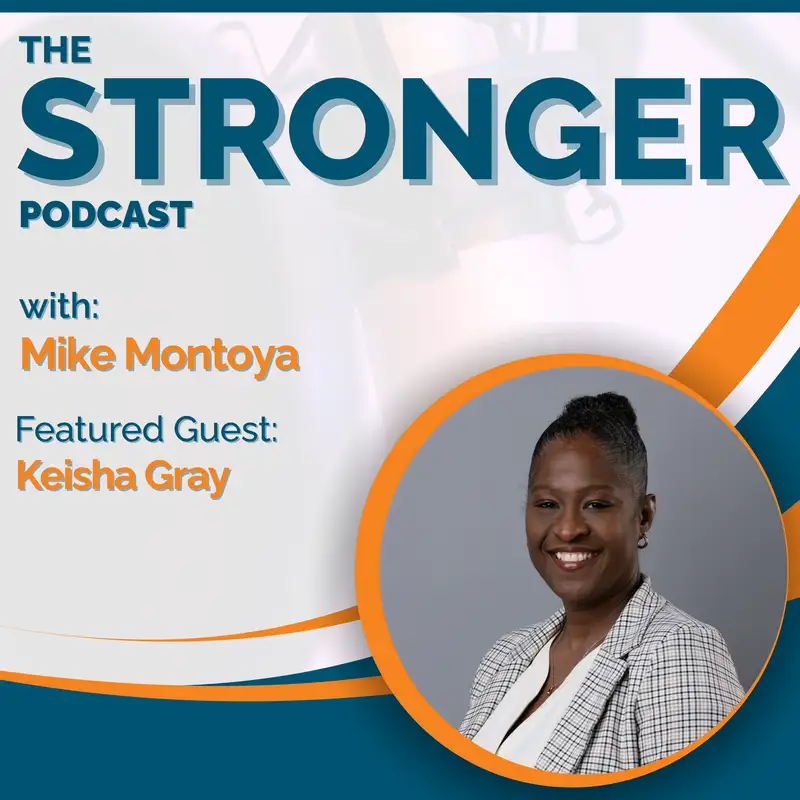
Nothing Goes to Waste Unless You Decide It Does: Cradle to Career Work, Coalition Building, and Spartanburg's Long Game with Keisha Gray
Welcome to the Stronger Podcast. Each week, we have honest conversations with education and social impact leaders about their leadership and career journeys. We talk about their origins, inflection points, and the work that they're doing today. The conversations are honest, human, and practical. If you're here for real stories and real takeaways, you're in the right place.
Mike Montoya:Let's jump in, and let's get Stronger together. Welcome to the Stronger Podcast. Today, I'm joined by Keisha Gray, the chief operations officer at Spartanburg Academic Movement, a cradle to career organization helping to create long term opportunity and economic mobility across Spartanburg County, South Carolina. We talk about why this work is hard, how cross sector collaboration actually gets done, and why Keisha keeps photos of local students in her office as a daily reminder of who this work is really for. Let's jump in.
Mike Montoya:Before we dive into today's conversation, I want to give a quick shout out to podcastsmatter.com. Their mission is to help impact driven voices get the visibility they deserve. If you want to share your message with the world, check out their website in the show notes. Good afternoon, everybody. I'm here with my friend and colleague, Keisha Gray, who is someone I met a couple of years ago through our work at Stronger Consulting.
Mike Montoya:So, Keisha, welcome to the program.
Keisha Gray:Thank you. So wonderful to be here with you in space. Thank you.
Mike Montoya:It's amazing. And you have this, and people will see this, there's an amazing image of somebody behind you. Can you tell me about who this this person is or what's this about?
Keisha Gray:Yes. So I have the wonderful pleasure of working for the Spartanburg Academic Movement. We are a nonprofit organization focused on cradle to career supports across Spartanburg County. And in doing that, we leverage academia as really a model for helping to well support young children and ultimately adults in achieving really good outcomes across their lifespan. And so in my office, I have this wonderful image of this little fellow.
Keisha Gray:I always get questions about who this is and people will say, is that your son? And at some point, a couple of times, if I'm feeling fine, I'll be like, yes, that is. That's little Brian. And then he's not my son. I have no idea who this gentleman is, but he is a child from Spartanburg County.
Keisha Gray:And that picture was taken of him when he was around four years old. Now he's probably seven or eight years old. But I also have in front of me that you can't see two other pictures. One is a it's a line of young smiling faces of elementary age students. And then I have another picture of a high school graduate, all of them being children from Spartanburg County.
Keisha Gray:And so when I was moving into the office and I had a chance to snag some photos, I chose these because it reminds me every day of what my work is really about and it's about creating opportunities for these young people.
Mike Montoya:So I love that. And I and then even though our audience can't see the photos, it's there'll probably be a screenshot at some point of of this young man on there. And I I I'm such a fan of, co centering the the end user of our work, right? And maybe that's like a little bit of a crass way of saying like the beneficiaries of the effort. And I call it keeping reminders in front of us helps us to be like, is this decision really in the best interest of this child?
Mike Montoya:If I think about them as whole? Does that come up for you sometimes too? I mean, that's what happens with me. I have some images of pictures of of folks too myself.
Keisha Gray:Yeah. Every every day. Because this work is, really, it can be really hard sometimes because you're trying to shift mindsets. You're trying to shift, systems that have been in place for a really long time. And when it gets tough and you wanna feel like you maybe wanna compromise a little bit one way or the other, having grounding yourselves in this young man's face and these other faces that I see in front of me, really brings me back to, you know, to our mission and what we're designed to do in our work.
Keisha Gray:And so you do, it's a, it's a wonderful visual. That's why we all show up every day, do the kind of painstaking work sometimes to work across multiple sectors, to work across multi with multiple partners in fulfilling the mission of our organization.
Mike Montoya:The and, you know, you said this word, the work is hard, right? And maybe I'll for for our audience, to say Spartanburg is in South Carolina, not too far from Greenville, right? And sort of for the rest of the people, Charlotte's not too far away. Asheville is not too far away. But Spartanburg is kind of its own county right here.
Mike Montoya:And so you have a lot of intersections going on. There's a lot of history in South Carolina, with access to opportunity and children systems working, sometimes not in cohesion. And it's South Carolina, Like lots of times systems are built for adults, but they're not really great for kids and sort of realignment of these things is where the hard work is, right? Is getting into other things, they call it like the flags all kind of going in the same direction. You know, community takes a lot of effort to kind of break down the silos of work and then reorganize them in some ways.
Mike Montoya:Is that kind of at the heart of Sam's work is this realignment of resources focusing them on certain outcomes?
Keisha Gray:Yeah. Our mission is really to create long term opportunities that leads to economic mobility for individuals and we do that by convening partners, aligning resources, and then getting clear about what the strategies are that will allow them to be prepared for every opportunity that is available along their life continuum. And so that's not easy work. Spartanburg, I think, is unique, in that, actually as a community, we're known for our ability to collaborate well.
Mike Montoya:Great.
Keisha Gray:You know, that's the first thing that people say about the the feeling that they get when they come here. There's so much cross sector work and alignment. Some of that I think may have been initially out of necessity because I've thought about that a little bit. Like, how do how do you create community that is willing to everybody come to the table and say, is what I can offer. It reminds me of that children's book about the stone soup and everything, you know, comes and brings whatever they have, their offering.
Keisha Gray:And then it makes a complete meal and nourishes everyone that is there to take to partake of it. And that's really kind of the story of Spartanburg as well. There we were a manufacturing town. We're an old mill town. That's the history of our of our community.
Keisha Gray:And when that the economic environment changed and that wasn't necessarily the pillar of economic growth for us anymore. There is a peak type of time period where, you know, we weren't sure how the community was going to continue to flourish in the way that we had back when we had vibrant mills. And so, when you get those kind of necessities, moments of necessities, you're trying to figure out what is your economic engine within your community. People tend to come to the table and, again, offer up what it is that they can to move all everyone forward. What has been beautiful though is as our economy has grown here, Spartanburg is actually, on some of the latest data, the twelfth fastest growing county in The US.
Keisha Gray:So we're trending people that move here. Sometimes selfishly, I'm like, stop moving here because what people excuse me commute is now a little bit longer. But, you know, we're growing. People know this to be a community where you can come and raise your family, have a thriving economy here, and that's really, really exciting. And it was because of the hard work that was done out of necessity, but we've desired to continue to do it.
Keisha Gray:When people work that way, you typically find out pretty quickly that you you really like working together. And so we build that muscle over time, and it's continuing to pay off for us in really, really nice tangible ways.
Mike Montoya:Well, out of necessity, which is the story of a lot of former manufacturing towns in America. Right? Like, it's in The United States, and it's a it's a it's a that's a thing where when people galvanize, right, around survival in some cases, but also in a chance of trying to make it a place that they remember as a vibrant, livable community. People, I think, historically want to live in safe places where their children can have good experiences of growing up. That's a common theme, I think, in The US.
Mike Montoya:And it's interesting that you said that they're twelfth fastest growing, which means that they will come because people will hear not just from this podcast, from other places they know that Spartanburg has the potential and opportunity. So you let's back up a little bit and talk a little bit about like how you ended up here because you're not I don't think you're from there. Right? But you you kind of journeyed into to the arena and had some other, I call it fun fun work history, which was part of a an NFL team is what I remember. Is that true?
Keisha Gray:That that is correct. So Spartanburg, I I was not born here. I did most of my younger formative years in actually in Columbia, South Carolina. My fam I was actually born in Pennsylvania, but my family pretty quickly moved to South Carolina when I was around two years old. So native for me to the state, but my family moved here probably at one of the worst times that you can move an adolescent right in the middle of middle school.
Keisha Gray:And I thought that I'd finally made it to the top of the food chain for the junior high school for the middle school experience, which would have been eighth grade, but we moved here. And I went to a junior high school so I was stuck in the middle again because
Mike Montoya:Put you down.
Keisha Gray:I thought I was gonna be, like, finally, big man on campus. And then I was, like, middle kid middle child again. Yeah. Because junior high school here. But, that that was an important thing to happen to me to to move here.
Keisha Gray:Even back then, I think that the school systems were really intentional. And if they recognized a talent or, you know, a child being maybe exceptional academically, you were well supported. And I felt that very deeply when they moved me here, or maybe just moved me here, but like when we all.
Mike Montoya:We all team together. Right? Yeah.
Keisha Gray:Yeah. And then, in addition to that, I met my husband of now twenty five years, almost twenty six years. We'll be twenty six years in April. We met here and became high school sweethearts and then got married. And subsequently, I have a fam a family that includes five children, three daughters and two sons.
Keisha Gray:And, you know, Spartanburg was very much home for me. But because of the experiences that I had here, it did afford me some really unique opportunities with employment. I had a background in human resources, which was cultivated by some relationships that I had that allowed me to work for the New York Times regional media group. So, I was the HR director with the Sarasota Herald Tribune, but that work started here in the HR department of that Herald Journal newspaper where I was also supporting two other newspapers in the Carolinas. So we had three.
Keisha Gray:One here in South Carolina and then two in North Carolina, but the Herald Journal here was the largest. But I had the opportunity to to move my family to Florida, and I worked for the Sarasota Herald Tribune and then got an amazing offer to come back to Spartanburg, actually, where I worked with the Mary Black Foundation. And I did that philanthropic work for almost seven years. And then got a call from a colleague who I'd worked with with the New York Times and brought me that call brought me back to Florida where I, was the HR director for the Tampa Bay Buccaneers for a few years and then got another call and they said it was from doctor Booker who was our CEO here. He was like, hey.
Keisha Gray:We're putting something special together and we could use your talent and now I'm here. So back here. But it's amazing that you can have these opportunities that take you away from home, but there's something about being able to come back to the place that nourished you so well in your youth and be able to create systems of support that over time will continue to nourish other, you know, people so they can have similar experiences. I don't know if everybody wants to be NFL.
Mike Montoya:It's interesting. It's an interesting as the kind of sidebar. Right? But it has to do with like, I mean, you're you're still you're dealing with the development of humans. Right?
Mike Montoya:And and their their their life experience. Right? Whether they're children. Right? Like these young people we talked about at the beginning or adults that were children, right, that got jobs, including football players, things like that, right, these are all just like life journeys.
Mike Montoya:And I think human people that are doing human capital work, human resource work, right, are like special people because you kind of hold this, like, very important, like, life thread for folks, right? Because like most of us are employed for a good chunk of our lives, you know, unless something magical happens, we win the lottery, right? But like, we rely on these experiences, that we gained starting in school that we got to, and the HR departments, hold this whole organizations together, right, because we're just a bunch of humans kind of working to make things happen. And, like, HR helps it function, right, and it's been critical. So I think you've probably seen a lot of there's probably a bunch of stories, both from the New York Times work and the Buccaneers, which we could talk about for sure.
Mike Montoya:But I'm super curious to see, like, do you find the work that you're doing now rewarding? Because it sounds like there's roots here from your childhood where you were supported, right, by the school system that existed then. Do you feel like this is like like part of your life's journey to, like, kinda come back to this place now that you're, I call it, more experienced, right, and you can kinda I call it weave stuff together in a different way, right?
Keisha Gray:Yeah. Yeah. I do. But one of the reasons why it kind of made sense for me because I I have of the the my youngest of children, she moved, of course, when we moved to Tampa. And it was in her high school.
Keisha Gray:It was during high school. And it was a really hard transition for her. She's a student athlete. And so the opportunity to bring her back here to finish out her high school career was another thing that was a bit of an impetus for, the decision to come back here. It just so happened that, I'll also have an opportunity, with the Spartanburg academic movement, and that the the work of Sam was also really, really appealing.
Keisha Gray:One, because this is the place that I've come to know as home in in my community. But then the other part was the ability to apply all of the things, the skills, knowledge that I built over time even in going to Tampa prior to that living in here. So working within the newspaper industry and even though it's the HR side of it, but understanding how communications work.
Mike Montoya:It's Yeah. Sure.
Keisha Gray:Back then, newspapers were it. That was the way they got the news. People confusing and knew what was important.
Mike Montoya:Or the Internet, everybody. Which
Keisha Gray:is kinda wild to say. I think we're both kind of dating ourselves. The Internet.
Mike Montoya:There's no such thing as podcasts or whatever. It's a whole new medium. Right? So even podcasts are now grown up. So sorry I interrupted, but like you're telling, like, like, this, like, gives you experience, right, that, like, makes it, I mean, these things are substantive, right?
Mike Montoya:Times when we get to practice, you build a craft, you build knowledge that you then utilize in the next stage of things. Mean, because Sam has part of their work of Sam, right, is to kind of, again, get people to cooperate, right, even if they're willing, there's still like a lot of work to do that. And that requires a massive amount of like, stakeholder management and communications and planning, right, etcetera, right, and executing and communicating again, and all that that work. Right? So those are things that kinda, I think, prepared almost like you were built for this job and you didn't know it.
Mike Montoya:You didn't know it.
Keisha Gray:I I do think so. I think that it's a it was a unique opportunity to bring together all of the experiences that I've had professionally up until this point. So to your point around the people management, organizational development piece for Sam who at the time when I came in, we had roughly the equivalent about 10 FTEs if you cobble together all the part time shared roles roughly 10 FTEs. Today we're at 40 employees. And so to have that kind of exponential growth in a really short period of time, those experiences that I had prior to coming here really understanding the way organizations work, how do you build the infrastructure to support four times as many employees.
Keisha Gray:The the exponential growth that happened here was not just because we felt like being a bigger organization, but understanding that there was a need for additional capacity to be able to live out the mission to its fullest and to be able to wear well support the next iteration of of this organization. And that requires talent to be able to do that. And so, you know, that prior work in HR really helped to do helped me to do that. The other part of my work so I I manage the, HR operations, business operations. Some of that is split with our the business operations is split with our CFO, who is amazing, Diane Crocker.
Keisha Gray:So the people management, but plus some general business operations falls under my purview. But then in addition to that, a lot of the strategy work as well, and that's our outwardly facing work. That is the work of our centers that are focused on very specific portions of the life cycle and how we can optimize opportunities to build the the best version of humans along the way.
Mike Montoya:Yeah. Sure.
Keisha Gray:To be able to contribute continue to contribute to the fabric of this community. And so some of the opportunities that I had through the Mary Black Foundation, working as a funder and getting to know and understand nonprofit communities in a much deeper way, understanding how to take research and then think about what you do with that, how do you apply that in ways that make sense to actually create the kinds of change that you want was a lot of what I had the opportunity to explore when I was at the Mary Black Foundation building out initiatives and strategies. If sometimes it felt like it was easier because you had the money.
Mike Montoya:Yeah. Right. Commit what you what
Keisha Gray:you dream of. Yeah. With others. But what has been interesting in this journey, so we were doing a lot at the Mary Black Foundation in convening folks and bringing folks together around particular topics of interest. That is really the core of the work of SAM.
Keisha Gray:And so I got a lot of practice around, like, how do you do coalition building? How do you bring various stakeholders together to think about particular issues and, again, how they can bring the best version of their organizational selves to processes that can actually change those problems and solve for those issues for the betterment of everyone. So I do I I kind of think that all of your I kind of have this way of thinking that there's nothing that goes to waste, unlike you decide to. Mhmm. And even if it isn't an application or a piece of knowledge that I can't put to use immediately for whatever thing that I'm working on, I tend to hold on to it because I know it's gonna come back around.
Mike Montoya:Yeah. Need to use it. Yeah.
Keisha Gray:For me, it's a piece of information I can share with somebody else that allows them to take whatever it is that they're mulling or thinking through to the next level as well. So, yeah, I I do think I was built for this.
Mike Montoya:Kind of a connect I mean, you're kinda like a connector, activator, imaginer, maybe, like, what is the Disney called them the chief imagineers. Like, these these these people that invent, like, things, right, based upon, background or history or just even concepts. Like you said, research is a component. And it does take practice and practical people that can imagine how do you operationalize something. I know that Sam has these kind of community centers that are kind of out and about in in different parts of the city.
Mike Montoya:Right? And as you said, there are different stages of a life that children are interacting, right, with the different features that you guys have. Right? So, like, none of that stuff really just just came out of nowhere. Right?
Mike Montoya:It is it had to be built through, effort and time. Right? And commitment of folks. And so organizing that stuff is like a key. So I think you kind of underplaying the strategy work because, I mean, I know that you've spent a lot of time on the ops side and kind of keeping the wheels on the bus, so to speak.
Mike Montoya:But the strategy work is the the is the programmatic outwardly facing work. Right? And so, I mean, is there something that, like, you guys are working on in '26, right, that you're super excited about or that you're looking forward to or what or something that you've, like, achieved recently that you're really proud of?
Keisha Gray:Yeah. So, before 2026, I think what I am most excited about, and this was kind of the last on my, you can't see it. There's a board I have with all of the positions that we needed to fill.
Mike Montoya:And the big strategic. Yes.
Keisha Gray:But there was one critical position that needed to be filled, and it was the chief impact officer role. And I am so excited that we were able to find that candidate. One, because it was, again, like, kind of the last position that I had up there that we're looking for, but also what that means for our work. And the impact team is responsible for the data and evaluation part of the engine of the work that we're producing. And so to be able to have really strong leadership for that portion of our organizational structure, coming in with a strong evaluation research background, a PhD level individual that can help us think through how well to continue to improve on the outcomes that we're seeking to achieve is huge for us.
Keisha Gray:And on top of that, just the the individual has a real heart for the work itself and understands both the quantitative and qualitative aspects of what it really takes to do this work and to do it well and create the kind of impact that we want. So I am super excited about having some additional, capacity in that facet of our work because it will help accelerate so many other parts. The other thing that we've been doing, because again, it's been rapid growth in a eighteen to twenty four month period is the opportunity to be thinking through what is missing, where are the gaps in our operational practices. And that's really found that's the foundational framework for the organization itself. We'll be able to, you know, partner with some really amazing consultants to do that.
Mike Montoya:Yeah. Sure.
Keisha Gray:We have partnered with Stronger Consultants.
Mike Montoya:Can we can advertise a little bit, but we're we're I mean, everybody and people will know that, like, we we worked together in the past, and we're looking forward to doing some additional work. Right? But please keep going. I mean, this is like the the account that's fine and the infrastructure, right, that required that's required for organizations. So what else?
Keisha Gray:Yeah. But that's that's I get really excited about that because, the more you're able to shore up the basic organizational functions regardless of what your mission is, regardless of what your organization is endeavoring to do. There are some core operational things that need to be in place that ensures the sustainability long term for the efforts that you're wanting to make and needing to make. And, you know, I'm excited that we will be able to dig into that and have this dedicated year to really assess what need where there might be gaps and then to be able to start to implement. So just the organization can be in a really, really good place, long term.
Keisha Gray:So
Mike Montoya:I'm going to pause the conversation here for just a second to talk about books that matter. Every entrepreneur or leader needs a book that elevates their business, builds their credibility, and makes an impact. If you've got more money than time, a ghostwriter can help you build your story. If you've got more time than money, a great book coach can guide you step by step through the writing process. If you have already written a draft, these folks can save a lot of trouble and money by shepherding you through the publishing process.
Mike Montoya:Head to booksthatmatter.org and get the custom support you need on your book idea or manuscript. Well, and the goal behind this, right, is I mean, so Spartanburg academic movement is working on economic mobility functions, features and opportunities for for children. The cradle to career work is like the born to born through college, right, that kind of time frame. So like the first twenty five years of someone's life, give or take. And the challenge is that a lot of things can go right in this time of life and a lot of things can go sideways.
Mike Montoya:And lots of, I call it, there's a very leaky pipeline where kids and stuff fall through the cracks all over the place. And so having organizations that are focusing on that whole time period where people can then make adulthood successfully is really where huge investments lie. And it's you said something earlier about, like, it takes talented people to do this work. And I mean, you're you're one of those folks, but I'm a huge champion of, like, professionalizing nonprofit work. Right?
Mike Montoya:Because it's lots of times people think about a nonprofit as like it's a hodgepodge of volunteers kind of doing, like, projects to, like, achieve certain things. But, you know, there is a whole massive industry around this, work that is highly professionalized. Right? Like people that have very extensive academic training. Right.
Mike Montoya:As well as like tons of years of experience, twenty, thirty, forty years of experience. Right. That are engineering this challenging work. And I think it's like sometimes not shared, like how much human capacity and talent is really invested in this work and why it needs it. Because if we don't do it, we end up with kind of like things that don't work that well for kids.
Mike Montoya:And we end up with kids that kind of fall to the cracks and we're like, oops, we lost that one. And that's the goal is to not lose them through the process. And make sure that they not only make it through, but that they make it through successfully. And they have skills and capabilities and experiences that make them healthy humans, Successful humans. Right?
Mike Montoya:I would call it that. I don't want to put like they must make a certain amount of money or they must go to college. Right? But some of those are some goals. Right?
Mike Montoya:But they're not the only things. Right? We want them to be healthy and happy in general. Right? And that's kind of like other features are there too.
Mike Montoya:But is there anything about, like, the SAM work that you find, I call it energy around in your community that people are really galvanized around that they're, like, super excited about something in particular?
Keisha Gray:Yeah. So we've been leaning pretty heavily into research on the early childhood side. Mhmm. That was initially started through the Harvard Center on the Developing Child and their founding director, doctor Jack Shonkoff, has now stepped down from that role but continues, the work through another initiative that sits under the center on the developing child around the intersection between where a child lives, the place where they grow and learn, and what that means for their long term health and well-being. So they're we're really excited about some things that are coming out of that research.
Keisha Gray:It is taking some of that early neuroscience and brain development work that the center on the developing child was, you know, so known for in the beginning and what is the next iteration of that as we apply it in the context of understanding that it's not just the relationships which are critically important, but also the environments in which a child is growing up, in which a adolescent is growing up, and quite frankly, in which adults are continuing to adult in over their lifespan. Those environments have a lot of impact on what their lifelong health outcomes are gonna look like and their ability to successfully achieve the things that they aspire to, throughout their lives. And so we've been really excited about some of that information because it aligns really well with our place based efforts where we're looking at what are those environments in which children, in particular, are spending a lot of time, typically schools and then what their neighborhoods are looking like and how do we well position position those environments, the school environment, the community environment to be resilience building for individuals and not detractors for them. And so we'll learn a lot through this that research that is coming out.
Keisha Gray:We're also really excited because we will be partnering with doctor Shonkoff and his team to do some deeper dives using he's gonna come here and spend some time here in Great. And to Yeah. Be contributing in very meaningful ways to what that next set of research and understanding is be is gonna be so that other communities can learn from what is happening here and what we're learning about, the impacts of the environment on how we grow and develop. So
Mike Montoya:Well, and it's I'm so happy that you brought this up because I think it's something that, like, I've known for years, and I think it's, like, kind of intuitive in some ways where there's a lot of evidence around, like like, literally and we know that, like, lead paint in the walls is terrible for humans to grow up in those environments and that clean water matters for health outcomes, things like that. But literally the physical spaces that we inhabit both in our homes and our institutions that we're a part of really changed the way that our brains value ourselves in ways. The formation of how valuable we are as people starts to shape when we're children. And that has massive ramifications for where we're headed. So we'll put some links about the Center for Developing in Center for Developing Child Children in in the show notes for people to follow-up.
Mike Montoya:But it's useful to know that Sam is kinda like diving deep into this work, right, and investing time and energy into this because I don't feel like there are like a lot of, like, I call it really practical places where people can see this stuff in action, right, and see it come to life. So I think in the future year, right, there's this opportunity to, like, say, like, let's tell this story as you guys tackle this issue. Right? Because it's gonna, like, transform, right, in some ways. Right?
Mike Montoya:The ways that people think about spaces and places, if that makes sense.
Keisha Gray:Yes. Yep. Absolutely. And there's already some other examples of how a place has transformed individual lives in the long term. There's been some additional recent data that came out in connection with Raj Chetty and looking at Hope six projects.
Keisha Gray:And so that federal investment and what that has meant over time for children that grew up in those neighborhoods post the investment of Hope six. And so it's not it's it's the built environment, but it's also when that environment, physical environment changes, what does that mean for a shift in the social connections in that which goes back to the original work that came down of the center on the developing child around the relational health. Right? And so most everything with humans is always built out of relationships. We learn through Yep.
Keisha Gray:Connections and our relationships. And over time, that can translate into what has been coined as social capital. And what social capital then can then mean for your economic success over time is also something that we're continuing to look at. So all of these things are related, and we lean very heavily into that research. But it's not just about knowing theoretically or ideologically or even from proven, of course, that comes out in research briefs and that type of thing.
Keisha Gray:But then the difference between us just saying that and sharing that information is that we're actually able to then say, alright. So what do you actually do with that information? K. How do you practically apply it to create the kind of change that you want to, see within your your particular community or as you're trying to solve for whatever issues it is that you're trying to solve for? So, what we're continuing to lean into is, like, how do we not only tell the story of our success, but get really clear about, like, what caused that success to happen?
Keisha Gray:What are not ways that people can pick up and do a carbon copy of Spartanburg's story in their community, but what are the components, the core components, foundational components that need to be in place for your community to create its own stories of success that's built in the context of your assets, your resources, the humans that make up your particular locale. So really excited about being able to
Mike Montoya:do Things starting with can be so simple. Yeah. Because it I mean, it's challenging work, right, to, like, take and actualize, like, the the things that that, like, we that the research is, like, showing as evidence. And I appreciate you kind of pushing on the, like like, how, like, human endeavors are, in fact, relational. That's how we learn and how we grow in social capital, which a lot of people have heard about social capital, bowling alone, and those things, like, in the demise of social capital in The United States is really affecting health outcomes for children and adults.
Mike Montoya:Now we're all trying to improve upon those things in many ways. And so think it'll be obviously the kids in Spartanburg will benefit over time. The impact officer is gonna have a fun job of trying to make sense of all this, right, and tell the stories. So glad that you're having onboarding them soon, I hope. So well, so we'll keep our eye on that.
Mike Montoya:I definitely will come back to you to hear more about how that work is starting to unfold because it's it's it's so important, right, for folks to sort of see, I call it the values, right, that are lived out in the assets that you guys are building on in Spartanburg. As you said, I think you said earlier that like, like, people kind of are willing to collaborate there. This is not true of every place on planet. Let's be true. So it's great that you guys have, I call it, like, some of the building blocks in place, if that makes sense.
Mike Montoya:Shifting gears a little bit, because I want I want I want our audience to hear mean, you shared a little bit about your work history and like the cool stuff, you know, with both newspapers and the NFL. I'm chuckling about the NFL because I'm like, that seems like such an interesting place to go. Like, you know, this is like life is there and we all watch some Super Bowl or something like that probably, right? So if you're thinking about, and I know you have some kids of different ages, but if you're thinking about like the younger, the generations that are following behind, let's just say we're both generation x. Let's call it that.
Mike Montoya:Okay. So so the ones the ones that are following behind generation x, in terms of, or I call it things that are good takeaways that you can reflect on that you would, I call it, forward with the next generation of leaders that are entering into this nonprofit space that are driven by this, whatever it is, there's a thing inside of them that they want to do something meaningful in their life. Can you share something with them that that might be, helpful?
Keisha Gray:Yeah. I think one of the things that has been most helpful for me is that I I have this fundamental belief that I can learn something from everybody and you can. And so you never want to discount the connections that are made from individuals on all levels because everybody has something to share that can be of value, that it'll it'll show up in the oddest of places and and you and you never know. It's it's almost like every interaction that you have with somebody else can be the the one thing where you're learning something that makes the connection with the next person. And I feel like I I have a lot of, like, random knowledge about things.
Keisha Gray:It's because I don't mind necessarily having the conversation with anybody. In fact, I I tend to do better. I'm a little bit of an introvert. People don't really believe me all the time on that. But I had I I'm highly relational, but in really small circles.
Keisha Gray:And so it allows me to be learn a lot about individuals and their stories and what that means. And so I can have a conversation with anybody about anything because I've likely talked to somebody that had some experience that connects even if it's not my own story.
Mike Montoya:Yeah. Sure. You've heard about it
Keisha Gray:a Yeah. That's I met this person in the airport and you were talking about this thing or whatever, you know, that kind of a thing. But you never know where that positions you because at the end of the day, I there's only a couple of I think there's only about 10 to 15 generalized stories to be told between all humans. And it's nuanced for you. It's nuanced for me because there's some variations within it.
Keisha Gray:But, like, the basic story, we've all got about 10 to 15 of them. And when you can come and present yourself as you're going through your professional career and being able to connect with all of those stories, it makes you much more marketable as a professional because you instantly humanize Yep. Yourself with that other person. And then your skills and all of that critically important. You can't just be like the whole relational person the whole time.
Keisha Gray:There are very specific skills that you need to be able to deliver on within your profession, whatever that path looks like. But, again, I think it all starts with your ability to make a connection with a human from one from
Mike Montoya:one place or another to this back to the Center on the Developing Child. Right? The relationship piece of well, I mean, yeah, because and I appreciate this. And you're I mean, you made me think about the word curiosity came to mind when you were speaking because it made me think like, okay, the just being genuinely curious, even a little bit about the people that you run across in your life, including airports and other places, right, gives you the opportunity to build a connection that you don't know where that necessarily will go, but at the very least, it's gonna give you a memory, right, of an experience of another human on the planet. You know, and there's a bunch of us, right, there's a lot of humans, right, But at the same time, like our circles are pretty small.
Mike Montoya:Like we travel around in small circles and we kind of get tracked into different things because of where we went to college or where we grew up, things like that, like narrow our scope. And it's a small, it is a small planet, right, in that regard, right? Like we're, we're constantly running into each other in various places. I think you and I had a good, I mean, we were in some conference room in Atlanta or something, right? Then we had it, that's kind of the first time we spent some actual physical time together because we had done some things remotely before, right?
Mike Montoya:But now I have like something to build on, right? And that's kind of how I see like our relationship expanding. And we do all these workshops where people like, how do you network and how do you build careers and stuff like that. So this point, I think is one that I'll try to carry forward, right? It's like the opportunity is kind of always available.
Mike Montoya:If you, I call it just grab onto it a little bit, right? You don't have to like make it your life's work to know everybody's whole life history. Right? But you can, like, pick up on something that you can share forward with somebody else. Right?
Mike Montoya:So Okay. Super helpful. Honestly,
Keisha Gray:the most impactful. Like, you can go to a networking event if your chamber puts it on and
Mike Montoya:that's Sure thing.
Keisha Gray:But it's the spontaneous moments of human connection that actually stay with people. Because at the networking event everybody knows we're here to network. It's go time.
Mike Montoya:So yeah sure.
Keisha Gray:Just taking advantage to your point of regular everyday interactions to really make a connection with a person. You never know you never know what that can mean.
Mike Montoya:I just wanna say that if you're a leader, entrepreneur, or business owner who needs some support, there's an easy way to get a think tank behind you and your vision. The Genius Discovery Program at Thought Leader Path is like having your own one on one incubation and acceleration program. They'll help you develop an approach based on your own story and your plan for impact and offer the tools and thought leader assets needed to really amplify your message, including launching a podcast like this one. If you're ready to stop grinding in the dark and start making real impact with the right support, check out geniusdiscovery.org. Yeah.
Mike Montoya:You're going to find your next, I think you said had a couple of those people call you up and they're like, Hey, could you do this thing? Because they remember, and lots of times people here remember kindness, right? Or something about the interaction, even if it wasn't the specifics of like, Hey, I had a positive feeling, as the result of my time with them, which goes a long ways. The trust building activity of relationships is one that can only be done when it's actually genuine. Because people can tell when they can't trust you.
Mike Montoya:We can smell someone sneaky I mean, anything coming from afar. Like, the you know, they used to call this used car sales guy, the sneaky guy. Right? Like, that's the the version of something like that. But, you know, we can kinda
Keisha Gray:Yeah. To that point, like, that connection and that feeling that you have, like, whenever, like, I've been in a ton of interviews and Yeah. Interviewing folks for particular positions. And at the when you get down to your final candidates, top two, maybe top three, there's always this moment in the discussion, especially when there are multiple individuals that are making the final decision or at least providing recommendations where when you start to do it quantitatively, it's like, yep. They got both of them check on this, check on this, check on this.
Keisha Gray:And it comes down to, like, I don't know. It was inevitably somebody's just gonna say something like, I don't know. It just felt right with John or it just Yeah. You know? Yep.
Keisha Gray:Because we we're humans and we're never gonna get away from that human connection piece. And I think for, you know, the future generations you gotta keep that in mind that again, like, yes, do the hard work, make sure you're well prepared from a skilled and technical position, but then fine tune your ability to show up in a way that allows you to authentically present that to others so that they say if it's you and one other person
Mike Montoya:Yep. Mac and Mac
Keisha Gray:It's Yep. Go with go with
Mike Montoya:them and go with the good vibes. Gotta go with the good vibes. I hear you. So Well, you heard it. You heard it from so the the back is out of this.
Mike Montoya:Keisha, thank you so much for sharing your experience and for for the work that you've done. I don't think I've ever said enough that nonprofit leaders need to be told that they are appreciated. And so I appreciate you. And I appreciate the work that you're doing in Spartanburg and, keep those kids that are on your walls in mind as continue the work. And we look forward to talking to you in the future and learning how List 26 plays out.
Mike Montoya:So thank you very much for your time.
Keisha Gray:Thank you so much.
Mike Montoya:As we wrap, I keep coming back to Keisha's reminder that this work is ultimately about people and that every decision should stand up to the faces of the children that we serve. Relationships are the engine and operational excellence is how you sustain the mission. If this conversation resonated, share it with someone leading hard systems work in their community. And thanks, and have a great day. Thanks for joining us and tuning in today.
Mike Montoya:To find out about other podcasts that matter, visit podcastsmatter.org. Thanks for listening to The Stronger Podcast. If this conversation inspired you, we invite you to follow the show and share it with someone who's on a journey to become a happier and healthier version of themselves. Links and resources are in the show notes. See you next Thursday, 9AM eastern time.
Mike Montoya:Have a great day, and stay strong.
Creators and Guests