 Episode 17
· 44:01
Welcome to the Stronger Podcast. Each week, we have honest conversations with education and social impact leaders about their leadership and career journeys. We talk about their origins, inflection points, and the work that they're doing today. The conversations are honest, human, and practical. If you're here for real stories and real takeaways, you're in the right place.
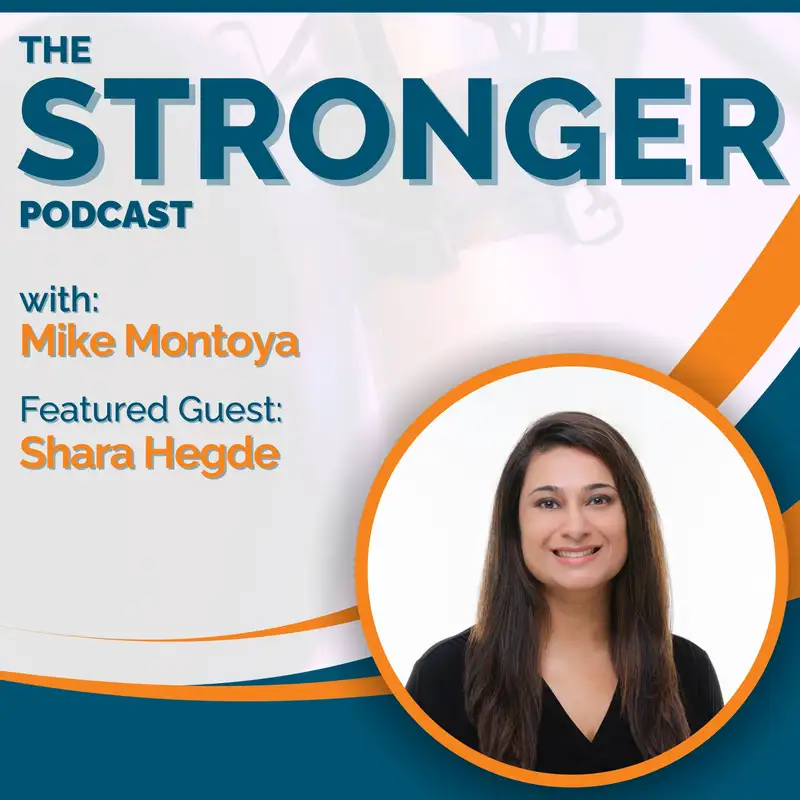
Mike Montoya:Let's jump in, and let's get stronger together. In this episode, I'm joined by Shara Hegde, the CEO of Alpha Public Schools in San Jose, California. We get into what it takes to lead through complexity, from strengthening support for families beyond academics to navigating the political realities of charter renewals and why leaders have to keep their heads up while staying grounded in the day to day work. Before we dive into today's conversation, I want to give a quick shout out to podcastsmatter.com. Their mission is to help impact driven voices get the visibility they deserve.
Mike Montoya:If you wanna share your message with the world, check out their website in the show notes. Good morning. Happy it's February 11 when we're recording this today, but I'm here with Shara, who's a friend and colleague, and she's with Alpha Public Schools in the greater San Jose area. Shara, it's great to see you. Thanks for spending time with me.
Shara Hegde:Thank you for having me. It's great to be here.
Mike Montoya:Tell me tell me what's going on in the Bay Area. You guys just had an amazing event that happened in on the global stage. Like, how's the vibe? What's the feeling like going on in San Jose these days?
Shara Hegde:Yeah. San Jose was lively for these last two weeks. I'm a Patriots fan, so I'm a little disappointed. But I think it was great to see the city just light up and have all the energy that it did. We also have more big events coming.
Shara Hegde:So I think that that will continue in the weeks and months ahead, including the World Cup and just other big sporting events other entertainment events as well. So it's been a fun time in this city, but I also recognize we are, especially in East San Jose, facing some challenges as well, and in particular, with the threat of ICE and the impact on our some of our local communities. So we're we're balancing both of those things.
Mike Montoya:Well, and thanks for thanks for bringing that up because, like, there's a significant tension going on in our society. Right? That is there's there's prosperity running rampant in some places, and it's also shadowed, right, by some of this under undercurrent of of stress creation, right, that's happening in the world. Right? And without going too much into politics, we know that just children and families are deeply affected by immigration policy, right?
Mike Montoya:And that's a huge issue that's happening in California in particular, but also across the country, right? So I want to acknowledge that for sure. So can you just just to kind of ground us a little bit, tell me a little bit about your how you got to where you are. And and I know you have some immigrant family history and also that you grew up potentially on the East Coast is what I remember. So tell me a little bit tell me the the, like, origin story you can go into.
Mike Montoya:So
Shara Hegde:Yeah. So I am a a Boston girl born and raised, but I also spent a couple of years of my life with my grandparents in India. My parents were new to The United States. They were still getting settled. And having a young child at that moment in time meant the best place for me to be raised was with my grandparents.
Shara Hegde:And I was raised on a college campus, The University of Mysore. My grandfather was the Vice Chancellor there and it was a really cool exciting childhood. I have pictures that I don't remember anything but the pictures are pretty interesting. So you know we had a pet deer growing up and I have a picture of that which is which is pretty cool. Came back to The US and did all of my K through 12 schooling in Massachusetts and went on to college.
Shara Hegde:And it was in college that I started getting exposure and understanding of the education system. I did some fieldwork through one of my classes. I taught at Providence Summer Bridge and really started to enjoy seeing classrooms and teachers in action. But I'm also South Asian and there are some expectations for how we think about our careers. And I had a plan to go to law school.
Shara Hegde:I took my LSAT. I started to think about applying. And then there was a moment where I just realized I couldn't do three more years of school. So I threw that away and said, I'm going to do Teach for America for two years. Got accepted and moved to Miami right after graduation.
Shara Hegde:And I thought honestly, it was going to be a two year stint, but it ended up being the beginning of my life work. And it was my time in Miami that really solidified that I did not go to law school. I wanted to be in education. I wanted to serve students and I wanted to do that work in underserved communities.
Mike Montoya:So, well, thank you for doing Teach for America and for and joining the I call it the joining the journey, right, of education kind of reformers, right, that are in the world. And I think just I like to acknowledge this with our with our guests because it's it's the calling for me is the way I think about it. It doesn't mean that it applies to everybody, but, like, as a 20 young 20 year old, right, when there's pressure from the potential family structure, etcetera, and and and cultural backgrounds and be high performing, go to law school, go to medical school. That's like a common theme we hear, right? What was that?
Mike Montoya:Do you remember kind of what that was like? What was going on in your own young experience that helped you to discover options? And then also, how did you get through that with your family to get to the place of like, okay, I'm going to go off and do this thing?
Shara Hegde:Yeah. I think there were times where my family wondered what was I doing. I had just finished an Ivy League degree and those are not cheap. And here I'm teaching and not making a lot of money and working really hard. And I don't know if it always made sense to my family.
Shara Hegde:However, my grandfather was an educator. And way back in the 1940s, he came to Stanford for a master's degree. And he had the option to stay in The United States. And had he taken that option, I think my life would have looked a lot different, both in terms of financial resources and potentially growing up not as the child of immigrants here in The United States. But he chose to go back and he chose to spend his time, energy, and efforts building engineering programs at different universities in India.
Shara Hegde:And he became really good at it and really well respected as an educator. So there was some background in my family for people choosing the path of education and choosing to be in service of others. So I think while my parents still did have some wonderings about what I was doing, began the work of founding a school. I think that's where it started to make a little bit more sense and the dots became more connected.
Mike Montoya:Got it. So I call it leveraging the family story and your grandfather's legacy of sorts, right? Maybe it's a powerful tool, right, to convince people like this is not an uncharted path. We've done it before. That's super.
Mike Montoya:So thanks for sharing about that. And it you know, because we're talking about this, like, immigrant experience a little bit, like, there's there's this, like, power, right, that happens inside American universities where people build knowledge and capacity and social relationships, right, that then can be transferred. Right? Talk a little bit about, like so Teach For America gathers a lots of other young people, right, into into these collections of people in Miami in particular. Right?
Mike Montoya:So, like, you also got to hang out for a few years with several other like, lots of other high capacity, energized, committed folks. Like, what was that like during that t TFA time in Miami? That was like I don't know. That was like it was a little bit ago. I don't know what exactly it was, but tell me about, like, how that was like for you.
Shara Hegde:It's over 20 ago. I remember there just being a lot of energy in our core. We were only the third corps ever in that city. And so there's such an opportunity for impact and such an opportunity to get more deeply engaged in the communities we served.
Shara Hegde:And so in addition to teaching, I would tutor. I ran an Odyssey of the Mind club for my students, and we ended up making the state finals in my second year of teaching. And so it was these opportunities beyond the classroom too that I think were so powerful, where you got to really know students, you got to know families. And it was just an amazing time. It was really such an amazing time.
Mike Montoya:I appreciate you bringing up Odyssey of the Mind because these are like these I was a science Olympiad kid, right, myself. Right? And, like, those those things, like, helped me apply all that stuff we were doing in class, right, into something that was, like, more fun and more interesting and got me to go do some traveling across, you know, the state in The US when I was a young man. And that was, like, part of, like, these it just kinda opened up my brain, right, to, like, what's possible. So I think those experiences happen for children when leaders, teachers, right, in particular, lean in and say, I'm gonna put this extra time, energy, effort, stuff into the, I call it what kind of the coaching experience, right, that goes with those kinds of non school programs type of thing.
Mike Montoya:Appreciation there. But I think that's part of the stronger founding story too, right? It's like, I'm in the game of like, like, I call it championing those types of things because they feel like there are a plethora of opportunities, though they're not highly accessible, right, to many to all children. I mean, I feel like TFA and the work that you're doing sounds like you're you guys were intentionally kind of, like, giving those choices and options to kids time. So this led to school founding.
Mike Montoya:I know you just mentioned it a little bit. It became part of the story. How did you decide you wanted to be a school founder? Just tell me a little bit about like that happenstance. How did that come into your life as an option and an idea?
Shara Hegde:Yeah, I think after Teach for America, I went to Stanford for a master's degree. I went into that program thinking I would go into some policy work or a leadership role and more through a traditional district. That's what I had worked in. In Miami, and that's what I knew. But I came across this opportunity through an organization called Building Excellence Schools.
Shara Hegde:The name has since changed to Build Exempt Sustain, but they were offering founders the opportunity to spend one year studying the top charter schools across the country and then taking those learnings and applying them to writing a charter petition and submitting it to their local school district in an area where there was a clear and compelling need. And so I applied. I did not think that I had any shot to get this fellowship, but I ended up getting it. And so I spent a year doing exactly that, writing a charter petition, trying to put my ideas on paper, and then visiting these amazing schools up and down the country. Fast forward about two years, we had received a charter and we were preparing to open our doors.
Shara Hegde:So it was a pretty whirlwind experience, but one that I think was so incredible in terms of shaping how I see things and the school that I built.
Mike Montoya:So the fellowship kind of gave you a sheltered experience where you got to and and sheltered in a sense of, like, organized in a way that was intentional, right, where you got to have both an income, but also a support program, right, to kind of get you in the game, right, so to speak. That's kind of how those fellows hips work. I want to highlight this just a little bit for our audience because there are a number there's a there's a basic premise here that's like the current public school options that are available to children across the country are not sufficient to meet all the varied needs and opportunities that maybe families want for kids. And so, school choice is one angle, right, on which we try to build new opportunities. And school fellowship options, right, school start fellowship options are kind of popping up all over the country.
Mike Montoya:The BES fellowship is one of the most prominent ones for sure, but they also exist in lots of state organizations, etcetera. And the so for, I call it excellent educators that wanna do something because they have a brilliant idea and are interested in founding a school, there's an opportunity across the country. And we'll try to share some of those things in our in our case notes after the in the show notes that where these fellowships happening. I know they're happening in Connecticut. I know they're in Oklahoma, and there's some stuff opening up in Nevada.
Mike Montoya:Right? And I know California still had several of them. So, like, these fellowships are, like, kind of key things. So, Shar, you're, like, an example of someone who, like, kinda got into it early. Right?
Mike Montoya:And then you kind of started to build a school and a school network. But there was something else that happened a little bit with the local you guys kind of merged or you became part of something else together. So tell me that component.
Shara Hegde:Yeah. So I was incredibly lucky because I got into the charter school movement in California at a time when supporting charter schools was truly a bipartisan belief. We had Republicans, we had Democrats. I think everybody could get behind the idea of parents choosing a school that really met the needs of their child. And what that allowed me to do is I was able to be collaborative with my local school district and we worked together.
Shara Hegde:We shared best practices. We shared resources. We pulled it off to an incredible start. Three years in we were named the California Distinction and had incredible scores, incredible outcomes for our students. However, as we were growing our school, the political landscape in California started to shift and there was some increased animosity and hostility towards charter schools.
Shara Hegde:There was also increasing bureaucracy and I started to see the writing on the wall. I had worked really hard for a number of years to hit the school off the ground and I knew the work was going to get bigger if I didn't have some sort of support. So I met with the CEO of another local charter school network, Alpha Public Schools, and I asked him, Would you be interested in joining forces knowing what this political environment looks like so that we are stronger together? And I have some expertise in elementary school. You have some expertise in middle school.
Shara Hegde:Maybe we can build out this amazing K-twelve network. And he was game. So we got our boards engaged and started to explore the idea and do the due diligence. And in July 2016, we formally closed the merger of the two organizations.
Mike Montoya:Okay. So it's been now it's been ten years and the experiment and the effort, right, turned into an actual network of schools, right, that now has a K-twelve experience. Is that true? Did you have you guys made significant progress in this area?
Shara Hegde:We have. Three of some of the original schools are TK through eight. So we actually go all the way down to TK. And we do have a high school as well. So if students choose to stay with us until twelfth grade, there's a place for them.
Shara Hegde:And that also includes post secondary support. And if our students choose to leave us after eighth grade and pursue different high school options, that's okay as well. Our high school isn't actually big enough to house everybody students. So that's okay. And we want to make sure they're in the place that makes the most sense for them.
Shara Hegde:We hope that's our high school, but if it's not, we hope they make it.
Mike Montoya:Well, and that's like maybe there's parts of success that are embedded there, right? When children and their families have choices and they actually have, I call it, pathways, multiple pathways, and then they choose one that's almost like at the core of what we're trying to achieve, right? We're trying to like give people choices and prepare them to make great choices. And sometimes they go the comprehensive high school route, right? And sometimes they stay in small high schools.
Mike Montoya:But the fact that they have any choice, right, is success in my view, right? Because a lot of us, I grew up in a place where like you went to the only thing that option was a comprehensive high school. And there were like 3,000 kids in that school. It And was just what it was. Right?
Mike Montoya:And whether that was good for me or not, that's just what the option was at the time where I lived. But it's like these ventures, right, in California in particular, right, have really started to give actual choices to kids and families in neighborhoods in particular. There aren't any, right? Or there were very few, right? So this is success.
Mike Montoya:Do a highlight you from recent times in one of your school settings that you're like, hey, we're really proud of this happening with kids or families that you kind of talk about?
Shara Hegde:Oh, so much. So the school I founded is still doing incredibly well. They were recently named a California School to Watch. So that's great news and something to celebrate. I'm also incredibly proud of some of the community work that our schools are doing.
Shara Hegde:We are a community school and we received the California Community Schools grant funding for that, but long before that funding existed, we had been doing things on our campus to recognize that our families and our students needed supports that went beyond academics. So there's a monthly food bank that we run. There were parent English classes and technology classes offered different periods of time to ensure our parents had the skills they needed to support their students on their college going journey. So, it's small things like that that I think are really powerful and really make me smile when I think about our work. But I'll tell you some of the best moments were just in classrooms.
Shara Hegde:Those little moments where you see a student make a mistake and rebound and fix it and show pride in their work, that to me is still the thing that makes my heart sing.
Mike Montoya:Got it. So sometimes we call them learning moments, right? Or when the light bulb comes on, right? You see a kid going, eureka, whatever. Like, those those, like, magic moments.
Mike Montoya:Right? And and in particular, when, like, the they call it the wheels click, then the gears start kinda turning it in sync with each other. I like the community schools comment because I feel like there's, like well, the community schools work has been in underway for twenty years roughly in some places across the country, but it really has taken off in California in large part because, of schools choosing it as a pathway because it makes, like, a lot of common sense. Right? Like, not all kids have all the things that I call it typical nuclear family might be able to provide for them.
Mike Montoya:Right? And so community schools kind of, I call it, plugs some of the holes and bring some of these resources closer to the school, into the school, into the school community, and allows people to kind of, like, access them more effectively. Right? And it also kind of like college shares resources, right, in many cases. So it can like bring costs down, but also bring resources up.
Mike Montoya:Right? So those are kind of the tricks. I'm just sharing this. We'll talk about community school. I'll put that in the show notes too, but I really appreciate that because you and a couple of other of our clients have community schools in works right in practical ways.
Mike Montoya:And it's really awesome to hear that like that policy work has really turned into a real thing. Tell me about I'm gonna shift gears here a tiny bit because I wanna hear a little bit about, like, as a leader, right, let's put on your leader hat. Because I know, like, as a leader, have to wear lots of hats and sometimes you have to be the teacher. Sometimes you have to be the the the parent certainly in your life. Right?
Mike Montoya:But also let's put on the leader hat. Right? In the ten years that you've been working with Alpha, how has your leadership shifted or changed? And maybe there's an inflection point where something has been a recollection from you about like, hey, this is when something had shifted for me. So tell just a little bit of how you reflect on that and what kinds of things maybe have evolved in ten years.
Shara Hegde:I think early on, I was really interested and engaged in the details, the day to day running of this and wanted to make sure things were done well, things properly. We were getting the outcomes we wanted and I didn't necessarily pick my head up and look around and see the broader landscape in front of me. The inflection point happened in 2019. So Alpha Cornerstone, the school I founded, was going up for renewal. And it had been in existence for ten years, two California Distinguished Awards, the Soda Schools Awards during that time, and really strong outcomes for students.
Shara Hegde:And as we went up for renewal, everything seemed really smooth and we were like, our scores are great. This is gonna be fine. The district gave every indication that it was going to be fine. And on the night of the decision, we were voted down 3–2. And so this is one of the top charter schools in the city of San Jose at the time getting voted to close.
Shara Hegde:Now, we did have an appeals process to the county that was going to take three months. But in that moment, I was second guessing myself and the right side of where I didn't see this coming. And the lesson in that was you can't continue to operate schools without keeping your head up and looking at the landscape in front of you. And so that shifted my leadership pretty dramatically. And when I became CEO in 2021, one of the first things I did was build out our advocacy arm.
Shara Hegde:So we have a director of advocacy. We have community organizers on our staff because we are not going to let this happen again. We're not going to be blindsided by an elected official's vote. We're going to work really hard to earn every vote. Now that also means we have to produce the outcomes.
Shara Hegde:It's not just a political endeavor or an advocacy endeavor. But I learned that I had to keep my head up. I learned that I had to see, you know, what's the expression, see the forest from the trees and not just focus on the day to day details. Because what we've seen up and down in California is you can run an amazing school that's doing great things for children. But a lot of these decisions are not based on data.
Shara Hegde:They are not based on what's good for students. They are political decisions. And I learned that the hard way. But it's a lesson I carry with me now and it's incredibly visible in my day to day work.
Mike Montoya:I'm going to pause the conversation here for just a second to talk about Books That Matter. Every entrepreneur or leader needs a book that elevates their business, builds their credibility, makes an impact. If you've got more money than time, a ghostwriter can help you build your story. If you've got more time than money, a great book coach can guide you step by step through the writing process. If you have already written a draft, these folks can save a lot of trouble and money by shepherding you through the publishing process.
Mike Montoya:Head to booksthatmatter.org and get the custom support you need on your book idea or manuscript. I'm sorry that that happened, And it sounds like a powerful lesson and maybe one that everybody should hold on to, right, which is the schools, schools, local school boards, and I mean, which are elected officials, right, are in fact a political experience, right, and that they have a lot of power in a small collection of humans. And the practice of, I call it, doing what's best for children based upon data and evidence, is not always going to win the game because of politics. And it can be a real shot in the arm. It can deeply affect with criticism, I'll say this, it can deeply affect children and families' well-being and lives.
Mike Montoya:And the impact of like say for example, having to take your child to another school while they're a high school student, right, is like an actual pretty significant and potentially traumatic event for them. I mean, it's not one that I recall that you would want it for your own child, right? So the doing it to others, right, is a real kick in the teeth, in that regard. But the keeping your head up is important. So maybe that's a leadership lesson, which is like, you have to keep your eye on the horizon and watch, I call it watch your flanks, so to speak, to like pull up the military metaphor.
Mike Montoya:Like, they can come around and outflank you sometimes when you're not paying attention. So what is it that you've and now that you've had that experience, like, how have you started to operate differently? What kinds of things are you doing in order to kinda be aware of those kinds of things now? Like what kinds of systems and processes are in place?
Shara Hegde:Yeah, I think first and foremost, as I mentioned before, we started an advocacy arm of our organization. And what we want to ensure is that our parents are deeply engaged, not just in the day to day runnings of the school, but also in the local politics as well, because I think parents are an incredible source of accountability for our work and accountability for elected officials. And so our parents host research meetings with every board member and elected officials up and down the city that may have a role in our school's existence or non-existence. So they are constantly asking the tough questions. They are inviting them in and asking them to come and meet.
Shara Hegde:And that's a really powerful thing. Second, I'm taking a larger leadership role across the Bay Area. I'm the chair of the newly formed Bay Area Advisory Council, which is a body of CEOs mostly and advocacy leaders that advises the California Charter Schools Association on how to have strong wins in the Bay Area and support the work of schools all the way from Santa Clara County up to Contra Costa County, Alameda County and San Mateo County, so all across the Bay Area. I think third, up in my personal time and not affiliated with my job at Alpha, I do run a political action committee, and I do fundraise because I think we want to see strong leaders who put kids first in these elected official seats. I know the job's not easy, and I know there's a lot of competing priorities, but that organization looks to really lift up and support the elected officials who make those tough decisions.
Shara Hegde:And we don't ask you to not be tough on us. We don't ask you to hold us accountable. But we do ask you to center your decision making around students first and foremost. So those are just three things that I spend a lot of time on in my day to day work and outside of work in order to move the needle.
Mike Montoya:Well, and thank you for the specifics, right, because it's helpful for people to hear some of the things that are actually happening and and practical. And what I one thing I'm taking away is that, like, parents have power, right, and influence as both voters and constituents of these school board members and other elected officials. Like, there's a whole gamut of people who kinda can champion good quality school options. Right? And everybody wants, like, great schools in their neighborhood when they care about their house value.
Mike Montoya:Right? Right? And when they think about their own child, they're like, hey. I want a great opportunity for my own child. Right?
Mike Montoya:And then it becomes the work of school officials and and elected officials, right, to make sure that we can provide those things. And I also appreciate the the comments around, like, the Bay Area specifically. Right? So San Francisco Bay Area is, like, six to 10,000,000 people depending on where you draw the boundaries. Right?
Mike Montoya:So it's a huge swath of California. Right? There's lots of humans in that space. And the Charter School Association in California also has a strong center in Los Angeles. Right?
Mike Montoya:So there's this piece of where voice can get lost because Los Angeles is, you know, 350 or 400 miles away, maybe even longer. Right? So it's it takes a chunk of energy to kind of be engaged in the Bay Area. So I appreciate that you're, I call it, organizing leaders and schools right around this around this effort. Do you feel like is there like an agenda of sorts that or highlights that you're trying to make sure that get in front of and more aware for folks?
Shara Hegde:Highlights from that work or?
Mike Montoya:Yeah, for sure, if you're interested.
Shara Hegde:Yeah, I think we're still organizing around key priorities at this moment in time, because we've only met once or twice at this point. But I think something we're really being thoughtful about is AB fifteen, and specifically the implementation at the local level. Unfortunately, what we've seen is a state law that was intended to provide clarity is now being utilized to really be a destructive force for many charter schools. So we see schools that are middle-tier, which is a presumed renewal, unless very specific findings are detailed, being denied. In fact, this just happened last night to a school in Oakland.
Shara Hegde:We also see middle schools being required to write improvement plans, which is a condition for low track schools, not middle track schools. So we see some misapplication of this law in the local context. And I think what we are trying to do as an organization is to think through how we can raise awareness around this and really fight for a fair application of the law.
Mike Montoya:Yeah, that's right. So it's a very reasonable approach what I'm hearing, right? Maybe I'm again biased in some ways, I'll certainly name that, right? But I feel like there's like the fair application of laws is a struggle, right, in society in general. So it also applies here, right?
Mike Montoya:And I think it's one of the things that like when you don't speak up, then it doesn't get any notice because, you know, just like we're all super busy and there's not a lot of visibility to some of these things, right? So but these can like cause people to run around in circles and do things that maybe aren't even valid, right, in many cases and should be, I call it, reserved for things that are actually meet the bar of challenge, so to speak. Right? So Okay. So that's so there are some actual things, right, that you guys are struggling to work on.
Mike Montoya:Right? And and as a collection of of other bay charter leaders in the Bay Area, you guys are, like, kinda organizing in a way to kinda make your voices more clear, but also, like, call it intentional, right, around the work that you guys are trying to achieve together. So while I'm gonna just say that's for you, for me, like, you for doing that and appreciate that. And I know and I know a lot of other charter leaders in the region that that are also part of this coalition of sorts, right, that that are starting to to, I call it, feel the power of that potential. So thank you for that.
Mike Montoya:Well, I'm gonna sort of shift gears a little bit and talk about I call it shifting into, like, reflections about your journey as a woman of color. I'm gonna label this. So you take the label away. Right? I'm gonna say, like, as a as a as a woman of color leading in the twenty first century, right, a group of diverse individuals in your school systems and also seen as a leader in the in the country.
Mike Montoya:Like, do you feel like there's, like, responsibility that comes with with having that mantle of sorts? And, again, I'm placing some things on you, I'm trying to put you in a corner, so please resist it. But I want you to reflect on that a little bit because I know it's part of how I show up in the world, but I'm curious how that affects you in the way that you think about your work.
Shara Hegde:Yeah, I think there's definitely a responsibility. We have to be thinking three, four steps ahead. We have to be thoughtful about how we show up in spaces. We have to be, I don't want to say guarded, but I will say guarded, in how we talk about certain things. We have to be thoughtful about when do we press the accelerator and when do we put our foot on the brake.
Shara Hegde:And so there's a lot of places where I have to make a judgment call, both as a woman of color, but also in the other roles that I have. I'm a parent, mom of three, right? I'm a partner. And all of these different roles come with responsibility. And so I am constantly thinking about that.
Shara Hegde:So
Mike Montoya:the parent role matched with being a leader, right, in a public space, right, those kinds of things can be, they call it take a lot of energy in that regard, right? And I call it, one of their leaders shared this, it can sometimes be lonely to be in that space. I mean, do you ever experience any kinds of emotional pieces that are tied to that, like kind of multiple roles that you have to play?
Shara Hegde:Yeah. I think it is leadership is definitely lonely, when there are tough decisions to make. And so you do have to carry that weight, but you don't have to carry it alone. I do have fellow CEOs I talk to regularly who are in similar positions who have to make those tough decisions and carry that same weight. I also think it's really important to have a vibrant life outside of my job.
Shara Hegde:So I coach flag football sometimes. I am an assistant coach for an AAU basketball team. My son is very athletic, so I'm always following him around. But I've made friends in a lot of different circles with people who know nothing about what my day job looks like. And I find joy in that because it's an opportunity to put down the weight and engage in a different way and explore a different facet of my identity.
Mike Montoya:Yeah, the having a life outside of the core of the work life is critical, I think, as a way to kind of, I call it balance the pressures that come with and the responsibility. So I appreciate you highlighting that. And I mean, at the end of this, right, like, if you do a good job as, as a, as a mom, right, and with your family, then regardless of what happens on the professional front, right, it's like a life that is fulfilling in some ways, right? Like, do you have other components that are like about life well lived? I mean, I know that you and I have reflected on this in separate circles, etc.
Mike Montoya:But I'm curious, like, what are some of the things that are showing up for you now, as I call it a grown and experienced leader, right, where you're like, okay, life well lived looks like this.
Shara Hegde:Yeah, I think for me, a life well lived is being able to be present for my children, present for my partner, to be able to have the clarity of mind to engage in the hard conversations outside of work, to be able to invest in the people that care most about me and to be able to receive their investment in me. And that may sound strange, but when we work as hard as we do, sometimes we forget to connect and allow others to give to us. And I've had to learn that. I have an incredible partner. I have an incredible group of kids in my house and they are just wonderful.
Shara Hegde:And they do so much for me in these really small but meaningful ways. And when I receive it, the impact it has on my day to day is just magical. And that can be as something as simple as a hug from from my littles or it can be, you know, been asked to be read to at night. But it's it's just so meaningful and it's the thing that keeps me growing.
Mike Montoya:I just wanna say that if you're a leader, entrepreneur, or business owner who needs some support, there's an easy way to get a think tank behind you and your vision. The Genius Discovery Program at Thought Leader Path is like having your own one on one incubation and acceleration program. They'll help you develop an approach based on your own story and your plan for impact and offer the tools and thought leader assets needed to really amplify your message, including launching a podcast like this one. If you're ready to stop grinding in the dark and start making real impact with the right support, check out Genius Discovery dot org. Yeah.
Mike Montoya:And the active receivership. Right? The active receivership is is one that can be glossed over in some ways. Right? It becomes hard to slow down enough to experience it and not speak to you specifically.
Mike Montoya:But like, I know that I have that challenge in my life too, where I'm like, I'm moving so quick and I have so many things that are like bubbling at the front of my frontal lobe right here that I don't slow down enough to experience the, I call it the engagement component, of being close to a human. Right. And because we do so much stuff virtually, right, it's like a it's like you get a little bit disconnected and the groundedness of people in your home giving you love, right, is it's one of the most powerful things that we can experience together. So do you how do you how do you translate that? I mean, these lessons are interesting to hear on my side.
Mike Montoya:Like, do you bring some of this to your to your leadership work, into your team, in your in your organization?
Shara Hegde:I am trying to get better at that, honestly. When you've led for so long, sometimes you have habits that are the things that made you successful initially. But as you grow in your leadership, they're not necessarily the things that are going to optimize your performance at work. And so one concrete example, I think it's so important to step back, to listen, and to be present as a CEO, and to not be doing, doing, doing. And I got to where I am today because I was a doer.
Shara Hegde:I was an executor. I worked countless hours every single day, seven days a week. That is not going to serve me in my current role. And so this notion of really being present and really trying to understand something that I that I do in my personal life and I'm trying to do more of in my professional life. It's not always easy.
Mike Montoya:I'm smiling on my side because I call this the leadership evolution, right? Where as a person, right, we grow and change as we, I call it just have more time on the planet. And we can, if we listen for the lessons that are in fact showing up for us, then we can, I call it, continue to move? I don't know there's a direct line we're traveling on. In my view, it's like we're kind of moving around in this global sphere of stuff.
Mike Montoya:And we're experiencing different components of our life. But if we're I call it continuing to expand, maybe is the is the word that I'm looking for, right? If we continue to expand right as people, right, then we can also I call it other people kind of get in our sphere, right, and then they start to move with us in that way, right. So that's kind of how I wish I could draw this. I had this amazing visual in my head, which is impossible to describe in some ways.
Mike Montoya:But I feel like what you're sharing is like this opportunity for us to kind of bring a fuller self right to this work. But we also have to hear our fuller self, right? We have to like be aware that it's there, right? Okay, I'm gonna let you share more a little bit about that, if you're willing. But can you talk to me about like one, I mean, sometimes people have talked, I love the CEO hacks around habits, and good, I call it good practices, right?
Mike Montoya:They kind of help you keep grinding. So before you just mentioned that you like worked hard, lots of time and inputs, right and effort into becoming the person and getting the success that you've had. But now that you're kind of in a different state stage, like what kind of habits show up for you regularly? It sounds like obviously paying attention to your kids and sports experience is one component. But like, what kinds of things can people take away?
Mike Montoya:It's like, hey, like this stuff on a regular basis piles up in a positive way. Like, what kinds of things show up for you?
Shara Hegde:Yeah. I think working out regularly is a practice that I am working hard to maintain. It is not always easy with all the commitments on your time. But even if you can do ten minutes, it does compound. And so try to strength train anywhere from three to five times a week, try to do some cardio two to three times a week.
Shara Hegde:And I love to cook. So I meal prep every weekend. So these are small habits. But I think when I think about being present, these are things that help me be present. I think also making sure you hug your kids and your partner regularly.
Shara Hegde:That's another thing that in the busyness of the day to day, you can forget that there's other humans around who need you and who need something very different from you. They don't need the brain that is operating 300 miles an hour. They need the person that's going to slow them down as well and provide that love and that care. So I think that's a critical thing as well. So I think those are two things that really have helped me.
Mike Montoya:Yeah. So the physical movement and exercise, we all I think, have heard like the cardiovascular benefit of that stuff. But it also like I call it calms the nervous system and creates all this good stuff in your head and your gut, in terms of serotonin and, and all the chemicals that make you feel positive right in the world. And so those are like important results. There's all sorts of biohacks and stuff out in the world.
Mike Montoya:So we're all gonna go find that stuff independently. But I think it's important to hear that people are actually applying this in real life. And that I think, you know, you don't have to do hours and hours of exercise, like when you were 22 years old anymore, right? You can get away with ten to twenty minutes a couple days a week, and it really benefits you in a positive way. So I appreciate those two things.
Mike Montoya:I mean, eating well, I mean, eating well, it's like a thing, right? People don't eat well. So meal prep helps, Sounds like for real.
Shara Hegde:Yeah, it's really fuel for everything in your life, what you put in your body. So trying to get better every single day, 1% better.
Mike Montoya:Yeah, for sure. 1% better. And I will say this to school people and people who are like working at schools, like the deficit of like, where you don't feed yourself because you're engaged all the time with kids and families in school and the activity of a daily experience in a school building, like it takes a lot of energy. So you're burning calories like crazy. And if you don't feel it up, no wonder you don't feel well at 03:00 in the afternoon, because you kind of burnt through all the stuff in your body, right?
Mike Montoya:So lunch breaks are hard, we know it's hard to come by, take lunch breaks, if you can even to get away from the desk and the people. Those are great things. Okay, so we're going to zoom out. One, this is a, I call it advice to the former self, or to the younger self. Or if you can even imagine a young person in your life that you're like, hey, these are the type this is like the thing that I wish I had known, right?
Mike Montoya:When when you were, I don't know, 15 to 25. Like, can you imagine somebody like that? And like, what's something that you'd love to share with them about?
Shara Hegde:You'll learn more from your biggest failures than your greatest successes. I've had lots of failure in my career, in my personal life, and I don't regret any of it. Even though at the moment when those things were going on, it feels like the world's ending a little bit. But you get through it and you walk away with lessons that fundamentally will change what your future looks like. And if you're really smart and thoughtful about it and process and apply those lessons, you can create a future that is even brighter and even better than you.
Mike Montoya:That's awesome. Yeah. The the the fear of failure can be overwhelming. And then when you but but we are going to hit struggles, like life is not super smooth. And the opportunity to pick up the lessons along the way, it's almost the point of life, right?
Mike Montoya:Learn the lessons, experience the components, And, and keep, I call it going and growing, is how I'll say it. So thank you for that. Yeah, you're causing me to think about, you know, my own experiences in the I call it sometimes the lessons keep showing up over and over again until you pick them up. You're like, Oh, I finally got it. Right?
Mike Montoya:You have to hear it a few times. Sometimes I'm a hardheaded guy, right, that kind of thing. So I appreciate that. Okay, so party birds. The Bay Area is a good place to be. If you have children and families in the San Jose area, check out Alpha Public Schools in because it's a great opportunity for folks.
Mike Montoya:And if you want to hear and learn more about Shara and her work, you can find the contact information in the show notes, etc. And so we'll make sure that that gets ahead. So Shara, thank you so much for spending time with me and take care of yourself as you head into the spring, okay?
Shara Hegde:It's a pleasure, Mike. Thank you so much.
Mike Montoya:My biggest takeaway from this conversation is Shara's reminder that strong schools are built on more than academics. They're built on community, trust, and real support that families can feel. If you're leading in education right now, this episode is a powerful lesson in staying student centered while also paying attention to the landscape around you. Have a great afternoon. Thanks for joining us and tuning in today.
Mike Montoya:To find out about other podcasts that matter, visit podcastsmatter.com. Thanks for listening to the Stronger podcast. If this conversation inspired you, we invite you to follow the show and share it with someone who's on a journey to become a happier and healthier version of themselves. Links and resources are in the show notes. See you next Thursday, 9AM eastern time.
Mike Montoya:Have a great day, and stay strong.
Listen to The Stronger Podcast using one of many popular podcasting apps or directories.