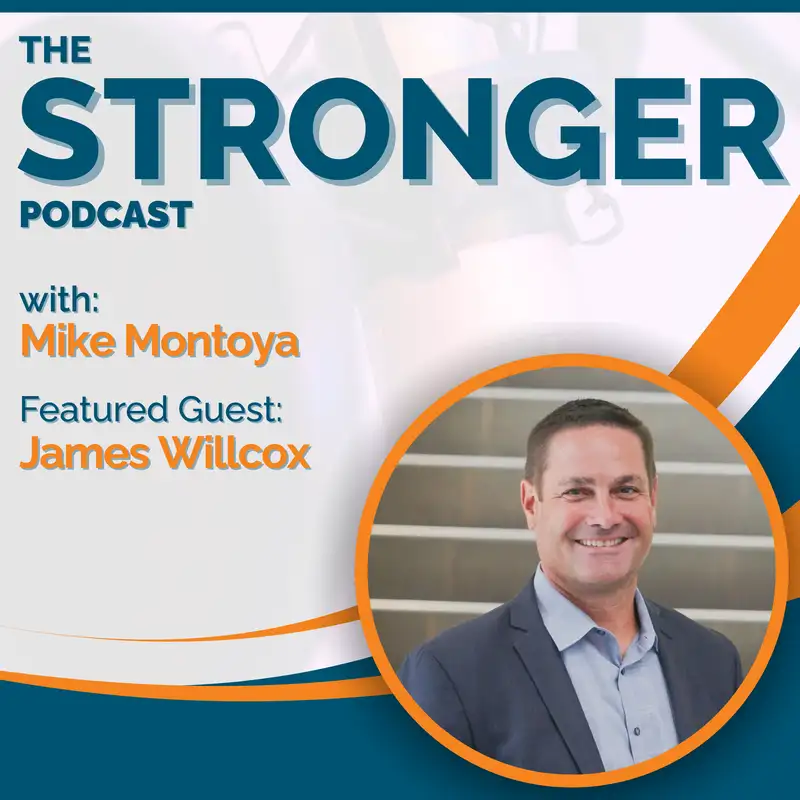
From Helicopters to Schools: Leadership Lessons from James Willcox
Welcome to the Stronger Podcast. Each week, we have honest conversations with education and social impact leaders about their leadership and career journeys. We talk about their origins, inflection points, and the work that they're doing today. The conversations are honest, human, and practical. If you're here for real stories and real takeaways, you're in the right place.
Mike Montoya:Let's jump in, and let's get stronger together. In this episode, I sit down with James Willcox, co- founder of Greenhouse E3, to talk about a challenge most people don't see coming. Nearly every charter CEO is a first time CEO. We explore that reality affects schools, what happens when leadership transitions go wrong, and why James believes investing in leaders is essential to achieving long term stability for students and communities. Let's jump in.
Mike Montoya:Before we dive into today's conversation, I want to give a quick shout out to podcastmatter.com. Their mission is to help impact driven voices get the visibility they deserve. If you want to share your message with the world, check out their website in the show notes. Good morning, everybody. I'm here with James Willcox, longtime friend and colleague.
Mike Montoya:He's currently the CEO or co CEO, let's call it that, of Greenhouse E3. We'll talk about Greenhouse. James, welcome to the program. Thanks for being here.
James Willcox:Thanks, Mike. It's awesome to be with you.
Mike Montoya:That's awesome. Thanks. Can you center us as an audience, like where in the world are you? And tell me a little bit about like what's going on in, I call it your physical space in the neighborhood or world that you're living in.
James Willcox:Yeah. So physically, I'm down in South Texas, just outside of Corpus Christi. We are if you don't know this area, we're about an hour and change from Mexican border and three hours three and a half hours plus Southwest Of Houston. So if you had not spent time down here, most people don't realize that the the coastal bend, as they call it, goes down to the latitude of Fort Lauderdale. So think of Corpus Christi as the Fort Lauderdale with a lot more wind of Texas.
Mike Montoya:And and a fair amount of heat and humidity, I think, is what I remember about that space.
James Willcox:So Yeah. And very much like the the Florida Peninsula. You get your fair share of storms that roll into The Gulf and create some adventure around about, you know, August, September, October pretty much every year. So that's kind of the the space we're in. We just got through our very short winter.
James Willcox:We usually have one or two periods of three or four days where it drops to about 30 or below, and that's our winter. We're we're just about through it. So I say that with trepidation knowing that there's a lot of people in a lot of places that are very cold right now, but we are not one of them.
Mike Montoya:Yeah. For sure. The Northeast and a lot of the Eastern part the country got clobbered. The West is getting zero snow either about West, and there's been like a snow, I call it a snow deficit. So people are panicking about that.
Mike Montoya:It's it's like maybe I don't know what it is. It's like 50 degrees in Portland, Oregon today, which is not our common either. So it's it's a flu season.
James Willcox:I will keep to myself with the temperature in Corpus Christi. I'll keep that to myself.
Mike Montoya:It's springtime here. I'm loving it. I'm happy about that. Okay. So let's I want to I love to ground people in like a little bit of like reality.
Mike Montoya:Like you're tell me about you're you're a dad, you're a leader, you're a husband, I think. So tell me about that. And so what are the what are the big buckets of things that you're holding in your life that in your daily experience?
James Willcox:Yeah. All those things are are are true. I guess I would say my life has pretty much been defined by two things, service and family. I was lucky enough to meet someone and become very close friends with them in college, like best besties, best friends. And ended up dating her for a short period of time and then getting married fairly young, but built on a foundation that we built over four or five years as really, really close friends.
James Willcox:And so because of that lucky circumstance of having that kind of life turn, got married fairly young and had kids fairly young, and so my professional life has been defined by family. I was married at the ripe old age of 22. I had my first daughter at 24 and second at 26 and the third one at 28, all in different places, one overseas. This is all military time. And, came back to came came got out of the military and went to grad school with as a family of five at the ripe old age of twenty nine.
James Willcox:So everything I've done that that people in our sector would know about, and even my military service before then has been in and around this core kind of central focus of growing up, becoming a dad, and becoming a husband really young, and my life being pretty much defined by that.
Mike Montoya:Yes. You had a call you you hadn't achieved a lot of life milestones early in rapid pace, right? Some people don't hit those things, so we're a much older type of thing, but you kind of checked all the boxes pretty quickly. I know that you're a graduate of one of military academies, right? People I would people like the excitement of, like, the idea of a helicopter pilot, right?
Mike Montoya:And people may not know that about you, but, I mean, what was that like as a I mean, can you remember being a young man and, like, and and what that experience was like? Like, how did you get there? And, like, I don't know. Was it was it by accident, by choice? I mean, how did it how did it happen?
James Willcox:Yeah. That's it's it's I definitely remember it. It feels like yesterday. It doesn't feels like yesterday. It feels like a dream I had yesterday.
James Willcox:Well, actually, a really, really clear and vivid dream as the years go by. But it was a fun, it was a fun experience. I was the son of a first, you know, first in our family to graduate from college. He went to college on the Navy in the late fifties on a Naval ROTC scholarship. And very young, we were told we were going to college, that was not an option.
James Willcox:How you're going to college is the only question on the table. And they always said pretty much the same thing. You can be really, really good in school and you'll get an academic scholarship. You could be really good in sports, certain music, and you can get, you know, an artistic scholarship somewhere, or the military will pay for it if you're willing to serve. So those are kind of your options.
James Willcox:And if you don't do any of those things, you can sleep in that bed and work at Taco Bell and go to University of South Alabama, but that's basically how this role because he believed so deeply in the power of continuing your education beyond high school and all the opportunities that it gave him. So very early on, this idea of of the military, I did I did pretty well in school, but I wasn't like my older sister who got an academic scholarship. I was, you know, an athlete, but I wasn't good enough to get an athletic scholarship. I was a musician, but I wasn't good enough to get a music, you know, a musical scholarship. So the military, I was good enough.
James Willcox:And I remember figuring that out pretty soon and wanting to kind of follow my dad's footstep and steps and his his aspiration to serve. And I remember having these posters on my wall in my bedroom, and there were always posters of like air force jets and, you know, the a ten war Warhog, which was this really cool plane and and helicopters. And I always had this dream of if I go into the military, that's what I wanna do. And so I would did all the math and figured out, you know, if you go to this place, you go to that place. How do you do this thing and whatever, whatever.
James Willcox:Long story short, I met that goal. I did it through West Point. It's all based on class rank. Mhmm. So it's a very clear line between how well you do, what your rank is, which is not just academics, it's leadership, it's it's your athletic performance and all these different physical fitness tests and everything else.
James Willcox:But if you were in the top 120, then the odds said that there would still be some slots for aviation left when you graduated because that's how you picked your branch. And I was like one zero eight. So I met my goal, the top 20 Get
Mike Montoya:in there.
James Willcox:Top one twenty. And I got into aviation, and the rest was history. And I got this really cool job that we always said, don't tell anybody that they we would just do this if they gave us food and a place to live. We don't really need to get paid because it was that much fun.
Mike Montoya:Yeah. Well, okay. So you you had a vision almost inspired by I don't know, maybe young men are excited about airplanes and cool shit like that. Right? That's kind of like, like, that's not surprising.
Mike Montoya:I think I was
James Willcox:able to say it was because Top Gun came out 1984 my sophomore year in high school, but I don't think it was that I was kind of enamored by flying way before that.
Mike Montoya:I didn't want to date you about when that might have happened. But that's about the right. All right. It makes sense to me. Okay.
Mike Montoya:And yeah, so good training. And I like to always comment about how brain science now indicates that, especially young people, men in particular, our brains are not working until we're about 26. So all of this stuff was happening before our rigor frontal lobe was pretty solid. But it's a good time to get all these pieces into place. And I think I talk about this because I like to reflect on how there's lots of opportunity in life when you're young and lots of time for growth and change and development.
Mike Montoya:And then as you get older, gets harder because you have to work a little harder because your brain is little All those pathways are getting more solid. So also exciting that you found your partner in life and and then started your family at that stage. So exciting times for that. But then you went to school in California. Right?
Mike Montoya:And and a great graduate school program, which kinda like I don't know. You had a whole career in California is what I remember. So
James Willcox:Yeah. So we we got out of the military as we like to say, and all five of us, and we went directly to not pass go from military service, got loaded up the the car and and drove to Beverly as they say. But we didn't go to Beverly. We drove to Stanford and showed up with our four year old, two year old, and one year old and proceeded to work our way through borrowing a ton of money to support a family of five with no savings coming out of the military and did a master's in education and a MBA at Stanford, and was really lucky to be there at a time where that was possible in two years, because I wouldn't have been able to stay for more than two years. I couldn't borrow enough money to live on for more than two years.
James Willcox:And I got the opportunity to do both things that I wanted to do. My dad ended up being an assistant superintendent for years in in Alabama where I grew up. And he was one of the very, very few people that was not a career educator that was in the central office. And that always stuck with me that he was able to bring this kind of business background. He was a banker before that.
James Willcox:Business background is something that there is a lot of business involved. You know, you have to manage money and budgets and and compliance and rules and testing and technology and all of this stuff. And he had expertise in that, but he did not have a teaching and learning expertise. So that stuck with me. So when I got out, and we got out and went to grad school, we wanted to do both those things as foundational kind of investments.
James Willcox:And what I wanted to do next, I knew it would be education and was lucky enough to get into a place like Stanford where I could do both.
Mike Montoya:Yeah. Well, I wanna I'll double down on this necessity in the education sector of the K-12 in particular, right, that there are a tremendous number of brilliant instructional leaders and people who started in the classroom that have become leaders in the field and have done incredible things with kids. And when they're paired with someone who I call it keeps all the things on the rails and can keep the ducks in a row in terms of books and buses on time and other components, that's a powerful combination. And it's something that I think is often missing in some of our school systems is people who can imagine instructional genius, right, matched with institutional kind of competence, right, that gets really a powerful instrument. So, was like, I think I've known this because I sort of have observed it and worked in this space for a long time.
Mike Montoya:But in the Bay Area, it was a time when there was a brand new charter work happening across The United States. California was on the leading edge of some of this work. And you got engaged with one of these, I call it legacy charter schools now. Like, now it's a legacy charter developer. So tell me about that work at Aspire.
James Willcox:Yeah. So after grad school, did a short stint at the Bridgespan Group. They had just opened their San Francisco office and then found myself to new schools, which was like probably the luckiest thing that ever happened to me because as you said, California, the second charter school law in the country, you know, one out of every nine kids in public school is being a California public school student in the country. And it's kind of the epicenter of of a charter movement that had just gotten some rocket fuel. And the rocket fuel is this new concept of being able to do more than one school and build a system of charter schools.
James Willcox:So CMOs were a very early thing and and started largely in California under New Schools, guidance and kind of their investment thesis. So I was there, found my way to one of those early investments very early on at Aspire. I think I got there in year six or seven. Mhmm. We had probably at that point just under 4,000 kids include in schools, probably about 12 or 15 schools, I think, when I got there.
James Willcox:Somewhere in that range, and being led by a career educator who was like, you know, the Energizer Bunny. He was, you know, a thirty year educator, super former superintendent, a career in education from the summer of love to 1998, and then decided, hey, I wanna start a nonprofit called Aspire Public Schools, and I wanna do this thing again
Mike Montoya:Yeah.
James Willcox:Under the umbrella of charters at age, like, 56 or 55, older than I am right now. I was like, hey, I wanna do a startup. It's kind of crazy when you think about it. It's crazy for me to think about it. But, know, six years later, I'm joining him as a second chief operating officer, my feet wet, with a few years at another startup CMO we had started out of New Schools that I joined.
James Willcox:And, yeah, became part of the kind of those the wave two team, I guess, if you wanna call it that. It wasn't the startup team anymore. There were lots of those folks still there. All the corps was still there, but there was like the wave two, which was reinforcements came in, to use a military analogy. And then we went to a regional manager structure and the founding COO became one of those regional managers.
James Willcox:I became the second COO and started building out this this approach to a statewide organization, which was also a very novel concept. And we may have been the only one
Mike Montoya:Yeah.
James Willcox:At that point that was doing this like multi geography, Sacramento to LA and to Stockton and Modesto thing. And it was a big piece of our strategy, so I found myself there. I had known Don, the founder, through my work at New Schools, and a couple years later, he moved on to the Gates Foundation and handed me the keys and stayed there for just under a decade, leading Aspire as the second CEO following him.
Mike Montoya:Yeah. So fertile ground, an opportunity with a seasoned leader meets you and you have, I call it, you have lots of energy and enthusiasm maybe at the time, right? That's super fun. We're talking about Don Shalvey for folks, and people can Google Don Shalvey and kind of hear about his history and stuff. He passed away a couple of years ago, and a lot of folks in the industry really revered him for being such a, I call it, pioneer in sorts, right, in the space for the charter management organizations.
Mike Montoya:So, this all built some muscles for you, right? You got a lot of experience, kind of in the fire, I call it the crucible, doing a multi site charter organization across a large state in California. There's lots of jurisdictional problems and just geography is a challenge. Angeles, they're close by airplane, but they're not close by day. You don't just drive back and forth.
Mike Montoya:So do you have any anecdotes or stories about, like, you know, like, one of the things that you're like, holy crap. I can't believe we pulled that off or this was a a thing. I know you have lots of stories. So Yeah. See if you can pull one out of there.
James Willcox:Yeah. I mean, the stories go on for days around that place. We had a a bunch of awesome people committed to what we were doing and and want to do really whatever it took to to do it. I think there is some there is some method to the madness of of doing a statewide organization. And Don always talked about it.
James Willcox:We talked about it as trying to tip California. It's 6,000,000 kids, plenty of work to do. A lot of them trapped in really struggling schools. And so there was like, why do we need to go anywhere else? And we never really asked the question.
James Willcox:Well, we often ask the question, well, couldn't we just do that in LA like a lot of our colleagues or just do that in the Bay like a lot of our colleagues? And the answer was California is a big place. And if you're just LA, you'll be written off as that's an LA thing. And if you're a Bay thing, you'll just be written off as that's a Bay thing. If you're just in the Central Valley, the agricultural, you know, breadbasket for the country, you'll be a Central Valley thing.
James Willcox:If you're just in Sacramento, you'll be a political thing. But if you're in all of those places, you're a California thing and it can't be denied. And so it was a very deliberate strategy to to basically capture mind share and cap, you know, get past the yes, but argument around whatever we were doing and we were doing some really, really fabulous, incredibly impressive work with really, really underserved communities that have been underserved for decades. And it was hard, but there was a method to it. There was a reason for it, and there was also a strategy to it because we would often find ourselves in in op in places where superintendent x was a really great superintendent doing great things for kids, taking everything the Charter movement could offer up as, you know, the innovation, the R and D labs that people wanted us to be, implementing those things and being really creative and come to us and say, I can't keep doing this and keep con approving charters for you.
James Willcox:And we we had the luxury of being able to say, make a call. Is that a good thing for kids or a bad thing for kids? Because this guy or this girl is, you know, really is in charge of everybody else. Yeah. Not just the ones in our classrooms.
James Willcox:They they're they're they can influence everyone. And so if it helps this leader move this whole system for the next few years, we didn't have to stop growing. We could grow in Modesto. We could grow in Sacramento. We could grow in Oakland or we could grow in East Palo Alto or could grow in Stockton.
James Willcox:You know, if it meant that LA could move in a way that LA couldn't otherwise move or the politics or whatever. So we had this really unique space place to to play. And we would like to then contribute in a unique way where we could have a different kind of relationships with our authorizers and our host districts because we weren't there beating them to death every day. We weren't there saying you're terrible and we're great. We were there saying we're all here to serve kids and we wanna help in whatever way we can.
James Willcox:And we think we can open great schools and we're that's helpful. We can do that. We will do that. And we're also willing to have a broader conversation about everybody else because we'll never open enough schools to serve all 700,000 at that point that were in LA. So as an example.
James Willcox:So I think that was a piece of the the strategy that kind of justified the craziness of operating in with 17 authorizers from Sacramento to LA, the Bay Of The Central Valley, and all the complexity comes with that.
Mike Montoya:Yeah.
James Willcox:There's a reason why we did it. It was tough to do, and there's a reason why it really doesn't happen that often.
Mike Montoya:I'm going to pause the conversation here for just a second to talk about books that matter. Every entrepreneur or leader needs a book that elevates their business, builds their credibility, and makes an impact. If you've got more money than time, a ghostwriter can help you build your story. If you've got more time than money, a great book coach can guide you step by step through the writing process. If you have already written a draft, these folks can save a lot of trouble and money by shepherding you through the publishing process.
Mike Montoya:Head to booksthatmatter.org and get the custom support you need on your book idea or manuscript. Yeah. It's definitely I mean, I'm thinking about, like, growth in other parts of the country. Right? And that's, like, one of the more complex stories.
Mike Montoya:Maybe people on IDEA in Texas are also managing complexity in that way, we keep in the franchise model type of thing. So, the good thing that I'm taking here is that there are lots of pathways through. And The concept between like collaborating with the district, right, is one that almost you know, I don't know if you invented it, right, but that's like a necessary potential, right? And it's like, there's a lot of maybe there's challenge there for district leaders, right, to find ways to work with charter operators in ways that it benefits kids, but also gives them coverage. Because I talked with somebody else about the politics of school boards, the lightning rods for everything.
Mike Montoya:And so did you find that like, some of that collaboration actually benefited the long term game for kids in California?
James Willcox:I think so. But I think, you know, at the same time, I also had been around this work long enough to see that it it goes and fits and starts. Right? There's no, you know, continuous improvement trend that I can see. I mean, there's there's exceptions, of course, but the general theme that I see is it's like two steps forward, one step back, three steps forward, four steps back.
James Willcox:And so you're making progress, but it's, it's incremental on a lot of times. And of course I can point to really important things that have happened in districts with really innovative leaders that while the getting was good, while the politics lined up, while the budget was there, while, you know, all the conditions were in place for something uniquely powerful to happen for kids could happen. I would like to say, of course, we didn't cause those things, but we were partners in those things. And I'm very proud that we were partners in those things. And I would just as quickly say that just talking about California for a second, those were different times.
James Willcox:Yeah. We had a different policy environment. We had a lot of power and appeal, meaning we had a lot it was the burden of proof to not open a charter school was on the district. There's a whole different kind of paradigm around the opportunity that charters represented. And if you do really boil it down, we had more power than than Charters do now in the state of California when it comes to this relationship.
James Willcox:And so instead of wielding that power and beating on people, we wielded that power softly and humbly, and we tried to be collaborative partners. And that was a very different approach by and large, not for everyone. And I think it led to some some powerful things and some powerful partnerships. Again, fits and starts, but generally moving in the right direction in a lot of places.
Mike Montoya:Yeah. And there's I mean, in California, like, such an interesting case study, and it's complex. As you said, there's so many, I call it, call it eras of sorts, right, that have happened since the nineties to now. And the kind of field that people are playing in now is not as fertile in some ways, right, in many ways. Because there has been success, and then there's resistance, and there's obviously ramifications for budget and and teachers and and just a lot of a lot of things.
Mike Montoya:And it becomes people, I call it, play to their play to their safety zone, if that makes sense, and protect protect their own in some cases. Right? And it becomes like, kids become, I call it, the victim of the circumstances of our adult behavior in in the political realm. And I I personally have a lot of criticism around this, right, which is to say, like, hey, we can all be doing better, right, all the way up and down through governors and through all their appointed folks, etcetera. There's there's everybody can take a piece of the problem and hold it as like something they need to work on themselves.
Mike Montoya:Right? And I think that's I don't know. It feels like we owe it to our children and the children that we care about to do better work in this area. But we have a lot of work to do in that regard.
James Willcox:So
Mike Montoya:let's shift gears to like what the you have a lot of knowledge and experience here. And so now you're applying this in a different way, right? As a as a non operator of a charter system, Now you're doing something different. So tell me about the work of Greenhouse and the work that you guys are trying to achieve over there.
James Willcox:Yeah. So our our organization is called Greenhouse E three. It's the E three is a a nod in recognition of the original foundational fellowship. It was piloted first in New Orleans by New Schools for New Orleans, and we of took over that program in New Orleans and then began to modify, replicate, build on it across the country. We do a bunch of other things besides that fellowship today, but we definitely want to give a nod to New Schools for New Orleans and and that nod is in our name, SDE three.
James Willcox:So a lot of people just call us Greenhouse for short. Greenhouse is a nonprofit. We are a national in scope, and we set out to solve a couple of problems that were long standing problems that a bunch of us during COVID started talking about. And a bunch of us were either former sit former CEOs like me from a charter management organization or sitting CEOs that were thinking about the future. The first problem was that The context of the first problem I should start with is that virtually all CEOs in the charter space, very different than most industries, are first time CEOs.
James Willcox:Which means that you don't have someone that kind of knows what the CEO job is. You have someone that's watched someone else do the job and thinks they have somewhat of an idea of what that job is. And then they get in the job and they figure out this job is not what I thought it was. And then you have the, you know, crisis of confidence of, if I don't have the right one for the job, maybe I'm the right one, someone believes in me. So now I have to learn this job.
James Willcox:Wait, I was really good at this other stuff that got me this job, but I can't do that stuff anymore. Like, you go through this whole transitionary period, and we've been doing that since the beginning. And what that causes is a lot of folks making mistakes in those first two, three years that really hurt them and really hurt kids that are avoidable mistakes. They're they're they're forced fumbles. They're on goals.
James Willcox:Sure. And we all can look at that and say, why is that happening? And for us, it was like, well, we all did the same thing. We're all just making this stuff up as we go. Everybody's new, but what are we doing about it?
James Willcox:And the answer was not a whole hell of a lot. And so we were looking at this, watching this, observing this, all of us. We experienced it, and then COVID happens. Now you've got new CEOs taken over either right before, during, or right after, whatever after it was and after a couple of years. And now the job's harder than it's ever been.
James Willcox:We've got a long overdue racial awakening happening in the country. We have a long overdue attention on representative leadership. And we still have this problem, where just about everyone is new. The job is harder than it's ever been. It's more complex than it's ever been, and we're still not preparing people for the job.
James Willcox:And so we all were observing this during the COVID years going, this is crazy town. We're finally gonna do something that matters. We're finally to get leaders that look and represent the kids that we have in our schools and we're just gonna hang them out to try. Some this isn't right. It's never been right.
James Willcox:It's more wrong now that are we gonna do something about it? So out of that came working group, a bunch of COVID Zoom calls where people are learning how to, you know, operate Zoom and Google Meets and all the things. And, you know, a couple years later, we're like, well, we've talked about this enough. We've got enough perspective around the table. We've talked to all of our colleagues that we can think of.
James Willcox:We designed something, are we gonna go do this or not? So the answer was yes. So I became the the person who basically took all those ideas, put it into a business plan, went out and raised some money, and we launched the program in 2022. And then took over the New Orleans program and and started doing this work nationally to try to address those problems, that leaders deserve better, we can do better. It's a national problem for the sector and it's a huge risk if we don't do something about this, and we can.
James Willcox:And so we are.
Mike Montoya:Yep. Well, it's, it's almost like the needed to be born out of the crucible of these several things happening at the same time. And the I mean, the fact that we were at home for a few years, and had time to figure it out, right, is maybe how it came to be. In some cases, I do want to speak to this opportunity moment, right? Because, as you said, we had a long overdue racial awareness moment, right in The United States in the 2020.
Mike Montoya:Right? Also, when people were home and, boiling over in some cases, that it was important that the charter movement has always tried to attract, not exclusively, but especially in urban areas, like kids that were underserved, which often tend to be kids of color that have lived in neighborhoods and it's tied to poverty and other socioeconomic situations. And the charter movement has tried to serve those kids in large cases. And so you have a disproportionate number of kids of color in the school systems, and then leaders, in many cases, white leaders, kind of founding these experiences in organizations. But in 2020, in the years kind of preceding that, we ended up with kids being led by a generation of leaders that had come up through the ranks and looked more like them.
Mike Montoya:They actually had more lived experience from those environments. They had been teachers, maybe they had been teachers as young people in these charter organizations, and then became leaders, and that kind of became their opportunity to a leader. And boards started to be significant. They're like, Oh, we have people prepared, mostly prepared. You said no one's ever prepared for that first time CEO job.
Mike Montoya:But they're mostly prepared to take on that leadership mantle, and we're going to invest in this opportunity. But then there wasn't a place for them to actually do it. So there's a gap, and this is what's really happening. And it would be, as you said, a shame for us to not lean into it as a sector to really make sure that folks can be successful, not just for the leaders, but more importantly, the organizations and the kids that are in these organizations so that the quality of the experience continues to go up and that it gets better and stronger. Do you find that, I mean, there a demand?
Mike Montoya:It sounds like there's demand for the work. And are you able to reflect and share a few things that you're showing up as like, hey, how are leaders actually engaging and growing and expanding in the work that you guys are doing with them?
James Willcox:Yeah. I can speak to that. So there's definitely demand. I think every I don't think I've had a single conversation that people didn't respond in one or two ways. Good for them.
James Willcox:Wish, you know, wish I had that and glad they do, former CEO or sitting CEO. Yeah. And then how can I help? And then if you're if you're a funder or you're an ed champion or you're something like that, it's like, this feels so obvious. Why haven't we done it?
James Willcox:And we're like, well, let's not talk about what we haven't done. Let's talk about what we can do. And people get excited about it because you're in one of two categories. This is either a theoretical conversation of, of course, we should prepare leaders. Of course, most of them are gonna be brand new.
James Willcox:Of course, there's gonna be some growing pains that we could do a better job at, and it's all theory and it makes sense to you. Or you're in a different category where, like, I experienced this. I was on a board. I was on a school board. I was a funder.
James Willcox:I was inside of an organization that really suffered after a a rocky transition from one leader to the other. I would you know, you've either had you've had this visceral experience of it. So I don't think we've met anyone in all the conversations we've had over the last five or six years that didn't fall into one of those camps. So everybody gets it. I think the the tough part about what we're doing that we're still figuring out, and really it's a fundamental question.
James Willcox:It's a relatively small market. If you think about this, you know, in my business school days, it's a relatively small market. If you carve off just the two or more school universe of charter schools, charter school systems, multi campus things, just as a subset of the whole sector, then you've got somewhere between 500, 600 organizations in the country, which means you have 500 to 600 individuals that are the CEOs of those organizations, which means that if you divide that by an average tenure of, say, six or seven years, you've got, you know, maybe 90 new people a year coming into the job that need some support for two or three. There's not thousands.
Mike Montoya:We're not talking about teachers.
James Willcox:We're not talking about principals every building. We're talking about the top executive job. So that leads to a really fundamental question around, okay. This is really small. How many players can be in this?
James Willcox:How many players should be in this? And then it leads to the next question, which is, you talk about for years, we've gone through, like, the highest leverage investment. It's the teacher closest to kids. The next highest leverage lesson or maybe more, depending on perspective, the the school leader, the principal. The next highest leverage investment, the leader that impacts all of the below you know, all of the above, the superintendent, the CEO.
James Willcox:Like, we talk about leverage all the time to allocate scarce charitable dollars. This is a leveraged investment. And then that question should become your history at at the Broad early days, the Broad Superintendent Academy. Should this be offered up for free as a public good to the k 12 sector? Mister Broad's answer was yes, and he had the resources to do it.
James Willcox:Yep. I think we're facing the same question as a charter sector. Is this so important that it should be offered up as a public good? Should it be like the Broad Superintendent Academy at Yale? Should it be like Pajara in Lone Rock?
James Willcox:Should it be something that leaders know that they can count on, boards know they can count on? And we are smart enough to look at this issue and go, this matters for kids in ways, and it's a relatively small group of people and a relatively high leveraged investment. So that's one of the things we're grappling with is this very distinct challenge. You've got underfunded small organizations and underfunded states with the same problems. Yep.
James Willcox:And getting people the support they need is not cheap. Yep. So should this be something for the well healed and well funded or should this be something for everyone?
Mike Montoya:Right.
James Willcox:Should you pay for national defense as a public good? Because you can. And if you can't, you should be in a place that you're just gonna, you know, be attacked by the the the next aggressive enemy that the country might face. I think I I think you can tell my answer to this. I lean one way, and I think it's pretty small and it's a pretty leveraged investment.
James Willcox:And I that's one of the big issues we're we're thinking about. How do we get this to everyone? And how do we make this something that's we can we can eliminate this risk to the sector in large part, definitely reduce it dramatically. Why aren't we doing it?
Mike Montoya:Yeah. It's like it's it seems like there's a small I mean, it's a big number when you put it all together, but it's not a big number. Right? It's not like a it's not like national defense number that you just mentioned. Right?
Mike Montoya:Like, it's not that kind of number. Right? These are these are you know, for a few a few I don't know, maybe 10,000,000, $20,000,000, we can solve this problem indefinitely on an annual basis. I mean, Broad was kind of running that kind of budget and, you know, could churn out that kind of stuff. So it's it's not a scary problem.
Mike Montoya:And these are just tiny dollars where we're talking about what AI is spending right now on water usage or something like that. That's a crazy thing. It all seems possible. And it's almost like at the base of this thing is the underpinnings of our society, which is the public education, it's a public good. And that equity, which is the scary word right now in that marketplace, is like, oh, that all children should have opportunities and that they should be quality opportunities and they shouldn't be at risk because leaders prepared or under supported.
Mike Montoya:Because it takes, as we just mentioned, it takes an instructional genius matched with a really strong individual keeping the stuff on the rail, and that's hard to train because we don't have these giant systems. And industry and business and the military have all these training systems and mechanisms because the scale is so much larger and the profit is so much different. And in public school, the profit comes from competent young people leading into the world and becoming the next generation of humans that we deal with all of our society. You imagine how amazing our world would be as all the kids were prepared and tackled the kind of dreams that you had as a kid, and wanted to fly helicopters, etcetera. But if we ever had that chance, what would our lives be like?
Mike Montoya:What would our society be like? It'd be a really different place. So I find it I'm really interested. I'm a challenge to the funders out there who will be hearing this. If you haven't been in this conversation with James and Veronica and stuff yet, it's one to have.
Mike Montoya:I mean, it's one that I think there's a challenge out there for all of us to be, I call it, really circumspect about and think about what our role and our part is to solve this. And it doesn't need to be it's not overly complicated, honestly. It seems like it's a pretty straightforward, like, let's just do great stuff. Let's make sure they have the supports that they need, and let's make it affordable, accessible. It kind of seems a no brainer.
Mike Montoya:Again, challenge out to other people who want to have a conversation with me about it. I'll have that conversation anytime. That's the challenge. You guys are trying to meet it right in the marketplace, and you guys are trying to work with it. It's still early stages in the first five ish years right here.
Mike Montoya:You guys have been around five or six years. So you guys are getting the ball rolling. Do you feel like what's ahead in 2026 is promising? Like, are you on a good path? And what's maybe one of the bright spots that you want to highlight here that's like an opportunity to say, okay, this is where we're headed, right?
James Willcox:Yeah. There's a bunch of things to be excited about and a bunch of things that we're, we're, we're really looking forward to in 2026. I would just say, you know, I would, we're, I would call it Greenhouse three point zero. So Greenhouse one point zero is the business plan. Everybody knows that it's a great plan.
James Willcox:You raise money on it and then, you know, you get hit in the face by reality in a marketplace. Greenhouse two point zero was adjustments to the business plan, adjust what we do, how we do it, learn, iterate, all those things. Greenhouse three point o is the next chapter. And the next chapter has some really different things about it than chapter two and chapter one. One of them is that we now have graduates.
James Willcox:We have people that have gone through our program that are new CEOs in the seat. We have now organizations that we've been working with for three or four years that are saying, hey, we're not done needing help. It's not a wham bam, thank you ma'am, two year program, I'm off to the races and I'm good. It's like, no, I have I need some help on this. I need some help on that.
James Willcox:I need to help. I need some hands on implementation help around these things, these concepts, what you we've learned about as a group, as a cohort, and applying them. I continue to need coaching. I need to redefine the job in my own image in year three or year four. And so we're in this really beautiful place to be able to say, okay.
James Willcox:So if our North Star is we want CEOs to be in the job for at least six or seven years, we want no kindergartner in the k 12 system on average to see more than two CEOs in their k 12 experience. That's kind of what we're shooting for as a minimum. Then what more do we need to do to fill in the blanks to get to year six or year seven or year eight and maybe beyond? And the answer is a lot more. And so in chapter three, Greenhouse three point o, we have the benefit of having people that are in those stages that are very close to us.
James Willcox:They're very pulled in as partners in this work and have gone through our programming, we are continuing to be coached by us. So we have this trusted insider look into what they now need to continue to thrive, be effective, and last in the position and give their organization stability, a purpose and vision, and strategy to do great things for kids. So three point o is about that. Like, what is our place in that? Are we uniquely positioned in that?
James Willcox:We think we are. Are there things we could do? Not everything for everyone, but are there things we could do that are uniquely powerful things with teams or with boards or to build on what we've done with that leader and help them continue to evolve and continue to grow in their leadership as a CEO because you're not done in year two. You've only just begun.
Mike Montoya:Yeah. This is the opportunity. Now you have your legs. Right?
James Willcox:Exactly. We've got legs as an organization. We've got credibility with a big group of leaders. We're probably up to like a 160 or a 170, maybe a 180 leaders we've worked with across the country. They're impacting close to 200,000 kids every day.
James Willcox:Like we have a foundation of knowledge and an insider trusted colleague relationship with these leaders, we can understand what they need because they tell us. So three point o is gonna be about that. Deepening the impact, continuing on past a couple of years and figuring out what we can do to help people be more and more effective over time. The second piece is that something we've been asked to do, which is this really unique leadership transition for schools that are single site schools considering opening another campus, replicating their existing one, opening another campus, you know, the iterations of this, adding grade levels, middle school or high school or backing up. And these days, increasingly, taking over another campus that already exists, that's struggling with enrollment or struggling because they don't have their next leader or whatever.
James Willcox:Quality, anything. Mergers and acquisitions. So we have this program it's launching this year called Beyond One, and it's meant to be beyond one campus. You could be adding grades. You could be adding another campus.
James Willcox:You could be taking over another school or merging with another campus, but doing more than your original one, whatever one was defined as for you. And we think that we've learned a lot about this over the years. There's a lot of people on our team who have done growth till the cows come home. Like, when I left Aspire, we were over 15,000 kids. When I got there, we were just under 4,000.
James Willcox:I know a lot about growth. There's a lot of people in our sector know a lot about growth. I did a startup. I know a lot about day one, day zero, day negative 180 to get to a place where you have a school, and doing more than one is a big leap. How does that usually happen?
James Willcox:That usually happens, all good intentions, with either aspiration to do more, a long wait list, and a check. And so when those three things collide, people open another school. Very rarely do we stop and say, hey, Mike, you've got aspiration. You got a long wait in this. Now you have a check.
James Willcox:Are you gonna like this job
Mike Montoya:Yeah.
James Willcox:Anymore?
Mike Montoya:Yeah.
James Willcox:Like, are the things that you love about this job going to grow and the things that you would rather not do gonna shrink? Do you enjoy walking in classrooms every day and talking to teachers? Because now you're gonna have double the number or more. You're not gonna be able to do that. Your job is gonna change.
James Willcox:It's gonna be this. It's gonna be that. Like, that conversation's really not happening. And so we think that business plans are written and plans are made. And sometimes organizations find themselves from day one set up to struggle.
James Willcox:And so we think Beyond One can be a pro a a place where we can avoid some of those struggles. So we're building a version of our fellowship, a version of how we do it with community and content and coaching to try to get ahead of some of those challenges in places that are really looking for ways to fill an unmet need in their community where they there are fewer quality seats than there are kids who need them. And so the folks that they have want to do more, could do more. We're trying to step into that void and say, okay, let's have a conversation about leadership, what it's gonna mean for the leader, the development gaps that that leader needs to fill and be recognized and build around. And then let's talk about checks and wait list and business plan and all the rest.
James Willcox:And that's an exciting thing we're launching this year that we think what we've done so far, we'll really launch that in a successful way.
Mike Montoya:I just wanna say that if you're a leader, entrepreneur, or business owner who needs some support, there's an easy way to get a think tank behind you and your vision. The Genius Discovery Program at Thought Leader Path is like having your own one on one incubation and acceleratorship program. They'll help you develop an approach based on your own story and your plan for impact and offer the tools and thought leader assets needed to really amplify your message, including launching a podcast like this one. If you're ready to stop grinding in the dark and start making real impact with the right support, check out geniusdiscovery.org. What I'm hearing you talk about is the centering of the leadership role, key top leader seat that we've called it.
Mike Montoya:That is a place that is I kind of assume that it will just rise to the occasion, whether that person is prepared or wants to do that or not. Because so many charter leaders are mission driven and want the success for the kids that they've started to see in first iteration of their school. And the complexity, it's not just doubles, but it gets considerably more complex. It's not just opening another campus, it gets wildly wild. But there's been lots of success too.
Mike Montoya:Lots of people that are your coaches have done this work and have successfully navigated the complexity and do have the muscles, so to speak, of the know how. I feel like, hopefully, you're getting traction with boards and having sat on a couple of them myself. The conversation at the board level is not really ever, is our leader ready for this thing? It usually only shows up when the leader's like, I'm done because I'm fried. And now we had to replace them.
Mike Montoya:It's now we're going to spend $100,000 replacing this person and have two years of slow movement as this new leader gets their feet under their belt. And there's a mission drift and there's a mission loss. And then there's two or three years of kids that didn't get the best thing that they could have gotten because we were, I call it sleepy on leadership the side of doing our jobs well as board members, as well as thinkers and leveraging resources. Sometimes I see we stronger in those leadership work and we see people sitting on pots of money that they could or should be investing in something to support the success of their schools. And I'm like, what are you doing with that pot of money over there?
Mike Montoya:Like, well, what's for the rainy day? Well, this is the rainy moment. It's basically the clouds are forming and you're headed into a significant scary moment. Like we know that is because you said the Gulf Coast, talked about the hurricanes brewing. Think you can see them coming.
Mike Montoya:Right? And we know that they're coming, but like, all want to pretend like it's not going to be the thing. Right?
James Willcox:So we have two charges
Mike Montoya:here. Funders and boards, right? These conversations are really real. Right? They're important.
Mike Montoya:Right? But they're also manageable. Right? Don't you feel like they as you said, they're containable. Right?
James Willcox:Yeah. We're not talking about, you know, millions and millions and millions of people. We're talking about a small universe of people. And as a relatively so if you just focused on, you know, multi campus and and we can talk about school leaders that are executive directors as a related but different problem Yeah. That we could solve.
James Willcox:And I've done a lot of work around that, frankly, over the years. We haven't done a lot of work on this one. Yeah. But I love your analogy. I'm gonna steal it, because I do live on The Gulf Coast, and I I've lived through a hurricane or two in my time.
James Willcox:But I do think it's a very apt analogy. Everyone knows when hurricane season is coming. That's the advantage we have with hurricanes. You don't know when your CEO is getting burned out necessarily.
Mike Montoya:Yeah.
James Willcox:But everybody has the same thought on the Gulf Coast. Oh, there's one in The Gulf, but it's not gonna come here. And you might get a little afraid and you watch it, and then it goes thousand miles away. Or it turns and goes a different direction. And you get this false sense of security that, okay, well, it sucked for them, that other organization that had a rocky transition, but it won't happen to us.
James Willcox:Yeah. Didn't happen last time, didn't happen. And we're we're safe. We're kinda like playing in treacherous waters, but it won't happen to us until it does.
Mike Montoya:Yeah.
James Willcox:And you weren't prepared. And now you got a real problem. Yep. And a whole community has a problem because you weren't prepared. You can think about Katrina, you can think about Harvey, you can think about Alan, the list goes on and on and on and on.
James Willcox:It's not because we didn't know it was gonna happen. We knew it was gonna happen. We just didn't prepare for it to happen.
Mike Montoya:Oh, we didn't
James Willcox:So I think it's a great analogy, and I think boards really do need to think about that. That's the risk they're playing with. They're playing with potentially catastrophic risk for kids Well, and it's not you can't get back.
Mike Montoya:It's a completely unnecessary thing because we do have the ability to anticipate. That's the brilliant thing about humans and their big brains. We can see shit coming because we can learn from the past. And now with AI, we can anticipate how this is going to look probably on some algorithm to produce the outcome potentially. But most of the time it's going to be like, okay, but it's not going to be great.
Mike Montoya:But okay is probably not good enough when you're trying to up level, again, student experience from a place of significant deficit. And I think this is important is that we're not just trying to tweak on the edges and make things a little bit better for some kids who already have a great experience. This is not a private school Exeter experience where we're just like, let's make sure that that class of kids does a little bit better. We're talking about a group of kids that really doesn't have other great options. And we owe it to ourselves and to them to do our best work all the time.
Mike Montoya:And that's hard. It takes extra effort. And that's, I think, where responsible adults need to show up like that. Thank you for being one of those guys, James. Okay, so let's back out of this crazy place of advocacy work that we're talking about here.
Mike Montoya:But let's see if we can pivot for a few moments to, how do I call it, think about maybe you can picture maybe your own children, but other young people that are joining this fight and into this world. What's some leadership nuggets of truth or advice that you'd love to share into this? I call it, I don't even know who they are. What are they, Gen Zs now? It's those people that are 20 to 30 right, that are entering this work and are really becoming, I call it, grounded and ready for leadership roles.
Mike Montoya:What's some things that you can share with them?
James Willcox:There's an analogy that I've used, and I hesitate to use it because I think you may misinterpret it, but I'm going to take the, take the risk and use it anyway. I talked about this a couple of times when I was at Aspire and I've talked about it over the years. Brie Hastings talks a lot about this too, if you, if you've ever heard him talk about the long arc of, of just history. And, you know, he goes back to like, you know, the Romans having the first sewer system and how long it took to get there. And then he'll take another chapter of history and then another hundred or five hundred years.
James Willcox:So his view is a little extended from mine. The mind is like, okay, let's think about something we can get our heads around, something we can see and feel. If you go to see the Cathedral Of Notre Dame and you look at that big structure, whether you're religious or not, it's a pretty magnificent structure. And it took a hundred and eighty two years to finish. It took twenty years before they could even do anything inside of it.
James Willcox:And so when you look at something and you say, wow, that's a beautiful, that's amazing, that's magnificent, that's special. Do we say those same things about a kid's experience from, you know, pre k through high school, much less through a post secondary type of education? We should be able to say that's something that's special and magnificent and we should be willing to invest in that. And we just as quickly have to also say, it's a long journey. It is a long term investment.
James Willcox:You're saving for your retirement. You're working out every day. You're trying to eat healthy. Those are long term investments. They don't pay off next week or next month or even next year.
James Willcox:And so if I had one thing to say to the next generation is, this is not something for the faint of heart, and we need you. We need you because this takes time. You're gonna hand this baton off to somebody else, and it's worth it. Because we won't have The country won't wanna have, and your kids and your grandkids won't have the future they wanna have unless we all gathered around this long term thing called k to 12 education, and it takes time. That's not to say you shouldn't be urgent.
James Willcox:That's not to say you shouldn't be impatient. That's not to say you should be like, what can I do? What can I do? What can I do? I You should be saying that every day and hold both things in your head at the same time.
James Willcox:That is true. And the cathedral is true. Yep. Takes a long time to build a cathedral and they both have to be held. So if you have you have the the the fortitude and kind of the motivation to hold both of those somewhat contradictory things in your head, we need you yesterday.
James Willcox:So come join us in this fight because we got a long way to go, but we can get there. Yep. We can get there, but we need to.
Mike Montoya:Yeah. You gotta and you gotta keep moving. You have to keep fueling the the train of of of momentum. Right? You can't just You can't back off.
Mike Montoya:You can't keep loading it up with coal. I'm going use the coal analogy in the coal train. This is just coming to my head for some reason. But if you don't keep fueling the fire with the next group of individuals that can take up the fight and learn and grow and expand and innovate, all those things. But it does take human energy.
Mike Montoya:It's inherently a creative process. And it forces us into a place of saying, we need to create a future. And if we don't, then we can go back to paganism or something, where everybody was illiterate, and there was no concept of knowledge sharing. And that's not a healthy place. I I don't think any of us would ever want to imagine what that would like.
Mike Montoya:But we were shy on toilet paper for a few months during COVID and people lost their minds in some ways. So we had to protect ourselves in some ways. And I think we've only begun to see what the potential is of our society and the world. And I think we can get there if we can keep, I call it, learning and growing as a team. That's awesome.
Mike Montoya:Thank you so much. I wish you well in your summer on the coast as arrives and the rest of us are so freezing across the country. Thank you for your leadership and your work historically, and for the work ahead. And we will see you soon. There'll be a bunch of stuff in the show notes about green greenhouse and the work.
Mike Montoya:If you want to get in contact with James, there'll be opportunity to do that. And we welcome people to the work. Okay?
James Willcox:Awesome, Mike. It's a pleasure spending time with you as always. Stay stay warm and be thinking about us when we're, going into hurricane season.
Mike Montoya:Right. You go. Alright. Take care, Ben.
James Willcox:Have a good one. Bye.
Mike Montoya:One thing that really struck me from this conversation with James is the hurricane analogy that we landed on. We know leadership transitions are coming. We know burnout is real. And yet too often, school boards and school systems act surprised when instability hit. If we care about kids, we can't afford to treat leadership preparation as a luxury.
Mike Montoya:It's a risk management strategy and a long term stewardship plan. Thanks for your work, James, and I look forward to continuing the conversation with our funder friends and leaders across the country. Thanks for joining us and tuning in today. To find out about other podcasts that matter, visit podcastsmatter.org. Thanks for listening to the Stronger podcast.
Mike Montoya:If this conversation inspired you, we invite you to follow the show and share it with someone who's on a journey to become a happier and healthier version of themselves. Links and resources are in the show notes. See you next Thursday, 9AM eastern time. Have a great day, and stay strong.