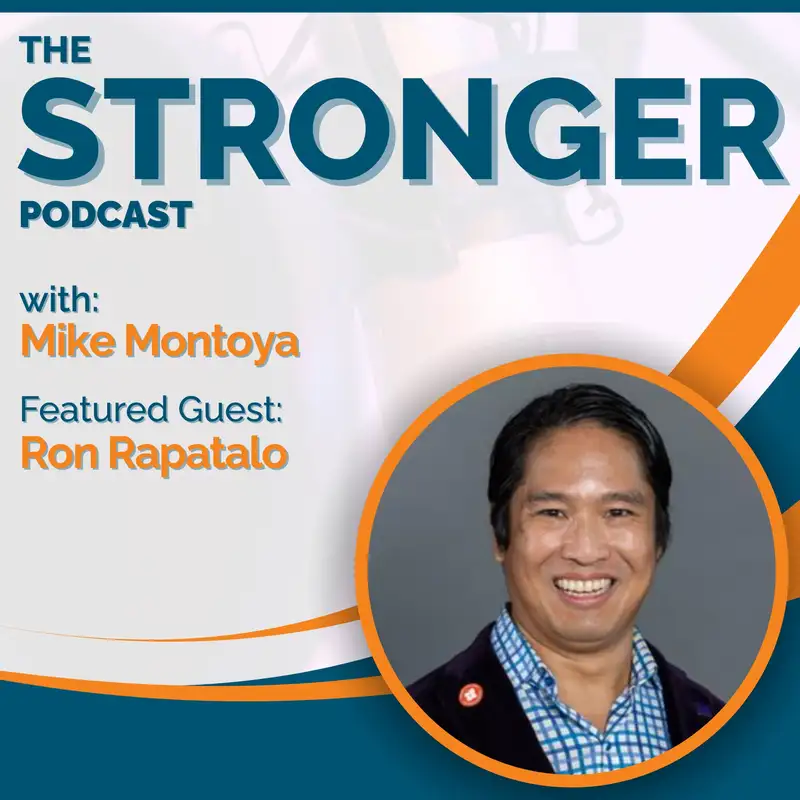
Finding Opportunity Through Relationships: From Immigrant Roots to Talent Leadership with Ron Rapatalo
Welcome to the Stronger Podcast. Each week, we have honest conversations with education and social impact leaders about their leadership and career journeys. We talk about their origins, inflection points, and the work that they're doing today. The conversations are honest, human, and practical. If you're here for real stories and real takeaways, you're in the right place.
Mike Montoya:Let's jump in, and let's get stronger together. Today's conversation with Ron Rapatalo is about more than talent and hiring. It's about legacy. Ron shares what it meant to grow up as a son of a Filipino immigrant family in New York, to lose his father at the age of 10 and to navigate the path that didn't follow the script, from premed to Morgan Stanley to Teach for America and into 20+ years of work in the talent sector and education sector. What struck me most about this is your network can really become your safety net.
Mike Montoya:This is a conversation about generosity, career pivots, and the kind of leadership that builds opportunity for others. Let's jump in. Before we dive into today's conversation, I wanna give a quick shout out to podcastsmatter.com. Their mission is to help impact driven voices get the visibility they deserve. If you wanna share your message with the world, check out their website in the show notes.
Mike Montoya:Good morning. I'm here today with Ron Rapatalo. It's great to see you, Ron, podcast pro. I just called you. So welcome to welcome to the group.
Ron Rapatalo:It's good to be on the other side of the mic, and especially because when I first joined Stronger, Mike, if you remember, I had joined the Ronderings podcast, and now that we've started Stronger podcast, it's now nice to be on the mic as a guest because there's less of a lift. I just get to chat.
Mike Montoya:You have
Ron Rapatalo:to do all the lifts because you're in a convo.
Mike Montoya:Just gonna hang out. You just gotta hang out.
Ron Rapatalo:Well, I'm here to hang out.
Mike Montoya:Yeah. One of one of the best parts about our opportunity here, right, is for us to kind of, like, share with the world a little bit of our own relationship and you as a human. And, you know, the work that we do, it's really exciting. And at the same time, it's got a lot of work involved, right? And so this is a chance to kind of put that at least on the to the corner a little bit, right?
Mike Montoya:And just talk a lot about who you are, etc. So let me just ask the opening question, right? Which is like, tell me where you are in the world. And like, where where your kind of roots are? Like, where did you grow up?
Mike Montoya:What was what was your early, like, first ten years experience like in the world?
Ron Rapatalo:Yeah. So to get to today and then I'm gonna go back in time, way back in time because I turned 50 last year. I'm currently in Jersey City right outside of New York, so I've never left the New York City Metro Area. Folks are not familiar with Jersey City. It is sometimes called more by New Yorkers than people in Jersey City, the sixth borough, because of its proximity in New York, and it's got a vibe that folks who are New Yorkers would say feels like Brooklyn.
Ron Rapatalo:Yeah. If you know, you know. Right? I'm just not gonna explain that. People will know what that means, but but but the very statement that I made.
Ron Rapatalo:But if I rewind back, I'm a child of Filipino immigrants. My dad came in 1970, mom came in with the other first six in April '72. And so I then was the only one born in America in June '75, months before martial law was instituted. Not me talking about when my mom and the other six came. And so I always reflect on two things before I was born.
Ron Rapatalo:One, would my family have been able to come if they tried to come after martial law was instituted by Marcos in '72. Open, legitimate question. And then two, I'm not here as a family. Right? Certainly without the fight by black civil rights leaders and groups for the creation of the Immigration and Nationality Act of 1965, right, which allowed for many folks because if folks understand the history of immigration in this country, you know, there certainly was immigration for folks that were passing for white or became white according to, like, American definitions.
Ron Rapatalo:And so that naturalization, immigration naturalization act, I think, opened up a lot of possibility for many of us. So I was born in Kings County Hospital in Brooklyn, and growing up in a family of seven plus two parents in a three bedroom apartment was fascinating because it was, I always felt like we were provided for and loved obviously, but things were tight growing up. You know, I was on food stamps as a kid. Yeah. Which you know, my parents were husband, my dad was really the only provider until my mom was able to like get full time employment later on as a nurse's aide, you know, the eighties.
Ron Rapatalo:And so, you know, if I paint a picture of like what growing up in Brooklyn, and when I moved to Queens at six, diversity has always been the center of my growing up, right? Because growing up in you know, East Flatbush and South Ozone Park, Queens, there was a lot of everybody,
Mike Montoya:you
Ron Rapatalo:know, black folks, folks from Africa who came to America, folks in The Caribbean, all kinds of Asian folks, all kinds of Latinx folks, Puerto Ricans, Dominicans, Ecuadorians, you know, group a lot of around a lot of Jamaican folks because East Flatbush Flatbush is known for like a pretty big, like Caribbean, particularly Jamaican population. So I grew up around that feeling that was normal and to be aspired to because my family and I not to say there wasn't difficulty around it. Right? But I would say it was more of an extreme net positive of going around so many different kinds of people that it felt like though people experience the world differently, we all shared very similar values, which was very exciting to like bear witness to as a young kid, which certainly then pervaded, like, the rest of my my life personally and professionally. I would say an inflection point because you mentioned the first ten years of life.
Ron Rapatalo:My father passed away when I was 10 in March 1986, and so that was a really big inflection point growing up, because it's one of those things growing up, you know, for any of the listeners who've ever had a parent pass when you were young, right, it's surreal because you think your parents are superheroes. I thought my dad was a superhero growing up, right? You know, was a CPA, he had three other, he was a real estate broker, insurance broker, he was an income tax broker, you're right, on top of his full time job. And so my dad just made everything seem possible, and so did my mom in different ways. My mom held down the house, my dad provided, right?
Ron Rapatalo:And so I thought, you know, when my dad passed, like, I don't wanna say the world felt like it stopped, but there was this inflection point of, like, it made me question my spirituality one. Was raised Roman Catholic, and I didn't know. I was like, you know, I think the thing that I asked was, why did God take my dad away? Right? It was a very surreal, like, I remember shouting it out as a kid when I found out the news.
Ron Rapatalo:And I think it just led to this moment of discovery of, like, how do we live life without our father? Which was I I think we all got impacted by it differently. Right? And I think, in some ways, being the youngest in my family I'm not saying the impact on me wasn't hard, because it was. But I think it was a level of insulation being the youngest in my family.
Ron Rapatalo:I didn't feel the weight of my father, not because I had my mom and my six siblings to kind of insulate me from that to some degree. Right? But living without a father from 10 on was really hard. Right? But yeah, I would say the the other things I would highlight about the first ten years of life was I remember just us having fun.
Ron Rapatalo:You know, I like to paint this picture of, you know, while we didn't have a lot, we were very ingenious. So we did this thing in our old apartment in East Flatbush, taking glossy magazines and taking the pages, putting it at the bottoms of our feet, and playing paper skates in our apartment. So we glide on the carpet on glass and just skate along because, you know, sometimes going to the park and outside for various reasons in the late seventies wasn't always safe, to be clear. I'm not saying it was safe. Like, it just wasn't always safe.
Ron Rapatalo:I just gotta name it. Right? So we at times had to do things in our apartment. Right? And we certainly didn't live fast forward when I lived in luxury apartment building, had a playroom and all these things.
Ron Rapatalo:It was yeah, the apartment, you might have had a functional elevator sometimes. But, know, we lived in, you know, the 5th Floor. So it was often walking up and down.
Mike Montoya:Climbing is out there. Elevator. The groceries and the things, right? Yeah. Yeah.
Mike Montoya:I mean, this is this is a really vivid picture. I appreciate you kind of like, I call it helpiness. Like imagine, right, what this was like, I think, like, lot of people have not spent and lived their lives in, you know, the New York City region. And so that's a picture. I think we all saw things on television, right?
Mike Montoya:As a kid, I was like, this is pretty unrelatable, like, but there was a show called Hill Street Blues, which painted my picture of New York City in the 70s and 80s. And it was like a pretty, you know, it was like at the 10:00 hour, right? Like, the kids were not supposed to be watching this show, right? But that's how I imagined New York City when I was a young man, right? As a kid.
Mike Montoya:And then, then having friends, right, now that I'm growing up, right, like having friends and spend a lot of time in the city over time, like having friends that have these stories like you're talking about, right, like this moment where like your mom was now responsible for your whole family's well-being, Right? And that's a and that's a huge thing. And, well, you'll never know what it's like to grow up with a father all the way through. Right? And so you and I have that in common, right?
Mike Montoya:My dad died also, like when I was in my 20s. Right? Or in early 20s. So there's a gap, right? There's a gap.
Mike Montoya:And I started to discover that guy. I started to do it. Maybe you can reflect on this. Like, I discovered the gap. I'm like, when I got to be about 40, I'm like, there's nobody above me giving me any suggestions or advice on life.
Mike Montoya:Like, it's just like make it all up as you go along, right? Or use the internet, right? I think at that point, but I don't know as a as a 10 year old, and like you said, you started to realize it as you got a little older, right? Like, did you did you feel the absence of your dad? As you got into middle school and high school?
Ron Rapatalo:It was more of a, you know, what I thought my dad and I would have done together. I remember when my dad passed, he was gonna take us all on a fishing trip, And so I never got to do that, right? And it was also, you know, the counsel of like, as I was becoming a man, and not to say my brothers weren't supportive, but they were still going through their own journey, like being in their teenage years, in their twenties, right? And so I think I miss that wisdom from a male parental perspective. Right?
Ron Rapatalo:I don't know if I've ever been able to capture that because, you know, aside from, like, my dad and, you know, some of my male siblings, to be clear, right, you know, I think the biggest kind of influence in my family has always been my mom and my two sisters, right? And so and then working in K-12 education, as you're well aware, Mike, you know, you're working around women a lot, right, because it is a it's a pretty industry. And so I think I have gravitated for a lot of different reasons to be around women, and particularly women of color. And so I think I've had to, like, in the last ten years, think rethink what it means to have more male presence in my life. I have a couple of really close male friends, but beyond that, you know, for me to name, you know, how many other men that I'm close with, I would say I probably have more acquaintances than, like, male friends.
Ron Rapatalo:I have tons of female friends I can name. Like Well, it's like it's like
Mike Montoya:a thing in our society. Right? Like, men whatever whatever the things are. Right? Like, men in our society and this is not this is, like, I'm doing really broad strokes here.
Mike Montoya:People don't get it out of context. Like, I'm not a psychologist expert, right? But my experience is that like, in the data, I think shows that like, men have a hard time having relationships with each other as they get older, for all sorts of reasons. And then those of us who didn't have dads, are like, where's the gap? And we fill it in with other pieces somehow, right?
Mike Montoya:And somehow we do okay, right? And but there's this like, there's this like, missed, missed transition of information and experience, right? Like you said, some of the things you may not have gotten to do, because your dad wasn't around, right? As a young man and your brothers, right, who are lovely people in their own ways, right? But they not they were not responsible for you as a kid necessarily, right?
Mike Montoya:Let's fast forward a little bit. You stayed in the region, you went to school in New York City, I think, and then eventually you ended up into a how did you get from from from college to to life as an adult now? You I know you have a family, and if you wanna talk about that, I'd love to hear more.
Ron Rapatalo:Yeah. I mean, like, I always this is always a talking point or a headline. I I say it partly in jest, like every good Filipino, I was destined for medical school since I was really young, right? Yeah. Was a math and only profession.
Ron Rapatalo:Yeah. The only profession, right? I mean, certainly if I was an engineer or lawyer, that would have been okay, right? But this is a classic, like, immigrant story of like, get the professional career that's stable, that pays, right? And this cuts across like every immigrant community that I've ever, right?
Ron Rapatalo:And I think because I held being a doctor up in this, like, theoretical, I didn't know what it was really like, although I volunteered at hospitals and never really did stuff, like, medically. I I not voluntary. I I worked in a storeroom as one of my first jobs in high school, right, for, like, a year and a half. But I had an inflection point realizing in my senior year, you know, and I was a almost double major in neuroscience and math, so I certainly had the grades, had the rigor, you know, I still say to this day, I would've been a really amazing doctor, because aside from like, you know, being technically brilliant enough, I think my empathy would've really carried the day, right? But at that young age, I think I said, at 29, four years of medical school, assuming I was gonna do school straight out of college, right?
Ron Rapatalo:And then years of residency, what's the picture I'm seeing? It was blank. I was like, I don't know what that feels like or looks like. I don't know. And so I hedged.
Ron Rapatalo:And so though I took the MCAT, did reasonably well, I got a thirty, ten in each section, decent writing score. Right? I I think I was competitive to get in some medical school. Right? I was just gonna wait for a year, and so I then ended up meandering through, like, two careers.
Ron Rapatalo:And so I took the job full time at the same place I was a student worker at NYU. So I did that for three years. It was basically like extended college. I was right on college campus, but I was an employee. Right?
Ron Rapatalo:And so, you know, hanging out in the late nineties in New York was fun. Right? And then at the end of the .com era, I got a job at Morgan Stanley because my sister referred me. And, you know, Morgan Stanley, like a lot of the investment banks back then towards the end of the .com era in the in the in the nineties, early two thousands. Right?
Ron Rapatalo:We're hiring a ton of people. So I don't have a finance degree to be clear, but I'm smart. And so I got hired to do operations work. Management skills. Yeah.
Ron Rapatalo:I mean, think I reflect on that time working at Morgan Stanley as a good thing because I ended up seeing what I didn't want to do. I just didn't like the industry for a lot of different reasons. I think the nature of the work that I did wasn't all that intellectually stimulating for me. And so I had what I affectionately like to call my quarter life crisis, which then, quarter life crisis, I was not 25 when this happened, it was more like 27, '28, right? And so in 2003, I had a friend who back then said, Hey, this is such a talking point in education, would make the statement, you're gonna laugh, is, We're hiring a Teach For America, Ron, you should look into our careers page.
Ron Rapatalo:I'm like, Dude, they always seem to be hiring. Great career. Right? So I never taught through the core, never been a teacher in a classroom, but I was the national office manager at our national office starting in summer two thousand three. As that that became the beginning and continuation of a twenty plus year being around k 12 education and then more broadly getting to social impact work.
Ron Rapatalo:And before I let you see if you have another question, working at Teach For America, though I would say my admissions experience was a little bit of like seeing what hiring could look like, but that's I don't consider doing admissions work at higher ed feeling exactly like hiring. It's a little different. Right? So when I was at Teach For America, was just curious how the sausage was made, I e, how did they do core member selection? It was fascinating to me.
Ron Rapatalo:It was like this model of, like, bring all these incredible back then, mostly recent college graduates to come in and teach in urban rural schools throughout the country for a minimum two year commitment. I was like, why do they do that? How do I assess it? And so learning that process got the hiring bug in me. Right?
Ron Rapatalo:Because it's like Yeah. Is kinda scientific, but it's also a little bit artistic, and it's also based on how you are getting people to share things with you. Because if you're not able to interview well by getting people to share in some relatively honest, vulnerable way, I think you fail as an interviewer frankly, right? And I even felt that early on, right? And so that became the beginning of twenty plus years being in and around hiring at some level.
Mike Montoya:I just wanna say that if you're a leader, entrepreneur, or business owner who needs some support, there's an easy way to get a think tank behind you and your vision. The Genius Discovery Program at Thought Leader Path is like having your own one on one incubation and acceleration program. They'll help you develop an approach based on your own story and your plan for impact and offer the tools and thought leader assets needed to really amplify your message, including launching a podcast like this one. If you're ready to stop grinding in the dark and start making real impact with the right support, check out geniusdiscovery.org. Yeah.
Mike Montoya:And talent work. Well, think I'm gonna pull on this thread. What I heard you say is like, it's Morgan Stanley finance spreadsheets, etc. Like not I mean, can be very lucrative, right? But not financially not intellectually stimulating.
Mike Montoya:Right. And there's a piece of you that I don't know. And now now that I've known you for a while, right? I don't know, ten years or so. Right.
Mike Montoya:Like there's like part of your genius zone, right? Is in this like relationship in inter interrogatory thing, right there where you're like, in in conversations with people, and you enjoy that. And people tell you things in you blossom right in that experience. Right? And that's right.
Mike Montoya:Like, that's like an amazing thing that you started to like, whatever, maybe fate, etc. Right? Dropped you into that that moment, TFA Teacher America is really great about finding talented people, right? And then helping them find some of their genius, right? And there's some I mean, of in the ed space, guess my opinion is that there are not great leadership development experiences on scale, and TFA is of the largest scale in the country on this area, except for schools of ed at the universities, things like that.
Mike Montoya:That's a different pathway. But this whole not traditional ways for people to come into the sector with these other experiences, TFA has been a really great conduit for that. So we're lucky that they, I called you, scooped you up in that regard, and brought you into the work because yeah, I think you were just talking about like, how you like, like to get people to tell you things. So tell me about how that's showing up for you a couple times in your life. And I know that like you have, you know, like you have your talent work and your like executive search work, but also like you do a bunch of other business development, things like that.
Mike Montoya:So like tell me about like how those skills right have sort of to be sort of show up for you now that you're now you're growing, you're a fully grown.
Ron Rapatalo:Yeah, I'm gonna rewind to college because it'll paint a picture of how I realized it was something I enjoyed, but the question was, who gets paid for these things? Who gets paid because you're good at relationships? It was always what I thought, right? And I knew that salespeople did, but I'm like, I always stereotype that sales is very like super transactional, just the way that people think about networking, which I actually learned over time, is the exact opposite if you do it well, right? And so there are couple moments in college that I think I realized that was good at getting people to trust me, right?
Ron Rapatalo:So I was a peer advisor, surprise, surprise, right? I'm doing all the classic things that like are centered on, what are student leadership opportunities that can get you to have people trust you, right? So I was a peer advisor four years through a student organization called Peer(s) Years. So I got trained in like things that were social work y admittedly, right? Because there were times I had to answer the phone at like the office where we were and college students can call for asking for advice of anything.
Ron Rapatalo:And I remember taking a handful of those calls. Right? It was a little surreal at a young age to, like, have to take calls from folks that were struggling with different things. They wanted to talk to a peer rather than going into counseling service. Right?
Ron Rapatalo:I also was an orientation leader for the College of Arts and Science in all university. And so I say all those things because a lot of how I was trained in those things was being able to have some technical information that was sharing some level, but it was a lot of asking good questions. Sounds a lot like hiring, sounds a lot like coaching, And so I think I started finding out later in life because I enjoyed doing those things, but I did so much of it informally. Like, I I think over time what happened, especially as I got into talent acquisition, Mike, is I became the person people knew to ask to have a convo if they're exploring the next career move. So I started providing informal career advice as far back as college, mind you, as an orientation leader who sometimes steered people away from the careers that their parents
Mike Montoya:Don't do that job.
Ron Rapatalo:One of my best friends tells me in this story, his name is Paul Kist. Love him to death. And he's a Coptic Christian Egyptian man. And the thing he tells me, which he then told his dad, who's a doctor by the way, that when Paul was asking for my advice during summer orientation around, should I be a doctor or not? I was really honest.
Ron Rapatalo:I said, you have to choose your own path and what's gonna give you joy. It's probably, by stereotype immigrant parents, that's like the worst thing to be able to tell an immigrant child. Don't believe that in my child. And so he then told me, he ended up telling his dad, I was like, I am glad your dad has not like met me too many times, to be like, you disappoint me, Ron Rapitello, because now my son's not a doctor, though my friend is a very successful technologist, who's worked at many amazing, like two different startups, and like was bought out, I mean he's like done some amazing work, right? But I think I realized, you know, this path in my professional career, of being the person who enjoyed giving advice on careers, but also life, and it stuck with me that eventually the moment that I knew that I could start getting paid for it was being asked by a friend, I would pay you for your service of updating my resume.
Ron Rapatalo:This is at least fifteen years ago, right? And I was like, you pay me? It was weird because I just, it's not why I did it, right? But I was like, the number, I still remember the number, it $50 for an hour. $5.00, yes, which is know, pretty good number.
Ron Rapatalo:Typically reasonable I guess, right, for a friend, and that is just something, that's literally how I started saying, I'm a coach. Because I was like, wait, if I'm already doing it, and someone paid me for it, now I'm doing it. Because I just remember starting to announce it. And so coaching, talent acquisition, recruiting, asking questions of folks, being able to position something in a way that told the story, I think I learned in the building relationships too, Mike, related to this, the ability to to talk to to sell a narrative was really important. Right?
Ron Rapatalo:I don't think it was exactly told to me such in that way, but I think when I realized when I would quote unquote sell jobs as recruiter, which at some level I still do, it's strong because people, someone just asked me about the job in Connecticut that we just launched, And so I was like, well, it's not my job to talk to you, I'm gonna hand you over to someone else. Someone else is a lot more the mix, and that's their job. Right? If someone really I'm like, I wouldn't say no. But what I find is being able to position the story vis a vis what that person's experience and values and what they want next is a dance.
Ron Rapatalo:Right? So sometimes it's questioning, sometimes it's sharing the story and saying, how does that resonate with you? There's a lot of back and forth that goes with, I'm looking out for you. Let me share some information, be truthful with what I know, and at the same time see, does this work for you or not? Right?
Ron Rapatalo:And I think that's often, that's how I sell too. And you know, you've been on calls with me, approach to I think selling is highly relational, right? Because it's about what do you want out of it and how can we match it rather than this is how we do it, how can it match you? Right? I I find that getting where people are, it's easier to overlay and be flexible with what we offer, what the client is offering, or whatever it is that you're selling, right, to be able to have that conversation to see if there's alignment or not.
Ron Rapatalo:Right? And so that's pervaded a lot of my approach where I think it just it's really intuitive at this point, where I'm like, it's not even something I have to think about. I don't script conversations anymore as a result because, you know, like I've had tens of thousands of these convos where I'm just like, it's an autopilot thing. It's like, I'm just being in the middle.
Mike Montoya:All parts of your brain are lighting up and connecting. Have that little hat that they put on you where you can bring activity like you're it's like you're all those bright spots. Well, but I think this is like a huge value to the field, right? Like I think we had a lot of calls from people who want to talk about their careers and they're really going in. There's no magic bullet here, right?
Mike Montoya:But I think what you talked about was helping people to uncover, unpack some of the stuff that they know inside themselves to be true. And they're like, how do I live into this thing that I'm holding on to as my experience, etcetera, and going towards? Or sometimes away from what dad wants or what journey is supposed to be or whatever that is. People talk about like, hey, I'm supposed to be this next, that's my next slice and job and things like that, but I'm really unhappy. Right?
Mike Montoya:And our space has a lot of people who are kind of like doing the next right thing, but maybe doesn't have like a lot of joy, right? Like sometimes the joy goes out of some of these jobs, right? Because they're so technically or like complicated in some other way that you're gonna sign. It's like not very fun, right? And so like this whole point of being like excited about your career and doing something interesting, right?
Mike Montoya:Because it's you got one life basically, like that you're gonna remember right now, right? But you have all these other opportunities, right, to kind of grow and blossom. And, you know, there's like your career and then I think it has to be compatible. And let's talk about this. Let's switch gears a little bit to like this idea of like career compatibility with life, right?
Mike Montoya:Because, right, like most of us, many of us have like our professional life and then we have our things behind the scenes, behind the screen, I call it like what's going on with the kids, the family, that kind of stuff, right? So like, as you as you've grown up and started your family, and how are how have you like, started to think about your career and your balance with life? What are the things that you're kind of holding as valuable and true in these two spaces right now?
Ron Rapatalo:Yeah, so I'll name one thing, I think since 2014, I've been working remotely full time, whether for myself or at other search and consulting firms like the one I work at with you now, Mike. And so, when I think about working remotely, the privilege that working remotely gives you more, when used right, and you have the environment support of a leader like you, is integrating work in life a little bit more. Now that does not work for everybody, I'm not saying integrating life, that means, you know, look, you and I get this right, because you're the boss, I'm a senior leader in your company, Sometimes you know, I'm popping off a 10PM email, but that also means between nine and eleven I'm working out, right? There's this sense of like, get the job done, and be responsive about how you're using your time, rather than, you must be here, ecstatic. Because I think what I watch in the industry in K-12, Ed, which is why I think there's a pull for people, because we have some of the most passionate people on the planet working in our damn industry.
Ron Rapatalo:But the way that we're asking people to work, which is much predicated on, let's be clear, children coming in person to a set building to learn, right, which is the model, and is, I think a lot of smart people have tried to figure out how do you shift that, but it becomes a childcare and a workforce. Complicating. I'm not saying that the model doesn't work, I'm just naming like what is, what the tension is here. But the fact is, I think, I think of if I'm given space to live, I work harder, not the other way around. I work hard to live.
Ron Rapatalo:No. And I think when I started realizing that through working remotely, it freed up a lot of like my brain space, right, because I'll rewind the audience back to when I was in second and third grade. I was that kid who would take a test, get a forty minute period, I finished many exam in ten minutes. Now one might argue that yes, the rigor of those exams did not meet where I was at. That is also true, right?
Ron Rapatalo:And I was also, I've always moved fast in lots of things, right? For better, for worse. And so that means that like, I could do things often faster than like your kind of average person that might take something and do it in three hours. If I'm working really efficiently and I get in my zone, I can do it in one. Does that mean that I have to stay the other two hours?
Ron Rapatalo:That for me, like it's never been.
Mike Montoya:I can say there was a conversation about that right now. It's like shift, right? For sure. Because it's that, yeah, this like idea, like how do your, how do you make space for the other things that matter, right? And like you have an active fitness career, right?
Mike Montoya:With your power lifting and then you're raising a couple of girls and a wife that's And also so like you have to juggle a bunch of things, right? I think in some ways, I could almost again, it's back to your bits of where how you function the best. I know for me, like, I had to be stuck at the desk all day, I'm like suffering, right? Essentially, I'm good for like three hours or four hours on the desk. And then I got like, you know, get the hell out and move.
Mike Montoya:And then my brain works better when I'm moving and thinking and Mhmm. Kind of engage in various ways. You know, that's
Ron Rapatalo:In fact, I think that's most folks. Like, you know, when I think about so I'm gonna get my in my nerdy neuroscience soapbox because I don't get to use it often. Cognition and movement are very related to each other. Right? Your ability to think is not just in your brain.
Ron Rapatalo:A lot of what is allowing our brains to think better is interrelated to the dynamism of our body moving.
Mike Montoya:Yep. So you
Ron Rapatalo:hear the anecdotes of, like, I've got some of my best thinking taking a walk. Right? I've done some of my best ideation when I'm at yoga or I'm, you know, it just, And so I I am particularly super bullish on talking particularly to all the seniors we know, Mike, who disproportionately do not incorporate movement into their lives, which I think ends up being a super detriment to their ability to lead over time. It's not something that immediately hits you, but over time, a year, three years, five years, it it it it takes away because we're not superhuman. We're not expected, I don't think, to sit at a desk and be in front of a screen for x number of hours and then Yeah.
Mike Montoya:We're kinda meant to, like, wandering the planet, right, slowly, while our feet, you know, picking the ball off the ground, right, like, it's like, this like, humanity evolved into a thing. Yeah. We put ourselves literally into a box, right? I kind of missed the pre COVID era before zoom was a thing, When like, people were like, let's just talk, right? And the cell phones weren't blown up with tech messages, right?
Mike Montoya:You just had a conversation, you just kept moving. I think you still do a lot of phone phone conversations, right? That's like kind of your MO in terms of
Ron Rapatalo:I don't offer on move works better, right? I don't offer Zoom, which throws people off every once in a while. Go, where's the Zoom link, Ron? I'm like, you read the calendar where I said no Zoom. Right?
Ron Rapatalo:And then I actually asked you, you're okay if this is no Zoom, this is a phone call. But I think we've automated folks so much in the workplace to expect a Zoom call that I what I find is most people having a phone call so they have space to save their eyes, quote unquote, and do other things, is actually quite liberating. And the only reason I do is because I've learned well, in my line of work, if I'm not in control of my calendar, how I'm spending my time, just then everything is gonna be put on me. Like, doesn't I think you learn things about leadership when once you get to a certain level like you and I are is that if you don't control the parameters of how people access you, you'll be accessed for everything.
Mike Montoya:I'm going to pause the conversation here for just a second to talk about books that matter. Every entrepreneur or leader needs a book that elevates their business, builds their credibility, and makes an impact. If you've got more money than time, a ghostwriter can help you build your story. If you've got more time than money, a great book coach can guide you step by step through the writing process. If you have already written a draft, these folks can save a lot of trouble and money by shepherding you through the publishing process.
Mike Montoya:Head to booksthatmatter.org and get the custom support you need on your book idea or manuscript. Yeah. Exactly. And it just comes in at all the there's this whole, like my my experience is, like, there's amount of energy, and you have to kinda manage energy, right, much more than time. Yes.
Mike Montoya:There are only some things that you can do. Some things require it's an intense focus for a certain amount of time before you get it off the ground or whatever. And then there's other things that you can do kind of, you know, when you're like a little more depleted energy wise, but like you can't, expect greatness when your brain isn't in the right spot. And so the whole idea of doing the right things at the right time is critical. And if people are like, when you're owned by somebody in terms of their time, it becomes a killer to like, hey, this our company is not super meeting heavy.
Mike Montoya:Like, we have a fair number of them. It feels like I'm in meetings all the time, but a lot of them are client facing, etcetera. And that's like a different story. Right?
Ron Rapatalo:And the team
Mike Montoya:itself doesn't have a ton of meetings. Right? And so, like, gives everybody space to do the stuff that they need to do. Right? I think is like a key that's like a feature of our company.
Mike Montoya:Talk about your talk about your list. Let's see what gets to like these, I call it pieces of wisdom. You and I had this conversation recently about like, yeah, forward looking, just said you were 50, turned 50 recently, right? About six or eight months ago, right? And so like now you're now and we talked about not having dads, right?
Mike Montoya:And the fatherhood piece, right? So your dad, you're looking to the future, there's this like, you're halfway through your life, probably right, give or take, you know, five years or something like that. Like, what's what's kind of what are some things that are coming up for you now that you've, know, kind of been doing your work and you're now living living your life, but now that you're a grown ass man, right? Like, how do you how you do think about the next ten, twenty years?
Ron Rapatalo:Yeah. Grown ass man is a very as in topic statement. Hope to be more grown ass by the being a student than later. Still a kid at heart, for better or for worse. But you know, when I think ahead, right, you know, I think one of the things I put at everyone's, you know, feet to think about as a kind of as a way to think about this, this is the way I've thought about it, right, is, you know, if I am in my nineties and I am at my wake and people are talking about me, what do people say?
Ron Rapatalo:Feels Mormon, but I don't think it is. Right? And so, Mike, you're aware at the time of this recording, my my I went to my nephew's burial, and I you never wanna go to the burial of someone younger than you and your family. Right? It's it's heartbreaking.
Ron Rapatalo:Right? And and yet, when I found that the theme of going to no funerals in my life, you know, both of my parents, you know, my brother Jess, who passed some years back, is it's also a moment to like reflect and talk about mostly the good thing, but sometimes the things that person may have been struggling with that you kind of laugh about as people a little bit, or like a, oh, that made that person really complex, and oh, maybe I should have added a little bit more empathy for that person. Right? Yeah. Is I would hope in my nineties, maybe I'll you know, who knows?
Ron Rapatalo:Right? When God decides I should be my spiritual form explicitly, not my body, his folks would say the following about me. Ron was super generous and he made time for me. The way he made me feel and Saul lighten me in ways that others might not have or I didn't for myself made me feel like I could do whatever I needed to do next. He was generous with connecting me with people.
Ron Rapatalo:You know? He didn't keep the people he knew in a box. He was good with figuring out where there were synergies between people. You know? If I think about, you know, legacy and impact, that for me is like, if that is true, then the kinds of things that might happen that I hope, you know, like to be able to missus and I have a foundation, right, that we end up with a bit more wealth than we might have, like, financially.
Ron Rapatalo:I mean, we have a ton of wealth spiritually, physically, mentally. Right? But, you know, if you think of the dimensions, wealth is not just money, and you need money to pay bills. Right? And so when I think about, you know, that legacy of having a foundation, being able to, you know, provide for our daughters so they don't have to struggle with things the way that my wife and I had to, the way that we grew up.
Ron Rapatalo:Right? But through that struggle was a lot of the learning and the journey of understanding of what to do when you don't have a lot that you can still find joy. You can still find, you know, a level of being able to do good things. And at the same time, not having enough causes a lot of stress and things that we can talk about a lot about. Right?
Mike Montoya:I mean, yeah. Yeah. It's a lot
Ron Rapatalo:of as
Mike Montoya:you're describing this future state, which is a ways away, right? But in terms of your family, when you're 90, your kids will be, I don't know, 45, right? So they're gonna have probably their own families or something, some version of that, right? Yeah. But it's kind of remarkable to me, just think about like your parents, you know, basically escaped the Philippines and people should go do the history of the 70s in Southeast Asia and etcetera, like understand what happened and what's going on there and America's interventions, right?
Mike Montoya:Coming to The United States, right? And literally in the span of fifty years, right, you've created a life and an opportunity for the next generation of kids. And that's just when we're in this moment when immigration is always the hot button, and it's just a ridiculous kind of vision of what the country can do for itself and each other. The giving back parts, building a lifestyle with your family and contributing in ways you just talked about, hey, we want to have enough wealth to give it back to somebody else in that regard. That's kind of this amazing story.
Mike Montoya:And I hear it all the time, I guess is the point, is that both who start with little and achieve fullness are basically looking to recommit it right back into the world that helped them produce it. And that's, thank you for doing that. I mean, A, and it's a powerful story. And it's important to think about, I don't know, empathizing with everybody else that we run across in our lives, Like each of these, you know, especially kids that we know and that we work with in these schools that we work with, like they're each of them is a little nugget of genius, right? Just waiting to grow.
Mike Montoya:And so, okay, I know. So you have some charter school leadership work that you're doing, right? I know you're working with some charter schools, but like, you know, do you think that schools are doing well enough that some kids are getting opportunities or is there like, it feels like there's, you know, my view is that there's a gap still, right, in opportunity, etcetera, but, like, what's your experience that you're kinda really close to this in some of your work as as a board member, volunteer board member, so?
Ron Rapatalo:Yeah. I think, you know, a lot of the gap is, from what I've seen, from just this is not just my charter school board membership, but just writ large observation of, like, charter schools. I also gotta add because I'm a, you know, product New York City public district schools, right, I forgot to add district schools to this, is the connection to workforce is still not as strong as it could be, right? Yeah. And I might argue that the college going, the roles of really good college counselors, career counselors, only starting in high school but in middle school, and those opportunities, because you can't learn these things in a textbook.
Ron Rapatalo:And so what are the rich amount of opportunity? Not only the school, but the local district, the local city, the state of providing. Right? So this becomes like layers of systemic things. Like, the question I ask is, our kids are brilliant.
Ron Rapatalo:How many opportunities are we giving them that don't depend on the ZIP code that they live in, frankly, that allow them to find out what their genius is just the way that you and I did as kids. Right? And so that for me, the thing, and I think that's a lot of what I watch in this space, right, is, you know, you know, the, it's not just, yes, college is still one of the best tickets out of being low income if you are a student of color. That is true. For sure, absolutely.
Ron Rapatalo:And again, we'd be remiss not to talk about the cost of higher ed, and the path of our young people. Some of them don't wanna go immediately into that, and I think it's the worst thing is to say, hey, we want you to go into something you don't want to do. Maybe you come back to it, but we're gonna give you all the tools and things possible so you can have something that you decide you want to do. Right? Which may not be the journey that we have sought for ourselves.
Ron Rapatalo:Right, and I think of some of the careers, like I was just at a career day at the charter school board that I'm a part of in Brooklyn, right. You know, there was a range of things, right. Chefs, folks who do beauty work, right, So there are all kinds of like really amazing careers that sometimes aren't the quote unquote, what people deem as a professional career, and it's so important to put that in front of you so they can see, you know, the event was called Success Looks Like Me, which is such a brilliant like kind of event, so you see people look like you. I could do that because I see someone who's story is not terribly different than mine, and they tell the story how they got there, I'm like plant a seed in you, it's possible, it's just how do we make the possibility so that you know, there are multiple layers of like safeguards so that folks or young people and their families won't have to, like, fail because I found the way that I grew up that I always felt this fear of failure because it was like, if I fail, will we my family and other be able to pick me up.
Ron Rapatalo:So the idea of being able to fail knowing how quote unquote little, like of a kind of
Mike Montoya:Yeah, safety.
Ron Rapatalo:Pain to land safety net, you know, is something, you know, I just think societally we've always had it a bit wrong about the safety net for our most vulnerable communities, and we're watching it right now with where federal government is reacting frankly, is to demonize and attack those who are our most vulnerable because it becomes a starting point. If you think you're feeling stable, we're gonna get them folks who are easier quote unquote for us to like
Mike Montoya:Lower hanging fruit.
Ron Rapatalo:Feel unstable because the rest of y'all will feel unstable as a result. Right? It just creates a lot of like cognitive Well, it creates a lot of dissonance.
Mike Montoya:Well, and I mean, it's the I mean, this administration's approach to solving like challenges in our social space, right? Is like, I guess, counter to my own way of approaching this work. Name it that, right? But I'm not in charge right now, right? And I don't have the choice, right?
Mike Montoya:I mean, it's like, we can resist and we are resisting and doing the things that we need to do that we can do. And at the same time, they have a big hammer right now. And they have a sledgehammer of sorts, right? And it's like a real thing that we're experiencing. And I think it's important, and I'll just say this to our listeners, right?
Mike Montoya:Like, we're on the side, I think, of children and families having opportunities, right, regardless of where they are from, right? And that, you know, like, America is better as a place, right? When we when we do that for everybody, right? And, we all grow and get healthier and better, right? We have those choices.
Mike Montoya:And I just imagine we'd be just thinking about higher ed, it's the crazy journey of helping kids giving choices early on so that they have lots of ideas, right? Because I think it's dangerous when we I think it's a seed of unhappiness that we plant in kids when we're like, this is your only path. Because we don't know what's going on in their little spirit. That's emerging as a kiddo. And our jobs as adults is to make these things possible.
Mike Montoya:And if we're not doing that, then we're kind of screwing it up, right? And I think that's like there's a challenge in the talent space, as you said, in my view, is that there are not enough leaders with enough resources to do the things that they all want to do to make kids' lives bright, right? And money goes all sorts of places, but sometimes it doesn't end up in the place that it needs to be for kids. And it's a real challenge, right? And from a leadership standpoint is how do we do that, right?
Mike Montoya:Okay, so shifting back, I want to come back to the bright spots of our lives, etcetera, a little bit. And if you're willing to share, and now I'm going ask you to be the dad that you didn't have guy, right? In some ways, like sharing and because there are, you know, other young people in our audience, I'm calling young people like 50. In our audience, anybody younger, right? People that have just not gone down the path that you maybe have gone down yet.
Mike Montoya:What are some anecdotes or something that you think would be helpful for someone that's emerging in their educational experience or someone that's entering into the workforce as a young person that would be a good thing to hold onto as a kid.
Ron Rapatalo:This is such a headline that said your network is your net worth. I think I realized at a younger age, once I realized that I was really extroverted, believe it or not, there was a time in my life that I thought I was shyer, and I was, right? It's not, I think these things are all contextual, right? But I think once I got into my later years in high school and then to college, right, you know, the idea of building relationships and getting being the person who knew everybody, who I had a dear friend of mine who's like pretty big in the AI space, in the DEI space, make the following comment to me two years ago. She said, Ron, what I remember most about you is how kind you were.
Ron Rapatalo:And for me, that's how if I fast forward to, like, my wake, you know, when I pass at some point, hopefully my nineties, early hundreds, right? That's a nice way to be remembered, right? She's like, you didn't carry airs about you. You were like genuinely nice to everybody. And considering the very competitive high school that I went to, that wasn't always the case, it just wasn't.
Ron Rapatalo:I mean, you know, it And wasn't, so that really sat with me and I think that's, you know, having our young people understand, like, you know, kindness and generosity goes a really long ways of value and how you showcase that to people. Even if you don't think you have a lot to offer, you actually do. You as a human have a lot to offer just by being in presence with people. And just because you don't have something immediately to offer as a young person and talking to someone older to you might something they offer to you, like advice, a job, connections. Right?
Ron Rapatalo:Doesn't mean they're not getting value in that conversation. I think the value of, like, when you're the one being poured into is to be able to always pay it forward. Right? So the idea of being generous with the paying it forward, you're not doing it that moment, but there's someone younger than you or some appear who may need the advice or the resource, you can be generous with that. Right?
Mike Montoya:Yeah. Grease my
Ron Rapatalo:I meal often think about these things that I wish I would have even tripled down when I was younger is how much authentic social connection has been the absolute created safety net for me in my life and for my family. I think without that, I it'd be hard for me to navigate this world and everything going on. Right? And that's something I I constantly talk about with with young people is, you know, the peers in your room, I say, look around the room. Those are the people, believe it or not, who you will be relying on at some point.
Ron Rapatalo:And it's not just me as the older person. Yeah, Don't get, right? I'm like, these may be the people you formed the company with, who hire you for something, who get you in and refer you. So be good to your fellow students. You're not quote unquote necessarily competing against each other as much as you think, even though you technically are.
Ron Rapatalo:But I don't like to think about these things from a competitive standpoint,
Mike Montoya:you know? No matter if you're an adult, right? Like when you're I mean, there's always competition for resources and things like that, right? But you're you're and kind of wrap here with is this like kindness, generosity, the paying it forward, the holding on to like, how you feel, or then feel how you make people feel or how people feel when they're around you. Like, those are all really powerful tools, regardless of whether you have a ton of resources, right?
Mike Montoya:Like, you know, these can be important tools in your toolbox, right? To be an effective networker, to have a build an incredible network of people that can be part of your support system, right? Like this, like those of us without the giant safety net, right, can still have, I call it peace in our bodies because we know that there are people who have our backs. And that's kind of how we can do better. So, hey, Ron, thank you very much for your time, for your service, for your work, for your life, for your generosity and kindness.
Mike Montoya:And
Ron Rapatalo:It's for the work you're a pleasure to once again be on the other side of the mic, to have all these questions to reflect on with you. And I'm looking forward to building more amazing things with you and the company and stronger over the next couple of years.
Mike Montoya:We're lucky to have you. Have a great have a great it's March. Here it comes March, everybody.
Ron Rapatalo:God.
Mike Montoya:Springtime is here. Alright. Thanks a lot, Ron. Take care. Thanks, Mike.
Mike Montoya:One theme that stayed with me from this conversation is generosity. Ron talked about wanting people to remember that he made time for them and that he saw something in them that they didn't see in themselves. That's not just kindness, that's leadership. Whether you're early in your career or decades in, the reminder is very simple. Be good to people and pay it forward.
Mike Montoya:Relationships become the most important investment you ever make. Have a good afternoon. Thanks for joining us and tuning in today. To find out about other Podcasts That Matter, visit podcaststhatmatter.org. Thanks for listening to the Stronger Podcast.
Mike Montoya:If this conversation inspired you, we invite you to follow the show and share it with someone who's on a journey to become a happier and healthier version of themselves. Links and resources are in the show notes. See you next Thursday, 9AM eastern time. Have a great day, and stay strong.
Creators and Guests