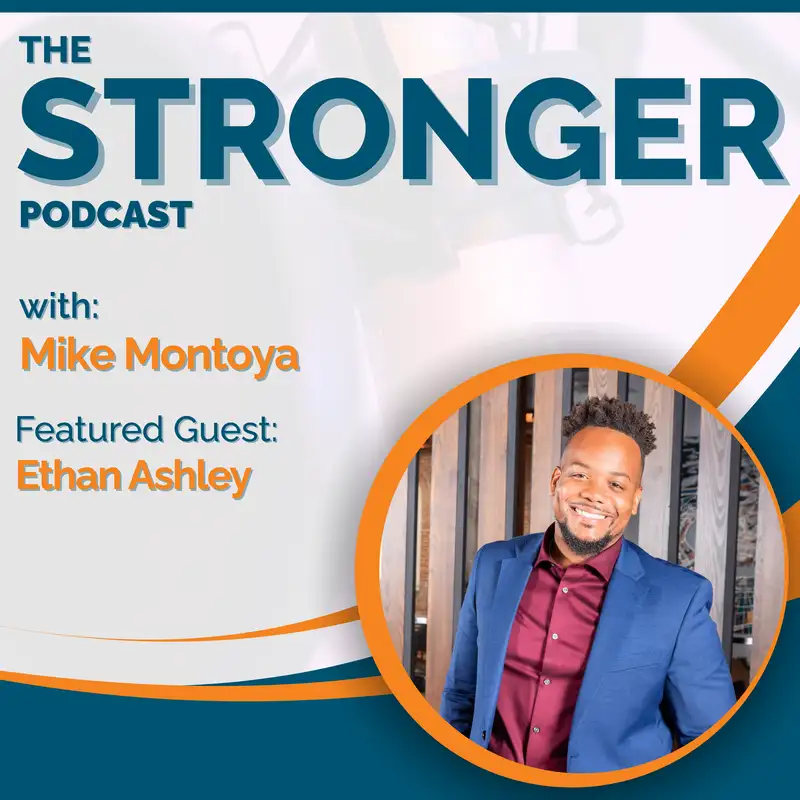
Make the Exception the Rule: Why Strong School Boards Decide Who Gets Opportunity, with Ethan Ashley
Welcome to the Stronger Podcast. Each week, we have honest conversations with education and social impact leaders about their leadership and career journeys. We talk about their origins, inflection points, and the work that they're doing today. The conversations are honest, human, and practical. If you're here for real stories and real takeaways, you're in the right place.
Mike Montoya:Let's jump in, and let's get stronger together. Today's conversation is with Ethan Ashley, the CEO and cofounder of School Board Partners, whose journey from Southern California to Honorary University Law School reminds us that opportunity is never accidental. Accidental. We talk about the people who opened doors along the way and why he's now focused on making sure public school systems create the same opportunities for every student, not just a few. Let's jump in.
Mike Montoya:Before we dive into today's conversation, I wanna give a quick shout out to podcastmatter.com. Their mission is to help impact driven voices get the visibility they deserve. If you want to share your message with the world, check out their website in the show notes. Good afternoon, our podcast community. Welcome to currently March and you might be listening to this in April or May, but I'm here with Ethan Ashley, the co founder and CEO of School Board Partners, which works to support local school board and school board members so that they can be strong leaders in our public education system.
Mike Montoya:Ethan, thanks for being here. It's wonderful to see you.
Ethan Ashley:Man, I'm so excited to be here. Thank you so much for the opportunity. And let's jump in, man. I'm ready to talk about the stuff. Let's talk about the stuff.
Mike Montoya:Let's do it. Well, thank you for your enthusiasm and for being part of the experience. And I think I would want to start with people so they understand where in the world are you roughly in where you operate from most of the time. And then if you can give us copy origin moments, like where you were born, where was childhood? Where did that happen?
Ethan Ashley:Yeah, great question because oftentimes when people ask me, where do I stay? The answer is Southwest in the exit row, Row 14 F to be specific. I spend my time there on planes largely because we fly all around checking on my my school boardrooms around the country. But where do I actually reside? I reside in New Orleans, Louisiana.
Ethan Ashley:There's no city like it. And I love every bit of my city. And so, but when you talk about origins, I think it's a great question. My origins is actually here in Louisiana, but my grandmother was a part of that great migration of black folks who migrated from the South and she went west to California. And that's where my mother was born, and subsequently, I was born, in the LA region, Compton to be specific.
Ethan Ashley:Although I wasn't born in Compton, I was actually born in Lakewood, I was raised in Compton, California, right behind the Compton Airport off of 156th And Central.
Mike Montoya:Yeah, well, I'm glad you named the location and people have heard of Compton. It's notorious for all sorts of reasons. Most people don't remember that it was established by people like your grandmother that made the move. Think Sharon DeBossier also has a similar story where her family is oriented in California because of that time period, most of us don't even like we weren't around, of course. It's harder to remember the basics on that stuff.
Mike Montoya:Okay, so is mom still in California? Is she still with us?
Ethan Ashley:Mother's still with us. Mother is not in California. She's actually in Las Vegas. So, she's trying to get, I guess, closer to me to some to some degree but we She had some stops along the way. To She stop along the way.
Ethan Ashley:But my grandfather is still the last living grandparent, lives in the Compton area still. My father and family live in the LA area. And so, you know, got a lot of family and friends that are still there, Sharonda being one of them. And, you know, I think I spend a lot of time sort of, you know, living between a couple of worlds because I was born in California, but I like to say that I really was raised in DC. I went to Howard for undergrad, Howard for law school, and then I ultimately, you know, worked, lead, and grew in New Orleans, so in the South.
Ethan Ashley:So, I went from the West to the East, and now I'm in the South.
Mike Montoya:And Howard is an HBCU, right? It is, it is. It's like was that like a I don't know as a young man was a dream to HBCU or it just happened or how did that happen?
Ethan Ashley:Well, first of all, shout out to the Bison. They just for the first time ever, the men's basketball team won our advance skews me in this in the in the March Madness. And so they for the first time ever they won a game. Very excited about those young men. Very excited to be a Bison.
Ethan Ashley:So let me name that. As a kid, man, let me say this. I think I didn't I didn't know much about Howard until I was in eighth grade. And I talk about this because my I have an older brother and my older brother was going to college expos and there was like a black college expo that was really big in LA and it was a big experience. And I went with my my older brother and there was only one school that pay that that paid me any attention.
Ethan Ashley:And now mind you I'm I'm in eighth grade so I know I'm young and you know ambitious. But but the way that the Howard recruiter talked to me at like at my tender age made it, you know, they made it seem like I could be there tomorrow. And it really like left a indelible mark on the way in which I sort of, you know, saw the school thought about Howard, and they really wanted me there. And I was like, that's really cool. Little did they know that I would end up finishing high school in three years and sort of make it there as quickly as possible as I could.
Ethan Ashley:So, yeah, yeah, yeah, yeah.
Mike Montoya:Okay, well, a good recruiter, this this human, whoever he or they were. Right. And I always wonder about like if you ever find people in your life as these humans that really made a change. Do do you know who they are? Did you ever find them again?
Ethan Ashley:No. No. No. My you know, so crazy. I have, a few of these folks in my life who played a very significant part in my, maturation.
Ethan Ashley:I I actually started college before I started high school. I started attending ELAC, East Los Angeles Community College, I was dual enrolled. I took an algebra two course and that was about two hours or so by bus from where me and my family lived. And I ended up moving to East LA and moved in with a Hispanic family, my like freshman year of high school, on a whim. I asked this family who I was really close with, you know, one of their daughters, And it was just tough for me to commute during the week while staying dual enrolled.
Ethan Ashley:And it was a, you know, it was a single family, you know, mother household led. I am like some, you know, I'm a random black kid that, you know, they hadn't known for a very long time. And this beautiful Hispanic family, all immersed in culture, Catholic strong Catholic background. I went to I know because I was I had I was going to church with them.
Mike Montoya:You were
Ethan Ashley:going to church. I was. I was going to I was going to church and I was tutoring the the the youngest son, but they let me sleep on their couch and sort of be with them during the week. And it allowed me to sort of dual enrolled. I, you know, to this, I'm now, you know, almost 30 removed, twenty five years removed or so.
Ethan Ashley:And I can't tell you that, like, I'm connected to those folks, but let me, I just want to name that, like, I'm really grateful that they allow me to do that.
Mike Montoya:Yeah. If these little angels maybe is I'm a use that word very softly, Just like these people that show up and do their part to, like, you know, help help a gun person along, right? They may not save forever. Right? But you're at the moment, they were really important humans and features.
Mike Montoya:Right? I appreciate you sharing about that. I think there was I called that's part of my story too. I had all these I call it little, like, rescuers. Like, people that kinda kept pushing me along gently without overstepping their roles and things like that, but it like allowed me to turn into an okay guy.
Mike Montoya:You also went to Howard early and we were an ambitious student essentially. Mean, you went from undergraduate right to law school, I think. Right. And like, what was like, you like, you're like, I'm gonna go make a bunch of money and be happy or supposedly that's the story.
Ethan Ashley:You know, so crazy. I I ended up dual enrolling and staying dual enrolled throughout my high school career, but it was largely because I was, I don't know how deep we're gonna get here, but I'll name it, I was dating an older individual who happened to need credit recovery, you know, I tell you when they ask me who runs the world, it's definitely girls, women, all the things. Thank god for you all because I you know, it really focused me and I and I realized in that class that I was taking or the courses I was taking, I end up doing better than the person I was interested in and I I end up staying interested in being in that collegiate setting. And and it ultimately allowed me to, you know, be 15 my my last year of high school. I'm I'm I'm an April 1 baby, and so my my birthday sort of runs in a weird place.
Ethan Ashley:So I was 16 and and and graduated two months after my sixteenth birthday and then went off to to Howard University. But my Howard story is also a story of like little angels because I was actually afraid to apply to Howard even though I just told you that beautiful story of the recruiter. And I, you know, I don't, you know, young kid from California moving across the country. I think it sounds good. You know, I was I I didn't I wasn't sure if my SAT scores could cut it.
Ethan Ashley:I wasn't sure of all the things. And so I had this this who's now Dr. William Franklin, who's now the vice president at the Cal State Dominguez Hills. He was running a college pathways program at the time, and he was the leader of that college pathway program. And he end up coming in the college corner one day and I was in there hanging out, in the college corner and they they we I was a part of his pathway program and he introduced him and I and and he asked me for my my stats and all the things that I and told him. The weird thing is I had a higher college GPA than I had a high school GPA.
Ethan Ashley:So I think I had like a 3.3 in high school and I had like a 3.5, 3.6 in my college courses. And I, you know, I had, you know, 11 something on the S1170 or something like that on SAT. And I, but I was like, scared. I was like, there's no way I, you know, I'm I'm a just, I got into college here. I'm a go to a Cal State.
Ethan Ashley:I'm just glad I got in. I'm young. And I said, but I would have really wanted to go to Howard. And he picked up the phone on that day, called Howard University. They answered.
Ethan Ashley:They asked him, well, what was my, you know, my SAT, all the thing? And they said they could have prior to that sort of given me an acceptance, a verbal acceptance, but I had missed the deadline. So then I had to, we worked all night and sort of overnighted all my stuff. And on my actual birthday, I got a postcard from them saying, congratulations, you've gotten Howard despite me missing the deadline. I really apologize, Howard.
Ethan Ashley:I know that was some years ago. We're not doing that anymore. You all are, you know, above board and all the things. And I went off to Howard University and I started Howard with about 21 credits or so. Took about 18 my first semester, 20 my second semester.
Ethan Ashley:I had to audit and get permissions to be able to do this because I needed 60 credits to be considered a junior at the end of my my freshman year to be on track to graduate early. And I stayed dual enrolled again when I'd come home on the winter or summer breaks, would do a course or two at the local community college. And then I did that, ended up again, I guess traversing really quickly through the experience. And I was 18 my senior year at Howard University, and I ended up graduating a month after my nineteenth birthday. And I went off to Howard Law, and the rest is history there.
Mike Montoya:I'm going to pause the conversation here for just a second to talk about books that matter. Every entrepreneur or leader needs a book that elevates their business, builds their credibility, and makes an impact. If you've got more money than time, a ghostwriter can help you build your story. If you've got more time than money, a great book coach can guide you step by step through the writing process. If you have already written a draft, these folks can save a lot of trouble and money by shepherding you through the publishing process.
Mike Montoya:Head to booksthatmatter.org and get the custom support you need on your book idea or manuscript. A couple of people I call it helping you go through call, get in the river, so to speak, into this thing. Law school becomes an opportunity, you work for an actual law firm. So, think good luck, you passed the bar, took that job, got the things and you spent some time in this field. Then eventually, you made a transition into your current and a longtime career in that space.
Mike Montoya:How did you just turn on about this? Like did the light turn on at some point? Does that okay? This is how I want to spend my time and my career?
Ethan Ashley:So you know I think a lot of this comes down to some upbringing things. You know at the age of six, I found myself handcuffed at the local police precinct. My mother had caught me stealing, and we were having, what I now know was a scared straight moment. And, you know, from there, my mother sort of, you know, was very clear that, you know, I needed to sort of focus. And, you know, at the time, I was really frustrated about the law and policy.
Ethan Ashley:And so I like that's really how I ended up in the law because I I just didn't understand why we were criminalizing someone like myself who, in large respects, I had stolen Bubbleicious, by the way, Mike. Don't look at me like that. Was still I stole Bubbleicious. And and for anybody who's curious about why that is is because, you know, at the time it was the packaging was was off the chain. I thought it was very needed.
Ethan Ashley:And and I, you know, we would go in the stores and we would get this lecture from my mother, you know, don't look at it. Don't ask for it. We don't have it. And and so I didn't ask for it, I took it. And, you know, there's this truthism that nobody, no young person, anywhere is is has been asked to be born into objective, you know, poverty where you have to make decisions and get aid from, you know, the state.
Ethan Ashley:My mother had found herself divorced, raising three boys, want a head start salary, and, you know, so I I just found myself sort of having sticky fingers and but being very honest about that. And I think, you know, me sitting and sort of reflecting on like, you know, why is the laws like this when, you know, we know young people don't ask to be in this situation, it made me think maybe my pathway and trajectory is around law and having my experience of graduating particularly early and, you know, going through that. I started off my career, you know, representing young people who were sentenced to die in prison, 15, 16, 17 year olds in partnership with a young man named Brian Stevenson. I was the Louisiana arm of the EJI work. I was a young lawyer sort of trying to work to end, you know, you know, this practice in in the state of Louisiana.
Ethan Ashley:And and doing that work, organizing, going to prisons all around the state of Louisiana, I've been in every prison. It was it was tough work. And I was just realized I really wanted to be on the front end of the school to prison pipeline and pay homage to the second part of my story, which was, you know, the ability to say, you know, by no means should I have been the exception to the rule graduating the way I did. You know, should have been the rule in the system that sort of allowed that, you know, my trajectory to be what it was, was largely the school board system. Know, I went to a performing arts elementary school.
Ethan Ashley:I went to a media magnet middle school. I went to a law magnet high school. I got bused to those schools. I didn't pay any, you know, fee for being bused. I went to I was dual enrolled, as I explained, didn't pay any tuition to be dual enrolled.
Ethan Ashley:I had the opportunity to sort of have all those experiences. And that's largely because LAUSD and the system allowed for that to be true and the policies sort of allowed that to be real. And that wasn't the case in Compton Unified at the time, although much better now. But the schools that I sort of had the opportunity to go to, you know, weren't necessarily available when I was growing up in my actual, you know, local district. And so I got an opportunity to wave in and get into the magnet programs and so you know I wanted to make sure how can I cast that truth for others and how can I do work to sort of improve systems that then allows my story to become the rule and not the exception?
Mike Montoya:More commonplace, right? I mean, there's a bunch of things that you dropped here, which is your work with Stephen Bryan, Stephen said, right, right to an important feature for all of us to know about his work in Louisiana and the school to prison pipeline is like a real thing in many parts of this country not just the historical fact, right? And so it's still plenty of work to be done This part around school boards, elected bodies, they have a lot of power without a lot of training many times, but they have many times have good intentions and good ideas that have a hard time making good policy and the policy quite convoluted over time. Convoluted contradictory in contrast with each other, it's only unequal or unfair, things like that. A lot of that bias dropped on dropped in because of school boards, and so maybe you recognize this as a kiddo that you want to make it better.
Mike Montoya:Now in your professional work, it clear that there's potential in the school board mechanism still? Because I mean, certainly it's provided for like a lot of opportunity in the country, right? But it's been imperfect for sure. So how do you guys how do you think about that now in your role?
Ethan Ashley:Yeah, you know, I think I think about it probably more than most. I think it is still one of the most powerful levers for change. And, you know, I think you kinda get to see that throughout history, but certainly in the present times that if I was to talk historically, you know, most people talk about Brown v Board being one of the most, you know, I think iconic and known landmark cases in school reform history. And most people can't name the board of education that Brown is actually about, Brown v. Board of Education.
Ethan Ashley:And I tell people all the time, the truth of the matter is if the board of education would have made a decision to allow for any of those plaintiffs to sort of integrate the schools, then in fact, there wouldn't have been an actual lawsuit. But the lawsuit came because, you know, there was a clear rejection of allowing students of color to sort of enter those systems. And in Brown in particular, again, although there were several cases that were consolidated to make up the Brown versus Board of Education, but I'll talk specifically about Topeka, Kansas. Topeka, Kansas and and miss Brown who actually, you know, tried to integrate the local elementary school. This story is really fascinating because, you know, it it happened roughly about four years prior to the actual Brown v Board of Education decision coming down.
Ethan Ashley:Know, Ms. Browns tried to integrate this elementary school, you know, the board was, had just, I think a year or two before hired a, pro segregationist superintendent. And there was an election that happened within three months of the timeframe that Ms. Brown had sort of entered into the, or tried to integrate the elementary school. Now keep in mind, the high school was already integrated.
Ethan Ashley:That's also really interested around the Topeka campus story. And so the elementary school, that being that so three months later, there's an there is an election. That election ends up having that board shift. So three of the six members change over, and within five to six months after that election shift or change over, they then ousted the pro segregationist superintendent, and they are the only district that actually integrated before the Brown v Board of Education decision came down. And most of us know that most of those districts didn't integrate at all and or it just took them a long time to do it.
Ethan Ashley:And so, you know, when you ask me about the significance of a school board, I mean, they make historic decisions and, you know, there's an example more recently out of Tennessee and I think in my excitement, I'm gonna forget the teacher's name, but there's a teacher in one of these districts that got ousted from his position largely because he was supposedly teaching woke curriculum. Sure. And the school board you know made a decision to say we're going to in fact dismiss this tenured teacher for teaching quote unquote woke curriculum and you know at the end of the day the school board didn't have to do that. Like, you know, this didn't have to be a thing. Like, and depending on who serves, they make decisions about what teachers can teach, what they can teach, which leaders can lead, where budgets and budget decisions ultimately lie, which kids get to come to school, which kids are, you know, considered, you know, third degree citizens and either get access to programming or, you know, have ICE sort of, you know, enter into buildings and take, you know, take them away, you know, all these things sort of play a part and boards play a huge part in those decisions that are made at that policy level.
Ethan Ashley:So if you're asking me, you know, are they significant? Are they impactful? My answer is certainly.
Mike Montoya:Yeah, so they're positioned with tremendous purviews of responsibility, And then most of them probably didn't know what they were getting themselves into to be a Kansas right, at the time. Right? And that's probably the truth. Right? And I think about our local school boards here and I live in Portland, Oregon and like some of the school board members.
Mike Montoya:I'm like, these guys are like decent people, but they don't really know anything about education, education policy, anything to do with that delay. Well, we want them to have nice buildings. I mean, okay, we want them to have nice buildings too, right? But there's all this other stuff and test scores like crap and all this other things. It's like a chuckle and I'm like, oh boy, we have work to do.
Mike Montoya:Which is why I do the work,
Ethan Ashley:Mike, the sad part is this is almost any elected office largely. I mean, listen, you talk from the president all down. People don't know what they don't know. They don't know the rule. And and, you know, I think I I spend a lot of time with community who wanna hold these elected folks accountable, but you have really good people who are stepping up, who don't know how to sort of deal with the historic challenges within the districts, you know, the academic imbalances, the historic, you know, disenfranchisement, the lack of, you know, investment, but they, like, have good hearts and they wanna see change happen.
Ethan Ashley:They got elected on the idea of making change happen, but then you get in a role and you're like, well, I was an advocate. I I thought I get on this board. I'm gonna say what I want. And the truth of the matter is you gotta craft the you have the you have the ability to make the change now. So you have to make the policy.
Ethan Ashley:You have the ability to sort of influence how you're gonna hold your superintendent accountable, call for, you know, clear goals, clear strategy, you know, all these things you have the ability to sort of lead, you know, you know, really steward, you know, the the the public dollars that are oftentimes either the the the largest or second largest, in the place of your jurisdiction. Right? And so you you you have a real, you know, calling. But like, look, I didn't know what I was I didn't know what I was doing either, Mike, when I got elected. Eight years, thought I was doing, thought I was good.
Ethan Ashley:And that's really where school board partners have started because I realized, like, there was, like, there's no, like, specific training or or or fellowship specific for school board members when they get elected. Everybody wants to hold me accountable but I don't know what was done historically. I can't even tell you what is done in a in a jurisdiction that is similarly sized and have similar demographics in a different state or place, let alone what's happening in the same state as me. You know, and so I started creating community practices around leadership and policy in terms of a fellowship sort of think about a broad upper heart specifically for school board members. And, you know, that's really where we got our start.
Mike Montoya:Yeah. And it's like it was a need based upon with a couple of good people around the table making decision making about like, hey, how do we work on this issue? And I think friend and our friend Carrie was involved in this at that stage, she's, I think was a school board member as well in Oregon.
Ethan Ashley:Right. And
Mike Montoya:I think you're still on the board. Is that true?
Ethan Ashley:No, I have retired. I'm a retired young man. Have a retired elected official, one of the youngest retirees. And, you know, I think Carrie is also, you know, that's my, that is my co founder, dear friend, specifically Carrie Douglas. Let me name that because we had a Carrie Irving who was on the board who actually the founding board member.
Ethan Ashley:Yeah. Yeah. Who was a founding board member who we pay a lot of homage to as well. But, yeah. Yeah.
Ethan Ashley:I'm I am no longer on the board, my friend.
Mike Montoya:Okay. Well, so now you're both in, I call it, a seasoned experience in several terms, right? Multiple terms. Yeah. I it in your hometown, right?
Mike Montoya:In the town where you live and have are raising your family. And those are not easy places to survive as a school board member because the pressure of like, hey, I'm going to like how lunch with these people and grocery store go to church with and all the things that are caused school board members to act in ways that are like not totally consistent because of that pressure of like I live next door to these people. Yeah. Did you ever feel like that became like overwhelming in some ways like where you're like I wish I was not doing this in my hometown for example.
Ethan Ashley:That's a good question, Mike. I can't say that that is true. Now mind you, I've been cursed out in meetings. You can go back and check the record. This is this is a this is a legitimate truth.
Ethan Ashley:I have had all kinds of stuff happen in meetings while I was president during the pandemic and otherwise. And I think, you know, we did really, I think community kept us honest and at least certainly kept me honest. And I was, you know, always in dialogue and community with a lot of folks about what the decisions we were making. It's also very personal for me because my kids were in the system, you know, and they're they're older now, like they were in the system when I was there leading and, you know, I I think I just I never had any issues or community in that way. I will acknowledge that like there are moments where my I remember my son who was in middle school at the time.
Ethan Ashley:Yeah, I think he got just really good treatment by virtue of how I was leading and, you know, I'd say thank you for those who thought I was leading well and treated my son well. And I, you know, I think I just thought, man, what if I had made a decision that wasn't a well, you know, this decision that they didn't think was well and how would they, you know, how would they treat my son then? And I think that's a very vulnerable truth. I think less about me, more about them in that way because they're kids and you don't want them to sort of be pressured by that. I'm very curious about how, and maybe we should have another conversation about this, but second generation electeds, like, you know, how they've sort of traversed the world because, you know, their parents have sort of said, Hey, I'm gonna serve.
Ethan Ashley:And part of that service means that we all get public scrutiny when things aren't great. And I sort of deserved some of the public scrutiny bad. I'm like a lie. There was times where I'm like, I thought that was a good idea and it necessarily wasn't. And, you know, I think in leadership, there's a couple things we don't do well.
Ethan Ashley:We don't say I'm sorry. We don't say I don't know and we don't say I need help and and I think there were times where I literally had to be very clear that you know, I I I was I I was sorry and I needed I needed to to learn a little bit more and I didn't know the thing that I thought I knew and it kind of allowed me to be, I think in practice vulnerability and leadership. And I think community sort of allowed me to grow up in that way.
Mike Montoya:I just want to say that if you're a leader, entrepreneur, or business owner who needs some support, there's an easy way to get a think tank behind you and your vision. The Genius Discovery Program at Thought Leader Path is like having your own one on one incubation and acceleratorship program. They'll help you develop an approach based on your own story and your plan for impact and offer the tools and thought leader assets needed to really amplify your message, including launching a podcast like this one. If you're ready to stop grinding in the dark and start making real impact with the right support, check out geniusdiscovery.org. Well, I appreciate your transparency here and honesty.
Mike Montoya:Leadership is an imperfect practice, right? Like impossible exactly right. And you not do anything ever the same way twice because circumstances change all the time.
Ethan Ashley:Your experience,
Mike Montoya:once you've done it once, you do it differently the second time because you're like, I'm gonna go a little smoother around this corner because I know what the heck the driver's like. And so anybody that hasn't been in an elected leadership role, including myself, I mean, I think I've been on a bunch of charter, like school boards and other, like, kind of nonprofit things like that, but I never, you know, wanted to be part of fortunately the public more win. So thank you for that. You know? And it's easy.
Mike Montoya:It's always easy armchair quarterback, other leaders who are doing that stuff. Right? Because you're like, oh, like, my my local board here in Portland, I'm gonna bring their next half What are you thinking? But now, like, don't have kids. I'm like trying to just be peaceful.
Ethan Ashley:That's all out the point. The school board. We appreciate that.
Mike Montoya:It's like like a real thing, and we appreciate it with that. So let's talk a little bit about, like, this this work that you that you're doing now. And just so can you help our audience? Because they'll read your bio and things like that, and they can go look up school board partners. But, like, what is what are some of the, like, the big achievable milestones you're 84 and 26?
Mike Montoya:Is there one or is there two things that you'd like to bring forward? And I know that there's a conference that's coming up that we want to talk about a little bit. But tell me a little bit about what are you focusing on? What are you hopeful for with your with your organization and your folks? Oops.
Mike Montoya:I lost your voice here. Hold on a second, audience. We're having technicals.
Ethan Ashley:Oh, sorry. Let's see. Am I back? Oh, good. Perfect.
Ethan Ashley:Perfect. Perfect. There are a couple of things. You know, I think we, organizationally are are thinking about how to meet this moment. You know, we we are very clear that some of the both technical and nontechnical threats to public education are showing up in different ways for different communities in this moment.
Ethan Ashley:And so you know, there at the core, we think about a couple of things. We think about how can we improve student outcomes, their experiences, their environments, and their access. And, you know, how can we do that by ensuring that folks are, you know, efficient in their work, which really takes skills, knowledge and leadership. How can we make sure that folks are impactful, that they're holding systems accountable, and how can we make sure that they're doing so in a transparent way that lends itself towards trust, right? And, you know, we, if we look at some of the issues that exist, both, historically, certainly, you know, now, we got folks that are trying to deal with chronic absenteeism in a way that is sort of being exacerbated by some of the decisions to sort of weaponize the DOJ and really the federal system, ICE otherwise.
Ethan Ashley:Have, so I have a clear mandate right now to figure out ways to ensure that our communities are ready to sort of teach the young people that, you know, Plyer and other legal presidents sort of say deserve education. So I'm trying to support that. I think we're thinking about, how can we go deeper in communities where there's issues around this? We have school closures is sort of a thing as like young people and families aren't having as many kids. I mean, I don't know about you, but we're not
Mike Montoya:having as many young
Ethan Ashley:people otherwise. And so, I think that population shift in communities is becoming a thing. And so letting sure, helping people sort of navigate what does it mean to have to deal with school closures and think about what that looks like as population shift. We're dealing with like the proliferation of AI and how is that holding up or not holding up giving people access, making systems efficient or not. And how do you do that in concert you know, you know, like employment and teacher contracts, union support, you know, community support as a whole, like how do you play a part in sort of navigating all those things?
Ethan Ashley:So like we have current things that we're sort of leaning into and some of that looks like some of our regional hubs where we are going deeper in certain places and spaces. And then, you know, we have, you know, our national fellowship, which we give, you know, a lot of support to. And then, you know, I think you were talking a little bit about our big national conference that happens. That's actually taking place November 13 through the fifteenth called Our Collective Power. But this is what I want to say, Mike, if you're part of, or if you know a school board member that, you know, really needs support with like cutting their learning curve or like just giving them continuous professionalization, then you want them to be a member of our, you know, a member of school board partners.
Ethan Ashley:Know, our community is about professionalization. It's about making sure folks have the right governance skills, training, support, to make sure that they have the right leadership skills and to make sure that our folks also are very clear about how to have the right relational and sustainability and self care skills to stay in the work and be in the work. And we take people on all ends of the spectrum. You can be a seasoned leader going through a tough moment on your board. And we certainly have programming specific for you.
Ethan Ashley:We have all leaders sort of cohort that we take people through, a bunch of board leaders from around the country sort of get together, learn together, be together, all the things. And we have, you know, I think the differentiation of our programming to sort of meet folks where they are on their journey of leadership within school board has really been the crowning difference for us, know, because we're not just teaching again around governance, we're teaching around, you know, your leadership skills, your sustainability skills, your ability, your relational skills in conjunction to the governance stuff.
Mike Montoya:So and thank you for the insight here about the various programmatic features that are possible. So the individuals who are not necessarily their full board are signed up for a partnership program, that's an individual school board member, they can take advantage of some of the offerings that you guys have, especially being part of a community of learners, people that are trying to do this difficult work, always unpaid.
Ethan Ashley:You know, it's largely unpaid.
Mike Montoya:Yes, largely unpaid. Whenever the perks of being in school or they not match the demand of the job, right. So, maybe in some cities they're paying really well, not very much or whatever. It's mostly about contributing to the betterment of your community and making sure that it's a strong place. This challenge, you see like 10 things that are problematic about pre school, which is like aptitude, but outcomes work, this is hard stuff, right?
Mike Montoya:And kids shouldn't be that hard sometimes, but I think in doing it at high quality at scale is an institution, It's not just an app happens to dance, right? So it does require engineering type of work, right, in order to be done consistently well over time for all kids is the big challenge, right? It's not just because it's hard, it's hard at scale. Appreciative of that. So let me just reset it.
Mike Montoya:So this will be the show notes for everybody out there, Our like Collective Power Conference is in Atlanta, Georgia, November '15. So, before the Thanksgiving travel season, you can go to Atlanta and come home safely. So, we'll put that stuff in the show notes, etc. I think the other thing that's important here is that you tell us about how people would go about making a query into school board partners. Is it just show up at your website and just poke around?
Mike Montoya:Yeah. That's great. Yeah.
Ethan Ashley:That's certainly one way to do it. Yeah. Yeah. You can certainly go to, you know, our website as I think about it. That's I wonder if that's actually the the-
Mike Montoya:We'll check. The best way.
Ethan Ashley:But like, think you go to schoolboardpartners.org and, you know, from there you can actually key into a bunch of things that you may be interested in. And I want to make sure we don't try to hide the ball or make it too difficult. You can sign up for our newsletter that's on the main page and sort of get as much information as you want. And then there's different works. You could come and say, Oh, you know what?
Ethan Ashley:I heard the podcast. I really want be a member. Let me sign up. You can learn more about what membership looks like. There's a little kiosk at the top that you can sort of drop down there.
Ethan Ashley:You can say, you know what, Ethan, as an individual, I think I'm great, but our board could really use, you know, some support. And you can go to our whole board consulting work and really go ahead and sort of outline, you know, and get some support from us in that way. And you can say, you know what, either I want to get a, I want to tap my toe in. I don't really know if I want to go all the way in. And you could say, all right, well let me come to the national conference.
Ethan Ashley:Again,
Mike Montoya:like
Ethan Ashley:Mike just acknowledged in Atlanta, November 13 through the fifteenth and come hang out like you are, you're gonna have a great time. You're learn a lot. You're gonna be connected to really great leaders and who are thinking deeply about again, how to improve student outcomes, their experiences, their environments, and ultimately their access. And you're gonna eat well and we're gonna treat you good. And you're gonna, you know, there's a very clear, we believe deeply in self care and sustainability and your leadership.
Ethan Ashley:And so you're gonna get a little bit of all of that. And so, yeah, we wanna make sure you feel invited.
Mike Montoya:Yeah, that's good. I if you guys haven't ever experienced like hospitality in the South, this is an opportunity to do that because it's a real thing. If you haven't been to New Orleans and seen how they do it, I think the team will bring some of that up to Atlanta, which is always strongly encouraged. So, I appreciate that. Ethan, I'm going ask you to as we back ourselves out of this, I'm a treat a little bit and to think about like, now that you've had some experience, you're doing some important work.
Mike Montoya:If you think about your advice to that younger, ambitious young man that we talked about extensively at the beginning, the one that was dual enrolling and doing all the things to get through it faster, Is there anything that you would like say yourself at that stage that you're like, hey, I had known this or maybe hold on to this truth, would you want to share back to yourself?
Ethan Ashley:I think I would probably tell myself that you are absolutely brilliant. I'd probably start there. You're brilliant. And everything that you are doing is the right thing and so don't feel overwhelmed with the lack of like awareness of where we're headed. You know, like, I think everything you're doing, all of the learning, all of the carry, like all the curiosity, that is your gift to the world is your ability to sort of be curious and connect.
Ethan Ashley:I think those two C's, curious and connectivity has sort of allowed me to be where I am today and do it. Be curious and connect deeply because those connections are gonna take you to the next step. You're gonna find yourself on a couch that you didn't know you would be on six months prior. You're gonna find yourself meeting somebody who's gonna allow you to be able to go to a school that's thousands of miles away from where you live. You're gonna meet amazing friends and family that become family at a place called The Mecca.
Ethan Ashley:You know, you're gonna have the opportunity to sort of go to, you know, there's gonna be a terrible storm that hits called Katrina that makes you sort of, you know, be clear about why Louisiana and home, your home state of your people matter deeply to you. And you're going to basically do what your grandmother couldn't and sort of get back to a place that sort of shaped who she was and pay homage to that as she was your first educator as an elementary school teacher. You know, you're gonna create a system of leaders that will ultimately be able to, you know, give you and your neighbors what you would have wished was true and available for you when you all were growing up. And so you won't have to worry about those who are on the block with you. You all will all get the same opportunities, not just you.
Mike Montoya:That's a really powerful day reflect on whatever twenty five ish years, right, of what you experienced in just a few moments, right? And especially, you your grandmother and coming back to the home, right, and I feel like there's this brain, so many generations experience of brain drain, right, in certain places in the country or the world, right, but oftentimes couple generations later, it comes back. Right? Because roots or hunger or something, right, like, draw those draw those closer back to the thing that, like, were part of our establishment. And so appreciate you showing back up community and raising your family there and putting a a young one.
Mike Montoya:I know it's so hot and up and coming. So good luck. You have you have to go through another cycle of of of That's that's lot. Good. You are now great.
Mike Montoya:So
Ethan Ashley:Good luck. World crew. James Ashley is here to stay. What can I say? He's the man.
Mike Montoya:That's incredible. Ethan, thanks for all your work. It's been a pleasure spending time with you. We're going to we're going to wrap up and say congratulations on making it to 2026 and into the next season. And good luck with the summer ahead and the work that you guys do, the school board partners.
Ethan Ashley:Mike, thank you, man. No one's told you that you matter and that you're loved. I love you. Appreciate you. Thank you for listening.
Ethan Ashley:And I appreciate your your just your companionship, my my buddy. You you were really good in the world, Mike. I appreciate you.
Mike Montoya:Ethan's story is a reminder that none of us gets through life alone. From the people who believed in him early on to the work he's doing now to support leaders across the country, this is ultimately about building systems where opportunity is not the exception but available to all children. Thanks for your time, Ethan. Thanks for joining us and tuning in today. To find out about other podcasts that matter, visit podcastsmatter.org.
Mike Montoya:Thanks for listening to The Stronger Podcast. If this conversation inspired you, we invite you to follow the show and share it with someone who's on a journey to become a happier and healthier version of themselves. Links and resources are in the show notes. See you next Thursday, 9AM eastern time. Have a great day, and stay strong.