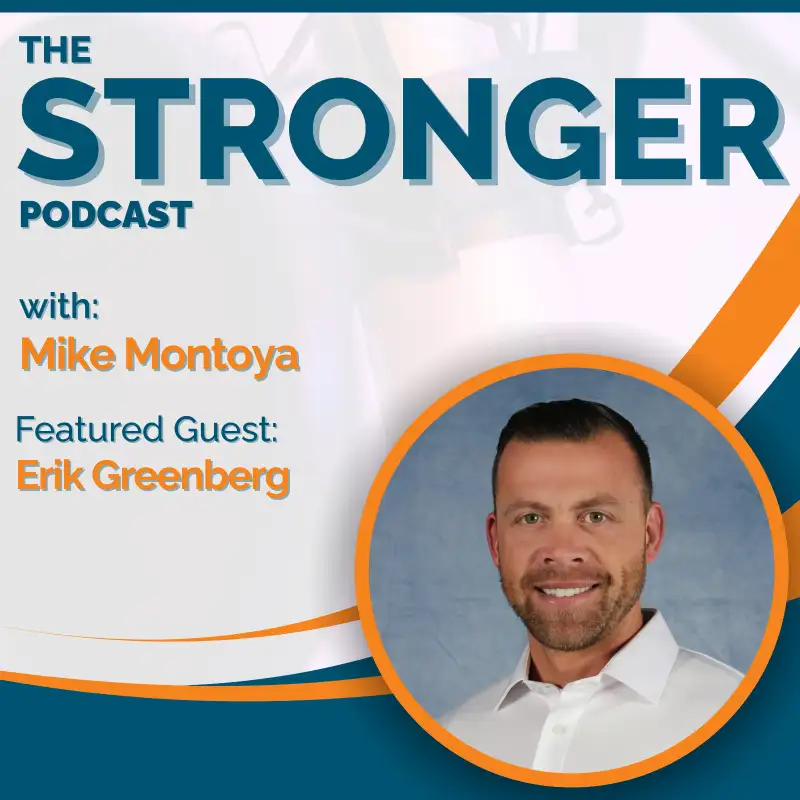
Stop Chasing Innovation in Education: Why Relationships and Retention Are What Actually Work with Erik Greenberg
Welcome to the Stronger Podcast. Each week, we have honest conversations with education and social impact leaders about their leadership and career journeys. We talk about their origins, inflection points, and the work that they're doing today. The conversations are honest, human, and practical. If you're here for real stories and real takeaways, you're in the right place.
Mike Montoya:Let's jump in, and let's get stronger together. In this episode, Erik Greenberg shares how he found his way into education by accident and why this work has become so personal
Erik Greenberg:for him.
Mike Montoya:We talk about serving with under resourced communities, the importance of consistency for students, and Erik's vision for building true community schools that change lives. Let's jump in. Good afternoon. Good morning, everybody. I'm here today with Erik Greenberg.
Mike Montoya:He's the CEO at Academies of Math and Sciences, which is largely based in the greater Phoenix area of Arizona, but also has some additional schools in other states. So we're going talk about that. Erik, welcome to the program. Thanks so much for being here.
Erik Greenberg:No, thank you, Mike. I look forward to it.
Mike Montoya:It's awesome. So what I know about you, Erik, is that, well, first of all, we just discovered a few minutes ago that we grew up in the same Colorado Springs. So I know a lot about the origins of that town having grown up there. But tell me a little bit about what it was like to be a young man or a young person in that city when you were growing up.
Erik Greenberg:Yeah. So my family first moved to Colorado Springs the summer before I started first grade. And I remember being a kid, not knowing anything about that. I started school and I looking back at it now, think what what an amazing place to grow up. I couldn't think of a better place to grow up.
Erik Greenberg:Colorado Springs was at the time it was kind of a smaller town right up next to the mountains and Pikes Peak. We lived in the Northern part of Colorado Springs. And so we had very close proximity to the Air Force Academy. And so just being close to the Air Force Academy, granted you a lot of things to do and a lot of things to watch, a lot of access to which unfortunately now it doesn't exist in a post nineeleven. But back then it was pretty fun.
Erik Greenberg:So yeah, I grew up in Colorado Springs, went to some really good schools. I played a lot of sports growing up and was afforded the opportunity to yeah, interact great schools, with great teachers and coaches. And I really do think it was a phenomenal place to grow up.
Mike Montoya:It has a lot of natural beauty, right? And at the time the public schools were like new and fresh, right? They had like beautiful new campuses. Right? And there was lots of, I call it, just talent teachers, right, good teachers that were available to to the kids.
Mike Montoya:Like, that's what I recall about that there that we were kind of in the nineties, right? That's kinda when we were And as you said, Air Force Academy is a huge influence, and there's some other air force bases. So there's a large military presence in that town, which kind of, I think, brings some structure. Yeah. Because I remember being highly structured, right, as a as a as a place to live, but also very beautiful.
Mike Montoya:And there was outdoor stuff was sort of unprecedented. Right? It was, good weather and beautiful mountains, things like that.
Erik Greenberg:Oh, yeah.
Mike Montoya:Did that did that, like, set a certain bar for you in in some ways? Like, what what you expected from education over time? Or were you even thinking about education as a career? When did the education as a career become a a element for you?
Erik Greenberg:Honestly, not until I'd say it probably honestly didn't hit me very strongly until about four or five years ago. I grew up with the expectation from my parents. My dad was a computer engineer. My mom was a stay at home mom. And so it was nice having my dad because kind of a built in math tutor, you know, and so so all of my siblings and I, we kind of did we kind of do well in math just because it was it was something near and dear to my my dad's heart.
Erik Greenberg:But I remember Mike growing up that we didn't talk often about college like it was expected of us to get good grades. Right? So we had to get good grades but it was almost something that wasn't an ongoing conversation I think for me and my siblings, we just knew that the next thing after high school is you go to college. There's no other way around that. It's just what we did and what you do and expected to do.
Erik Greenberg:And so don't think it really hit me the importance of it till much later. I think having kids of my own and then the work that we do here at AMS really opened my eyes to a lot of different things that I'm sure we're gonna chat about today, but two big things that resonate to me is I think back on my teachers and coaches that I had, right? And I still remember my elementary school teachers, I still remember, I remember almost all my teachers names. I've been able to keep in touch with some of those teachers and coaches to this day and I'm well into my forties now. And that's one of the things that gets me right is where the market is in education right now.
Erik Greenberg:It's it breaks my heart that kids these days won't necessarily have that right? A teacher that they had in middle school as they continue to go up through the middle school and the high school that they probably can't go back to the middle school and see that same teacher there.
Mike Montoya:Yeah, and
Erik Greenberg:to not have that level of influence and closeness and connection, it breaks my heart. And the second thing is, I get older and I think about how I grew up and what some of the work we do now is, although I'm extremely appreciative of the circumstances by which I grew up, it's not okay to me that, and I understand that this is the reality of our country and look at a state and break that state down into a subset of different markets that I know that that these things exist. But I have an issue with not every kid, student, child has currently the same opportunity that I had growing up. And I don't like that. And I'm not okay with that.
Erik Greenberg:And I think, you know, I can't fight the things around that to support that, but what I can fight is the experience that they get going into school that hopefully will change their trajectory moving forward. And so to your question on education, I took, I honestly, I didn't give it the importance while I was in it. Just, I didn't know any different.
Mike Montoya:Yeah, that's right, like
Erik Greenberg:a lot of people. I got a school, I gotta do my homework. I gotta get good grades or else I get grounded or I get in trouble or a queue. Go to the baseball game or whatever, and then you go to college and you have a career. I never intended to get into education.
Erik Greenberg:I went to school with an international business degree. I honestly wanted to go into finance, all of that stuff, I kinda fell fell backward into it. And here I am, this many years later.
Mike Montoya:That there's there's a a lot of folks who get in get into this work on accident, quote unquote. Right? I'm gonna use those words myself. I kinda back into it from for some reason, there's probably a series of events that may have happened to get you there. Right?
Mike Montoya:But I I agree that, like, most people don't know, like, the state of education experience for young people in our country. And because a lot of us who grew up in, like, nice suburban ish communities, right, had, like, good enough schools. Right? And we just weren't exposed to it. And later on, we started to discover that there's lots of children who don't have those options.
Mike Montoya:Right? And and unfortunately, right, it's, like, largely tied to income and location, right, with regards to inner cities and things like that. Yeah. And the bigger the metropolis are in the country and I was just never last week. Right?
Mike Montoya:I drive you through Denver. It's not the same number as I when I when I was a kid, and there's a lot more diversity. Right? And there's a lot more poverty, right, that are that is in Denver than when I was a kid. Right?
Mike Montoya:And so the number of children that are experiencing that, right, has gone up significantly, in my view, at least Colorado. And I think that's probably true of Phoenix and other places too, right? Yes.
Erik Greenberg:Correct.
Mike Montoya:Yep. So the work of AMS is really about providing opportunities for this group of kids that is largely under resourced, right, and under supported. Is that true? And how would you guys describe your work and the core focus?
Erik Greenberg:Yeah, that's it. And I think as we've continued to expand, and I can chat about that expansion. I think when you're an organization that is expanding and you wanna grow and add more schools etcetera there is that, I don't wanna call it a temptation but there is that thought of oh, things might be different or easier or we could diversify more if we went into other neighborhoods or served a different demographic of And I think for us, Mike, you know, obviously it it starts with me, but really it's the it's the talent and passion of the individuals that we have at our organization where that never comes into the conversation. We are here to serve disadvantaged communities and we will never deviate from that. And that mission, if you if you if you if you wanna call it that, For us, it's really important that we talk often about that.
Erik Greenberg:But it kind of burns and everybody that passion of this is this is what we do. And there's no other conversation around changing that mission. And so then because of that, our conversations can lead to other things around how do we provide the best level of support? How do we provide the best education? How can we provide the best opportunity to build these communities to to support that?
Erik Greenberg:And for us, it's it's become something where nobody's ever gonna perfect it. Right? And I think that's the that's the quest for me anyway of knowing that I'll never perfect it is what keeps me going. Like, get struck. Yeah.
Mike Montoya:Yeah. For
Erik Greenberg:sure. I wanna figure it out. We have to perfect it. Knowing that we never will. But that's kind of the drive that we have that it's a never it's a never ending work if you will.
Mike Montoya:Well, I mean, one of the one of the keys here, right, is like, well, one, you have an attraction mechanism to the the talent that you talked about, right? People want to be part of something like yourself in some ways, They're driven by this intrinsic need to do better by more people, for example. And they make a choice to be involved in that kind of work. And at the same time, the work is kind of always evolving. Right?
Mike Montoya:Because it seems like we should be able to teach children how to read and write and do math. Like, we should have figured that out basically by now.
Erik Greenberg:Right. But where I mean, do you do you have
Mike Montoya:a sense of, like, why it continues to be, like, a a problem that, like, persists even if we kind of know how to do those things?
Erik Greenberg:Yeah, I might start some controversy if you will in some of my comments, but one of the reasons I, so I kind of fell backwards in education, Right? I'm I'm not an educator. I don't even try even after this many years in education, I don't even try to pretend to be one because I I'm just not. However, you learn a lot as you go. And I think one of the things that I've experienced in education and I'm super fortunate.
Erik Greenberg:I spent almost a dozen years in higher education and then I went to early education and now the last seven going on eight years in K-twelve education. 've realized a couple of things in education, specifically as it comes to our country and some research into other countries and how they they managed public education. Education to me is one of the most archaic aspects of our society. Right? We really don't do education any differently than how we did it a hundred, two 100, three hundred, however many years ago.
Erik Greenberg:Right? It's kind of the same concept. You have teacher teaching teaching pupils, if you will. And so I think that's one problem. Right?
Erik Greenberg:Is that I think education gets a lot of attention in some regard because there's this constant quest to innovate. But at the end of the day, we're not. We're kinda doing it the same way every time. Right? The other and so that's that's something that fascinates me.
Erik Greenberg:I think it's a very complex puzzle. How to educate kids, I think it's a very complicated complex puzzle that doesn't matter how many theories or or thesis are written on it. Executing it is very different. And I think, it needs and requires very talented special people to do that. And that kinda leads into the second controversial thing I would I would I would say, Mike, is I think something that I never recognized prior to going into it is the importance of how education is funded, managed, is run, etcetera.
Erik Greenberg:And I have a lot of thoughts and opinions on that. They're not by any means, I would call them intelligent or or the right answer, but it is a drive for me personally. One of the reasons that in addition to our mission, right, in serving serving kids and serving communities, one one personal mission for myself within the organization is is how can we continue to grow and evolve and do really good quality work so that our people have a voice. I do think that education needs to be at the forefront of conversations that happen at the the local level, at the state level, at the federal level. Because we do need to do a better job of attracting smart, intelligent, talented people to come in and help us figure out how to solve your problem right there.
Erik Greenberg:Right? Yeah. Because data shows that we aren't progressing when it comes to math. We're not as a as a country, as a society, we're not getting any better. Some of the trends are very alarming with with how we're not doing a good job with that.
Erik Greenberg:And so I think, you know, I I don't have the answer for how to solve that systematically. I do think that people are always the answer. Right? Talented, passionate people who want to come and solve this and help out. The other thing I'd say Mike is a fun conversation for me in the Charter world, right?
Erik Greenberg:In an organization like ours that is attempting to expand to serve more communities. I'm fortunate to have conversations with state authorizers or different stakeholders associated with charter schools and helping bring in maybe a charter networks that can serve the population. One question that I love getting asked is, what's different about your school? So if you come into this community, what is something different that you're going to offer our kids, right? Whether that's performing or then this is, and I appreciate all forms of schools.
Erik Greenberg:So I love charter school, right? Is you can be whatever school you want. For me and the and the communities we're wanting to serve the the question that question that my answer is well, we need to teach math and reading better than anyone. Right? Because that's what these kids need.
Erik Greenberg:They need math and reading. And if we can then figure out how to do science great, we'll do science great. If we can then incorporate other aspects of that, but at it when it comes to reading and math, we need to focus on being the very best at that. And and to your question, I think we need to continue to look for opportunity to solve that through smart, talented, passionate people.
Mike Montoya:Well, and I think, like, you're talking about, as you said, like, for centuries, we haven't really evolved, right, as a as a way of communicating knowledge, right, between generations. Right? It's like an ongoing challenge. I almost only in the last, say, twenty five years, right, has, like, the computerized Internet really changed the subject matter, right? Because now all of the information that's available on the planet is available immediately, right?
Mike Montoya:And so the ability to consume it and digest it and utilize it in an intelligent way, right, is probably the new challenge for the generations ahead. And we're kind of living in it. We're like the people that kind of did it before there were computers, and now we're doing it with them, right, and with the Internet. And it's like a real interesting thing. And the way that kids learn, they're still consuming, right, information, but they have to make, I call it, sense of it.
Mike Montoya:And that's where the human component becomes a really important
Erik Greenberg:factor. So Yeah. I agree. 100%.
Mike Montoya:Do you you feel in the charge of AMS, right, Academy of Math and Academies of Math and Science is essentially, is it like a STEM focused curriculum and then you guys have really built that out significantly?
Erik Greenberg:Yeah, obviously the folk, you know, any school we have, we wanna be kind of a comprehensive STEM school. What's not lost on that, however, is going back to the previous comment is how important reading is. For us, you know, our schools are in some, you know, we have schools in Arizona, we have schools in Arkansas, we're about to have schools in Nevada. What's interesting is the demographic of those schools are very different. Some of our schools have a very high EL population, some don't.
Erik Greenberg:And so, but at the end of the day, right, reading is an important factor of that. And we know and understand the research that's associated with it of how important reading is, as it pertains to the other things and vice versa as well. And so, yeah, all of our curriculum is STEM focused, but like I said, me personally, we need to make sure that we are the very best when it comes to teaching math and math and reading.
Mike Montoya:Math and reading, yeah. Well, because if you give the kids the ability to consume stuff, right, you know, literature and as well as like textbooks or science, I was a biology major in college, so I read all that terribly hard scientific papers and I'm like, what the hell are some of these words? Then you learn how to do that stuff, But if you don't have a comprehension capabilities, then none of that stuff is accessible, right? And I think that's where the fundamentals of the K-five, K-three age really is important. And you did a bunch of preschool stuff before in your earlier career, right?
Mike Montoya:Do you have a sense of like are AMS kids showing up ready for kindergarten and are there strong early education opportunities for them or is that something you guys are having to capture and remake early stages?
Erik Greenberg:Yeah, I'd say on average, whether it's their entering a kindergarten or within the first three years, we're seeing on average, majority of our students being two years behind. So that is an issue, Mike. And, you know, anytime you serve a low income population, that's gonna be a problem. Right? The affordability of good quality preschools is not not is is very difficult.
Erik Greenberg:The options are are difficult. And so it is something actually that we're we're looking into. Can we help can we help solve that? And how can we solve that at scale to at a at a level that really provides a benefit to families who can't traditionally afford to send their kids to a preschool. But if we can't, our charge is once come to our school, right, we need to we need to rapidly get them to a place of exactly.
Erik Greenberg:We gotta lift them up and Pick them up. Them there.
Mike Montoya:Yeah. Pick them up. I think and there's like the good the great I think the bright shiny the shiny thing that we should all hold on to is that, like, there's lots of proof of the ability for schools that are focused on on recovery and and helping kids get caught up. Right? It's possible.
Mike Montoya:Right? And then there's lots of evidence that it that it's totally doable. Right? And it's been achieved, you know, hundreds of thousands of times, right, with individual kids. Right?
Mike Montoya:And the systematizing of it is where there's that's where it gets a little more challenging, right, to do it consistently across all all the schools, across all the, call it, different cities or, like, townships or neighborhoods that are in. Right? Because they show up with different challenges in different neighborhoods. Right? For sure.
Mike Montoya:And are you noticing that now as you're starting to work with different states outside of Arizona, that your kid populations are showing up with different kind of deficits or both also assets as well, like they show up with different things, right?
Erik Greenberg:Yeah. A 100%. And and that actually led to some really fun research that we did in Arizona and and, you know, we were we're about to have 12 schools in Arizona. But in Arizona, the, population we serve is typically an immigrant population. Right?
Erik Greenberg:It's a very high Hispanic. And so making the decision to go our first out of state venture was to Little Rock. And so we we did a lot of research and spoke to a lot of people or, you know, we need to we need to understand the population we're serving. I came across this brilliant research paper and it really kind of opened my eyes to a lot of things. In Little Rock, we serve more of a generational poverty versus in Arizona, more of an immigrant poverty, right?
Erik Greenberg:And this research paper that we came across and really studied to help us understand those families and the community and what that means to that community to have a good school. What was super fascinating, Mike, is at the end of the day, everything came back to the teacher, how influential the teacher was, but their level of influence on the two different populations was very different. Very interesting the effect that it had on kids, but at the end of the day it was all about the influence of the teacher and the principal. And what resonated with me is with the case studies they did was the relationship and how long or enduring that relationship was. And that's when it resonated with me because, you know, my baseball coach for example, it was my math teacher.
Erik Greenberg:I still communicate with him today. Right? And so there was a level of influence that that he had and there were many others who who had that influence in my life. But to create that connection is is super important and as we've done research in in different markets to identify where is that missing and why and then how can we fill that. I think that's something we're still trying to figure out.
Mike Montoya:It's a real challenge. Right? The longevity piece, right, the as you said, endurance, right, of a particular relationship. There's a lot of youth development research that kind of leads with that, which is to say, when kids have consistency of adults, it changes in some ways their ability to participate in the learning experience or the development experience. Because they almost like their nervous system settles down and they can be feel safe and then they can be vulnerable and then they can access the higher like, your brain starts to work better, right, when everything is kind of functioning like that.
Mike Montoya:And I think that's kind of what there's the the undercurrent that we don't really understand it totally yet.
Erik Greenberg:100%. And and and I have two thoughts on that. And because I I thought through how can I fight it? Right? Like, wanna fight it.
Erik Greenberg:I wanna take it back Yeah. Yeah. To what it was. Yeah. I don't think we can.
Erik Greenberg:Right? And so how do we work with it? And so one of the things that is exciting for me and something we think about is, if we can't solve that, Mike, how can we solve today? How can we make sure that today's engagement and today's interaction, the experience that both the teacher and the student get today, right? You might not have that long lasting relationship, you might not have that long lasting consistency that maybe you and I had, but can you create something that has an impact focusing on today?
Erik Greenberg:The other thing is, you know, we're we're in Arizona and some of the other states that we're in, know, choice is very prolific and and, you know, a lot of us in the charter world, we are beneficiaries of school choice, right? We appreciate school choice, we like school choice, but sometimes, you know, like I said, that prolific nature of school choice could have some downsides as well, right? Where, you know, it's easy for a parent to pull their student out of one school and go the school down the street and then a couple months later or the next year, pull them out, go to the next school. Now, it's great that we have those options, but the effect that it has on the child is very detrimental. So that's something that I particularly, if I was the most passionate outside of our mission, once we talk about serving communities, is the retention of those students, right?
Erik Greenberg:And so, I wanna try to help solve the teacher retention which we have a lot of tactics that we're doing for that. But if we could help retain students not just for their experience and how that affects them psychologically and the friends and consistency that you talked about. But we've run enough internal case studies and run enough data models to show that if you don't change anything else, Mike, if you don't change your curriculum, if you don't change anything outside, you know, just keep everything the same, right? Yeah. Once that kid gets to that third year in your school, you know, there's a double digit growth when it comes Yeah.
Erik Greenberg:To there's a huge jump. And so the need to retain kids is.
Mike Montoya:Well. And, you know, the the circumstances by which kids or parents need to shift schools. Right. That that wide ranging. Right.
Mike Montoya:There's a bunch of things that are part of the challenge. Right. Like housing and affordability and transportation and where people are employed, all that stuff can affect whether a kid stays in a school for a while. Right. And sometimes it's like they have a bad experience with one teacher, then they go look someplace else.
Mike Montoya:Right. That's also possible. But I think there's a lot of drivers that you can't control. Right. So the idea of how can and this gets to like our larger society problems, is housing affordability, can people live in a sustainable way in a neighborhood for the duration of a K-twelve experience?
Mike Montoya:It's just harder now, I think, than it used to be, as you said. Research is super fascinating to say. And I'll try to put some of this stuff in the notes for this podcast, which is some of that research around the longevity and the three year plus work, right, because they think that's important seminal stuff. The Wallace Foundation also did all the work on the principal stuff, the importance of the school leader and the principal and the consistency there. Right?
Mike Montoya:That stuff is, I think, foundational. It's almost like it's that that piece of literature has made its way through the the networks now, but it's sort of like people like, principles are important. Should really do a great job with principles. Right? And that becomes like an anchor.
Mike Montoya:Right? People like understand it now better than they did ten years ago for sure. So I think I feel like we're making progress. And as you said, it's still like it's almost like and maybe immigration is one of the gifts and challenges that presents itself to our country. Right?
Mike Montoya:It's like we get all these incredibly bright potential kids. Right? But then we have to kind of catch them up the language skills, which is like a fundamental, But you guys are doing a lot of the EL. So do you guys have special EL English language learner work that's embedded in your early childhood stuff?
Erik Greenberg:Yeah, mean, I don't I mean, we think it's special, but I don't think there's anything, there's anything unique about it. At the end of the day, it comes down to the individuals. Right? And so that's the ease, I know that's an easy cop out answer, Mike of, Yeah. Hey.
Erik Greenberg:We we solved it because we have this very special unique curriculum. No. It comes down to the people. Right? And so for us, it's how do we hire the right people?
Erik Greenberg:But not just hire them. Right? How do we give them the tools? How do we give them the resources? We're we're we are not shy with our expectations.
Erik Greenberg:Right? And that's one thing that I love when we talk about these community schools that we have and I and I'd I'd love to talk to you about that idea of community schools. But right, like most of these kids come to our school, in their life they're probably not given expectations. Right? They're probably not used to being told that we expect this out of you.
Erik Greenberg:Right? And so I think society gives them a pass. Well, I'm not I'm not okay with that. Right? Yeah.
Erik Greenberg:Every kid can be given high expectations and given the support and the tools and the confidence to achieve high expectations. Well, we feel the same way about our staff. Right? Is I I don't care what your background was. Right?
Erik Greenberg:I it doesn't matter to me. You're here. I'm I love that you're here. Right? You can do a phenomenal great things.
Erik Greenberg:And I welcome all the different backgrounds, right? Outside of the traditional, I went to school, I got a degree in education and I got my teacher license, etcetera, right? Kids these days need all of it, right? And so to me, I don't care what your background was. You're here, I love it that you're here.
Erik Greenberg:Thank you for being here to serve these kids because they need you. But we're gonna give you some high expectations and we believe you can hit those high expectations. And if that gets transferred to the students, even better, right? We can expect more out of these kids. And they'll know it's still the challenge.
Mike Montoya:And that's a clear, I think high expectations kind of got a bad rap in the charter space for a little while, right? Where we were setting like almost like a routinized bars of excellence, right, that didn't adapt to children's background and experiences. So you're talking about expectations of staff and team to bring excellence to their work, right? And then to also essentially expect that in terms of children, but then provide essentially the support and the platform and the methodology by which that people can achieve things, right? Not just like, you didn't do it.
Mike Montoya:There was this argument for a while, right? That, like, you didn't meet our expectations and you can't be part of our school community. Right? That was one of the one of the criticisms. Right?
Erik Greenberg:Right. Yeah. No. I'm very much against that. In fact, we I I like to lead with visuals, you know, I don't like to create complicated strategic plans and I I like to keep things very simple.
Erik Greenberg:Right? And so and and our organization, our mission is simple. Our vision is extremely simple. Our values are simple. Our goals are simple.
Erik Greenberg:Our priorities are simple. I put all that into a visual, Mike, and kind of the story of the visual that I share is that the vision, you know, if we do it right and we have the right inputs, then the system almost grows and gets bigger on its own. Right? And that means it's okay. Right?
Erik Greenberg:Like, with with that visual and the idea of it moving to get bigger, the idea is continuous improvement. Right? We're gonna mess up. Right? We're you know, I I spoke to a candidate for a leadership position that we were interviewing for and and, you know, as much as we like to talk about the great things that we do, like, I it was important for me to be honest that we do a lot of things not great.
Erik Greenberg:Right? But that's okay because we need to identify those. But one of the reasons why we're okay with that is because we have a high bar. Right? Let's be honest about where we're at.
Erik Greenberg:Let's be honest about what we're not good at. But the focus is how can we get this thing moving in a way where it just, it goes like this and you need that attitude of continuous improvement. Same thing with students, right? They're not failures just because they didn't hit your expectation. It's an opportunity to, okay, how can we adjust the input so that we can focus Right, on
Mike Montoya:yeah. Well, and it's like, as you said, it's like a, you know, it's almost like a business that we talk about, like growth, grow or die, basically. It's kind of how it works, right, in business. And so in school, it's about, like, getting better at the craft of the education component and then, like, measuring the results, right, for both staff and students so that you can see the progress. And where you see lagging progress, you can improve, the inputs, right?
Mike Montoya:And it gets stronger over time. Right? Yeah. And eventually you hit like this magic formula and then the magic mode, you hit the magic call it when you hit the magic formula for a while, it'll be perfect. And then two years later, something will change.
Mike Montoya:Right? Because it's like, that's just the circle of death.
Erik Greenberg:The the magic formula is a very dangerous place to be in. Right? Because you can you can very easily get caught and, okay. Alright. We're there.
Erik Greenberg:We're good. Let's take a breather. And then to your point, it
Mike Montoya:Somebody changed.
Erik Greenberg:It's gone in an instant. And that's why, you know, a close colleague of mine, he's the one who kinda impressed upon me this idea of it's a never ending work. And you asked the question earlier, why, you know, how can we solve it? How can we get better at it? This seems like we're not getting better.
Erik Greenberg:Well, that's because it it constantly evolves. Right? Like, that's why to me education is is one of the most complex puzzles. Not only does your your your staff population evolve with different generations and personalities and characteristics, but you're bringing in a whole new different generation of kids. Right?
Erik Greenberg:The kids we're teaching today are very different than the kids we taught five, six, seven years ago. Same with our staff. Right? And so you have to adapt and you have to be able to to change. And with that, unfortunately, it comes to what you said is, man, there's all this change.
Erik Greenberg:We can't figure it out. Well, I like that. Right? Because if perfection is, you know, or excellence or whatever you wanna do, right, it forces you to be in that place where you have to continue to look at every day as something new. Right?
Erik Greenberg:We have to get better at this part today because if we hold on to it and rest on our laurels, tomorrow is gonna be a
Mike Montoya:tough Yeah, it's gonna be different, right? And that's kind of, I mean, sometimes it's like the attitude of like going into it, knowing that it is a creative experience, right? And one that has like some guardrails and then it's like clear trajectories by which you can pursue, that, as you said, like the dynamic between a teacher and a student in a classroom or a group of students, right, is unique to that single experience, right? And like that can be capitalized on that for that moment. Then it has to shift and change because the people that are involved are different, right?
Mike Montoya:And that's, I think, that's, like, one of the hardest parts about the whole thing. And it's also what makes it interesting to stick with it, right, and to keep going. Yeah. And you see the results. Like, you see my my favorite part is, like, we're coming up on graduation season in a month or two.
Mike Montoya:Right? And so you see kids making agreements with where they're gonna go to college and things like that. And you sort of if you've known that kid for a while, you're, like, kind of I'm always impressed. I'm like, look at that journey that that one kid went on, right, to get to this place in their life. Totally.
Mike Montoya:And we could not have constructed another person just like that. Right? He he or she or they would have shown up in a different way. Right? And that's super fascinating to see all the variety of humans that come out of these experiences.
Mike Montoya:That's super fun
Erik Greenberg:to me. And going back to my my initial, I think that's what that's what's so beautiful about what what we're trying to do is is I mean, the harsh reality, Mike, is we can't we can't do it for everybody. Right? It's like but if we can increase the opportunity that we provide, then we're doing it. No.
Erik Greenberg:We have to. We have to. We just have to.
Mike Montoya:Well, and the expectation is that you should do it all. You can't do it. You're right. You're not at the scale or nobody no single single institution, right, can do it for everybody. Right?
Mike Montoya:But, like, a combination of really great institutions doing it collectively, right, in a state, right, can make a huge difference. Right? And clearly, we've, as a society, figured that out somehow. Right? To most kids get a pretty decent shot, but not all the kids, but we gotta keep working on that.
Mike Montoya:But at least we're doing that. Right?
Erik Greenberg:Right. Increase the number who get a shot.
Mike Montoya:Yeah. That's exactly it. So you said you wanted to talk about community schools. So know this is so tell me about that because that word means a lot of things. So tell us what it means when you when you bring it up.
Erik Greenberg:So it's it's an idea that we came across a couple years ago and I think, you know, having having this role in in this organization, right, constantly looking for opportunities to not only do a good job at in the markets you're in and the schools you have in the communities you serve, the parents and the staff and the students. But, you know, this idea of how can we do more? Right? Because it's one thing to just educate, do the right, you do math, you do science, you do reading really well, that's one thing. But for me there's way more.
Erik Greenberg:And as I delved into thinking about that and researching that, what I realized is that the idea of a community school is gone. It's lost, right? Especially in high school choice states because you know you can just move schools. Also, something we talked about because your community at that school doesn't last many years where you can go back years later and it's the same principal and the same teachers. So that idea and that concept of community school is kind of lost.
Erik Greenberg:And as we look at markets, you know, to go and expand it to, and as we really interact with parents and students and try to understand what are the best opportunities, this idea of a community school really resonate with us. And so it's probably the thing we talk about the most is how can we build and maintain a community school. And I'll say, Mike, we have a couple of schools that I would consider we've achieved that community school status. But I don't think we've entirely figured it out. Because to truly incorporate and build a community school, need in fact the entire community.
Erik Greenberg:And these days that's really hard, especially, you know, various things are everyone's fighting, we're all fighting different battles, right? Whatever business we're in or whatever, you know, neighborhood or market, whatever, we're all fighting, you know, kind of same battles in different ways and so how can we bring a community together to create a place where, you know, we can all align on, you know, whether that's giving back, whether that's focusing on doing more, whether that's lending a hand, whether that's embracing someone else, or providing different opportunities or resources, etc. We have a very strong vision of what we wanna create in a and I think for me, you know, kind of those, you know, whether that's an unstated goal or something you can't measure that's not on a board that says we're gonna achieve these metrics. It's that feeling of building a community school. And especially serving, you know, disadvantaged communities or underserved communities or low income, whatever you wanna call them.
Erik Greenberg:Right? Like to me, they need it the most. How can we provide support resources? How can we bring people together to surround a community to students, but also surround students to the community?
Mike Montoya:Right, get them in your act by each other, right?
Erik Greenberg:That with parents, how can we bring parents more and and provide those of those things to them. And there are some schools out there who do some pretty do some pretty cool things. I think there's some pretty cool things that we do. But to me I think that that's that's the dream. How can we build and maintain a community school because they don't exist anymore.
Erik Greenberg:But how can we build that? But at the end of the day, what's the lasting effect that it has not just on kids, but building a community school that has a lasting effect on every single person associated with that. And I think that's really cool. That's really cool thing. And I know that's probably a little more, you know, butterfly and roses type of a way of thinking about things, but the world needs more of that.
Erik Greenberg:Right? We need
Mike Montoya:more interconnection. Right? Because we we learned that, like, isolation and the whole social construct and the bullying alone work right about in social capital really is fundamental to the idea that people need to be connected with each other in order to thrive. If we live in a place where we're not connected, be that through our churches or our schools or through other institutions, that we can decide to become kind of in contrast to each other. We sort of look for the problems with each other versus the things that we can achieve together or that we can kind of co identify about.
Mike Montoya:Right? And some agents you said, like, that's a that's like a modern day America problem. Right? And it's one that, like, has started to shift. Maybe maybe it's been around for a century, right, as we started to, like, kinda automate everything and things like that.
Mike Montoya:Right? But, like, the opportunity, right, it's for, you know, school systems to really build these places, right, that people can be connected. Right? That's super valuable. Yeah.
Mike Montoya:So that's exciting.
Erik Greenberg:Yeah. I think it's a fun it's a fun thing to talk about. I don't think anybody has the right answer, and I think that's okay. And that's pretty fun because there's a lot of cool things that can come from it. But at the end of the day, it has to make sense for for that community.
Erik Greenberg:Yeah. But yeah. That that that's a yeah. Something for us internally that that's become kind of our our dream and what kinda drives us at building building and maintaining community schools. And the effect that it has on everybody associated, even ourselves, how it affects us.
Mike Montoya:Well, people know when they feel like they belong somewhere. Right? You sort of know. And Yeah. It's it's really obvious because you want to be there.
Mike Montoya:You get drawn to come back or you get decided to contribute or be a part of. Right? And it's hard to not every place will look the same as the next place. Right? Because it's people oriented.
Mike Montoya:Right? And that's and that's another another component. I think about this because I grew up in the Catholic church and I was thinking about different churches and parishes, and they each have a different community feel to them. And I remember as a kid, my parents really liked this one place and I liked a different place because it just felt different. Right?
Mike Montoya:Yeah. And I felt like school had some of that component too. Right? Which has, like this school attracts me because it feels like a place where I can thrive. Right?
Mike Montoya:That's why people love me and care about me there. Yeah.
Erik Greenberg:And it has unique I mean, obviously, community within with within religions is super important and community within different you know, you can find community within sports. You can find community within Sure. Any anything. What I love about this idea is you bring all the communities. Right?
Erik Greenberg:Let let's let's let's let's just do the whole thing. Right? And what that means and how can we create how can we create the things that we always talk about but we're not doing to improve the lives of both our kids and and ourselves for that matter. And so, I don't know, like I said, it could be it could be me on my own little Cinderella story but it I it's a passion project for hours that goes beyond just, you know, what's the letter grade you got this year and what's your what's your growth and proficiency rates. Something that hopefully can mean a lot more to the people involved.
Mike Montoya:Well, and so let's make that a call out, right? Maybe this is the opportunity here, and you can say this because I heard you talk about talent and this idea of attracting people that want to be part of the AMS mission and vision. And so maybe the ask into our community is like for people to learn more about AMS and to learn more if they want to be part of a place that's trying to build a it's almost like I'm going to use the word it's like a utopian version of what a school community can feel like. Like there's an opportunity for folks on the talent side to check out AMS and learn about what they have to offer and including both in the Phoenix area, but also in Arizona and Arkansas, right?
Erik Greenberg:Everywhere, So. Yeah. Like I said, we're we're open opening a school in in Las Vegas this fall. We have our sights set in other states but to me it doesn't matter. I'm I'm fortunate in my role that I get to talk to a lot of people and and when it when it comes to talent I think you know, here's the thing Mike, like I know I'm a nobody man like I know like I can't like I don't I don't bring a whole lot to the table here right?
Erik Greenberg:So what I'm looking for are like just tough, passionate, hardworking individuals who wanna change the world, I mean call me. Like come, come. Not to say everybody's changing the world and I love that everybody's out there changing the world. But it takes a lot of hard work. And and and what's sad to me, Mike, is realizing that that part isn't for everybody because it's hard.
Erik Greenberg:It's hard. You get beat up every single It's hard. But again, if we keep those expectations high and not drop them, if we hold ourselves to a certain standard and do the work associated with it, it's gonna happen. And if more people can join in that, the more people we can affect and the more lives we can impact and the more good that we can spread. And again, I don't know how this podcast turned into kind of a or buttressing.
Erik Greenberg:As you call this this this utopian place. But that's what this life is all about. Right? That's what we're doing. Right?
Erik Greenberg:We have schools to serve kids and make kids' lives better. We might as well change a bunch of lives in the process of doing that anyway. Yeah. Right? So let's do it.
Erik Greenberg:Let's go.
Mike Montoya:It's more it's more it's certainly more. I'm getting the little tingleys, whatever you call that, where the buzz is on the body when you get excited about something. And so it's exciting to me. So as our listeners in this world, the podcast will go out and people will hear about it. So it's amsschools.org, right, is is how you kind of find ams in Arizona.
Mike Montoya:And all of Erik's contact information will be available to folks. I'd like to part with this question, which is like, you know, from a leadership standpoint, like a message that you would like to share with, I call it, the future leaders in this work. Right? You're kind of being quite humble about like the value that you as a CEO bring to this particular job. Right?
Mike Montoya:Because that, you know, you're you're part of the glue, right, as far as I can tell. But you see a lot of people and you see a lot of things.
Erik Greenberg:So is
Mike Montoya:there a message that you want that you would impart to, like, in a future leaders besides, like, it's hard work and and there's passion that's necessary that you wanna drop here?
Erik Greenberg:Oh, boy. That's a hard one. Maybe it's it's based on a mistake or a fallacy that that I I made or had early on in my career. And, you know, I started my career, had no idea what I wanted to be. Like I was just, I had a job and I was like, okay, well I'm gonna be the very best at this job.
Erik Greenberg:Then you get promoted and then you're a manager, right? And you're like, okay, well I'm just gonna be the very best manager. And you kinda like for me, I just kinda relied on what I thought was the right thing. Right? Which is really odd because coming from an athletic background and I was fortunate to go to college on an athletic scholarship and so for me everything was about hard work and working on your craft.
Erik Greenberg:But the mistake I made was I associated that with a goal associated with sports. Right? Like I didn't think like, oh, you gotta make you better
Mike Montoya:and like you gotta focus
Erik Greenberg:on that. And I remember I had a supervisor, I was I was a manager going into my third year, second maybe my second year and he goes, hey, do you have a mentor? And I go, mentor? What do I need a mentor for? Like, on, I'm doing great.
Erik Greenberg:Right? Done fine. And he's like, let's let's let's talk about you getting a mentor. He kind of inspired me. And so the person who I chose was I was I was at a manager training and I was fortunate.
Erik Greenberg:I started my career with a very large organization. So I had access to all these trainings and people. Access to people and that was amazing. And I didn't know at the time, I appreciate it now. But I remember he was kinda new to our region and he came in to speak to us at our training and I was like, for the first time in my life looked at somebody professionally and said, that's what I wanna be like.
Erik Greenberg:And so I I I embarrassingly and nervously asked him if he'd be my mentor. I remember our very first ment and he agreed. And still an amazing guy today who I consider very close, know, one of the reasons I am where I am today and others for that matter. But I remember my very first mentor meeting with him, he said, so what are you what are you reading? What do you like to read?
Erik Greenberg:And I'm two years out of college. I'm like, read? Read. In the world would I read anything? Are you crazy?
Erik Greenberg:And he goes, if you want to lead, you have to read. And I didn't it probably didn't hit me, Mike, until maybe a year after that is is when it kinda hit me of leadership just like anything else is a craft that you have to learn and you have to fail and you have to figure out and that leadership evolves. Right? You learn different things, you make mistakes in certain areas, but leadership is, it's almost like an active muscle. It needs development, it needs work, it needs pain, it needs growth, it needs all those things.
Erik Greenberg:And I think for me the cool part of it is and this is what I would say is there are so many resources out there. Don't be afraid to go hit those resources looking for opportunities to get better at your craft, whether it's leadership or whether it's a certain aspect of leadership, whether it's strategic planning or budgeting or a one on ones or how to host meetings or how to have a performance conversation or how to even manage performance for that matter. Yeah. There are so many resources and don't be afraid to go seek those resources because they're everywhere. They're in movies, they're in books, in articles.
Erik Greenberg:But there's people and there's so many good people. And you said it earlier, we've kind of become a society that's a little insulated. Right? And something that that I I had the advantage of and I didn't know until much later is I had access to people. And there's a lot of people who want to help and a lot of people who know way more than me and are way better at certain things.
Erik Greenberg:And so maybe that's something that might be meaningful to somebody.
Mike Montoya:Yeah, well I hope they take it up, mean the vision of like relying on others and finding someone that you can model off of in some ways like and be like kinda point yourself towards. Right? Even if you're not gonna be exactly like them, like, not like a mini me, but, like, a a mentor type relationship is really valuable. Especially when you're earlier in your career. Right?
Mike Montoya:Like, these pathways, right, become a bit more apparent when you can talk to people about them. Multiple mentors is super valuable. Right? And then the learning I mean, the good news is, like, there's everything's out there. Right?
Mike Montoya:You can find it in the Internet now, and it's amazing how many resources. So, obviously, getting multiple resources to make sure you're not going down a crazy road or whatever is always a good idea. So
Erik Greenberg:I appreciate that question, think it's a great question for all of us and a good reminder for myself as All
Mike Montoya:right, thank you everybody, I'm gonna let Erik get back to his day job and we appreciate him and for his work and Erik we will make sure that people get pointed to to your school system and to what you guys are doing, and hopefully they'll reach out to learn more.
Erik Greenberg:Okay? I appreciate it. Thank you, Mike.
Mike Montoya:In closing, this conversation is really about more than school performance. It's about belonging, stability, and kind the of community that helps students, families, and educators thrive together. Erik's vision for community schools is a powerful reminder that education can and still be a place where children learn and grow every day. Thanks for joining us. Thanks for listening to the Stronger Podcast.
Mike Montoya:If this conversation inspired you, we invite you to follow the show and share it with someone who's on a journey to become a happier and healthier version of themselves. Links and resources are in the show notes. Notes. See you next Thursday, 9AM eastern time. Have a great day, and stay strong.
Creators and Guests