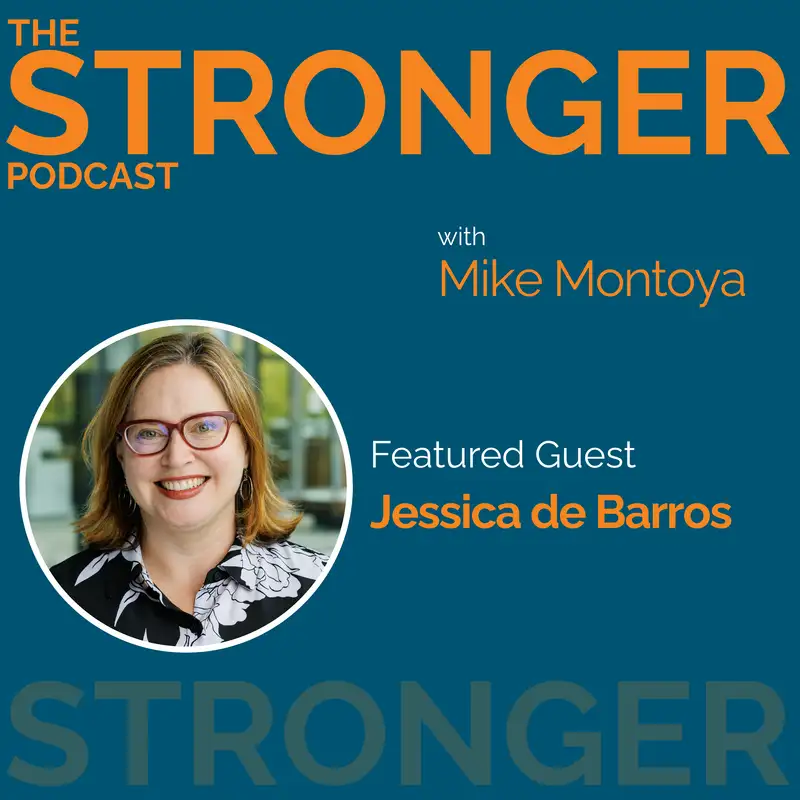
Equity Isn’t Optional: Calling Out Broken Systems – with Jessica de Barros
The Stronger Podcast: (00:00:00) Welcome to The Stronger Podcast. Each week we have honest conversation with education and social impact leaders about their leadership and career journeys. We talk about their origins, inflection points, and the work that they're doing today. The conversations are honest, human, and practical. If you're here for real stories, and real takeaways, you're in the right place. Let's jump in and let's get stronger together.
Mike Montoya: (00:00:23) My guest today is Jessica de Barros, an education sector leader living in Seattle who navigated the pendulum swings between equity and accountability. In this episode, we unpack why No Child Left Behind changed the conversation and the Race to the Top partnership that she championed to push districts to fund community-based organizations as true co-educators. Let's jump in.
Mike Montoya: (00:00:50) Before we dive into today's conversation, I want to give a quick shout out to podcastmatter.com. Their mission is to help impact driven voices get the visibility they deserve. If you want to share your message with the world, check out their website in the show notes.
Mike Montoya: (00:01:03) Good afternoon, Jessica. Thanks for spending time with me. How's your afternoon going?
Jessica de Barros: (00:01:07) Good to be here. So, really excited to see what happens tomorrow.
Mike Montoya: (00:01:13) That's right. Yeah. For our audience, we're recording this on the November 3rd, the day before the election in 2025. So, lots of things happening across country. So, and we'll what will happen in a few months when we'll all be living in it, whatever whatever it is, right? So, exciting times. Jessica, where in the country are you? I think you're in Seattle region. Is that true?
Jessica de Barros: (00:01:34) Yeah. Yeah, I live in Seattle. I've actually grew up in Seattle, so have lived here most of my life.
Mike Montoya: (00:01:41) Okay. Excellent. So, you survived for many decades in the clouds and the rain. That's what they everybody thinks about Seattle. Is that true or is that just a a false narrative?
Jessica de Barros: (00:01:52) Very true. And as of yesterday, we entered the dark month because of daylight saving. So, it's getting dark now. It's about 4-4:10 and it's rainy and getting dark already. And we're we're in it for the next four months and then we'll zoom.
Mike Montoya: (00:02:11) I'm appreciating like your um I call it muscles around this because I just moved to Portland this year and so I'm learning this now about what the next four months are going to be. So, it's the my very first beginning of this. So, Um, but I I agree it's getting dark outside by time. Well, it'll be it'll be pitch black by the time we're done. So,.
Mike Montoya: (00:02:30) Yeah.
Mike Montoya: (00:02:32) Did you go to a public school as a kid?
Jessica de Barros: (00:02:34) I did. Yeah. So, I grew up in Seattle and went to school here and actually that really shaped my educational leadership journey. There was busing when I grew up in the 80s and 90s in Seattle as an effort to desegregate because like many cities, Seattle was pretty segregated due to redlining and other policy legacy policies. So yeah, going to public school here was really shaping to me of my journey because I kind of ping ponged across the city to different schools and all of our schools were really integrated.
Mike Montoya: (00:03:13) Got it. So you were you were a kid on the bus getting moved around is that as part of the integration strategy and this was like what in the 80s somewhere?
Jessica de Barros: (00:03:22) 80s. Yeah. 80s and mid 90s is when I was going to.
Mike Montoya: (00:03:26) Okay. So, this legacy of integration that started back in like the 50s, right, was playing out all it was 30 years later then, but now it's 50 years since then, right? It's been a journey, right?
Jessica de Barros: (00:03:38) Yeah.
Mike Montoya: (00:03:39) What was that like? Did you make sense of it as a kid?
Jessica de Barros: (00:03:42) As a kid, you know, people were during this time other cities were considering and did do busing and I think it caused parents a lot of consternation. It was fun. We did our homework. We had pencil fights. Probably we shouldn't have done that. And we, you know, I got to wait to the bus stop with my friends. It was what everybody did. It was fine. So I the bus itself was not a big deal to me as a kid. However, it did allow me to see different types of schools and to really make friends with a lot of different people who I wouldn't have known otherwise. So, you know, I had friends who went on ski trips and went on trips to Hawaii. And I had friends who were refugees from Southeast Asia. It really shaped who I am. And then I got to see too the differences in the different schools. So I could tell the differences going to a school in Seattle South End versus the North End, they weren't the same. And while I didn't have words for that, it really staped my drive for equity.
Mike Montoya: (00:04:47) Got it. So let's just like speculate a little bit. Like different parts of the city had different school facilities that were of different quality for sure. And then kids are moving around across the city going from one place to the other in order to like kind of equalize some of the stuff. That was the early approach to to sort of giving people access to things, right? So this was what you were experiencing. Okay.
Jessica de Barros: (00:05:14) Yeah. So students would students from Seattle would to North Seattle, students from North Seattle where I grew up would Seattle. You would do that for a few years and then you would stay at your neighbor school. So there was this constant crisscrossing and and the was what you to integrate the school, you know, didn't mirror the segregated dental patterns that existed.
Mike Montoya: (00:05:37) Sure.
Mike Montoya: (00:05:40) Yeah. Everybody wants a neighborhood school, right? That's kind of what everybody that's what we were all kind of geared and promised and there's still like a pretty big movement towards that, right? Because like families really appreciate that in many cases if they have the choice. And would you say that like you establish relationships and friends with kids that lasted through school? I think I went to school with the same kids my whole not not all of them, but a lot of them we started in kindergarten and went all the way through because we were all in the same neighborhood, right?
Jessica de Barros: (00:06:11) Yeah.
Mike Montoya: (00:06:13) Did you…Was that different for you?
Jessica de Barros: (00:06:17) Oh, that's a good point. You know, we all ended up many of us ended up in the same high school. So, it was actually kind of interesting and cool to see, you know, you end up in high school and it's, oh, there's somebody who was in my third grade class who I haven't seen since third grade and So, and I didn't really make lasting friendships that I have to this day. We had our 30-year high school reunion this year. And while we have, you know, we all have different lives, of course, we have this common thread that is very unique because we're, you know, people all different races and from different areas of town, and we have this just common pride together that I don't think exists anymore. It was really unique and and it's something that shaped me quite a bit.
Mike Montoya: (00:07:07) reflect on any of your now we got to high school, right? So this this moment in high school like what was it a big high school like a comprehensive high school?
Jessica de Barros: (00:07:18) It was it was about oh gosh there were 350 or so students in my graduating class. So it wasn't it wasn't it was big for Seattle but you know normal side. It was a school that had a magnet program you know that was another thing happening was to to draw families to different schools. It had a humanities program that where social studies and science and language arts were really integrated and in many ways it was a great education. That was kind of interesting though because the humanities craft was a little segregated and so even though we were all going to, you know, the schools were quote unquote perfectly integrated, they weren't 100% perfectly integrated because there were differences. But it was, yeah, it was an enjoyable experience for me. It was interesting though going to college. I went to a private school for college and And it really I don't think I realized how unique my high school education was until I got to college because on the one hand I knew a lot more than my college peers about for instance the civil rights movement or you know other oppressive parts of American history because we had a really social justice forward curriculum but I didn't know like Latin root words or philosophy or had to take remedial math and And that's not to say that I mean if you have a social right social justice curriculum doesn't mean poor academics but but that was the reality in some in some aspects of what I got and I recovered just fine from it.
Mike Montoya: (00:08:52) Like we need magnet forgot to do the math part.
Mike Montoya: (00:08:57) I think that's super interesting. Well tracking was a thing I remember tracking in my school experience too where like if you didn't take the right math class in like seventh grade grade, then you were on a different track than the kids who took the right math class, whatever that was. It was like pre-alggebra and then algebra. We were taking algebra in like seventh grade or eighth grade or something like that. And that was and then we were all on that track.
Mike Montoya: (00:09:25) I didn't know there was another track because I was just the one I was in, right? And then I got to college and I realized that there were all sorts of tracks, right? All sorts of ways. Do you And who also in college did you have to catch up and take like all this extra math class or did you just through it?
Jessica de Barros: (00:09:47) A little bit and then take the lower level class. It was fine. I think you you could tucked out of it if you weren't in a science math major, which I wasn't. So, I still had to take a math class.
Mike Montoya: (00:10:00) Fair enough. I know. And then I think about like now now in school there's a huge effort to get kids advanced degree attainment right in high school, right? As as an opportunity for them to like build save money potentially, but also just to be engaged sufficiently in high school because lots of times the high school is not rigorous enough and so then they're getting like I'm not sure what they even call it now. It's like early credit opportunity, right?
Jessica de Barros: (00:10:33) Right. Yeah, definitely. That wasn't a thing when I was in high school and you actually reminded me of another memory which was, you know, you just know what you know when you're in in school. You only know the education you're getting. And um didn't even speak Spanish. I still teach Spanish to this day. And well, and I thought my Spanish was great. I was getting A's, straight A's, and was one of the best in the class. And so I then took the AP test. And for the AP classes, like the SAT, you would go on a Saturday, and you would go, you know, students from all different schools would go because it would be offered just in one place on a given day. And there was an oral part of it where we had these tape recorders.
Jessica de Barros: (00:11:15) Tape ourselves, speak speaking and a woman when it talks to men. I remember all of these my age around me just fluently speaking Spanish into their tape recorders way better than I they just had no idea that was supposed to have known how to speak Spanish the same level as they did and they had gone to other schools. So that was another kind of early marker of oh wow and you you kind of don't know and I had a lot of privilege so it wasn't a hardship for me but I did notice these inequities.
Mike Montoya: (00:11:51) Yeah, I would say the inconsistency of the quality, right, which is what you're referencing, I think, is widespread in our public education system, right? There's like very little consistency across school sites, even within the same city, right? And certainly across state lines or across the country, right? Like like a great school in New York is not the same as a great school in Seattle, right? I'm guessing that there's wild differences, right?
Jessica de Barros: (00:12:15) Yeah.
Mike Montoya: (00:12:17) Which gets into like, well, Well, so like so how did we get here? Like so you have some policy I think, right? So like for for our audience like we're we're going to get a little education wonky, right? So like it's probably okay for the moment, but we'll come out of this in a minute. But like we got here because we as a country believe in public school boards. Is that part of how we got here? And individual I call it sets of standards, right? That are like very hyper localized, right? That's kind of what I remember from my policy school experience, right? Right.
Jessica de Barros: (00:12:49) True, true. And it's primarily state driven. So not only by school, but every state is really different except for, you know, the movement in the 2000s to, you know, to centralize a little bit through centralized standardized tests, etc.. But generally to your point, it was very locally driven that every community should have a school with locally elected school boards.
Mike Montoya: (00:13:14) Yeah. And other like when I remember when we were benchmarked against other nations which have a much more centralized system, right? Like they also tend to have a much more consistency. Not not exclusively, but there's like really good strong benchmarks in other parts of the world where like like all of these schools have a centralized curriculum and a centralized standard and they all kind of march towards a similar kind of drum. And then the argument on the American side has always been like well innovation is very high in America and we really value the individualized and so hyperloized parts of our experience. So then it brings in the inconsistencies right which then kids of course experience like this is very confusing. Right.
Mike Montoya: (00:14:02) And I don't know, were your parents paying attention to any of that stuff or like parents just like were like I don't know like what were your parents doing? I know my parents were like not participating in like thinking about school policy at all when.
Jessica de Barros: (00:14:14) Yeah. You know a very unusual educational experience came from a very unusual family meaning my parents were you they were very liberal and you know they They went to Berkeley in the 60s. They were hippies. They moved to Canada in the 70s and built a lawn cabin with their own hands. And I was born in Canada and lived in that cabin for the first year of my life. You know, it was it was quite unusual.
Jessica de Barros: (00:14:48) Yeah.
Jessica de Barros: (00:14:49) So, they were more than thrilled to have me be part of this desegregation movement. And, you know, they were typical Seattle liberals. And however, they they really valued education. And so, there were times I recall And my dad would say, "The education you're getting is just not up to par. I'm going to make you do your own book report or assigning me summer homework." And you know, I feel like I'm kind of painting a picture that it was a subpar education. I don't feel like it was, but yeah, my parents did did notice some of the differences.
Mike Montoya: (00:15:24) Okay. All right. So, no, because you opened up the can of worms about you said Berkeley and you said Canada and then you said a cabin. So, okay. So, so your parents were like they were like existential like 60s style hippies of some sort and then they they chose Canada as as a place to go homestead in some way. It sounds like that like did they tell you stories or were you do you have a conscious memory of this stuff as a kid?
Jessica de Barros: (00:15:52) I don't really have a conscious memory of it. So I have you know pictures and stories and we moved to Seattle when I was two years old. So my first memories were in Seattle but yeah they were part of the free speech movement in Berkeley and you know really uh were swept up in that. and believed in it. It was a big part of their identity. And so they knew I think my mom had some relatives in Canada or who were living, you know, they weren't from Canada, but they were living there. And I think my parents went up there and and decided they that's where they wanted to be for a certain amount of time.
Jessica de Barros: (00:16:35) So they did. They learned how to build a cabin. They bought 40 acres, which is still in our family. It's in very rural northeastern British Columbia. Then where I was born is Cam Loops, which most people have. where the Cam Loops is. I tell you a story about that later.
Mike Montoya: (00:16:53) Okay. Well, usually unless someone's a hockey fan, they've never heard of Cam Loops.
Jessica de Barros: (00:16:59) So, that's where I was born, which was, you know, two hours away from our cabin and they had chickens and goats and pigs. I mean, it was everything you would think of. And anyway, then they moved to Vancouver. They they actually realized that they didn't want to raise me there. There wasn't high school. There was only a very small school. You had to travel a mile, excuse me, an an hour away to go to high school and you know the boys would grow up and be loggers and the girls were homemakers and that's not the future they wanted for me so that's why they left.
Mike Montoya: (00:17:34) Fair enough. Okay. So they had this experience and then they had kids and they're like okay we got to get to a city.
Jessica de Barros: (00:17:42) Yeah.
Mike Montoya: (00:17:43) Then you end up down in Seattle which I wish I mean maybe maybe we all want to go to Canada to visit your family's property now because there movement for Americans like hey how do we get out of here? type of moment we can all go camp up there or something like that. So, all right. And then was there other was it just you and your family or is there other siblings and and other kiddos?
Jessica de Barros: (00:18:07) I have a sister. She's six and a half years younger than I am. So, she was born in me that was born in Canada. I have happened to get my passport last year.
Mike Montoya: (00:18:20) Okay, fair enough. Yeah, you're now you're safe and legal here in the US and so that's good. Well, we appreciate you making this your your second home, so to speak, in in that regard. And do you do you now that you've but you've you've built your career in the greater Seattle area, right?
Mike Montoya: (00:18:41) What were a couple uh maybe one or two highlights from your early career, like say your 20some to early 30s some points in your career? What were a couple things that you really enjoyed?
Jessica de Barros: (00:18:55) Yeah. Well, so I went to college in Washington DC even though I spent most of my career in Seattle DC was really important to me. I was really interested in politics and policy. And 1992 was called the year of the woman because that's when many women were elected. Patty Murray, who's the US senator from Washington and has now now has very long tenure, was elected then. And it was also the year Bill Clinton was elected and Hillary Clinton was the first kind of non-traditional first lady. So a few years later, went to college and then when I graduated I ended up well in college I interned for Patty Murray. So it was really fun to be interning for my senator and then I got a job in the Senate after I graduated. So for the first year after college I was a legislative correspondent. I answered constituent mail and met with constituents and in her DC office. And it I would say that was kind of my heyday. You know I thought it was so cool. I was 23 and I would you know listen to NPR in the morning and say like that's what I'm going to do at work today. I watch the Sunday talk shows and, you know, look for my boss. It was it was really fun and I I greatly enjoyed that. Not only because it was like just fun to be in that element for me, but it was also I mean, interestingly looking back, the federal role in education is really about equity. It typically has, right? It it now is a little questionable, but that's how the federal role in education started. And I was working on education issues and so But when you think about Title I which is focused on students with lower incomes or special education or multilingual education, migrant education, this is all federal role to support the most marginalized students and that's actually where I found myself working for my first job which is pretty I feel very lucky. It's pretty remarkable. So I'd say that's something that really shaped me.
Mike Montoya: (00:21:05) I'm going to pause the conversation here for just a second to talk about books that matter. Every entrepreneur or leader needs a book that elevates their business, builds their credibility, and makes an impact. If you've got more money than time, a ghostwriter can help you build your story. If you've got more time than money, a great book coach can guide you step by step through the writing process. If you have already written a draft, these folks can save a lot of trouble and money by shepherding you through the publishing process. Head to books that matter.org and get the custom support you need on your book idea or manuscript.
Mike Montoya: (00:21:44) Okay, so yeah, I think the federal Department of Ed got established in like 1982 or one or something like that. And so you're right, that's where like the money that had been kind of spread across the whole federal government started to get consolidated in various programmatic areas inside the Department of Ed. And then 10 years later, you're like part of a legislative body, right, that's like putting this stuff into practice, but also sort of setting policy. There was a lot of ed policy that just didn't exist in the early 90s, right? So was was your senator part of anything that you recall that was like a opponent and I kind of remember what happened during the Clinton era frankly? I mean, it was like, you know, I was pretty young too right so I was like paying attention to it kind of but not really right so.
Jessica de Barros: (00:22:36) Yeah so I was working for the Senate between about 97 and 2000 and some of the things I recall were class size reduction that was a huge issue and it really played out in California so you know there were I recall hearings where they'd have expert on both sides, right? On both sides. Like the economists who would say class size doesn't matter and the the Perry, you know, the there was a Perry preschool project and other class preschool project.
Jessica de Barros: (00:23:17) I sound like that's a wonk.
Jessica de Barros: (00:23:20) So it was Yeah, it was a very interesting time to be we were very pro class. I distinctly recall in California, you know, that led to a teacher shortage. policies intentions where suddenly you're running speaker. So like we were beginning to reauthorize Elementary and Secondary which many more years later reauthorizationally resulted in.
Mike Montoya: (00:23:55) Yeah. which is like circuit 2002ish or three run there area right? Yeah.
Jessica de Barros: (00:24:02) Yeah.
Mike Montoya: (00:24:03) Okay. So Right. This is a journey. It takes about a decade for education policy to move one step and then it goes backwards. That's my experience as well. Okay. So, it's it's good for people in our audience who don't know. I was thinking about the equity piece because I was I had a conversation with another maybe a client or a colleague this week about actually they're at the Department of Ed right now on furlow and we were talking about equity, right? And I'm like, oh my how much do you know about the equity journey? And we went all the way back.
Mike Montoya: (00:24:43) To the civil rights movement. Right? And Brown versus the board, right? And all the components that we're kind of coming from there and how we're like winding it back, right? Now, everybody's wants to not everybody clearly half of the country is favorable in in one direction versus the other, which is like a significant tension, right, that we're currently living in, right? And like a lot of our colleagues, right, are that are running public schools that are part of the public school era, right, are dealing with this in the moment, right? So, do you feel like there are I call it lessons that have been learned and forgotten by our contemporaries, right, about like the hard fought battles, but also like the effect that these things have had on us over many decades that we don't even notice, right? Like we didn't notice.
Jessica de Barros: (00:25:32) Yeah. One thing that comes to mind is kind of a theme that's been rolling around in my mind is how equity is tied to accountability and and that really especially when we think about No Child Left Behind, that was the intent, right? Is if We assume positive intent that that greater focus on outcomes would lead to greater focus on most marginalized students getting supported and that we're actually making sure that our efforts are making a difference. And I think that that part the accountability has been a little bit lost when we look at and and this is kind of unpopular to say but you know when we look at say the pandemic relief fund and I recall I was working in for the regional education service district at the time supporting, you know, dozens of school districts to spend those funds. And there was a real urgency to spend them as fast as possible. And so there wasn't a real focus on accountability necessarily. That wasn't the driving force from Department of Ed or or others, frankly. And I think that is something that's been lost because it's harder for us to know where we are when we look at the generationwide results, you know, impacts of the pandemic. They're pretty stark and I think that we could use a dose of outcomes again.
Mike Montoya: (00:26:54) Yeah, I agree. I feel like there's I mean the question marks about people's willingness to cooperate around the like better outcomes for all children like people don't want to talk about it in that context. They it's like a battle between the halves and have nots, right? Or the kids that get more because of the equity work versus the kids who are getting reductions because of the equity work, right? Like it's just like this like pitched battle between like ideologies which is like Certainly a kid doesn't know anything about that, right? And you know the adults are my favorite thing is the adults are at war and it's affecting the kids, right?
Jessica de Barros: (00:27:32) Yeah.
Mike Montoya: (00:27:34) Yeah. And
Mike Montoya: (00:27:39) Yeah. I feel like and I don't know if like we really value that there has been a lot of scholarship and like back to science in school, right? Like there's like we know a lot more about like what things matter to kids right now than we did in the 80s or the 60s, right? and we can keep going down this road, but there's now there's question marks about facts and truth and science and all that stuff, which is actually not really a question mark about those things. I think we're just, you know, can and stuck in an ideological battle right around this stuff. And I feel like I feel like we all should be leveling up our expectations for like what we're doing with public funds, how they're being utilized, who's responsible for them. Like all this stuff matters because like there's not enough of them, right, to go around and take care of all the kids and all the places, right? And so we're just kind of kicking the can in many cases down the road. So, do you feel like there's like is there any glimmer of hope that you can see in the one to two years ahead that I know you can't see around a corner, but is there is there anything that you're aware of that's like coming that's like hey common ground, something we can build on?
Jessica de Barros: (00:28:44) Well, when you were talking it was what was coming to mind is this tendency for us to think about it in a zero sum that like equity is focusing on equity and focusing on students who are most marginalized or or people who are most marginalized in any social sector is is sort of a loss for people who aren't as marginalized and that seemed to be the backlash against the equity movement and and it's false you know we don't need it's not a zero sum. So I have seen the pendulum swinging a little bit here in Seattle we had and I don't work for the district currently but just I have in the past but now I'm just following the news and like many places Seattle Public Schools has a budget deficit a structural budget deficit like many districts was considering closing schools. And the way they went about it was primarily to close most of the option schools, which were the schools that had different types of learning modalities. And it was perceived in a way that was this zero sum, like you're going to take away options so that everybody's equal at a lower level kind of thing.
Jessica de Barros: (00:29:56) There was a lot of backlash and the school board and superintendent backed off and reought it. And even in talking with some of the running for school board. Now, it it does seem to be that people's eyes have been open to multiple ways of going about this and having schools that meet multiple students need without while still balancing the budget. So, at a at a hyper local level, I have seen some glimmer of Yeah. some cooperation, but it's really hard to predict nationally.
Mike Montoya: (00:30:31) Well, right that back to like there's so many decision makers between the voter and you know, who's making federal policy and setting direction. around the you know use of funds etc.. It's like a that's minefield maybe is my word maybe that's a humble right. I think the only thing that ever was more powerful in my recollection of this work at 30 years is like the effort to measure teacher effectiveness there was a moment when we thought that we should try try to try to have that conversation in a in a robust way and I feel like we made some progress in some areas but also it was like so riddled with politics, right, of of human capital politics, right, that it became really difficult. And up in Seattle, of course, the Gates folks up there um played a significant role in spending money to try to figure this thing out. And I don't know if we'd learned any lessons except for like it's really hard to measure effectiveness of how about any adults work, right? Not even not just teachers, but measuring the effectiveness of adults over time is tough, right? Period. I don't know if you want to wander into this territory or not, but I'm curious since if we're talking about Seattle and the the Gates folks. So,.
Jessica de Barros: (00:31:49) Yeah. Well, no, that's a really good point. And I think, you know, when when looking retrospectively at the homes and results movement, which there was such a focus on that with No Child Left Behind, even having, you know, I worked in city government in the early 2000s as well, and that was this there was this era where mayors were bringing their whole cabinets together and fing them, grilling them on data and and reviewing data report. And so and that whole culture even looking at more standardized tests which had a good intent because we wanted to ensure students were learning similar concepts across states and then measuring teacher effectiveness kind of all of these efforts converged and in some cases unintentionally ended up seeming like a punishment or a threat and I think that's a lot where the it backfired especially with teacher effective labor seeing oh you know our colleagues could there could be a negative consequence whether or not that was going to happen or not.
Jessica de Barros: (00:32:56) That that seemed to be I think that's something that we could have done a little differently as a sector.
Mike Montoya: (00:33:01) well and the first time through it of course it was riddled with like all sorts of misfires right?
Mike Montoya: (00:33:10) and and for good reason I think labor right which let's just blanket call it that like labor has always been at odds with with management right since Right? So like you know it's just it's not it's like an age-old it's like an age-old challenge that like you know the the education space got involved in and and is still I think in many cases working itself through right because I think we did learn something about like you know teachers you know want to be effective with kids and that there's a base assumption there that like in many cases that's what the effort is. I think the the rub became like when it became you know job about their jobs and employment that it became tenuous, right? And because we couldn't measure it accurately or fairly, right? And all the measures were experimental in many ways, right? Like it wasn't it had very high stakes for people's livelihood, right? Which for good reason makes people super nervous, right? So it's no wonder it was not surprisingly, you know, hit hit a wall here and there, right? So for sure.
Jessica de Barros: (00:34:20) Yeah. And then the measurements start getting blamed. That was something that I lived through. So I I worked in Seattle Public Schools and my task when I worked for the chief academic officer was, you know, do a landscape analysis, interview different partners and stakeholders including union and teachers and principles and and come up with a district-wide assessment system because we didn't have one. There wasn't one in Seattle.
Mike Montoya: (00:34:52) Yeah.
Jessica de Barros: (00:34:53) And so we landed on MAP, measures of academic progress, and the union actually was really supportive of it. Then Fast forward a couple years when we're in negotiations and negotiating measuring teacher effectiveness, MAP gets selected to be the tool and then later it was blamed and there was this whole backlash against MAP and protests and and it was it was disappointing to me having led that initiative because I thought that it was valuable test and it could provide valuable data to teachers but then when used for a different purpose it took on a life of its long. So.
Mike Montoya: (00:35:36) Yeah for for and I think that that goes into like data in any case can be leveraged for good or for not good, right? Or for.
Mike Montoya: (00:35:46) One one one person's direction or another, right? That's kind of like the challenge with like policy work in general, right? Like it is not a clear-cut like one direction fits all people because there's multiple sides to any kind of challenge or or or problem we're trying to solve, right? And so and hence the real work of policy makers, right? Like professional policy makers like have to balance all of these things, right? And somehow come up with a pathway through that benefits, you know, the majority of society, the the right people in society. I mean, that's where the conversation really is, right? And that's where it becomes a political discussion, right?
Jessica de Barros: (00:36:26) Yeah.
Mike Montoya: (00:36:29) Wow. Okay. So, you are in DC. We're going to try to pull back into this like we kind of went down the lessons and lessons in policy over decades moment here, right? But on the personal front, like are there is there a leadership you reflected a little bit on your your Seattle time, right? But like is there a lesson in leadership, right, that you've started to pick up as a result of being in these spaces, right, and kind of dealing with sort of like policy up here and also how it is implemented, right, in in real situations? Like what have you learned about how to lead through these ambiguous experiences, right? Like this is like been your work for many years now. So you've had a lot of a practice, let's call it that.
Jessica de Barros: (00:37:18) Yeah. You know, one one thing that comes to mind. One of another highlight in my career was implementing a Race to the Top grant for that was a consortium grant of seven school district in this area. So working across seven districts with one grant came with it highlights challenges right they hadn't worked together in the past when I took this job it became really clear to me that the community based organization also had been heavily involved in designing this grant and expected money from it and this was a grant to school districts. It was from US Department of Education to district and and I was administering it. So I had to tell these community based organizations, sorry, you know, you might be able to get a a grant through the district to do some of the work. This is just for school districts. And there was a kind of this misunderstanding and there was a lot of disappointment in looking back it really it shaped the way I approached my work because in that moment I kind of just thought that those are the rules. Let's we need to implement them. Community based organizations can't get these grant dollars. And this a woman took me to lunch and said she was she represented one of these CBOs and said you have power Jessica and you're not using it. You know we need you to be standing up to the Department of Education. Why aren't you at least asking the question? And honestly it had not occurred to me. I just I kind of tend to be more of a rule follower when it comes with policy, right? And have had to learn to to to use my courage in in new ways. And I thought I was almost kind of like embarrassed and disappointed in myself that I hadn't thought about pushing back or asking. So, you know, talked to the superintendent and stuff and then went back to the Department of Ed and said, "Here's the case. These community based organizations will be providing educational services in coordination with the school district" and they said yes. So that was just such a lesson to me that if you don't ask if you know if you don't ask it's not going to happen. And then also just as a white leader too I realized like I I I can afford to take risks like this and and ask and to use my power in this way. And I really I still take that lesson forward. It was more than 10 years ago and it's a it was a really big leadership lesson for me.
Mike Montoya: (00:39:55) So Did you think you're well congratulations on the win, right? Uh and and like the the opportunity to like get a positive response from anybody about anything. It seems like almost like impossible to achieve some days, right? But like it sounds like you had a win. Do you feel like like your position as a white leader in Seattle like gave you like a I mean a little bit more of like people's willingness to listen to that conversation? or was identity part of the the probing on that because it wasn't it wasn't as simplistic as that.
Jessica de Barros: (00:40:40) I think where where that showed up for me in my identity as a leader was that the community based organizations were representing culturally specific or organizations and primarily people of color. And and the way they were experiencing this was they did all of the work to a lot of the work to write this grant application. The school districts would get the the money and they wouldn't get anything but would be expected to, you know, to to do the labor for free and to help contribute to the implementation. So, I would say for me it was more in my self-reflection of being a white person, not so much that I had extra power.
Mike Montoya: (00:41:26) Yeah. Okay, fair enough. Well, thanks for the clarification on it too. I think but you you kind of were in a position right at the time where almost like I call it like where does education happen and how do where do kids learn and it's there is an um I don't know what it is like does education only happen in schools the answer is clearly no from my view but that's but that's where the majority of the money is funneled is into the school systems whether it's public public traditions or public charters right like the the dollars are funneled into the schools to be managed in various ways with lots of rules, right? And that's just how we've decided that that's it should be done. However, education in my view is happening all over the place. Like I mean basically if if you're awake and breathing, you're learning somehow, especially when you're a kid, right? And and so you get educated at school, you get educated in the streets, you get educated at church, you get educated all these after school stuffs places, and none of those places are getting a federal stream of money, right? Necessarily the way that the public schools are.
Jessica de Barros: (00:42:37) Yeah,
Mike Montoya: (00:42:37) that makes me that's what came to my mind when when she mentioned that particular thing and and the community organizations do a lot in partnership right with the school systems right? Do you feel like that's shifted now like is there more cooperation between school system and and CBOS's now is that is that changed?
Jessica de Barros: (00:43:03) You help create that pain through this grant. whether it's been sustained I can't speak to but you're right it's The districts in fact need the community based organizations to reach effectively reach families and students in ways that work for them. So was a case that they were strongly making it started, you know, it predated me and my leadership and that was part of the harm that people were experiencing. So it it felt loaded at the time or or charred. But because we then not only did we allow the community based organizations to to get funds, but we also then required the districts to partner jointly with the community based organizations in applying for the grants because they had to apply to us to get the quote unquote subgrants. So, and and that was that was definitely an adaptive change. I mean, the districts weren't it was a they had to it was a lot more work to to provide to collaboratively come together and figure out how was this going to work on paper. And so, the district just getting money and then deciding a community based building contract with. Yeah. So, we ended up having to hire technical assistants and it was not perfect, but I do think that we made a difference and and some really interesting partnerships came about. Like one that stuck with me was there was technology is obviously a big sector here in Seattle. So, there was a girls and STEM nonprofit that wanted to work with the East African population. We have a very large East African population in the Seattle area. And so they partnered with a nonprofit that worked with Somali youth and families and they together held girls STEM classes after school and then train the Somali women on then it was like a train the trainer. So it was just like partnerships that I hadn't thought of and that were new that really supported educational outcomes came out of that.
Mike Montoya: (00:44:59) I just want to say that if you're a leader, entrepreneur or business owner who needs Need some support? There's an easy way to get a think tank behind you in your vision. The genius discovery program at Thoughtle Leader Path is like having your own one-on-one incubation and acceleratorship program. They'll help you develop an approach based on your own story in your plan for impact and offer the tools and thought leader assets needed to really amplify your message, including launching a podcast like this one. If you're ready to stop grinding in the dark and start making real impact with the right support, check out geniusdiscovery.org.
Mike Montoya: (00:45:40) Yeah, that's true. Right. They they They back to almost like what like as a kid like you don't know what your education is providing or not providing, right? Like if you don't have exposure or opportunity to collaborate, right, with the the larger portion of the population, right, or the community, right? Like you don't know what you're missing in some ways, not you specifically, right? But this is just like in general, but I think all of us are vulnerable to, right? We only know what we know in our consciousness. Like we only have so much capacity and awareness and all that kind of stuff, but the more we open ourselves up to, right? what might be possible then the potential solutions like are much wider right my view right again this is like I guess it's an opinion show right I guess I'm allowed to express my opinion so yeah my that's my my view I'm I'm almost always like super surprised I'm like huh I never would have thought of that like I constantly get checked by like like somebody else's viewpoint on something that I never would have imagined and I feel like that's been one of the couple bright spots in my career right when like picked up these moments where I'm like, "Oh, that's a totally different way to imagine this thing because their life experience was so different than mine, right?" And I like to think about myself as like reasonably educated, reasonably well read, things like that. But like the number of things I don't know like far outweigh the stuff that I know, right? That's for sure. So, I feel like that's a good experience. Do you feel like this is a generational thing? Like that the more willingness to cooperate and and listen is getting stronger in our country or is it going the other direction?
Jessica de Barros: (00:47:20) Oh my gosh, I hadn't thought about that. I sure hope so. And it seems that the younger generations are they seem open-minded to me and the younger generations I've had the opportunity to work with seem very connecting is important and even though a lot of it is on technology, I've got to think that will help us cooperate a little bit more.
Mike Montoya: (00:47:43) Well, I think we're a little more more aware, although the algorithms might be pigeonholing us. sometimes into the wrong spots, right? But at least we are more cognizant, right, of that the world exists in much more complex ways than than like I don't know. I think we only knew what was in our library or whatever as kids and maybe on the internet. It was before I was in school before the internet, I guess. Like it was like I don't know. It was like basically books and newspapers, right? That that's how we learned, right?
Jessica de Barros: (00:48:19) Yeah.
Mike Montoya: (00:48:21) Different world for sure. I'm a little bit I mean I don't know if you have kids or maybe you know people who are raising children, right? Like how they would reflect on this as parents, right? Like are do parents get nervous about the future of their children? Like I'm nervous for all these children and I don't even have any. So I'm super.
Jessica de Barros: (00:48:40) I don't have children either. And I'm right there with you my like I don't want to ask parents like aren't you worried about the world your kids are growing up in? But I definitely have the thought and it provides me with motivation to continue to make sure our world is a better place and that it's that there's opportunity for PE for young people today to contribute to our communities being better.
Mike Montoya: (00:49:10) Okay. So that piece right of that altruistic bend or or attack that you're taking do you think it started where did it come from? Was it planted as from your I don't know is it planted from your parents? Was it like learned through experience? Did you take a class?
Jessica de Barros: (00:49:30) Oh my parents. My My mom really founded an organ a nonprofit organization supporting refugee women in Seattle. And so I grew up with helping others being front and center and she was always the one looking out for who's left behind and being the voice for people who weren't being spoken, weren't able to speak themselves. So that was and also my parents, you know, being leaders in the free speech and they really believed in the civil rights movement. that was that was a family value. And and then also I think just seeing the differences in the types of schools that that I grew up in and attended and the different experiences of that my friends had that we all might have known each other in elementary school but not everybody crossed that graduation stage and certainly not everybody to a private college. So I really had a fire for expanding access.
Mike Montoya: (00:50:31) planted planted seeds in your mom. and her experience that kind of grew and expanded over time. That sounds reasonable. Like like it sounds like, oh yeah, that makes good sense to me. Like that's like we kind of pick up these things. Back to learning everywhere, right? We're learning all the time from those around us and the kids that we experiencing in school and then our parents and what they expose us to. Those kinds of things make a huge difference, right? And like never quite sure what where it turns out in adulthood, right? But it showed up right now in your career and your work, right? For for obvious reasons. So.
Jessica de Barros: (00:51:11) So yeah. Yeah. In very different ways, you know, not not in a protesting hippie way, but in a a policy wonk way.
Mike Montoya: (00:51:24) Plenty of opportunity for protest these days.
Jessica de Barros: (00:51:28) Yeah.
Mike Montoya: (00:51:28) So, as we as we approach our time together, like I'm going to ask you to think about, you know, if you're if you were like giving some sage wisdom or advice or just even exploratory ideas, right, to like a upandcomer in the education space or the social policy world. Is there anything that you would encourage someone to think about if they're thinking about their career, etc?
Jessica de Barros: (00:52:00) Being open-minded? Because as you and I have talked about, depends on swings and there are these waves of we're cur focused. We're evidence focused. We're we're expanding access for everybody and and it's important to not be dogmatic and to see both sides. Even as I think about working on in the and not knowing about unintended consequence or conflict people coming up now to be open-minded and listen to multiple points of view because usually there's a kernel of truth in each of those points of view.
Mike Montoya: (00:52:41) Yeah, fair enough. Fair enough. Yeah, I think yeah to discount anybody's life experience or point of view, right? Like this is basically to say like hey like that you have the strangled knowledge or something, you know, and and like it we talked about how data can be manipulated and utilized in all sorts of ways and and it takes the wise sort of people in the middle, right, to find a way to work with the whole group. And I I'm I would say like I've failed many times, right, in this area myself, but I've also like learned some lessons about like what's it called? Qui slow to judge, quick to act, something like this. There's a there's a phrase somewhere that's like, you know, pace yourself. listen, you know, maybe talk talk less, listen more. That kind of thing is all like in my head. I'm not coming up with the exact like catchy phrase at the moment, but it's it's kind of what I'm hearing from you at the moment. So,.
Jessica de Barros: (00:53:40) Yes.
Mike Montoya: (00:53:42) All right. What's I And we'll kind of wrap up on the personal note. I heard you took a break last year and went traveling. Where did you go? Did you leverage your language skills?
Jessica de Barros: (00:53:51) I did. Yes. So, I went to Mexico for five weeks. It was Ily recommend taking taking a break and your mid career was well needed. I didn't I never thought I'd do something like that but was really grateful for the opportunity to to do so and I was really intentional. So I went and had fun and but I didn't really have a huge itinerary. I spent time and I journaled and I thought about what's my next ideal career move and I ate a lot of great tacos in Mexico.
Mike Montoya: (00:54:30) That's awesome. Okay, so that's that's that's the advice. Listen to other people. Be openminded. and take a break when it's necessary. Makes good sense.
Mike Montoya: (00:54:49) Jessica, I want to thank you for taking the time with us today with me. I'm I'm super appreciative having you in my I call it my professional network of of I call it champions and I'm going to call them reformers, right? People who are trying to bend the curve in many ways in a positive direction for life and thanks for sharing your story with your family, etc.. Okay,.
Jessica de Barros: (00:55:14) Thank you so much for having me on.
Mike Montoya: (00:55:18) Jessica left us with some practical wisdom. open-minded, listen across differences, and take the pause you need to lead well. Yes, even a mid-career reset like her five weeks in Mexico matters. If today's conversation push your thinking on policy, practice, and partnership, share it with a colleague and keep the dialogue going. Have a great day.
Mike Montoya: (00:55:41) Thanks for joining us and tuning in today. To find out about other podcasts that matter, visit podcastsmatter.org. Thanks for listening to The Stronger Podcast. If this conversation inspired you. We invite you to follow the show and share it with someone who's on a journey to become a happier and healthier version of themselves. Links and resources are in the show notes. See you next Thursday, 9:00 a.m. Eastern time. Have a great day and stay strong.