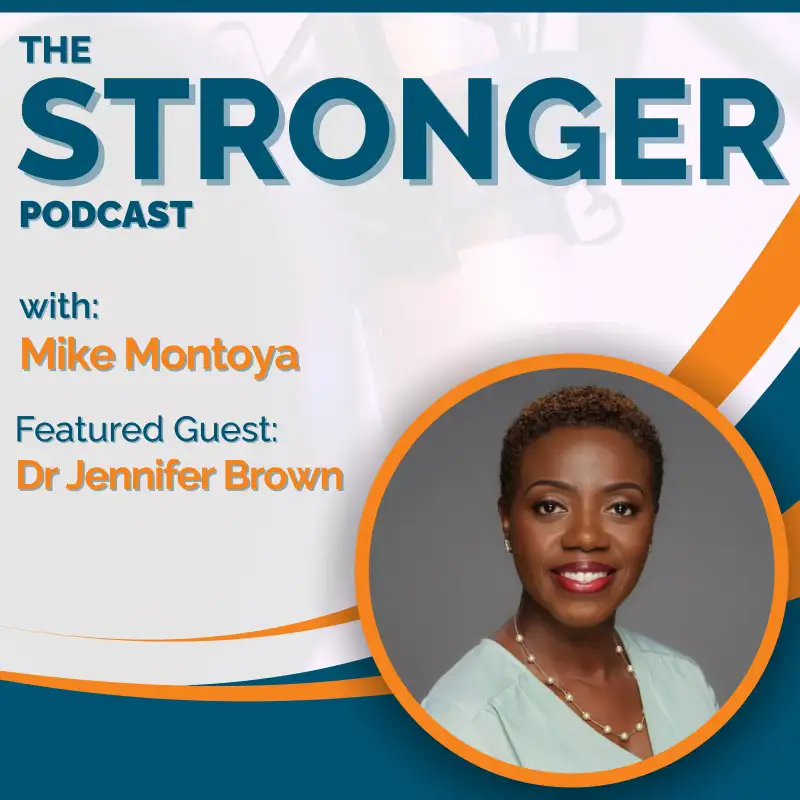
The Hidden Power of Relational Intelligence in Building High-Performing Teams with Dr. Jennifer Brown
Welcome to the Stronger Podcast. Each week, we have honest conversations with education and social impact leaders about their leadership and career journeys. We talk about their origins, inflection points, and the work that they're doing today. The conversations are honest, human, and practical. If you're here for real stories and real takeaways, you're in the right place.
Mike Montoya:Let's jump in, and let's get stronger together. In this conversation, Dr. Jennifer Brown reflects on growing up as a military child, learning adaptability early, and finding her way into education through the teachers who saw something in her before she fully saw it in herself. We talk about leadership, teamship, and what it means to build strong communities inside schools and school systems. Let's jump in. Good afternoon, everybody in our in our listening audience.
Mike Montoya:Maybe it's morning, depending on when you're listening to this. I'm with, Dr. Jen Brown, who is, kind of like someone I've known for many years from afar, but in the in the last year, gotten to know you a little bit better through your work with the KIPP Foundation and some of the work that we're doing with them. So, Jen, welcome to the program. Thanks for being here.
Dr Jennifer Brown:Mike, thank you so much for having me. I count it an honor.
Mike Montoya:That's awesome. And I, you know, I I was just sharing with you before I started. Like, I feel like so much privilege because I get to spend time with people in, like, a pretty intimate setting. Right? Like, we don't normally get that much time just to hang out with colleagues and friends and work that we're doing because our like, we're always moving.
Mike Montoya:Right? We're rode like, we got a bunch of things always burning, lots of fires going on, and that's just kind of the nature of it. Let me let me have people sort of ground themselves a little bit. Like, where are you physically at in the world now? And then and then I wanna kinda I wanted to ask you, like, where did you start?
Mike Montoya:Like, where was home as a kiddo, for example? And maybe I'd love to hear just kind of that origin component a little bit.
Dr Jennifer Brown:This is great. I am physically located in Charlotte, North Carolina, and returned back to Charlotte, North Carolina. In July, it'll be two years. This is going to sound more morbid than it should, but it will sound it is absolutely situated in current context. And I'm thinking about your where did you grow up, like, where are you from kind of question.
Dr Jennifer Brown:I was thinking recently about where I would like to be buried if I should be buried because people tend to want to be buried in home, wherever home is, and I don't quite know where that is. Here's why. I am the daughter of a soldier. My parents got married at 18 and 19. You may have seen my mother recently passed away about two months ago.
Dr Jennifer Brown:That's part partly why I was thinking about burial.
Mike Montoya:Of course.
Dr Jennifer Brown:Yeah. But my parents got married when they were 18 and 19 years old. This month, they will have sell would have celebrated fifty years together. My dad joined the army right out of high school. Said he knew he wanted to be a soldier since he was six years old.
Dr Jennifer Brown:Consequently, we moved around all the time. My parents, for the longest time, would call home Quincy, Florida, where they were both born.
Mike Montoya:K.
Dr Jennifer Brown:It stopped being home, when he retired from the army. They settled in Columbia, South Carolina, and they've been in Columbia, South Carolina for thirty years. So that's home now. It is where my mother is buried. But I lived in Columbia for high school, and then for a couple of years after college, I don't know that it feels like home exactly.
Mike Montoya:It's not yet.
Dr Jennifer Brown:Lived in Charlotte. We moved away to Jacksonville, Florida for nine years where I was with Kipp Jacksonville. I'm not sure that Charlotte is home yet, but maybe it will become home.
Mike Montoya:Yeah. Well and and I appreciate like, of course, it makes sense that you're thinking a little bit like this because your mother's recent passing, which Yeah. You know, my acknowledgments of. And and but to say that I mean, you're a long ways away from that probably, right, given all the, I mean, current age and, like, where we're headed with all the medical magic. Right?
Mike Montoya:So so there's a long time to figure that out right now, honey. I mean, you're you're amongst many guests that I had. I I mentioned to another guest this morning that, like, I I grew up in Colorado Springs, Colorado, and it was a military town. And so we had lots of military young kids, you know, friends that came and went, and that was just kinda like part of the culture, right, of that. Like, kinda kinda we were not a military family, but we had lots of that happening.
Mike Montoya:Some of my best friends turned into really important people in the armed forces, etcetera. So it's a great career thing, but it's weird to grow up like that a little bit. Right? Because you kind of don't have a place. Right?
Mike Montoya:Yes. And did you have so let's just ask this question. Right? You had lots of different school experiences. Yes.
Mike Montoya:Assuming that you were mostly in public schools or the or the defense department schools. Absolutely. So do you have a do you have a like, what was it like? Good, bad, middle, something like that?
Dr Jennifer Brown:Probably middle. Probably middle. When we were overseas, I was in DoDEA schools, mostly in primarily in public schools, it just kind of depended on where we lived. If we were on a base in The United States, then maybe I went to the base school, but probably went to school off the base where everybody else went. Graduated from high school at like I said, in Columbia, South Carolina.
Dr Jennifer Brown:That was a school that was off base, but it was a school that we were zoned for. And I do I do remember coming back from Germany. I would have come back in the third grade, coming back from Germany. I do remember being a bit bored in my third grade classroom in Savannah, Georgia because my dad got stationed there because we I was ahead with whatever that content was, and that was when I was at a DoDEA school. So I do remember feeling a little bit bored, not to mention the the culture transition coming back to The United States having been in Germany.
Dr Jennifer Brown:There's a there's a funny it was not funny at the time because it felt really embarrassing to me as an eight year old. But I remember coming back and not knowing what certain candies were.
Mike Montoya:And there's a there's a
Dr Jennifer Brown:a southern candy that's kinda harder than taffy, and it sticks to your teeth. It's called a Now and Later. And I did not know what a Now and Later was, and I remember there being a moment where the teacher was rewarding the class with with candy. And I got this thing, and I was like, what is this? And some of my peers around me, like, burst into laughter.
Dr Jennifer Brown:How come she doesn't know what a now and later is? And I'm like, we didn't have this candy where I just lived. They're like, what do you mean you didn't have this candy? I said, well, we had a candy truck that would come around every week, kinda like an ice cream truck, and they just thought that was the strangest thing. So there were a couple of those instances, the transition back to The United States as a little girl.
Dr Jennifer Brown:I just had some really what I thought were uncomfortable or awkward moments. But it there's there's something that I find I think is true of most military children that I know is that we we learn a certain adaptability and a a comfort with change at which has served me well. And probably a bit of a thick skin. Like, you're bringing some experiences that that maybe many of your peers, like a global lens or perspective that that many of your peers may not have. And I just kinda learned to to just roll with that, not be boastful about it, not be defense defensive about it, not be arrogant about it, but just aware.
Mike Montoya:Well, and it's it's interesting to hear you reflect on that very specific cultural transition. Right? Like, I mean, living I mean, anytime that we anybody time we anybody goes away from their home to another country, right, you you get a little bit of a shock or a thing. Right? Right.
Mike Montoya:But to, like, live and function someplace and then come back to Savannah I don't know what Savannah was like in whatever that was. The eighties or nineties or something like that. Right? But, like, it it finally felt really different. Right?
Mike Montoya:And so Yes. But I think that's military kids build muscles around resilience and, like, adaptability, and that's that's part of, like, what makes and and and maybe for our listeners, like, US has a standing group of armed forces that's close to a million humans. And then a lot of them have families, and then there's children. So there's tens of thousands of children every year that are going through this kind of experience, right, that we're talking about that are if they're school aged. And so it's pretty common, but there's a lot our society has a it's a kind of part of our fabric.
Mike Montoya:Right? Right? There's a lot of
Dr Jennifer Brown:kids Absolutely.
Mike Montoya:That grew up like this, right, that are, like that have then moved on and had careers that are not in the military. And so you started out then so did you go to college? And and when did you get, like, the when did you get the education journey sparked? Did that happen sometime? And maybe tell me about that.
Dr Jennifer Brown:I thought my all the way till eleventh no. Actually, probably my senior year of high school, I just knew I was gonna be an attorney. That way, I was obsessed. I, just knew. And, you know, LA law, I'm probably dating myself.
Dr Jennifer Brown:The show.
Mike Montoya:Oh, they must have been the show.
Dr Jennifer Brown:LA Law I'm like, oh, yeah. I'm in the courtroom.
Mike Montoya:Gorgon Bertrand.
Dr Jennifer Brown:I'm like, folks are so they just have these eloquent arguments, and they're so passionate, and they're fighting injustice. That is gonna be me. And, that was the case until the summer before my senior year. Two two things happened. One, the summer before my senior year and then my actual senior year.
Dr Jennifer Brown:One, my parents got me a summer job at an attorney's office. And again, my daddy was a soldier, like middle class, lower middle class existence. Right? He was not an officer. He was an enlisted soldier.
Dr Jennifer Brown:And so, you know, we had friends through community. He in the second half of his military career, he was a recruiter. So he always had lots of different partnerships or relationships with folks in the community. And he met Edie Lane, who I'm still connected to to this day. And she said, Yeah, I could use some help around the firm.
Dr Jennifer Brown:And the firm was Edie Lane herself. It was her practice. And so I worked for her for a summer and it was great. And very quickly revealed to me, I do not want to be a lawyer. I remember saying to her one day, Is this what you do all day?
Dr Jennifer Brown:Just kind of sit and read and research? And she's like, Yes, most of the days that is what I do. And sometimes I get to go to court and I argue, and it looks nothing like it looks on LA Law because that's a TV show.
Mike Montoya:And I think there's a lawyer show about real lawyers that'd be, like, bad ratings because it'd be boring and be like, yep. We're gonna read some more stuff and write some more things. Right? Yeah. So
Dr Jennifer Brown:the second most important thing, I think, or I would say influential or shaping thing that happened was at my high school, they had a course called teacher cadet. South Carolina, I think, still has this. And it was an elective course. You could take it if you might be remotely interested in going into education. It was the state's way of, you know, kind of trying to early
Mike Montoya:Crite the
Dr Jennifer Brown:public. To build a pipeline. Right? I I was super smart. And I ended up taking it.
Dr Jennifer Brown:Just not because I thought I might wanna be a teacher, but because I thought it might be interesting. And loved it. Loved it. Did did a practicum, a junior practicum. So one day student teaching experience.
Dr Jennifer Brown:And I did one in middle school and another one in elementary school. And I think, I don't know if I had fallen in love with teaching or education yet, but I absolutely was smitten with Barbara Thompson, who was the teacher cadet teacher. And she had been a classroom educator from grades K through 12. She was, at that point, she was probably in year 25 or 30. And she was absolutely infectious as a teacher.
Dr Jennifer Brown:So I had her in my senior year. I also had Dean Ruth, who was my English teacher, English four, that year. They are my favorite when anybody asks, who are your favorite teachers from high school, they are my favorite teachers. I absolutely just loved the way, they designed the classroom experience and what we learned. And they loved teaching and they loved students.
Dr Jennifer Brown:So I think I fell for them, the teachers, before I fell for the actual profession. I went to Winthrop University. It's a small liberal arts college here in in right across the border in South Carolina. And I actually majored in English because I loved English. So I didn't even major in education.
Dr Jennifer Brown:Majored in English lit, and then I did an alternate certification route to get into teaching.
Mike Montoya:And Well, and, like, that's a good a very like, there's stronger arguments in the education space about this pathway. Right?
Dr Jennifer Brown:Because Yeah. Yeah.
Mike Montoya:Alright. Because and maybe the strongest argument is, like, like, subject matter experts actually know their thing. And so degreed individuals, right, with with each of these disciplines make really inspired, passionate. They may not know, like, the teaching practice and the classroom management stuff and some of the other things you'd learn in the education school side. Right?
Mike Montoya:But but they know the subject, which makes it much more interesting, right, potentially for kids. Right? And that's the argument. Right? So is that so did you find out?
Mike Montoya:So did you you got certified, then you started teaching. And were you teaching English or similar?
Dr Jennifer Brown:I was teaching English. Yeah. Yeah. And I started out teaching high school English. And so I was not much older than my juniors and seniors because I got assigned to teach juniors and seniors in my very first year teaching.
Mike Montoya:No, I'm taller than you right down here.
Dr Jennifer Brown:This, I remember my mom took me shopping, when I got my first teaching job and she said, we have to get you pantsuits and skirt suits because you are not much older than these children and you need to go to work looking like a professional grownup. And so we did. I wore heels and I wore dresses and I like came in like a business person. And also to your point about like what I had absolute strength in was the content area. And I, through the alternate certification program, was learning the pedagogy.
Dr Jennifer Brown:I will tell you what I did not have trouble with was classroom management, because I am Janice Nelson's child. And Janice Nelson ran a house that was tightly managed. So, there were things that I knew from my upbringing to do in a classroom that would just serve the classroom community well. Like, we will we will have order. There will be a way of doing things.
Dr Jennifer Brown:And and my mother was not the actual one who was enlisted in the army, but she was very much. She was
Mike Montoya:a commandant, right?
Dr Jennifer Brown:Oh, absolutely.
Mike Montoya:Absolutely. Well, so you had these experiences from your parents, right, that also influenced how you got into the craft and the teaching. And teaching is such an amazing experience when you're especially when you're young because you have like you said, you're close to the age of these kids, quote unquote kids. But, like, there might be four or five years between you, not very much, and and which is super challenging, right, in that regard. Were you teaching in a well, tell me about the school you were teaching in.
Mike Montoya:It was high school. Sounds like and, like, what was, like was it were there black students? Like, not what was it like? Yeah. Tell me about that.
Dr Jennifer Brown:Started out teaching in Aitken, South Carolina. K. So parts of Aiken, I think, would be considered rural. So maybe a little bit rural, a little bit suburban, mixed demographics, but predominantly white student body. Probably mixed income as well, but it was not Columbia, which I was familiar with because I had graduated.
Dr Jennifer Brown:So it was a it was a new city in South Carolina. And I was very clearly that so I started in the middle of the year, Mike, because their teacher had left in like February. And it worked out that I'm like, okay, great. I'm gonna I can just slide on in here for this job. And so, like I said, juniors and seniors, I remember showing up for the first day of work and my textbooks for my classes were at the front office.
Dr Jennifer Brown:So the principal came to greet me, Here are your textbooks. Your first class is gonna start in about an hour. Was my onboarding. Was my onboarding. Fabulous.
Dr Jennifer Brown:And there was oh, I'm sorry.
Mike Montoya:The least they gave me books. That's my
Dr Jennifer Brown:last There was the textbook. There was the English department because, you know, in high school, it's departmentalized. The English department had mostly experienced tenured teachers who had you know, they'd been there for a while. So there was not you know, this is your typical high school in a in a smallish southern town. They've been there for a while.
Dr Jennifer Brown:They grew up in the community, so I was clearly the youngest person in the department. There was one other black teacher in the department, and she kinda took me under her wing. We would talk literature and how we would how I might approach teaching a particular topic or a particular text. She was the one who kind of gave me the skinny on, hey, you're having some you have some questions about this particular student, or let me tell you about this student because I've been here a few years now. Let me tell you about this family, give you some key insights.
Dr Jennifer Brown:Let me tell you about this colleague of ours and how you might navigate that relationship. So on, like but it was the, like, the the informal politics of of the school community. She kinda took me under her wing, Iris, and and helped me better understand that. It's my very first teaching job. I'm like, I went to school, but I hadn't worked in a school before.
Dr Jennifer Brown:So you you need somebody who helps you understand. Like, there there is a professional contractual thing that you are showing up to do every day, and there is a there is a society that is also happening in the school setting. And you you have to be wise to pay attention to it, understand how it works, and how you best navigate it, who holds power, why they hold power, because we know that things, a number of things get done through informal channels and so on and so forth.
Mike Montoya:Well, you made me think about there's this show called Abbott Elementary on TV. Yeah. Which is like, like, like, the current version of, like, a crazy school. And I just think of I'm like, I'm like, oh, yeah. It's like a whole society.
Mike Montoya:There's, like, almost no children in that show. It's all the it's like the office for for schools. Right? And so it's a it's a bunch of that's what I mean. You made me think about something.
Mike Montoya:Oh, yeah. I could imagine that, like, that there's a culture, right, in a way of being, and it's like an adult centric culture that's happening. Then there are kids. Right? And then there are the young people doing their thing.
Mike Montoya:Right? So Yeah. That's right. Yeah. So you you learn that.
Mike Montoya:So that's but just, like, an interesting place to start a career. Right? Because, like, the the there's not like a I I call it generally, like, schools don't have a whole bunch of hierarchy and leadership pathways, things like that. And so but, I mean, you can become a maybe a department leader, and then you become, like, and you add on, like, coaches and things like that. And eventually Right.
Mike Montoya:Like, you become a dean or assistant principal or principal, things like that. So did you take that kind of route, and you ended up did you work were you a school leader at some point and and or not? Oh,
Dr Jennifer Brown:wasn't. I I had no plans to be a principal or to try to, like, climb in central office. And keep in mind, this point, I I knew nothing of of charter schools. Sure. And this is back in 2000.
Dr Jennifer Brown:So they definitely existed, but that was it was not even a conversation that was anywhere on my radar. I just thought I would be a I'd be a classroom teacher. I didn't think I would do it for a lifetime because I thought maybe I would pursue something in, like, creative arts, or something like that. That that bug has never left me. Maybe we'll get to
Mike Montoya:that in another part of the
Dr Jennifer Brown:conversation. But I did not I did not think that I would be a career educator. That was not on my radar. I thought, like, this is something that I'm gonna do for a little while. I also if you had known me growing up, I used to say pretty adamantly, I'm never going to go into the Army ever.
Dr Jennifer Brown:Ended up changing my mind on that as well. So what what if I'm fast forwarding, you know, so through some different examples, moved around to different school districts, continued teaching, worked on and and received my master's again in English literature. I'm just, like, obsessed with knowing it deeply. And I worked at a school where this by this point, I had transitioned to middle and junior high grades. So I transitioned to teaching eighth grade, which became my favorite grade to teach.
Dr Jennifer Brown:Middle schoolers are absolutely bananas, and I love everything about it. They're crazy people, and I love them. But that was when a principal that I had back then said to me, I want you to be the grade level chair. The the I'm sorry, the the department chair. And that was my first kind of formal leadership role in a school.
Dr Jennifer Brown:And, again, not a whole lot in not not a whole lot in the way of onboarding into that role or into that assignment. Was kinda like you figure it out. But but it was it's very much aligned to this trend where there have been leaders in my life who saw something in me. They they would be able to tell me what it was later, but they put me on a path to leadership. So this principal did that, became the grade level chair in that school.
Dr Jennifer Brown:This principal left, went to work in another district, recruited me to that district to what was effectively a district level school improvement team. And he's like, I'm putting together a multidisciplinary school improvement team. I want you to come be the literacy person. It's big, at that point, biggest role I've ever had, biggest influence that I would have ever had because this is district level and and it was a clear mission. We've got these schools in this district who are identified as the lowest lowest performing, and we've got to get them off this list, and we've got a year to do it.
Dr Jennifer Brown:And so that's how I got introduced to both turnaround and, you know, this kind of enterprise level leadership in in school setting.
Mike Montoya:Yeah. And so, like, you and we and we talked a little bit about, like, leadership before we talked about, like, how leaders are kinda, like you kinda get identified as by somebody else like, someone more senior that was looking for a team of people that kind of appeal. So there's some qualities that you have. Right? And I then we're gonna get to the army conversation here in a second because I think there's there's, like, this transition of of experience that that's really important here.
Mike Montoya:Like, the the you started to build these muscles. Right? You probably had some of them from being a young woman and being in your family. And then they became useful in a way that you could have some influence and positive effect in that. And so you mentioned that there was something about team.
Mike Montoya:Team that exceeds individuals, etcetera. So talk to me about this, when you're talking about teamship, shared with me this coined term that you're coming up with. So share more about that.
Dr Jennifer Brown:Yeah. This is it's connected to what you're talking about. I think that this quality that leaders have seen in me and why they have kind of pushed me or shepherded me into different leadership positions, It it's rooted in relational intelligence. That that's what I believe it is. For all of my life, people have said things to me that sound like, you are actually you've got this people thing.
Dr Jennifer Brown:You're so good with people. You you have this ability to make anyone that you are engaging with feel so seen, feel so heard. You repair even when you have to say very hard and direct things to people. Like people still love you and they still want to be with you and you've just said this very hard thing to them, what is that? And so recently, I came across this article out of Stanford Review, and it was about relational intelligence and how this could very well be the competency or the skill that that gives us the competitive advantage, you know, as the robots start to come for us.
Dr Jennifer Brown:Like, this is the thing that we gotta get right so it can, you know, keep us distinctively human and competitive. And when I read that, Mike, like, this is what relational intelligence is, I said, this is the thing. This is what people have been saying I have. And so that so I'm like, yes, finally, I have a language for it, a name for it, a framework for it. Part of the the roles, these leadership roles, is like, because I have been because I have high relational intelligence, it shows up in how I bring people together and how we function together as a team.
Dr Jennifer Brown:That matters to me. A collective orientation or an orientation toward the collective, over the individual matters deeply to me. And so, I wish I could take credit for coining It's, Teams it's, it is not mine, but it's not widely in use out there. But it is really thinking about it's different than teamwork, which would be like a discreet, you know, teamwork or team building would be a discrete set of actions, right, a curated set of actions. Team ship is really about the discipline of team and teamliness.
Dr Jennifer Brown:To what extent is a team functioning well and meeting its intended outcomes? What are the what are the relationships like there? Where is the degree of trust? What about selflessness in the way the team functions? So there there I think that there are some domains around that and, you know, hinting towards something that I'm gonna be thinking about in the future.
Dr Jennifer Brown:Now this one I did coin is is teamitude. What is a team What is a attitude and behavior around functioning as a team.
Mike Montoya:K.
Dr Jennifer Brown:You know, Pat Lencioni talks about the ideal team player being hungry, humble, and smart. I could not agree with that more. I I think I wanna extend this thinking a bit more and really study what high performing, highly effective teams, do differently, but around a certain set of particular domain areas. Like I said, some of that, the selflessness, the trust, those kinds of things. So I'm I am obsessed with that, want to to study that more in the future.
Dr Jennifer Brown:Obviously, you might be hearing folks start to talk about their teamitude.
Mike Montoya:Well, most of you,
Dr Jennifer Brown:we're gonna let's talk about
Mike Montoya:take the let's take the opportunity to kinda promote that concept, right, because, like, it's worth holding onto. Right? Like, we've talked about, relational intelligence, which is kinda like a it's like a way of expanding the idea of EQ or emotional intelligence and and, like, and and leadership work, right, include, like, the ability for humans, right, to interact with each other in ways to organize themselves, get things done. Right? And oftentimes, it feels like it's hierarchy.
Mike Montoya:Right? There's, a leader, and then there's followers, and there's people that are doers. Right? But, like, the idea of team team approach, right, has its own dynamic. Right?
Mike Montoya:And it requires other people it requires people to kinda interact with each other in a different way versus, like, we're gonna follow this single person's idea or vision. Right? We're gonna, like, somehow we're, like, co co cooperating in this in ways. Right? Is that is that a word?
Mike Montoya:I'm I'm that's the word, but I'm not trying to think about the word. Right? It's it's a way of cooperating and interacting and relating to each other in ways that allow us to participate, right, in something that is bigger than just us as an individual. Right?
Dr Jennifer Brown:Absolutely. There it it is you are spot on in in some of that. And I'm thinking about there is lots of scholarship that I think would inform this around probably psychological safety. The extent to which an individual as a part of a team even feels comfortable enough being vulnerable because there's a selflessness part of this orientation as well. There's something around, like, an alignment.
Dr Jennifer Brown:Like, are we clear about what our roles are on the team, and and and are we working in an aligned way towards whatever our objective is? There's something even about, like, energy, Mike, on the team. Sure. Right? Like, just the what is the, like, motivation, the the spirit of motivation, purpose?
Dr Jennifer Brown:You know, when this team is coming together and and is actually functioning, what would it look like for us to, you know, become a sociologist studying it, put the team in the fishbowl? What would we what might we say about the team's energy level?
Mike Montoya:Yep.
Dr Jennifer Brown:And and and members disposition toward being a part of a team. You know there are some people who are adamant about being an individual contributor. They want no parts of being on a team. And I think that that's fine. No judgment there, but I but there is a disposition that is necessary and a willingness to sacrifice that is necessary when you are a part of a team.
Dr Jennifer Brown:And Well, and
Mike Montoya:you have
Dr Jennifer Brown:to this influx.
Mike Montoya:You have to have this, like, I call it, like, permeability, flexibility. Yes. I call it tough some some one of our clients, like, they're like, they need thick skinniness. Right? That's Yeah.
Mike Montoya:Is a word. Right? They they do have to have enough of a membrane around you. I call it integrity, right, within yourself, I mean, in order to interact with people who are part of a team environment, team experience. Right?
Mike Montoya:And there's much of literature around integrity and, like, what that really means and and that work. And but some of what you're talking about, right, is, like, how do these how are these things actually characterized, and how are they showing up in in actual because, like, we're doing it. Like, we're like, teams exist and function, but the the the way of, like, how I call it almost like engineering and working towards it as a as a methodology for achieving things together is it's like it hasn't it's not extrapolated yet. Right? Not not significantly.
Mike Montoya:Right? And so there's lots of interesting opportunity here. And I think with schools I mean, in kinda getting back to, like, your early leadership experience that you're talking about being a a a department chair, right, and that was your first thing. Like like, almost, like, wondering, like, if you were able to apply this knowledge that you have now back into that setting. Like, could could you do that?
Mike Montoya:And, like, what would that look like?
Dr Jennifer Brown:I could. I I could absolutely do that. And and I think what I would do is going back and and going forward too, because I think that there are gonna be some opportunities for me to do this or at least support some other folks in doing it, I'd go back and it would start with what let's define what team actually is. I'd start there. We're we're the English department or we're the eleventh grade team.
Dr Jennifer Brown:What does it mean? What are we responsible for doing? Right? What is the goal for this team? There are some academic metrics that must be true by the end of the year.
Dr Jennifer Brown:And then there are some other things that should be true about the way we function together, the way that we are together as a team, and we would define those early on. Any any good leader comes in and they create the vision, right, for the team. So I think that that's what I would have done. Now, of course, I was super young back then, had had no knowledge that that's what you're supposed to get in and do as a leader.
Mike Montoya:Being grown up and and and retrospect back. And that's this is why we need people who are experienced Yeah. Yeah, in their craft and have, like, deep content knowledge that can contribute, and then that that's we they come back and they lead other people to and through those experiences. Right? And, you're part of a team now.
Mike Montoya:Right? And let's talk about this a little bit. Yes. You're you're you're on this amazing team, and Stronger was part of the the group of folks that got to come together and work and work with the KIPP Foundation to create this kind of regional superintendent structure, which is like a new thing for the foundation. Right?
Mike Montoya:And it's work that you're you've been you've been in a couple of years now. This is a year too. And and then and then there's some change coming. So, like, how does that feel? And I mean, do you feel like some of this team stuff is happening that environment now?
Mike Montoya:Absolutely. Like, working across the whole country. You're kinda removed from the five of you, and it's, like, a thing. Right? So
Dr Jennifer Brown:Absolutely. You know, it's like, imagine taking four former CEOs, you know, who led their own things, they were in the top seat in their own things, and then you put them together. It's like, it is not unlike, what do they call it? Like the dream team, the Olympic dream team where you get the the highest
Mike Montoya:from Yeah. Hockey team is yeah.
Dr Jennifer Brown:And then yeah. This is that's the extinct of my sports analogy. So let me let me back out everything and come back to what I know. I'm seeing the the things that you and I are talking about with team. That that's at play every day with the four of us.
Dr Jennifer Brown:You know, we, of course, are led by the president at the KIPP Foundation, But there are lots of times when we are together, just the four of us, we are thinking about what do our CEOs, our executive directors most need right now? What is the best way to get them that information? We have a portfolio of those CEOs, those executive directors. How are we each coaching, supporting those folks? But we come together and we're thinking about and having to create different tools and resources and navigating the dynamics that are happening in regions and at the KIPP Foundation and having to have some of these same conversations around when do I need to actually Yeah, I've been a CEO, so have the other three.
Dr Jennifer Brown:This is a time where I actually don't need to be pushy about my point of view on this. And we need to decide as a team, what are we aligned on? What's going to go forward? Or there's a time when I actually do need to make my voice heard on this, and here's why. When we need to have some when we're high energy, you can tell, if you came to one of our meetings, you can tell when we're high energy.
Dr Jennifer Brown:But there's some informal stuff that that happens with us too, Mike, that I think is important to team. We've got a text a text group, called the Fantastic Four.
Mike Montoya:The giant text came out there. My god.
Dr Jennifer Brown:We send each other silly things. Send silly things. So we're we're building relationship there as well. They know about my children, my husband. I know about their families.
Dr Jennifer Brown:We're texting things like that. Those folks literally picked me up off the floor when I got the call about my mom passing away. I mean, hugs, and I've known Joanna the longest. I just met the other two six months ago, but that something that I experienced when I was in the Army Reserve, I'm experiencing it now. Those moments of vulnerability, hardship, challenge, those are necessary in forming a great team.
Dr Jennifer Brown:We might skip past or minimize the importance of what happens, the bond building that happens in those moments, their deposits for what comes later. Allowing them it wasn't even an allow that I had no choice, But they saw me at probably one of the lowest moments of my life, the most the rawest, most vulnerable, and nothing changed about the way that they felt about me. And those moments are important for teens.
Mike Montoya:Well, in you're talking about these, like, the I mean, it's like the under under it's almost like the undercurrent, right, of of relationship. Right? Like and and sometimes we separate our professional and personal lives for good reasons. Right? It's and just have some distance and space around things and protect all sorts of parties.
Mike Montoya:But, also, when you're amongst a group of people that you can trust and I think we used the word trust a few times here. Right? People that you can build trust with, that you can establish trust with, rapport, ability to, like, listen and share, but also stand up for yourself but not be subsumed by the team. Like, those are all features, right, that allow us to be, I call it, vulnerable humans, right, leading in the space that we're that we're leading in. And it's it's almost like a gift.
Mike Montoya:And I think I, as a as a as a young man, I had the opportunity to be part of a few organizations where, like, that existed because, you know, we had some incredible culture leaders, right, that, like, really helped us grow and develop that that skill and those, I call it, bonds of sorts. Right?
Dr Jennifer Brown:That's right.
Mike Montoya:And I'm like, man, that would be the best. For me, it's been, like, an incredible career to have those choices and opportunities, right, to be amongst people that I really know, that I really trust, that know me, that I can be an impossible person around. Right? Because I'm an impossible guy too. Right?
Mike Montoya:Like, all those things. Have all my, like, you know, things. But importantly, right, is that they still we still show up for each other in various ways. Right? In really important ways.
Mike Montoya:And we and I think, like, I would say, like, schools work actually has the opportunity to give you that kind of career if you allow it to be, if you can find a great organization that supports that culture. But you've been doing this for a while. You helped build some of that in your own CEO roles in Jacksonville, And then kinda carried that forward into your work at the foundation. And so but now something special kinda happened. Right?
Mike Montoya:You're making an intentional decision about a transition here. So tell us what's coming.
Dr Jennifer Brown:I am. I started reflecting back in probably September, October and start you know, I report to the president, so started having a conversation with her that I think it's time. I'm feeling a pull towards my family. It's the same pull that I felt in Jacksonville that that I knew it was time for us to move back and be closer to family. And we you know, my husband and have a one daughter is in tenth grade.
Dr Jennifer Brown:The other daughter is in third grade. And you know because you're you're in it every day, so you don't quite feel how fast time is moving. I feel like, in some ways, tenth grade just sneaked up on me. And and every week, I am now saying, she's only here every day for, like, two more years. What is happening?
Dr Jennifer Brown:What is happening? She is very much in this college conversation already because that is just the child that she is. And I remember saying in the fall, I've got to be here more. I've got to be here more. I I won't get this back.
Dr Jennifer Brown:And and so I made the final decision in December and communicated the that decision to our CEO. And, you know, I had talked about with the president about it for for several months, and then it got announced in late January and then early February. I'm not clear on what comes next, which is how I know I'm very convicted about it because I made that decision not knowing what comes next.
Mike Montoya:Going around. Yeah.
Dr Jennifer Brown:Yeah. That wasn't that wasn't as important to me. What was most important was declaring that my family is a priority.
Mike Montoya:That was also elevating that in a significant way. And, like, for a long I mean, since you were a young woman, right, you Yeah. Have been giving and contributing right to, I call it, like, the greater good, right, and these social experiences, especially with kids and and in many cases, children and families who don't have a structured and privileged environment that we have come to be in. Right? And and now you're making a a shift, right, to make sure that you're there as part of the it's almost like like tenth grade is significant because it sounds like your daughter's, like, accelerating and thinking great creatively about the future.
Mike Montoya:Right? So which is great. And so it's gonna be an amazing experience to be part of that Yes. As well. Right?
Mike Montoya:Like, this is, like, a moment that you don't wanna you don't wanna pass by. No. You know? And and your career and stuff will also still be here.
Dr Jennifer Brown:Right? Absolutely.
Mike Montoya:Know? And eventually eventually, you'll be able to, like, decide if you wanna engage back in that very specific way.
Dr Jennifer Brown:So Yeah. And and in the meantime, I think what I'm gonna do is, you know, a little bit of I'm gonna hang my shingle out and see if there are folks who might be interested in in being coached Yeah. You know, by a woman who's learned a few things or two about being in the top seat, being a being a teammate. And so I'm gonna put my shingle out there, but not in a way that will overload me. So so maybe one or two coaching clients and some maybe a little bit of contract and consulting work along the way.
Dr Jennifer Brown:But but always with the priority in mind that I've got to have the flexibility in this season, to really be with my husband and my girls.
Mike Montoya:Yeah. To be available. Well, in your job, unlike some other jobs, requires a lot of travel. Right?
Dr Jennifer Brown:A lot of
Mike Montoya:people, like, people in, like, time zones all over the the country. Like, I
Dr Jennifer Brown:think Yeah.
Mike Montoya:The re the KIPP the KIPP, just for our listeners to hear, the foundation supports, like, 26 regions across the country and about almost I don't know. How many there's, like, a few 100,000 kids in this experience. Right?
Dr Jennifer Brown:Yeah. That's
Mike Montoya:right. So it's a huge it's a huge enterprise. Right? And so it's a it's a big I call it the big job that people have to have, and then that you can't do indefinitely and forever. Right?
Mike Montoya:And so you have to, like, be able to paint yourself over this time. Other me because you're again, you have, like you probably have, let me just say it, ten or twenty years of career life left somewhere if you decide to do it. Right? It's just a matter of, like, make pacing yourself through that experience. So and I wanna be cognizant of, like, just I wanna make sure I pull on a thread here, which is about women in leadership in school environments.
Mike Montoya:And there is more women in schools work, but they are not the majority of leadership And so if you can think about that for a second, if you if you have a word or a I call it a few pieces of wisdom for for women, especially younger women that are entering the profession or that are on this journey, like, how do they how do they kinda get in how did how can they be successful in ways that's gonna be both fulfilling to them personally and and balancing those things? I mean, this I mean, again, I'm kinda like I'm trying to get the moment, right, because I it's really happening here, and I want people to hear about that. So
Dr Jennifer Brown:That's really great. Isn't it's so reflective of our country.
Mike Montoya:Yeah.
Dr Jennifer Brown:You know, it's so reflective of our country where the you can be a woman who is absolutely qualified overqualified in ways, and there's there's something about our orientation toward women leaders, that it is almost as if we can't allow ourselves to envision a woman being in charge. And we we just have to keep reorienting, widening the aperture, if you will, and showing what that looks like to this is important to me, and it was important to me in Jacksonville to demonstrate what that looks like in a way where they don't also have to sacrifice being married, if you want to be married, being a parent, if you desire that, and having healthy relationships and being present with those people in your life and still being very present at work. I would often say there is no balance. There are trade offs. There are days when my family absolutely gets less of me in terms of hours than KIPP Foundation gets.
Dr Jennifer Brown:And and I think what's important is early on making sure that our women leaders, our aspiring women leaders, understand that that's a reality of of leadership, that you can design for. And when you get to the places when you're in the top seat, you get to redesign the thing that you're leading so that it actually opens the door for more women leaders to follow.
Mike Montoya:Yeah. So don't assume that the structures that are in place are permanent. Right?
Dr Jennifer Brown:That's right.
Mike Montoya:And almost like it almost takes more iterations of women
Dr Jennifer Brown:That's right.
Mike Montoya:In roles re reconfiguring things in ways. And and the rest of us to adapt to that thing. Because we've all adapted to this, like, patriarchal, like, you know, white guy thing that's out there. Right? And we and we you know?
Mike Montoya:And that's been around for centuries, though. Right? It took a long time to get here. Right? And lots of oppressive and crazy things have happened in a in a negative sense.
Mike Montoya:And and We got
Dr Jennifer Brown:iterating. We actually will.
Mike Montoya:Keep building. We've we've built an incredible society that has also been richer with problems. Right? Etcetera. So I I, for one, am a, like, champion of, let's turn the corner a little bit more.
Mike Montoya:Right? And, like, let's see what the potential is when
Dr Jennifer Brown:we That's right.
Mike Montoya:Don't lead this way. Let's lead, like, a slightly different way. Right?
Dr Jennifer Brown:That's right.
Mike Montoya:And and and, like, imagine what's what's possible. So, Jen, I wanna encourage oh, aye, I wanna thank you for being the person that you are and for the work that you've done in the space. And I look forward to hearing what's what's around the corner in the future. I mean, we I thank you so much for being here and and and contributing to to the Stronger community and to the work that that we're doing together with the foundation, and we look forward to having you in a in a future conversation. Okay?
Dr Jennifer Brown:Thank you, and it was an absolute pleasure. Appreciated the conversation.
Mike Montoya:Thank you so much.
Dr Jennifer Brown:Okay. Thanks.
Mike Montoya:What stays with me from this conversation is Jen's clarity about season, purpose, and choice. She has spent years helping build strong schools and stronger leaders. Now she's making the bold decision to center her family while still using her gifts to serve others. That's leadership too. Thanks for your work, Jen, and thanks for being you.
Mike Montoya:Thanks for listening to the Stronger Podcast. If this conversation inspired you, we invite you to follow the show and share it with someone who's on a journey to become a happier and healthier version of themselves. Links and resources are in the show notes. See you next Thursday, 9AM eastern time. Have a great day, and stay strong.