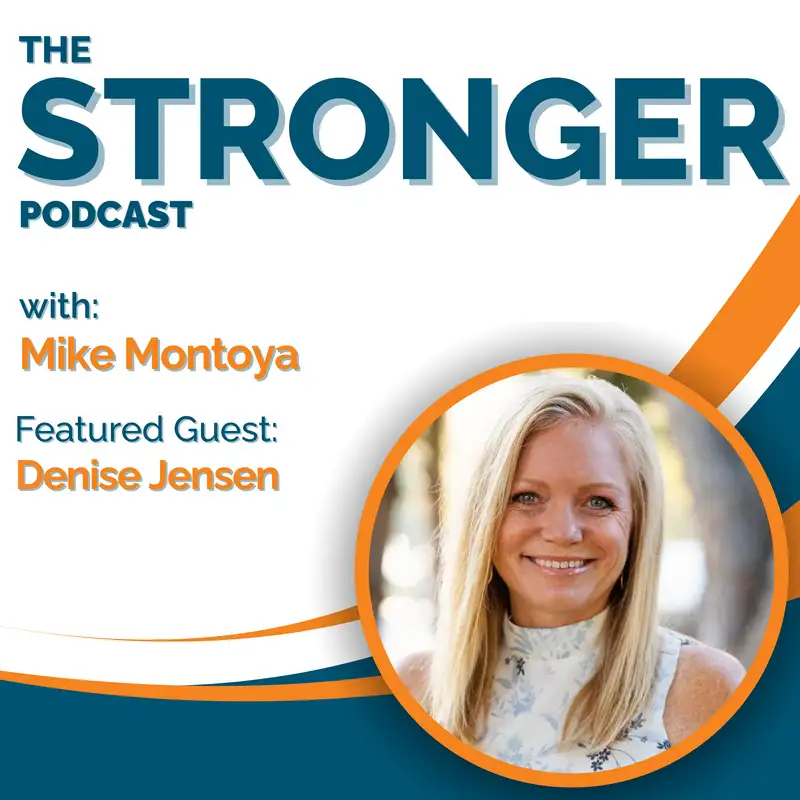
People Already Know What They Need: Behavioral Health Systems, Agency, and the Softening That Leaders Resist with Denise Jensen
Welcome to the Stronger Podcast. Each week, we have honest conversations with education and social impact leaders about their leadership and career journeys. We talk about their origins, inflection points, and the work that they're doing today. The conversations are honest, human, and practical. If you're here for real stories and real takeaways, you're in the right place.
Mike Montoya:Let's jump in, and let's get stronger together. In this episode of the Stronger Podcast, I sit down with my business partner and friend, Denise Jensen, to talk about leadership, behavioral health systems, and what it really means to build organizations around people. Denise shares her journey from growing up in a deeply conservative culture in Idaho to leading statewide systems work to focus on some of the highest need children and families in the country. Let's jump in. Good afternoon.
Mike Montoya:Good morning to everybody out in our listenership. I'm here with my, one of my business partners and a friend as well, Denise Jensen, who is our partner and lead operating officer at Stronger Consulting. Denise, it's wonderful to have you. Thanks for being here.
Denise Jensen:Thanks, Mike. It's fun to be here with you today in in this capacity. So
Mike Montoya:Yeah. It's it's fun. And we were just chatting about how, like, it's we get a we gotta shift gears because we Denise and I spent a lot of time together hammering through issues and problems and creating, like, cool things for our clients, and now we're gonna just kinda talk to each other, and that's kinda fun, because it doesn't happen as much as you wish in the virtual world. So tell our listenership just kinda ground themselves. Tell me tell us, like, where you're physically at in the world and, like, where where operating is from.
Mike Montoya:And then I'm gonna, like, ask you to kinda go back to, like, childhood, so, like, get prepared for that. But tell us a little bit about where you're at right now.
Denise Jensen:I'm in Boise, Idaho. Actually Meridian, Idaho, but the So we're like right outside the foothills and the Rocky Mountain West area. And, you know, it's beautiful. There's rivers, mountains. I'm a big outdoorsy person, so I get to get up in the mountains all the time.
Denise Jensen:So it's
Mike Montoya:Yeah. And Boise is, uniquely situated because it's, like, it's the only large city kind of in the region, and it's, like, six hours to everything else. Right? And the the cool parts about that I love about Boise is that it's, like, sunny often. Yeah.
Mike Montoya:And it doesn't have too much snow, but it does get some seasons. And then the summers are just beautiful and incredible there in terms of the mountains and the opportunity. So if people haven't done mountain life, you should get out to Denver, Boise, Montana, like, all these states that you're, like, in the middle of that you don't get to, the square states, I call them, because they're hard to find some. So Yes. Yes.
Mike Montoya:Well It's So but I like people to kind of share a little bit about like kind of where their, like, their origins are, right? And a little bit about like what it was like in your, call it your early childhood experiences. Tell me some of that stuff. Would that be helpful?
Denise Jensen:Yeah. Yeah. Absolutely. So I born and raised in Idaho. So I grew up here, left for about ten years too and lived in Utah, raised my kids in Utah and then came back to Boise.
Denise Jensen:But I grew up in a very conservative culture. My family is Mormon and I grew up that way. I don't go to church anymore or do any of that, but I was very much raised in that very religious, very conservative lifestyle where a mom stays home, she raises kids, she cooks and cleans, and the dad goes to work and does all of the work things. And so I have a big family. There's seven kids in my family and, I was a little bit the oddball out in my family.
Denise Jensen:I wanted to do something different. I didn't understand why a woman had to stay at home and had to like be the homemaker and couldn't have a career of her own. And so I kind of made my own way as a kid and as a young adult. And I made a lot of people in my family mad for a little while and stepped outside of the culture and the cultural norms and had to create, like I said, a path for myself. And it's been a really beautiful and wonderful and winding and circuitous, and it's been a lot of fun.
Denise Jensen:But I kind of found my way into this work through behavioral help. A lot of people that I knew, a lot of people in my family had behavioral health issues. And I had some of my own as a young kid and as a young adult. And so it was really important to me to use my voice to be a voice to others who didn't have opportunities to be heard in their communities. And so I found myself kind of growing up in my career in places that allowed me to kind of give voice to those kinds of things in a different way of thinking.
Denise Jensen:And I think that started really young for me when I would question things about my culture, things about the religion. And I just kind of kept that questioning happening my entire life.
Mike Montoya:You sound like the little bit of tenacious child that escaped the boundaries, right, of of the traditions of of both both, you know, the Latter day Saints church, right, as well as just the culture of of of the American West, right, which is, like, tends to, like, be a little bit behind, right, whether it's a progressive East Coast experience or something like that. Right? There's lots of I'm just I'm super generalizing here in that regard, but just say, like, like, things come slower in the West because it just hasn't had as many years, right, to develop. And so it's you're talking about things that, like, maybe other places kinda went through with children, you know, twenty or thirty years prior to you. Right?
Mike Montoya:So the generation before. Right. Did you do you feel I mean, and to for our listeners to know, like, I think you ended up with your own set of children and your own set of grandchildren now. So, like, you still did this, like, child rearing thing. Right?
Mike Montoya:You didn't just go down career path only. Right? But, like, how did that how did you kinda balance those two, like, this urgency to, like, not be traditional, but also you ended up putting them with the whole family?
Denise Jensen:I know, right? You know, I don't know that I balanced it well most of the time, but I did balance it. I think I found a lot of pride in my career. So I often leaned into my career and I also knew like the impact that I had as a parent on my kids. So I went into the mental health field.
Denise Jensen:Have my master's in social work. I did therapy for a little while, was a therapist for a little while, and then made my way into government work. So all of that helped me understand that regardless of the kind of parent that I am, no matter how good or how bad I am, my kids are going to need their own therapy because it was not like the thing that they needed. And that's just kind of the process of parenting. And so I always kind of balanced how do I have vision of myself versus me being a parent.
Denise Jensen:I didn't ever want to be have being a parent be my only identity. For me personally, I had to have a separate identity that was also about work. And so I kind of sometimes kept them separate. Sometimes they were together, sometimes they were merged and it was hard. It was really hard.
Denise Jensen:Had my youngest, I adopted and he had special needs. And so there was a lot of time that I needed to be at school for him, that I needed to be in therapy sessions for him and treatment. We were involved with the courts for a little while with him. So like there were a lot of times that I had to be a parent to him really focused. And at those times, my career also lent itself to like merging both of those.
Denise Jensen:So I was a system of care director for the state of Utah for several years. And during that time, my son was also going through all of those systems that because of his needs, he was going through all of those systems. And so I was able to kind of create a voice for what he needed. And so my parenting and career kind of merged sometimes and then also they were separate. So it was like this really fine line that I had to balance over time.
Denise Jensen:And at each stage of the kids' lives, my identity kind of shifted as well. It was really a circuitous like, experience. And I don't know that it was perfect or great in any of it, but it was kind of the path that we all went in together.
Mike Montoya:Well, and I appreciate you sharing as much as you have about, like, the, like, call it the the move through, moving through of, like, I call it phases or stages of, of life, right, with with children. And I think, I'll, I know, I'll extrapolate here. Like, I have a lot of, you know, women in my life, my sister, my own mother, right, and I sort of see how they, they have done this as well in yourself is is another another data point about, like, how women have to map out a different path because, like, of the expectations of what a mother motherhood in particular, right, or or parenthood. Like, it's very like, it's like a lot to sort of assume that, like, all girls wanna be mom Mhmm. And that they're gonna become their core identity.
Mike Montoya:And I think my own mother had that, like, thing herself. Like, her raising being a strong parent was, like, my mom's most important thing. And then when we no longer needed her to be that person, then her identity was like kind of lost. Right? And that was like a kind of like a really scary, I think, for her.
Mike Montoya:It's hard for us as adults to sort of see her go through that shift change, but it sounds like you were trying to balance that throughout. Right? And you found ways to do that.
Denise Jensen:Yeah. Yeah. And it was interesting because I didn't really have role models who were doing that well, so I didn't have anything to look to. So there was lots of mistakes along the way and also lots of really big successes. And I would say my kids are very thoughtful adults and they found their own way.
Denise Jensen:And they often come back to me and they're like, oh, you were a really great role model. You taught me what to do and what not to do because I experienced both the good and the bad the way that you raised me. And they see that as a benefit now. So like, I don't feel so bad for the ways that I raised them and did the best that I could. But it's really hard.
Denise Jensen:I think that as women, we have a lot of like you have to show up powerful in the workplace. And there's like an ease that you also need to bring. And then you have to be soft and caring and loving with your children and also toe the line for them because you're often the one that's disciplining and all of those kinds of things. And so it's a real, it's an interesting dynamic. You can't just be one person.
Denise Jensen:You have to be many, many people to the people that you show up to work with, to your children, to your neighbors, like in all of the different communities. You have to be many things and wear many hats.
Mike Montoya:Well, and I mean, you're talking about like flexibility, adaptability, right? And I call it code switching, right? Or wearing different kind of identities and masculine. I think to talk about the professional part of your experience, is navigating significant systems level work at the state level in Utah and Idaho, right? Most of these things didn't really exist, right?
Mike Montoya:These systems of care. So tell us like kind of what that even means, like a system of care and like what are the pieces that are in that? And like, when it didn't happen, how did you guys get the ball rolling in that direction? Yeah,
Denise Jensen:so a system of care is a term that we use in children's mental health, and it's about creating a safety net for the highest need kids in the state. And so in Utah, about ten percent of children take up about 90 of the funding needed in care, whether it's Medicaid or local community dollars, insurance funds, all of those kinds of things. And they come from different systems, but they all have this really high need. So some of them come from corrections, some of them come from the courts through child welfare, some of them come through the mental health system. So they come through all of these, some in disability.
Denise Jensen:The schools sometimes bring kids forward. And so my job was to bring all of those organizations together to start building plans and creating a way to serve kids who were really, really difficult and people didn't know how to take care of them. And so oftentimes what would happen is the kids would go into a state hospital, they would go into a correction center and they would just kind of stay there and never be in their community. And that comes with all sorts of trauma for the child, trauma for the family. When kids are in the home and they're high need, it's really tough on the family.
Denise Jensen:There's high levels of divorce in families with kids with high needs. And so the full idea is how do we wrap services and supports around kids? How do we bring all of these systems to the table to support a kid staying in their home or as close to their home as possible so that they can be close to their family, they can reduce trauma, and they can give that family and that child the best next step that they need. And so it was working with judges and court systems. We brought school districts together and then funding from human services.
Denise Jensen:So children's disability services from Medicaid, from mental health, and then child welfare. And we had regular standing meetings of, you know, initially it was what are the issues that these kids address? Who are they, first of all, because everybody kind of knew who they were. How are they getting into the system? And then what is it that they need and what do their parents need?
Denise Jensen:And then we brought their parents to the table and we brought the kids to the table. And it was like this big community engaged kind of process. And then it was asking people for money like courts. What do you have that you can bring to the table? And then and then also asking people to change the way that they did business.
Denise Jensen:And that's really hard at state organizational levels. Right? So we were asking the state hospital to let go of some of their some of their admission criteria and create space for some of these kids that didn't meet criteria anywhere, but needed a space for a couple of weeks to really, like, what was going on with them internally and give their families a little bit of respite so that the family could recuperate and and let go of some of, like, the tension that they felt as well.
Mike Montoya:Yeah. Well and so what I what I'm gonna interpret this a little bit for for folks is, like, know, lots of kids that are facing lots of challenges or come with, like, kind of, like, from traumatic or tumultuous backgrounds. Right? They require a lot of resources, right, in order to to kind of not fall totally through the cracks and into the prison system only. And and the the state systems are quite fractured, or have been historically.
Mike Montoya:And so the building of more continuity and cohesion across all these systems so that the child and the family is not, I call it, ping ponged around through all the chaos is the work that you're talking about, right? And so this alignment, right? And we're gonna talk about this kind of with some of our clients too. We talk about, like, what does it take to align the resources in a community towards, right, like, good outcomes for children, including children that are showing up with significant deficits and challenges, right? And like that's kind of our responsibility as a society, right, to take care of all of them, right, when their families are not able to do so totally by themselves, which is, you know, as you said, there's a defining the problem is even one of the challenges.
Mike Montoya:Right? Like, who are these kids? Where are they? They kind of move in and out of systems. It's hard to keep track of some of them, etcetera, and their families are, you know, oftentimes not, like, showing up and doing the regular stuff that, like, other other, you know, kind of, like, traditional families might be doing.
Mike Montoya:So so so that's your that's your anger. And, I mean, so you were quite successful in in Utah making progress there. Right? And, I mean, I think there's I think there's a governor's award right around, like, developing some some work. So, like, what was the what were you, like, highlighting in that experience?
Mike Montoya:Like, what just tell us about, like, how that success turned out.
Denise Jensen:Yeah. I mean, work that I did there was specifically around building the system. So Utah did not have children's system of care before I stepped into this role. So I was the founding director of that work. And so it was creating really seven regional hubs of this work so that those seven regional hubs could then focus on their target children and then a statewide system from those seven hubs that would focus on that.
Denise Jensen:The award came from actually some work that I did in substance use treatment specifically prior to the children's system of care. And in substance use treatment, people typically have to go into a treatment center and the treatment center tells you how you can get clean and how you can get into recovery. And like they really hold the purse strings for people in recovery and wanting to seek recovery. And in that work and that award was specifically around breaking apart those treatment systems and creating a way to pay for care where people could choose what it was that they wanted. So if they only wanted outpatient treatment, then they got to do that.
Denise Jensen:If they only wanted recovery supports, they got to do that. And it was some mandates that required systems to actually pay for those services for people. So that's what that was.
Mike Montoya:These are both, I call it vanguard type of experiences, tip of the spear changing the significant, I call it entrenched or old versions of how things functioned, right, where people had less agency, where people had less support, where there was, like, less, I call it, core responsibility, right, that was shared amongst, I call it, the whole populace, right, that we all are like we all should be taking care of each other somehow, and there are tax systems that allow for this stuff to be in place, but it gets bureaucratic. Mhmm. Right? Or I call it highly siloed is the word, like like, where things get really narrow and there's, like, very specific, gates to get through things, and it gets really hard for people to be successful. Mhmm.
Mike Montoya:And especially the substance use. I mean, if we just talk about, like, substance use disorder and folks who are in recovery, right, like, pathways for them are not super clear because there's so much, like, sort of dysfunction at the time when this has started spiking in their life. And then they can get through it. Right? And they do.
Mike Montoya:Yep. But it requires it to be not, I call it, not impossible, right, to navigate. You know, like, if the only option is, like, go to treatment in a thirty day or sixty day or ninety day center and, like, do what you do with your children and your stuff in your job? Right? How do you live?
Mike Montoya:Right? And how does your family live when you go through this experience of getting healthier? Right? And those things are almost impossible for people to like, if they haven't struggled through it, to know what that feels like. Right?
Denise Jensen:Yeah. And I feel like systems often are created to tell people what to do and how to get better when they don't know that person, right? Like as an individual, we individually know what we need innately. And I believe that with every core of my being is if you ask anybody, they know what they need. They may not be able to like get access to what they need because they don't have the resources, but they know what they need.
Denise Jensen:And if we can build systems that support that, that give voice to that, that's really important to me at the end of the day because everybody needs agency, regardless of who we are, regardless of our circumstances, we need some level of agency and systems just aren't often set up to do that. I see it more frequently in the work that we do. I love going to meetings with clients because I hear over and over again from school leaders, from organizational leaders that they're showing up asking about how are we working towards the people that we serve and how are we giving them agency back in their life? And that's really, like, exciting to me in in everything that we do.
Mike Montoya:Yeah. Well, and I appreciate the the sort of transition because, one of the things that comes up in our client conversations is, well, how did how does how did all of our team show up, right, for for clients? And a lot of our clients are in the education space and the youth development space. But, you know, I love the fact that you come from a, I call it, a slightly different tangent, right, than myself, in terms of our partnership, because it allows us to kind of come at the experience with our clients from a different angle. And even within our client experiences, the agency that the client, they all show up with different stuff.
Mike Montoya:They're bringing whatever energy and system challenges that they're particularly facing that we're trying to work on with them, they all come from a different spot. And so having someone that's really facile with that and just sort of assumes best intent and assumes that people have rights and responsibilities, that we can get through it together, is a real gift, right, I think, and I appreciate that about your work. Let's Thank you. Shift gears a little bit, and I want to hear you share about, you know, like, now that you're I'm going call it now that you're grown up. Right?
Denise Jensen:Yes.
Mike Montoya:Now that you're now that you're post child rearing and post systems work, right? You know, you're starting to do work that is more like intentional and directed, right, with children and families, right, through the Stronger Consulting work. So tell me about like, you know, how that transition's been for you and like what what are some of the like things that you're excited about right in this work? And and I wanna I'll talk about your leadership work in particular. So I wanna hear what your thoughts are.
Denise Jensen:Yeah. You know, I really enjoy working with leaders. I think that we all show up wanting the best for our organization, for our employees, for the kids and families that we serve. And I enjoy helping leaders solve those big problems that they know feel untenable to them sometimes in whatever capacity that is and to help find a through line. Sometimes it's like threading a needle and it's really hard to find that path forward.
Denise Jensen:And so I really enjoy being able to work with our clients in finding that through line. And we do it in so many different ways, but all of it comes back to supporting leadership so that then leaders can do the work that they need to do so that they can solve all of the big problems that they need to in their organizations. So I think the thing that excites me the most though, is just the learning about each of the organizations and the passion that leaders have for the work that they're doing and then helping them kind of find the path that gets them the results that they're looking for. And sometimes it can feel a little circuitous and we have to step back a little bit and sometimes we just lean in and we just go straight for it. But it's really fun being able to just show up every day and have conversations with leaders about how they're doing, what's happening in their organization.
Denise Jensen:It often surrounds the work that we're doing with them, whether it's compensation studies or executive search and recruitment or strategic planning, right? Whatever that is, it all kind of comes back to how can we be of support to you? It may be specific to whatever that is, but it always comes back to as a leader and down this path that we're going, how do we support you in the best way possible? And it might look slightly different in each organization, right? So when we're coming to the table with compensation study, we have these five steps that we do, but there's also like all of the we've got to take into consideration the context of you as an organization, of your community, right?
Denise Jensen:And being able to like be a little agile in that and meet organizations is fun to me and exciting to me. I like to Keep Like your fresh. Yeah. It makes everything fresh and new and exciting. And so I like being able to show up like that and really make something that is that's targeted to a specific organization.
Mike Montoya:Well, and, like, that's and I appreciate that you said we we use the word back to agile and and back in, like, sort of like what we were talking about in your in your previous work with states. It's like finding pathways to things that don't exist, right, essentially as part of our our our our, well, our gift as a company and the people that we bring to the table. Like, in our orientation with clients, and this is gonna be a commercial for Sean and Consultee versus a second. Right? Our orientation for the clients, right, is, like, we want them to be successful in the work that they're doing with children and families, and that is not as, call we it, a cookie cutter way of doing it.
Mike Montoya:There are methodologies to our approach. And there's some kind of strict rules we have around, like, how do we get through this stuff in an effective scientific manner to get to the actual stuff that's reliable and concrete? And sometimes it's hard to talk about client work because you can't describe specific client work in this conversation because there's lots of stories. There's lots of case studies on their website that are up there. You can learn about it.
Mike Montoya:But I think importantly, it's this idea of the attitude of, like, we're your partners. We're gonna work on it together. We're gonna bring we're like a we could be a scalpel. We could be a hammer. Sometimes we need to be the chainsaw.
Mike Montoya:Right? There's lots of ways that we need to show up with clients to help, and it requires, like, a team and leadership. Right? That is a I call it open to doing it in lots of ways. Yep.
Mike Montoya:Because our clients are all over the place in terms of their needs and and in immediate moment. And sometimes they have, like, really tiny problems that, like, oh, that's a simple solution. We can do that. Sometimes their problems are more complex, and they require, like, multiple solutions. Right?
Mike Montoya:And so it's it's fun to work with a team of folks that are like, I call it have the orientation Yep. Towards like, let's get it done together. Right? Exactly. And we'll find a way.
Mike Montoya:Right? Exactly. And that's kind of what you're talking about. Yep. Yep.
Mike Montoya:Okay. Got the commercials over for a second. So so okay. So, like, let's talk I mean, so it's exciting times. It's also been a really interesting time in in America's society.
Mike Montoya:Like, lots of I call it the needs have not gone anywhere. Right? The work that we do with supporting success of young people in their in their communities is not going anywhere. The way we do it has shifted in the last couple of years, right, because resources have changed from federal work and from philanthropy, etcetera. Like, if you can you see around the corner about, like, how people are doing how people are like thinking about the future and and from can't tell a specific client story, but just like things that you know are on the horizon.
Mike Montoya:And are you feeling optimistic now or how are you feeling these days?
Denise Jensen:Yeah. I think, yes, as a whole, I'm feeling optimistic. I think the ways that people show up are slightly different. So instead of saying here's this big, huge like project that's ginormous and we want to do all of it today, it's like phased approaches to work. What's the small piece that we can do right now that we can take on A, as an organization and B, financially, right?
Denise Jensen:I think there's a real understanding in organizations that people are having a tough time with all of the change that's been going on, right? I mean, ever since COVID, it's like change, change, change, change, change. And so from an organizational level, we've got to do some change management. So I see organizations like tackling things in chunks instead of like big, huge projects that are going to shape the entire organization from top to bottom. And I think we're going to continue seeing more of that.
Denise Jensen:I see a real focus in on how do we retain people? How do we build systems that retain people that help us identify who we should retain? Right? And why we should retain them and then processes to be able to do that. So there's a real focus on people and wanting to keep great people, but wanting to do that with information.
Denise Jensen:I haven't seen that in the same degree historically as I'm seeing that happen now. And so I think there's a lot of needing to see the results and needing to see processes that will create results for organizations, that they're building. So I think those are some of the big things. But things aren't necessarily changing, but it's the way that we're doing it. So we still need leaders, we still need people in seats to lead and guide our organizations.
Denise Jensen:We still need people to show up every day, but we're doing like big massive change. I'm not always seeing that. I'm seeing more of let's do this in bite sized pieces because we retain really great people and we know that they're getting tired and we don't want to tire them out anymore. And we want to create a system that's going to help support them rather than tire them even more.
Mike Montoya:Right. And you're talking about a lot of our human capital work, which is like and Talker is known for its executive search and recruitment work that happens in our school systems and nonprofits. But the work that we think is as valuable or more important than executive search is this overall talent landscape and and call it having a holistic plan to support and retain individuals who are helping you get your work done effectively. And it's like it's it sometimes gets overlooked because it's if it's not in the process and system already at the organization, it needs to be built because it when you turn people over all the time because they get tired or worn out, then you're, like, losing momentum. I always like to talk about the cost of the impact, right, versus the there is a bottom line cost, right, to, like, people turning over cost money.
Mike Montoya:Yep. But if you can if you can keep momentum on the work that you're doing, then you have a better shot at achieving some of your, I call it, outcomes related work, right, with regards to kids and and and kind of the end user, right, of the the focus. Yep. And if you I call it, if if you if you lose your program chief, then you got six months of, like, nothing really moves as effectively as it could because it takes time to replace that and stand it back up and get it kind of reoriented. And then people have a different strategy and different approach, and then it takes you know, then shift gears and, you know, whatever else is going on in the world is still gonna happen, and we still have to deal with that too.
Mike Montoya:Right? So Yep. Exactly.
Denise Jensen:For sure. Exactly.
Mike Montoya:Do you do some coaching with some of our clients, right? Again, we got a specific one. But do you enjoy that part of supporting people as individual leaders? The question is, I'm going to ask you a follow-up, what are some of the things that you think specifically women leaders need to know or hear, right, in kind of the current times that would be, I might call it, helpful to our audience?
Denise Jensen:Yeah. I do coaching and I do love it. Like my heart goes into coaching because it's so similar to the therapy work that I've done with clients. Focus in therapy was substance use treatment and so working with specifically women who had experienced as a therapist. And so I love working with women leaders as well.
Denise Jensen:I think one of the things that I see in, you know, leaders across the board is that we we often feel like we have to be, like I said earlier, all things to all people and we don't allow ourselves to soften into our identity and how we show up as a leader ourselves. So we get upset with ourselves when we have to be strong and we have to be like hold the line for people and we get called names sometimes when we do that. We also have to be soft but then how soft to be? And then we have to hold a vision for an organization. And so all of those pieces can be difficult to do.
Denise Jensen:And so my feedback often is sloughing into it. Let's get okay with us and who we are and who you are and then be okay with not everybody's going to like us. At the end of the day, we're not going to be liked by everybody And that's okay. But are we holding the vision? Am I living according to my values as a leader?
Denise Jensen:Am I living according to my values? Am I showing up in that way? And am I you know, creating space for others to do the same thing? And and really, like, allowing I'm I call it a softening because I feel like we, like, feel like we need to be so rigid and in a box, and we're we don't need to fit into a box really anymore. We need to be strong.
Denise Jensen:We need to be, like, messy and outside of the box because that creates so much more opportunity, not only for ourselves, but for our staff and for like young women to see how they can be messy too. It's okay.
Mike Montoya:Yeah, right. This whole profession or professionalism, right? Like that's a very suspect word. I'll just use that clearly. It's very suspect about what it means to be that.
Mike Montoya:Because those are constructs that have been handed to us by previous generations or by certain groups that are in power positions. And it's not the only way in which you can operate in the human services world that we function in, right? And often these, we call it softening ways of approach, are actually the more valuable. They have tremendous value in human services work, because we're talking about the development of emotional systems and brain cognitive abilities, right? Those things are not super rigid, right?
Mike Montoya:They require flexibility and investment of energy and time. And if you're the person that shows up and is really rigid, it's hard to navigate in the nonprofit space because it's such a human centered experience. Do you feel like this ethos of softening has got momentum? Are people able to hold onto it now? Or is it still I mean, I'm sure there's tension, but I'm curious what your observations are.
Denise Jensen:Yeah. I mean, I think there's tension still. And I think that there are women seeing, you know, if I can build a system and a team that supports me, then I can be soft, I can soften into all of this with the right team and with the right supports. So I am seeing some of it starting to happen and I see that as really exciting. And I think there's still work to do, right?
Denise Jensen:Sure. We've all been ingrained with I have to show up. The thing that I keep with that I recall is suit up and show up, right? I've got to suit up and show up, and I've got to be strong and I've got to do all the things. And so to let go of that armor is really difficult, but I'm seeing women do it over and over again.
Denise Jensen:And that creates like psychological safety within organizations, which then creates like longevity of our team members, which then increases outcomes for kids because our team members are staying longer and they remember what's going on with kids and they can support a little bit better. So that softening has such a huge impact in our organizations and across families in such a big way. So it is happening and there's more to do.
Mike Montoya:Right. Yeah. Well, and you used the word I was trying to find the word a few minutes ago. Was psychological safety, right? The space that you can create within an organization by leading in a way that allows for people to be who they are, still get work done and achieved.
Mike Montoya:Right? But, like, people are better their better selves, right, that when they're not, call it, highly activated all the time. Right? Or call it, like, on the hot button all the time. Right?
Mike Montoya:That's that's, like, stress creating. It makes it almost impossible to use functional and highly successful. So I'm learning about I learned I have learned a lot, right, through my through my experience with you because because we have different styles, right, for sure. And at the same time, I think we've also, like, learned how did I call it dance our dance with our clients and with our staff together, right, in that regard. So they probably appreciate and love you more than me sometimes.
Mike Montoya:But
Denise Jensen:we show up every day and we give it our best and we admit when today is not our best and you know, and we keep things moving forward. You know, we all with the eye of always keeping things moving forward. So
Mike Montoya:Yeah. It's fun. And, yeah, for for folks who I'm gonna shift gears a tiny bit because I want people that there's a lot of people who are in our audience that are independent consultants, who do work in the space that we do work in, but more independently or in smaller groups. But Stronger has been around ten years, and we've gone through lots of versions of ourselves, but the version that we have now is like a team that you've been a part of for about two and a half years, almost three years coming up in this fall. And so it's exciting.
Mike Montoya:Right? That, like, you know, as we turn the corner on a decade, right, that we have new leadership, we have you, and we have Ron that has been part of the the Anchor team for now a couple of years. Right? And that's really exciting for me. So, like, as as if we're talking to, like, the I call it the specifics that the audience that is working in consulting work, any words of in I call it wisdom and support for folks who are either starting out on this journey or that are like working in this space alongside of us?
Denise Jensen:Like find your community and know your value. Right? Like I think those are the two things that over and over again come up is like we feel so siloed. You know, individual practitioners can feel so siloed that they need community. And we don't have feedback often about how like what we bring to the table and how valuable we are.
Denise Jensen:And so just that reminder of like, know your worth, know know who you are and and how you impact others and create community so that you can get some of that feedback because it's hard when you're individually going out and, you know, seeking connection with organizations or it can be hard and it can be really siloing. Now is not the time to be independent and alone. You know, create community for yourself so that you've got some touch points.
Mike Montoya:Yeah. Well, I love that you came up with it so quickly. Right? It's like clearly something that you've like I mean, I would not preplan that question by the way. So it's just to be so but but part of that's really true.
Mike Montoya:Right? Like, the the isolate I mean, we have each other, and we have our team has each other and our and ourselves, etcetera. So, like so that helps a ton. Right? Because but we don't get a lot of sometimes we don't hear about client feedback in the positive fashion until at the end or sometimes in the middle, we're, like, getting, like, really strong feedback about, like, hey.
Mike Montoya:This isn't feeling right. So we have to, like, course correct and improve things. Right? So, like, sometimes you can be, like, under pressure. Right?
Mike Montoya:So when you're under pressure, it's helpful to have people that you can rely on to help you go through it, right, as well as, like, kinda right size things as necessary. And independent folks may not have that back to, like, they may not have that in their company, but they may have it in their community. Right? So they can find each other. Yep.
Mike Montoya:That's helpful. You just made me think, like, maybe we should start a community for independent consultants as a commute. But I always think of stuff like this, and I'm like, be careful. I've created a new problem
Denise Jensen:wanting to do that. I have. Like, it's been in the back of my head, and it's just like, how do we create the space and time to do it? And I feel like we should because I think it's valuable and important.
Mike Montoya:Yeah, I think it's true. Well, part of like what Stronger is about, right, is like helping kids and families and communities be successful. And like we are part of the marketplace, but we're not the only, obviously we're not the only player in the marketplace. Right? And there's lots of really great folks doing really important grid work who have, like, tremendous skills.
Mike Montoya:A lot of them join our team in various ways. Right? And and are part of our I call it my slate of of magical be super beings. I call them, like, people that just know and can do lots of creative stuff that I that I personally can't do, but, like, they make a huge difference. Denise gets to shepherd all those folks through the experience.
Mike Montoya:Are you getting are you enjoying it? Is it does it something that you is it I mean, just yeah. Like, what are your feelings about Shepard?
Denise Jensen:I do enjoy it. I enjoy working with people from so many different backgrounds and like I get to talk to people every day who are so passionate about the work that they do and And it's super fun. It's fun coordinating. Like it feels a little bit like a jigsaw puzzle and it's like who fits where and how do we all support each other together? Because I truly believe that no one person, like I said earlier, no one person can be everything to everybody.
Denise Jensen:So how do we become a better like resource to each other? Because we can only like do more with everybody's input and support. So I like coordinating, I like bringing people together. I like building community and I think that other people bring really talented work to the table that maybe we I don't do. Right?
Denise Jensen:Like, I'm not great at all things and other people are. And so I like to get to know them and figure out what that is so that we can work together in whatever capacity that is.
Mike Montoya:Yeah. That's awesome. Is it it is a superpower. This well, back to, like, I almost feel like you were, built for this given your experience of a seven children in your family.
Denise Jensen:Right?
Mike Montoya:Raising your own kids, right? Raising your own kids and navigating those systems with your young one also. And then building systems in places that haven't been built yet. Those are all, I call it the master weaver types of skills that are hard to come by. And if anybody's ever tried to weave, we should never if anybody's ever tried to do something like that, it's not very easy.
Mike Montoya:Right? It's like a real skill, and it can be really fun, but also it has its own set of challenges for sure, because we have all these personalities, etcetera. So we love that. So parting words, I always like to miss my pinnacle question, which is if you were giving your younger self or the next generation of a young female leader? Maybe it's not just a female leader, a young leader, right, that's coming into this into this work.
Mike Montoya:Like, any thoughts and suggestions for them as as they kinda enter the career and and do work in social human capital, human services space, like, that you would sort of say, like, hey. Hold on to this as a piece of advice.
Denise Jensen:So I'm going to speak to my younger self because she needed some words of wisdom. You don't control everything and it's okay. Be facile, be agile, and let go of the tension within and everything will be okay.
Mike Montoya:Yeah. That's it. Yeah. Thank you very much. Yeah.
Mike Montoya:And thank you for that. And like, yeah, like you, you bring so much to our clients. I know they they appreciate you and our team appreciates you, and I appreciate you as my partner. And we look very much forward to, I mean, a very successful 2026 and the years ahead. Everybody in the industry, we're gonna get through the current moment.
Mike Montoya:Yes.
Denise Jensen:We are. I believe. I know and I believe.
Mike Montoya:Hang in there, everybody. And, thank you, Denise, for for being part of the world and our time. Okay. Thank you.
Denise Jensen:Thanks, Mike.
Mike Montoya:One of the things I kept thinking about during this conversation was Denise's belief that people already know what they need. They just often lack the systems that actually support them. Whether she's talking about children and behavioral health systems, women leaders navigating pressure, or nonprofit organizations trying to retain talent. The through line is the same. People thrive when they're given agency, trust, and room to be human.
Mike Montoya:Thanks for spending time with us today. Thanks for listening to The Stronger Podcast. If this conversation inspired you, we invite you to follow the show and share it with someone who's on a journey to become a happier and healthier version of themselves. Links and resources are in the show notes. See you next Thursday, 9AM eastern time.
Mike Montoya:Have a great day, and stay strong. Podcaststhatmatter.org.