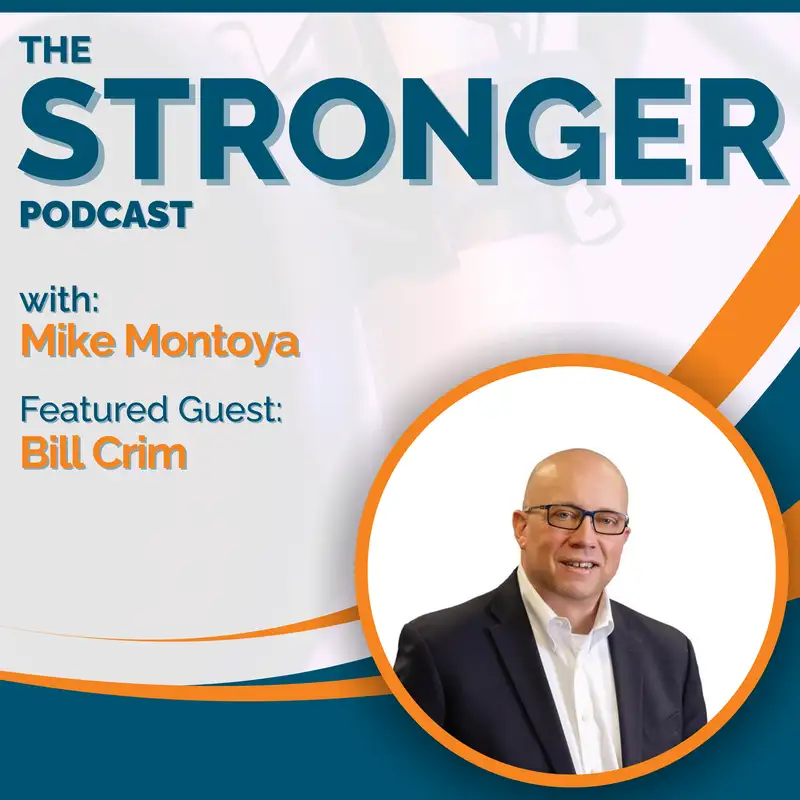
Breaking the Mobility Trap: Aligning Partners Around Cradle-to-Career Outcomes – with Bill Crim
Welcome to the Stronger Podcast. Each week, we have honest conversations with education and social impact leaders about their leadership and career journeys. We talk about their origins, inflection points, and the work that they're doing today. The conversations are honest, human, and practical. If you're here for real stories and real takeaways, you're in the right place.
Mike Montoya:Let's jump in, and let's get stronger together. In this conversation, Bill Crim and I unpack a hard truth. Economic mobility in America isn't guaranteed anymore, and that's not just a family issue. It's a community issue. We talk about what it takes to align cross sector partners around shared outcomes and why community voice has to shape the solutions.
Mike Montoya:Let's jump in. Before we dive into today's conversation, I wanna give a quick shout out to podcastsmatter.com. Their mission is to help impact driven voices get the visibility they deserve. If you want to share your message with the world, check out their website in the show notes. All right.
Mike Montoya:Good morning, good afternoon, depends on what time zone you're in. It's nice to see you. I'm here with Bill Crim, who's a colleague and a friend, and we've become associates over the last couple of years. And so, Bill, I'm gonna let you introduce yourself, tell us where you're at, what you're doing right now professionally, and then we'll dive in. Does that sound good?
Bill Crim:Yeah. That sounds great. Hi, everybody. My name is Bill Crim. I'm the CEO of United Way of Salt Lake and Utah's Promise, two sister nonprofits that we've organized here in Salt Lake City, Utah and in the state of Utah to advance economic mobility for kids and families in our state.
Bill Crim:And been in my role for about ten years. We are we're I think a uniquely designed kind of united way with a very focused purpose. We do two things. We operate a 211 infrastructure that aims to to help people get their basic needs met and to improve the social care infrastructure of our state and we support through Utah's promise and United Way, the promise partnership Utah, which is a cross sector cradle to career infrastructure of place based community initiatives and statewide now collective impact work to improve economic mobility and education outcomes for kids.
Mike Montoya:So small job, it sounds like you have lots of free time to, I call it, go golfing and go go skiing. So thank you, Bill, for the intro. Utah's in the news right now because there's no snow, and everybody's like, what's going on in the West? But maybe that's appreciated by the locals for a moment to not be buried is is kind of my thought so.
Bill Crim:No. It it's kind of terrifying here because we're in kind of a perpetual drought here in in the West and water is the main concern and we wish we were having some snow, not just for our ski resorts, but for our water table.
Mike Montoya:Yeah. There'll be a there'll be an issue not too far around the corner, right, for the Western States without the snowpack. As a Colorado kid, this has been on my radar since I was a child. Where's the water going? And it's always slowing downhill into the other states is what I remember.
Mike Montoya:And it's still a huge concern with the more population that gets to the West. Right? The the water resources are more and more scarce. Right? So that's a real real actual concern besides the ski resorts wanting some tourists.
Mike Montoya:Right? Which, of course, they need that too. That's part of the economy. So you shared a bunch of pieces about you used the word promise partnerships, place based initiatives, collective impact, and our audience may or may not know some of these things are. So let's see if we can kind of tick them off a little bit at a Maybe at the core of this, though, is this idea of advancing economic mobility.
Mike Montoya:So in a way that's accessible to folks, what's the core problem that exists, and what is the promise intended to try to achieve?
Bill Crim:Yeah. So one way to talk about the core problem is just to acknowledge that that poverty exists, that at any particular time in our history, there are people in our communities, in our country for whom the people who lack adequate financial resources to survive, basically, to live with dignity. That problem is its own problem and it's it's really tied up in something that I think a lot of us don't necessarily recognize. We have this idea that each successive generation is going to be able to surpass the prior generation, its parents generation in terms of economic mobility and and you know, wealth creation and and just financial stability. That turns out to have been true for a while, but has not been true for the last, you know, couple of decades.
Bill Crim:Like we are losing economic mobility from generation to generation. We're less likely, even if we're in a middle class household, we're less likely to do better than our parents. We're less likely to be prepared for retirement. Now in many places in our country, we're less likely to even be able to afford a home and when that becomes true, when wages and incomes don't keep up with inflation, when new families can't afford the entry point, the homeownership entry point into the middle class and into wealth creation, that becomes a huge huge problem. I think not only for for those families but for communities, for our economy, for the future of our of our country and democracy.
Bill Crim:And and the idea that the promise partnership is part of an a national network of organizations committed to improving economic mobility for kids and families. The idea that we need to tackle this problem, not just to solve poverty, we need to tackle it to to kind of restore the economic foundation of our country.
Mike Montoya:Yeah. Like, the the the the basic premise here is that, like, an ownership society has a much richer capability of sustaining itself. Right? Because people are more, I guess, invested in the communities and the homes and the places that they live and where they own. And basically, homeownership has become a more challenging thing in the last certainly twenty years, and probably even upscaled in the last ten significantly.
Mike Montoya:And as you said, wages aren't keeping up with costs in many places and especially the rising costs of fundamentals like homes, cars, houses, food, those things. Childcare. Health care. Health care. Yeah, exactly.
Mike Montoya:So big pillars, things that we need literally to be functional as humans and survive. We need shelter and food and medical access. Those things are, for a large portion of the population, growing portion, getting harder to get to. So the promise is an idea, and it's also like an alliance of of organizations and people. And in Utah, you guys are kind of at the the hub of this.
Mike Montoya:Is that a fair way to to think about it? And then things are kind of coordinated through and with you. Is that how it works?
Bill Crim:Yeah. So you've identified two and two of several maybe core ideas. One, the promise is an idea. Yeah. It it is the promise.
Bill Crim:It's an actual promise to kids and families in our community that we're going to join them in trying to solve this challenge. Now the WE is not just two organizations, United Way and Utah's Promise. The WE is a partnership. It's an alliance. It's a cross sector intentional collaboration of of hundreds of organizations, businesses, nonprofits, school districts, city governments, state government agencies, all making that promise, that what we're doing now collectively is not working or what we have been doing and we need to work differently.
Bill Crim:We need to work together. We need to commit and make a promise to people to get better results. We need to engage them in the work. That's that's a core part of this. A lot of this is modeled after some national networks and and frameworks.
Bill Crim:The Harlem Children's Zone really popularized and and brought attention to the notion of cradle to career place based infrastructure, aligned services from from birth to through college and into career. Strive Together, for example, was featured in the in the original description of the collective impact framework. Strive Together, now a national network of regional cradle to career cross sector infrastructure. We we've borrowed and learned from from those networks and others, the community school movement across the country but the general idea is you can't program your way to solutions. There's no silver bullet to solving these problems.
Bill Crim:You have to align the work and the efforts of every sector of ideally every program and organization And when you do that, you get way better results. It works.
Mike Montoya:So the the concept of it's not a government solution only, but it's a like, but government has a a role in this alliance, this partnership work, but also that it's all the, let's say, call them the nonprofits and the other entities that are serving children and families across the state, in this case, deciding together that they're going to march towards a common horizon of sorts. A lot of that has to do with There's a strong prevention model in this assumption, which is to say we're trying to get way upstream to when the kid is on the way from the womb into the world, you're thinking about their long term, sometimes they call them social determinants of health, the well-being outcomes of kids at the age of 25 to 35. That's kind of where we're talking about. That's my, I'd call it hack way of describing what I understand to be the work. Is that true?
Bill Crim:Yeah, yeah, that's exactly it.
Mike Montoya:Okay. So that seems like a small feat. I'm adjusting here, right? That's like the idea of people working together in a large fashion across a swath of land is something that we've all tried to achieve in government, and it has some limitations, of course. You said something about involving and engaging the kind of, I'm going to call it, the most centered person, which is the the children and their family.
Mike Montoya:How does give me some examples of what that that kind of means in in practicality.
Bill Crim:Yeah. In in our case, it means trying to design the decision making structures about what gets done, with the voice of people who are impacted by that. It's just, it's that simple. It's listening to community members, to kids, to young people, understanding what their needs are and trying to design the interventions and the partnership strategies around their experience and their knowledge. I think a lot of times that doesn't happen in the kind of typical design of government programs and services, even non profit services over time.
Bill Crim:It's easy to take a view that somebody knows better what what needs to happen and and if you don't get the voice of affected populations, community members into that design, you often end up designing things that don't work and then and they're wasting money, you're wasting people's time. And then in a worst case scenario, I think people blame community members when poorly designed solutions don't work Yeah. Doesn't work.
Mike Montoya:Of the the that happens a lot with and we do lots of schools work. Happens it's the kids fault that they can't learn, for example, right, and not to put the finger on anybody, but to say that like, what we can design in a vacuum versus what we can design in community can actually feel quite different. The uptake can be considerably different too. So community members co designing some of this work with the partnerships allows for it to be a little bit more salient and and, I guess, high utilization. Have you guys I'm I'm not asking you to quote data because I don't expect you to pull it out of thin air.
Mike Montoya:Right? But, like, have you guys seen that this approach has had a has a positive benefit?
Bill Crim:Yeah, for sure. In in every aspect of our work. We just started last year project modeled after something the Harlem Children's Zone does called Baby College. Mhmm. So we have this program designed, you know, locally with the voice of people here, not and not only the voice of of parents and expecting parents, but the voices of service providers in Utah.
Bill Crim:The last thing they wanted to see was a new competing program, you know, offering early childhood support That's to you know, one of our core beliefs is we shouldn't start new things. And so pulling people together, asking the families what they needed, asking service providers what would help them reach more families, what would help them fill gaps in their programs, what would help us all collectively. The big question is what gets better results? What do we do together that works ourselves out of a job? Like ideally like what do we do together that solves the problem and we designed this program.
Bill Crim:We call it baby and you promise baby and you and it's been wildly successful in its first year and we're growing it and expanding it and and that idea works. I want to maybe mention another thing that that is important in terms of making sure you design systems that are accessible and seek out and are responsive to community member voice. The other data about how important that is is is the is just the observable data about communities and systems where that voice is taken for granted and always present. So you mentioned school systems. If you go to a neighborhood, a school where there are lots of highly educated, highly empowered, well off parents, you don't have to design a program to get their voice heard by the school district.
Bill Crim:It happens automatically. Yeah. The school district is responsive to the voices of those parents. And in the long run, know, isn't that how it should be for every school in every neighborhood and and it works like, you know, schools that have resources, keep those resources and the voices of those parents get heard and, you know, the curriculum gets designed in in response to those parents. I think the same thing is something we should assume every school needs and and obviously school districts.
Bill Crim:I don't I don't think should be run by community voice. You need the expertise and experience of educators and I think the broader community. But my point is we see all the time how effective community voice is for people who already have that voice, and we should expect to create the same for people who often are excluded.
Mike Montoya:Yeah. There's like a it's like a it's secret muscle that people who went to university and had already a solid foundation on which to start, They learned how to advocate for their needs throughout their lives in a direct fashion, but also through policy and voting and showing up for all the right things in all the right places to make sure that things stay on the rails in a positive way. So we have these very healthy communities across our country, which are shiny stars, places to live that people want to live and where kids want to grow up and where parents want to have their families, etcetera. So there's a bunch of bright spots around the country. And then, like, right next door, there's these places where there's, like, a a group of people that have, like, for started from a different place, right, and don't have the same pathway.
Mike Montoya:Right? And so, like, this is we're trying to, like, I call it, even the playing field a little bit. Right? And, also, I call it strengthen the fabric of society, I think, in many ways because there's not if without communities and without people connected to each other, it's easy to get, I call it, disconnected from your neighbors. Right?
Mike Montoya:We see some of that in our national landscape and politics and some of that right now too. We forget, You're a human. Me too. We all want to breathe clean air most of the time and be safe most of the time, things like that.
Bill Crim:Yeah, exactly.
Mike Montoya:I sent you a set of questions, and just for our audience, the goal here is not to pepper Bill with all of his knowledge about his particular work. But you know, Bill, I'd love for our our listeners to hear a little bit about, like, how you got to this place of doing this work. And I think starting with this idea of, like, you know, like, is there a a drive or a story that kinda starts with like where you started out as a younger person that has like led you to this this place of like leadership doing this work, but like, how did you get there? Where where what's the impetus for it? Can you share about that?
Bill Crim:Yeah. Sure. Well, maybe the place to start is that I grew up in one of those communities where, you know, where there was strong social capital, there was lots of opportunity for everybody, where economic mobility was assumed and taken for granted. And I I I wasn't aware of or exposed of to the realities of other communities. And so I I I went I started college with not a clear idea of my future path.
Bill Crim:And and I wrote I wrote on some paper, I'm gonna major in mechanical engineering because that's what my father was and that's what I could see and and I I went to college and rolled up my sleeves and tried to learn calculus and and chemistry and physics. And during my freshman year in college, I got exposed to a number of just opportunities like chances to travel and and see other communities in the country, see other parts of of the world to see other parts of Utah that you know, just were five minutes away from from where I grew up and and I got involved in a community service center at the University of Utah that helped students like me engage in our communities differently and learn differently. And and I I got exposed to poverty and homelessness through that. I could have been exposed to to any number of other things, I got interested in and focused on poverty and homelessness in in Salt Lake first and then lived in Washington DC for an internship and got exposed to disparities of wealth there and did some international travel and saw the same. Story short, I became really troubled by the way our systems distributed opportunity for people.
Bill Crim:And and I came to see poverty and economic mobility and and economic opportunity largely as political problems and and political choices. And so I I changed my major to political science from mechanical engineering. My father had a heart attack and like and said, do not want you living in my basement, so you're gonna have to explain to me like what you do with that and Uh-huh. And it all worked out fine. I I finished my degree in political science and and went to work for a nonprofit advocacy organization and and just tried to learn as much as I could about how do you change conditions in a community or in a state or even more broadly, what are the strategies that can be used?
Bill Crim:The organization I worked for was primarily focused on policy advocacy and research, But we did some community organizing work and community development work, and I just learned a lot during that time. And and sometimes people say, well, how did you end up if that was your path, how did you end up at United Way?
Mike Montoya:Yeah. That's my next question so keep going.
Bill Crim:Introduction to United Way was was that the organization I was working for, the advocacy organization, was a United Way funded partner agency. And I became the the executive director of that organization. And I needed to meet the the donor, the United Way donor.
Mike Montoya:And like
Bill Crim:and so I I connected with the CEO of United Way and she told me, she said, Bill, I really love the work you do but my board doesn't like advocacy work. They think policy work is quote repugnant and we're not going to fund you anymore. And and I was a little shocked and taken aback. I I didn't think of policy work as repugnant and seemed pretty important to me. And I looked at the United Way board at the time, this was back in 1999.
Bill Crim:All of the, you know, the most respected business leaders in Salt Lake were were on the United Way board and they all have lobbyists for their companies.
Mike Montoya:It's just another word for advocacy
Bill Crim:and empowered empowered. So so I just sit I said, I asked her, I said, can I come to one of your board meetings and make the case for why this is important, why it's in United Way's interest to do this? And she was very welcome. She's like, yes, of course, please do. And I I that started a relationship with United Way that exposed me to the power of United Way to convene diverse multi sector partners, nonprofits and businesses and government, and to bring people together and and and I just became fascinated by that.
Bill Crim:The data that I showed the United Way board in 1999 was persuasive to them. They saw the value. They saw the connection. Oh yeah, like if it's good for us, it's probably good for the organizations that we're trying to help. And and so it wasn't a controversy at all.
Bill Crim:It was just like, do we are we do we understand what we're talking about? We're using the same language and and can advocacy work be done in a way that's not polarizing and divisive? And I believe that it can. Sure. So that brought me to United Way and it we had a partnership, my prior organization United Way for about five years doing advocacy related work and and other things.
Bill Crim:And then in 2004 I came to United Way and have just been here, you know, kind of plugging along with our team, trying to figure out the the next best thing to get the next best results for our community.
Mike Montoya:I'm going to pause the conversation here for just a second to talk about books that matter. Every entrepreneur or leader needs a book that elevates their business, builds their credibility, makes an impact. If you've got more money than time, a ghostwriter can help you build your story. If you've got more time than money, a great book coach can guide you step by step through the writing process. If you have already written a draft, these folks can save a lot of trouble and money by shepherding you through the publishing process.
Mike Montoya:Head to booksthatmatter.org and get the custom support you need on your book idea or manuscript. Thank you for the kind of bringing us into, like, where where Utah was in that at that time, right, the turn of the millennium, so to speak. And do you feel like the board and the thinking has evolved in the last I mean, it's been a quarter century now, right? So things have probably changed. I'm just curious, like, what your observations are now.
Bill Crim:Yeah. Well, it went from you know, before we had those conversations and looked at the data together, went from repugnant to, oh this is important, we'll play a role, we'll join you, we'll engage, you know, on behalf of our partner organizations and policy work to in 2004 when when I I said to the then CEO, you should hire me to lead United Way's public policy efforts because we'll have more more impact. And she said, of course. And so the board was supportive of that and and funded it. And, you know, over time, the board became completely convinced that that policy advocacy is a critical strategy to having impact in communities.
Bill Crim:And it's been part of our works officially since probably 2000. We've had a staff person dedicated to it since 2004. At various times we've had board members who would say publicly that policy advocacy is the most impactful thing we do. And, you know, we have board members and a policy agenda working at our state legislature today. And to for all the people that didn't weren't policy majors or policy people, which is kinda like where
Mike Montoya:you and I kinda come from, is to say that, like, you know, the the work of nongovernment folks, right, is to influence government in a way that's, like, supportive of the outcomes that they're trying to achieve because, like, the gross amounts of public dollars that function in our society are enormous compared to anything that the United Way or any rich folks can contribute. It's just an order of magnitude different in many ways, and so influencing the best use of those dollars. And I think from my history and my knowledge, policy has not always been, I could call it, for the common good of all people. It's sometimes for the common good of a few people, And so poor policy or poorly designed policy work can actually cause quite a bit of damage to the society. And so, like, when you can get that stuff more aligned, right, and then you don't have to spend other money, you can spend public money to achieve sort of better outcomes.
Mike Montoya:That's the kind of core essence. Is that I don't want to speak for you, so I'm just speaking for myself in this case. But I think that's basically why policy matters more. Yeah. I think that's it.
Mike Montoya:Okay. Okay. So it became a thing. It sounds like you're a champion of that work, and you have and you have some dedicated team and staff to this still. And I think you and you mentioned I wanna go back to this a little bit and talk about United Way and because United Way has this, you know, storied history in our country, and not every United Way is the same.
Mike Montoya:Let's just say they're all a little bit of a different shape and style and size. You and I chatted about this before, that there's a trend with some of the United Ways across the country to sort of take up the work that's similar to the work that's going on in Utah. So have you seen other places start to blossom in the same way of being, like, a hub of influence and I call it the backbone? Right? Lots of times people use that word.
Mike Montoya:Is that is that becoming more common in the United Way structures across the country?
Bill Crim:Oh, yeah. For sure. That is. And and I would say, you know, we didn't invent in the United Way world. We weren't the first to go down the public policy road.
Bill Crim:Like, one of the awesome things about the United Way network is that it is a durable part of a community's infrastructure across our country and across the world that is deployed in the way communities need it to be and and and and and want it to be. And many united and it's a a kind of a durable laboratory of experimentation and and collaboration and, like, they're it's just an it's a really important part of our country's fabric. What I think is has been true over time is that more and more United Ways are shifting to the stance of like, how can we be partners with others in in solving problems? How can we be how can we be a voice for a better public policy? United Way Worldwide, the national office, has had a policy team probably for longer than I've been around.
Bill Crim:Like, this is you know, this the focus on good policy work and on unifying communities, whether it's around philanthropy or policy or both, I think it's something that that's it's built into the DNA of United Ways and depending on the community and the community leadership around the table and the needs of the community, it may or may not play a very prominent role. But more and more United Ways are joining with others to drive greater and greater impact in their communities.
Mike Montoya:Yeah. I feel like there's like a brand awareness about them and they're and that they're like almost like a a people trust there's an amount of trust going on with United Way. Right? The the the label in it, there hasn't there's not been a tremendous amount of scandal or something going on ever. And, that I mean, there's probably hits and misses across the country.
Mike Montoya:There's always something like that. But, like, people believe in the fact and almost by having the two eleven infrastructure intentionally placed with United Way, which is this tremendously important community asset to hold the two on one infrastructure, which is how everybody gets the services that they need if they need them. And I laugh about it. Like, oh, I love two on one because you can go look up stuff that you're like, didn't even know that exists. It's almost like the phone book of our twenty first century.
Mike Montoya:I mean, it's not run by Google. Right? So it's like a little bit more, I call it neutral, if that makes sense. Yeah. So I think United Way has done a good job of maintaining a reputation of positivity and and reliance, right, in the community.
Mike Montoya:And it sounds like you guys are being adaptive and responsive back to what's going on in Utah. Do you guys have I know there's a giant framework out there about community critical career work and outcomes. What are a couple of the big things that you guys are shooting for in Utah that people would say, hey, these are our bright spots or our horizon areas that we're, like, looking towards? And, like, what's the time what's the time frame around some of these these outcomes that you're looking for?
Bill Crim:Yeah. So maybe I'll describe just again the outcomes that in this framework of Cradle to Career work, most partnerships I think are they're trying to get milestone outcomes like better school readiness, better third grade reading or early literacy, better math proficiency, better high school graduation Yep. Better college preparation and enrollment, and better college completion or post secondary completion. Okay. Often that's kind of the the education set of outcomes that we're all pursuing.
Bill Crim:Communities, think, also add other things. They, you know, they add health metrics and they add employment and and homeownership metrics and and sort of build around that. But the core education pipeline and the the sort of theory of change is that if you can help kids succeed on that education pathway, you can help them be healthy and financially stable along the way, you're setting them up for success in the future.
Mike Montoya:Yep. So like these key things, think like ed research, etcetera, is like, hey, if they can read and do math well by third grade, then their chances life outcome, chances like triple or whatever that is compared to those who can't. So those are some critical factors. Okay, sorry I interrupted. So keep going on that if you want.
Bill Crim:Yeah, so that's the framework we're working in and we've organized ourselves to push on those outcomes at three levels, at a neighborhood or a school level, at a whole community level and multiple communities and at a regional or statewide level. And so when you ask like what are we focused on right now, we are relentlessly pursuing all of those objectives within the, you know, 50 ish community schools where we work, within the currently six promise communities where we work and within our our region. And we've organized our effort, you know, communities don't all move at the same pace. This isn't a it's not a machine or a science. It's an art and a it's it's a human adaptive effort.
Bill Crim:And so we sort of organized our efforts around where are the places where there's the most alignment and energy across sectors. Where's the most accountable leadership? So we have some proof point communities that are just hard charging towards a 100%, a 100% progress on those core outcomes or a 100% results on those core outcomes. I think that in in and of itself is is a an outcome. Yep.
Bill Crim:Because it would be crazy for for any individual leader to say, I'm going to graduate a 100% of my kids from high school on a career path without this kind of infrastructure. Like, don't know a single superintendent who would say that on their own. There might be some in the country, god bless them, but in Utah, you know, we have great superintendents. We have 41 school districts and we have great people leading them and we only have one that is part of the promise and he he is part of the promise partnership. We have one that will say, I have a 100% initiative in two communities in my school district, and I'm committed to that because and I know we're gonna get there because I have a partnership surrounding The mayors of those cities are driving towards that.
Bill Crim:I just came from an event in a in a a ballroom of a hotel where nonprofit leader I had not seen in years came up to me and the first thing out of his mouth was we're part of the 100% initiative in South Salt Lake. I don't know very many nonprofit leaders who would publicly hold accountability for every kid because they don't serve every kid. But in a partnership that is mutually accountable where the systems have been built, where people are using data for continuous improvement, then you get everybody from mayors and superintendents to nonprofit executives saying that's we should we all share that goal. We are all part of that. We're all driving towards it.
Bill Crim:I think that's a significant outcome in and of itself and because we've started to see that kind of buy in, the the last part of my answer to your question is we're we're running legislation in Utah to make this this infrastructure statewide, to bring state resources to the table so that we don't we don't have to go as slowly as we've been going. We can go from you know what was two communities to six communities to 20 to 24 to more hopefully.
Mike Montoya:Yeah keep it going quicker, faster. I mean there is a timeline here right, like every year a kid you know like is one more year of their life right. If we take thirty five years, that's a couple of generations to get through it, there's a whole society that's being built. I think it's ambitious to say 100%, and most people don't want to be on the hook for that by themselves. Because there is a lot of there are a lot of factors that, you know, let's just say, even if we're all organized, like, we don't control everything, right, obviously.
Mike Montoya:Right? There's a there's a role of the human and the the end user, let's call that, the kid, the family that they also have to be there and show up and do their part and etcetera. But if they have a better shot, right, when things are, again, working with each other, right, working towards this common goal and they're not like I call it, sometimes you can't get the things you need because it's too complicated bureaucratically. Right? And there's not, like, the ability to I think I was talking with somebody else recently.
Mike Montoya:Like, the ability to get on the bus, right, to get to the right place at the right time is, like, part of the challenge. And if you don't have the cash to get on the bus, right, the nickels or the dollars to get on the bus, then the rest of it doesn't matter. So you have to make sure that the weight of getting there is there. And then when you get home, that it's safe and clean and a place that you can do your homework and those kinds of things are really critical. And so the whole picture needs to be in place.
Mike Montoya:It's almost like the childhood that is sometimes on TV, whatever the essence of the perfect community was on television does exist in our minds, but to achieve it requires a lot of alignment and cooperation. And I think in many cases, some of these people think legislation means new money or spending a bunch of money, but it also can just mean a realignment of resources that are already existing. So you can do a lot by just reorganizing and making some tweaks, smoothing the path. Right? Getting rid of redundancies.
Mike Montoya:There's a lot of that kind of work. Is that true? I'm just again sort of using my
Bill Crim:That's a 100% true. That that's embedded in this kind of work is that you're trying to align what exists.
Mike Montoya:Yep.
Bill Crim:And not create new things or pour new money on on a system that's not built well. So you align what exists first, you find the gaps, you invest in those and you relentlessly measure and improve over time. Utah spends, you know, upwards of 10 billions of $10,000,000,000 a year on kids between zero and 24 in our public ed, our higher ed, our surrounding youth systems. And to think we couldn't align those resources better is is just giving up before we start. Like, what if we intentionally aligned all of the efforts that we have going on in a community, those funded philanthropically, those funded by the state to get a you know, to get every kid reading on grade level?
Bill Crim:That that doesn't yeah. Yeah. That does not sound too big. Like that sounds like absolutely doable. And this kind of infrastructure where there's a backbone, a set of partners holding accountability, that's I think the precondition for for using that resource those resources wisely and effectively and getting to big results that that people generally have given up.
Mike Montoya:Yeah. A lot of people have said it's too hard or impossible. And I think this is changing or has changed. Because I do remember this conversation in about 2005. It was really hard to convince people that cooperation was a better pathway than independent tried to achieve.
Mike Montoya:School districts on their own or a single nonprofit trying to champion a cause, there's not enough resource within those isolated things to tackle the whole thing. So I think that's shifted. I think the advocacy work over the last twenty years has made a dent in the way that people's minds are thinking about cooperation amongst agencies and institutions and state and federal work. So I feel like that's Sometimes I'm like, Oh, are we getting anything done in our lives after hacking away at it for a whole career? And then I sort of think back about what the conversations were like back in the day.
Mike Montoya:And now I feel like when I'm like, Oh, listen to you talk about what you're doing in Utah, it makes me feel like, Oh, we made a real progress as a society to get our act together in some ways. I'm like, Oh, that feels good. So as a leader, there's probably about a 100 things you have to do in a given day. All of them sometimes align, sometimes not. But what kinds of leadership, call it muscles, are you having to leverage the most these days in this current context and what you're doing?
Bill Crim:You know, that is I could unpack a lot of things around that question. But the first thing that comes to mind might really just be about seeing leadership and practicing leadership as a team and collaborative endeavor, like building leadership everywhere, training everyone in the practice of adaptive leadership, the book, the practice of adaptive leadership. I I think sometimes we don't go fast enough if we hold too much leadership among a few people. Yep. And you like, if you're trying to change the world or trying to change a whole community and you you accept that you can't do it by yourself, it's not a single person, single organization task, then it becomes instantly everybody's leadership role to do that.
Bill Crim:And, you know, we really subscribe to the to the book, the practice of adaptive leadership and the skills within that. But but giving the work back to others and engaging others in that leadership work is absolutely critical. Organizationally, that becomes a talent question, which is what we've worked with you and your team on. Right? Like it is I I think this is a commonly held view in this field and all of the the groups that that do this kind of partnership building backbone work wrestle with, like, building talent that is practicing this adaptive leadership skill set in a way that is just, you know, professional professional sports level kind of backbone, world class level backbone.
Bill Crim:And this is a field where, know, prior in my in my experience, prior to 2011, there wasn't a word associated with the human being's job who wakes up every day and pulls people together and helps them become collaborative leaders in a partnership. And and when the authors of the collective impact article named that a backbone role, suddenly it became important to be able to hire people with backbone skills and to define backbone competencies. And lots of work has been done around that. And it's still, you know, it's not a common thing to find. You don't go to a university and ask for their you know, in what department do you train backbone people?
Bill Crim:That that's not a thing. Yeah. Sure. So so I think this this is a long answer to your question, but, like, finding the people who can themselves become backbone leaders, behind the scenes partnership facilitators, enablers of others' leadership, and helping more and more and more people take up the leadership from wherever they are in a community, wherever they are in a system, Take up the belief that their system can change, that communities can be better, that you can get to a 100%. That's that's the leadership challenge, I think, the that has to it's like the first step leadership challenge is we all have to believe that things can be different and that we can lead that kind of change no matter where we are, whether we're in an executive leadership role in an organization or the leader of a city or a school district or whether we're five layers down in a school district bureaucracy and we can see the thing that needs to change, like we've gotta help each other all be leaders and be better leaders in that way.
Mike Montoya:I just wanna say that if you're a leader, entrepreneur, or business owner who needs some support, there's an easy way to get a think tank behind you and your vision. The Genius Discovery Program at Thought Leader Path is like having your own one on one incubation and acceleration program. They'll help you develop an approach based on your own story and your plan for impact and offer the tools and thought leader assets needed to really amplify your message, including launching a podcast like this one. If you're ready to stop grinding in the dark and start making real impact with the right support, check out geniusdiscovery.org. I'm glad that you touched on the talent piece, thank you for just playing with this.
Mike Montoya:You're right, there isn't a degree program for backbone readiness. There are lots of degree programs that are focused on the utilization of cross sector skills and things like that. But people can learn this by being, in some cases, mentored and immersed inside of organizations that have both a framework right, around, like, what it means to be successful utilizing these skills and then also training, support, mentoring, etcetera, etcetera. Right? All these pieces that allow people to become better at the craft.
Mike Montoya:Right? I call it I always think about it as art and craft. Right? And and it's like a a series of skills that are needed to be woven together. Almost like you need to be able to be tuned in enough as an individual in the community that you're working in so that you can know which skills to pull on when in order to move from A to B to C to D down a chain of activity.
Mike Montoya:It requires a lot of, I call it, awareness on the part of a human to be able to be in those positions. Because this stuff is not easy. It's riddled with conflict sometimes, and it and it's like there's always I call it pushing rocks up a hill is a common a common phrase that we have to do where it's like, my gosh. We have to go up this hill now. Right?
Mike Montoya:So that's, like, very common. So there's, like, some I call it resilience. Right? And some stick with it ness. Sometimes, like, it's not a very strong accurate word, but it's a good way to describe the ways that people need to show up and be tenacious, right, is a way to think about it.
Mike Montoya:And I think one of the things that we've worked on with you guys has been around, like, how do you both find those people, but also then how do you maintain them, grow them, develop them, and help them become, I call it, stick with it ness humans that stay in the job and the work for years because they get a lot of trust in their communities. And for them to be turning over and rotating out slows the whole thing down. So if we can get them to hang out and stick and do their jobs well for a long period of time, then we get results that are easier to measure, these 100% things. That's how the 100% stuff happens. Small job, simple, simple problems.
Mike Montoya:And Bill, I want to give you a chance to sort of if you have something to share about reflections on the journey of sorts that you've been on certainly the last ten years of this work, but maybe all the way back to when first were trying to I call it scrap for your job in front of the United Wayboard. Is there any salient points that are worthwhile to lean in to share with people in retrospect? Well,
Bill Crim:I don't think of myself as having a lot of advice for people. I think I think I I have had this really fortunate, you know, career journey of literally being able to create or choose almost every job that I've had and almost and and in I've I've worked for two organizations in my career. I sought them both out and and I've just been very lucky to do work that I care about, that teaches me things, that allows me to work with and learn from other people both within my organization and across the country. And so so I guess that's one reflection is just that this work of trying to create a more just and opportunity filled world is is, like, it's a it's a long journey, I guess. Like, I don't I don't know I don't know if it ends.
Bill Crim:I'm a little bit troubled by the notion that it can't or won't. I I would like to think that we can work ourselves out of a job. I would like to think we live in a country with enough resources and and enough still social capital and enough belief in justice and freedom and and opportunity that that we could literally solve some of these big economic mobility problems, that that we can end the the really fundamental injustice of living in a country with so much freedom, so unfairly apportioned that a child born five minutes from where I'm sitting right now will have a ten year lifespan, ten year fewer lifespan than someone born where I'm sitting or five minutes, you know, in the other direction. That that should be something we we can finish and end in both of our lifetimes. And, you know, if you look around and read the news today, you wonder if like, if we're still on that path.
Bill Crim:I believed that and still do that we're on that path, but you see things going on and and things affecting our neighbors and ourselves and our team members and that challenge the very essence of who we've thought we were as a country. And you wonder if we're still on that path. You wonder how we get back on a path that is marching towards, you know, towards fairness and opportunity and and freedom for everybody.
Mike Montoya:We're thank you for that. I mean, like, we are definitely in a, like, a challenging moment literally today, January we're recording this for the audits on January 30. Right? There's, like, national protests going on across the country, and and it feels a little bleak at the moment. I do believe in that achievement of a just society is an ongoing endeavor, and it's one that is defined by the people that are actively moving towards that.
Mike Montoya:And doesn't always swing the direction that we maybe as an individual choose at the moment. It's a little bit like the stock market, it kind of just keeps going up, but it's definitely got its variability in a given short period of time. I'm hoping that we're all going to learn from this moment and that we have an opportunity to re engage when it's the right time to keep our efforts moving forward. And I think at the heart of this, we have people that care about each other doing stuff that's supportive. If we can keep the commonness about why we're alive together, where most of us, again, want to have clean water and clean air.
Mike Montoya:If you go to Utah If anybody hasn't been to Utah and visited the national parks and the experiences that are happening in that state and you wanna know why we need to have these things that gets worth your trip. So take advantage of that opportunity. Bill, thank you for your time today, and thank you for your work. And we will we will say goodbye to our audience for the afternoon.
Bill Crim:And we'll thank you for having me. It's been a pleasure, and I've enjoyed our conversation, Mike.
Mike Montoya:Alright. Thank you, Bill. Take care. As we close, I'm struck by Bill's clarity.
Bill Crim:We
Mike Montoya:can't program our way out of poverty. We can't fix systems without the voices of people most impacted. Whether it's aligning existing resources, strengthening policy, or building partnerships across the state, this episode is a reminder that progress comes when we choose to work together. You can learn more about collective impact work at strivetogether.org. Have a great day.
Mike Montoya:Thanks for joining us and tuning in today. To find out about other podcasts that matter, visit podcastsmatter.org. Thanks for listening to the Stronger podcast. If this conversation inspired you, we invite you to follow the show and share it with someone who's on a journey to become a happier and healthier version of themselves. Links and resources are in the show notes.
Mike Montoya:See you next Thursday, 9AM eastern time. Have a great day, and stay strong.