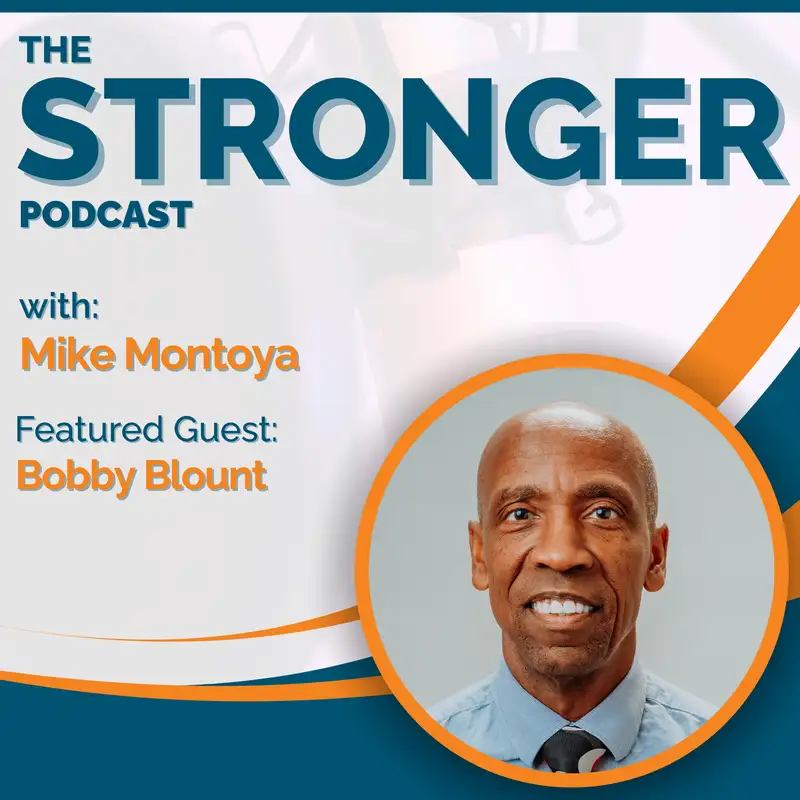
Keep Your Eye on the Ball: 27 Years on a School Board and the Discipline of Not Getting Distracted with Bobby Blount
Welcome to the Stronger Podcast. Each week, we have honest conversations with education and social impact leaders about their leadership and career journeys. We talk about their origins, inflection points, and the work that they're doing today. The conversations are honest, human, and practical. If you're here for real stories and real takeaways, you're in the right place.
Mike Montoya:Let's jump in, and let's get stronger together. In this episode, we'll sit down with Bobby Blount, a board member at the UP Partnership in San Antonio, Texas. He and his colleagues are working at the intersection of education, workforce, and community impact. From middle school career pathways to citywide alignment around the future ready vision, Bobby shares what it really takes to connect schools, employers, the opportunity and why that work has us earlier than we think. Let's jump in.
Mike Montoya:Good morning. Good afternoon, everybody out in our audience. This is Mike Montoya. I'm here with Bobby Blount, who is a client and a friend that I'm getting to know more. And he is a board member the UP partnership, which is based in San Antonio.
Mike Montoya:And they do work with children and families, specifically trying to help young people have opportunities in the going into life experience. And Bobby's got a really rich history and story. We're gonna talk about that today. So Bobby, welcome. Thanks for being here.
Bobby Blount:Thanks for having me. I appreciate it.
Mike Montoya:Bobby's, I think he just told me you're at the school's conference right now. So tell me how, I mean, why are you at a school's conference? Like what's going on?
Bobby Blount:Well, is on my school board side of the house, one of the state organizations I'm part of is called the Texas Caucus of Black School Board Members. So we're having our annual education summit in the Austin area. We have it about this time period, typically. So we're addressing those challenging education issues and catching up with each other and seeing where we can collaborate and have an impact, not only for African American students, but all students across the board.
Mike Montoya:Do you feel like the energy is positive in your experience right now? Or are people like, what's it feel like?
Bobby Blount:Well, for this conference, interesting enough, we actually came up with our slogan for this year, which is which way is up. So we weren't sure. It can go either way, depending how you talk about that as a topic for those that can remember the movie and the song itself too. But it's the reason why we had this conference is it's sort of to motivate everybody. So we have some good, really good speakers we know that are really good motivational, that can take the topic and really address things and get everybody inspired.
Bobby Blount:And so we started out with that in the morning and then, you know, we had the more sort of serious type issues that we'll address, and then we'll liven it back up this evening with our banquet. So we keep it in a good high tone to keep everybody going no matter what is going on across the board, as you know.
Mike Montoya:Yeah, well, and that's amazing to hear because no matter Yeah, there's always another, I call it, kind of brewing, right, in sometimes in our lives. We're all living in it a little bit together. Do you feel like there's optimism for school's work and opportunity for kids right now? Or is it really I don't know. Again, I think that there's like a little bit of like trepidation going on, right, in our industry, in our space right now, but I'm curious what the confidence feels like.
Bobby Blount:Well, you know, it depends on which angle you're going to look at it from and which perspective across the board. You know, I tend to stay positive and hopeful and do a lot of things with kids. I'll tell you one of the other things I've got going on Monday that's pretty interesting also for getting kids excited about school education. But no doubt, if you look at the whole country's tone across the board and the way that media and others have sort of been carrying things right now, you you do think it's more along the negative type tone or things aren't being fully supported. But from a day to day sense, when you're out there with the teachers or you face those kids and even among some of us on the school board and other type things, you know, we're gonna they're gonna keep things going and say, hey, know, our our bottom line is, you know, keep your eye on the ball, and our objective is to be successful for those particular kids.
Bobby Blount:You have all these other distractions that are going on that can take you away from that if you're not careful, but, you know, we try to say, no, no, no, we're gonna do the best that we can. And, you know, if you look historically, we've always had challenges that we're facing across the board and maybe this has hit broader communities, you know, some things that the inner city and others have seen for some years, others are starting to see that. But on the other hand, we address and we move forward with it.
Mike Montoya:Yeah, well, and I appreciate that, like you need to kind of keep showing up, right? And the consistency of being a participant and showing up, and I think especially young people are sort of affected by by circumstances of the world in a different way, but they tend to be like optimistic as a as a group in our society in general, right? Like kids kids kids maybe don't know the hard parts of life as much as as, you know, older folks. Right. But they I think I call it bring energy to their own lives, and we can be there for them, I think, in many ways.
Mike Montoya:I always love our listeners to hear a little bit about the leadership and the people. Tell me, are you willing to share a little bit of your background story? I call it the origin story moment, right? Which is like, where did you grow up? What was your schooling experience like as a young man?
Bobby Blount:Yeah, I grew up a lot of different places. My dad, I'm from Dayton, Ohio, our family's from Dayton, Ohio originally, but my dad had joined the Air Force. So he had twenty nine years in the Air Force. So I lived practically everywhere, literally. And a lot of what I do is sort of those different experiences I had from being, I used the word military brat for those that are familiar with that, and those types of experiences, etcetera.
Bobby Blount:So I ended up living in places, for example, like in Mississippi, for example. So we were in Columbus, Mississippi. So I spent my high school years there. At that particular time, segregation and other things were ongoing. So, you know, some may have seen movies and other type things, but I actually lived through, you know, I went to one school first, and then when they were doing integration, had to drive by that school to go to another school and having those folks standing in front of signs saying, don't come here, etcetera, etcetera, to put it lightly.
Bobby Blount:You know, I lived that, and that was a part of my experience also. And then I went from there and talking mainly high school sets, and I went out to high school in Utah. And that's a little bit different too, as you can imagine, per se. Went from one to another different type of And that was different experiences too, being one of the few African Americans literally, not only at the school, but in that particular area, sort of learn from that and other type of things too. And then early on, prior to that, I actually went to school and different experiences in places like Panama, Delaware, etcetera.
Bobby Blount:So by the time I had finished high school, I'd been to 10 different schools literally from all over the world. And, you know, just learn from that, you know, you face the challenges, you see folks in different ways, there's things that carry you through that you remember, etcetera. And the thing that always got me through is, you know, I realized I had opportunities that others may not have wherever I may be, etcetera. And I had to take care of those and make sure I leverage those opportunities, of became my theme. I watched my parents and how they helped out others across the board in that particular regard.
Bobby Blount:So to me, as always, from what I learned from those experiences was not only for myself, but how can I help out others? Because I've been fortunate. So I always try to reach back and help out others per se. So that was sort of my experience from an education sense. Yeah.
Bobby Blount:Work wise oh, go ahead.
Mike Montoya:I'm sorry. Yeah. Go ahead. No. So, I mean, like, this this wandering around military brat is a strong is a word that is like I grew up in Colorado Springs where we had transitions.
Mike Montoya:We had lots of military kids coming through. Right? And they were your friends for a while and then they disappeared. Right? That kind of thing.
Mike Montoya:I remember those experiences from that that perspective. But like, I think, as an African American guy yourself, I think the Utah piece is interesting to me because it's like a fish I would say it's a fish out of water. I don't know what year it was when you were there, but the diversity, at least in terms of skin color in that state is a little on the short side is what I remember.
Bobby Blount:Oh yeah, no doubt. No, that's definitely true. And actually, yeah, and I was there during that time period. Like I said, there's very few. And actually the biggest influx of African Americans then was because they had moved a large military unit that had a good number of African Americans over to Utah.
Bobby Blount:And that's where it sort of changed quite a bit. But prior to that, no doubt, etcetera. So those are the extra entry. And I went from the entry you bring up Colorado Springs, because I went from Utah, then I went to the Air Force Academy. So I was fortunate to go to the Air Force Academy, and then career wise, did five years in the Air Force, but then I became part of a fairly funded research and development center that was tasked to solve the government's most difficult and challenging problems, etcetera.
Bobby Blount:So that led into my career. And then at that time, I started also engaging in other areas to leverage my company because of the strength it had to help out in local community also. We are very community engaged. Our company even gave us time off to be able to support the community itself. So that's sort of sort of got involved in the community side of the house.
Mike Montoya:Yeah. Well, that's interesting. And I didn't know you were an academy guy. Right? So like the cadets, it's a special group of people, right, that aspire to be part of the of the military that in that way.
Mike Montoya:Right? And it's a it's a strong rigorous educational experience, right, at the at the academy. Right? So do you have an engineering background? Is that I mean, almost everybody out of there has an engineering background.
Mike Montoya:So
Bobby Blount:Yeah. At least for the air No, can't speak for all the academy. I'll speak more for the Air Force Academy. Yeah, we definitely have more of the engineering degree. So I do have an engineering degree, that's correct.
Mike Montoya:Okay. And so you started, and then you spent some time in the Air Force. And then did you stay, did you say, did you, were you basically an engineer professionally for all your life?
Bobby Blount:You got it, yep. From that timeframe, was in the air force, I had gotten involved in some major engineering and actually early on, going back to I graduated back in 'eighty one, 'eighty two. Everybody's talking about cyber now. Well, I was doing cyber before it became popular, before it became a whatever type world, etcetera. My career is sort of follow that particular problem, working more IT, information technology and cyber throughout my whole career.
Bobby Blount:The air force, when I got out the air force, you know, I elevated it more when I with this fairly funny research development center that I was working with to help the our DOD and other government agencies out.
Mike Montoya:Yeah. Well, this was before the Internet, right? That whole that era, right? And there was a I call it you had to do things the old fashioned way in that regard, right? And actually probably had to do math using a calculator.
Bobby Blount:You go you go go on back. A protractor and all this stuff. The day.
Mike Montoya:I think it was it was a different era for sure. The actual studying and practice that you learned in university became an actual necessary skill set in order to survive in the work world in that regard. Well, it sounds like you moved into a space where you were able to do some social work, right, social good. So tell me how that, like, was that, got a spark, you kind of like felt like you had opportunity and so that kind of led you to just kind of pay it forward, or pay it back, right, in some ways. Tell me what did that lit a spark and you got engaged, how's that been treating you these days?
Bobby Blount:Well, know, I'll say, I guess two sides to it. I didn't tell you about the spark, and I'll tell you how it's been treating. Where the spark really actually happened for me when I was in the DC area. And when I was in the DC area, we had asked to go out go out into some pretty challenging areas within DC itself, and talk about exactly what you're talking about, being an engineer or encouraging kids, etcetera. So we go out and talk to the kid, you can see they're bored to death, you know, they were sleeping and other type things.
Bobby Blount:And we say, Hey, we gotta figure this out. So we convinced our company then and say, Hey, let us do something a little bit different. That's really to have an impact. And I'll go back to about, it's about 1990, 'ninety one, etcetera. So think about that timeframe.
Bobby Blount:So what we actually developed was a true multimedia presentation. So we bought out the computers, we take those out, and on there we had the number one DJ in the area, and he would say, Hey kids, listen to what they have to say about being an engineer and science executive. Wait a minute, how did y'all do that? We had on that video, Six Flags had given us something on how to build a roller coaster in that regard. If you remember the name, Carson, Benjamin Carson was a young heart surgeon at that time.
Bobby Blount:He actually had some footage of him doing heart surgery. So we took that stuff out. Now the kids were listening. So we said, Oh, wait a minute, you know, we can actually have an impact. So that's what really got me going to say, Hey, can I continue those types of things?
Bobby Blount:Not just go out and say whatever, but actually have an impact. So then I just continued on from there. I've been fortunate, you mentioned I'm about, I don't know, seven or eight different boards right now, about four or five school boards related. I get involved also in the economic side because that's sort of the next step as you talk about education is really preparing kids for society. So the economic portion is very, very important.
Bobby Blount:So I serve on those types of boards also. I tend to, I don't like to be on boards just to show up for meetings and stuff. So I want the hands on interactive, going out in the community type of boards that I that was that we're actually creating and engaging in projects, etcetera.
Mike Montoya:And then Yeah. So, yeah, tell tell me more about that. I mean, like, they're they're I mean, most of these boards are unpaid. Right? A lot of them I mean, meant my assumption is and so, like, there's a lot of it's a big it's a huge time commitment.
Mike Montoya:Right? And you're dealing with, like, sort of serious issues, and with regards to, like, you know, what you're all are trying to achieve. But, like, there's a lot of joy in it as well, it sounds like. So, I mean, give me a couple of examples of things that that sound I mean, I appreciate you sharing about, I call it, engaging young people to be curious is hard work, right, for sure.
Bobby Blount:So Yeah. Well, I'll give you two good examples. Okay. Well, first of all, I don't know any paid board members yet. So I'm not all of mine are unpaid, not majority, every single one is unpaid.
Bobby Blount:Some places that's a little bit different. Fair But I'll give you two quick examples of something I'm working on right now. So for example, on Monday, I'll work backwards from it, but we're gonna present our final four for our reading competition. So we had a reading competition in the San Antonio and surrounding area. And this one, had about 105 schools involved, about 10,000 kids, and it's only third graders.
Bobby Blount:And what it is, is how many minutes do they read? So every campus, would calculate on a weekly basis, how many minutes they read. And they're about total right now, think about 11,000,000 total minutes we know have been read.
Mike Montoya:A lot of minutes
Bobby Blount:to So we bracketed it down. We started with a 100, and then a month later, we went 50, down sixteen, eight, four, and now we're at the final four. And we just went out and went out yesterday, and we sort of let them know, and we've recorded on the say, you're on the final four, and we're gonna have a big ceremony on Monday to announce who those winners are. And it's gonna be a very big event. And we had, again, we had not only the San Antonio area, it was even outside the San Antonio area that participated.
Bobby Blount:So I've been helping I've been running that, you know, it took on quite a bit, you know, getting the prizes, going out to the schools, motivating the kids, getting the community involved, etcetera. One example. The other one I'll do to help out raise money for another organization that's called the San Antonio Area African American Community Fund. And what we do is we give out, it's a philanthropy notion, but we give out funding to those that are having an impact in the community. So right now we give out like grants, if you've got an arts and health, whatever program you have, there's so many small businesses and some nonprofits that don't have the funding, we'll help do that.
Bobby Blount:Anyway, the big kicker, and you may like this, maybe you'll do it for me one day, is our major fundraiser is the Dancing With The Stars competition.
Mike Montoya:Oh, shit.
Bobby Blount:We've had it for fifteen years.
Mike Montoya:Okay.
Bobby Blount:And the way that it works, and it's done just like the show. And we have professional dance studio, they're paired off, they work together for about four or five months. But it's based on not only how well you dance at night, and we shake all the big celebrities in the San Antonio area, but how much money you raised prior to the event.
Mike Montoya:Got it.
Bobby Blount:So it's a unique way of doing fundraising and having some fun. So those are some of the other hands on type things, I mean, when it's supporting different organizations I'm part of.
Mike Montoya:Well, it sounds like some creativity. I don't know where you got the creativity from, but like the again, it's it's like it's sort of like, I mean, like, a lot of things can be incredibly boring, but then there's also, like, opportunity to make them kind of compelling, interesting, funny. I I can imagine a bunch of adults trying to I think we did a fundraiser one time where they, like, locked us in a in a room or in a jail cell or something like that, and we had to, like, call all of our friends and and and help us to get free at some point. And and I'm like, yeah. This that was motivating.
Mike Montoya:I remember that because I'm like, I didn't wanna be in that place for very long, but it was it was for a good cause. So the more creativity out there in in the fundraising space is it gets exciting. So do you, do you, I mean, so this is a lot of time investment. Do you feel like the the work that you're doing, is, like, I guess, I call it making a difference in the ways that you want it to? I mean, what are the what are the kinds of things that, like, you hold up as, like, most valuable that you wanna see achieved with with the with the investment you're making?
Bobby Blount:Yeah. Well, yeah, I'm worried about impact across the board in a huge sense. So what I mean by that, you know, I can help out on onesie twosie, but for me individually, that doesn't mean anything. It's when we can move the needle. So what I try to do is these programs I do, you know, for example, I mentioned a reading program, 10,000 Kids, a month ago, we had to racing solar race cars.
Bobby Blount:We had about 1,200 kids that were elementary school kids racing and building solar race cars that I created about 1996, and we've had over twenty something years. But to me, we can actually move the needle per se to say, Hey, we're narrowing the gap, we're helping out kids across the board or whatever group needs a little bit more assistance. And even those successful, if I can get more to be even more successful, to go beyond the moon and maybe go to Neptune or whatever it may be, etcetera. But to me, it's having a huge impact. It means it has meaning to me.
Bobby Blount:And I mean, you know, an answer to your question is, I haven't gotten there yet. So I got to work hard. Yeah. Exactly. You gotta keep it going.
Bobby Blount:And that's what keeps me going is realizing that I haven't gotten there yet.
Mike Montoya:Well, and that's kinda aspirational, right, in that regard. Mean, I think when people I mean, like, I and I I I remember working with you on the work that we did with the UP partnership and, like, feeling like there's a little bit of infectious energy around this site, which is like there is a strong optimism that you bring to the conversation, and you assume that you can get through any of the challenges and problems that we're
Bobby Blount:facing. Exactly.
Mike Montoya:So let's talk a little bit, if you're willing, to talk about your school board work, because you know, there's school boards are a labor of love as well. Right? But they have, like, a real serious responsibility. Right? And they require a sort of ongoing commitment, right, to the the outcomes and fiscal responsibility, obviously with the organizations that you're leading.
Mike Montoya:So tell me a little bit about your school board service and like, how did you get into that specifically? Think there are a lot of people that like could be called to that work, but they don't really know what the pathway looks like.
Bobby Blount:Yeah, so I give you the good news and sort of challenging news right now. The way I sort of got involved is, and I've been on the school board twenty seven years now, I'm sure how many years I've been on, but initially got involved because I was already, I was doing quite a bit when I moved from DC to Houston to San Antonio. When I came to San Antonio, I'd ask, Hey, you know, I've got some programs, etcetera, how can I be helpful? And so I was doing different things. They said, Well, if you wanna really tie things together, have a big impact, then consider running for the school board.
Bobby Blount:So that's how I actually ended up getting on is I've been encouraged by others to have a broader impact to help out across the board. And I will say this, key to the school board is really knowing how to work with others per se. Yeah. Because you can't be successful as an individual. You really do have to work with others.
Bobby Blount:And not only within your own school district, you know, that's why I'm at this stage school board conference is figuring out how to work across the state, with other school boards, how to work with legislators and others across the board. I think the more that you do and within a community helps you understand it further. I mean, when you get on, I don't care. You can't watch it from the back and say, oh, I can't figure this out. Armchair.
Bobby Blount:Armchair. I got I got this Monday morning, but if you get more involved in your community, you learn more and not just education. What I've learned is if you understand economics, you talk to corporations and see what type of jobs that they need. If you talk to others in other fields, it helps you be a much stronger school board member. I will say this though, the challenging part right now, school boards, it's very hard to be on a school board now.
Bobby Blount:Politicians and major, and those that have interests and a lot of money behind them have targeted school boards, which has made it a challenge and want to own school board seats and some other type things, because they could realize the influence and other things are gonna happen. So it has gotten to be a little bit challenging. Now you'll see more friction even among school boards within, because you do have, you know, you want diversity and different viewpoints, etcetera, but you want it to be in a cohesive sense, but in a lot of cases is getting away from that per se. But having said that, you know, to keep it positive per se, again, you just gotta keep your eye on the ball to say, okay, this is still going on. It may be a distraction, but again, what's my focus and what I'm trying to achieve with the kids.
Bobby Blount:So in the end, the problem to try to solve hadn't really changed. You just had to be careful with the other things that are going around it. So we do need more people given those types of challenges that can handle those situations, that got corporate, nonprofit, other experiences that they know how to juggle different balls and keep things focused, and they make great school board members because they know how to be successful.
Mike Montoya:Yeah. Well, and, like, the it it means it's like the and I appreciate you kinda, like, dancing carefully around the issue of, like, it being overly politicized, right, in this regard. It's like it's almost at the at the heart of democracy, right, of what's going on in in local school boards. Right? And and it can be, I call it, hijacked in some ways, right, by some of the, like, you know, national lens and national priorities, things like that.
Mike Montoya:And it's I I think about those things as distractions from the core purpose, right, of what a school school's board board, school system is supposed to be focused on, which is like actually, you know, high quality educational opportunities for kids, right? Like that's, that can be easy to forget about it, right? Because we have all these other, you know, lightning rod type issues, like, that show up. You're like, who's going to the bathroom where? It becomes a real thing.
Mike Montoya:You're like, really? How big of a thing is it? And that, you know, that that can distract people from from serious issues of, our kids learning. Do you feel like the as you said, the challenges sort of seem similar. Right?
Mike Montoya:What is it What is it that you're excited about in the year ahead? Like, what do you guys, as a school board, looking forward to for your school system?
Bobby Blount:Yeah, yeah, yeah, yeah. So like I say, the excitement I have right now is really how we're tying career opportunities at the middle and elementary school level. So with our middle schools, we've actually in my school district and others actually having magnet programs, for example, at the middle school level. So they can learn about cyber health careers. We even do one that's sports medicine related.
Bobby Blount:So it's a good variety for them to be able to look at those career opportunities. Then I was also talking about how we're making a bigger push, especially at high school, from what we call academies. So in other words, as opposed to just having a centralized magnet school that, depending on your size, not everybody can get to logistically, is to get it all the different campuses, and it can be on financial literacy. It could be whatever the subject matter that the community thinks is important for all. And the one I'm most proudest of, because I always make a big push for elementary school as the key, we're starting to have STEM labs for kids to do experimental.
Bobby Blount:As you can walk in and see a kid doing AI and cyber, now at elementary school, starting from kindergarten on. So some of these unique things that we're bringing forth, I think is real important. I think the other thing, and I'm less, I'm weaker in this area, but it's really important is the mental health aspect and the focus that we're starting to give that, not only for the students themselves and how to handle those different situations and where they can get help or what others can do to help them out, etcetera, but also for the teachers and others too, as becoming more apparent what the need is and we're providing more in that particular regard. I think the more of the engagements that I'm seeing with companies and organizations and others within the schools themselves, seeing them now offering they're not only their employees, but labs coming in and different things like that. And you could tell more on the technology side of the house of things, it's something else.
Bobby Blount:So I think there's a lot of promise going on and a lot that's occurring that despite what you may be hearing otherwise, that you'd be walking to a classroom, you're gonna be amazed at what those kids are doing and what they're learning in most cases.
Mike Montoya:Yeah. I think, yeah, you can you can assume that there isn't anything exciting or fun or engaging going on because, like, you just don't hear about it. Right? You just you just don't hear. Like, nobody tells us good news.
Mike Montoya:Right? Nobody nobody shares, like, kind of innovation going on in school systems. Nobody pays attention to that stuff, like, from the media standpoint, so it's hard for people to have, like, a picture into that. Right? Nobody goes to school board meetings.
Mike Montoya:Like, only the people that are unhappy about something sort of sort of to school board meetings. So it's it's helpful to hear that you guys are doing this kind of work. And I think, like, student engagement is probably one of the most critical factors, right, in that like, do the kids show up on a regular basis and have a positive experience? And if it's always boring and dull and unengaging, then it's not really, I call it, optimizing their opportunity. Right?
Mike Montoya:And so do you again, when in the school board conversations, like like, are are are the are the professionals and the professional leadership of the school, are they bringing you all these ideas and opportunities, or are you having to come up with them on your own? Or like, how does that dynamic work between you and the professionals that are part of the administration?
Bobby Blount:Yeah. You know, it's a mixture. Yeah. And I think it should be. Think it's, you don't want too many coming from the school board.
Bobby Blount:You don't want us driving ship per se, to put it lightly, but somebody receptive to, hey. Why don't we try this out, etcetera? But I think that's gonna vary with the school board, to be honest, and others, and and the superintendent and others that they encourage that that be be brought forth, new ideals, engaging, etcetera, officially. Alright? So I noticed I said officially.
Bobby Blount:Now unofficially, they're taking care of things out there. When I go out there and see, we may not hear about it or know about it centralized, but if you go out there and see, you said, man, this is some really great I didn't even know about that. Like I said earlier this week, I've been going out because of reading one. I've been visiting a lot of campuses and talking a little bit further, and there were things they were doing there I had no idea the
Mike Montoya:world They
Bobby Blount:said, Yeah, but they said, Yeah, we're gonna keep it going. So long as the local campus is the key. If that local campus is taking care of things, that's the key. That's where it's gotta happen, whether it come from us or whether it comes from internally within themselves.
Mike Montoya:Well, in school, the public level that it's happening is an actual huge enterprise. There's a lot of things that go into the buildings opening every day with a bunch of adults and a bunch of kids coming through, showing up, experiencing things, eating, getting there, all the all the stuff that happens in the school building is in it's, like, an amazing enterprise that people haven't seen it. Like, it's, like, not just it doesn't just happen on accident, right, in that regard. And and I would say, like, in most cases, there's a ton of adults, like, that are educators that really care, right, about about, you know, making it a positive experience. Right?
Mike Montoya:This is not always perfect. Right? It certainly has, you know, its challenges, so to speak. But, like, on whole, right, like, most people are committed to helping kids have a a positive experience. Right?
Mike Montoya:And you kinda can see the joy. Do do you feel like this the reading program you're doing, it sounds like I mean, you walked into a school, you can kinda feel and get a sense of, like, the the the attitude of of kids in particular and the and teachers there. Like, is that is that inspiring in some ways? Like, what's it feel like?
Bobby Blount:Oh, it is. Yeah. It's like yesterday, went to this one campus in our particular district, and we wanted to record a video, and they were doing math. They were doing something else. And we walked in and he said, Hey, we wanna record this video.
Bobby Blount:We'd like to capture the kids reading. And so we interrupted the teacher. I felt a little bit bad. But what happened is she said, Hey, it's And the kids started cheering. Not for us, they wanted to read.
Bobby Blount:They're hung up on a competition to get more men, but they were really excited. And we actually recorded it too. They started jumping up and down, they went to get their books, and they all went to their different spots and they started reading. It amazing was to see. And one other comment to you also, because everybody's used to same for whatever, the school hours per se.
Bobby Blount:What you gotta watch now is schools are really twenty four seven. There's a really good especially a high school campus, there is always something going on, all day and night, literally. I'm not exaggerating. Even like elementary school, you know, some gardening and other type things that they do, you know, that's after hours and all the clubs and other things that are occurring. So to me, it's more interesting that to see the twenty four seven school and you see how many are there.
Bobby Blount:Now you're talking about something that's creative and a good environment.
Mike Montoya:Yeah. Well, and I I appreciate that what you're discussing here, which is like, they can be these really vibrant communities that are really I mean, like, we have we have this huge public investment in in buildings and and facilities and and things like that. Right? And sometimes when they don't get utilized, you're like, why are we not utilizing it more? Why aren't we doing it more?
Mike Montoya:Right? Because it's like a it's it's a huge investment, as I said, and it has a lot of opportunity. And so and and when kids get to experience all the clubs, the sports, the after school experiences, right, the the evenings and the weekends, it's like a like a constantly going. I think being a school principal was probably one of the hardest jobs and the most rewarding, right? Because they're kind of holding a lot of balls in that regard.
Mike Montoya:We hire a bunch of school principals for school districts and things like that, and it's like a huge endeavor to take on those jobs. You get involved in hiring decisions at the school board level besides the superintendent, or is that mostly just at the superintendent level?
Bobby Blount:We it's mainly at the soup well, actually, superintendent and deputy superintendent level is how we define it. Okay. We're involved, essentially that's what we're involved by policy, how we But define naturally out of courtesy and other type things, this other staffing, like assistant or vice president may not be that deputy super, they'll inform us because they know the community is gonna ask us in the end.
Mike Montoya:Right. Right. You shouldn't
Bobby Blount:have to really Well, at least let us know. And if it's a good school board, they're gonna respect that, hey, it's not my decision to make, but at least I'm informed so I can talk to others that they have questions.
Mike Montoya:Well, and that's I appreciate I mean, you're very experienced, right? Like you've done it for a lot of years. You've learned where the boundaries are, right, and the role of the school board versus like maybe a school board that pushes in a little bit too much and gets involved, in things that are not their professional experience or not the expertise area. It sounds like you have some experience creating some good boundaries. As a school board member, you have a influence, right, also in the community in in other ways.
Mike Montoya:And let's if you can, we then we pivot and talk a little bit about the UP partnership that you're that you're part the board of. Tell us a little bit about what UP partnership is about, and then almost like how is it assembled, right, with with their eyes? Because there's a bunch of school leaders and superintendents and board members are part of that organization's school board.
Bobby Blount:Yeah. When initially started out, the idea was pre kindergarten, so we do pre K here in Texas, it's probably when we label it, all the way through to the workforce. So the idea was how do we tie and we bring together those key community leaders and key organizations, not only the education side of the house, but the business side of the house, the nonprofit side of the house, and bringing everybody together to help out not just education sets. So it wasn't just graduation rate and other types of things, was really to help our workforce have the best labor that they can have per se. That's why we didn't have superintendents, a school board member, officially one school board member, we had superintendent.
Bobby Blount:We had from our larger corporations and organizations in the San Antonio area, they were part of it. And actually, they were initial chairs for it. It wasn't educators. It was actually our USAA and some of our larger corporations that were initially engaged in trying to analyze it. So we had met as a board.
Bobby Blount:At the same time, the people that did the real work, we encouraged them to engage too, in certain topic areas that needed to be addressed for us to be successful. And then as we've driven through the years, because of some of the success we had and other things changing over the partnership, we have gotten more of the education type focus up to the workforce before we focus more on the other end of the workforce also to be successful. So it's worked out good as not only a convener and a collaborator, but San Antonio's have sort of seen a model with our new initiative called Future Ready. So the 70% post enrollment, it could be career related, military related, college related, etcetera. But trying to get 70% of all of our students at that particular number.
Bobby Blount:So we got everybody focused on that. And not only from a financial standpoint, but we're trying to direct, for example, organization XYZ, if you're doing this, can you help us focus on the future ready, etcetera? After school care programs, can you begin to share data? And again, hopefully focus in that particular area. So it's been a good collaboration between the superintendents, primarily some school board members, the nonprofits primarily, and some major, we don't have as many of the major organizations we had before from a corporate standpoint, but they're still sort of watching.
Bobby Blount:And then also the other key one is our major funders in the area, you know, our foundations and others that they're directing their funding to better support us in that particular go to. So everything now, even though a partnership in theory was pre K to the workforce to help out students be successful in engaging, but the future radius allowed the focus now, that 70% number post enrollment.
Mike Montoya:And and I appreciate the the I call it, like, the galvanizing of almost like mission that you guys have crossed over. Like, it's basically gives you guys an umbrella to under like, kinda work within, right, together cooperatively, right, to achieve certain things. And, like, for many, many years, like, graduation rates was the only thing that people talked about, right, for kids. And those numbers were, in many cases, were abysmal in many places, and they've gotten better because people focus on things like making sure that they do get achieved. And then there's, like, I call it, like, what's, like, gonna be the next thing for this group of kids?
Mike Montoya:Right? Like, the the goal is not to just finish high school and then what? Right? Like, the goal is for them to have, like, a productive life that's, like, where they're happy and healthy in many regards. And, like, if we can't get them on to pathways that are, like, ready for them, then we're kinda, like, we're kinda, like, stopping short, right, in that regard.
Mike Montoya:And it feels like places like San Antonio, right, have, like, over time, really kind of organized yourselves in a way that allows people to kinda get, like, I call it, get on board with this thing that we can all believe in, right, and and organize our resources and attention to that thing. Right? So back to, like, not getting distracted. Right, Beth? Maybe that's gonna be the title of this podcast.
Mike Montoya:Right? Stay focused.
Bobby Blount:Alright. So I had a manager that worked for me. I liked what he described it best. He's a he could use a baseball. So he says, keep your eye on the ball.
Mike Montoya:There you
Bobby Blount:go. The ball. You got all these other things going around you, people yelling at you, and etcetera. But just after bat, keep your eye on the ball.
Mike Montoya:That's awesome. I I feel like there's yeah. That's such a crazy it's such a crazy thing to think, like, how well, we all it's easy to get distracted. We all get distracted by things easily. Right?
Mike Montoya:It just happens all the time. So I'm gonna shift gears for the last few minutes we had together and talk a little bit about your your leadership qualities. Right? The things that you I mean, I'm gonna say, like, you have a lot of optimism, but maybe that's maybe something that you noticed about yourself or not. But you you picked up leadership skills, right, and and abilities, right, over the course of your life.
Mike Montoya:What are some of the things that you're relying on now as I call a seasoned leader, right, in this work that really show up for you that's most important qualities that leaders need to have to operate and function today?
Bobby Blount:Yeah, and I hate to say the first word, but I will, but it really is that vision part of it. So you really, whatever you're doing per se, you gotta have the vision that's there that sort of keeps you on track and always keeping you focused on where you need to go per se. And I think the other part is just staying focused and dedication, being able to figure out, okay, what is important and how do we get there per se? So the focus part of me is extremely critical. And the other two I'd bring up is get as much experience as possible.
Bobby Blount:Mean, the more you can do, don't just focus on your own single tunnel or pathway we wanna call it, etcetera. You do a variety of things. You're gonna fail on a lot of things. Believe me, I failed at many things I've succeeded. And y'all heard the old thing about, Michael Jordan probably missed more shots than he took.
Bobby Blount:Not sure, Mike probably don't like that comment. But nevertheless, it's the same idea. So I've, you know, I've tried a lot of things that didn't work out, but then I've refined it and learned from that, etcetera. And then you have to the other the last critical one I bring out is you gotta figure out which people can help you be successful. Because you can get a lot of people to be volunteers and other type things, but some, when the pressure's really on, they're gonna they're gonna fade out on you, but they're the ones that are committed and gotta help you out and can make you successful and you can delegate to is the key.
Bobby Blount:And I'm sorry, I'll bring up one more, we're running of time. The other one is how you institutionalize things. So for example, I mentioned to you the solar race car thing. When I started, we were just doing it at one school myself. I was carrying all the equipment, other things around.
Bobby Blount:Once I got the school district adapted, school districts, then we went from 16 kids to thousands of kids. So how you institutionalize something to make it bigger beyond yourself and make it last, etcetera, I'll say is the key thing. And I and I'd tell you one other last thing. I've said that before. Right?
Bobby Blount:You go your edit. The one thing you didn't bring up Take
Mike Montoya:it, man. This is good stuff. Keep going. The other
Bobby Blount:thing that, that I've learned a lot from per se see, right now, believe it or not, I coach five soccer teams.
Mike Montoya:K.
Bobby Blount:So, you know, from a leadership, building that up, how you deal with that, especially with the different ages and the different requirements across the board, has been very successful to me and the things I've learned there that I can apply to the other things that I do because that puts you on the spot immediately. So something as light as that at times, people don't think about that and correlate that, oh, how does that relate to you being a corporate manager and having responsibilities you do? Said, oh, you wanna put some heat on yourself and dealing with yelling parents and trying to figure out kids with different ability and other people, right? It carries over. Yeah, it carries over like you would not believe.
Bobby Blount:Well,
Mike Montoya:that's an incredible component, right? Like this idea of how leadership kind of is broad and deep, right, at the same time. Right? And and and the more you I think you used one of your versions was, like, exposure and experience. Right?
Mike Montoya:Like, the more ways that you can practice. Right?
Bobby Blount:You got leadership.
Mike Montoya:Right? And and bring, you know, setting a vision for soccer kids. Like, the objective is to score the goal, right, and have a good time, and there's lots of things there. But that's, like, that's, like, kinda how most of life functions. Right?
Mike Montoya:It's, like like, having having a group of people working towards something that they can achieve together, right, or or or or the experience during the pathway. Right? Like, soccer is, like, a good analogy. Right? A good a good picture for, like, what I mean, if we could all cooperate in the same way that that what is it?
Mike Montoya:11 people on a team? Something like that can can get the ball down the field. Like, that would be a good that'd be a good thing for, like, you know, the American government to focus on each of our local governments to be like, let's just, you know, eye and the ball. Right? Eye and the ball.
Mike Montoya:So k. We're liking the sports analogies today. I appreciate that. So
Bobby Blount:Yeah. And I got you know? And, especially, when I went to the academy, though, I had a professor and I had to do a speech, whatever. I did a basketball analogy, and he told me if I ever did that again, he'd fail me. He said, You never compare life to a sports analogy.
Bobby Blount:So I just wanna tell him.
Mike Montoya:Disagree with you. I I disagree with him, whoever he is. Right? So life life life is I mean, there's a lot of things. I think people learn a lot in sports.
Mike Montoya:And I think that's, like, one of the things that, like, when school systems provide these, like, great opportunities for kids to try different things and experience, like, know, both the robotics and the cyber and the, like, kinda the connected stuff, but also, like, the the experience of being on a team and having to, like, struggle and work hard and and practice together, all that stuff, all those social skills, right, become part of who you are as an adult, as as a growing up. And, like, it's important that I think, you know, we as a society keep investing in those ways. Right? Because that's what make life kind of worth living, right, is having these, like, opportunities to, like, be a part of a community and enjoy it. Right?
Mike Montoya:And and then eventually, like, a lot of these kids grow up, and then they have their own families, and they can reinvest in those similar ways. So it it is it is a circle of life. Maybe it's I'm thinking of the lion king now for some reason, but in my head was born or something. Somehow it came in my head, so that's an amazing thing. Okay.
Mike Montoya:So parting words. I mean, this is a and and I'll just restate for our for our leadership and our our student, our audience. I'm working with Bobby Blount, who's our a member of the UP Partnership Board in San Antonio and and several other boards, but he's a client of Stronger, and we appreciate him being here. So Bobby, kind of last words about like, if you were giving, I call it, wisdom or advice to the the current new generation of of leaders, like these young people that are kind of coming out of high school into college or post college into the work world, what are a couple of things that you encourage them to think about as they head into that adulting experience?
Bobby Blount:Yeah. The first one is get as much experience as possible, do a variety of different things, especially right now when you're younger, because again, that'd pay off for you, and you have the opportunity now to really try things out. So, I mean, get involved within your community, even at your work, if they tell you to do one thing, do something else, try something else per se. So that's one thing that I definitely encourage. The other one is you gotta figure out how to work with a lot of different types of people.
Bobby Blount:People you don't like, people you may not, literally may not respect, you gotta learn how to respect, and other type of things, etcetera. So I encourage them to get involved with things that are gonna allow them to garner that particular perspective. And the last one I tell folks is find one thing that you're successful at, find your core and make it successful. I mean, just keep working at it, working at it, working at it while you're doing a variety of things. You gotta be great.
Bobby Blount:You're gonna be good at a lot of things. There's something you gotta be the best at. And that's, for me, what made all the difference in world was finding that one thing I was the best at that nobody could challenge me at, and then taking a broader and other elements to it. So those are the things I would say.
Mike Montoya:So keep focused, keep focused. Try a lot of things where you're young, because there's opportunity to experience things. You can make mistakes. Mistakes teach you a lot. Right?
Mike Montoya:As we said, we fail a lot. And the more you experience and learn from those mistakes, it can make just you as a stronger, more, I call it, richer person over time. And then and then and then get really good at something, right, and keep practicing that thing. I think there's there's evidence of, like, ten thousand hours makes you an expert, right, which is, like, five years of considerate considerate focused work if you're working full time at it, like, then you become, like, a credible source in that in that work. Right?
Mike Montoya:And there's some great there's some great literature out there about that that ten thousand hours kind of concept. So, Bobby, we appreciate you for I I I appreciate you for the work that you're doing and for all the volunteers for volunteerism and service work that you're doing in addition to your your I call it your day job, right, in your career, and then also for the the relationship that we developed as part of the work we did with UP. And thank you for your time.
Bobby Blount:Yeah. Good. Well, thank you. I enjoyed it. Appreciate it again.
Mike Montoya:Bobby reminds us that none of this work happens by accident. It takes vision, focus, and the ability to bring the right people together, and then stay committed long enough for it to make it stick. Whether it's building career pathways in middle school or aligning the entire city around outcomes, this lesson is simple. Keep your eye on the ball. Thanks for joining us.
Mike Montoya:Thanks for listening to the Stronger Podcast. If this conversation inspired you, we invite you to follow the show and share it with someone who's on a journey to become a happier and healthier version of themselves. Links and resources are in the show notes. See you next Thursday, 9AM eastern time. Have a great day, and stay strong.
Bobby Blount:Podcaststhatmatter.org.