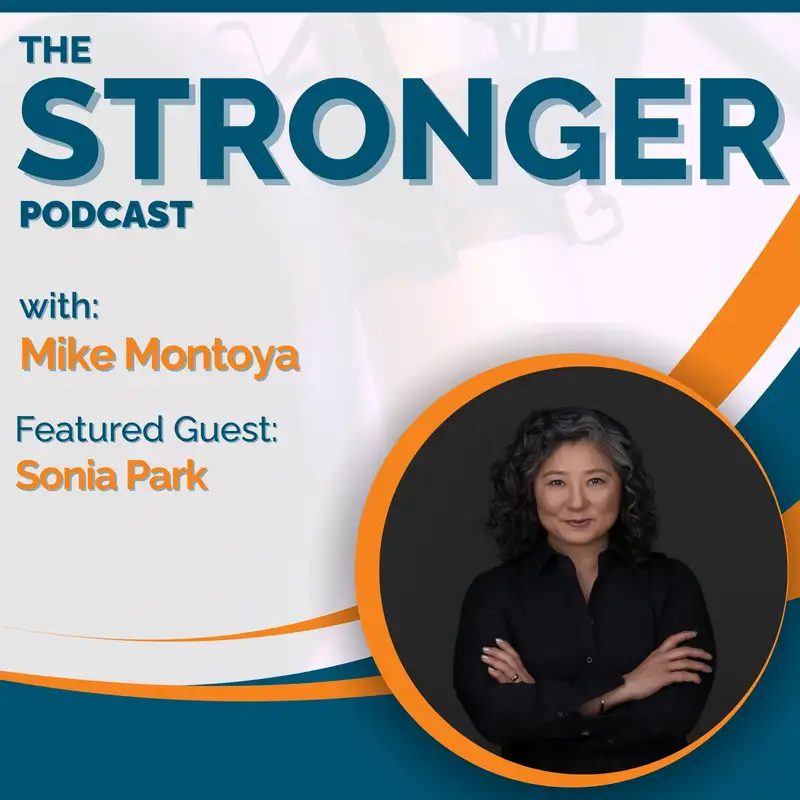
Belonging Is Not a Side Issue: The Charter School Coalition That Can Still Say "Diversity" with Sonia Park
Welcome to the Stronger Podcast. Each week, we have honest conversations with education and social impact leaders about their leadership and career journeys. We talk about their origins, inflection points, and the work that they're doing today. The conversations are honest, human, and practical. If you're here for real stories and real takeaways, you're in the right place.
Mike Montoya:Let's jump in, and let's get stronger together. In this episode, I'm joined by Sonia Park, executive director of the Diverse Charter Schools Coalition. Her personal and professional journey make a powerful case for intentionally diverse schools. From her childhood in Philadelphia to her work in New York City and at the federal level, Sonia explains why diversity, belonging, and identity are not just side issues in education, but central to whether young people can thrive. Let's jump in.
Mike Montoya:Before we dive into today's conversation, I want to give a quick shout out to podcastsmatter.com. Their mission is to help impact driven voices get the visibility they deserve. If you want to share your message with the world, check out their website in the show notes. Good morning, everybody. I'm here with Sonia Park, who is the CEO of the Diverse Charter Schools Coalition.
Mike Montoya:Actually, maybe the title is Executive Director. I use that word CEO sometimes. But Sonia, thanks for being here with me, and I appreciate your time. Good morning.
Sonia Park:Good morning, Mike, and it is a pleasure to be here. I will take CEO. I'll also take executive director. Either is fine.
Mike Montoya:Basically, the top job at a place, That's kind of what we think about it as. Tell me, I know you've been in this world and work of of strengthening schools and opportunities for for children for, like, most of your career. Right? And so we'll explore that a little bit. I'd love for the audience to kinda, like, if you could place them, like, where where are you physically at?
Mike Montoya:Where do you kind of operate from in your normal life? And then, like, where did you where did you start? Like, where did you where were you where were you born? Where where's your early childhood life? Like, just tell us a little bit of those stories.
Sonia Park:Yes. Thanks, Mike. And that's a lot. So I'll try to keep it brief. But I am currently living and working in New York City, Brooklyn specifically.
Sonia Park:And I've been a Brooklyn resident for, say, twenty five plus years. I'm originally born and raised in Philadelphia, so always a city kid. And just some personal background, I'm the daughter of Korean immigrants. I'm one of three, the second, the middle child, if you will. And we spent a lot of time living in and outside of Philadelphia.
Sonia Park:My father was a serial entrepreneur. So sometimes we do really well and we were living in the suburbs, other times not so much, and then we would move back into the city. And because of that, in the city, in the suburbs upbringing, I really got to experience public education in a lot of different ways. So a big notice for me is that when we were in the suburbs, the schools were great. Smaller class sizes, newer buildings, carpets, clean carpets in the classroom.
Sonia Park:And in a lot of ways, the idealized version of what a good public school should be. But on the downside, a lot of times, my brother and sister and I were one of the handful of students in the school that were kids of color. Because of that difference, we were often targeted. I was made fun of a lot. I didn't have very many friends.
Sonia Park:And it felt really, really uncomfortable for me because there wasn't a connection to other kids in the classroom, but even to teachers, to the stuff that we were learning in school. It was just very isolating in a lot of ways. But then when we were going to public school inside the city, buildings were a lot older, like a 100 plus years. Class sizes were much larger. And there were so many other kids there that looked like me or kids of color.
Sonia Park:And classrooms could have been chaotic, but I also felt that there was a better sense of belonging because teachers knew and they recognize like we're in an urban environment and we're working with families and students that are coming from all over the place. And that difference really stuck with me is that you can have all the pretty shiny things, but it as a student, if you don't feel actually connected to any of those things, it can be really, really hard and isolating. So took that with me. I graduated from the Philadelphia High School for Girls. It's a magnet school, and it was also one of the most diverse schools I had ever gone to.
Sonia Park:So over 50% of the students at that time were black, and they were drawing girls from all across the city because you had to have a certain grade level. It was a magnet school to get in. And that was another noticing on my part that one of the most diverse, rigorous, challenging in a good way schools I've I had gone to it at that point was a test in school. Again, like it's a public school, but why is it only for a small sliver of girls that managed to get to that place? And so that was my K-twelve background.
Sonia Park:I went to a small liberal arts school in New Jersey, which was PWI and again, like marginalization. From there, I ended up going and living in Korea for two years. I grew up in Philadelphia, so I didn't really speak the language. So I went to Korea. I got in touch with relatives I never really knew.
Sonia Park:I learned Korean and it was another time for me to be in a country where everyone really did look like me. That was, honestly, there's a certain level of comfort to know that I really do fit in where a lot of times in The US, I never felt that way. Again, that sense of belonging and understanding from folks around me. Coming from a lot of different places and how I ended up now running the Diverse Charter Schools Coalition is taking all that of my background experiences in public schools and then seeing it play out in a different way for my son, know, born and raised in New York City, the most diverse city in the country, in the world, some would argue, and still one of the most segregated. And so he went to public school, K-twelve, K-eight charter, and then to a district high school.
Sonia Park:And he ended up feeling, through part of his education, as marginalized, as othered, and made to feel like he shouldn't be spoken to because of how he appears. And that just made me so angry. Like it's still thirty years plus since I went through something similar and he's experiencing it now. And that sort of reinforced me, like, there has to be a better way. We have to be able to educate our kids in public schools that reinforces and celebrates who they are instead of trying to make kids feel like they don't fit in because there is only one idealized version of what a student should be.
Sonia Park:So, it's a long story, but it really helps inform me because it's not just saying we're talking about policies about creating intentionally diverse schools. It is really affecting students on an individual basis, and that's how I try and center and approach the work that we do.
Mike Montoya:Well, and I appreciate you giving I mean, clearly you've thought about this and it's become part of your why, right, the work that you do, essentially. And my understanding as you were discussing that is like you have your personal journey, right, which has informed your present day work, right? And it's also recycling itself in terms of your own family, right? And so there's motivation, right, to maybe make things better for yet the next version of children that are in the pipeline, so to speak, right? And I want to explore just a tiny bit because the reflection of the other in right, which you just talked about for yourself, like is common amongst a lot of my guests, where people have talked about, like, not feeling like they belong in a space.
Mike Montoya:And, you know, as a gay kid myself, I never like, when I go to us intensively gay city, I'm like, oh, it feels safer. Right? And it feels different. But it's hard to find, right? You have to work hard to be in that place and to sort of blend in.
Mike Montoya:Otherwise, you're always putting all the masks on and trying I get away with it a little bit. Right? But like other it's harder, right, when when it's like more obvious in terms of skin color or something like that. And or if you're a woman, in The United States, like, there's some obvious challenges in those regards. But you said something about going to Korea, I assume kind of as as a young woman
Sonia Park:Yes.
Mike Montoya:At at that stage in your life. How did that time, like, sort of expand or affect the way that your identity, developed? Because you really hadn't had a strong Korean influence besides your family before that. So what happened during that period of time that really I mean, did it change you in any ways? It like?
Mike Montoya:Or maybe it was super challenging too, or all of those things are possible, guess, right?
Sonia Park:It was super challenging. I deeply, deeply am glad that I spent that time there. And it also reinforced for me, like, I'm so glad my parents immigrated to The United States. I was glad I had that American passport, I'm not gonna lie. But it was also the timing of being in Korea was during a lot of the student protests and riots because against the government and I got swept up into some of those things.
Sonia Park:I've been tear gassed, never thought I would have to live through that. And inadvertently like stumble upon some of these student protests and again be witness to a lot of the things that were happening. So that was a bit of a political awakening on my side because I didn't see the equivalent happening as intense in The US with US students, like my college experience versus what I was seeing Korean college students do. So that was one thing. But on the other side of it, Korea is a deeply patriarchal society can so be so chauvinistic.
Sonia Park:So there were assumptions already put on me because I am a woman. And so expectations on my behavior, on what my goals should be in life. What are the things like when I went to Korea, my father came with me and we were doing the rounds. Like we went to see a lot of his friends. He would tell me, if you ever need anything, you can go talk to Mr.
Sonia Park:So and so or so and so. And almost to a one of meeting all of his friends, they would ask him because they weren't really talking to me, you know, was I there to get married? So it was the expectation that I was going to Korea to find a husband. And to my father's credit, he kept saying, no, she is here to study. She's here to go to school.
Sonia Park:Because in addition to going and learning Korean, I was also doing grad work and modern East Asian studies. And he's like, she's here for school, not to find a husband. And they were like slipping him pictures of potential folks. And he didn't tell me this until afterwards. I'm like, what?
Sonia Park:Are you serious? It's like, oh, yeah. So there is that part of it too that I couldn't just be there to be. There had to be an underlying motive like, oh, she's here to get married. I'm like, nope.
Sonia Park:A little bit of that too.
Mike Montoya:The funny story sort of except for like, that it's like based in a reality, right, which is like how Korean society functioned then and probably still does in many ways, right? Like that, that there's really strong gender roles, right? That are in place in that country. And so, yeah, I mean, the trade off is like, in your maybe your dad's like, we're not staying here. We're just here visiting, right?
Mike Montoya:He's like, already made the hard work of getting out. Right? So do you do you is there like, there any, I don't know, I'm going to use the word appreciation, right for like, the tension between those two life experiences, one that could have been in Korea and the other one that is in The United States. And even though The US has done an imperfect job of immigrant welcoming and assimilation of sorts, it also has tremendous benefits for the individual who could get through it because it's not easy, But right? It has some benefits, right?
Mike Montoya:So, again, I'm putting this on you. Mean, does any of that resonate with your own experience?
Sonia Park:It definitely does. When my parents immigrated and they met in The US, they didn't actually know each other when they were in Korea. But my mom is one of eight. She has two older brothers and five younger sisters, so she was the oldest daughter. All eight immigrated.
Sonia Park:And my father too also came from very large family. And everyone came to The US because they, you know, the little bit of the stereotype, it's land of opportunity. You work hard, you can do well with your families. And so I think that part was the narrative I grew up with. And so when I went back to Korea, it was interesting to see that the Koreans who my the extended family, not for my mother or my father's immediate, like brothers and sisters, but part of their extended family, the ones who stayed, they worked really hard too.
Sonia Park:And they were successful just in different ways. And I actually, interestingly, Korean cab drivers are really chatty. So they will ask you questions like, why are you here? And then I had been lectured by taxi cab drivers about like, oh, well, your family abandoned Korea when we needed them the most, right? Because that's when the country was building and growing and thriving and, you know, like really pushing forward on modernization.
Sonia Park:So there's a little bit of that too of, you know, we stayed here and we worked really hard and we brought the country to where it is. And like a little bit shame on your parents for not being here and being part of that effort. So, you know, no place is perfect. But one of the reasons why I really was appreciative of having my American background is being able to be critical. Like, I can be critical of The US, and often I am.
Sonia Park:But in a way that I'm not fearful of being reprimanded or, like, being called out because of x, y, and z. Where in Korea, they were still in that phase of censorship. So, like, a big thing that one of the most popular movies that was showing when I was there was Taxi Driver because it had been banned in Korea because of the the subplot of, you know, he was trying to shoot a politician. And be because of that, that movie was bad. And so it finally got to be released in in Korea, and everybody wanted to see it.
Sonia Park:And it was that sort of thing where the country was emerging, but it was still not, you still couldn't do everything that you wanted to do or say the things that you wanted to say or see the things you wanted to see. And, you know, we can do that here or maybe I should could. Used to be able to do that here in a way without the fear factor. So I think those are two different things. And I deeply appreciate my Koreanness and my Americanness.
Sonia Park:Sometimes they don't always sit together perfectly, but I'm really glad that I got to spend that time in Korea because it helped me realize, despite all my complaints about The US, I'm glad that I had that. That was my norm of being able to be you know, the aspect okay. Maybe it sounds cheesy, but the freedom side of things is something that I took for granted. And I got to see well, I was in Korea that is something I should not have taken for granted.
Mike Montoya:Well, right. Well, I mean, that's kind of young people behavior until you get exposure. Right? That's, like, pretty common. I can reflect on that a little bit.
Mike Montoya:And, like, I I think the highly structured aspects of some parts of the world that are still emerging, etcetera, right, are, like social order is part of how they get through challenging things and the control. And I think The US has a history of that at different stages, obviously, as well, right? And so right now, certainly seems a little bit like all over the place, right? But you know, that that only comes through right people resisting and continuing to break down the conventions, etc. Korea is on a path in some ways, right?
Mike Montoya:That that will eventually I watched the K pop experience. I'm like, Oh, they're on the they're on literally the bandwagon. Right. And so it's it will happen as it opens itself up to the world. And that's exciting.
Mike Montoya:Also, I guess this all gets back to the core thing of why diversity matters and why in The US, if we can, I call it encourage and enrich people's experiences through others, right? They turn out to be, they call it more balanced humans. I'm not going say better humans or smarter humans or that, but they just seem to be more aware, right? And so it's like, it's really interesting to hear you talk about this arc that has been like your childhood experience and the work that you're doing. So let's shift gears a little bit.
Mike Montoya:I want to hear about some of the so you made it through that stage of your life. And then you got into this school's work, right? But largely in the cities of the Northeast, right? And so tell me a little bit about a highlight of a couple of your moves, Certainly the time you were in in New York City and then also some of the department of ed work, which was, you know, short but important. Right?
Mike Montoya:Because I'm super curious about that.
Sonia Park:I I got into charter schools a little bit by accident. Because when we were growing up, there's no such thing as charter schools, right? I don't think My husband jokes about this. Like no one dreams about being a bureaucrat, right? That's not your goal in life.
Sonia Park:But I was working at Columbia University And I saw, and this is how old I am, it was an ad in a newspaper, a newspaper ad looking I know, you actually had to read it out and I highlighted it. And so I applied for this job with Edison Schools and they were launching charter schools across the country. And so they're looking for a grant writer and application writer. So I applied and got it. And so that's how I ended up starting to do charter school work because charter laws were starting to crop up all over the country, including New York.
Sonia Park:And Edison, for those who don't know, was established as a for profit charter management organization, education management organization, an EMO. And there were a few in addition to Edison. And Edison grew really fast. So opening up schools in New York, in Florida, in Michigan, in California, in Texas, and each new state that the company moved into, I had to learn the charter law and start drafting applications because each state was different. So I got like trial by fire hose.
Sonia Park:Got to learn a lot about charter law. And Edison also had the talent to hire extraordinary people. So in addition know, Benno Schmidt was at Edison, John Chubb. And then if we look at a whole bunch of other folks that have worked at Edison, they have got we call it the Edison diaspora that have spread out all across the country. So that was my start in charter schools.
Sonia Park:And then from Edison, moved on to do a lot more direct work with the New York Charter Schools, the State Association and the Resource Center. And then through that work, helped launch, I would say like close to 40 different charter schools across the state, helping them as a consultant and working through the resource center to get them where they needed to be. And then I ended up working at the New York City Department of Education because of all the charter school experience I had. I was part of the charter school's office there. And then eventually ended up running the office under the last administration of under Mike Bloomberg.
Sonia Park:So worked with Dennis Walcott. That was great, exciting time. And then it there was a big shift with with
Sonia Park:next administration coming in, and they had a very distinct difference of opinion around charter schools. So then I left. And that's when I ran a very tiny two school network as an ED.
Sonia Park:And from that point, working at Manhattan Charter Schools, that's where I ended up moving on to, on the federal level, the Department of Education under John King, his last year as a senior policy advisor. And I think that I have to say was a matter of luck, to, to have that job. And it was because one of my colleagues at the New York city DOE he used to work for me. He moved to DC and he was working for OMB. And so he had reached out to me.
Sonia Park:He's like, Hey, I know somebody at the Department of Ed and they're looking for a senior policy advisor. Can you just spread the word? And they gave me the JD. I'm like, you know what? I might be interested in doing this.
Mike Montoya:A good recruiter trick. I'll tell you all about
Sonia Park:Well, you're probably right. And it was an inflection point, not just for me, but with my family, because it was clear it would be for the last year. So it was only a year. My son was in middle school. And, you know, was it worth it to make this disruption?
Sonia Park:Either we moved to DC for a year or I moved to DC for a year. Is it something that is going to how's it gonna affect the family? All those different things. And my husband said, you know, this is an opportunity you're never really gonna get again. When else are you gonna work under this administration, the Obama administration?
Sonia Park:And we can we can do anything for a year. And so with his support, I that's what we did. Like, I got out an apartment in DC, and this is before remote work was really
Mike Montoya:viable. So
Sonia Park:I was down there for like Monday to Thursday, Monday to Friday, then I would be back up in New York on the weekends. So it was sometimes it was a challenging piece, but it was really good for us. And I really appreciate my husband being fully supportive of this and also my son. He actually asked me when I told him like, I'm gonna go work for the government. His first question to me was, do you get to carry a gun?
Sonia Park:No.
Mike Montoya:Not anymore, unfortunately.
Sonia Park:Not anymore. Not AFT. I'm working for the education department. So, but when I was at the federal work, I did specific work on in charter schools and under John, he had an initiative of rethink discipline. And so it was moving away from punitive discipline policies across all schools.
Sonia Park:And I worked specifically with charter schools. And was one of his big initiatives. Another one was on diversity and really talking about supporting what intentionally integrated schools look like. And so that was another way for me to start incorporating some of my personal beliefs in what this looks like on the education side, policy side. And so that led to my, after leaving ed, to working and leading the Diverse Charter Schools Coalition.
Sonia Park:It was like a kind of a slow walk what I'm doing right now.
Mike Montoya:I'm going to pause the conversation here for just a second to talk about books that matter. Every entrepreneur or leader needs a book that elevates their business, builds their credibility, and makes an impact. If you've got more money than time, a ghostwriter can help you build your story. If you've got more time than money, a great book coach can guide you step by step through the writing process. If you have already written a draft, these folks can save a lot of trouble and money by shepherding you through the publishing process.
Mike Montoya:Head to booksthatmatter.org and get the custom support you need on your book idea or manuscript. Yeah, that's Well, and thanks for sharing about that, because I always find these little important elements that happen, these pivots that people have. I want to drill down a tiny bit. I'm going use the word ambition a tiny bit, because, and I'm curious about whether that feels like there was a part of you at that time when that opportunity presented itself of either career ambition or I call it impact ambition, right? Which is like this ability to influence something at a very specific time, right?
Mike Montoya:I call it policy windows open and you have to run through them quick, right? Because they will close quick, in my view. And so I'm curious, like and I ask this from the personal side because it's easy to see someone's career moves, right? But like what was going on in your head at the time that was motivating? I think in particular, because as people listen to this, career track and path is not linear, and it's not anticipatable in our space.
Mike Montoya:It's often very shifty and has these opportunities that people run through it. So I'm curious, what was going on for you when those things happened? Because I really want people to hear, oh, is how a single individual who's been quite successful thought about the moment, right?
Sonia Park:Yeah. So I appreciate the question, Mike, because if I look at my career track, it implies that there was a path I was following. In actuality, that was not the case. It was different opportunities that presented themselves to me. And I you know, like like I said, with taking the job at the federal level, there are a lot of competing factions for me.
Sonia Park:So not just like the time limitation and how it would affect our family. And I was taking a salary cut, honestly. Like, becoming you know, leading ED over two schools to being a senior year policy advisor. So I took a salary cut. There were trade offs with their personal life.
Sonia Park:But the opportunity was so unique that that was a compelling force. And having that the strong partnership with my husband to say like, we can do anything for a year. And that was the foundation I needed to like, okay, let's do it. Like, I'm gonna do it. And I think that's like part of my calculation.
Sonia Park:Like also working at the New York City DOE, I had a thriving consulting business and I was, you know you're successful when you have the ability to pick and choose your clients, right? As a consultant. And I was doing really well. And the opportunity to work at the district level, there was something else I was weighing. It's like, well, do we really wanna do that?
Sonia Park:Because, you know, and I realized too, like at that point I had done a lot of other work on with charter schools. I had done like application writing, school reviews, like board development, all these different things, but I had not worn an authorizer hat. So, to round out my experiences, thought, well, let me, I should do this because then I have a different perspective of charter schools and also district work. And again, I'm really glad I did it. I also realized too that with the change administration from Mike Bloomberg to Bill de Blasio, that and I left the department, that my why wasn't I wanna stay in the district with this district job with all of its guarantees and benefits and and all those things that I joined the department to do the work.
Sonia Park:And when the work shifted, it wasn't important to me anymore. And so I I kinda do what my why was, and that helped me think about what my next pivot was gonna be because the work is important to me, not necessarily and and other folks have different drivers, not necessarily the my angle wasn't having a district job. Sure. Yep. Yep.
Sonia Park:So Well
Mike Montoya:and and thanks I mean, thanks for that. I mean, I I mean, that and people may not know the whole history of the Department of Ed and and certainly the the New York City DOE, right, and and the channels through Joel Klein and up through Walcott, etcetera, there were these shifts in policy and focus and things like that. And charter schools thrived in terms of expansion under some of that work in both 2005 to twenty fifteen ish, something like that. It just really grew, right? But then that window shifted, right?
Mike Montoya:And then it becomes less possible to move the needle on some of that stuff. So then you, again, move towards something else. Certainly, or ten years doing anything, it's a lot, right? But there are people that are in that position, career in an institution is one of the ways that they maintain stability and they have a good channel and opportunity. And then other people do it differently, right?
Mike Montoya:Which is what you're talking about, right? You kind of call it weave your way, or I call it wind your way through different pieces, like a little bit like a river in that regard. I'm curious about lessons or muscles that you've flexed in these different environments. Terms of a leadership muscle, now you're leading in a non Basically, it's set up as a nonprofit, an association of charter schools working together, right, to achieve certain policy goals, etcetera. So tell me a little bit about that work.
Mike Montoya:And I think like, what are what are the two one or two muscles, leadership muscles that you're having to really, I call it, lean on now, right? Because the last couple years has been very special. And I'm curious, like what you're what you're leaning into in terms of your leadership experience right now.
Sonia Park:I love that you called it special, because it is. So the Diverse Charter Schools Coalition. Yes, we are a coalition of intentionally diverse charter schools. It was founded by members, 14 original schools and networks. You know, their leaders came together saying like, we're actually doing something different.
Sonia Park:We're intentionally creating diverse schools and it's more than a momentary thing. It's actually part of a growing movement. Maybe, you know, you can think about it like charters two point zero, like the next iteration of charters and innovative models. And so from those original 14, we now have 106, which represents over two eighty individual schools across 26 states in DC, right? And so we've all these leaders that have come together really thoughtful, intentional about like, how do we serve our community better?
Sonia Park:How do we ensure that everyone that touches the school, not just students, but staff, teachers, board members, families feel that this is their school, that this is their community, that there's a sense of belonging. And so the work we do to support our members is to bring them together. A lot of it is peer to peer learning and sharing. We have our community practice. We have our annual convening, which you're there.
Sonia Park:Had you had your folks there. They were wonderful. And we highlight the work that's happening on the grounds. We look to pro bono members, like, telling their stories, because they're successful stories. And and and let's face it, oftentimes, the successful stories aren't necessarily the most sexy stories in the news.
Sonia Park:So we really wanna uplift all the good work that's happening on the ground. And we also do that through targeted advocacy work. So really being out there promoting and talking about how the work that's happening here in these schools are important to the ecosystem in their educational context. And then we also look to grow the movement. So inviting schools, existing schools to join our coalition.
Sonia Park:We have a fellowship program that is looking to provide additional training and support for the next gen of leaders through our explorer program. And it's really trying to push and see the notion that there's a lot of promise and power in creating intentionally diverse communities and we're doing it through our schools. I think the pivots we had to have made over this past year or so under this current administration, We have diverse in our name. And so that came under fire pretty quickly. And we have been able to stand firm.
Sonia Park:We've had our member schools come to us and ask us like, how should we interpret this latest dear colleague letter that's coming down from the Department of Ed? What do we do with this executive order that's now saying we can't use the word diversity? We've had schools scrub their websites, taking out certain terms. So not changing the work that they do, but changing how they talk about it because they're still receiving federal funds, whether it's through CSP or title funding. And so the work that we have been able to do is really say, we are the Diverse Charter Schools Coalition, and we can say these things that some of our members now weren't able to, can't say anymore.
Sonia Park:And so we've been able to push the the the intention and the reasons why we we do the work that we do. And I'll be I'll be honest. A a big reason why we can say these things because we don't receive federal funding. We are not beholden to federal dollars. You know, before in the prior times, I was applying to get federal dollars, and now I'm glad we actually
Mike Montoya:Not on that host, right?
Sonia Park:Because of the restrictions tied to those funds would have, I think, changed in some aspects the nature of our work. And we our strength and what we've heard from our members is our ability to stand true despite some of the buffeting winds that are that have been blowing for this last year or so. And our intention is that we will continue to do so, you know, not just now, but like long term, and use this as a way, as an indication that this is something that's really important, and we shouldn't be afraid to talk about it. We shouldn't be afraid to share best practices. And we wanna make sure that folks feel comfortable coming to us and saying like, we wanna learn more.
Sonia Park:We wanna know how to do the work in our school and our community. So last thing, with our Explorer program, part of that is sharing the knowledge. So we open it up to not just member schools, but anyone else that's interested to go through the program. So we've had charter schools, we've had district schools, we've had independent schools send folks so that they can actually see what's happening on a day to day basis in intentionally diverse schools.
Mike Montoya:I just want to say that if you're a leader, entrepreneur, or business owner who needs some support, there's an easy way to get a think tank behind you and your vision. The Genius Discovery Program at Thought Leader Path is like having your own one on one incubation and acceleration program. They'll help you develop an approach based on your own story and your plan for impact and offer the tools and thought leader assets needed to really amplify your message, including launching a podcast like this one. If you're ready to stop grinding in the dark and start making real impact with the right support, check out GeniusDiscovery dot org. Well, somebody has to be the champion in good times and bad, right?
Mike Montoya:And it's unfortunate that you guys are in a place that you're not, you call it, under the gun from the federal restrictions. I call it chaotic, erratic behavior and ideological kind of motivated stuff, right? And there's a part of society that like, thinks diversity is the anathema of the world, right? Because it allows for people to be who they are, right? And that just doesn't feel comfortable to a lot of folks, which is part of the challenge, which is part of why we need it.
Mike Montoya:And it's like a circular logic. Would be better if you all understood each other better than we all would like hate each other less. And that would be good, right? And we're trying to like, pull this thread for children. And I think maybe for just the audience here, like, diversity in your case is not just about like, skin color or ethnic background or something, but it's also about like, where people live and the kinds of like, I call it profiles of like cultural backgrounds, etcetera, that are also important.
Mike Montoya:And then also like financially, You guys are not, you guys are kind of like allowing for all of this stuff to be part of and intentionally plan. Does that make sense? Is that Is that I'm trying to make sure I'm characterizing it right. Yeah.
Sonia Park:That's true. That's a great capture. So it's not just race based, but socioeconomic status, language, ability, cultural backgrounds. I think that's one of the first three questions people ask us, like, well, how are you defining diversity? And it can feel like an unsatisfactory answer when we say it depends because a diverse school is reflective of the community that they're serving.
Sonia Park:So a diverse school in New York is gonna look different from LA versus St. Louis versus Nashville because the populations they're drawing from are different. So I would never say, you know, for a school to be diverse, 35% of your population has to be this and 15% has to be that. It really has to be contextualized to where the schools are the communities that the schools are in. So it is feeling really inclusive in the broadest sense, and reflecting the community that you're serving also in the broadest sense.
Mike Montoya:Yeah. Well, does take intentional, right? We use the word intentionally diverse because it didn't just happen. It's because a group of humans, adults probably, got together and said that we wanted something like this to occur. And then they can learn from others that have done it before or that are doing it in other places.
Mike Montoya:And you guys provide that experience. And the Explore program is super interesting because it gives exposure and access to things that people would not be aware of in many cases. So I love that. And I love working with you guys because I feel like it's like if that had stuff had existed in my community, when I was a young man, right, my life would be different than it is now. Not that I don't love my life in, you know, lots of ways.
Mike Montoya:But I feel like there's also all this other enriching stuff that could have happened that would have been great. So I'm super appreciative of that myself. So I'm going to kind of like see if we can talk as we kind of wind our way through this. Part about being, I call it a seasoned professional, with lots of experience, let's called Ever Grown Ups right here, and you've had a lot of things. So if you reflect a little bit on your history and think like, Okay, these are the things that have helped me be able to keep functioning in this stuff, even though it's highly variable?
Mike Montoya:Like is there, I call it a habit or even a way of operating that you really rely on as a leader now?
Sonia Park:One thing I try and do is unplug, and I do that by I run almost every day. I'm not a fast runner, but it's it's time for me to step away from from work, from everything else. I listen to a whole bunch of podcasts, and and I also run by myself. So I don't have a running partner or a part of a running club because I want to just spend time with me versus a lot of other people. The nature of our job as leaders is that we have to be out there, right?
Sonia Park:You have to talk to a whole bunch of folks from your team members to board members to funders to everything. And I'm by nature more of an introvert, so I need to make sure that I have time to actually unplug. And so my running is is when I do that. So that's important for me. I think another important thing, and this is something that is much harder for me to do is to learn to kind of forgive myself.
Sonia Park:Well, I can play things over and over my head like, I should have done it this way. Or I wish I said it like that or I should have. So the coulda, shoulda, wouldas, I can't change the past, so I have to learn this is my mantra now, like, to let things go, you know, learn what I can and move on, but not try and relive the same thing over and over again because that is not it's not ultimately helpful. And so forgiving and moving on myself is is next time you see me, Mike, ask me how that's going.
Mike Montoya:I appreciate you naming it because it's a it is a I call it it's a practice. Right? That ability to, like, identify the lesson, not hold yourself responsible for every single potential outcome that could have played. It's like a choose your own adventure book. You wish you could review and replace and fix and improve every single thing, and not you specifically are doing this.
Mike Montoya:But I know I do that. And it's really challenging to, I call it, just keep living in the now, Because it's part of what you want to perfect in some of the things that you can't control. And for me, there's so many things that are way beyond circumstances that I cannot manage or control. And so, but holding on to that is like a weight, right? It holds you, I call it back even from potentials and opportunities.
Mike Montoya:And so I'm going to definitely talk to you more about this because it's almost like this is the thing we needed to talk about, right? Was this like, as a leader, learning how to forgive yourself and let go and know that you're also human doing your best and that there's no way to be perfect, right? That that's part of being a leader is that you learn to build the muscle of moving on and keeping, I call it keep trekking, I call it through the because there's a bigger hill, there's more mud. If you're a runner, whether you're outside, there's just always another challenge. And if you're waiting by all this stuff all the time, as opposed to having the lessons that can be a lot lighter and valuable, it's hard to be successful.
Mike Montoya:So I'm glad you found that one because I wasn't sure where we were going to go with that, but that's a really important one. So like being with yourself on the running is important. And also in this then, I call it listening. Mean, those two things are almost paired together in this ability to become a little bit more aware. Is that fair?
Sonia Park:I think that's absolutely fair. Yes. And I like what you said. It is a practice of living in the now and being able to accept the reality, like we are not perfect and we are gonna make mistakes. And as leaders, that is, you know, part of the job of leading.
Sonia Park:You're never gonna get everything a 100% right. And setting that expectation, you know, for yourself or even for your teammates is unrealistic, and you're always gonna be disappointed, right? Because no one we have said this too at DCSC. It's like yoga. It's a practice.
Sonia Park:It's not imperfect. You're never going to get to perfect.
Mike Montoya:Yeah. It's literally impossible. And I think I've spent a lot of money on coaches and people helping me understand this about myself and to be like, oh, it applies to me too. The things that I also coach people about and talk with them about is like, it applies to me too, right? And that like letting it go and holding on to like your best self, right?
Mike Montoya:Because I always think like in business, you know, there's like 1,000 problems, no matter what. So you can only solve 10 of them. So you, you know, if you look at about the other 900, like you're just never gonna be successful, right? And people get knocked down by that. And so that's super useful.
Mike Montoya:Well, as we as we pull this out, and I'm gonna like, I'm gonna have you reflect and I want you to put in your head, if you can, this young woman that you were when you headed to Korea, about that time, I mean, I'm not sure if that's the exact age, but thinking about that persona or that person that you were then, or maybe there's even a young person that's in your life, potentially your son and others that are in that friendship group. Like if there's a nugget for them to that you would, I call it drops of wisdom about what that moment in life allows for, that you would say like, hey, consider this. Is there anything that you would impart at this stage?
Sonia Park:I would have two things for myself at that stage of my life, and actually maybe even now, is don't take it so seriously. Like, it's it's important, but it's it's I tend to, like, hold on and really fixate on things. So, like, relaxing and and being like, what you said, like, being in the moment, like, serious is important and fine, but don't overemphasize the seriousness of of it of life, maybe. And the other thing I could also say is, you know, you got to pause every once in a while. Not everything is go, go, go, go, go.
Sonia Park:Sometimes you see things with greater clarity when you take a step back. And the the times in my life and in my career where I've I've been forced to take a step back, like after I left the DOE and before I be I started leading DCSC, I was working as a consultant. And it made me realize, like, I what do I wanna do? And that forced period of trying different things on and reflecting, is this what I really wanna do? Is that what I really wanna do?
Sonia Park:Helped me choose working at DCSC in a way that was much more intentional than because I had to take a job or because, you know, X, Y, and Z external pressures. And I've been here now for, oh my goodness, almost nine years. And this is the longest- Yeah. This is the longest I've ever been at any one position because I was intentional in investing in the work that I was doing. So taking the pause, I think, a really good thing.
Sonia Park:And I think also, like, I don't really do it unless somebody forces me to do it, and I need to be much more intentional on that too.
Mike Montoya:Well, I mean, the awareness that it's important, thanks for the nuggets, right? Like that ability to like take the pause and not take it overly seriously, are both great elements to hold on to for, I think you just said it. Was thinking about a kid, a young person, but it applies to me too, and it applies probably to a lot of other folks too, which is this cadence that we can get on as humans of constantly moving and moving fast, or I call it trying to control every aspect of things. It's just like a professional muscle that they try to teach you in school or graduate school or whatever, and then you get on that bandwagon and it becomes crazy making in that regard. And sometimes you can miss the really important things because you're kind of busy in the stream and stuff, right?
Mike Montoya:And that's helpful to hear about that. Sonia, I want to appreciate you for the life that you've lived so far, the work that you're doing now, for spending time with me here today, and for your future work. I mean, there's plenty of to come. Right? And we're in this moment in our society now that we need leaders to stay strong, right?
Mike Montoya:And I don't pun intended that this is the Stronger Podcast. But the goal is for us to hold each other carefully and support each other right to this to this phase of experience. Because, you know, the children that we're working with, right, in particular, right, are not going anywhere. Right? And so plenty of work to still do.
Mike Montoya:So thank you for your work.
Sonia Park:Well, you, Mike. I really enjoyed our conversation. And I would love to continue it offline, maybe with the cocktail. Where we can deliberately pause together.
Mike Montoya:That's perfect. That would be awesome. Well, we'd love to have you back in the future. And we will definitely spend more time together in the coming weeks.
Sonia Park:Sounds great. Thank you.
Mike Montoya:Sonia's story makes clear that building better schools means more than chasing shiny outcomes or polished systems. It means creating communities where students, families, and educators can thrive, valued, and grow together with intention. Looking forward to hearing more about Sonia's work in the future. Thanks for joining us and tuning in today. To find out about other podcasts that matter, visit podcastsmatter.org.
Mike Montoya:Thanks for listening to The Stronger Podcast. If this conversation inspired you, we invite you to follow the show and share it with someone who's on a journey to become a happier and healthier version of themselves. Links and resources are in the show notes. See you next Thursday, 9AM eastern time. Have a great day, and stay strong.