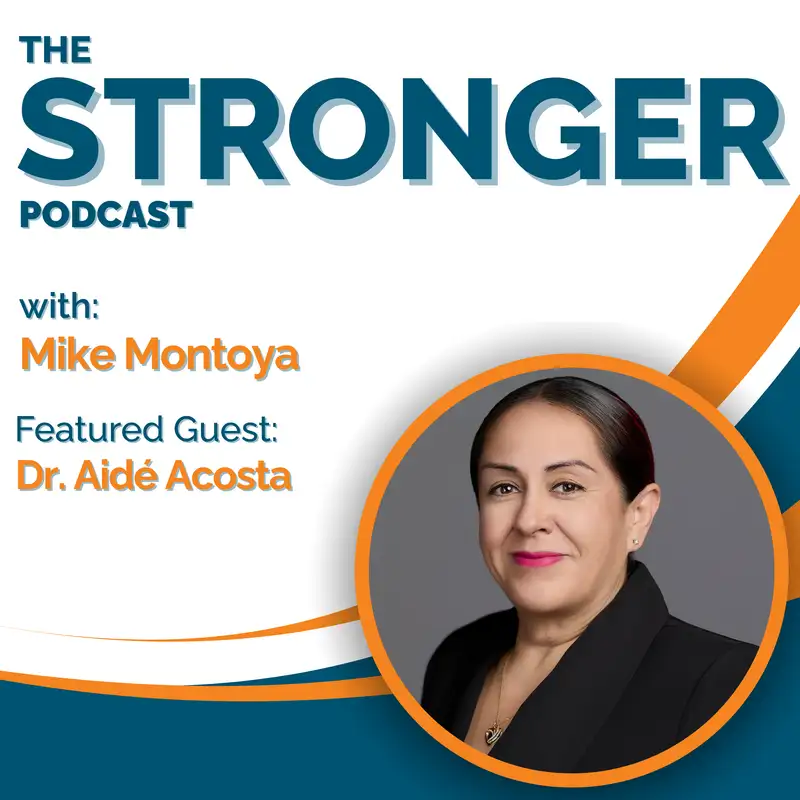
A Turtle Carries Home on Its Back: First-Generation Leadership and Student Success in Higher Ed with Dr. Aidé Acosta
Welcome to the Stronger Podcast. Each week, we have honest conversations with education and social impact leaders about their leadership and career journeys. We talk about their origins, inflection points, and the work that they're doing today. The conversations are honest, human, and practical. If you're here for real stories and real takeaways, you're in the right place.
Mike Montoya:Let's jump in and let's get stronger together. Today's conversation is about pathways and who gets access to them. Dr. Acosta shares her journey from rural Mexico to becoming a nationally respected leader in the higher education and college access space. We talk with her about what it means to create the conditions for students to thrive, why representation matters, and why the promise of education remains deeply important for working class families in immigrant communities.
Mike Montoya:Let's jump in. Good afternoon. Good morning, everybody out in our listenership. Today, I'm with Dr. Aide Acosta, who is the vice president of student affairs and the dean of students at the National Louis University in Chicago, Illinois.
Mike Montoya:But I met you right, a while back in a couple of different contexts, right? So welcome. Let's say hello and good morning to
Aide Acosta:Yeah, good afternoon, everyone. Acosta. Pleasure to be here.
Mike Montoya:And if you could see, there will be images of this conversation, like little screenshots, things like that. So like, she's sitting with her headphone on, she's in an office, right? Like she's like a serious, I call it a serious operator right now. And it's fun to see in this context. But you and I met back in a couple of different ways.
Mike Montoya:One is through your work at Noble Schools in Chicago, which we'll talk about. And another was through your work with Lial, which is about Latinos leading in America in terms of charter schools in particular. Right? So we'll talk about those things. But can you just tell us a little bit about the origin?
Mike Montoya:Like where where did you start your life in your early journey as a as a young one?
Aide Acosta:Yeah, I would love to. And we also connected as you are a Pahara alum. I'm currently a Pahara fellow, and it's definitely an important connection for all of us, which I'm having a really good time with. And speaking of Pahara, it definitely pushes us to think about our origin story, our leadership journey, and how do we become who we are as leaders. So a little bit about me as Mike already introduced me, Aide Acosta.
Aide Acosta:And while I currently live in, work through Chicago Midwest in many ways, I have been in the Midwest most of my adult life, Home is, to use San Salvador's phrase, I'm like a turtle. I carry home in my back. And I say that because I've moved around countries, moved around cities, moved around homes, and was born in Mexico in a small rural town in the Pacific Northwest Of Mexico, Sinaloa, which is my home state. So for those that know the region, Sinaloa, while unfortunately has a name that infamously is connected, right, to drug trafficking, if you saw in Marcos, Mexico, of course, that's the whole narrative. But Sinaloa is also a place, a home of hardworking people, and it's the breadbasket of the country.
Aide Acosta:And I would say North America more broadly, for example, big exporter of tomatoes, shrimp capital of the world is in Mazatlan. And of course, my people created panda, which is a lot of fun. I have to start with talking about my parents first and foremost. My parents arrived to this country with a collective education of eight years. And I'll speak a little bit more why I'm so proud to say that, to say, stand here and share with you that not only was I able to complete high school as an immigrant child in an American educational system, but earned multiple degrees, a bachelor's, a master's, and a doctorate.
Aide Acosta:Now, I'm proud to say that both of my parents were also born in rural Mexico in the highlands of Sinaloa. My dad actually came to The United States as a very young man, 16 years old, as a bracero. For those that don't know, that was a guest worker program during the World War II era to alleviate some of the labor shortages that were taking place in the country at that time. So my father tilled the fields of Southern California, traveled around, and was really representative of what was migration patterns at that time of a back and forth, right? Kind of that it was different.
Aide Acosta:That doesn't change until the nineties, but his ability to return home, to go back family, he was very much a contributor to his family and to his whole community. And as the first one that arrived here, he started helping other family come to The United States as well. My mom comes later as my mom unfortunately lost her father at a young age, about seven years old. And her mother, of course, as is the case, whether that's in rural Mexico or any other rural areas, a young widow, right, options, doesn't have many choices, and they have to make choices that are limited within their circumstances. So for my grandmother, it means that she remarried, moved to The US, started a new family, and left her three children behind, unfortunately.
Aide Acosta:So that included my mom who's the oldest. Because she had my grandmother and Edina had children here in The US, there was this small law of immigration where she was able to regularize her status. It was very short lived during the seventies. Regularized her status because she had US born children and then an extent was able to regularize the status of her children, her three children that were in Mexico. What that that led was that my mom had to come to The US and leave her children behind to be able to do that process, right?
Aide Acosta:So I stayed back. I was five years old, stayed back in Sinaloa in Rancho in Rome, Mexico. She brought her, my two youngest brothers to the border town of Tijuana, San Diego. So we were very much separated for, I don't have any concept of what the timing is I never ask.
Mike Montoya:Anytime somebody asks me, how long
Aide Acosta:were you separated? I was like, I never ask. And obviously it's a defense mechanism for myself, right? I don't go back and circle and look, mom, how long was I there as a child? But it is critical for me to share that because that very much defines who I am and what I, how that separation informs why I'm so deeply committed to different things that will get more in-depth.
Aide Acosta:Eventually, I came to The US. I often share a story that my first words were American citizen. And that was being guided early on by an uncle to say that I was an American citizen so that I can come and join my mother who was in Southern California. Successfully made it eventually, you know, got my spent of my first initial years in elementary education as an undocumented child and eventually was able to regularize my status through kind of that lineage that I explained. My two siblings still stayed in the border for about two years.
Aide Acosta:I do recall that being in first grade and my mom having to go back between Santa Ana, where we recited, which is next to Anaheim where Disneyland is, just for context, to crossing the border, spending the weekends with my siblings. And I had to stay back because I didn't have documents. So we very much spent those two years, her going back and forth and as a family that was separated and eventually, you know, coming together by the time I was in third grade and and having to adapt right to what that meant. Yeah. That our lives were very much fragmented by multiple borders.
Aide Acosta:And now here we were trying to figure out who we were as a family unit. I'm gonna pause because I spoke a lot, but I can't
Mike Montoya:Well, no. And I mean, this is like the storytelling of this particular moment. Right? It's important because I think a lot of folks don't can't imagine what it's like to not be with your parents and with your siblings right at a young age, whether it was a few months or a few years. I mean, somewhere in there, there's a range that's affected your whole life story in many ways.
Mike Montoya:And I think it's an important anchor point. And I think in today's parentage, being away from your kids for summer camp is a huge thing for child. And to be distant for that period of time, it shapes your character in various ways. Right? And also, it's an interesting time in America around the immigration issues currently.
Mike Montoya:Right? But these are the lives and how things are affected by immigration policy in the twenty first century and the struggles. America has a push pull love hate relationship with immigration depending on the political moment. Right?
Aide Acosta:And it's
Mike Montoya:a real thing for real people. Right? Yeah. So thank you for sharing about the start. Right?
Mike Montoya:And also that your early education, I think, was in the San Diego region, This is where grew up, which is a beautiful place to grow up. If people have never spent time in San Diego, it's a very binational experience. It's very common for people to be going back and forth across the border and have families. Now back in the seventies and eighties, it was like it was maybe a little more fluid. There was less lines, less less total population.
Mike Montoya:Right?
Aide Acosta:That's right.
Mike Montoya:Do you feel like you're I mean, you may not have a comparison point, but do you feel like your education experience in The US was substantive and valuable when you were a K-twelve kiddo?
Aide Acosta:Yeah. Substantive in the way that it defines who I am. And why I'm such a And it informs, I'll get to it, but it informs so deeply why I care about our K-twelve, why I care about inclusivity, why I care about making sure that children have options, right, and that parents have choice in their children's education as well. Going into, of course, growing up in a working poor or working class communities meant that, as is true with our American educational system, I didn't always have, right, an equitable school experience. I do recall being, you know, having to confront, right, the races, practices, ideologies that teachers can also perpetuate in the classroom, right?
Aide Acosta:So I've had a combination of experiences with both public schools. And then my mom put me in Catholic school, second, third grade, because she was convinced that that's the only way I would learn English. That was very traumatic through a child that started in ESL, very eighties, English as a second language to all English in a Catholic school that then there's the class also experiences in there to then back to public schools. And eventually heading to We lived in Santa Ana up until I was in sixth grade in Southern California, and then moving to San Diego in middle school. So this is seventh grade.
Aide Acosta:Now, those of you that are educators, you already know where that story is gonna go, where a child that has moved not only across country, from the family, had moved multiple homes, right? And now it's seventh grade and I'm moving to a whole new city. To a middle school that is very much in a poor community, under resourced, and that had teachers that were really racist. I mean, till this day, know, recall because I was always getting myself in trouble being in this alternative class where the teacher would call us wet bags. And we thought it was okay because in his argument, a white man, of course, he would say that because he was married to somebody Mexican, he could say that.
Aide Acosta:And the harm that that teacher caused me and caused the children, right, in that classroom that I'm certain led to closing opportunities for them, right? Because what we believed about ourselves. So that was one that was very defining to me. And unfortunately, once I got to middle school, I wasn't showing up as who I could be and what my full potential was, right? Because I started believing what those adults believed about working class kids, about working class Mexicanos, right?
Aide Acosta:In the South Bay National City, Chula Vista area of San Diego. And I actually eventually, so I was always in trouble. I would skip school, all of it, all the gamut. By the time I got to high school, that pattern, of course, just continued. I had no interest in school.
Aide Acosta:I was disengaged. And by then we had moved and I lived, I literally lived across the high school and I wouldn't show up to class and I could hear the bell and I still wouldn't show up. And my mom was working, right? My mom would have already had left to work. The story with my dad is a little bit complex, but it was generally my siblings, my mom and I.
Aide Acosta:Or my friends would come and
Mike Montoya:have lunch with because I lived across the street and then they would go back
Aide Acosta:to school. So eventually I dropped out because my mom had gone to the principal's office multiple times. At this time, my mom, when we were in San Diego, she used to work cleaning hotels at the beautiful resorts in San Diego, right? So very big dissonance with where she worked every day and then where we lived and what her experience was. And she was tired.
Aide Acosta:And, you know, she said, it's like, doesn't seem like you want to go to school. This is the life you want. Why don't you stop going to school, go to work and figure it out? And my first job was Popeyes. Let me tell you, I figured it out really quick.
Mike Montoya:Motivation, right? Was motivation making $4.25
Aide Acosta:an hour in the late 1990s. And I recall even having to advocate for myself to try to get $4.50 and not, you know, not being able to get it. That was that's kind of what started like really sparking for me that that just was not a viable option. Eventually, I went back, finished school through a combination of adult school and my GED. I did get my high school diploma and started at my local community college.
Aide Acosta:And while I was at community college, had by then I left, I walked out of my job, by the way, at some point, because they wouldn't give me that $4.50 and they were demanding responsibility management responsibilities for me, but didn't wanna pay me. As you could imagine, I was always I I have always been a natural leader. So when Then I started at McDonald's. That's another one that quickly shapes you. And there's two things that I learned while I was there.
Aide Acosta:Then I could speak more about my experience. But one, it was I started understanding that I did have leadership, I was a leader, right? Because I was immediately couldn't as a management within months, right? Here I was young, early 20s, trying to manage adults. It was a challenge.
Aide Acosta:But what I did, I can think about back now what I was telling my husband this. I was like, you know, I have some of the best drive through results. I've always been results oriented. And he's like, well, what do you mean? How do you know?
Aide Acosta:I was like, because I would look at the screen and I could and I would have a plan for all the 12 orders that I saw on the screen. And it's a skill set that I've learned to actually sharpen and use that I'll speak to in the later component. But definitely my training ground. Having worked at McDonald's, I was working about fifty hours a week while I was at my community college full time and then successfully transferred to the University of California Riverside to complete my bachelor's there. And
Mike Montoya:thank you for sharing about what it feels like to be a young woman in a fast food service industry. Build skills, but you also see parts of yourself to to blossom and come out in some ways. I'm using that word generically, but to say, like, that you started to recognize things about your health and at the same time going to school. So now you're kinda call it I call it the journey of a lot of immigrant children is, like, do both. Go to school and work because that's what circumstances demand.
Mike Montoya:Right? And somehow you learned how to be successful and navigate. I'm going to highlight just this cool thing that happens in California that people don't know about is the community college transfer program to the EC systems and CSUs, which is like a pathway. And this is almost how your career quits in some ways. This pathway opportunity that is constructed in that state from through policy is to say that if you go to community college, you get your core stuff going, you can successfully then transfer in.
Mike Montoya:It's almost like a guaranteed opportunity, right, to find a slot, right, over time.
Aide Acosta:Yeah.
Mike Montoya:So did that was that Yeah. Was it clear to you that that was what's gonna happen when you started? Or how did that
Aide Acosta:become I really wanna talk about this because this is this is so impactful. Thank you for sharing the context. So at that time it was called the transfer guarantee program. And there, I need to go back and do a little bit more digging how we got there because it's I'm always it was brilliant. It was very simple and brilliant.
Aide Acosta:But and yet it's not as simple, even though if I use that for myself. So, you know, once I got to my my my city college, shout out to Southwestern College in Chula Vista, California, a very binational program and which was home to me and where I really blossomed. It was my first to use your words. It was my first steps into what was possible. Right?
Aide Acosta:And my first steps to understanding economic disparities and the promise of education. So and I and and very much I have to attribute to one of my professors, Professor Chavez, who taught the Mexican American classes at Southwestern College, they were always packed. And I remember that the first time I tried getting in, he was wearing a hat and had a lecture and I was so inspired and I didn't make the cut because it was they had a long But eventually I made it to his class. And two very important things happened in the classes that I took with him. The first one was that he pushed his students to do extra credit.
Aide Acosta:Right? And I was very fortunate. This must have been like 1998, all. Some of your listeners may not have been born. I don't know.
Aide Acosta:And it must have been for women's history month. Right now and I'm saying 1998 because I don't recall. Right? There's no social media. We don't really have a digital platform.
Aide Acosta:None of that. It's just word-of-mouth. And our guest speaker is Dolores Huerta. And boy, did that change my life. To making those connections of what was possible and feeling for the first time sitting as a Chicana, as Americana, as a Mexican American woman and feeling so much proud, pride and so much in this first time that I saw myself on what was possible.
Aide Acosta:So this is why, you know, just for me Dolores Huerta, like I wouldn't be here. You know, there's so many people, right? And even if I've met her a couple of times, but obviously not that close connection, but I wouldn't be here without that moment. And I wouldn't be have been there without Mr. Chavez, right?
Aide Acosta:Without Professor Chavez. The other piece that he did that is so important is he actually brought a brochure for that program, my reference, the transfer guarantee program. The transfer
Mike Montoya:program, yeah.
Aide Acosta:And he brought it to the class and he said to us, you all can try, you all gotta think about what you wanna do next, right? And particularly the women in this class, you are taught that the only option for you is to go get married and have children. I am telling you that there's a different path for you. Who knew that this, I don't know if he knows this, but like, that was like, you know, such a, the groundings for my feminist thinking. Because I recall just feeling a sense of like, yeah, like I don't have to get married, I can do something else.
Aide Acosta:Right. It wasn't like my family pressure me. My family was very much non traditional in some ways and traditional in some, but there was that cultural pressure, right? That a young woman in her twenties should be thinking about getting married and having children already, right?
Mike Montoya:Yeah, and this late is in ninety ish timeframe, right? So this is not like the 1950s.
Aide Acosta:No, the late ninety ish.
Mike Montoya:Before I get into the late 90s, right? Like it doesn't feel like that long ago, was still a ways back. Right? But this was this was the prevalence of the time, right, especially for for people of color. Right?
Mike Montoya:Women of color. Like, they like, there hadn't been opportunity. Light bulbs started shooting off for a while. Yeah. And I I wanted, like, maybe just, like, put a bookmark on this reality that Professor Chavez and guest speaker Dolores Huerta had brought to the picture, is like the representation of successful people in education for children or young people that you weren't a child at the time.
Mike Montoya:Right? But, like, for young people, like, is how you start to get a picture of what's possible. Right? Yeah. Because otherwise, you have a very few models, right, especially before social media, etcetera.
Mike Montoya:You basically had like your parents, right? Or the people that lived on your street or people that were in your neighborhood. Those are the options, right? Those are the things. You school gave you the picture into other worlds and other places.
Mike Montoya:Then obviously a brochure, a good old printed brochure. This is what the opportunity is. So weird, these little print things. When did you decide you were going to pursue this thing besides marriage and family only?
Aide Acosta:Yeah. And let me answer that. And one more thing about this pivotal moment that is very much in the foundation of how I lead, whether it's in K through 12 or whether it's in now, right, in higher ed. And something has always been true to me, right? Is that we gotta believe in our students and we have to create the conditions, especially those that are in the margins, within the margins, right?
Aide Acosta:So what he did to me is that he showed me, right? He was not just to me, but to the whole class. He talked to us, he talked to us for what was possible, for what was our potential. And it was one of the first times that had happened. This is a class predominantly, again, Chicano Mexican American students and why to me that's critical for educators to always teach to a student's potential, especially when they're not showing up as their highest selves, because something else is obviously going on.
Mike Montoya:Yeah. Like, they don't show up at the same Yeah. I call it runway, right, or the pathway, right, where which they've kind of started that to blossom at a certain stage. There's moments when these things can make a huge difference. And lot of people have stories about, like, a single educator making an impact, right, in their life.
Mike Montoya:Yeah. So it's powerful to hear this particular one. But to emphasize it, like, there's pretty big contrast between, like, your elementary school teachers who spoke to children, you know, in derogatory terms. And and, like, that was also very common at the time. I think I could remember my own family using those terms of other immigrants that were darker skinned than my family.
Mike Montoya:I'm like, What does that mean, mom? And then she was like, Oh, I have to explain this now to my children. How complicated that could be. Then this opportunity where a much more educated human is taking that opportunity to lay some groundwork for you, piece of the potential.
Aide Acosta:So important. It's possible.
Mike Montoya:Jumping ahead a little bit to your a big thread of your career has been working in the college and career pathway opportunity zone. And so, I met you, you were the chief
Aide Acosta:Chief College Officer.
Mike Montoya:What's the what was the title? Can't remember
Aide Acosta:the title. No. It should have been there. Yeah. Chief college officer at Noble Schools.
Aide Acosta:Yeah.
Mike Montoya:Yeah. So tell me about that. Like, what was what was that like, how did that start to come into fruition?
Aide Acosta:Yeah. So let me tell you about the piece with UC Riverside and the transfer because it it ties. Why this Why is the next next phase, right? So I successfully transferred to the University of California Riverside. And we also got in once I had put in my application, I should also say that I was on the fence if I was gonna apply or not.
Aide Acosta:And because I was working, I was a manager and I
Mike Montoya:was making decent money for somebody who lived at home
Aide Acosta:and didn't pay, it didn't have to pay rent. And they were already at the simultaneously, what was happening is that they were creating the conditions for me to learn more management. So I was already going to management classes. I was set to come to Chicago to get my Hamburgology, whatever they called it, to the Hamburger University. And then I don't know what happened.
Aide Acosta:They probably pissed me off because it's also high stress that those type of work, right? And I submitted my application the last day. And then I went to a transfer event that was put out by Chicano student programs at the University of California Riverside, and it was home to me. And that matters, right? Because those, again, it's how you're creating the conditions for people to be create a sense of belonging and to thrive.
Aide Acosta:Now at Riverside, I transferred in 2000. This is also at the time of the 2000 census, long time ago, you know, but there was a lot of buzz at that time with the 2000 census and the growing demographics for Latino population specifically. And I remember, and I would that there was a lot of narrative or a big buzz about Latinos kind of trending to be the biggest minority within the minority group by 2015 more so, right? So it's like our demographics are shifting. You know, they're imploding and we're kind of in the middle right now, Where we're seeing some of that, but we still have some projections to live up to.
Aide Acosta:At the same time, I was very fortunate that I got hired right away by what was then the Ernesto Galarza Applied Research Center. Like on day one, I showed up and I got hired. That's a different story. But again, changed my trajectory. So simultaneously, there was a study that was released by UCLA at that time about the pipeline for Chicano students into education, right?
Aide Acosta:Yep. And I started putting the of the pieces together of like, wait a minute, we're projected to skyrocket as a population, but we're not making it through the pipeline. Our children are barely finishing high school. They're definitely not getting access into higher educational institutions, be it associates, bachelor's, definitely not masters and doctorates or law degrees and so on. And it was there and through my formation with my participation in METCHA at UC Riverside, which was very much rooted.
Aide Acosta:There's a lot of controversy around, yes, as a political movement, right? But what I learned through METCHA, one leadership, refining my leadership skills, but the power of education. That was very much rooted from, of course, the civil rights movements during the 1960s and how we could change the trajectory of our communities through educational access. So that is that kind of, you know, to get to your, I'm going get to the second stage. I know you're going push me there, Mike, but like that's really setting the foundation, right?
Aide Acosta:Like at that time, it's like all the conditions from the people that I was around having mentors, strong mentors in the anthropology department, having a strong student center with Chicano student programs, and then being politically involved in student activism to increase the educational opportunities for underserved populations in California for the broader Latino populations of Southern California.
Mike Montoya:Well, and what you're talking about is like, I kind of sometimes people get lost about like when we talk about equity and opportunity, right? These are kind of buzzy words and they get kind of like lost in translation sometimes. But what we're talking about is society putting effort and energy into supporting a population that's growing in order that that population can be successful beyond the labor force only, which is how they relied on Mexicans. Right? And so that is the journey.
Mike Montoya:And it requires just a few key individuals advocating and working in constant motion all the time and getting into as you get opportunity to lead, then you can amplify it significantly over time. And I feel like anybody that doesn't know a first generation college going kid should get to know one because their stories often have a version of struggle and triumph. Like, the hero's journey is a very common experience for people who make it through this, I call it gauntlet of resistance. Right? That causes like because it's just kind of natural in our society to kind of make it harder than it needs to be.
Mike Montoya:Right? And Now we're having some significant investment where people are choosing to make the pathway a little easier. It's almost like, Let's pave this road versus let's make it full of rocks and bumps. So, tell me about how that goes.
Aide Acosta:Yeah, yeah. And it's an and. Was like, Oh, yes, you're speaking my love language. Let's talk about education towards pathways to economic mobility. But I really want to focus on what you just said, that there has been kind of an expansion, right, of like, how do we create the conditions?
Aide Acosta:How do we create the supports, right, so that we can be in positions to self determination within our communities. And yet there's also a big pushback, right? Yeah. Resistance. In resistance, whether that's in policies that continue to limit the educational access opportunities for underserved children, for students of color, whether that's in the cutting right of resources, financial aid, for example, currently, the cutting of several grants that impact first generation students as an example.
Aide Acosta:But also we got to talk about the social narrative, right? And we'll come back to it. But like this debate about college is not for all, and that has been really in my work, right? And I ask, well, college is not for whom, right? I know, Mike, you know that I feel very strongly about that.
Aide Acosta:And I feel strongly, right, again, my foundations, my formations of what I just talked about my time at Southwestern College at the University of California Riverside to then my graduate program through the University of Illinois at Urbana Champaign. Now, when I graduated with my doctorate, I thought I was gonna go on and live a Bohemian life of drinking coffee and writing books and teaching classes that I loved. And the journey took me somewhere else. But what has been pretty consistent in my journey and kind of that moment of awareness that I talked about for meeting Dolores Huerta for the first time is my compass has always been around educational access. Whether I was creating programming at UC Riverside, whether I was creating programming as a graduate student or as an assistant professor at Indiana University, my compass has always been about creating the conditions so that students can thrive, so students can succeed, and that students can actually have access to educational opportunities.
Aide Acosta:Now, when I changed careers in many ways, this was over a decade ago in 2013, found myself in Chicago, and I had a friend who was a principal at Noble Schools. And she was very much like, you gotta come and work for Noble. Like you, you're just so aligned in your thinking and the work that you wanna do. And I, you know, I was teaching, I was a lecturer at Northwestern and simultaneously started working with dear friend and principal Rosa Laniz of Golder College Prep here in Chicago, and who was also a big advocate for undocumented students. So at this time, Noble right, was already skyrocketing a staple in the charter space, a staple in Chicago for the amazing work that was happening, the educational work that was happening in the city, driving innovation, all of it, but for their college access work.
Aide Acosta:And yet the gap that was there was our majority of our students were accessing college about a 90% rate, 80% to four years, 10% to two years, less than a quarter of undocumented students were accessing college, right? So we were promising students, this is possible, this is what's gonna And then that didn't translate into an outcome. Now, sometimes, right, we are just put in the crosswords that were meant to be. She recruited me to support her in some of the work that she was doing. And then it just happened to be that I hadn't had expertise through, not only as an immigrant child, but expertise through my doctorate work on immigrant populations and was able to apply for a grant, was able to be the expert and leading lead expert for Noble to apply for a multimillion dollar investment to support undocumented students.
Aide Acosta:And what I did next, right, was that I was like, oh, this is possible. If I'm gonna do this, I am committed to this population. I am committed to increasing educational access and I have found a home for the work that I wanna do. And I wanted to do it with excellence. So I actually start, I applied for a college counseling role over more than a decade ago, started at UIC College Prep, learned everything I had to learn about college access and created a strong program, right, particularly for our undocumented students so that they too had educational access.
Aide Acosta:And one of the outcomes that I'm most proud of in my long career now is that the year that we launched the Pritzker Access scholarship is we flipped the script for our DACA students where they had you know, I just told you the data, only a quarter were going to four year colleges. The class of 2015, three quarters of them started at a four year college.
Mike Montoya:Got it. So it's significant changes.
Aide Acosta:We flipped the And not only that, the retention was high and I got that class to graduate at a rate of 60%. That is national leading and non existent across the nation when you're talking about a significant, you know, one of the most, a significant marginalized group, right? Now, to give you a data, a comparison on data, right? When you look at socioeconomic status, about 60% of those that are in the top income bracket earn degrees. So we're talking about the most marginal group earning degrees at the same rate of the highest income quartile or some of the most privileged students in this nation.
Aide Acosta:Now, I love that work and you could hear my passion.
Mike Montoya:You do, for sure.
Aide Acosta:And I'm also clear that the conditions within noble schools were there, the structure was there for me to contribute and to have the adequate support for our students to thrive, right? Because while access was a limit, what Noble had been doing was creating a high bar of educational excellence for all students.
Mike Montoya:Right. So the conditions were there. Yeah, this is, I want to kind of talk about this. There's this idea that there's like a zero sum game, right? Where like if you invest in a marginalized group, in this case, you're talking about undocumented youngsters in Chicago through a grant, etcetera.
Mike Montoya:If you invest in them, then other people don't get opportunity because you're stealing from one to give than the other. And that's not how it works because when you're in an environment where you're raising the bar or the floor for everybody, and everybody can rise up in that regard, then more kids get more opportunities or stronger opportunities than they would have had. And I think it's so fascinating to me that this data came out in the most recent couple of cycles for higher ed, about students who are matriculating effectively into higher ed out of high school. And the pressure back against what was affirmative action that kind of got sunset in the last couple of years really indicated that young people, regardless of whether they're a person of color or a white young person, right, that they all need support to make the transition successfully. Right?
Aide Acosta:That's
Mike Montoya:right. And that when when you don't have some of those pathway components in place and the place of belonging at the university and the opportunity for, like, student affairs work to be supportive of those things Yeah. Then those kids don't make it. Right? They They slip off the map or out of the pipeline.
Mike Montoya:Then you've kind of lost an opportunity for them to be, they call it their highest potential, right, in some cases.
Aide Acosta:Know, Mike, I want to talk about what you just said also about when you this misperception, right? When you invest in one group, it somehow takes away from others. I always say like there's enough room under the sun for all of us. Right? And and in saying that, I sure raised the bar for everybody.
Aide Acosta:Because what I was able to do then from a successful program is take what I learned in student success and what worked. Right? Because I replicated it. Not only did I replicate it, once I came off the program, we still replicated that work. And soon after, I was tasked with leading our alumni support work.
Aide Acosta:So it was our alumni success work more specifically. So I was tasked with leading the strategy and initiative that would increase our retention rates. So we were tracking our graduates that were they retaining at the colleges that they were going to. And we were very data centered, right? We had some incredible tools where we weren't just guiding students to just go to any college.
Aide Acosta:There's a whole science and art to it, right? And then what I was able to expand on is like, all right, we got access. 90% of our kids were going to college. We got access. Well, let me move the needle then on our retention.
Aide Acosta:That is the primary lever to eventually complete towards degree completion and then the lever towards ensuring that students have a successful career, which is the ultimate measure are were alums on a pathway to lead choice field lives? Because even if you went through all this trajectory, and yet you did, if we made that, we got them to graduate from high school, we got them to graduate through, to go to a college. We got them to graduate from college and they didn't have a career. They weren't on a pathway to a choice for their lives, right? They're in high debt, right?
Aide Acosta:We really had a strike, you know, I was, you know, very, I feel very lucky that I was in the position to lead the strategy that would be transformative, that would drive positive multi generational change, because that's what it looks like in practice. Now, by December 2019, I became the chief college officer for Noble Schools. And you know what happens three months later? We have a global pandemic. Yeah,
Mike Montoya:global And I'm a new leader.
Aide Acosta:I'm a new leader, and I still have to figure out how we're going to send students to college, how we're still going to, you know, ensure that students can graduate from college. And I know we only have a few minutes left, but the headline is that at a time where I was a new leader and there was a lot of turmoil, what I did very successfully is to really ground us and root us in who we were. We promised our families that they would receive a college prep education, that college was possible. This is not the time to lower the bar, to lower the expectations, because even in moments of crisis, or particularly in moments of crisis, our communities and the most marginal communities within our society still maintain high aspirations. So I was able to reground us there and then reground us as the pendulum started swinging in the opposite direction in this anti college narrative, I kept steady that students deserve the option.
Aide Acosta:It wasn't college or bust. Right? That's what I was It able to was about that they deserve to have the educational experience that will give them options and that can have that there is choice here. I'll pause.
Mike Montoya:There's some debate there's some debate about that in our in our industry and sector, right, about, like, college for all, college or bus, you know, career pathway opportunities. CTE is now becoming, like, in vogue again. Lots of people are investing energy, time, and money into that. Like, industry is pushing towards that in some cases, and the cost of college is like a challenge nationally for sure. Right.
Mike Montoya:So so that and this is not something that we can obviously solve in this moment. I think what we should do at some point is have a group of you together, right? I
Aide Acosta:would love that.
Mike Montoya:Feel like it needs to be continued to have the conversation, because in particular, and all the data shows that young people of color, the college degree attainment and the pathway into a first stage career is a necessary thing in order to achieve economic mobility. For people who've come from a place of economic stability, I'm going use the word stability, a place where their parents had enough, a squarely middle class household, which there are a lot of in The United States, but not everybody starts there. And I think in this conversation, neither one of us started in that situation. And so without college, there there would not be a pathway to that. We would be, I call it forever stuck in a job that only gave us enough to survive.
Mike Montoya:Right?
Aide Acosta:Yes. Can I tell you two stories to know where we're going close out? So that closes me back to where we started because I love what you just said. We have different starting points, right? So our comfort in eliminating opportunities is going to be different because for those of us, right, that saw our parents, so my mother that cleaned hotel rooms, I see the pain that she carries in the body from that work.
Aide Acosta:I aspire something different for my child and I aspire something different for every child that I work with. I like I you know, I often when I talk to students, I talk to them like what is you know, what is the vice president student affairs fee or what is the chief college officer do? I was like, let me tell you about what this life affords me, right? And it's a life filled with choices. I have a very nice home that I proudly can say like, no, I I purchased along with my husband, financial contributor.
Aide Acosta:Nobody bought it for me. And it has a nice two car garage, and it has a guest bedroom. A guest bedroom that nobody sleeps in. My son has a bunch of toys in there, but a room that we have just in case. And I see the face of students, what that means.
Aide Acosta:And what that means to me is that I came to to this country and I slept on the floor in my aunt's living room with my mom. And to say that, that what like my career, the opportunities that I've been able to take advantage of because I had the different people right in my life. I do this by myself or that I can say that I've had a successful career that affords me that is what I aspire for Arcadia. And the second story I wanna tell you is that recently I ran into a current student here at National Louis University. And I always love to ask, what high school did you go to?
Aide Acosta:Very, of course, very, I come from the secondary level and Noble is always gonna be in my heart because I spent over a decade these are the students there and these are the kids that I sent to college. And this young woman had started at one of the Noble schools in when we came back from the pandemic, right? So she was an eighth grader in 2020, freshman that remote year and a sophomore when we brought kids back, at least in Chicago, that's how long it took, right? And she was involved in a lot of altercations. And I said jokingly, because I was in the expulsion committee, you didn't get expelled, did you?
Aide Acosta:And she said, well, no, but did you know about this fight? I was like, of course I knew about that fight because of course I was a leader. And I said, so what happened? And she ended up, she did not get expelled, but she left our school, went to another charter school, continued that pattern of altercations and then ended up in an alternative school. And while she was in this alternative school, she had a teacher from one of the other charter schools that continued to reach out to her and helped her get to National Louis .
Aide Acosta:She's now a sophomore in our education program. And for me, it was a full circle moment of the work that I've done and what I care so deeply about and why I care about not just second chances, but multiple chances.
Mike Montoya:Multiple chances, right.
Aide Acosta:And I told her, I said, look, you're gonna be an excellent teacher and you're gonna be an excellent teacher because you're gonna know the kids in your classroom and you're gonna understand better than anybody that when they're not showing up that their best selves, it's not a reflection of their potential, but that there's some deep pain that's going on in their hearts that you're gonna be able to address. And we cried and we hugged. And And I believe that. And I believe, and I'm gonna be in her graduation and as I am with, as I have in many of the ones of our students. But the compass, the why I wake up every day, even the days that are hard, is because I really believe in the potential of our students and what is possible for them.
Aide Acosta:And I really believe that creating the conditions for multigenerational change isn't lofty. It's simple. It's hard and it's simple at the same time.
Mike Montoya:The consistency of that, and I'm going to put an exclamation point on the belief in the potential and teach to that opportunity area. That young woman, whoever she is, will keep her safe in our heads. But it's to say she'll be reflecting on this experience that you just discussed at some point in her future as a pivot, call it almost like the boost. I always call these things turbo boosting moments that can happen in the lives of young people. And we kind of owe it to, I call it, our culture and our families and our extended families to do that work as people.
Mike Montoya:But also in the professional setting, you have the opportunity to do that in a regular way, in a significant influence, that's a huge opportunity to make a difference. I want to say thank you for we never have enough time in this. This is how it always goes. But I want to just recognize you for the work that you've done and the work that's ahead and for your I call it sharing your journey and your story because it's one that, you know, our community needs to hear about, right, and just to understand. And I I I just, again, thank you very much for your time.
Aide Acosta:Thank you, Mike, and thank you for doing this space. So much fun to be able to just pause and reflect on the journey that brings us here. Thank you. I appreciate you.
Mike Montoya:You're welcome. Dr. Acosta's journey is really a story about possibility and what changes when schools, colleges, and educators can choose to see students potential instead of their circumstances. The conversation reminds us that talent is everywhere, but opportunity still has to be intentionally built. Thanks for listening to the Stronger Podcast, and have a great day.
Mike Montoya:Thanks for listening to the Stronger Podcast. If this conversation inspired you, we invite you to follow the show and share it with someone who's on a journey to become a happier and healthier version of themselves. Links and resources are in the show notes. See you next Thursday, 9AM eastern time. Have a great day, and stay strong.
Mike Montoya:Podcaststhatmatter.org.